About The Kaʻū Calendar

Friday, December 20, 2024

Kaʻū News Briefs Dec. 20, 2024

A very cute Hawaiian goose, or nene, with a green band around its right ankle, steps behind the left rear wheel of a parked car in a parking lot.
It is nēnē breeding season and visitors to Hawai'i Volcanoes National Park are urged to look out
for the native goose, along roads, on roads and in parking lots. NPS photo
 
May be an image of 2 people, road and tree
Construction continues at the entrance to Hawai'i Volcanoes National Park.
The Park recommends going there before 10 a,m. and after 4 p.m.
to also avoid the crowds. NPS photo
THE LATEST ALERT FROM THE VOLCANO AREA IS TO COUNT ON CROWDS DURING THE HOLIDAYS. A statement from Hawai'i Volcanoes National Park says, "Visitors planning to see Hawaiʻi Volcanoes National Park during the holidays should expect crowds and construction unless they plan ahead."
    "We don't discourage visitors from coming to Hawaiʻi Volcanoes National Park during the busy holidays, but we do urge everyone to plan ahead, be safe, and keep park resources safe," said Hawaiʻi Volcanoes National Park Superintendent Rhonda Loh.
The Park statement says, "Plan ahead!" and lists "what every park visitor should know this holiday season." The list recommends:
    Avoid crowds at the park entrance and popular sites like the visitor center, Kīlauea Iki Trail and Nāhuku lava tube. 
    Come before 10 a.m. or after 4 p.m. The park is open 24 hours, including Christmas and New Year's Day. (The visitor center is open daily 9 a.m. to 5 p.m.)
Steam rises from the ground adjacent to a trail as the sun begins to set behind big puffy clouds in the distance
One of the popular places at Hawai'i Volcanoes expected to be very crowded during the holidays is Wahinekapu (Steaming Bluff) and the Park recommends going there before 10 a.m. and after 4 p.m. NPS photo by Janice Wei

    A two-year construction project is underway in the park. Expect weekday traffic delays, area closures, detours and fewer parking spots. Drivers must use extreme caution and comply with traffic control workers, road signs and speed limits.
    Plan Ahead. Make the park website your first step before you visit. Find alerts, construction closures, things to do, hikes, drives and more.
    Plan B. If the area you want to explore is too crowded, go to a less-visited part of the park and try again later. Watch this 5-minute video for ranger tips on where to go.
    Hikers should always stay on trail and stay away from cliff edges and other hazardous terrain. Bring plenty of water and stay hydrated!
    Protect Nēnē is another alert from the Park which advises, "Drive attentively and watch out for the native goose especially on roadsides and in parking areas. It is nēnē breeding season and you could encounter families or individual nēnē throughout the park. Never feed them and keep your distance."

To read comments, add your own, and like this story, see facebook.com/kaucalendar. See upcoming events, print edition and archive at kaunews.com.
 
A group of about 20 young adults post with two park rangers in front of a large crater
Youth rangers with leader Kupono McDaniel on the left and Ranger Dan on the right.
NPS Photo by Janice Wei

THE YOUTH RANGER PROGRAM AT HAWAI'I VOLCANOES NATIONAL PARK is reviewing applications for its summer internship program for 2025. The program is for high school juniors and seniors in Kaʻū and Puna.
   Youth in the program experience what it’s like to be a park ranger and types of careers possible with the National Park Service. Youth ranger training takes place at Kaʻū and Keaʻau High Schools.
    Interested youth can email Park Ranger Kupono McDaniel with name, address, phone number, high school and grade. Include a statement on "Why you want to be a Youth Ranger intern," and "Why the Park should choose you." Email letters of interest to kupono_mcdaniel@nps.gov or call him: 808-985-6015 with questions.
    The Youth Ranger Program has been operating for 15 years and is supported by the National Park Service, Friends of Hawai'i Volcanoes National Park and Hawai'i Pacific Parks Association.

To read comments, add your own, and like this story, see facebook.com/kaucalendar. See upcoming events, print edition and archive at kaunews.com.

A LEADER FOR A FLAG FOOTBALL PROGRAM AT KAʻŪ HIGH & PĀHALA ELEMENTARY IS SOUGHT. Deadline to apply is Jan. 17. Athletic Director Jaime Guerpo said the school is "seeking a dedicated and enthusiastic individual to lead our Flag Football program. This position offers an exciting opportunity to mentor student-athletes, foster teamwork, and promote a positive athletic experience for participants at both the high school and elementary levels."
BIIF Ka`u High School - Hawaii High School Athletic ...
    To qualify applicants must have: Experience playing or coaching flag football or a related sport; strong leadership, communication, and organizational skills; ability to work effectively with students, parents, and school staff; commitment to fostering the personal and athletic growth of student-athletes; and CPR and First Aid certification (or willingness to obtain).
    Each applicant must pass a background check in compliance with DOE requirements.
Qualifications include: Previous coaching experience at the high school or youth level; knowledge of flag football rules and strategies; and familiarity with Ka'ū High School & Pāhala Elementary's athletic program goals and community values.
   Stipend-based compensation will be provided. Interested candidates are required to submit a Coaching Application; brief cover letter expressing coaching philosophy and vision for the program; and contact information for at least two professional references, Deadline is 4:30 p.m. on Jan. 17. Send to Jaime Guerpo, Athletic Director. Kaʻū High & Pāhala Elementary School; PO Box 100, Pahala, HI 96777. With questions, contact AD Guerpo at 808-289-3472.

To read comments, add your own, and like this story, see facebook.com/kaucalendar. See upcoming events, print edition and archive at kaunews.com.

Volcano Art Center Gallery inside Hawai'i Volcanoes National Park.


Thursday, December 19, 2024

Kaʻū News Briefs Dec.19, 2024

May be an image of crater, eclipse and nature
The last full moon over Kaʻū and Volcano before Christmas and dawn of 2025 came and went this past week
and was captured in this photo by Janice Wei of Hawai'i Volcanoes National Park.

HAWAI'I FOOD PRODUCERS ARE RECEIVING MUCH FUNDING to help bridge the gap from growing to processing and making more locally grown food available to purchase locally. The grants help assist production of new food products for market through USDA Resilient Food Systems Infrastructure. Applications for new grants will be available. See https://www.ams.usda.gov/services/grants/rfsi 
    Seventeen projects were recently funded $2.6 million in Hawai'i under the Resilient Food System Infrastructure program. USDA reports that "The RFSI program is aimed at strengthening middle-of-the-supply chain operations and local food systems by supporting processing, manufacturing, storing, transportation, wholesaling and distribution of agricultural products."
     Through this program, the Hawai'i Department of Agriculture will fund four infrastructure grants and 13 equipment grants to support middle-of-the-supply-chain infrastructure.
    "This RFSI initiative offers Hawai'i a unique opportunity to strengthen processing capacity across our island state, while adding value to locally grown products," said Sharon Hurd, chairperson of the Hawai'i Board of Agriculture. "Through this grant program, agricultural businesses in both rural and urban areas will receive support to scale up their new and existing products, open up market opportunities, create jobs and generate new revenue streams." 
        Hawai'i companies and organizations receiving funding include:
USDA Announces NEW Resilient Food Systems Infrastructure (RFSI) Grant  Program - Morning Ag Clips
Ahualoa Family Farms, Hawai'i Island – $498,141
Kumano I Ke Ala o Makaweli, Kaua'i – $478,167
Hawaiʻi ʻUlu Producers Cooperative, Hawai'i Island – $311,899
Farm Link Hawaiʻi, O'ahu – $296,224
Tea Hawai'i & Company, Hawai'i Island – $100,000
USDA Ag Marketing Service | USDA AMS ...
Kawamata Farms LLC – Hawai'i Island – $100,000
Punahele Provisions, PBC, O'ahu – $100,000
Purdyco Ltd dba Island Princess, statewide operations –              $97,434.96
Kupu Place Aquaponics LLC, O'ahu – $93.970
OCR Inc. dba Small Kine Farm, O'ahu – $91,339
Alternate Structures International/Kahumana Food Hub,              O'ahu – $83,795.38
Maui Breadfruit Co. LLC, Maui – $77,896
Ahiki Acres LLC, O'ahu — $67,409
NH Properties, LLC dba Haiku Organic Farm, Maui –               $59,058.43
JYY Inc., Maui – $48,135.63
Kamiya Gold, Inc., O'ahu – $40,866
Hawaiian Chip Company, O'ahu – $36,376
    This awarded funding is part of the $420 million available through the RFSI grant program to build capacity within the middle of the supply chain and support local and regional producers. It is funded by President Biden's American Rescue Plan. Through this program, USDA has entered into cooperative agreements with state agencies, commissions, or departments responsible for agriculture, commercial food processing, seafood, or food system and distribution activities or commerce activities in states or U.S. territories.
    For more information, visit the USDA Resilient Food Systems Infrastructure webpage. The status of each state and territory's RFSI program is available on the program's State Grant Webpage.

To read comments, add your own, and like this story, see facebook.com/kaucalendar. See upcoming events, print edition and archive at kaunews.com.

WHAT'S TRUE? THE SCIENTIFIC METHOD USED BY USGS. That is the focus of this week's Volcano Watch called U.S. Geological Survey’s review process: checking and verifying our information — The article is written by Natalia Deligne, a geologist at HVO:
    Hawaiian Volcano Observatory is part of the U.S. Geological Survey, the science agency of the U.S. Department of Interior. Our job is to obtain and share science-based information about the volcanoes of Hawaii and American Samoa and earthquakes across the state. What are the different types of information that HVO provides and how do we ensure its accuracy? 
    We start with HVO's volcano and earthquake monitoring network, scientific research, and other techniques, such as field work, lab work, and other analyses. These form the basis of science-based information we provide through briefings with our partners and public meetings, written publications, maps, presentations at conferences, and more. 
Color graphic showing examples of different forms of information delivery in boxes
  Examples of information that the USGS Hawaiian Volcano Observatory provides, including data of current activity, scientific publications, maps, and summaries (such as fact-sheets), and eruption response information. All have been part of the USGS review process.  USGS images
    A critical step we take before sharing information is the "scientific review process." The USGS review process ensures our scientific approach is sound (how we got and interpreted the data) and that we are providing information that is as accurate as possible. This is different from public consultation that is part of some government policy initiatives. 
    What does the review process entail? There are many details, but in general we can think of three types of information that HVO provides, each of which have a different review process. 
    The first type of information is data from our monitoring instruments, such as a seismometer or a webcam. Here, how the data is collected has been signed-off on. Data collection is automatic (for example, a webcam photo every two minutes) and follows a specific procedure for computer processing and archiving. We share monitoring data on the HVO website and global repositories without further review. 
    The second type of information is based on research and often years of work. These include findings from research our scientists are leading or contributing to—such as scientific papers, geologic maps, and scientific conference presentations—and the compilation and interpretation of knowledge in a useful and useable format—such as fact-sheets, eruption chronologies, and other map types. All publications are reviewed by (usually) two subject matter experts who were not part of the study or project. Authors then make changes as needed and document how they addressed the experts' questions, comments, and feedback. 
Color graphic with information about art and poetry contest
    After revisions have been made, most publications then require sign-off from the author's supervisor, the Volcano Science Center director, and a dedicated approval official within the USGS; some of these steps are delegated for short publications. The review process takes anywhere from a day or two to months (or longer!). At times it is a back-and-forth process. USGS review is required even when USGS scientists are not leading a project—if the USGS is involved, the review process ensures the data, interpretation, and resulting knowledge meets the USGS's scientific standard. 
    The third type of information is an interpretation of what the volcanoes (and earthquake activity) are doing right now. This information is included in USGS volcano alert-level system official notices that describe current conditions: volcano activity notices announcing a volcano alert level change (for example, an eruption starting), information statements, status reports, and updates. Maps showing where magma is moving or lava is advancing are also in this category. As this information is immediately required, HVO (and other USGS volcano observatories) have special authorization to share it promptly, as long as those involved have received required training, are operating within their area of expertise, and are following agreed upon practices. 
    While some products in this category are developed, edited, and published by one person, many are developed by a small team of staff who ensure everything is as accurate and clear as possible. Even HVO's lava flow mapping data—directly published in an interactive map on our website—is a collaborative process with checks built into the process. 
Color calendar of events
    While the review process takes time, it is in some ways the most important step: it double (and sometimes triple) checks our information before it is made public. HVO and the USGS confidently stands behind the science-based information we provide, secure in the knowledge it is based on quality scientific methods and approaches and verified by experts. After the review process, the information is ready to be shared and can support decision-making, raise community awareness, and increase knowledge and understanding of our volcanic environment. 

To read comments, add your own, and like this story, see facebook.com/kaucalendar. See upcoming events, print edition and archive at kaunews.com.

VOLCANO ACTIVITY UDATES: 
      Kīlauea is not erupting. Its USGS Volcano Alert level is ADVISORY. Over the past week, earthquake rates beneath Kīlauea summit increased and were more than double that of the previous week. About 270 earthquakes were located beneath the summit. Earthquake rates in the upper to middle East Rift Zone remained comparable to the previous week. Ground deformation rates in the summit region showed steady inflation over the past week, while ground deformation rates near the September 15-20 middle East Rift Zone eruption site have slowed. Future intrusive episodes and eruptions could occur with continued magma supply. 
    Mauna Loa is not erupting. Its USGS Volcano Alert Level is at NORMAL. No earthquakes were reported felt in the Hawaiian Islands during the past week. HVO continues to closely monitor Kīlauea and Mauna Loa. Please visit HVO's website for past Volcano Watch articles, Kīlauea and Mauna Loa updates, volcano photos, maps, recent earthquake information, and more. Email questions to askHVO@usgs.gov.


To read comments, add your own, and like this story, see facebook.com/kaucalendar. See upcoming events, print edition and archive at kaunews.com.

Volcano Art Center Gallery inside Hawai'i Volcanoes National Park.


Wednesday, December 18, 2024

Kaʻū News Briefs Dec.18, 2024

Marlene Freitas and her Ku'ui Ihi Flowers & Gifts invited keiki to receive gifts through Letters to Santa on Wednesday.
Photo by Julia Neal

Marlene Freitas and Santa.
Photo by Julia Neal
LETTERS TO SANTA gift giving drew more than 130 keiki and their families to receive gifts from Santa on Wednesday. The program organized by Marlene Freitas invites keiki to drop letters into her mock post
office box with signage North Pole in front of her Ku'u Ihi Flowers & Gifts shop in Pāhala Center. The keiki ask for specific affordable gifts of their liking.
    Freitas and friends buy them and wrap them for each keiki by name and invite keiki to meet Santa and receive their Christmas gifts and candy canes ahead of the holiday. Cosponsors included R&G Minimart, 'O Ka'ū Kākou, Navarro Coffee Farm, Mike & Val Pakele Transport Company, Ka'ili Mali'e Farms, Kei & Loke's Art Haven, Milton Crutchfield, The 
Kaʻū Calendar newspaper and three who wish to be anonymous.
    Letters to Santa is a continuation of the program over the years that was organized by Jana Kaniho at Pāhala Post Office. Behind the white beard, Santa is Brad Villanueva. To donate for next year, contact Freitas at her store or call 808-987-2578.

Letters to Santa in the North Pole netted results, gifts for each child. Photo by Julia Neal 

To read comments, add your own, and like this story, see facebook.com/kaucalendar. See upcoming events, print edition and archive at kaunews.com.

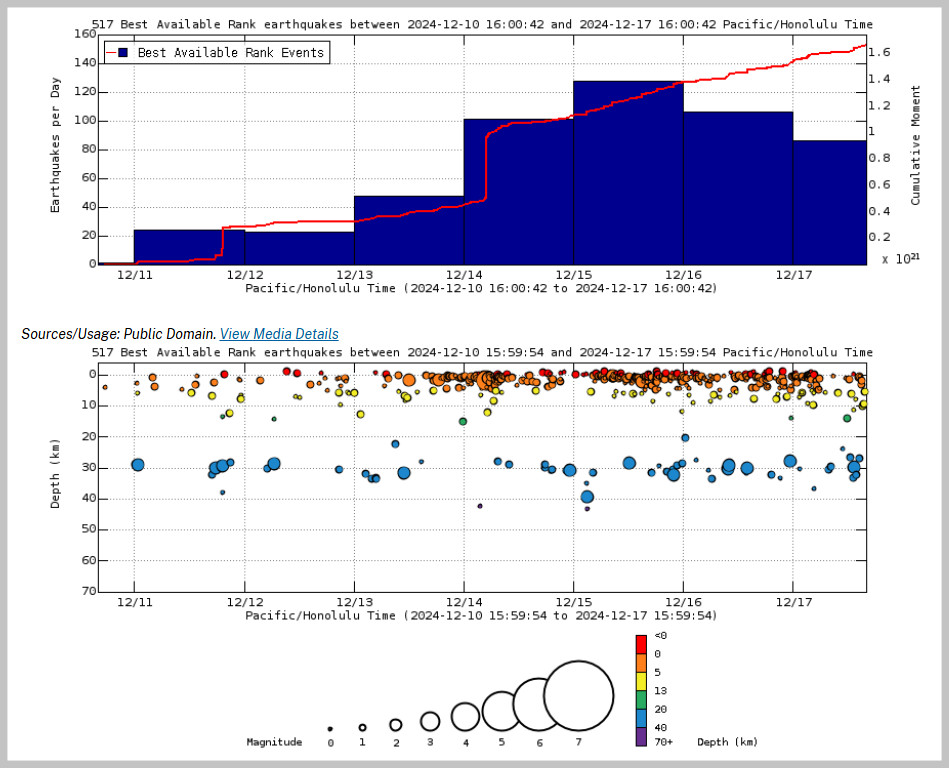
SUMMIT OBSERVATIONS from USGS Hawaiian Volcano Observatory notes that earthquake activity is heightened in Kīlauea’s summit region following a low in the first half of the last week. Starting in the early morning of Saturday, there have been a few periods of increased seismicity activity, lasting from one to a few hours, often accompanied by minor inflation as recorded at the tiltmeter at Uēkahuna, northwest of Kaluapele, the summit caldera, and tiltmeter at Sand Hill, southwest of Kaluapele. 
    Overall, there were about 250 earthquakes underneath the summit, most at depths of 1 to 3 miles under the surface, and most below magnitude-2.0. Since the September eruption in the East Rift Zone, there have been sustained rates of inflation at the summit. The most recent measurement of the sulfur dioxide (SO2) emission rate from the summit was approximately 70 tonnes per day on Oct. 17, a value representative of noneruptive conditions at Kīlauea. Unfavorable weather and wind conditions have delayed acquisition of a new SO2 emission rate measurement, USGS reported.

Above Top: Number of earthquakes per day during the past week (blue bars). The red line is the cumulative moment (energy) release. Bottom: Depth of earthquakes during the past week in the area shown on the map above. Depth is reported relative to sea level, which is equal to a depth of zero on the above plot. On both figures, circle-size represents magnitude, and color indicates depth. Graphs from USGS Hawaiian Volcano Observatory

To read comments, add your own, and like this story, see facebook.com/kaucalendar. See upcoming events, print edition and archive at kaunews.com.

POLICE ARRESTED 18 FOR DUI during the week of Dec. 9, through 15. Hawai`i Island police arrested 18 motorists for driving under the influence of an intoxicant. Seven of the drivers were involved in a traffic accident. Two were under the age of 21.

    So far this year, there have been 923 DUI arrests compared with 902 during the same period last year, an increase of 2.33 percent.
    Hawai'i Police Department’s Traffic Services Section reviewed all updated crashes and found 943 major crashes so far this year, compared with 811 during the same time last year, an increase of 16.3 percent.
    To date, there have been 26 fatal crashes, resulting in 28 fatalities, compared with 14 fatal crashes, resulting in 15 fatalities for the same time last year. This represents an increase of 85.7 percent for fatal crashes and 86.7 percent for fatalities.

To read comments, add your own, and like this story, see facebook.com/kaucalendar. See upcoming events, print edition and archive at kaunews.com.

Volcano Art Center Gallery inside Hawai'i Volcanoes National Park.