About The Kaʻū Calendar

Monday, August 06, 2012

Ka`u News Briefs Aug. 6, 2012

Biofuel crops are being tested along Wood Valley Road for planting between Pahala and Na`alehu for a
biofuel crop farm. Photo by Julia Neal
THE `AINA KOA PONO BIOFUEL REFINERY, proposed for land off Wood Valley Road above Pahala, is part of the discussion in statewide media. A Honolulu Star Advertiser story this morning points out that last Thursday, “Hawaiian Electric Light Co., a HECO subsidiary, asked the Public Utilities Commission to reconsider its rejection last year of a surcharge of O`ahu and Maui customers for the expense of using biofuel to feed a power plant on Hawai`i island. The proposed 20-year contract is with `Aina Koa Pono, a new company that would convert a variety of plants and crops into a liquid fuel to replace fossil fuel at HELCO’s power plant near Kailua-Kona.”
      A Honolulu Star Advertiser editorial this morning says that “Hawai`i has become a playing field for developing feedstocks for a biofuel supply chain, while HECO is moving forward on using it in place of oil in its power plants. Environmentalists prefer that biofuel replace gasoline in both aviation and ground vehicle engines, but the growth of the energy alternative still could have the long-term dividends they desire.”
State Energy Office director Mark Glick
       The Star Advertiser story notes that “state regulators had rejected HECO’s proposed surcharge toward buying 16 million gallons a year of the biofuel (from `Aina Koa Pono). The company now says the surcharge would not begin until the biofuel is delivered to the plant, and it would ‘decrease over time as petroleum-diesel prices rise.’”
      The Star Advertiser editorializes: “As new energy options develop, the focus must be on projects and strategic plans that are justifiable to consumers and cost-attritioned, not ones that depend on ratepayers for exorbitant or indefinite subsidies.”
      The editorial states that Gov. Neil Abercrombie’s “administration agrees with environmentalists that biofuel should be used directly to power transportation rather than replace oil in power plants. Mark Glick, the state Energy Office director, says the HECO contracts may someday extend to use of biofuel in the way the state desires. However, the use of biofuel in power plants should not dampen advances in other sources of energy — solar, wind and geothermal.”
      The story quotes Glick: “We really advocate moving away from power generation as the focus for biofuels.”
      States the Star Advertiser: “As for biofuels’ future in Hawai`i, the only state that depends on shipped oil for electricity as well as gasoline: Hawaiian Electric Co. is enthusiastic about the use of biofuels in reducing that dependence, but not in the way other proponents of clean energy envision substitution of oil derivatives.”
Jeff Mikulina of Blue Planet Foundation
Photo from blueplanetfoundation.org
      The story reports that Blue Planet Foundation executive director Jeff Mikulina said that “use of biofuel in that fashion would get in the way of the long-term effort to replace oil as Hawai`i’s major source of electricity with wind, hydro, solar and geothermal energy.”
      The story quotes Mikulina: “Having a policy preference for biofuel produced in Hawai`i, the first use should be transportation and, if there are leftover products, use that for electricity. If a utility gobbles up that supply, we’re going to be up a creek for the transportation side.”
      The Star Advertiser reports that Mikulina said that a state policy to clarify a “preference for biofuels would help prevent solving one energy problem at the expense of another.”
      The story says that Mikulia “scoffs at what HECO regards as planning for the future” in its preference for biofuels to run its old oil burning power plants. It quotes him saying, “They just put in a different fuel. We would much prefer them to do the more complex, but — we think in the long term — more affordable approach of using more solar and wind and starting to shut down the power plant.” Mikulina told the Star Advertiser that two-thirds of Hawai`i’s imported oil goes to transportation, and the remainder to electricity.
      “That one-third for electricity we have other solutions for — wind, solar, geothermal, waves — but for the transportation side, we really have to have a liquid fuel — jet fuel, diesel, gasoline,” he told the Star Advertiser.
      “The ideal biofuel project would not be too dissimilar from a regular refinery,” Mikulina added, “where you put in crude oil and you get out gasoline, diesel, jet fuel and the stuff that the utility burns. A project that would produce all those products would be ideal, but when they start designing only to produce biodiesel, only for use in the power plant, then I think there’s an opportunity cost in doing that,” Mikulina told the Star Advertiser.
      The Star Advertiser editorial concludes: “While biofuel is now more expensive, continuing to be shackled to fossil fuels comes with larger costs, both militarily and on streets and airways. In the end, solar, wind and geothermal should replace over-reliance on monopolistic power plants while biofuel is fed into engines.”
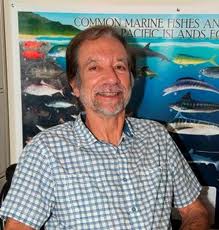
NOAA's Jeff Polovina questions DLNR's plan to build
artificial reefs using scrap concrete.
USING SCRAP CONCRETE TO CREATE ARTIFICIAL REEFS is the plan of Department Of Land & Natural Resources chair William Aila, Jr. He told Civil Beat’s Nathan Eagle that “it’s probably the most beneficial in terms of providing a return to fishermen and the resource at the same time. And it recycles concrete that was normally going to the landfill, so triple benefit.” 
      The story quotes Jeff Polovina, of the National Oceanic and Atmospheric Administration, who questions the plan. “It’s true that if coral reefs are going to be dying, building some concrete reefs could help climate change, but the idea of, well, we need to increase our fish catch so we put more of these down can actually result in greater exploitation of the population. An artificial reef can attract 10 times as many fish as it produces naturally,” he said. “So if unrestricted fishing is allowed, the fake reef just acts as a fish aggregator and can decimate the population.”
      “We should be out there looking for additional sites (for artificial reefs) throughout the state of Hawai`i,” Aila told Civil Beat. Eagle said that, when an artificial reef was proposed for Kailua-Kona, some Big Island residents blocked the effort based on public health and protection of natural reefs. “If they don’t want it, we don’t push it,” Aila said. See more at civilbeat.com.

EARLY ABSENTEE WALK-IN VOTING is available today and through Thursday before the primary election on Saturday. The ballot includes choices for a new County Council member, mayor, state senator and representative and U.S. senator and representative. Voters can cast ballots from 8 a.m. to 4 p.m. at West Hawai`i Civic Center Community Room, Waimea Community Center and Aupuni Center Conference Room in Hilo. 

DAVE TUGGLE PRESENTS AN ILLUSTRATED JOURNEY to the islands of Micronesia, the ancient, massive stonework of Palau and the limestone structures of the Marianas tomorrow at 7 p.m. at Kilauea Visitor Center Auditorium in Hawai`i Volcanoes National Park. Two-dollar donations support park programs, and park entrance fees apply.

SUPPORT OUR SPONSORS AT PAHALAPLANTATIONCOTTAGES.COM AND KAUCOFFEEMILL.COM.

Sunday, August 05, 2012

Ka`u News Briefs Aug. 5, 2012

 Christmasberry is one plant `Aina Koa Pono is considering as a feedstock for its biofuel refinery.
Photo is of holly, another invasive species in many places. Photo from ainakoapono.com
LEADERS AT `AINA KOA PONO, the hui that wants to build a refinery near Wood Valley Road and plant biofuel crops on ag land between Pahala and Na`alehu, have changed. The new website at ainakoapono.com names Kenton Eldridge as chairman, replacing Dr. Melvin Chiogioji, who was co-founder of `Aina Koa Pono. Chiogioji has formed a company called Sustainable Biofuels Solutions, which is licensed worldwide to sell TekGar’s new Microwave Catalytic Depolymerization process, now called Micro Dee.
`Aina Koa Pono chairman Kenton Eldridge
Photo courtesy of The Nature Conservancy
      Hawaiian Electric Light Co. and `Aina Koa Pono are applying to the state Public Utilities Commission for a contract to sell biofuel to the utility. The PUC turned them down last year, saying the cost was excessive and not cost-effective. This year’s contract would charge the utility less for the biofuel. A summary of the proposal is expected to be placed on the PUC website soon for public comment.
       Eldridge is also statewide chairman of the board of The Nature Conservancy, which owns and manages Kamehame turtle nesting preserve makai of Pahala and several other preserves between Pahala and Na`alehu.
      The website says he brings 40 years of business experience to `Aina Koa Pono, including 15 years with Duty Free Shoppers (DFS). He has extensive business operating experience in the U.S. and Asia, the website says. He also serves on advisory boards of Innovac and Entrepreneurs Foundation of Hawai`i. Prior to his retail career, Eldridge spent four years as a U.S. Army officer, serving in Europe and Vietnam. He attended the Defense Language Institute in Monterey, CA and the Army Officer’s Candidate School at Fort Benning, GA. He received Bachelor of Arts, Master of Arts and Master of Business Administration degrees from University of New Hampshire, the website says.
      Named a partner in `Aina Koa Pono and spokesman for the group is Kenton Eldridge’s son, Chris Eldridge. He is founder and president of America’s Mattresses Hawai`i, which, according to the website, is the state’s largest chain of specialty sleep shops. The website says Chris Eldridge has 20 years of entrepreneurial and start-up experience, having founded four companies including America’s Mattress and PortaBox Storage. “PortaBox Storage/FileMinders grew into Hawai`i’s largest commercial records and data storage company and was sold to Access Information Management in 2005,” says the website. 
`Aina Koa Pono plans to build a biofuel refinery on Meyer Camp Road off of Wood Valley Road above Pahala.
Photo by Julia Neal
      Chris Eldridge serves on the board of directors for Kapi`olani Medical Center for Women and Children as well as on advisory boards for several private companies. He is a member of The Nature Conservancy of Hawai`i’s Corporate Council for the Environment, and a member of the Young President’s Organization. He attended Punahou School and earned a Bachelor of Arts degree in Economics and Business form Boston University. Both Kenton and Chris Eldridge live on O`ahu. 

THE NEW `AINA KOA PONO AND HAWAI`I ELECTRIC LIGHT CO. PROPOSAL that could increase the average household electric bill by only one dollar a month could lead to much larger cost increases for businesses, schools, hospitals and other institutions, which are already looking for ways off the grid. The new West Hawai`i Civic Center installed photovoltaics, and University of Hawai`i is planning to install a second round of solar voltaic panels.
      “If you’ve ever felt the pain of paying an unanticipated monster electricity bill, just imagine being the guy who writes the checks at University of Hawaii at Hilo,” says a West Hawai`i Today story this morning by Colin M. Stewart. Electric bills increased by nearly a half million dollars in the 2011-2012 fiscal year, putting some educational programs at risk, UH-Hilo Chancellor Donald Straney told Hilo Rotary Club last week. 
       To get away from the growing electric bills, UH-Hilo appointed a sustainability director to help cut utility costs and develop an energy management plan. UH-Hilo is installing more photovoltaics after putting up solar panels that already generate more than 150 kilowatts. An additional 500 kilowatts will be installed. However, the additional photovoltaics “will put the campus very near the limit of photovoltaic production within the guidelines established by Hawai`i Electric Light Company,” the story says.
      See more at westhawaiitoday.com.

Dr. Nathan Zilz
CARDIAC SCREENINGS are expected to come to farmers markets and other public locations on the south end of the Big Island, according to a story in this morning’s West Hawai`i Today. The Colin M. Stewart article introduces Hawai`i Island Cardiovasular, Inc., “a new nonprofit that will seek to provide island residents with access to early screenings that can identify heart health issues before they become serious and expensive.” The founder and philanthropist behind the effort is Ray Chalkin, and the volunteer medical director is cardiologist Nathan Zilz.
      The story quotes Zilz on his mission as a doctor who prevents illness: ‘There’s an old Chinese proverb that says something like ‘A superior doctor prevents sickness. A mediocre doctor attends to impending disease. And an inferior doctor treats actual sickness.’ We want to try to prevent sickness, and hopefully we can change some of the statistics that we’ve been talking about.”
      Screenings will include blood pressure, blood glucose and cholesterol levels as well as ultrasounds and education.
      According to the story, Zilz said that, in addition to markets and fairs, the organization plans education in schools where volunteers will talk about anatomy and physiology and how to become and stay healthy. The story also reports Chalkin saying that, “by this time next year, we could be screening many, many hundreds or even thousands of people.”
      The article points to the Big Island having a 20 percent higher death rate than statewide in heart disease-related illnesses. See more at westhawaiitoday.com. To find out more and to make a donation, call Mary Stancill at stancill@hawaiicardiovascular.org.

One of Micronesia's monumental structures. Photo from NPS
MONUMENTAL ARCHITECTURE OF MICRONESIA is the topic at After Dark in the Park: Tue at 7 p.m. at Kilauea Visitor Center Auditorium in Hawai`i Volcanoes National Park. Dave Tuggle presents an illustrated journey to the islands of Micronesia, the ancient, massive stonework of Palau and the limestone structures of the Marianas. Two-dollar donations support park programs, and park entrance fees apply. 


SUPPORT OUR SPONSORS AT PAHALAPLANTATIONCOTTAGES.COM AND KAUCOFFEEMILL.COM.

Saturday, August 04, 2012

Ka`u News Briefs Aug. 4, 2012

Sugar cane and napier grass are possible feedstocks for `Aina Koa Pono's biofuel refinery to be built on Meyer Camp Road above Pahala. Photo from ainakoapono.com
`AINA KOA PONO-KA`U “is aimed at cracking dependence on fossil fuels by using a microwave process to compress to 50 minutes the millions of years it takes nature to convert biomass into crude oil,” says the new website at ainakoapono.com.
      The website was re-launched this week in tandem with `Aina Koa Pono asking the state Public Utilities Commission to consider a new contract it proposes for selling fuel to the electric utility. The proposal calls for allowing the utility to raise electric rates by about $1 a month on the Big Island and O`ahu to cover the likelihood of the cost of the biofuel produced in Ka`u being more expensive initially than fossil fuel.
      The plan calls for using 13,000 acres of farmland in Ka`u to grow biofuel crops and constructing a refinery above Pahala near Wood Valley Road. Edmund C. Olson said earlier this week that `Aina Koa Pono would first begin with a small test plant. However, `Aina Koa Pono representatives said they're applying to the PUC for a contract that would require construction of a large facility.
      `Aina Koa Pono says on its website that, “We look forward to supporting the diversified agriculture efforts of our joint venture partner, the Edmund C. Olson Trust, and helping to achieve Hawai`i’s goal of increased energy security.” The website describes `Aina Koa Pono’s proposal to the PUC as “risk free to the utility – if `Aina Koa Pono fails to deliver, HELCO pays nothing.”
      `Aina Koa Pono estimates bringing 400 construction jobs over three years and 200 permanent agriculture and factory jobs to the Pahala area.
       `Aina Koa Pono describes its product: “The biofuel is a ‘drop-in’ fuel that has the same properties as fossil fuel and can produce electricity or be refined for vehicle fuel.” The website states, “AKP was formed to develop sustainable, renewable, reliable, environmentally sound energy solutions that generate local economic development opportunities in Hawai‘i.
      The website says that `Aina Koa Pono has “licensed the exclusive rights for Hawai`i and the South Pacific for Microwave Catalytic Depolymerization (Micro Dee) from Sustainable Biofuels Solutions, LLC, which holds the worldwide rights. Sustainable Biofuels was formed by Mele Associates, Inc. and its founder Melvin Chiogioji, who was also a founding partner in `Aina Koa Pono and visited Pahala several times to make the `Aina Koa Pono case to the community.
      The Frequently Asked Questions section of the website presents the following:
      “Where is AKP’s first project located?
 The project is located in the Ka`u District on the Island of Hawai`i, on Camp Meyer Road approximately 1.5 miles from the town of Pahala. AKP has leased approximately 12,000 acres from the Edmund C. Olson Trust II and the Mallick Trust.
      “How would AKP impact the state and local economies?
 AKP’s biorefinery will help to create a new industry. We estimate that in terms of present value, our biofuel project will increase state revenues from general excise and personal income taxes by a total of $174 million over 22 years. This compares to a $1.5 million in tax revenues if the use of imported fossil fuels continues at HELCO’s Keahole power plant. The local economy should benefit greatly from locally available high-paying jobs and the creation of new businesses to support the additional jobs created. We project that approximately 200 permanent jobs would be created by this project, with an additional 400 construction jobs during development. We hope to fill as many of the jobs as possible with local hires. AKP is committed to supporting the community, and we are working with stakeholders to provide a meaningful Island Benefits Package.
Meyer Camp Road off of Wood Valley Road above Pahala is the site ofthe biofuel refinery to be built by
 `Aina Koa Pono. Photo by Julia Neal
      “What is AKP’s agreement with HELCO?
 HELCO has signed a contract to buy 16 million gallons a year of locally produced biofuel to power its generators at its Keahole power plant on the Island of Hawai`i. The contract calls for AKP to supply biofuel to HELCO at a fixed price over 20 years beginning in 2015, thereby providing significant security from potentially wide price swings in petroleum due to unpredictable geo-political events. The contract also puts the utility on track to meet its commitment of generating 40 percent of its electricity from renewable sources by 2030. 
      “What is biomass?
 Biomass is any carbon-based organic material comprised of large complex hydrocarbon molecules and generally exists as a solid at normal temperatures and pressures–typical examples include green material such as lumber, grasses, bushes, plastics, synthetic and natural fabrics like nylon, polyester, cotton, paper and cardboard, food waste, and tires. AKP’s Ka`u project proposes to process many different types of biomass, likely beginning with invasive species in the area.
      “What technology will be used for producing biofuel?
 AKP will be using an established technology called Microwave Catalytic Depolymerization (Micro Dee). This technology applies heat and pressure to organic material to produce biofuel and biochar. Micro Dee breaks down lignin and cellulosic molecules into shorter chain hydrocarbons that exist in the liquid fuel range, thereby generating synthetic crude oil that can be easily refined to useable fuels using traditional processing technologies. In a nutshell, the Micro Dee process accelerates the natural decomposition and metamorphosis of biomass to crude oil to 50 minutes. AKP will produce a renewable synthetic fuel or “drop-in” fuel with the same properties as fossil fuel. “Drop-in” fuel is biofuel that can literally be “dropped into” the fuel bank without further processing. It can be used for electricity generation as well as all forms of ground, marine and air transportation.
      “Is Micro Dee a proven technology?
 Yes. AKP’s engineering, procurement and construction management partner, AECOM Technology Corporation, has completed testing on AKP’s processing technology at a demonstration facility in North Carolina. Test results have met or exceeded projections, and AECOM has determined the Micro Dee process, now a second generation technology, to be optimal for renewable liquid fuel production.
      “Will AKP grow its own feedstock?
 AKP will develop our biodiesel using crops grown on private land in Pahala. The Hawaiian Islands Land Trust will review AKP’s planned use of approximately 12,000 acres it has leased from the Edmund C. Olson Trust II and the Mallick Trust. Initially, we intend to harvest and process existing and invasive biomass species, such as Christmas berry, and to harvest eucalyptus trees. AKP is analyzing the land and soil types on the property and is working with Hawai`i Agricultural Research Center (HARC) to integrate the appropriate feedstock crops. We intend to incorporate the testing and protocols developed by HARC and to implement appropriate weed control and proven eradication protocols. We will cultivate long-term tree crops, sweet sorghum varieties, non-seeding napier grass, and other feedstock that will have been tested and proven by HARC.
      “What is AKP’s plan for clearing the land? Will this increase the risk of erosion and/or flooding?
 AKP will not be clearing or harvesting thousands or even hundreds of acres at one time. The perennial energy grasses re-grow after each harvest. Areas cleared by bulldozing will be remediated with biochar recovered from the fuel process and replanted with appropriate feedstock. There is little exposure of soil during all phases of planting and harvesting cycles.
      “Does the proposed project require an Environmental Impact Statement (EIS) or Environmental Assessment (EA)?
 No. However, AKP has engaged the services of R. M. Towill Corporation to prepare a voluntary assessment of environmental issues. We will verify the safety of the Micro Dee process and of storing and transporting our biofuel, address issues and concerns raised by the community and develop mitigation measures appropriate to the site and community.
      “Will AKP offer jobs to local families or bring workers from O`ahu and the mainland?
 Our renewable biofuels facility is expected to create more than 200 permanent management, professional, operations, maintenance, agricultural and administrative jobs, in addition to 400 construction jobs over a three-year period. We hope to fill as many of the jobs as possible with local hires. It does not make sense to bring in outside personnel unless the capability is not available locally. AKP has initiated meetings with Big Island Labor Alliance, Work Hawai`i, and the University of Hawai`i. We will work with the County Planning Department, Ka`u High School, and unions to develop training programs to fill our needs.
      “What impact will the project have on Ka`u’s rural lifestyle?
 It is AKP’s sincere intention to enrich Ka`u, to be a good neighbor, and to impact the local community in the least intrusive manner so as not to interrupt or alter its cultural character.”
      The ainakoapono.com website contains photos of grasses, sugar cane, eucalyptus and Christmasberry. The new website is powered by obscurenetworks.com in Honolulu.

One of Wayne Keeth's orchid paintings.
EARLY ABSENTEE WALK-IN VOTING is available today and Monday through Thursday before the primary election next Saturday. The ballot includes choices for a new County Council member, mayor, state senator and representative and U.S. senator and representative. Voters can cast ballots from 8 a.m. to 4 p.m. at West Hawai`i Civic Center Community Room, Waimea Community Center and Aupuni Center Conference Room in Hilo. 

WAYNE KEETH’S MULTIMEDIA and functional art exhibit opens Monday at 10 a.m. at Volcano Art Center’s Niaulani Campus in Volcano Village. Entitled Invading Consciousness, the exhibit is designed to provoke thought and awareness of invasive species in Hawai`i. Opening reception is tomorrow from 4 p.m. to 6 p.m.

SUPPORT OUR SPONSORS AT PAHALAPLANTATIONCOTTAGES.COM AND KAUCOFFEEMILL.COM.