About The Kaʻū Calendar

Saturday, February 16, 2013

Ka`u News Briefs Feb. 16, 2013


Bill Walter, president of W.H. Shipman, Ltd., has sent a letter to the Public Utilities Commission in opposition to `Aina Koa Pono's proposal to manufacture diesel at a refinery to be built off Wood Valley Road above Pahala.
Photo by Julia Neal
“THE AKP CONTRACT IS A BIGGER THREAT to our economic life” than was another recently proposed rate increase by the electric companies, writes Bill Walter, president of W.H. Shipman, Ltd. This week, Walter wrote to the Public Utilities Commission in opposition to `Aina Koa Pono’s proposal to sign a fixed-price contract for 20 years to buy diesel that would be manufactured in a refinery that would be built off Wood Valley Road above Pahala. The diesel would be trucked to a power plant in Kona.
Bill Walter
      AKP representatives said earlier that it was unfortunate that their proposal was before the PUC at the same time as the rate hike, making theirs more difficult to gain approval. Now that the rate hike has been withdrawn, Walter asks the PUC “to turn your attention seriously to the continuing concerns that we all have and that we’ve expressed concerning the proposed contract between Hawai`i Electric Light Co. and AKP. We understand that HELCO, the PUC, the Consumer Advocate and state government have a strong sense of responsibility to move our energy generation from its dependence on foreign oil with its high prices and increasingly unstable supply sources. We appreciate that these are concerns that are taken seriously at the highest levels. This is as it should be, and we thank you for placing these concerns as a high priority.”
      Walter says that “both the 4.2 percent rate increase and the proposed contract with AKP were addressed by residents of the island. We are aware of no one who spoke against the AKP contract who, given the agreement on the 4.2 percent rate withdrawal, is now OK with moving ahead with the AKP contract.”
      Walter continues, “At a fixed cost of $200 per barrel for up to 16 million barrels per year for 20 years, the built-in cost of this contract is simply a burden that we cannot and should not be asked to bear. What we desperately need here are technologies that drive the costs lower, not higher. These technologies exist. Rather than looking for replacements at any cost, we need to be looking for technologies at much lower costs. One example is geothermal that has an equivalent cost of $57 per barrel and easily sufficient volumes to move us forward. This is not the only such alternative - and not one that we push singularly.
      “We have done a number of studies to determine and illustrate the affect of energy costs to residents of the island of Hawai`i. One recent survey showed a school district on the island that pays $115,900 per month to HELCO. At O`ahu’s (already high) costs, this cost would be $115,900/1.25 = $92,700. This is a savings of $23,200 per month that could otherwise be invested in teachers. This is significant!”
      “Walter concludes, “We ask that you help this island by turning eyes on serious cost savings that can help HELCO turn the tide here by reducing our electricity costs and in so doing allowing us to better invest in all that we do to improve the lives of residents on the island of Hawai`i.”

Ka`u residents can participate in next week's County Council and
committee meetings via videoconference from Ocean View
Community Center.
COUNTY COUNCIL COMMITTEE MEETINGS are scheduled this Tuesday at West Hawai`i Civic Center in Kona. Committees meet as follows: Housing, 9:30 a.m.; Public Works & Parks & Recreation Committee, 11 a.m.; Finance Committee, 11:15 a.m.; Government Relations and Economic Development Committee, 1 p.m.; and Planning Committee, 3 p.m.
      Committee meeting agendas are available at http://www.hawaiicounty.gov/lb-council-committee.
      The full Council meets Wednesday at 9 a.m. at West Hawai`i Civic Center. An item on the agenda calls for $200,000 in funding for improvements to the water supply at Ocean View’s Kahuku Park that would provide sufficient water for drinking and irrigation and an auxiliary source of potable water in a disaster. The bill, introduced by Council member Brenda Ford, passed the Finance Committee unanimously at the committee’s last meeting.
      Council agendas, along with information on how to submit testimony, can be viewed at http://www.hawaiicounty.gov/lb-council-meeting.
      Ka`u residents can now participate in committee and Council meetings via videoconference at Ocean View Community Center, 92-8924 Leilani Circle. The system is available until 3 p.m. or later if public witness testimony has not been completed.
      For more information, call 961-8536 or edistrict6@co.hawaii.hi.us.

Sen. Mazie Hirono
SEN. MAZIE K. HIRONO, the first Japanese immigrant to serve in the Senate, has been named Senate co-chair of the Congressional Study Group on Japan, a bipartisan organization committed to promoting frank and candid dialogue between American lawmakers and their counterparts in Japan.
      Hirono joins Sen. Lisa Murkowski (R-AK) as Senate co-chairs for the CSGJ in its 20th-anniversary year. Rep. Shelley Moore Capito (R-WV) and Rep. Jim McDermott (D-WA) co-chair the group in the House of Representatives.
      “Our nation’s special relationship with Japan is now more vital than ever, particularly as our foreign policy places increasing attention on Asia and the Pacific,” said Hirono. “The Study Group prides itself on an honest, frank and informative dialogue with our counterparts in Japan, and that can only work to the benefit of both nations.”
      “This role is a special honor for me personally as I was born in Japan and lived there the first eight years of my life,” said Hirono. “My personal bond with Japan enables me to bring a unique perspective as I work closely with the members of the Study Group to strengthen the special relationship between our two nations.”
      For thirty years, Congressional Study Groups have provided substantive, issue-based opportunities for members of Congress to engage with their counterparts abroad. The Study Groups are the flagship international programs of the U.S. Association of Former Members of Congress, a bipartisan organization that works to promote public service, strengthen representative democracy, and keep both current and former members of Congress educated, engaged, and empowered to serve their country. Programming of the Congressional Study Group on Japan is supported by grants from the Sasakawa Peace Foundation, the Japan-U.S. Friendship Commission and corporations that make up the Study Group’s Business Advisory Council.

HAWAI`I VOLCANOES NATIONAL PARK’S Kahuku Unit offers lunch with a ranger tomorrow at 11:30 a.m. Rangers choose varied topics and guide an open discussion with visitors over a bring-your-own-bag lunch. Check activities boards at Kahuku Visitor Greeting Area for the day’s topic and location. Free. For more information, call 985-6011.

WINE TASTING, PUPUS AND ARTWORK by Christina Skaggs are featured at Friends of Hawai`i Volcanoes National Park’s fundraiser at Hilo Hawaiian Hotel’s Wai`oli Lounge this Wednesday from 5:30 p.m. to 7:30 p.m. Wine tasting will include four specially selected wines with unlimited return visits to the wine bar. Along with an unlimited, open pupu buffet, the event includes live music, an optional raffle, a silent auction and an art display and sale. Participants may choose wine tasting or pupu bar for $20 each or both for $40. All proceeds benefit the nonprofit Friends group. Tickets are available at 985-7373 or admin@fhvnp.org.

VOLUNTEERS CAN SIGN UP for Humpback Whale Sanctuary Ocean Counts taking place next Saturday, Feb. 23 from 8 a.m. to 12:15 p.m. and again on Saturday, March 30. Site leaders and general volunteers are needed to monitor humpback whales and provide important population and distribution information. Visit hawaiihumpbackwhale.noaa.gov.

IN SPORTS THIS WEEKEND, Ka`u High Schools junior varsity softball team travels to Kea`au today for a game at 1 p.m.

SUPPORT OUR SPONSORS AT PAHALAPLANTATIONCOTTAGES.COM AND KAUCOFFEEMILL.COM. KA`U COFFEE MILL IS OPEN SEVEN DAYS A WEEK.

Friday, February 15, 2013

Ka`u News Briefs Feb. 15, 2013

DLNR is asking Ka`u residents to report defoliation of koa trees or an abundance of native caterpillars and/or moths which are currently causing damage in Hilo and Hamakua and could spread here. Photo from DLNR/DOFAW  
THE HAWAI`I HOUSE OF REPRESENTATIVES has unanimously passed HB 1133, which would repeal the Public Land Development Corporation. 
      House Lawmakers held a public hearing last Saturday to engage the community in considering a variety of options for dealing with the PLDC that ranged from overhauling the administrative rules to repealing the corporation. Testimony from the five-hour hearing made it clear where the public stood on the issue, a statement from the House says.
Rep. Cindy Evans, second from right, chairs the Water and Land
Committee. Photo from House of Representatives
      On Monday, Committees on Water and Land and Finance voted unanimously to advance an outright repeal of the PLDC to a full vote on the House Floor. “Today’s vote sends HB 1133 to the Senate with a clear message that the House and the public support repeal of the controversial PLDC,” the statement says.
      Water and Land Committee chair Cindy Evans said, “The public, in oral and written testimony, voiced its displeasure with the PLDC with an overwhelming number of people calling for repeal of the act. Clearly, the way it was structured, the public came to a point of understanding that the authority we gave the corporation bypassed county plans and zoning laws. Democracy spoke today with the passage of HB 1133.” 

THE SENATE COMMITTEE ON HEALTH has approved SB 130, which would privatize Hawai`i’s public hospitals, including Ka`u Hospital and seven others on the Big Island, Maui and Lana`i that are currently managed by Hawai`i Health Systems Corporation.
Sen. Josh Green
      Hawai`i Government Employees Association released a statement saying, “In response to member testimony and staff lobbying, the Senate Health Committee made some significant changes to the bill to ‘encourage further discussion.’ Amendments included adding a requirement that both the Senate and House vote to approve the transition of one or more regional systems of HHSC to non-public status. The committee also removed the section that would allow Banner Health to be exempt from Hawai`i Revised Statutes chapters 76, 87A, 88 and 89. Chapter 89 is the collective bargaining law that provides for union representation. This was a significant accomplishment, but we must remain vigilant and keep the momentum going, as the bill is now being referred to the Senate Ways and Means Committee.”
      Colin M. Stewart, of Hawai`i Tribune-Herald, reports that Sen. Josh Green, who used to be a doctor at Ka`u Hospital, said that testimony from HHSC employees “served as a reminder that any legislation would have to take their concerns into consideration.”
      “People testified that have been working for our hospitals for 10, 20, even 30 years,” he said. “I think we have to honor their service.”
      HGEA member Barbara Uwekoolani, who works at Maui Memorial Medical Center, said, “Sending money to the mainland is like sending prisoners to the mainland. She said she is also concerned about reduction of services in areas that don’t generate money but where services are needed.
      Green told Stewart, “We created an amendment to protect all the workers so that they would continue to have benefits and be able to bargain in a proper way. I also amended the bill to force a ratifying vote of the House and Senate if there’s going to be any sale to a private entity. We’ve restored control to the situation.”

Koa looper (Scotorythra paludicola) in caterpillar stage.
Photo from DLNR/DOFAW
THE DEPARTMENT OF LAND AND NATURAL RESOURCES Division of Forestry and Wildlife has documented extensive defoliation of large sections of mature koa forest on Hawai`i Island, which scientists believe is the result of a natural but sudden proliferation of a native moth. Koa trees located in the Hilo and Hamakua regions, between elevations of 2,000 and 4,000 feet, appear to be impacted at this time. 
      The area currently impacted is estimated to span over 24,500 acres and is the largest koa defoliation in written history. Based on data from previous outbreaks, it is possible that the koa looper outbreak will spread to other areas of Hawai`i Island, although the exact path is unpredictable.
      “The department has determined that this defoliation event is the direct result of feeding by a moth native to Hawai`i, the koa looper. Fortunately, past occurrences of these outbreaks show us that koa forests can recover,” said William J. Aila, Jr., DLNR chairperson. “We are thankful that researchers from the University of Hawai`i, U.S. Forest Service, U.S. Geological Survey and Hawai`i Agricultural Research Center are assisting DLNR to monitor this rare natural phenomenon.”
      Although the koa looper (Scotorythra paludicola) is a native moth commonly found in koa forests, caterpillars of this species have historically been associated with mass koa forest defoliation. Oral accounts indicate that such events were occurring before the first written documented outbreak in 1892. To date, researchers have not yet discovered what circumstances trigger the occasional moth population explosions.
      Given that this is a natural process caused by a native moth species, the DLNR will focus its efforts on documenting and monitoring the outbreak.
Koa looper (Scotorythra paludicola) in adult stage.
Photo from DNLR/DOFAW
      “Mapping the boundaries of this infestation will tell us what areas are affected right now, and provide a way for us to measure movement of the moths into new forest areas,” said Roger Imoto, DLNR Division of Forestry and Wildlife administrator. “We want to assure the public that this is a natural phenomenon, and DLNR and its partners are actively monitoring. The public can help us by calling DOFAW if new areas are observed.”
      Land managers and researchers have an opportunity to collect data on the moths, the koa, and the environmental conditions -- the combination of which may help answer some long-standing questions about these events.
      “We are prioritizing monitoring efforts because it is important to understand how this outbreak might affect our forests and koa forestry on Hawai`i Island,” Imoto said. “Despite the rapid and severe visual impact of defoliation caused by the caterpillars, it should be noted that koa can and do recover after such outbreaks.”
      Members of the public are encouraged to report koa defoliation and/or increased caterpillar or moth abundance to the DLNR if it is observed outside of the Hilo and Hamakua region.
      Call 587-0166 with information on the nearest street address, date of sighting, and a description of the defoliation. The public is encouraged to send photos with location information to DLNR@hawaii.gov.
      For more information on the koa looper, visit: www.hawaii.gov/dlnr/dofaw.

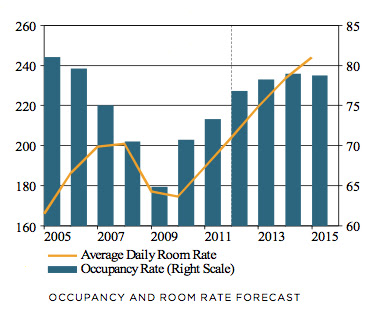
Graph from UHERO
“EXPANSION SHIFTS INTO HIGHER GEAR” is the title of a report released today by University of Hawai`i’s Economic Research Organization. “Despite an exceptionally mediocre global economic environment, the Hawai`i visitor industry had a phenomenal year in 2012,” the report states. “Total arrivals grew by more than nine percent, exceeding their previous 2006 peak by more than 300,000 visitors. Expenditures rocketed upward more than 18 percent. This surge reflected both the higher visitor census and also higher hotel room rates, which were 7.7 percent higher than in the first three quarters of 2011. Statewide occupancy rates approached 77 percent, their highest level since 2006.
      “Based on planned air capacity and other early indications, we expect another impressive year for Hawai`i tourism in 2013, if off last year’s blistering pace. But we are now entering the final phase of what has been an exceptional period of recovery and expansion. With occupancy rates averaging near 85 percent on O`ahu in 2012, industry capacity constraints will begin to bite over the next few years. Room rates and other costs will rise, deterring some potential visitors, and growth in new markets will crowd out visitors from others. After 6.5 percent expansion in arrivals in 2013, we expect a tapering of growth to 2.1 percent in 2014 and 1.5 percent in 2015.”
      The report also says the construction industry is beginning to regain its footing. “Forward-looking indicators look positive, with the total value of permits shooting up almost 60 percent in the first three quarters of the year,” it states. “Government contracts awarded rebounded by more than 150 percent through the third quarter, but are estimated to end the year up closer to 80 percent from very low levels in 2011. Private building permits were up a robust 42 percent, but more than one-half of this surge was still driven by additions and alterations, which in turn owe a significant fraction of their strength to photovoltaic system installation. Residential building permits grew by more than 20 percent, and commercial and industrial permits declined by five percent.”
      “This pickup in permitting figures presages what we think will be a strong industry expansion building over the next several years,” according to the report.

Kumu Hula Roy Palacat Photo by Ken Kuroshima
HALAU NA PUA HA`AHEO O KONA with kumu hula Roy Palacat performs tomorrow at 10:30 a.m. at Volcano Art Center Gallery in Hawai`i Volcanoes National Park. Hands-on cultural demonstrations take place from 9:30 a.m. to 1:30 p.m. on the gallery lanai. Call 967-8222 or email julie@volcanoartcenter.org for more information. 

LUNCH WITH A RANGER takes place Sunday at 11:30 a.m. at Hawai`i Volcanoes National Park’s Kahuku Unit. Rangers choose varied topics and guide an open discussion with visitors over a bring-your-own-bag lunch. Check Activities boards at Kahuku Visitor Greeting Area for the day’s topic and location. Free. For more information, call 985-6011.

FRIENDS OF HAWAI`I VOLCANOES NATIONAL PARK host a winter fundraiser with wine tasting, pupus and artwork by Christina Skaggs at Hilo Hawaiian Hotel’s Wai`oli Lounge this Wednesday, Feb. 20 from 5:30 p.m. to 7:30 p.m. Wine Tasting will include four specially selected wines with unlimited return visits to the wine bar. Another feature is an unlimited, open pupu buffet. The event includes live music, an optional raffle and silent auction as well as an art display and sale. Participants may choose wine tasting or pupu bar for $20 each or both for $40. All proceeds benefit the nonprofit Friends group. Tickets are available at 985-7373 or admin@fhvnp.org.

SUPPORT OUR SPONSORS AT PAHALAPLANTATIONCOTTAGES.COM AND KAUCOFFEEMILL.COM. KA`U COFFEE MILL IS OPEN SEVEN DAYS A WEEK.

Thursday, February 14, 2013

Ka`u News Briefs Feb. 14, 2013

Halau Na Pua Ha`aheo O Kona performs at Volcano Art Center Saturday. Photo by Ken Kuroshima
IMMIGRATION REFORM was the topic of Sen. Mazie Hirono’s testimony yesterday during the U.S. Senate Judiciary Committee’s first hearing on the subject. She argued that reform should refrain from shifting the purpose of immigration away from a family focus. While Hirono acknowledged that increasing immigration among those trained in science and technology sectors is important, she warned that Congress should not get tunnel vision and forget that immigration reform should be rooted in a set of guiding principles to ensure that the U.S. immigration system addresses critical needs of the economy, while maintaining the nearly 50-year tradition of bringing families together.
       “There is a huge backlog in our legal immigration system. These backlogs have prevented Filipino veterans of World War II, men who fought for our country, from reuniting with their children for decades,” she told the committee.
       “We now consider how to address the numerous problems in a large and complicated system; to bring the millions of undocumented out of the shadows so that they can contribute to our society fully; to reduce and eliminate the backlogs in family-based immigration; and to reunite the Filipino veterans of World War II with their children.
Sen. Mazie Hirono
       “I know many of my colleagues have highlighted the importance of providing green cards to STEM graduates of U.S. universities. I agree that we should not educate foreign students and then send them away to work for foreign competitors of American companies. It only makes sense to keep that talent here. However, we should not shift the purpose of immigration to the United States away from a family focus toward an employment focus. In advocating for more employment-based immigration, we should not get tunnel vision and forget the human element of immigration. We should be looking to expand the opportunities for families to be reunited and kept together – and this should include LGBT families.
       “The needs of employers are important in this debate, but I believe that family-based immigration is essential to ensuring the continued vitality of the American economy. The success of immigrants in this country is often the success of immigrants with their families. Families provide American workers with a support network and social safety net.
      “I am also concerned about how women and children are treated, both in our current immigration system and under any reforms we put in place. Female immigrants and unaccompanied minors face unique circumstances that are often lost in this debate that focuses on enforcement and the job market. For example, a woman who stays at home as a domestic worker could fall through the cracks and be denied legal status if she suffers the loss of her husband or becomes a victim of domestic abuse.
       “Our immigration policies should allow for discretion in dealing with vulnerable populations. This should include how we treat families and children in our enforcement and detention system, but it should also include how we design an earned legalization program to be inclusive of women and children under immigration reform,” Hirono testified.

Bobby Jean Leithead-Todd
GREATER COMMUNITY INVOLVEMENT in consideration of proposed Planned Unit Development projects is proposed by Hawai`i County Planning director Bobby Jean Leithead-Todd. She proposes an amendment to the Hawai`i County Code that would, among other changes, require a community meeting before submittal of an application for a P.U.D. The measure comes up before the Leeward Planning Commission during its meeting at 9:30 a.m. on Thursday, Feb. 21. 
      One thousand acres zoned for 20-acre agriculture lots, for example, could be subdivided into 50 ag lots. However, a Project Unit Development is sometimes used by developers to obtain smaller, more desirable lots for estates and houses. The procedure is to place unbuildable land, such as steep hillsides and gulches, in one large parcel, leaving other lots smaller than the 20 acres for which the property is zoned. For example a 1,000-acre parcel zoned Ag-20 could possibly be subdivided into one 500-acre lot with cliffs and streams, and 49 other flat lots 10.2 acres each. The intent of the P.U.D. was to make for better planning by avoiding simple cookie cutter developments. However, its use by developers has often been to maximize the number of small lots that can be obtained out of a large agricultural parcel. Some proposals have attempted to maximize beachfront lots for estates by making one large lot in the most mauka section of the property and putting the smaller, often skinny, long houselots under 20 acres near the shoreline.

THE KOHALA CENTER INVITES high school students to apply for scholarships to residential engineering and environmental science summer programs. These opportunities are offered in partnership with Cornell University, Brown University, and the University of California, San Diego.
The programs are:
  • Brown Environmental Leadership Lab at Brown University, Sustainable Development, June 24–July 5, July 8–July 19, and July 22–August 2. Application deadline is March 29. The Kohala Center and Brown University are offering full-tuition scholarships for two Hawai`i Island students. Scholarship recipients must cover their own travel costs. For two-week sessions, students will live at Brown University’s Haffenreffer estate, a 372-acre historic farm adjacent to Narrangansett Bay in Rhode Island, and learn how human demands on the environment often compromise long-term ecosystem health. Students will also learn about policies, practices, and emerging technologies that can help reduce humankind’s ecological impact. Mentoring is provided by Brown faculty, graduate, and undergraduate students.
  • CURIE and CATALYST engineering academies at Cornell University, July 14–20. Application deadline is February 18. The Kohala Center is offering two full-tuition scholarships to qualified high school students to attend either the CURIE Academy or the CATALYST Academy, both hosted by the Diversity Programs in Engineering at Cornell. Qualified applicants may apply for one or both of the programs. 
    • The CURIE Academy is a one-week residential engineering program for high school girls who excel in math and science and want to learn more about opportunities in engineering in an interactive atmosphere. Cornell University’s faculty and graduate students will lead CURIE participants in classes, lab sessions, and project research. Rising sophomore, junior, or senior girls with a minimum cumulative GPA of 3.0 on a 4.0 scale are eligible to apply.
    • The CATALYST Academy for rising high school sophomores, juniors, and seniors is a one-week summer residential engineering program, during which the university’s faculty and graduate students lead participants in classes, lab sessions, and project research. The mission of the CATALYST Academy is to advance diversity in engineering and its related disciplines. Scholarship applicants must have a minimum cumulative GPA of 3.0 on a 4.0 scale.
  • University of California, San Diego Academic Connections—San Diego, July 7-27. Application deadline is March 29. UCSD and The Kohala Center are offering one full-tuition scholarship to a qualified high school student to attend an Academic Connections program of their choosing in San Diego. Scholarship recipient must cover his/her own travel costs. Academic Connections at UCSD is a three-week pre-college summer academic and residential experience targeted to college-bound high school students, grades 9–12. Students will experience courses taught by UCSD graduate students or work side-by-side with UCSD researchers in their labs on specific projects.
  • UCSD Academic Connections—Hawai`i, August 10–17. Application deadline is March 29. UCSD is offering one full-tuition scholarship to a qualified high school student to attend the Academic Connections program on Hawai`i Island. The Alaka`i i ka Malama Honua, “A Leader in Caring for the Earth,” course is made possible by a partnership between UCSD and The Kohala Center. This one-week pre-college summer academic experience for college-bound high school students in grades 9–12 examines the diverse ecosystem and climate zones of Hawai`i Island. Traveling around the island, students will study geology, volcanology, marine science and Hawaiian history.
      For more information and application forms for all programs, go tohttp://www.kohalacenter.org/scholarships/about.html, call 887-6411, or e-mail Erica Perez at eperez@kohalacenter.org.
Have Lunch with a Ranger at Kahuku
Sunday at 11:30 a.m.
VOLCANO ART CENTER GALLERY in Hawai`i Volcanoes National Park presents a Na Mea Hawai`i hula kahiko performance featuring Halau Na Pua Ha`aheo O Kona with kumu hula Roy Palacat Saturday at 10:30 a.m. Established in 1985, this halau is dedicated to caring for, maintaining and perpetuating the art of hula with particular attention to ancient dances. Kumu Palacat said, “Today in Hawai`i, mele and hula form a link to the past and provide an important means for Hawaiians to celebrate their rich and proud musical heritage.” Hands-on cultural demonstrations take place from 9:30 a.m. to 1:30 p.m. on the gallery lanai. Call 967-8222 or email julie@volcanoartcenter.org for more information. 

LUNCH WITH A RANGER takes place Sunday at 11:30 a.m. at Hawai`i Volcanoes National Park’s Kahuku Unit. Rangers choose varied topics and guide an open discussion with visitors over a bring-your-own-bag lunch. Check Activities boards at Kahuku Visitor Greeting Area for the day’s topic and location. Free. For more information, call 985-6011.

SUPPORT OUR SPONSORS AT PAHALAPLANTATIONCOTTAGES.COM AND KAUCOFFEEMILL.COM. KA`U COFFEE MILL IS OPEN SEVEN DAYS A WEEK.