About The Kaʻū Calendar

Sunday, January 05, 2014

Ka`u News Briefs Sunday, Jan. 5, 2014

Ka`u Coffee Farms are not only famous, they help protect water resources and prevent desertification.
Photo by Julia Neal
"THE KA`U DISTRICT IS AN EXAMPLE of change in local climate. Thousands of trees have been planted there during the past 40 years. The region around Pahala has been reforested with macadamia trees and windbreaks. It was transformed from a dry, dusty region known for its incessant winds into a green and productive oasis.” This is the conclusion of Norm Bezona, once an agronomist at Ka`u Sugar. Bezona himself planted a collection of trees in the open space in the middle of Pahala, with a cork tree, bat-pollinated sausage tree and many other tropical trees among them creating a park-like setting on the grounds of what is now Royal Hawaiian Orchards and Pahala Plantation Cottages - the old Sasaki Store and Ka`u Meat Market.
Macadamia trees on Olson Trust lands protect the watershed and create
compost. Photo from olsontrust.com
     In his 2014 outlook on Hawai`i Island and the planet, first printed in West Hawai`i Today, Bezona writes about his New Year’s resolution that fits well with the multicultural, economic and environmental diversity of Ka`u, which can be an example for others. Writing mostly about others, Bezona says:
     “Humans seem to be hardwired to exclude. We tend to think of our team versus their team or our tribe is better than your tribe. We live in exclusive neighborhoods and go to exclusive schools or clubs, and others don’t. We tend to think having lots of material things makes us better than someone with less. The recent movie, The Wolf of Wall Street, is a good example of materialism carried to the extreme. This kind of mindset makes us vulnerable to an ‘us versus them’ way of thinking that affects our spiritual, political and cultural point of view. It can breed cynicism, fear and hate.
      “How do we diffuse the constant bombardment of negativity we experience? It’s not easy, but we can practice in our everyday life by being aware of what isolates us from one another. Prayer and meditation can help us find balance. When it comes to politics, to think inclusively is to respect the other person’s point of view even when it is different than ours. When it comes to humans in general, remember there is only one race: the human race.
      “Comedian Frank DeLima put in bluntly, and I will paraphrase: When every culture is reflected in your family tree, it’s hard to find anyone to hate. We are blessed in Hawai`i, where we have many cultures and religious philosophies coming together. It gives us an opportunity to practice inclusiveness. Our multicultural community is reflected in our landscapes.
MacFarms macadamia orchards help prevent deserts in Ka`u and
South Kona. Photo from macfarms.com
      “Let’s look at how we can learn some lessons from our gardens, parks and forests. We can focus on the value of planting and protecting native trees, but recognize the value of plants that have been brought by Polynesians, folks from Asia, Europe, Africa, Australia and other regions. Our gardens reflect the cultural diversity of our people.
      “We can view plants we see as weeds in a broader sense by seeing they are really pioneer species trying to heal the wounds created by human or animal activity or natural disturbances such as flood, drought, lava flows and fires. If we find ourselves or our environment out of balance, we can approach the issue without fear or anger, but determine the role we can play to achieve connection, balance and aloha.
      “We know our planet is suffering from climate change and deforestation, but what can we do to reverse this trend? Parts of China, Africa and India are examples of vast areas that were deforested over the centuries. However, more damage has been done in the past 50 years than in the past several centuries. Untold numbers of species have been lost and climates altered.
      “How does thinking inclusively affect what we plant? We have a much broader palette of plants to use if we think outside the box. New reforestation projects often require drought-hardy species such as eucalyptus and neem, or fast growing types such as bamboo. Whatever trees we use, we need to start soon. Much of the tropics could become desert if this deforestation and climate change continues. Imagine how our island appeared when the first Polynesians set foot on it. There were forests covering the Kohala Mountains, Mauna Kea, Hualalai and much of Mauna Loa. Dryland forests extended to Kawaihae. It is time to reverse the trend of deforestation. It would be difficult to replant these vast areas with only native trees since we can’t be certain what was here before the first humans. Besides, the climate has probably changed since those ecosystems were destroyed.
      “Some advantages to planting forests are reducing wind velocity and erosion; preserving forest watersheds, native ecosystems and recreation opportunities; and, of course, tying up some of the excess carbon in our atmosphere.
Royal Hawaiian Orchards macadamia orchards are also home for bees
that help increase production of many agricultural crops.
Photo by Julia Neal
      “Forests and their effect on climate are nothing new, but as important as they are, they have not been put to use as much in Hawai`i as they should be. A primary purpose of forests is to reduce wind velocities to a degree that will provide protection. Some secondary effects of reducing wind velocity are temperature modification, increased humidity and reduced evaporation in the protected area. This reduces dust problems and supplies shelter and food for wildlife. They also add beauty.”
      In addition to the orchards of Ka`u, Bezona points out that “lava flows of West Hawai`i are being transformed by urban reforestation to create parks, gardens and golf courses. This means jobs for landscapers, gardeners and plant nurseries. Hamakua, Kohala, Waimea and Waikoloa also could benefit from this kind of long-range planning and planting. Unfortunately, trees take years to grow, and we too often think in terms of short-term profits.
      “Around East Hawai`i, forests of macadamia, banana, rambutan and other tropical fruit are sprouting up where sugarcane lands were abandoned. Giant timber bamboos could be grown as well. Many bamboos are easily maintained and extremely ornamental. Landscaping coastal lava fields to golf courses and homes planted with trees is not popular with some folks, but this too is urban forestry.
      “In many ways, we are on the track to create a better balanced environment, but it is important to continue to make a difference with cool heads and warm hearts. We can do this best by working together with respect and remembering we are all on this planet and need to treat it and each other in a consciously sustainable and inclusive manner.”

TO HELP MAKE THE NEW YEAR GREENER, the Solid Waste Division of the Department of Environmental Management is offering treecycling. Through Jan. 31, Ka`u residents may leave trees in the designated area at Wai`ohinu transfer station. Attendants will direct the public to the proper drop-off point. 
      Trees should be free from all decorations, lights, tinsel and ornaments. Artificial or flocked trees are not accepted.
      In addition, residents may recycle Kadomatsu decorations, which are normally a combination of bamboo, pine and flowers. Kadomatsu is a tradition that began 600 years ago in Japan as a way of offering luck in the New Year.
      For more information on recycling, visit www.hawaiizerowaste.org or call the Solid Waste Division Office at 961-8270.

SAFETY, EFFICIENCY AND PROTECTION OF DARK NIGHT SKIES are being taken into account in design of exterior lighting at the Ka`u Gym and Disaster Shelter, according to Hawai`i County Energy coordinator Will Rolston. “We are planning to install the new LED lights, fully shielded, in the parking lot,” he said. Rolston said these advanced lights will have a filter that restricts 98 percent of blue light, which is the wavelength that scatters in the atmosphere, mostly due to water particles, and mitigates the dark skies that the astronomy sector relies on. He said the lights should prevent most of the glare created by conventional lighting and put the most light on the ground. The lights also would improve safety through a more visible light spectrum. They are more efficient, as well, using half the wattage of the previous lighting requirement.
      David Yamamoto, Building chief from Department of Public Works, is overseeing the construction and working with Traffic Department chief Ron Thiel as well as lighting consultant Robert Billingsley on design of the lighting.

Frank Trusdell presents a Volcano Awareness Month program
Wednesday at Ocean View Community Center.
Photo from USGS/HVO
AS PART OF VOLCANO AWARENESS MONTH, USGS Hawaiian Volcano Observatory offers two programs this week. At After Dark in the Park on Tuesday, geologist Tim Orr reviews highlights from the past 31 years of eruption on Kilauea’s east rift zone and talks about recent developments. The program begins at 7 p.m. at Kilauea Visitor Center Auditorium in Hawai`i Volcanoes National Park. $2 donations support park programs; park entrance fees apply. 
      How well do you know the volcano in your backyard? USGS volcanologist Frank Trusdell discusses Mauna Loa’s eruptive history and current status Wednesday at 6:30 p.m. at Ocean View Community Center.

KA`U HIGH GIRLS BASKETBALL TEAMS hosted Honoka`a yesterday. In Junior Varsity, Deisha Gascon scored Ka`u’s 6 points, while 

Honoka`a came up with 44
. 

Varsity 
also lost 32 – 65. Denisha Navarro was high-point scorer, with 9 points.

KA`U HOSPITAL URGES RESIDENTS to complete its Community Health Needs Assessment atsurveymonkey.com/s/93HQ5MX. The deadline has been extended to Jan. 31.

SEE THE DIRECTORY from the Ka`u Chamber of Commerce at http://snack.to/fzpfg59c.

SUPPORT OUR SPONSORS AT PAHALAPLANTATIONCOTTAGES.COM AND KAUCOFFEEMILL.COM. KA`U COFFEE MILL IS OPEN SEVEN DAYS A WEEK.


Saturday, January 04, 2014

Ka`u News Briefs Saturday, Jan. 4, 2014

State Representative District V, with its southern boundary at Honu`apo, is getting a new representative after the resignation of Denny Coffman.
NAMING OF NEXT STATE REPRESENTATIVE for west Ka`u and Kona is expected at any time. The state Democratic Party has declined to reveal the names of the three selected by local Democrats and sent to Gov. Neil Abercrombie, who will pick the next Representative to fill the seat vacated by Denny Coffman. The governor will submit the name for confirmation by the state Senate.
Former State District V Rep. Denny Coffman
      After a persistent request from The Ka`u Calendar, Big Island Democrats did reveal the names of nine Democrats in District V who applied for the job. In alphabetical order, they are: Abigail Au, who works in the governor’s office in Kona; Kaliko Chun, who has worked for the state Legislature for 12 years and sits on national park and other advisory committees; Richard Creagan, retired physician and farmer in Ka`u; Barbara Dalton, governor’s representative in Kona and retired Na`alehu post office manager; Una Greenaway, coffee farmer and organic farming advocate; Lei Kihoi, Kona social worker and attorney; Gene Bucky Leslie, Holualoa florist; Michael Matsukawa, a Kona attorney who has worked on community issues; and Steve Sakala, a diversified farmer in Kealakekua.
      Selection of the three was made through the voting of 12 Democrats attending the selection meeting and one proxie. The candidates were not interviewed and did not attend the meeting where the selection was made (except for those among them who had applied and recused themselves from voting). Candidates were apparently well known to those making the selections.

MORE THAN HALF THE UNITED STATES RECENTLY enacted laws to reduce availability of abortion, according to a report in yesterday's New York Times. With the Hawai`i Legislature opening Jan. 15, pro-choice and pro-life supporters are reviewing Hawai`i’s and other state’s laws to propose adjustments. 
     According to the New York Times story by Erik Eckholm, three states placed a ban on abortions at 20 weeks after a woman’s last menstrual period. Four states further restricted reasons for abortion. Four enacted tougher abortion reporting laws. Nine states enacted new restrictions on abortion providers, including a requirement for the doctor to have practicing privileges at a hospital. Ten states further restricted insurance coverage. Seventeen further limited abortions achieved by administering drugs. Twenty-three states enacted limitations requiring more parent involvement for minors, ultrasound requirements and waiting periods.
     According to Healthy Mothers Healthy Babies Hawai`i Coalition, the rules in Hawai`i are as follows:
     A woman can legally obtain an abortion up to 24 weeks into her pregnancy. Abortion after this point is only permitted to save the life or preserve the health of the woman. Females under the age of 18 can obtain an abortion without having to notify or get permission from a parent. “While you may want to seek the advice of a parent or another adult, you are not required to obtain their permission. Further, there is no imposed waiting period to receive an abortion in Hawai`i,” reports the Healthy Mothers website.
     In Hawai`i, medical records are private and confidential. However, these laws may not apply to insurance records, “so while an insurance company should not share personal medical information with an employer, privacy is not guaranteed by law. To find out how insurance reports to an employer, and what type of information is provided, call the customer service office for the insurance plan,” the website recommends.        
      Medicaid in Hawai`i covers abortion services. Those in a Medicaid managed care plan have the right to obtain an abortion or contraceptive care from any Medicaid provider who offers these services without a referral or prior approval from a managed care organization.
      Those not on Medicaid already but are unable to pay for an abortion may be eligible for Medicaid due to “presumptive eligibility.” This allows quick and temporary enrollment in Medicaid in order to obtain needed services. Many abortion providers will help arrange this coverage.
      In Hawai`i, a pregnant minor has the right to decide for herself whether to continue a pregnancy or have an abortion. In addition, any pregnant woman can consent to medical, dental, health and hospital services relating to prenatal care. Any necessary medical treatment a pregnant woman receives can be regarded as “relating to prenatal care.” For this reason, a pregnant teen can consent to all or almost all health care services on her behalf.
     Those under 18 using parents’ health insurance or Child Health Plus benefits may not maintain confidentiality. Itemized benefit statements sent to the family can sometimes reveal confidential information. A young person seeking services under a parent’s private insurance plan can contact the insurance company directly to inquire about its policy and thus be aware of the risks of disclosure before choosing this method of payment.
     Medicaid offers two programs that will enroll teens without counting family income. Pregnant teens may be eligible for coverage under Medicade’s Prenatal Care Assistance Program. It covers nearly all health care during pregnancy and, for most teens, will also cover abortion services. Medicaid’s Family Planning Benefits Program covers most family planning services such as contraceptives (including prescriptions), pregnancy tests, STI/HIV tests, and Pap smears.
     In Hawai`i, a teen can also protect medical information confidentiality by paying for care directly, rather than relying on insurance. Because medical care is costly, the teen may have to seek out care with a low-cost provider, states the Healthy Mothers, Healthy Babies website.
      See NYTimes.com and also hmhb-hawaii.org.

ACCORDING TO AMERICANS UNITED FOR LIFE, Hawai`i lacks the most basic protections for women and unborn children. On its website at aul.org/states/hawaii, the pro-life organization states Hawai`i’s abortion policies and its views about them.
      Hawai`i “fails to require informed consent for abortion, to mandate parental involvement in a minor’s abortion decision, or to ensure that abortion clinics meet minimum health and safety standards.
      “Hawai`i has adopted a ‘Freedom of Choice Act.’ The act provides a ‘right’ to abortion even if Roe v. Wade is eventually overturned, specifically providing that ‘the state shall not deny or interfere with a female’s right to choose or obtain an abortion of a nonviable fetus or an abortion that is necessary to protect the life or health of the female.’
      “Hawai`i has no informed consent or parental involvement law.
      “Hawai`i maintains no enforceable abortion clinic regulations; however, only licensed physicians, surgeons, or licensed osteopathic physicians or surgeons may perform abortions.
      “The state has an enforceable abortion reporting law, but does not require the reporting of information to the Centers for Disease Control.
      “Hawaiian taxpayers are required by statute to pay for ‘medically necessary’ abortions for women receiving state medical assistance. This requirement essentially equates to funding abortion-on-demand in light of the U.S. Supreme Court’s broad definition of ‘health’ in the context of abortion.
      “Hawai`i offers ‘Choose Life’ license plates, the proceeds of which benefit pregnancy care centers and/or other organizations providing abortion alternatives.
      “Hawai`i allows a pharmacist to provide ‘emergency contraception’ to women without a prescription, provided the pharmacist has a collaborative therapy agreement with a licensed physician.
      “Health insurance plans that provide prescription coverage must also provide coverage for contraception. An exemption exists for religious employers.”

KAMEHAMEHA WARRIORS OVERCAME the Ka`u High Trojan boys basketball teams at home yesterday. Junior Varsity score was 60 – 80, with Evan Manoha scoring 17
 points and Titan Ault scoring 16. 

The 

Varsity
 game ended 56 – 81. 
Alexis Alejo scored 11
 points, and Chance Emmsley AhYee and Brian Gascon scored 9 each. 

VOLCANO ART CENTER’S NEXT EXHIBIT OPENS next Saturday, Jan. 11, with the opening reception at 5 p.m. for New Earth, New Art, The Colors of Sacred, featuring neo-primitive paintings by Christina Skaggs. Call 967-7565 for more information.

ALSO NEXT SATURDAY IS VOLCANO ART CENTER’S Colossal Rummage yART Sale, a major fundraiser at Ni`aulani from 9 a.m. to 4 p.m. Drop off donations on Wednesday, Jan. 8 & Thursday, Jan. 9 at Ni`aulani Campus in Volcano Village.

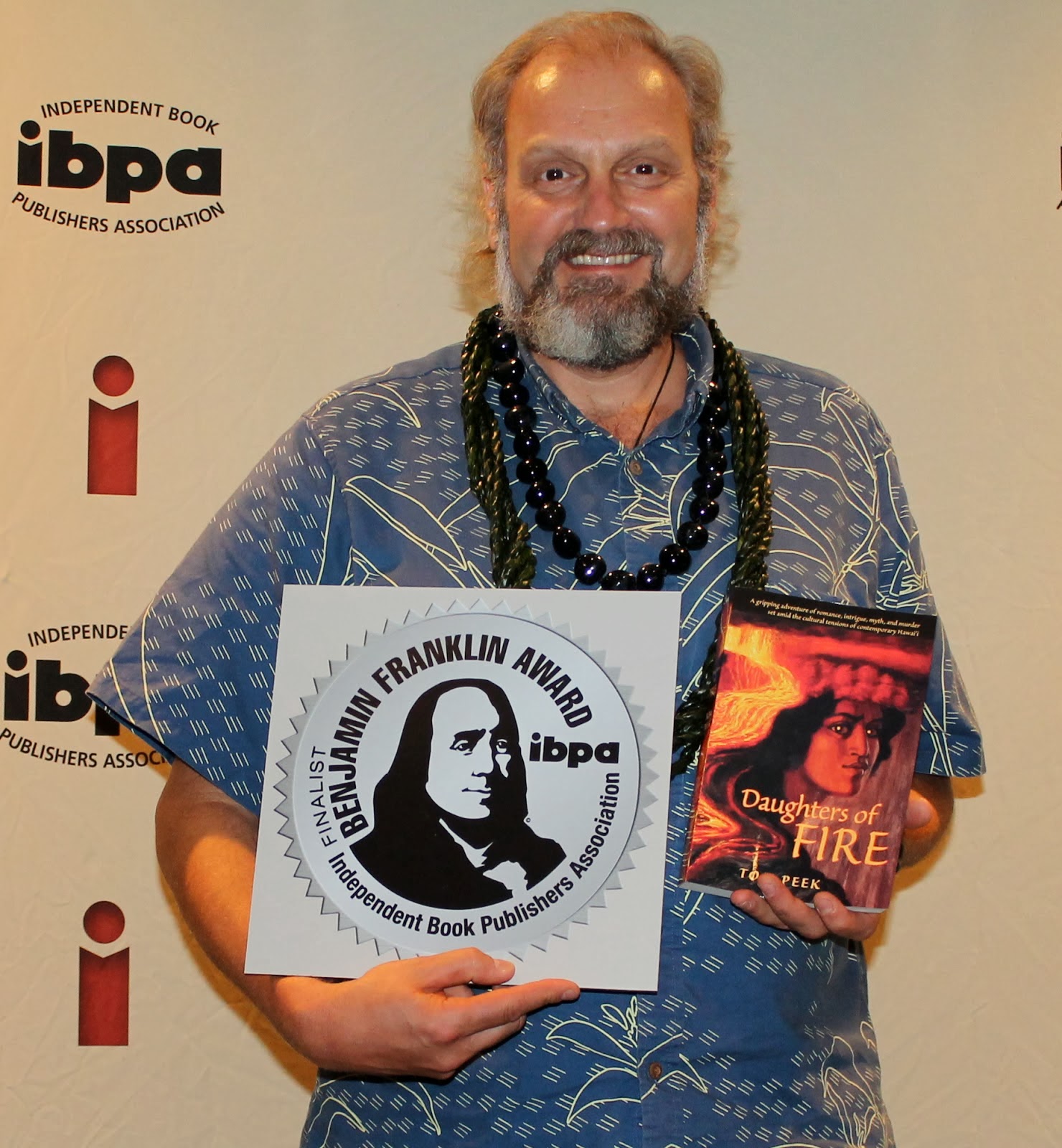
Tom Peek, author of Daughters of Fire, holds a writing workshop
next Saturday. Photo by Julia Neal
IN HIS WORKSHOP ENTITLED Tapping Your Creative Right Brain, Tom Peek helps participants unlock the part of their minds that holds wild dreams, fascinating associations, deep metaphors and other gems of imagination, then apply them to writing. The workshop from 9 a.m. to 5 p.m. Saturday, Jan. 11 at Volcano Art Center's Ni`aulani Campus is open to all levels and genres, and no writing experience is necessary. Sign up at 967-8222. 

A BENEFIT CONCERT TAKES PLACE next Saturday, Jan. 11 from 10 a.m. to 4 p.m. at Pahala Community Center. Ka`u High School senior Kamrie Koi is producing the event to raise money for cancer research through the United Way. Entertainment includes Just in Case, JR Band, Keaiwa, Boni Narito, Honokua, Hui Okinawa Kobudo Taiko, Ka`u High School ensemble class and more. The event also features vendors, games, raffle tickets and prizes. Call Kamrie Koi at 430-4964 or Jolene Koi at 936-6249.

KA`U HOSPITAL URGES RESIDENTS to complete its Community Health Needs Assessment atsurveymonkey.com/s/93HQ5MX. The deadline has been extended to Jan. 31.

SEE THE DIRECTORY from the Ka`u Chamber of Commerce at http://snack.to/fzpfg59c.

SUPPORT OUR SPONSORS AT PAHALAPLANTATIONCOTTAGES.COM AND KAUCOFFEEMILL.COM. KA`U COFFEE MILL IS OPEN SEVEN DAYS A WEEK.


Friday, January 03, 2014

Ka`u News Briefs, Friday, Jan. 3, 2014


Ka`u peppers are among the many locally grown vegetables that provide food in the district. Photo by Geneveve Fyvie
BUYING LOCALLY PRODUCED FOOD may get a boost from the County Council. Council member and attorney Margaret Wille has a resolution coming up before the council's Governmental Relations and Economic Development Committee on Tuesday. Her idea is to tag Big Island produced food with the label Hawai`i Island Produce & Products,  or the label Hawai`i Island Produce & Products – Organically Grown. She points to Kaua`i Grown and Made in Maui as examples of local labeling elsewhere. Currently many local producers use the statewide labeling Island Fresh, Buy Local, It Matters, Join the Movement! 
     Willle says that the statewide labeling only requires 50 percent local content while her idea for this island is to require close to 100 percent local ingredients in order to use the logo label.

Dean Okimoto. Photo from HFBF
HAWAI`I FARM BUREAU FEDERATION PRESIDENT DEAN OKIMOTO says that providing farmers with land at a reasonable cost is needed to produce more food. In an interview in Pacific Business News this morning, Okimoto, who is statewide president of the ag non-profit, pointed to the Trust for Public Land’s success in helping to transfer more than 1,700 acres on O`ahu to two state agencies. “It is going to be a great model going forward in showing if you get farmers on land at a reasonable price that we can grow more food, become more productive. It is a neat vision in helping to mitigate costs and challenges,” he said.
      Concerning food safety. Okimoto said the Hawai`i farmers “are far behind on food-safety issues,” concluding that the state will have to help. “We have food safety issues that will be coming up with the federal regulations that haven’t been put into place yet…..Farmers don’t have money for the cost of infrastructure associated with food safety. In old-style farming, you take water, you have an open shed, you rinse your crops, wash them, put them in a box, and send them to market. That’s no longer acceptable,” he said.  
     Regarding the GMO debate, Okimoto supports the seed companies, which are banned from strarting up business in Hawai`i County, through new legislation by the County Council that was recently signed by Mayor Billy Kenoi.  Says Okimoto, "I think if we chase these companies out of Hawai`i we’re not only doing a disservice to agriculture in Hawai`i’, but we’re hurting our economy and our people by keeping a lot of land out of production. That will create pressures toward development. So people that want to stop more development and want more agriculture truthfully need this technology,” he told PBN

Hawaii`i Farm Bureau Federation advocates for affordable land and food safety. Photo from HFBF

     Okimoto pointed to this island: “Farmers are upset on the Big Island, and it’s sad because that’s where we have the most land, and we’re now prohibiting guys from using the technology there. My question is, ‘Of all the milk imported here, what do you think is in that milk? What do you think they do on the Mainland?’ The fight against GMOs is so rabid, misconstrued, it has gotten totally out of hand, and we need to sit down with each other and really talk," Okimoto told PBN.
See more in this week's Pacific Business News print edition  and at www.bizjournals.com/pacific
     The Ka`u Farm Bureau is expected to announce a meeting soon to elect the 2014 officers and plan for the state legislature.

Black Pellets to burn in power plants would
be shipped in from the Mainland.  
PELLETS FOR ELECTRIC PRODUCTION area once again proposed for Hawaiian Electric Co. `Aina Kona Pono had proposed making pellets from biomass, put them into a microwave process called MicroDee to manufacture biodiesel and send the biodiesel to power plants to burn for electricity. The new proposal, this one by Zikha Biomass Energy, has been offered to the state Public Utilities Commission which recently turned down the AKP plan. 
        According to an Alan Yonan Jr. story in the Honolulu Star Advertiser this morning, Zikha, which is owned by Microsoft founder Paul Allen and partners, would import from the mainland pellets made from wood harvested from tree farms and dead trees in forests that have been ravaged by pests. Zikha representatives say that HECO could save roughly $40 million a year for each generator unit converted to its Black Pellets. The Blue Planet Foundation, which has opposed Liquid Natural Gas as an option to reduce fuel costs in Hawai`i, called the Black Pellet possibility “exciting." One of  its advantages, according to the Zikha website, is that they are waerproof and can be shipped in open containers. See more at www.zicha.com and www.staradvertiser.com.

NO MORE PLASTIC BAGS will be allowed at retail checkout stands in Hawai`i County after Jan. 17 when the one-year transition period ends. This week, Bobby Leithead-Todd, the head of the Departmen of Environmental Management, issued a statement to remind consumers that “the purpose of the ordinance is to reduce the usage of single-use plastic bags by prohibiting their distribution at store checkouts and encouraging the usage of reusable bags.”
    She notes that many stores are choosing to stop using plastic bags and are already encouraging customers to bring their own reusable bags. “One high quality reusable bag can replace hundreds of single-use plastic bags over its lifetime. In the long term, the cost of a reusable bag can be lower than the cost of the single-use plastic bags it replaces,” states Leihhead-Todd.
     The ordinance exempts plastic bags without handles that are used for retail items such as meat, produce, bulk food items, garments, and prescription drugs. It also exempts non-profit organizations and non-incorporated community booster organizations. Paper bags are still permitted under the ordinance. 
    If a business violates the ordinance, a warning letter will be issued. A second violation will result in a civil fine of $250 per day. The third violation will result in a civil fine of $500 per day and subsequent violations will result in civil fines of $1,000 per day.
       “Environmental problems posed by plastic bags warrant the implementation of this type of law and it is consistent with the County’s General Plan, which implores the County to ‘take positive action to further maintain the quality of the environment,’” says the Environmental chief. “It is an important milestone on the County’s path toward Zero Waste, a commitment to protecting our island.”
    She states that Hawai‘i County residents join 54 percent of the world’s population who live in an area that has plastic bag bans or fees to reduce plastic pollution. All Hawai‘i counties have passed plastic bag reduction ordinances, joining a growing list of cities, counties, and nations around the world taking similar initiatives including 28 entire countries.
     For more information, visit HawaiiZeroWaste.com where the ordinance, rules, and outreach materials can be viewed and downloaded. For questions and additional information about the new ordinance,  contact the Department of Environmental Management at bring-ur-bag@hawaiicounty.gov or 961-8942. 
     To help clean up bags and other plastics from Ka`u beaches, contact Hawai`i Wildlife Fund at kahakai.cleanups@gmail.com.
Walt Kaneakua

WALTER KANEAKUA is U.S. Rep. Tulsi Gabaard's new Hawai‘i District Director. A retired Colonel and former Air Force command pilot, Kaneakua  retired after 27 years of active duty with the U.S. Air Force and the Hawai‘i Air National Guard. He flew as a Captain for Aloha Airlines, and later served on Sen. Dan Inouye’s Honolulu staff as his Executive Assistant for Military Affairs. He served U.S. Sen. Mazie K. Hirono as a senior military affairs officer during her transition from the U.S. House of Representatives.
     This morning, Gabbard explained the choice of Kaneakua: “His deep commitment to serving Hawai‘i and our country, as well as his thorough knowledge of military, economic and Hawaiian affairs, will serve our constituents well as we constantly work towards addressing Hawai‘i’s key priorities and needs. I look forward to working closely with Walt to provide the best possible constituent services and community outreach across our islands.”
     Kaneakua said he is grateful to be able to support Gabbard's efforts "on behalf of Hawai‘i’s citizens and especially for service members and veterans, care for our kupuna and keiki, and creating job prospects for a 21st century economy.”

HAM RADIO OPERATORS pot luck gathering is this Sunday, Jan. 5 at 11:30 a.m. at Manuka Park. Call Dennis Smith at 989-3028.


KA`U HOSPITAL URGES RESIDENTS to complete its Community Health Needs Assessment atsurveymonkey.com/s/93HQ5MX. The deadline has been extended to Jan. 31.

SEE THE DIRECTORY from the Ka`u Chamber of Commerce at http://snack.to/fzpfg59c.

SUPPORT OUR SPONSORS AT PAHALAPLANTATIONCOTTAGES.COM AND KAUCOFFEEMILL.COM. KA`U COFFEE MILL IS OPEN SEVEN DAYS A WEEK.