THE LITTLE FIRE ANT INVASION AND BATTLE in Hawai`i is making international news with Associated Press circulating a story telling of the pest reaching Maui through a shipment from Big Island and the state Department of Agriculture lacking sufficient resources for an effective eradication campaign.
The story says when LFA were first detected in 1999 on this island, officials deemed the population too widespread for eradication. Ten years later, LFA were found on a farm on Maui and eradicated only nine months ago.
Three months ago, officials found the largest LFA infestation so far in Hawai`i on 20 acres of forest near Nahiku on the northeastern shore of Maui.
Agriculture officials also continue to battle a 13-acre infestation at Kalihiwai, Kauai, where they say the ant appears to be under control.
According to the story, the annual impact could reach $170 million if LFA become established on O`ahu.
Three months ago, officials found the largest LFA infestation so far in Hawai`i on 20 acres of forest near Nahiku on the northeastern shore of Maui.
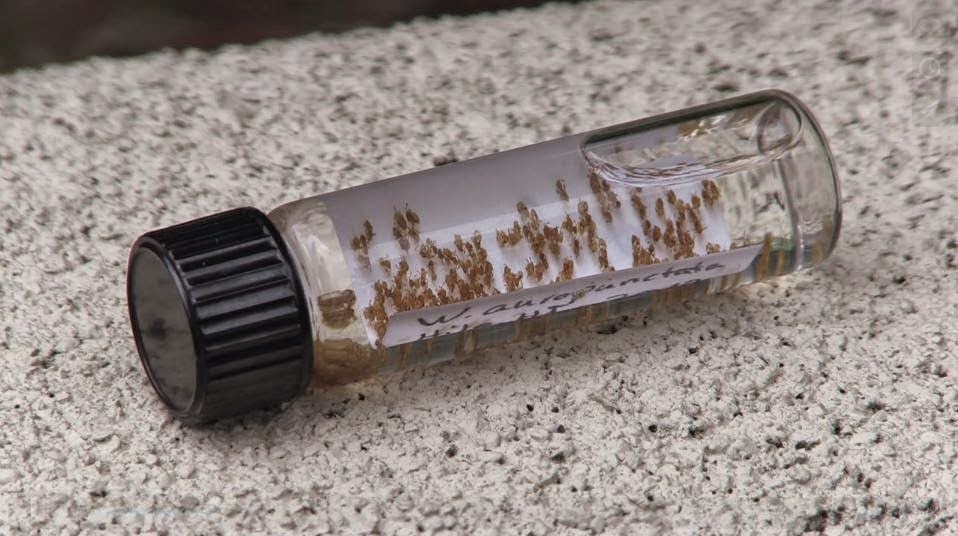 |
| LFA are small even under magnification. Photo from DLNR |
According to the story, the annual impact could reach $170 million if LFA become established on O`ahu.
Randy Bartlett, interagency coordinator with Hawai`i Invasive Species Council, said, “The (state Agriculture) Department doesn’t have enough personnel, and the ant could turn up anywhere. If everyone would just look in their own backyard, it could go a long way to getting on top of this.
“What we’ve seen so far could be just the tip of the iceberg.”
“What we’ve seen so far could be just the tip of the iceberg.”
Anyone finding little fire ants can call Hawai`i Ant Lab at 315-5656. For more information on little fire ants and how to control them, see www.littlefireants.com.
See hawaiitribune-herald.com.
THE HOLIDAY CHALLENGE at Kilauea Military Camp in Hawai`i Volcanoes National Park continues through New Year’s Eve. The public can judge cottages decorated in holiday lights by KMC employees and vote for their favorites. Park entrance fees apply. Call 967-8371 for more information.
SUPPORT OUR SPONSORS AT PAHALAPLANTATIONCOTTAGES.COM AND KAUCOFFEEMILL.COM. KA`U COFFEE MILL IS OPEN SEVEN DAYS A WEEK.




To comment on or like this story, go to facebook.com/kaucalendar.com.
POPULATION GROWTH IN HAWAI`I is a result of foreign immigration and births compared to deaths, rather than an influx of people moving here from the mainland, according to an Associated Press story reporting that Hawai`i’s population grew by 10,500 since the 2010 census. U.S. Census figures also show that more Hawai`i residents moved out of state than arrived from the mainland.
The rate was higher than the national growth figure of 0.7.
Breaking down the figure, almost eight in 10 new Hawai`i residents resulted from the difference between births and deaths, and 20 percent was the difference between people arriving from and moving to foreign countries.
Residents migrating from Hawai`i to other states in 2014 numbered 5,141.
See hawaiitribune-herald.com.
To comment on or like this story, go to facebook.com/kaucalendar.com.
 |
| A prototype bus in Sweden wirelessly gets electricity from charging stations at bus stops. |
THE FUTURE OF ENERGY AND ELECTRICITY is on Henry Curtis’ mind as the New Year approaches. Curtis is director of Life of the Land and involved in several energy dockets under consideration by Hawai`i’s Public Utilities Commission.
“How will the delivery of energy and electricity change over the next five or ten years? How will consumer demand change? How do we envision our future?” Curtis asks. “These questions need to be answered before we determine what business structure is best for delivering that service and who should serve in that role.
“Scania is testing Sweden’s first wirelessly charged hybrid city bus. Starting June 2016 a prototype will go into daily operation in Södertälje. The system uses induction to wirelessly transfer electricity from a charging station located under the road surface to a battery on the bus. The transfer takes six-seven minutes. In the future buses could get a 30-second charge at each of several bus stops.
“Hawai`i has been a lab for testing scientific breakthroughs. In 2008 a solar beam was successfully sent from Maui to the Big Island through 92 miles of air. A successfully demonstration of the world’s first robotic underwater vehicle powered entirely by ocean thermal energy conversion occurred off Hawai`i in 2009-2010. Temperature differentials in different layers of the ocean provided all of the power necessary to move and operate the ship.
“In recent years there have been a number of impressive technological breakthroughs. Imagine desk laptops, storage, video cameras, cell phones and game controllers but without the jumble of interconnecting wires. Electric and magnetic fields have successfully transferred electricity through the air.
“Regenerative breaking energy storage systems allow the energy caused by slowing down to be used to recharge batteries. Energy can be harvested from weight, motion, vibration and temperature changes … . Israeli engineers are testing a new road surface containing piezoelectric crystals that produce electricity when they are squeezed.
“Airplanes have been charged in mid-air by aiming ground-based lasers at panels on the underside of their wings. A combination of ground-based, plane-based and satellite-based solar arrays could gather solar energy and beam it to lightweight rocket ships seeking to leave the earth’s gravitational field.
“For more than ten years it has been possible to send data and power over the same lines. In 2004 the FCC established regulations for Broadband over Power Lines. Sandia National Laboratories is now developing Power-over-Fiber Optic Communication Cables. Some U.S. utilities offer combined packages including cable, telephone and electric service.”
See ililanimedia.blogspot.com.
To comment on or like this story, go to facebook.com/kaucalendar.com.
 |
| Lava diversion was attempted when an eruption threatened Zafferana Etnea in 1991 and 1992. Photo from wikipedia |
HAWAIIAN VOLCANO OBSERVATORY scientists tackle lava diversion in the current issue of Volcano Watch.
“What does it take to successfully divert a lava flow?” they ask.
“In discussions about lava diversion, Italy and Iceland often are touted as places where lava flows have been successfully diverted. But what did it take for those efforts to succeed?
“With the eruptions in Italy and Iceland, successful slowing or diversion of the lava flows required costly and time-consuming efforts for months at a time. The successes were not the result of building just one barrier, breaching just one lava tube or spraying water on a lava flow for only a few days. Each required multiple and/or continuous efforts that lasted for as long as the eruptions produced threatening lava flows.
“Importantly, none of these eruptions threatened populated areas for more than a few months. Would the outcome have been different had the eruptions produced threatening lava flows for many years? This unanswered question is the source of debate when declaring lava diversion a success.
“As with many success stories, the devil is in the details.
“So, using the 1991-93 Mount Etna eruption as our first example, we will look at the details of what it took to successfully divert the lava.
On Dec. 14, 1991, Etna began erupting, sending lava toward the town of Zafferana Etnea, located six miles downslope of the active vents. On Jan. 1, 1992, workers began constructing a 256-yard-long, 69-foot-high barrier about 1.2 miles above the town. But on Jan. 9, the lava flow front stalled and activity became focused upslope. By early March, another lobe of lava passed the original stalled front, reached the barrier March 14, and overtopped it by April 10.
“The barrier successfully delayed the lava for a month, but flows continued to threaten Zafferana, and the population prepared for evacuation. Three more short barriers were built to slow the lava flow’s advance, but they, too, were overtopped.
“Meanwhile, plans for a different kind of lava-control project were enacted farther upslope. Per this plan, explosives were used to open up the feeder lava tube in an attempt to slow the flow’s advance. After four unsuccessful attempts, the lava was successfully redirected into an artificial channel in late May. Robbed of its supply, the flow advancing toward Zafferana stalled.
“By June 1992, the eruption rate had decreased by half and lava flows were only active upslope. Lava no longer was threatening Zafferana. and efforts to slow or divert the lava were no longer required. The eruption ended in March 1993, after 16 months of volcanic activity and about five months of work to control the flow.
“Our second example focuses on the 1973 Icelandic eruption.
 |
| Wednesday is the deadline to vote for favorite cabin decorations at Kilauea Military Camp. Photo by Dave Berry |
“In January 1973, Eldfell volcano on the island of Heimaey erupted an `a`a lava flow. During the next five months, billions of gallons of seawater were pumped through an elaborate network of pipes laid out across the lava to cool the flow and slow its advance toward Heimaey’s only harbor, the lifeline of the island and a critical economic resource for the entire country. The fragmental nature of the lava flow’s surface allowed the seawater to penetrate deep into the flow and cool the lava near its core, and the advance of the flow was slowed as the flow front thickened dramatically.
“The eruption ended before the lava flow inundated the harbor, but the diversion effort required round-the-clock maintenance of the pipe and pump network until the eruption stopped in July.”
“The eruption ended before the lava flow inundated the harbor, but the diversion effort required round-the-clock maintenance of the pipe and pump network until the eruption stopped in July.”
See hvo.wr.usgs.gov.
To comment on or like this story, go to facebook.com/kaucalendar.com.
THE HOLIDAY CHALLENGE at Kilauea Military Camp in Hawai`i Volcanoes National Park continues through New Year’s Eve. The public can judge cottages decorated in holiday lights by KMC employees and vote for their favorites. Park entrance fees apply. Call 967-8371 for more information.
SUPPORT OUR SPONSORS AT PAHALAPLANTATIONCOTTAGES.COM AND KAUCOFFEEMILL.COM. KA`U COFFEE MILL IS OPEN SEVEN DAYS A WEEK.