About The Kaʻū Calendar

Wednesday, September 07, 2016

Ka`u Calendar News Briefs Wednesday, Sept. 7, 2016

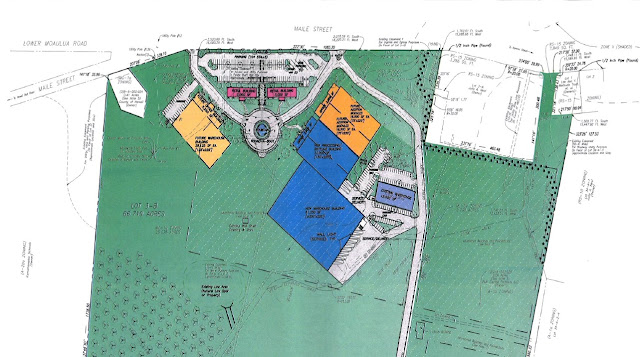
Pahala Town Square & Hawaiian Springs Facility is proposed for the former Ka`u Sugar mill site.
Images from Hawai`i County Planning Department
A WATER BOTTLING PLANT with giant fountain and round-about, parking for buses, vans and cars and 10,000 square feet of retail space are planned makai of Maile Street in Pahala on old sugar mill land. Pahala Town Square & Hawaiian Springs Facility is up for plan approval, any day, by county Planning Director Duane Kanuha.
"Commercial facilities should be designed to fit into the locale
with minimal intrusion," according to Hawai`i County
General Plan.
      Pahala Town Square & Hawaiian Springs Facility would be located on industrial-zoned land from the old metal sugar warehouse toward the former KAHU-FM radio station – the historic building and vault, once a branch of Bank of Hilo. Retail operations would be allowed for sale of water bottled on the industrial site, as well as related items. The land also has a macadamia orchard.
      According to submissions to Hawai`i County Planning Department, PMK Capital Partners, LLC, led by Al Kam, is asking for approval of a natural water bottling facility to include accessory retail sales, warehouse buildings, offices, parking lots, landscaping and related structures designed by DRA Architecture, LLC, of Honolulu. One warehouse would be 81,250 square feet; the old warehouse is 12,000 square feet. Another processing building would be 33,000 square feet. For parking fronting Maile Street, there would be 104 stalls for passenger vehicles, five for buses and two for tour vans. A huge fountain would welcome the tour buses, vans and cars to the retail area near the bottling plant. Open space with trees and other landscaping would be preserved between the site and Pahala Plantation House, a buffer to the residential area along Maile Street.
      Water for the bottling facility would apparently come from a well that Ka`u Sugar developed for its mill. The opening of the tunnel that leads to the well via a now defunct funicular railroad is located on the PMK property. The shaft extends some 1,500 feet going under Maile Street. The well hasn’t been used since the sugar company shut down 20 years ago.
New warehouse and processing buildings dwarf the existing
warehouse on sugar mill land.
      According to Hawai`i County Department of Water Supply, the operation would be restricted from using county water for bottling and retail sales. The small scale of the county water system in Pahala, with its well above the town, also places limits on development of housing for the community.
      For plan approvals for the new facilities, the planning director is allowed closer inspection of certain types of development in certain zones to ensure conformance with the General Plan, the Zoning Code and conditions of previous approvals related to the development.
      General Plan policy 14.3.3(f) reads: “The development of commercial facilities should be designed to fit into the locale with minimal intrusion while providing the desired services. Appropriate infrastructure and design concerns shall be incorporated into the review of such developments.”
      The Planning director may issue plan approval subject to conditions or changes in the proposal which, in the director’s opinion, are necessary to carry out and further the purposes of the Zoning Code.
      The planning director considers the proposed structure, development or use in relation to the surrounding property, improvements, streets, traffic, community characteristics and natural features and may require conditions or changes to assure proper siting is provided for; proper landscaping is provided that is commensurate with the structure, development or use and its surroundings; unsightly areas are properly screened or eliminated; and within reasonable limits, any natural and man-made features of community value are preserved. The director shall require any conditions or changes in the proposal which, in the director’s opinion, are necessary to carry out these purposes.
      Comments on the plan can be sent to planning@hawaiicounty.gov, susan.gagorik@hawaiicounty.gov and larry.nakayama@hawaiicounty.gov.
      To read comments, add your own, and like this story, see Facebook. Follow us on Instagram and Twitter.

Activity at Kilauea's lava lake last night included spattering
and upheaval of chunks of crust. Photo by Ron Johnson
VOLCANIC ACTIVITY AT KILAUEA’S summit continued to wow onlookers at Jaggar Museum Observation Deck in Hawai`i Volcanoes National Park yesterday.
      The lava lake within Halema`uma`u Overlook vent was active and at a relatively high level, with its surface easily visible. Lava spattering 40 feet or so high and chunks of the lake’s crust heaving upward mesmerized viewers last night. This morning, the lake surface was still visible at a height of 52 feet below the adjacent floor of Halema`uma`u crater.
      To read comments, add your own, and like this story, see Facebook. Follow us on Instagram and Twitter.

KTA PUAINAKO IN HILO IS BLUE ZONES Project’s first approved grocery store in East Hawai`i. The supermarket will host a celebration from 11 a.m. to noon on Saturday, Sept. 10. The event is open to the public, and guests are welcome to enjoy free food samples and natural movement activities.
      “We’ve partnered with Blue Zones Project to make healthy choices easier for our customers,” said Puainako Store Director, Sanford Toma. “That means highlighting healthy food items throughout the store and even creating a new Blue Zones Project checkout lane that makes healthy food easier to find for you and your `ohana. Together, we can live a longer, healthier and happier life.” 
KTA Puainako is a Blue Zone Project-approved grocery store.
Photo from KTA
      The Blue Zones Project checkout lane is one of several actions that KTA Puainako completed to become Blue Zones Project approved. Rather than candy bars and sugar-laden beverages typically seen in checkout lanes, the Blue Zones Project checkout lane displays healthy grab-and-go snacks like fresh fruit, nuts and granola bars, and healthier drink options.
      The grocery store also added signage to highlight locally grown produce and foods that meet the Blue Zones Food Guidelines. They also now provide half sandwiches in the deli and label the number of serving sizes for fresh cut fruit and salads. The store also started a popular “Quick & Ono” lunch special every Wednesday with Blue Zones inspired recipes, and installed parking signs that encourage patrons to park farther from the store and walk, in order to incorporate more natural movement in their day.
      Brought to Hawaii through a sponsorship by HMSA in collaboration with Healthways, Inc. and Blue Zones, LLC, Blue Zones Project is a community-by-community well-being improvement initiative designed to enable community members to live longer, happier lives with lower rates of chronic diseases and a higher quality of life.
      To learn more, email BlueZonesProjectHawaii@healthways.com, or see bluezonesproject.com.

MEALANI’S 21ST TASTE of the Hawaiian Range Gala takes place Friday from 6 p.m. to 8 p.m. at Hilton Waikoloa Village. 
      Participants meet the people who produce many local products from around Hawai`i Island. Kuahiwi Ranch, of Ka`u, will be on hand with their pork and beef products. Kahua Ranch, of South Kona, is providing mutton and lamb.
      A cornucopia of fresh island fruit, veggies, honey, spices and beverages will also be available.
      Tickets are available at tasteofthehawaiirange.com.
      To read comments, add your own, and like this story, see Facebook. Follow us on Instagram and Twitter.

Hidden Valley by Patrick Ching Image from VAC
VOLCANO ART CENTER presents Patrick Ching’s Inspirations of a Hawai`i Wildlife Artist on Thursday from 7 p.m. to 9 p.m. in Niaulani Campus’ Great Room in Volcano Village. Ching is a renowned Hawaiian conservationist and wildlife artist, author and ornithological illustrator who has garnered international recognition for his realistic renderings of nature. Hawai`i’s native birds, insects, plants and ferns come alive through his art.
      Call 967-8222 for more information.

HAWAI`I COUNTY FINANCE COMMITTEE conducts a workshop to discuss the county’s Dedicated and Nondedicated Agricultural Real Property Tax Programs tomorrow at 9 a.m. at Council Chambers in Hilo. Ka`u residents can participate via teleconferencing at Na`alehu State Office Building.
      Testimony from the public will be taken at the beginning. “Healthy and structured interaction between stakeholders, committee members and members of the public” will be encouraged during the workshop, according to the announcement.
      The workshop will be streamed live at hawaii.county.gov.

SUPPORT OUR SPONSORS AT PAHALAPLANTATIONCOTTAGES.COM AND KAUCOFFEEMILL.COM. KA`U COFFEE MILL IS OPEN SEVEN DAYS A WEEK.


See kaucalendar.com.
See kaucalendar.com/TheDirectory2016.html
and kaucalendar.com/TheDirectory2016.pdf


Tuesday, September 06, 2016

Ka`u Calendar News Briefs Tuesday, Sept. 6, 2016

After rising steadily yesterday, Kilauea's summit lava lake offered visible volcanic activity this morning.
Photo from USGS Hawaiian Volcano Observatory
AN EARTHQUAKE OCCURRED underneath Moku`aweoweo, Mauna Loa’s summit caldera, this morning. U.S. Geological Survey’s Hawaiian Volcano Observatory recorded the magnitude-4.0 earthquake at a depth of 0.74 miles at 4:25 a.m.
A magnitude-4.0 earthquake struck at Mauna Loa's
summit this morning. Map from USGS-HVO
      The USGS "Did you feel it?" website (http://earthquake.usgs.gov/eqcenter/dyfi/) received only one felt report within an hour of the earthquake. This report described light shaking (Intensity III). At that intensity, damage to buildings or structures is not expected. The lack of felt reports is consistent with the remote location and shallow depth of the earthquake.
      The earthquake appears to be isolated. As of 6:30 a.m., no aftershocks had been observed. HVO’s deformation monitoring instruments registered the earthquake but show no significant change in deformation rates or patterns that would indicate increased volcanic hazard at this time.
      Magnitude-4.0 or greater earthquakes occurred in the summit of Mauna Loa six to seven months prior to the volcano’s two most recent eruptions in 1975 and 1984. However, today’s isolated earthquake does not represent a significant departure from the seismic activity rate for the past year, so the Volcano Alert Level for Mauna Loa remains at Advisory.
      According to HVOs Scientist-in-Charge Christina Neal, the earthquake had no apparent effect on Kilauea Volcano’s ongoing eruptions. The Pacific Tsunami Warning Center determined that no damaging tsunami was generated (http://ptwc.weather.gov/?region=2).
      HVO reported this morning that Kilauea’s summit lava lake level has risen to 62 feet below the adjacent floor of Halema`uma`u crater, bringing volcanic activity into view once again.
      For information on recent earthquakes in Hawai`i and eruption updates, see USGS Hawaiian Volcano Observatory’s website at http://hvo.wr.usgs.gov.
      To read comments, add your own, and like this story, see Facebook. Follow us on Instagram and Twitter.

ELEVEN OF THE WORLD’S leading conservation organizations will partner to identify, map, monitor and conserve Key Biodiversity Areas – places that include vital habitats for threatened species – with more than $15 million committed over the next five years. The announcement was made at the IUCN World Conservation Congress currently taking place on O`ahu.
      Through the KBA Partnership, resources and expertise will be mobilized to further identify and map Key Biodiversity Areas worldwide. Monitoring of these sites will enable detection of potential threats and identification of appropriate conservation actions. The Partnership will also advise national governments in expanding their protected areas network and will work with private companies to ensure they minimize and mitigate their impact on nature.
      “This is a vitally important initiative for our planet’s biodiversity,” said Braulio Ferreira de Souza Dias, Executive Secretary of the Convention on Biological Diversity. “This partnership will enhance global conservation efforts by highlighting internationally important sites in need of urgent conservation action. It will also help us reach the targets in the Strategic Plan for Biodiversity and allow national governments and conservation organizations to ensure that scarce resources are directed to the most important places for nature.”
      The International Union for Conservation of Nature has engaged with hundreds of experts and decision-makers to develop a Global Standard for the Identification of Key Biodiversity Areas. The standard was launched during the World Conservation Congress, on Monday.
Porites pukoensis is a critically endangered coral found
in Molokai's marine area. Photo from Corals of the World
      “Our planet is at the crossroads, and we need to take urgent action if we want to secure its ability to support us,” said Inger Andersen, Director General of IUCN. “Information about where and why a site is considered key for the survival of threatened species underpins all sustainable development and will be critical for achieving Sustainable Development Goals.”
      In particular, knowledge about Key Biodiversity Areas will contribute to achievement of goals on conservation and sustainable use oceans and to manage forests, combat desertification and halt land degradation.
      The KBA Partnership builds on the partners’ established track record in site identification, monitoring and conservation. Over the past four decades, BirdLife International has identified more than 13,000 Important Bird and Biodiversity Areas on land and at sea in every region of the world through its 120 national partners and others, while the Critical Ecosystem Partnership Fund has supported identification of 6,000 Key Biodiversity Areas within global biodiversity hotspots.
      To date, more than 18,000 global and regional Key Biodiversity Areas have been identified and mapped. These include Molokai Island marine area, home to the Critically Endangered coral Porites pukoensis, known only to occur in the shallow waters of this site.
      The new Partnership will unite these efforts under a single KBA umbrella. It will expand the KBA network to cover other species and ecosystems using the global KBA standard. These data will guide decision-makers on areas that require safeguarding and will help a range of end users to define their conservation priorities, achieve their international commitments, and comply with their environmental policies.
      KBA Partners are the Amphibian Survival Alliance, BirdLife International, Conservation International, Critical Ecosystem Partnership Fund, Global Environment Facility, Global Wildlife Conservation, IUCN, NatureServe, RSPB, Wildlife Conservation Society and the World Wildlife Fund.
      “Advancing and implementing successful conservation solutions depends on clearly identified global strategies,” said Naoko Ishii, Global Environment Facility CEO. “In this regard, we are proud to be one of the founding members of this exciting new partnership to help map and protect some of the planet's most valuable biodiversity.”
      To read comments, add your own, and like this story, see Facebook. Follow us on Instagram and Twitter.

Brennen Nishimura
Photo by Coach Erin Cole
Kyle Calumpit at HPA
Photo by Coach Erin Cole
KA`U HIGH CROSS COUNTRY team has started its season. Two runners participated in the race on Aug. 27 at HPA. It was warm and sunny in Waimea on the first race of the season, which makes the hill at HPA extra challenging, reports coach Erin Cole. The race changed this year from three miles to 5K (5K is 3.1 miles). 
      Brennen Nishimura came in with a time of 26:32 – #101 out of 177. Kyle Calumpit ran a time of 27:32 – #118 out of 177.
      The Trojans have several more runners that have been training and will be running in future races this season. The race scheduled for Sept. 3 at Kealakehe was cancelled due to the storm. Next race is at Kamehameha School on Sept. 10 at 2 p.m.
      To read comments, add your own, and like this story, see Facebook. Follow us on Instagram and Twitter.

HAWAI`I COUNTY COUNCIL HOLDS meetings this week. Tomorrow, the full council meets at 9 a.m. Public Safety & Mass Transit Committee meets at 1 p.m.; Finance, 1:15 p.m.; Planning, 1:30 p.m.; Public Works & Parks & Recreation, 2 p.m.; and Governmental Relations & Economic Development, 2:45 p.m.
      The Committee on Finance conducts a workshop to discuss the county’s Dedicated and Nondedicated Agricultural Real Property Tax Programs on Thursday at 9 a.m.
      Testimony from the public will be taken at the beginning. “Healthy and structured interaction between stakeholders, committee members and members of the public” will be encouraged during the workshop, according to the announcement.
      All meetings take place at Council Chambers in Hilo. Agendas and live-streaming are available athawaii.county.gov.
      Ka`u residents can participate via teleconferencing at Na`alehu State Office Building.

SUPPORT OUR SPONSORS AT PAHALAPLANTATIONCOTTAGES.COM AND KAUCOFFEEMILL.COM. KA`U COFFEE MILL IS OPEN SEVEN DAYS A WEEK.

Click on document to enlarge.
See kaucalendar.com
See kaucalendar.com/TheDirectory2016.html
and kaucalendar.com/TheDirectory2016.pdf.


Monday, September 05, 2016

Ka`u Calendar News Briefs Monday, Sept. 5, 2016

Happy Labor Day! According to Hawaiian Volcano Observatory scientists, "charcoal is good
for more than the barbeque." See below. Photo from Wikipedia

SHOULD HAWAI`I ERADICATE MOSQUITOES? A group of stakeholders will ponder the question during meetings this week at Kilauea Military Camp in Hawai`i Volcanoes National Park.
      “We are discussing sort of how we realize the potential for a mosquito-free environment here for public health, conservation and quality of life issues,” Durrell Kapan, co-organizer of the workshop and adjunct professor at the Center for Conservation and Research Training at UH-Manoa, told Max Dible, of West Hawai`i Today.
Dr. Kenneth Kaneshiro
      “There are a number of near-term and potentially longer-term solutions. The important thing is to make sure all the people involved are thinking about these solutions, and to get all those people in the room to understand what those possibilities are.”
      Dr. Kenneth Kaneshiro, program director at UH-Manoa’s Center for Conservation and Research Training, explained that mosquitoes could be controlled by interrupting the insects’ reproductive systems.
      When Dible asked about consequences of eradication, such as reducing food supplies for species such as hoary bats, Kaneshiro said, “Eradication of mosquitoes wouldn’t cause any other problems because they’re not native to Hawai`i. They’re an invasive species that doesn’t belong in the native Hawaiian ecosystem.” He said the ecosystem worked fine before mosquitoes were introduced.
      See westhawaiitoday.com.
      To read comments, add your own, and like this story, see Facebook. Follow us on Instagram and Twitter.

Sen. Brian Schatz
KA`U’S U.S. SENATORS send Labor Day greetings to their constituents.
      “On Labor Day, we honor the work and sacrifice of the labor movement in our country,” Sen. Brian Schatz said. “We thank labor unions as champions for the minimum wage, Social Security, workplace health and safety standards, child labor protections and the 40-hour work week, but our thanks must be more than just words.
      “As Congress returns to session this week, we must focus on the fact that millions of working families are struggling to make ends meet. We are the wealthiest country in the world and yet for far too many Americans, a full-time job still means a life below the poverty line. We must do better. I look forward to working with my Senate colleagues to make real progress toward improving the lives of working families in our country.”
Sen. Mazie Hirono
      Sen. Mazie Hirono said, “When my mother brought our family to Hawai`i, we struggled. We lived in fear of mom getting sick and not being able to work – which meant no pay and no money for food or rent. She had no employment protection. But our family circumstances changed dramatically when mom’s workplace unionized. Better job security, better pay. We were finally able to buy our first home. As we celebrate LaborDay, we celebrate the men and women who fought and sacrificed for basic protections, like safe working conditions and fair wages, that American workers have today.”
      To read comments, add your own, and like this story, see Facebook. Follow us on Instagram and Twitter.

AS KA`U RESIDENTS ENJOY Labor Day barbeques, Hawaiian Volcano Observatory geologists explain in the current issue of Volcano Watch how they use charcoal.
      “One of the fundamental premises of geology is that the key to understanding the future is to look at the past,” the article states. “In order to understand how a volcano will behave, geologists map the deposits of past eruptions. 
      “An important element for characterizing volcanic deposits is to establish if the eruption was predominantly effusive (characterized by lava flows) or explosive. Furthermore, we want to know the spatial distribution of the deposits, and how frequently and where the different types of eruptions occur.
      “To help determine the timing of eruptive activity, geologists use a radiocarbon age-dating technique. Collecting charcoal is the most common method used in Hawai`i, not only by geologists, but also by archaeologists, ecologists, and others.
      “How does radiocarbon, or carbon-14, dating work?
      “Carbon-14 is produced in the atmosphere and readily utilized by plants to build tissue, fiber, and wood. Carbon-14 is radioactive and has a half-life of 5,700 years. As long as a plant is alive, the amount of carbon-14 in its tissue remains approximately the same.
      “Once the plant dies, however, the quantity of carbon-14 in the plant tissue decays, so that after 5,700 years the amount of carbon-14 is 50 percent of the amount present when the plant was alive. After another 5,700 years, the concentration is down to 25 percent of its initial concentration.
      “Any high temperature volcanic product, such as a lava flow, spatter, and hot ash, can create charcoal when it burns or buries a plant. In Hawai`i, geologists dig under lava flows to recover charcoal left from plants.
Dark-colored charcoal, left of rock hammer, from a log buried by lava
was found at the base of an `a`a flow in Ka`u. Photo from USGS-HVO
      “Scientists use the decay rate of carbon-14 to obtain age-dates from this charcoal. A relatively new accelerator mass spectrometer technique can now provide ages between 80 and 100,000 years. 
      “Geologists often make assumptions about the charcoal they collect. We assume that plants are alive at the time an eruption occurs. In addition, we assume that charcoal is created when a lava flow covers the vegetation.
      “These assumptions can create problems if the charcoal is created from wood that was already dead when it burned. There are other potential sources for confounding a radiocarbon age, such as dating forest fire charcoal or ‘old’ living wood, for example, the core of a log one meter (three feet) in diameter that could be quite a bit older than the exterior of the log.
      “To minimize these problems, geologists make sure that collection techniques are impeccable to reduce the chance that spurious charcoal is recovered. We also try to minimize infiltration of contaminant charcoal. Given the choice of age-dating a log or a twig, we choose the twig to avoid inadvertently dating old wood in the interior of the log.
      “Once charcoal is recovered, we dry the sample and pick out small pieces of black shiny charcoal that has a distinctive ‘snap’ when broken. Soft pliable charcoal is discarded. The sample is then sent to a radiocarbon-processing lab, where it is chemically treated to remove modern carbon. The sample is converted to graphite, which is used to determine the radiocarbon age.
      “Once we get the results from the lab, how do we then decide if the age is ‘good?’
      “The radiocarbon age has to fit into the stratigraphic framework based on geologic mapping of the volcanic deposit. For example, if Flow B, dated at 550 years old, is bracketed by Flow A, dated at 1,000 years, and Flow C, dated at 1,500 years, it is highly likely that the radiocarbon age of Flow B is not good, because it should be between 1,000 and 1,500 years.
      “Once we determine that the radiocarbon results are consistent with stratigraphy, we have to calibrate the age. Calibration is necessary because, using tree-ring data from around the world, we know that the concentration of atmospheric carbon-14 varied from time to time, and we must account for this variability.
      “Most ages are reported in years before present, with zero being A.D. 1950, before atmospheric atomic bomb testing altered the amount of carbon-14 in the air. If the age control is good enough based on stratigraphy, radiocarbon ages can be presented in terms of calendar years to facilitate comparison with non-geologic historical events.
      “So, in geology (and other fields), charcoal can be useful for more than just grilling on the barbeque.”
      See hvo.wr.usgs.gov/volcanowatch.
      To read comments, add your own, and like this story, see Facebook. Follow us on Instagram and Twitter.

HAWAI`I COUNTY COUNCIL HOLDS its regular and committee meetings Wednesday. Full council meets at 9 a.m. Public Safety & Mass Transit Committee meets at 1 p.m.; Finance, 1:15 p.m.; Planning, 1:30 p.m.; Public Works & Parks & Recreation, 2 p.m.; and Governmental Relations & Economic Development, 2:45 p.m.
      All meetings take place at Council Chambers in Hilo. Agendas and live-streaming are available at hawaii.county.gov.
      Ka`u residents can participate via teleconferencing at Na`alehu State Office Building.

SUPPORT OUR SPONSORS AT PAHALAPLANTATIONCOTTAGES.COM AND KAUCOFFEEMILL.COM. KA`U COFFEE MILL IS OPEN SEVEN DAYS A WEEK.

Click on document to enlarge.

See kaucalendar.com/TheDirectory2016.html
and kaucalendar.com/TheDirectory2016.pdf.
See kaucalendar.com.