About The Kaʻū Calendar

Thursday, January 05, 2017

Ka`u News Briefs Thursday, Jan. 5, 2017

A 66 year old albatross living in Hawai`i is making international news as the world's oldest-known breeding bird in the wild.
 See story below. Photo from U.S. Fish & Wildlife Service 
PRESIDENT-ELECT DONALD TRUMP'S "HYPOCRICY in denying Russian interference in the election," was the criticism levied by U.S. Sen. Mazie Hirono on Thursday, during a Senate Armed Services Committee hearing on cybersecurity threats. “It’s more than ironic that we have a President-elect who kept talking about our elections being rigged, but at the same time denying Russia’s interference in our election." Hirono said.
Sen. Mazie Hirono calls out Donald Trump for hypocracy in
denyingRussian intervention in the U.S. election.
Photo from Sen. Mazie Hirono
     Hirono also questioned the witnesses, including Director of National Intelligence James Clapper and Admiral Michael Rogers of U.S. Cyber Command, about the impact of the President-elect’s disparaging comments about the intelligence community might have on efforts to recruit an experienced and skilled cyber workforce.
   "If this attitude doesn’t change on the part of decision makers, including the President, wouldn’t you agree that it would make it that much harder to attract the kind of experienced cyber workforce we need to protect our country?” Hirono asked.
 To read comments, add your own, and like this story, see Facebook. Follow us on Instagram and Twitter.

SEN. MAZIE HIRONO plans to meet with President-Elect Donald Trump's Secretary of Defense nominee General James Mattis on Friday. Hirono, who is a member of the Senate Armerd Services Committee, said she will press Mattis on his commitment to the Indo-Asia Pacific rebalance, his position on civilian control of the military and and the Trump administration’s views on establishing a fair, impartial system to address sexual assault in the military. The meeting will take place in the Hart Senate Office Building in Washington, D.C.
 To read comments, add your own, and like this story, see Facebook. Follow us on Instagram and Twitter.

Chis Todd is the new state Rep.
taking the seat of the late
Clift Tsuji
CHRIS TODD WILL REPLACE THE LATE CLIFT TUSJI as a state House of Representatives member from the Big Island. A statement from Gov. David Ige says: "After careful consideration of three nominees selected by the Hawai‘i County Democratic Party, Gov. David Ige today appointed Chris Todd to the State House of Representatives, District 2. Todd will fill the seat left vacant by the late Rep. Clift Tsuji, who died on Nov. 15, 2016."   
      Todd was born and raised in Hilo, where he earned his college degree in economics and political science from the University of Hawai‘i at Hilo. He held several positions at the Suisan Fish Market before becoming distribution manager for Hawai‘i Paper Products last year.
     Todd coaches football at Hilo High School. His wife, Britney, is a teacher at Kalanianaole Middle School.
     “I am very grateful for this opportunity to serve my community. I look forward to the hard work ahead and will always keep an open door and mind,” Todd said.
     The governor is required by law to make his selection from a list of nominees submitted by the Democratic Party.
 To read comments, add your own, and like this story, see Facebook. Follow us on Instagram and Twitter.

"WISDOM OF THE ALBATROSS," reports BBC news, writing that the large seabird called Wisdom, "the world’s oldest-known breeding bird in the wild, has laid an egg at 66 years of age after returning to a wildlife refuge in the Pacific Ocean."
     The U.S. Fish & Wildlife Service staff has posted photos from the Midway Atoll in the national wildlife refuge, showing the albatross mom with an egg incubating between her feet. Midway hosts the world's largest colony of albatross.
    BBC reports her story: "Wisdom’s journey back to motherhood, at 66 years of age or possibly older, has amazed staff at the refuge.
One of the offspring of Wisdom the oldest known
albatross. Photo from U.S. Fish & Wildlife Service
    "Laysan albatrosses, which are monogamous, typically live for 12 to 40 years. They spend the vast majority of their lives in the air, flying thousands of miles each year in search of food across vast tracts of the north Pacific Ocean.
    “'I find it impressive that not only has Wisdom returned for over six decades as the oldest living, breeding bird in the wild, but also that biologists here on Midway have been keeping records that have allowed us to keep track of her over the years,' Charlie Pelizza of the Midway Atoll refuge wrote. 'When I made it to lunch, I knew something was up. The staff was abuzz with the news that Wisdom was back and incubating.'
     "The biologist Chandler Robbins, now 98, first placed an aluminium band around the albatross’s ankle at the Pacific Ocean atoll in 1956. Forty-six years later, Robbins spotted Wisdom among thousands of birds near the same nesting area and affixed a sturdier band to her ankle.
    "Wisdom has fledged at least nine chicks since 2006, and travelled roughly 3m miles in her lifetime. Her latest chick, Kukini, hatched in February.
     "Wildlife officials said Wisdom would be likely to incubate her egg for a number of days until her mate, Akeakamai – a Hawaiian word that means a love of wisdom – returned to take over the incubation and she ventured to sea to eat."
 To read comments, add your own, and like this story, see Facebook. Follow us on Instagram and Twitter.

NEW HULA CLASSES ARE STARTING UP IN PAHALA, under Kumu Hula Debbie Ryder. They will be held on Wednesdays at Pahala Community Center, with registration on Feb. 1 from 5:30 p.m. to 7 p.m. The classes are sponsored by Uhane Pohaku Na Moku O Hawai`i. Classes are traditional and modern, Kahiko and `Auana.
 To read comments, add your own, and like this story, see Facebook. Follow us on Instagram and Twitter.

VOLCANO WATCH INTRODUCES CASCADES VOLCANO OBSERVATORY in this week'
s presentation by scientists at the Hawaiian Volcano Observatory:
     "Most readers are familiar with HVO—the first volcano observatory in the United States, and one of the oldest such facilities in the world. But how well do you know the other four U.S. Geological Survey volcano observatories, and how work in Hawaiʻi has influenced each?
      "We start our exploration with the second oldest USGS observatory—the David A. Johnston Cascades Volcano Observatory in Vancouver, Washington.
      "CVO was founded after the devastating May 18, 1980, eruption of Mount St. Helens, during which the observatory’s namesake lost his life while monitoring the activity. During the two-month buildup to that eruption, a steady stream of volcanologists set up camp in Vancouver, collocated with U.S. Forest Service headquarters. Many of these scientists were current or past Hawaiian Volcano Observatory staff, since Hawaiʻi is an ideal place for USGS scientists to gain familiarity with studying and monitoring active volcanoes.
     "Following the catastrophic 1980 eruption, several smaller explosions and lava extrusions occurred at Mount St. Helens, which demanded continuous observation to better understand how the volcano worked and to provide warnings of volcanic hazards. Most of the monitoring techniques used there had been pioneered in Hawaiʻi; for example, laser ranging and tilt to assess deformation, and strategies to sample gas emissions.
    "The acknowledgement that Mount St. Helens is just one of over a dozen large volcanoes in the Cascade Range of Washington, Oregon, and California led to Cascades Volcano Observatory's permanent establishment in 1982. The observatory rapidly built basic monitoring networks on all the volcanoes for which it is responsible.
      "After Mount St. Helens went quiet in 1986, CVO focused attention on other Cascade volcanoes and volcanic processes. Scientists designed experiments to understand volcanic landslides, studied how sediment from a volcano can influence river systems, and mapped each of the volcanoes to better understand their past activity.
Cascades is a sister to Hawaiian Volcano Observatory and the home of
Mount St. Helens. Photo from USGS
      "Working groups were formed for each Cascade volcano to develop volcano response and coordination plans, which are critical tools for ensuring smooth communications and effective responses during a volcano crisis. The Volcano Disaster Assistance Program, a collaborative effort of the USGS and the U.S. Agency for International Development’s Office of U.S. Foreign Disaster Assistance that is headquartered at CVO, also quickly grew into a world renowned team of experts that responds to volcanic crises around the world at the request of foreign governments.
      "CVO’s preparation and vigilance paid off when Mount St. Helens rumbled back to life in September 2004, beginning a period of lava dome growth with occasional small explosions that lasted until early 2008. The eruption was a great opportunity for scientists to further develop new technologies to study the eruption, including remote cameras (based on an HVO design), as well as robotic “spiders” that hosted multi-parameter instrument packages and could be deployed by helicopter.
      "After 2008, CVO embarked on a mission to upgrade monitoring at all Cascade volcanoes, including better seismic networks, continuous GPS stations, gas monitoring sensors, and other instruments. In 2004, there were only four continuous GPS stations dedicated to volcano monitoring in the Cascades—one at Mount St. Helens and three at South Sister, Oregon. Today, there are several dozen GPS stations spread across the Range.
      "CVO’s work is not done, however. Some Cascade volcanoes still have relatively few monitoring instruments. Educating local populations about volcanic hazards—especially if the “volcano in their backyard” hasn’t erupted in several hundred years—also remains a priority. In these efforts, CVO and HVO work together, exchanging staff to facilitate the sharing of ideas and best practices.
      "Next week, we’ll visit the observatory that tracks volcanoes in the Last Frontier—Alaska! Until then, please join us for this coming week’s Volcano Awareness Month talks at Hawaiʻi Volcanoes National Park on Jan. 10 and Hilo’s Lyman Museum on Jan. 12.
 To read comments, add your own, and like this story, see Facebook. Follow us on Instagram and Twitter.

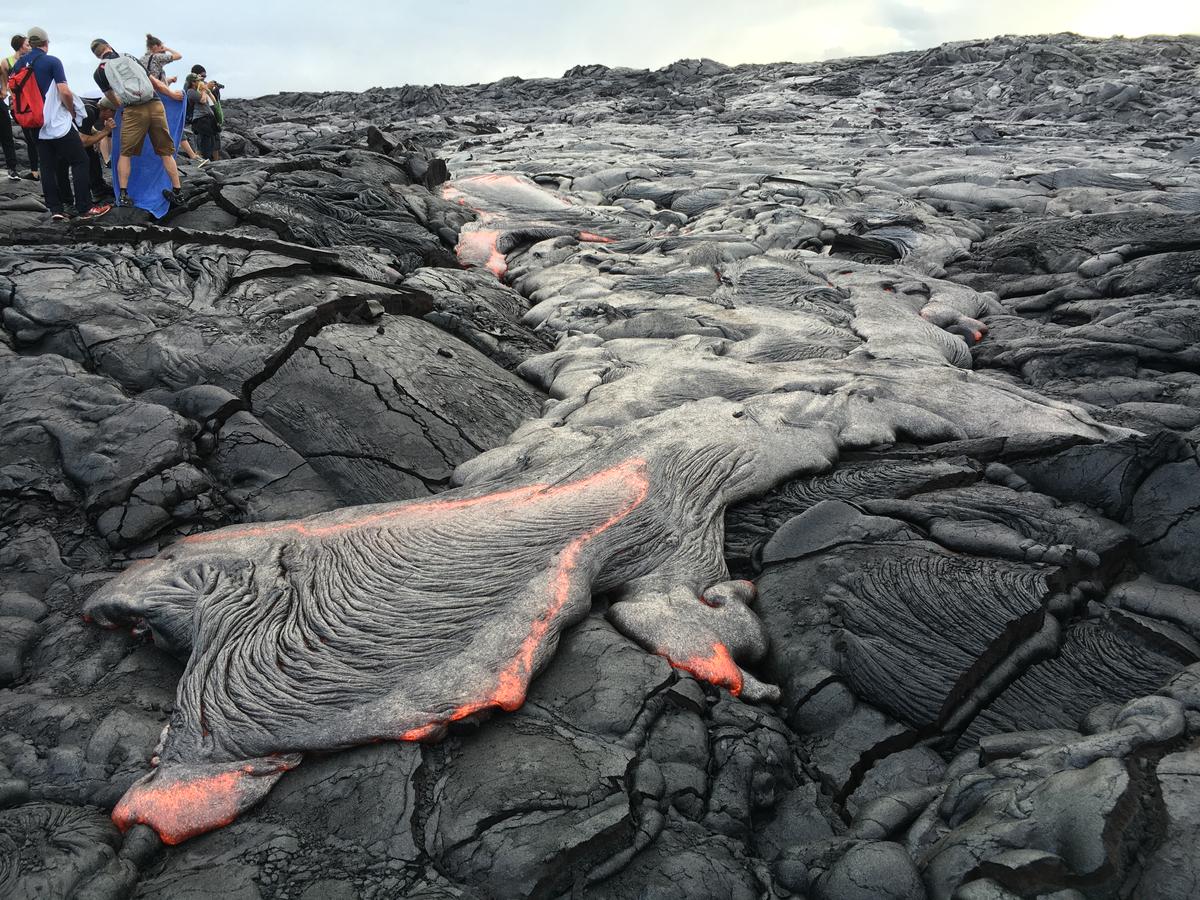
VOLCANO ACTIVITY UPDATES: Kīlauea continues to erupt at its summit and East Rift Zone. This past week, the summit lava lake level varied between about 9 and 34 m (30–112 ft) below the vent rim. The 61g lava flow was still active and entering the ocean near Kamokuna. On Dec. 31, nearly all the eastern Kamokuna lava delta collapsed into the ocean, along with a large section of the older sea cliff east of the delta. Significant hazards are associated with ocean entries and delta collapses, so visitors to the coastal lava viewing area are cautioned to heed all warning signs and to stay outside closed areas. A younger branch of the 61g flow is advancing slowly to the east of Pu‘u ‘Ō‘ō, but none of the 61g flows pose an immediate threat to nearby communities.
     ew small-magnitude earthquakes occurred beneath the volcano, primarily in the upper Southwest Rift Zone and summit caldera at depths less than 5 km (3 miles). GPS measurements continue to show deformation related to inflation of a magma reservoir beneath the summit and upper Southwest Rift Zone.
      No earthquakes were reported felt on the Island of Hawaiʻi during the past week.
      Visit the HVO website http://hvo.wr.usgs.gov for past Volcano Watch articles, Kīlauea daily eruption updates, Mauna Loa weekly updates, volcano photos, recent earthquakes info, and more; call for summary updates at 808-967-8862 (Kīlauea) or 808-967-8866 (Mauna Loa); email questions to askHVO@usgs.gov.
 To read comments, add your own, and like this story, see Facebook. Follow us on Instagram and Twitter.

SPAGHETTI DINNER FUNDRAISER at St. Jude's Church in Ocean View on Friday, Jan. 6 from 6:30 p.m. to 9 p.m. Tickets are $8 for one person or  $15 for two, $20 for a family. 939-7555.

TIMELESS TREASURES, Saturday, Jan. 7 - Feb. 12. Illustrations of Hawaiian folklore by artist Dietrich Varez on display at Volcano Art Center Gallery, daily 9 a.m. to 5 p.m.


www.kaucalendar.com


Wednesday, January 04, 2017

Ka`u News Briefs Wednesday, Jan. 4, 2016


Pesticide buffer zones around schools and hospitals,  and more monitoring of pesticide drift from farms
to waterways and people, are some of the expected proposals at the 2017 Hawai`i Legislature.
Photo from Hawai`i Center for Food Safety
PESTICIDES IN AGRICULTURE will be the focus of a group of health advocates at the 2017 Hawai`i  Legislature, particularly since the courts have held that the state, not the counties, are allowed to regulate pesticides. An Associated Press story this week quoted west Ka`u's state Sen. Josh Green, who plans to introduce a ban on glyphosate, an herbicide used by farmers, gardeners, landscapers and state and county highway crews for weed control. Glyphosate, with brand names like Roundup, Accord, Rodeo, Touchdown, and Glyphosaste 360, was identified by the World Health Organization as a probable carcinogen.
     While the U.N. Food and Agriculture Organization says glyphosate unlikely poses a carcinogenic risk through diet and the U.S. Environmental Protection Agency says glyphosate is of low toxicity to humans, Green, a physician, sees it differently. He said he is concerned with the aerial distribution of glyphosate and other toxic chemicals into the human respiratory system and onto the skin. He said breathing and touching glyphosate and similar herbicides are a risk to health.
Hawai`i Crop Improvement Association supports genetic
engineering and opposes government enforced buffer zones.
Photo from Hawai`i Crop Improvement Association
    "I'm hopeful that we're not going to wait for a bad event and see some terrible sickness in our state," Green told the AP.
     The AP story referred to herbicide use around an elementary school and in seed corn fields where workers became ill,  leading the Environmental Protection Administration to ask a federal judge in December to levy a $5 million fine on Syngenta. The EPA stated Syngenta failed to inform its farm workers in Hawai`i to stay out of fields treated with restricted pesticides. Several workers went to the hospital. "Syngenta allowed or directed workers to enter the treated field before the require waiting period had passed and without proper personal protective equipment. After the workers' exposure, Syngenta failed to provide adequate decontamination supplies onsite and failed to provide prompt transportation for emergency medical attention," the EPA concluded.
      The AP reported on an ongoing O`ahu and Kaua`i study of pesticides in surface water "before and during storms to evaluate if chemicals are moving offsite at unacceptable levels. The state also is planning to triple its fee to register pesticides to fund monitoring and to expand statewide the Kaua`i Good Neighbor Program - in which seed companies on Kaua`i voluntarily report their pesticide use monthly to the state."
Scott Enright, Chair of state Board of Agriculture.
Photo from Big Island Video News
     The AP story said that  "critics say the new programs fall short because reporting is voluntary and because the companies don't disclose the location where the pesticide is sprayed. Requiring companies to report spray locations could be tricky because fields where seeds are tested are generally spread out to avoid cross-pollination and because it's a competitive industry, said Scott Enright, chairman of the state Department of Agriculture." The AP report quoted Enright: "Even though they're doing similar work, Syngenta, Monsanto Dow and Pioneer are all competitors, and they're trying to keep the millions of dollars that the've put in to research the genetics lines that they're developing as confidential business information."
     The Hawai`i Crop Improvement Association, with many of the genetic engineering companies in its membership, objects to the buffer zones and other controls, saying they could hurt small farmers and are an affront to private property rights. The organization's website says that "Genetic changes have helped farmers improve crops in Hawai`i for centuries," and that "Today's seed companies continue that tradition by breeding crops for traits that help farmers achieve their goals, such as drought tolerance, increased yield, pest management or disease resistance."
   At the state legislature this year, proposals are expected to call for herbicide free buffer zones around schools and hospitals. Hawai`i Center for Food Safety director Ashley Lukens, who has given talks in Ka`u, said the genetic engineering industry, with companies like Syngenta, Dow AgroSciences, DuPont Pioneer and BASF, treat their crops with large amounts of pesticides that drift to nearby properties, creating a health risk.
     “It’s high time EPA called out Syngenta’s unethical and illegal practices," wrote Lukens. "The necessity of EPA’s complaint against Syngenta is a tragic reminder that despite federal regulations, our communities and our farm workers risk their lives every day – not to feed our families and country, but for the benefit of chemical companies that care only about their bottom line.
     “We are told time and time again that the pesticide/engineered seed industry in Hawai`i is a responsible user of agrochemicals and a ‘good neighbor’, but even a cursory look at the dismal environmental and public health track records of these companies reveals otherwise. The people of Hawai`i, our food, and our environment deserve so much more than an economy driven by greed.”
      See more at www.staradvertiser.com, www.bettercropshawaii.com and www.centerforfoodsafety.org/hawaii.

     To read comments, add your own, and like this story, see Facebook. Follow us on Instagram and Twitter.

STATE SEN. JOSH GREN hosts a talk story at King Kamehameha Hotel in Kona on Thursday, Jan. 5 from 5 to 7 p.m. to discuss the 2017 Hawai`i Legislature.

The map shows the area that collapsed into the ocean on New Year's Eve. Map from USGS
"HAPPY BIRTHDAY TO PU`U O`O," sang about 250 people celebrating the 34th anniversary of the beginnings of the current eruption. Ranger Dean Gallagher led the singing last night in the Hawai’i Volcanoes National Park auditorium as a prelude to a talk by Dr. Tina Neal, entitled “43 Years and Counting.” Neal is Scientist In Charge of the USGS Hawaiian Volcano Observatory. Her talk was an After Dark in the Park event, which, this month will feature talks on Vulcanology to promote Volcano Awareness Month.
Dr. Tina Neal, Scientist in Charge at 
USGS Hawaiian Volcano Observatory.
     Addressing a packed auditorium, Neal recounted the various stages of the Pu’u O’o eruption, which began Jan. 3, 1983 about 10 miles from the auditorium, and the summit eruption which began about eight years ago about two miles from the talk.
     Neal described the activity of the first three years as “fountaining lava and fast-moving pahoehoe flows, which did not reach the ocean, but rattled windows in the Royal Gardens subdivision.” The next five-and-a-half years saw the creation of lava tubes which provided a conduit for the lava to reach the ocean. “This was the most destructive period,” said Neal. “One hundred-sixty eight structures, mostly homes, were destroyed.”
     From 1992 to 2007, the flows were to the southeast, extending the coastline for 15 years. From 2011 to 2014, the flows were again reaching the coast. June 2014 to March 2015 was a time of crisis when the outbreak on Pu’u O’o’s northeast flank sent lava flowing toward the Kahoe homesteads and Pahoa. One home was burned, the transfer station and cemetery were invaded, and then the lava flow stopped as the supply rate dropped.
Pu`u O`o's flows have amazed onlookers for 34 years.
USGS photo
     From April 2015 to May 2016, the volcano became “pressurized” and the 61g breakouts occurred – one to the north and another to the east. The northern-most lobe dried up as the eastern one got momentum, and by June 23 there was flow activity along the National Park boundary. On July 25, lava crossed the emergency road built in case Pahoa was cut off, and on July 26 lava reached the ocean for the first time since July 2013. The Ka’u Calendar published a Volcano Watch recap of the 2016 activity in this blog dated December 29.
     Neal explained the science behind the dramatic earth-shattering delta collapse of New Year’s Eve, which, fortunately, did not claim lives. She showed a slide of the first collapse, which destroyed most of the new delta, and of the second collapse, which destroyed “old” cliffs and invaded a small part of what had been designated a lava viewing area.
     She also talked briefly about the current summit activity, which began on March 19, 2008 with an explosion that created a vent about 115 feet wide in the Halema’uma’u crater within the Kilauea crater. This vent can be seen from the Jaggar Museum. Neal showed videos of the vent growing from wall collapse.
      Her plans for 2017 at the HVO include installing a radar system to monitor the activity within Halema’uma’u and getting a high-resolution heat sensing camera to monitor the gas plume. Scientists will also create a detailed map of the 61g pahoehoe flow so that they can better predict where flows are likely to go. 

To read comments, add your own, and like this story, see Facebook. Follow us on Instagram and Twitter.

HAWAI`I COUNTY COUNCIL MEETINGS,  Thursday, Jan 5 at 9 a.m. Ka`u residents can participate via videoconferencing at Na`alehu State Office Building. See hawaiicounty.gov for agendas and live-streamed and archived meetings.

OCEAN VIEW NEIGHBORHOOD WATCH MEETING, Thursday, Jan. 5 at 7 p.., Ocean View Community Center. 939-2442 and 928-2015.


Tuesday, January 03, 2017

Ka`u News Briefs, Tuesday, Jan. 3, 2017

Eruption crew rangers Rob Ely and John Moraes mark the closed area at the coastal cliffs with a white rope line.
  NPS Photo/Janice Wei
A NEW LAVA VIEWING AREA AT KAMOKUNA was established by park rangers on Tuesday, following the large lava delta collapse on New Year’s Eve. The new lookout is approximately 900 feet east of a cascade of lava pouring into the ocean, and about 60 feet inland of the coastal cliffs. Hawai`i Volcanoes National Park rangers, in conjunction with USGS Hawaiian Volcano Observatory scientists, thoroughly assessed the area, and established the new viewing site with white rope lines and numerous signs that clearly mark hazardous closed areas.
    Visitors are strongly urged to stay out of closed areas and heed all posted warning signs and park rangers.
New lava cascade at Kamokuna in Hawai‘i Volcanoes National Park on
Monday, Jan. 2. NPS Photo/J.Ferracane
    “Visitors who do not heed warnings not only endanger themselves but the lives of others, including our park rangers, who work tirelessly to ensure a safe visitor experience,” said Park Superintendent Cindy Orlando.
    After the delta collapse on New Year’s Eve, a group of five visitors ignored rangers and warning signs and slipped beneath the white rope lines into a closed area at the coast. Two park rangers had to chase after them, and made them turn around – 15 minutes before the area they were standing on collapsed into the ocean.
    In addition to the threat of another land collapse, the toxic plume of volcanic particles and acidic gas generated by lava mixed with ocean water is very dangerous, and irritates the lungs, skin and eyes. Land collapses, which trigger tsunami-like waves, and the toxic gas plume, are also a serious threat to aircraft and boats. There is currently a 1,000-foot above-ground-level temporary flight restriction at Kamokuna.
    HVO scientists estimate that nearly all of the 26-acre lava delta is now gone, along with more than four acres of older coastal cliff area, which included the former lava viewing site. The collapse on New Year’s Eve started in the afternoon and lasted several hours, creating blasts of volcanic rock and a series of damaging waves, in addition to a thick, dark plume of debris and gas.
Visitors begin the five-mile hike to Kamokuna shortly after the
 park opened the lava viewing area on Tuesday, January 3, the
34th anniversary of the eruption of Pu‘u ‘Ō‘ō vent on Kīlauea,
the source of the lava flows going into the ocean today.
  NPS Photo/Janice Wei
    It is closer from the east entrance to reach the new lava viewing area within Hawai‘i Volcanoes National Park. From the east, or Kalapana/County of Hawai‘i side, visitors must hike about 4.2 miles one way along the gravel emergency access road. This entrance is open daily from 3 p.m. to 9 p.m. From the park, or west side, visitors can hike out from the Coastal Ranger Station at the end of Chain of Craters Road, about five miles one-way. About one mile of the hike goes inland of the gas plume over hardened, uneven lava flows. The park entrance is open 24 hours a day.
    Hikers need to be prepared for a long trek. Wear sturdy closed-toe shoes or boots, gloves to protect the hands, and long pants to protect against lava rock abrasions. Carry plenty of water (three to four quart/liters per person). Wear sunblock, sunglasses and a hat. Visitors who plan to stay after dark need a flashlight and/or headlight with extra batteries.
    For hiking tips, visit the park website https://www.nps.gov/havo/planyourvisit/upload/Hiking-Tips.pdf. For County of Hawai‘i Lava Viewing information, call (808) 430-1966. For the latest eruption updates, visit the USGS Hawaiian Volcano Observatory website: http://hvo.wr.usgs.gov/activity/kilaueastatus.php. Monitor air quality at http://www.hawaiiso2network.com/.

A FLOAT NAMED SPIRIT OF HAWAI`I took top prize in the 2017 Tournament of Roses Parade on Monday. The annual Tournament of Roses Parade in Pasadena, CA. was attended by about 700,000 people and viewed on television by about 70 million. It was held on Jan. 2, since the traditional New Year's Day parade date fell on a Sunday.
     The float featured a 10-foot tall sculpture of King Kamehameha, an erupting Hawai`i Island volcano, four waterfalls utilizing 2,000 gallons of recycled water, and floral sculpted animals including parrots, sea turtles and geckos decorated in tropical flowers. Fruits featured on the float were provided by Dole Packaged Foods, including bananas, pineapples, and mangoes. The float was 55 feet long, 18 feet wide and over 28 feet tall.
Spirit of Hawai`i took first place in the Tournament of Roses Parade in
Pasadena, CA on Monday.
    In a statement, the company said “Dole is proud to announce its 2017 Rose Parade float, "Spirit of Hawaii," took home the coveted Sweepstakes Trophy for this year's Tournament of Roses Parade for its outstanding floral presentation and design. Dole has received much recognition from the Tournament, holding the Rose Parade record for most Sweepstakes Trophy wins, having won the award six out of the seven times it has participated.”
     Spirit of Hawai`i celebrates Dole Packaged Foods' origins in Hawaii in 1899. The company is currently based in California. The float featured non GMO fruits, showcasing Dole’s “commitment to preserving natural resources around the world”.

A BILL RELATED TO AGRICULTURAL TOURISM goes before the County of Hawai`i's Windard Planning Commission on Thursday, Jan. 5 at the Aupuni Center Conference Room, 101 Pauahi Street in Hilo. The bill aims to define "agricultural tourism" and include new definitions for "agricultural products" and "agriculturally related products." It also would define requirements for plan approval review and regulation for ag tourism operations. Agricultural tourism is considered a way to promote Hawai`i agriculture and subsidize farmers who face a high cost of doing business in Hawai`i. It has also been a cause for concern in some neighborhoods where tourists cars line the neighborhood roads.
Visiting the drying floor of Ka`u Coffee Mill would be an example of acceptable
agricultural tourism, according to the newly proposed regulations.
  Photo from Ka`u Coffee Mill
    The proposed measure says that, "Agricultural t tourism means visiting an agribusiness, horticultural, aquacultural or agricultural operation that is managed by the owner or by an operator resident at the subject property for the purpose of recreation, education, or active involvement in the operation, other than as a contractor or employee of the operation, and includes the sale of agricultural products and agriculturally-related products. The term agricultural tourism does not include educational tours sponsors and conducted by public or private schools located within the County."
     The proposed legislation also says, "Agricultural products means the commodities resulting from income producing activities or uses such as the cultivation of crops, including but not limited to flowers, vegetables, foliage, fruits, forage, and timber; apriary activities, including but not limited to royal  jellly, bee pollen, and beeswax; farming or ranching activities or uses related to animal husbandry, aquaculture, or game and fish propagation; and production of compost or mulch.
     The bill describes two types of operators:
     Agricultural tourism major "means an agricultural tourism operation that qualifies to host between five thousand and thirty thousand visitors annually."
A visit to Earth Matters farm to see organic agriculture in on South
Point Road  would be another example of agrotourism.
Photo from Earth Matters
     Agricultural tourism minor "means an agricultural tourism operation that qualifies to host less than five thousand visitors annually."
     Agricultural tourism major requires plan approval prior to operation. Both major and minor operations require approval prior to construction or installation of any new structure and for any addition to that exceeds ten percent of the existing structure.
        Plan approval applications require such information as whether there will be visits by buses and the carrying capacity of the busses, proof of adequate on street or off street parking, loading, unlaoding and turn around space, adequate legal acces to a public highway, and a plan for vehicular and pedistrian access ways. 
     Ag tourism revenue cannot exceed the revenue that comes from the agricultural enterprise, the legislation states. If the farm or ranch shuts down, so does the related ag tourism, the bill states.

HAWAI`I COUNTY COUNCIL MEETINGS, Wednesday and Thursday, Jan 4 and 5 at 9 a.m. Ka`u residents can participate via videoconferencing at Na`alehu State Office Building. See hawaiicounty.gov for agendas and live-streamed and archived meetings.

OPEN MIC NIGHT, Wed. Jan. 4 from 6 p.m. to 10 p.m. at Kilauea Millitary Camp's Lava Lounge in Hawai`i Volcanoes National Park. Singers, bands, comedians are welcome. Open to authorized patrons and sponsored guests. Park entrance fees apply. 967-8365 after 4 p.m.

OCEAN VIEW NEIGHBORHOOD WATCH MEETING, Thursday, Jan. 5 at 7 p.., Ocean View Community Center. 939-2442 and 928-2015.