About The Kaʻū Calendar

Wednesday, March 01, 2017

Ka`u News Briefs Wednesday, March 1, 2017

New interpretive signage for the famed Ka`u footprints shows the area well traveled in the 1700's by Hawaiian families
 trading and visiting. While walking through Ka`u, wet ash rained down and their footprints became frozen in time.
 Painting by John Dawson
THE FAMED KA`U FOOTPRINTS were likely left in the 1700’s by Hawaiian families traveling between Ka`u and Puna, rather than by warriors caught in volcanic ash raining down on the Ka`u Desert. That is the new evidence from the footprints with new educational displays accessible from Manu Iki trail in Hawai`i Volcanoes National Park. The trailhead is makai of Hwy 11 between Pahala and Volcano, between mile markers 38 and 39.
Ranger Jay Robinson feels the texture of the famous Ka'u footprints on the life-size
model, which weighs over 300 pounds. It was created by Joh Geigle from photos
and measurements of the real footprints. It was brought to the shelter by 
helicopter last month. Photo by Ann Bosted
   The new signage is illustrated by artists John Dawson and Kathleen Kam. Dawson is known for his wildlife paintings at Hawai`i Volcanoes National Park Visitors Center, on U.S. postage stamps, and in galleries. Kam is known for her wildlife and cultural murals at Ka`u High School, Ka`u Coffee Mill, Keauhou Bird Refuge, Volcano Store, Kamehameha School and in Hilo.
     One illustration for the footprints shows people traveling along a trail and suddenly being covered with wet ash. The footprints may have been left during two separate ash-falling events in the 1700s.
     Near the trail, the park has installed a model of footprints themselves. This prevents visitors from touching the actual Native Hawaiian footprints that were were made in wet ash – not lava - during eruptions from Kīlauea in the 1700s. Hawai`i Volcanoes National Park replicated the footprints and visitors can touch the life-size model in order to appreciate them. In addition, several interpretive signs are added to the first quarter mile of the Mauna Iki trail that goes to the footprints, as well as a historic shelter.
     Park Ranger Jay Robinson and park volunteer George Jensen were installing interpretive signs along the trail last month. Jensen explained that these are the final touches in a long project that  included placing interpretive signs and displays in a structure built by the Civilian Conservation Corps in 1941.
      “The stone protective shelter was originally conceived as a way of conserving some outstanding examples of very old Hawaiian footprints, that were created in freshly fallen wet ash,” explained Jensen. Robinson added that park rangers were able to look at photos of the original protective shelter and restore or mimic many of the original features, but not the original catchment-fed water fountain, which does not conform to modern health standards.
A footprint made in wet volcanic ash in 1790. likely by a male adult. It is one 
of 1,773 separate footprints belonging to at least 400 individuals that have been
 documented by NPS archeologists, led by Dr. Jadlyn Moniz-Nakamura. 
Photo by Ann Bosted
    “Protecting the trail’s highlight, the actual preserved footprints, required a completely new approach that would allow them to be viewed, yet not disturbed,” explained Robinson. A newly designed A-frame protective cover was set on a stone wall that dates to 1941. Three glass panels on one side now allow the public to peer in and look down to the ground and see some of the original footprints.  “The glass
ensures that visitors can see, but cannot touch the actual footprints in the ground,” explained Jensen.
     On the other side is the 300-pound model of the footsteps, created, from photographs and measurements of the footprints. Here, one can look at the exact replica and also touch without destroying the original footprints. This model had to be flown in by helicopter, as the historic shelter is now in a designated wilderness area, so closed to vehicles, including wheelbarrows, which can cause damage. There are three original cabinets for interpretive signs in the shelter, plus space for two new signs near the model. Two of the glass doors were restored by park carpenter Daniel Patao, then all the wood was repainted, making the shelter look as good as new.
     Robinson, who has fielded many questions from visitors, explains: “It just seems like for years ­we had gotten just about everything wrong about the footprints. First of all, the footprints were not made in hot lava! That’s just impossibly crazy! They were made in cool wet ash that quickly hardened like concrete. Secondly, most of the footprints were not made by Keōua’s army. And third, the footprints are along a very busy trail that connected Ka‘ū to Hilo and Puna. There were really a lot of people caught out there in a couple of pretty nasty eruptions. They survived and are the ancestors of many of my Ka‘ū friends, which explains a lot about why they are so tough today.”
     The most recent set of footprints were created in 1790 when Kīlauea erupted violently, covering all the land around with one to two inches of wet ash. This event was well documented in Hawaiian oral tradition, and was called Keonehelelei, the Falling Sands. Sand and small, pellet-sized ash were embedded in this ash layer before it hardened. While small and harmless looking, after falling from perhaps several miles high, they would have been extremely painful to encounter.
The explosion of ash that rained down on Ka`u not only left footprints, it
injured and killed many people. Illustration by John Dawson
     This, however, is not the same ash layer that is enclosed under the glass. Hawaiian Volcano Observatory geologist, Don Swanson, has discovered that a similar terrifying event took place some decades earlier. The mountain erupted violently, spewing wet ash, on an earlier generation of island residents, immortalizing their footprints on this popular trading route. Again, there are large, man-size prints, others that were likely women, and even smaller prints from children traveling along-side their parents.
     Park archeologists, led by Dr. Jadelyn Moniz-Nakamura, have documented 1,773 separate footprints belonging to at least 400 individuals. A layer of gritty black sand can be found below, above and between the two layers. It is likely that the sand erupted from Kīlauea during the caldera collapse of around 1500. As the winds blew the older sands around, they buried much of first ash layer before the second layer fell in 1790 – in some places it is thick, and in others it is non-existent. Today, as the layers erode, the relentless winds of Ka‘ū continue to blow the sands, sometimes covering the footprints, and sometimes revealing them.
One of the many interpretive panels explaining the power of the volcano and
the raining ash that helped form the footprints.
Illustration by John Dawson
     When the footprints were first discovered by Ruy Finch of the Hawaiian Volcano Observatory in 1919, they were thought to be made by the army of Keōuakū‘ahu‘ua, the great war chief of Ka‘ū. As they were returning home from Hilo, they passed near the summit of Kīlauea during an extremely violent eruption. One third of the warriors (as many as 400 people) perished in a scalding pyroclastic surge that swept across them with hurricane force winds. With his army diminished by Pele’s wrath, Keōua never stood to fight again. Within a year he was sacrificed by Kamehameha at the dedication of Pu‘ukoholā Heiau.
    “The theory that they were all from Keōua’s army is now considered incorrect as the footprints were not made by people running or even hurrying,” said Robinson. “The footprints show their makers were walking both mauka and makai on a busy trail. Some footprints are made by people walking east and west. Both sets of prints – those made in 1790 and the sets made decades earlier – involve a similar mix of travelers - mostly men, but nearly half were women and children.”
    The exhibit artist John Dawson wanted to know what the wet dripping ash would look like. Robinson used himself as a Guinea pig. He mixed ash with water in a bucket and then dripped it over himself. He reported “at first it was cold, heavy, and got into your ears, eyes and other places that were uncomfortable. Most amazingly we found that in less than a 20 minutes, the wet ash had hardened and was unable to take any foot prints. We figured that the preserved footprints were likely made in just a few hours.” Where layers of ash are exposed along the Mauna Iki and Ka‘ū Desert Trails today, they have a rock-like hardness. “For so many footprints to be made in so short a time, the islands population of must have been large,” explains Robinson. (These ash layers are not to be confused with the far thicker and heavier Pāhala ash layers which are from around 16,000-31,000 years ago).
     The self-experiment has got Robinson wondering. “I’ve spent many hours just sitting out there near different sets of footprints and thinking about who made them and what they must have gone through. I mean, hundreds and hundreds of people were caught in what must have been absolutely terrifying eruptions. Just imagine, daylight turns to night as dark clouds crack with lighting and dump cold mud on you. Then as things just start to look up, rocks and sand begin falling. Those people must have all survived to have left so many footprints, but what a horrible day . . . and it will probably happen again someday ”.
     Now that the protective shelter has been hung with new, lavishly illustrated interpretive panels explaining the footprints, Robinson and Jensen, are erecting interpretive panels along the Mauna Iki trail to explain to visitors the significance of features they are looking at. Two panels explain an epic, but often forgotten, battle fought between the armies of Keōua and Kamehameha in the story of Kaua ʻo Kauaʻawa, the bitter Battle of the ʻAwa Rain. An additional exhibit is set further along the trail near a huge lava ball. The panel explains how lava balls form (they get bigger as they are turned by the flowing lava, in much the same way as snowballs grow) and where they come from.
George Jensen, a long-time National Park Service volunteer, hikes along Mauna Iki
 Trail toward a new interpretive exhibit that he and Ranger Jay Robinson installed. 
Photo by Jay Robinson
 Between the last panel and the shelter, hikers using the Mauna Iki trail make an abrupt change from hiking past younger ‘a‘ā lava from Mauna Loa (200 – 400 years old), to the lower, smoother, pāhoehoe flow from Kīlauea (400 – 750 years old). The Mauna Iki trail can be accessed from the Ka`u Desert Trailhead on Hwy 11, 9.2 miles from the park entrance to Kilauea crater in Volcano. There is pull out parking on the side of the road between mile markers 38 and 39. There is no charge for hiking the trail.
     With the improvements by Hawai‘i Volcanoes National Park, hiking in the Ka’ū Desert is further enriched as a learning experience with appreciation of the ancestors of the people of Ka‘ū.


PRESIDENT DONALD TRUMP'S Joint Address to Congress on Feb. 28 drew the following statement Tuesday evening from the U.S. Senator representing Ka`u. Mazie Hirono: wrote: "With this President, I pay attention to what he does more than what he says because in his first month in office, Donald Trump's actions have not lived up to the clichés he delivered tonight.
      "He stands by executive orders that have spread fear and chaos throughout the country. Tonight he called for repealing the Affordable Care Act and replacing it with rhetoric. He also clearly called for school vouchers, and in this he has the right Education Secretary who does not believe in public education. For all his rhetoric about national security and American interests, he had absolutely nothing to say about getting to the bottom of Russian interference with our democracy. No matter what the President said tonight, I remain resolved to resist his dangerous, divisive actions."  
      On Wednesday morning, Hirono focused on her introduction of Senate Resolution 70, marking the 75th anniversary of the issuance of Executive Order 9066, which led to the internment of more than 120,000 Japanese Americans during World War II. "S.Res.70 affirms that policies that discriminate on the basis of actual or perceived race, ethnicity, national origin, or religion would repeat the mistakes of the internment."
After Pres. Donal Trump's remarks on immigration during his talk to congress, Sen.
Mazie Hirono pointed to what happened to the Japanese in camps on O`ahu (above)
and at Kilauea Military Camp during World War II.
     Said Hirono, “The President can continue to live in a world of alternative facts, but it’s clear that his administration’s policies harken back to the hateful rhetoric that led to the internment of Japanese Americans. This internment of Japanese Americans was deeply wrong, and it set a precedent – that it should never happen again. We will resist any and all attempts that take us back to this dark era.”
     Japanese Cultural Center of Hawai`i president and executive director Carole Hayashino wrote, “We stand with Senator Hirono and pledge our commitment to honor the memory of the Japanese Americans incarcerated from Hawai‘i simply because of their ancestry. Whether our wartime imprisonment was a result of martial law or executive order, the government action was based upon ‘race prejudice, war hysteria, and a failure of political leadership.’ May we never repeat the mistakes of the past.”
      National Council of Asian Pacific Americans National Director Chirstopher Kang wrote, "It has been 75 years since our nation succumbed to fear and shamefully incarcerated 120,000 Japanese Americans. Today, as we sit at a similar precipice in history, we must not forget the lessons of the past. We must continue to speak out and force our leaders to recognize the harms to our immigrant, refugee and Muslim communities from recent discriminatory policies and executive orders."
More than 120,000 Japanese Americans were
interned in WWII.
      Muslim Advocates staff attorney and Head of Program to Counter Anti-muslim Hate, Madihha Ahussain, wrote: "As President Trump attempts to write anti-Muslim bigotry into law, we are reminded of another very dark time in our country's history when race was used as the basis to intern thousands of Japanese Americans. We cannot allow prejudice to divide our communities during this time of concern."
     The resolution is supported by more than 30 organizations including: the American Bar Association, American Civil Liberties Union, Council on American-Islamic Relations, Demand Progress, Democracy for America, the Fred T. Korematsu Institute, the Japanese Cultural Center of Hawai`i, the National Asian Pacific American Bar Association, the National Council of Asian Pacific Americans, the Japanese American Citizens League, South Asian Americans Leading Together, the Sikh American Legal Defense and Education Fund, Muslim Advocates, the Shoulder to Shoulder Campaign, and the Sikh Coalition. Click here to download a copy of the resolution.

PROTECTING MEDICARE, MEDICAID AND SOCIAL SECURITY is the aim of a letter sent to Pres. Donald Trump today from 16 U.S. Senators including Mazie Hirono. They urged the President to keep a campaign promise to protect Social Security, Medicare, and Medicaid from drastic cuts and privatization. The Senators’ letter called on the President to issue a public statement saying that he would not sign legislation that makes significant changes to Social Security, Medicare, and Medicaid through the reconciliation process, and to issue official guidance making clear the President’s support for these programs.
     The letter asserts to Trump: "Your appointment for Secretary of Health and Human Services, Tom Price, has authored proposals that would undermine the hard-earned, guaranteed benefits of Medicare by privatizing the system and ending Medicare as we know it. Price has also supported plans to make significant cuts to Medicaid, which would weaken the vital support it provides. As The Washington Post reported after his confirmation hearing before the Senate Health, Education, Labor, and Pensions Committee, Trump has pledged not to cut Medicaid or Medicare, but Price did not do the same.’
     “Simply put, the stakes of rushed, ill-conceived, or ideologically-focused changes to Social Security, Medicare, and Medicaid on the lives and security of American families are too high to be left ambiguous, particularly as you and our Senate colleagues seek to pursue legislation related to health care.”
     In January, Senators Hirono and Joe Donnelly led an amendment to protect Medicare and Medicaid from drastic cuts through the budget reconciliation process.


Open Mic Night, Wed, Mar 1, 6 – 10 p.m., Kīlauea Military Camp’s Lava Lounge in Hawai‘i Volcanoes National Park. Open to authorized patrons and sponsored guests. Park entrance fees apply. Sign up at 967-8365 after 4 p.m.

Ocean View Neighborhood Watch meeting, Thu, Mar 2, 7 p.m., Ocean View Community Center. 939-2442 & 928-2015.

Stewardship at the Summit, Mar 3, 10, 18, 25 & 31; 9 a.m. – 12 p.m., Kīlauea Visitor Center in Hawai‘i Volcanoes National Park. Volunteers clear ginger from park trails. Free; park entrance fees apply. nps.gov/havo.

Girl’s Day Doll Craft, Fri, Mar 3, 2 – 3 p.m., Kahuku Park. Ages 6 – 12.
Register Mar 1/2. 929-9113.


Tuesday, February 28, 2017

Ka`u News Briefs Tuesday, Feb. 28, 2017

Janiece McNichols, Chief Financial Officer for East Hawai`i Region; Sherrie Bazin, Director of Nursing for
Ka`u Hospital; Barry Taniguchi, East Hawai`i Regional Board member; and Dan Brinkman, Chief Executive
Officer for the East Hawai`i Regional, view the lana`i and learn about Ka’u Hospital Charitable
Foundation’s fundraising project to add enhance the garden lanai. See story below.
IN ADVANCE OF PRES. DONALD TRUMP'S ADDRESS TO CONGRESS, broadcast Tuesday at 4 p.m., Hawai`i time, Ka`u's Representative in the U.S. House, Tulsi Gabbard, sent out a message:
     "Like many of you, I’m deeply concerned about the fundamental principles we hold dear, including protecting the environment and our precious water supplies, protecting civil liberties, protecting and expanding affordable healthcare, ending counterproductive regime-change war, ensuring protections for vulnerable refugees and reforming campaign finance so that our democracy isn’t overshadowed by the vast financial interests of billionaires and corporate elite."
     Gabbard stated: "There is an age old strategy that is being waged today on the minds of the American people: divide and conquer. So long as we are fighting amongst ourselves, stoking disdain and resentment against our fellow citizens, we cannot unite against the powerful oligarchy that has wielded disproportionate influence to the detriment of everyday Americans.
Rep. Tulsi Gabbard released a statement on protecting the environment and "precious
water supplies," ahead  of Pres. Donad Trump's first speech to Congress, and after
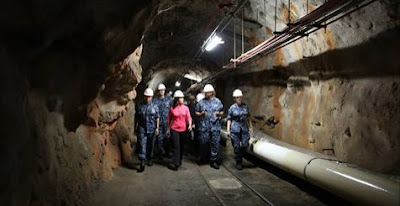
she visited the Navy's Red Hill Bulk Fuel Storage Facility on O`ahu. Gabbard and
the Hawai`i congressional delegation have introduced legislation to help protect the
aquifer from leaks at Red Hill. Photo from Tulsi Gabbard 
     "Those who seek to maintain the status quo don't want us to take action to create will change.
    Gabbard concluded:  "What’s happening in Washington is not a true reflection of what’s going on in our communities. There is so much that the vast majority of Americans share in common. We are tired of watching trillions of dollars of taxpayer money disappear on counterproductive regime change wars in the Middle East that cause great human suffering and strengthen terrorist groups like al-Qaeda and ISIS. We are tired of being exploited by multinational corporations who have no care for our communities. We are tired of chasing an American Dream pushed farther and farther out of reach by fraud and corruption on Wall Street."
     Gabbard stated that she remains "committed to bringing the voice of the people back into government -and that voice is calling for peace, an end to political and corporate corruption and a fair shot at the American dream. We are all in this together."
      Trump's first speech to Congress since his inauguration was scheduled to be broadcast live on television and internet beginning at 4 p.m. Hawai`i time.

To read comments, add your own, and like this story, see Facebook. Follow us on Instagram and Twitter.

"BUSINESS IS BOOMING IN OUR NATIONAL PARKS," said Sen. Mazie Hirono, addressing the U.S. Senate on Tuesday, as she expressed concern for Pres. Donald Trump's nominee Ryan Zenke to run the Department of the Interior. Hirono, who sits on the Energy and Natural Resources Committee, pointed out that National Parks nationwide hosted more than 305 million visitors in 2015, a new record, generating $17 billion in economic activity in nearby communities. Even with record numbers of visitors, however, sequestration and a hiring freeze have led to 10 percent fewer rangers and support staff than five years ago. Hirono warned that the Trump administration's new 90-day hiring freeze threatens "nearly 2,000 permanent vacancies that are critical to helping our National Parks function." Hirono also pointed out that despite the National Parks' popularity and economic benefits, there are 12 billion dollars in deferred maintenance at the National Parks.
    "We need an Interior Secretary capable of standing up to the President to make preserving our public lands a priority," she proclaimed on the Senate floor. She said her interviews with Zenke and his record did not give her the assurances that would allow her to vote for him.
Sen. Hirono with Ka`u Learning Academy students and ranger at Hawai`i Volcanoes
 National Park. NPS Photo by Janice Wei
     Hirono said she is also concerned about Zenke's view on the federal Land and Water Conservation Fund, which has been used to help acquire coastal lands in Ka`u for conservation. She called it "an important fund to add protective lands to parks." Hirono said she would like to see permanent funding for the Land and Water Conservation Fund, saying it has suffered from chronic underfunding during its history.
     She also said she is concerned about whether Zenke will be committed to supporting alternative and renewable energy, which she called "important to Hawai`i people." Hirono said she believes that the Trump administration and Zenke are "too wedded to the fossil fuel industry."
     The U.S. Geological Survey is another concern of Hirono's. She noted that "USGS lists climate change as one of its top mission areas." Would Zinke try to limit climate change work at USGS?  Would he commit to allowing "USGS to continue to make climate change research a priority or to protect the right of these scientists to pursue their research without interference?" Hirono said she worries about the "Trump administration's ongoing efforts to silence our federal workers, including those within the National Park Service for speaking out about the threat of climate change." She characterized the Trump Administration as being "full of climate deniers."
       Concerning endangered species, Hirono stated that as a congressman, Zenke voted to block funding for any listed endangered species for which the U.S Fish & Wildlife Service failed to conduct a five-year review. She said incompletion of reviews was caused by cutting necessary funds. Said Hirono, "Cutting funding in this way would devastate conservation and recovery efforts for  as many as 850 species across the nation, 137 of which are in Hawai`'i."
    Hirono quoted a Big Island constituent who called Zinke "a destroyer, not a fixer, not someone for the environment or the people." Zenke's  interest in oil pipelines creates a conflict of interest and could could help move exploration and extraction into formerly closed to exploitation, the constituent wrote.

To read comments, add your own, and like this story, see Facebook. Follow us on Instagram and Twitter.
     
OFF THE SHELF IS TWO-PERCENT REDUCED FAT MILK from Meadow Gold Daries, following the state Department of Health issuing a cease and desist order on Monday. Lab tests showed coliform bacteria exceeding acceptable limits. A statement from the DOH sanitation branch said state inspectors are working with Meadow Gold to trace the source of the contamination, correct it and conduct more tests until standards are met to resume sales.

EAST HAWAI`I REGIONAL BOARD, the governing body of Ka`u Hospital and Rural Health Clinic, Hilo Medical Center, Hale Ho`ola Hamakua in Honoka`a, and eight other specialty clinics, held a public forum last Saturday, Feb. 25.
     In Ka`u Hospital’s multipurpose day room, members of the community gathered to learn about developments in clinical services, finances and strategic priorities for healthcare in the East Hawai`i Region.
Born in Ka`u Hospital, Rae Yamanaka joined the East
Hawai`i Regional Board last year.
Wayne Kanemoto, Board Member, admires the new clinic
area made ADA compliant by carpentry talents
of Ka`u Hospital's Jay Taganas.
     Merilyn Harris, Administrator for Ka`u Hospital and Rural Health Clinic, shared updates on services and personnel at the hospital. She emphasized that the primary goal of the hospital was to provide quality health care services close to home.
     “One of the most notable developments at our hospital has been a transition with new nursing staff mainly due to retirements,” said Harris. “Within the last year, we also welcomed an innovative Director of Nursing, Sherrie Bazin, who really wanted to set down roots in Ka`u and care for the community.”
     After experiencing some transition in primary care providers, the Ka`u Rural Health Clinic staff has stabilized with Dr. Sarah Howard joining nurse practitioners Susan Field and Megan Lewis.
New patients are being accepted and may call 932-4205 for an appointment. 

TAKING CARE OF THE DIETARY HEALTH of patients and staff at Ka`u Hospital is an opportunity for a Ka`u resident needing full time work. Keone Grace, Morgan Dacalio and Stephanie Kawa`auhau could use a hand in the kitchen at the hospital. Breakfast, lunch and dinner are made daily for long-term residents, patients and those who work at Ka`u Hospital and its Rural Health Clinic.
     According to Hospital Administrator Merilyn Harris, "It is a good job for someone local to the area."
     While a formal education is not required, the employee must have knowledge of preparation of raw and processed food to be cooked; methods, materials, and tools used in cleaning kitchen equipment, appliances and utensils; kitchen safety and sanitation; requirements and personal hygiene.      The employee must have the ability to learn quantity cookery; operated kitchen equipment and appliances; measure food servings and serve food: give and receive oral and written instructions; work cooperatively with others, tolerate kitchen heat and noises; and perform heavy lifting, moving and carrying.
     To apply, find more information and an application on line at www.kauhospital.org

To read comments, add your own, and like this story, see Facebook. Follow us on Instagram and Twitter.


Open Mic Night, Wed, Mar 1, 6 – 10 p.m., Kīlauea Military Camp’s Lava Lounge in Hawai‘i Volcanoes National Park. Open to authorized patrons and sponsored guests. Park entrance fees apply. Sign up at 967-8365 after 4 p.m.

Ocean View Neighborhood Watch meeting, Thu, Mar 2, 7 p.m., Ocean View Community Center. 939-2442 & 928-2015.

Stewardship at the Summit, Mar 3, 10, 18, 25 & 31; 9 a.m. – 12 p.m., Kīlauea Visitor Center in Hawai‘i Volcanoes National Park. Volunteers clear ginger from park trails. Free; park entrance fees apply. nps.gov/havo.

Girl’s Day Doll Craft, Fri, Mar 3, 2 – 3 p.m., Kahuku Park. Ages 6 – 12.
Register Mar 1/2. 929-9113.


Monday, February 27, 2017

Ka`u News Briefs Monday, Feb. 27, 2017

Bolo, who is known for his annual presence at the Ka`u Coffee Festival, and Kahikina Ching drum up support for the
annual Feed-A-Thon, which raised over 73,000 lbs in edibles. Photo from Food Basket
GEORGE YOKOYAMA, well known in Ka`u for his work with Hawai`i County Economic Opportunity Council and the dedication of his life to serving the cause of fighting poverty, was recently remembered at the Hawai`i Legislature and at services last week. He is the author of the book Memoir of a War on Poverty in Paradise, published in 2015, and available on Amazon and other outlets.
George Yokoyama remembered at the Hawai`i
Legislature. Photo from Sen. Kai Kahele
     Yokoyama, who died at 90 on Jan. 22, raised close to $100 million in state and federal grants for Hawai`i Island in over 45 years. Pahala resident Anna Cariaga worked with Yokoyama and HCEOC for more than 30 years and praised his work in providing housing and electricity assistance for low-income people and for raising money and organizing volunteers to build clubs for youth and seniors. He was a grassroots political and volunteer organizer, who continued his grant writing and other services at the HCEOC office in Hilo until his health finally failed him, she said.
      On the floor of the Hawai`i Legislature, Sen. Kai Kahele called Yokoyama "a champion for the underprivileged, the elderly, the disabled. He was such a fantastic individual." Kahele described Yokoyama  exemplifying that "one person can make a difference; one person can change the world. He was a big idea type of guy and wouldn’t take no for an answer.”
      Yokoyama worked through Office of Economic Opportunity, a nationwide initiative of Pres. Lyndon Johnson’s War on Poverty. The local program later became Hawai`i County Economic Opportunity Council. 
      An HCEOC colleague of Yokoyama, Mary Miho Finley, of Volcano, remembered Yokoyama growing programs out of need for youth activities. “There was nothing for the kids or young people in those days,” Finley said. She recalled Yokoyama challenging them, from Na`alehu to Ocean View. “What do you want?” he asked, after police chased them from gathering at the shopping center and parks.  Finley remembered more than 150 youth, from eight years old to high school, asking Yokoyama for a place of their own. Yokoyama told them, "You will have to mobilize resources to make this happen."
     He helped them look for opportunity and it arose when Punalu`u resort developers planned to demolish an old gentlemen’s clubhouse and offered to give the building to the youth. Yokoyama taught the youth how to coordinate and make it happen: Ka`u Sugar provided land in Na`alehu and Jobs Corps trained the young people with skills to help fix up the building. Kilauea Military Camp and Ka`u Sugar trucks moved the pieces of the building to what is now Na`alehu Park.
Anna Cariaga worked side by side with George Yokoyama to
fight poverty in Ka`u and beyond. Photo by Julia Neal
      HPM donated building plans and prepared building permits. Atherton and McInerny foundations and Hilo Kiwanis donated funds. Tommy Ishimaru donated construction of the cesspool. Na`alehu Community Club donated a kitchen sink and pool and ping-pong tables. Community members like the Beck `Ohana, the Kailiawas, Pilipo Kenoi, Adolpho Pascubilio and Joe Tassill helped out. Youth from Keaukaha, Laupahoehoe and Honoka'a traveled to Ka`u to volunteer. 
     In Pahala, Yokyama and his Ka`u team operated the HCEOC office at an old store building in the old sugar mill camp.
     During the recent services for Yokoyama, friends remembered that he could always turn ideas into people coming together to make them happen. They also remembered that while young people were involved in building and using their own club, police reports confirmed that crime went down. 
     At a rededication ceremony on May 2, 2015, then-Mayor Billy Kenoi, contractor Micheal Tonini, former HCEOC Youth Advisor Anna Cariaga, and former Ka`u District Supervisor Mary Evangelista emphasized the importance of carrying on Yokoyama's tradition of investing in young people. Several former members of the "youth gang" also attended, sharing the recollections of the hard work and challenges of building the clubhouse  - the way the place turned their lives around.

To read comments, add your own, and like this story, see Facebook. Follow us on Instagram and Twitter.

HAWAI`I ISLAND’S FOOD BANKS, including the Food Basket, announced on Monday that it collected over 73,000 pounds of food at Hawai`i Community Federal Credit Union branches, with one in Na`alehu and one in Pahala, and five KTA Super Stores. This year’s Feed-A-Thon from Feb. 8 - 17 far surpassed last year’s event total of 38,348 pounds, the campaign cut short by severe storms.
Record collections in money and food through
Hawai``i Community Federal Credit Union, KTA
and other donation venues.
     Kahikina Ching, longtime ambassador of the Food Basket, led the drive and said, “My Hunger Angel provided us with overall a very nice jump start, which gave a boost to the volume raised.” An anonymous donor kicked-off the drive with a donation of 11,156 pounds of food, which helped to lead to one of the highest total volumes of food raised during any Feed-A-Thon in recent years. The community’s dollar-by-dollar and can-by-can heeded Ching’s infamous “one can if can” advice and raised over 62,000 pounds, which rounded out the total poundage. Entertainers volunteered their time, including Bolo, known for his performances each year at Ka`u Coffee Festival and his composition of the song about Ka`u's mysitical mountain Kaiholena.
    The Food Basket’s Executive Director En Young said, “This drive brings out a unique opportunity that allows us to connect with our community first-hand. It’s one of the unique aspects of a 10 day, island-wide drive.”
    The stated mission of The Food Basket, Inc. is to “feed the hungry in Hawai’i County while attending to the root causes of this critical social problem. The Food Basket will accomplish its mission by preventing the waste of all edible food in Hawai’i County, feeding the hungry with this food, educating the community about local hunger and what can be done to solve this social problem, and collaborating with organizations of partnering missions to eradicate poverty, the root of hunger, and other social ills.”
     One in five Hawai`i Island residents are served by The Food Basket through a network of nearly 100 partnering agencies island-wide. With one in three children in Hawai`i County eligible for free or reduced school meals, and many families and kupuna facing high levels of food-insecurity, The Food Basket is in need of community support on a yearly basis, said a statement from the organization. For more information on ways to help feed the hungry on Hawai`i Island year-round, please contact The Food Basket at 808-933-6030 or visit www.hawaiifoodbasket.org

KA`U FOOD PANTRY PICKUP  for people in needed nourishment is on Tuesday, Feb. 28 from 11:30 a.m. to 1 p.m. at St. Jude's Episcopal Church in Ocean View. Showers are also offered. The Food Basket helps by contributing food.

To read comments, add your own, and like this story, see Facebook. Follow us on Instagram and Twitter.

Andrea Kawabata urges Ka`u Coffee farmers to turn in surveys.
Photo by Julia Neal
KA`U COFFEE FARMERS ARE REMINDED to fill out two surveys being taken by the University of Hawai`i College of Tropical Agriculture. They are due on Tuesday, Feb,. 28. Andrea Kawabata, Associate Extension Agent for Coffee and Orchard Crops, said that farmers taking the surveys can choose to remain anonymous. "Or, you may choose to provide contact information to enter a $15 gift card drawing and for research and extension collaboration consideration." The surveys, she explained, assist researchers to better understand project impacts and interests, and provide direction toward pursuit of future projects and funding to support the coffee industry. The surveys contain questions about the health of the soil and coffee trees, disease, pests and farming practices. Take the survey at the following: 2017 Coffee Survey and 2017 Flat Bark Beetle Survey.

HOVE Road Maintenance board of directors meeting, Tue, Feb 28, 10 a.m. 929-9910.

Line Dancing, Tue, Feb 28, 2 – 3 p.m., Kahuku Park. Ages 6 – 12 register Feb 22 – 27. 929-9113.

Open Mic Night, Wed, Mar 1, 6 – 10 p.m., Kīlauea Military Camp’s Lava Lounge in Hawai‘i Volcanoes National Park. Open to authorized patrons and sponsored guests. Park entrance fees apply. Sign up at 967-8365 after 4 p.m.

Ocean View Neighborhood Watch meeting, Thu, Mar 2, 7 p.m., Ocean View Community Center. 939-2442 & 928-2015.

Stewardship at the Summit, Mar 3, 10, 18, 25 & 31; 9 a.m. – 12 p.m., Kīlauea Visitor Center in Hawai‘i Volcanoes National Park. Volunteers clear ginger from park trails. Free; park entrance fees apply. nps.gov/havo.

Girl’s Day Doll Craft, Fri, Mar 3, 2 – 3 p.m., Kahuku Park. Ages 6 – 12 register Mar 1/2. 929-9113.