About The Kaʻū Calendar

Friday, March 10, 2017

Ka`u News Briefs Friday, March 10, 2017


NOAA and Sea Grant work with University of Hawai`i to provide scientific information and
develop programs regarding climate, natural disasters and environment. Sea Grant faces elimination
and NOAA faces severe budget cuts in the new Trump administration's  proposal to Congress.
Photo from NOAA
ELIMINATING THE SEA GRANT COLLEGE PROGRAM at University of Hawai`i and in other states is one of Pres. Donald Trump's budget cuts, according to a statement from Sen. Mazie Hirono and a story in The Washington Post. 
     “The Sea Grant College Program has been serving coastal communities and economies through the provision of science based information, tools and technologies for more than 50 years. Based at universities in 33 coastal and Great Lakes states as well Puerto Rico and Guam, Sea Grant serves as NOAA's link to University research and the communities they serve,” said Dr. Darren Lerner, Director of the University of Hawai`i Sea Grant College Program.
     Hirono pointed out that in 2015, University of Hawai`i received more than $2 million in federal funding for the Sea Grant Program.

To read comments, add your own, and like this story, see Facebook. Follow us on Instagram and Twitter.

NOAA'S GOES WEST satellite provide information for disaster
preparedness and daily weather forecasts in Hawai`i. Photo form NOAA
DRASTIC BUDGET CUTS TO NOAA'S SATELLITE PROGRAM are proposed in Pres. Donald Trump's budget. 
     NOAA provides critical imagery and forecasting information for community disaster preparedness, response and recovery and for U.S. military navigation.  
     Sen Mazie Hirono and Sen. Susan Collins, a Republican from Maine, wrote a bipartisan letter to the Trump administration, saying: “In 1992, Hurricane Iniki struck Kaua`i, Hawai`i, causing six deaths and $1.8 billion (1992 USD) in damage. If communities had not been warned about the hurricane in advance, the death toll could have been much higher. Deep cuts to NESDIS’ monitoring equipment and activities will directly increase coastal states’ vulnerability to hurricanes and other natural events that can threaten our communities and run counter to NOAA’s building of a Weather-Ready Nation.”
     The letter was also signed by Senators Lisa Murkowski (R-Alaska), Angus King (I-Maine), Dan Sullivan (R-Alaska), and Brian Schatz (D-Hawai`i).
    Business leaders also weighed in:  “The NOAA IOOS program provides the real-time data that we need to understand and adapt to changing ocean conditions. The system is critically important to our team members and the coastal communities where we operate,” said Ronald K. Lau, Operations Manager of Kona Coast Shellfish, LLC- Pacific Seafood Group.

To read comments, add your own, and like this story, see Facebook. Follow us on Instagram and Twitter.

NOAA' Mauna Loa Baseline Atmospheric Observatory recorded a fifth straight year of record CO2 in
the atmosphere. Photo from NOAA
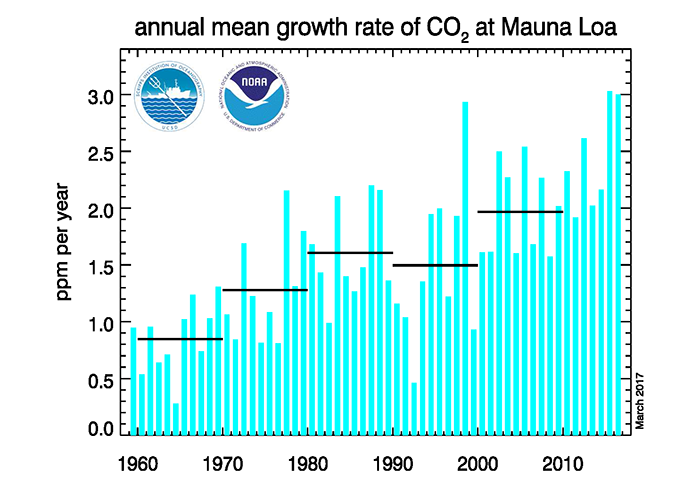
A RECORD INCREASE IN CARBON DIOXIDE in the atmosphere was recorded for 2016 at the Mauna Loa Baseline Atmospheric Observatory. According to a statement on Friday from NOAA, C02 levels rose by 3 parts per million to 405.1 parts per million (ppm) in 2016, an increase that matched the record jump observed in 2015.
     The two-year, 6-ppm surge in the greenhouse gas between 2015 and 2017 is unprecedented in the observatory’s 59-year record. It was a record fifth consecutive year that carbon dioxide (CO2) rose by 2 ppm or greater, said Pieter Tans, lead scientist of NOAA's Global Greenhouse Gas Reference Network.
     “The rate of CO2 growth over the last decade is 100 to 200 times faster than what the Earth experienced during the transition from the last Ice Age,” Tans said. “This is a real shock to the atmosphere.”
    Globally averaged CO2 levels passed 400 ppm in 2015 — a 43-percent increase over pre-industrial levels. In February 2017, CO2 levels at Mauna Loa had already climbed to 406.42 ppm. NOAA has measured CO2 on site at the
 Mauna Loa observatory since 1974. To ensure accuracy, air samples from the mountaintop research site in Hawai`i are shipped to NOAA’s Earth System Research Laboratory in Boulder, Colorado, for verification. The Scripps Institution of Oceanography, which first began sampling CO2 at Mauna Loa in 1956, also takes independent measurements onsite.
     Emissions from fossil-fuel consumption have remained at historically high levels since 2011 and are the primary reason atmospheric CO2 levels are increasing at a dramatic rate, Tans said. This high growth rate of CO2 is also being observed at some 40 other sites in NOAA’s Global Greenhouse Gas Reference Network.        
     Carbon dioxide is one of several gases that are primarily responsible for trapping heat in the atmosphere. This “greenhouse effect” maintains temperatures suitable for life on Earth. Increasing CO2 levels trap additional heat in the atmosphere and the oceans, contributing to rising global average temperatures.
     Atmospheric CO2 averaged about 280 ppm between about 10,000 years ago and the start of the Industrial Revolution around 1760. Track CO2 concentrations at Mauna Loa and other global locations online.
To read comments, add your own, and like this story, see Facebook. Follow us on Instagram and Twitter.
Rep. Tulsi Gabbard, making the regime change pitch at the
National Press Club, is joined by Sen. Rand Paul with
legislation in the U.S. Senate.
THE STOP ARMING TERRORISTS BILL, sponsored by Tulsi Gabbard in the U.S. House of Representatives, has a champion in the U.S. Senate. Sen. Rand Paul introduced the measure into the U.S. Senate on Friday. The bipartisan legislation (H.R.608 and S.532) would prohibit any federal agency from using taxpayer dollars to provide weapons, cash, intelligence, or any support to al-Qaeda, ISIS and other terrorist groups, and it will prohibit the government from funneling money and weapons through other countries who are directly or indirectly supporting terrorists.
     The legislation is currently cosponsored by Reps. John Conyers (D-MI), Scott Perry (R-PA), Peter Welch (D-VT), Tom Garrett (R-VA), Thomas Massie (R-KY), Barbara Lee (D-CA), Walter Jones (R-NC), Ted Yoho (R-FL), and Paul Gosar (R-AZ), and endorsed by Progressive Democrats of America (PDA), Veterans for Peace, and the U.S. Peace Council.
       Said Gabbard, “For years, the U.S. government has been supporting armed militant groups working directly with and often under the command of terrorist groups like ISIS and al-Qaeda in their fight to overthrow the Syrian government. Rather than spending trillions of dollars on regime change wars in the Middle East, we should be focused on defeating terrorist groups like ISIS and al-Qaeda, and using our resources to invest in rebuilding our communities here at home. The fact that American taxpayer dollars are being used to strengthen the very terrorist groups we should be focused on defeating should alarm every Member of Congress and every American. We call on our colleagues and the Administration to join us in passing this legislation.”
      Senator and physician Paul said: “One of the unintended consequences of nation-building and open-ended intervention is American funds and weapons benefiting those who hate us.” This legislation will strengthen our foreign policy, enhance our national security, and safeguard our resources.”

      Gabbard provided the following background: The Stop Arming Terrorists Act prohibits U.S. government funds from being used to support al-Qaeda, ISIS or other terrorist groups. In the same way that Congress passed the Boland Amendment to prohibit the funding and support to CIA backed-Nicaraguan Contras during the 1980’s, this bill would stop CIA or other Federal government activities in places like Syria by ensuring U.S. funds are not used to support al-Qaeda, Jabhat Fateh al-Sham, ISIS, or other terrorist groups working with them. It would also prohibit the Federal government from funding assistance to countries that are directly or indirectly supporting those terrorist groups. The bill achieves this by:
     · Making it illegal for any U.S. Federal government funds to be used to provide assistance covered in this bill to terrorists. The assistance covered includes weapons, munitions, weapons platforms, intelligence, logistics, training, and cash.
     · Making it illegal for the U.S. government to provide assistance covered in the bill to any nation that has given or continues to give such assistance to terrorists.
     · Requiring the Director of National Intelligence (DNI) to determine the individual and groups that should be considered terrorists, for the purposes of this bill, by determining: (a) the individuals and groups that are associated with, affiliated with, adherents to or cooperating with al-Qaeda, Jabhat Fateh al-Sham, or ISIS; (b) the countries that are providing assistance covered in this bill to those individuals or groups.
     · Requiring the DNI to review and update the list of countries and groups to which assistance is prohibited every six months, in consultation with the House Foreign Affairs and Armed Services Committees, as well as the House Permanent Select Committee on Intelligence.
     · Requiring the DNI to brief Congress on the determinations.

To read comments, add your own, and like this story, see Facebook. Follow us on Instagram and Twitter.

JAZZ IN THE FOREST, Saturday, March 11, Volcano Art Center at 4:30 p.m. and 7:30 p.m. with Jean Pierre Thoma & The Jazztones. See www.volcanoartcenter.org. 967-8222

SUNDAY CLAY: High Fire, Sundays, March 12 – May 7, 11:30 a.m. – 2:30 p.m. or 2:45 –5:45 p.m. at Volcano Art Center. $185/$166 VAC members plus $13 materials fee. 967-8222

REP. RICHARD CREAGAN SPEAKS AT THE NEW VOICES MEETING on Sunday, at Punalu`u Bake Shop at noon. The public meeting will be held in the upper pavilion. Creagan will review activities of the 2017 Hawai`i Legislation which has reached mid session and also discuss the national situation with the new President's administration. For more information, call Melissa Wheeler at 808-785-2643.
www.kaucalendar.com


Ka`u News Briefs Thursday, March 9, 2017

Peter Anderson captured this sunset on March 7 at South Point where fishermen traditionally lifted their catch on a hoist after bringing their boats close to the Ka Lae cliffs.

DISMANTLING THE AFFORDABLE CARE ACT, as planned by Pres. Donald Trump, is a major concern of Sen. Mazie Hirono who took to the U.S. Senate floor on Thursday to protest. She said that President Barack Obama and the Democratic party "have been fighting to make sure everyone has access to affordable, quality health insurance. Pres.Trump and his allies in congress do not share this commitment. Instead of debating how best to expand access they are fighting with each other to see just how many people they can kick off insurance roles, all in a crusade, apparently, to save some people money," stated Hirono. Organizations such as AARP, the American Hospital Association and the American Medical Association have also issued statements of concern.
Hirono opposed Trump Care and Trump's appointment
to run Medicare, Medicaid and insurance markets.
     "This is not a crusade to improve the lives of as many people as possible," she said. "It is a crusade to serve their radical, anti-government ideology.
     "In fact," said Hirono, "ideology over people is a useful shorthand to describe the first two months of the Trump administration." She said that "people are left out of the debate."
      Hirono contended that under the plan being debated this week to repeal the Affordable Care Act, "twenty million people in our country will be without health insurance, without health care." She said she understands the fear of not having health insurance. When her mother came to Hawai`i as an immigrant with her and her two brothers, her mother's first job did not provide health insurance. As a child, said Hirono, her greatest fear was that her mother would become sick and unable to work for food and rent for the family.
Seema Verma
       She noted that 20 million previously uninsured people gained health insurance through the Affordable Care Act.    
     "Millions will be hurt by Trump Care," she said, contending that it would end the "Medicaid expansion that millions of people depend on," and that also keeps hospitals in rural and underserved communities from closing down. She said Trump Care would provide less funding for Medicaid and would be particularly devastating in Hawai`i where the number of people on Medicaid has grown 20 percent under the Affordable Care Act. "Reducing access to Medicaid is wrong," testified Hirono.
     She also testified that Trump Care would charge older persons five times more for health insurance than younger people. It "would also zero out funding for Planned Parenthood." She pointed to a new mobile application for Planning Parenthood that reaches rural Hawai`i.
     After taking away health insurance and services to millions of people, said Hirono, Trump Care would benefit the "wealthiest of the wealthy, with a big tax cut."
     Hirono said she would vote against Trump's nominee to head the Centers for Medicare and Medicaid Services, which oversees benefits to seniors and low income persons and oversees the Affordable Care Act insurance markets. Hirono called nominee Seema Verna unqualified to oversee its $1 trillion budget. Verma is founder of a health care consulting firm and has that worked with the state of Indiana and then- Gov. Mike Pence.
    The Senate ended debate Vema's nomination on Thursday and will likely vote on the confirmation next week.
     "I will fight tooth and nail against Trump Care," said Hirono.

To read comments, add your own, and like this story, see Facebook. Follow us on Instagram and Twitter.

Hawai`i Attorney General Doug Chin talks to the Muslim
Association of Hawai`i, whose Imam is a plaintiff with
the State of Hawai`i in opposing the federal travel ban.
Photo from Muslim Association of Hawai`i
"DISCRIMINATION AGAINST PEOPLE BASED ON NATIONAL ORIGIN OR RELIGION IS A VERY DARK PATH we must never accept," said Hawai`i Attorney General Doug Chin on Wednesday. He filed the first case in the country against Pres. Donald Trump's second travel ban Executive Order - this one banning visitors from six Muslim majority countries. The State of Hawai`i filing in federal court argues that Trump's revised Executive Order "is another attempt by the Administration to enact a discriminatory ban that goes against the fundamental teachings of our Constitution and our immigration laws, even if it is cloaked in ostensible neutral terms. Strikingly, The Executive Order even admits that these changes were designed to 'avoid litigation.'"
Muslm Association of Hawai`i reminds the public that
Hitler was elected and legalized atrocities.
Photo from Muslim Association of Hawai`i
     The Attorney General contends that "Nothing of substance has changed" with the Administration's rewrite of its travel ban. "There is the same blanket ban on entry from Muslim-majority countries (minus one), the same sweeping shutdown of refugee admissions (absent one exception), and the same lawless warren for exceptions and waivers. The court did not tolerate the Administration's last attempt to hoodwink the judiciary, and they should not countenance this one," stated Chin, who also filed against Trump's first travel ban attempt.
     The filing notes that "Hawai`i is the most ethnically diverse State, and is home to more than 250,000 foreign-born residents. More than 100,000 of Hawai`i's foreign-born residents are non-citizens." As of 2010, 22 percent of Hawai`i business owners were foreign born and Hawai`i had the fifth-highest percentage of foreign-born workers of any State.
     The co-plaintiff is Dr. Ismail Elshikh, Imam of the Muslim Association of Hawai`'i. Defendants listed are: Pres. Donald Trump; U.S. Department of Homeland Security and its Secretary John Kelly; U.S. Department of State and its Secretary Rex Tillerson; and the United States of America and "all government agencies and departments responsible for the implementation of the INA (Immigration and Nationality Act), and for detention and removal of non-citizens from Iran, Syria, Somalia, Sudan, Libya and Yemen who arrive at air, land and sea ports across the United States, including Honolulu International Airport and Kona International Airport."

To read comments, add your own, and like this story, see Facebook. Follow us on Instagram and Twitter.

NEW VOICES HOSTS REP. RICHARD CREAGAN this Sunday, March 12 at 1 p.m. for a talk story at the upper pavilion of Punalu`u Bake Shop in Na`alehu. The new organization was formed in Ka`u after the Women's March in January in order to monitor and respond to the the new U.S. President's first 100 days in office. Laurie Boyle is the facilitator for Ka`u Voices. 
    In addition to addressing the national political scene, the Ka`u Voices and Creagan will talk about the status of legislation in the state House of Representatives and Senate following the recent cross over of bills from one chamber to another. 
     For more information, call Melissa Wheeler at 808-785-2643.

RECENT COLLAPSES IN NEW VOLCANIC LAND at the Kamokuna ocean lava entry underscore the on-going hazard. This is the subject of this week's Volcano Watch from scientists at Hawaiian Volcano Observatory:
     Since its initiation on July 26, 2016, the Kamokuna ocean entry has drawn thousands of visitors, eager to witness the creation of new land. The interaction of hot lava and cold seawater produces beautiful and powerful displays that can only be observed on Hawai`i Island.
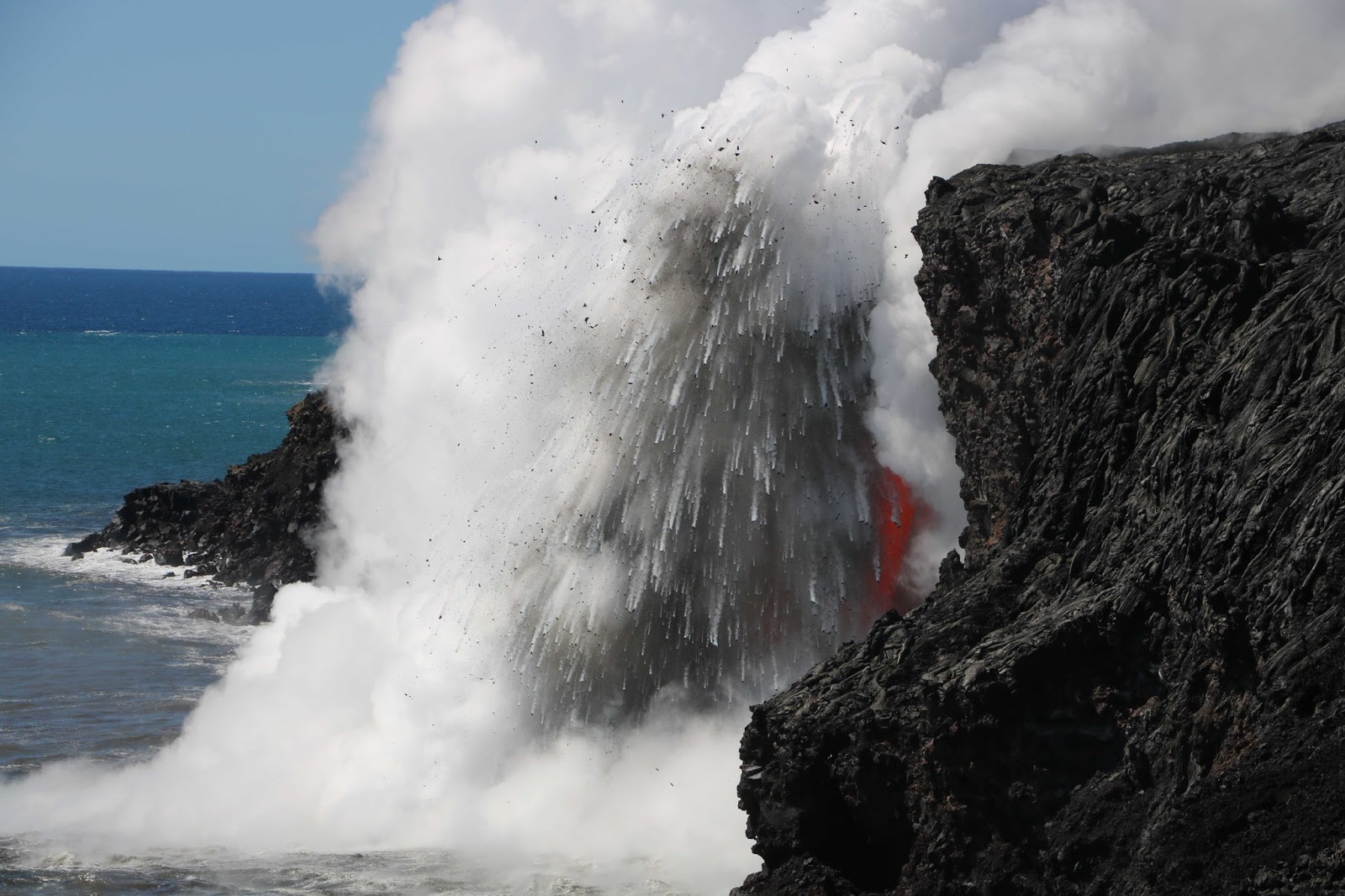
As seen in late January, the interaction of molten lava and cold seawater
at the Kamokuna ocean entry produces an explosion, sending hot fragments
and steam high into the air. The sea cliff in this image is about 15 meters 
(50 feet) high. USGS photo
     But the ocean entry also represents a unique set of hazards. As detailed in a July 28, 2016, Volcano Watch article, these hazards include explosions that send debris and molten spatter into the air, toxic gases in the steam plume, and collapse of the newly created land and adjacent sea cliff. Repeated collapses around the ocean entry since New Year's Eve of 2016 have underscored the danger of this last hazard.    
     As soon as the 61g lava flow entered the ocean last summer, it began forming new land, called a lava delta. The lava delta grew seaward, forming a broad, flat shelf. By the end of the year, it had grown to cover an area roughly the size of 18 football fields.
     Lava deltas are inherently unstable. They are typically built on top of loose rock fragments that form when the incoming lava hits cold ocean water and shatters. As the lava delta grows, this poor foundation cannot support the added weight, and partial or wholesale collapse sends chunks sliding into the sea.
     This was the process at work on Dec.  31, 2016, when almost the entire 23-acre lava delta and 4 acres of the older sea cliff slid into the ocean piece by piece over the course of the afternoon and into the evening.
     Small explosions accompanied many of these collapses when newly exposed hot rock came into contact with cold seawater. These sent rocks, steam, and molten lava fragments flying into the air. Large waves were also generated when sections of the lava delta and adjacent sea cliff crashed into the water; some were reported to have splashed as much as 9 meters (30 feet) above the 15-meter (50-foot) cliffs east of the delta.
     Since the events of New Year's Eve, the area has continued to be unstable and large cracks have been observed on top of the cliff behind the ocean entry. In early February, USGS Hawaiian Volcano Observatory (HVO) staff working in the area noted gentle swaying of the ground – similar to standing in a treehouse on a gusty day – at a distance of up to 200 meters (650 feet) away from the entry.
New land cracks and eventually falls into the sea. USGS photo 
     The exact cause of this ground motion felt so far away is not known, but it was a clear warning of instability. Sure enough, on Feb. 2, 2017, HVO geologists witnessed a large section of the sea cliff behind the ocean entry falling into the ocean.
     They had entered the closed area to deploy equipment for monitoring the ocean entry and the gradually widening crack on the sea cliff. Within a minute of HVO geologists reaching the site and just after setting up a camera, the sea cliff seaward of the crack collapsed with no warning. Fortunately, they were far enough away to be unharmed.
     The newly placed camera recorded dramatic video of the collapse which you can find along with photographs on the HVO web site. (https://tux.wr.usgs.gov/multimedia/uploads/multimediaFile-1629.mp4). Afterwards, in the video, a remaining section of the surrounding sea cliff sways back and forth for several seconds before coming to a rest. Several hours later, most of this piece of the sea cliff also collapsed.
     While the most hazardous sections of the sea cliff are no longer standing as of this writing in early March, the sea cliff near the ocean entry remains unstable and further collapses could occur at any time. Visitors should heed the rope line established by Hawai`i Volcanoes National Park at all times and maintain a safe distance when viewing by boat. More information about the hazards associated with ocean entries is available on the USGS Hawaiian Volcano Observatory website (http://hvo.wr.usgs.gov/hazards/oceanentry/main.html).

To read comments, add your own, and like this story, see Facebook. Follow us on Instagram and Twitter.

EARTHQUAKE UPDATE: Five earthquakes were reported felt in Hawai`i in the past week. On Sunday, March 5, four earthquakes were felt in the span of 11 minutes between 6:06 and 6:17 a.m. HST. These earthquakes, ranging in magnitude from 3.8 to 3.1 occurred in Kīlauea's Upper East Rift Zone between 5.8 km (3.6 mi) and 4.1 km (2.6 mi) southeast of the Kīlauea summit at depths of 2.7 km (1.7 mi) to 2.1 km (1.3 mi). On Thursday, March 9 at 3:03 a.m. HST a magnitude 4.2 earthquake occurred 64.8 km (40.2 mi) northeast of Kaunakakai, Moloka`i at a depth of 17.0 km (10.6 mi).

MURDER ON THE NIILE is Kilauea Drama & Entertainment Network's third Agatha Christie murder mystery, which will open Friday, March 17 at 7:30 p.m. at Kilauea Theater in Kilauea Military Camp.
     The story takes place on a paddleboat steamer going down the Nile between Shellal and Wadi Halfa in Africa.
   Simon Mostyn and his rich, beautiful wife Kay are on their honeymoon. Simon's former love, Jacqueline has been following them throughout their journey. The bevy of memorable characters, including Kay's guardian, Canon Pennefather, all play a part in the mystery. When Jackie gets hysterical and shoots Simon in the leg, an audacious conspiracy is revealed, everything is questioned, and eventually the criminals are caught.
     "Agatha Christie is so much fun to do. There are so many twists in the plot and one must pay very close attention to understand the ending. Having done so many Gilbert and Sullivan operettas, we realized her mysteries are a lot like Gilbert and Sullivan without music," says director Suzi Bond.
     The cast is led by Hayley Pereira and Stephen Bond as Kay and Simon Mostyn, with Stephanie Becher as Jacqueline, and Ray Ryan as Canon Pennefather. Supporting characters are Lezleigh Bignami as Aunt Helen, Erin Smith as Christina, Mark Rawlings as Smith, Barbara Johnson as Louise and Steve Peyton as Dr. Bessner. Also appearing in the show are Lowden Borgens, Carol Denecker and Roch Jones.
     Performances are March 17 – April 2, Fridays and Saturdays at 7:30 p.m. and Sundays at 2:30 p.m. Tickets prices are $15 general, $12 seniors and students and $10 for children 12 and under. Tickets are available at Kilauea General Store, Kea'au Natural Foods, the Most Irresistible Shop in Hilo and at the door. For reservations and more information call 982-7344 or email kden73@aol.com.

To read comments, add your own, and like this story, see Facebook. Follow us on Instagram and Twitter.

JAZZ IN THE FOREST, Saturday, March 11, Volcano Art Center at 4:30 p.m. and 7:30 p.m. with Jean Pierre Thoma & The Jazztones. See www.volcanoartcenter.org. 967-8222

SUNDAY CLAY: High Fire, Sundays, March 12 – May 7, 11:30 a.m. – 2:30 p.m. or 2:45 –5:45 p.m. at Volcano Art Center. $185/$166 VAC members plus $13 materials fee. 967-8222


www.kaucalendar.com

Wednesday, March 08, 2017

Ka`u News Briefs, Wednesday, March 8, 2017

Visitors observe the erupting volcano from the safe overlook in Hawai`i Volcanoes National Park.
NPS Photo
BUSTED, SNEAKING INTO THE ERUPTING VOLCANO's closed area at Halema'uma'u were a French tour guide and a tour group of 13. They were caught early Monday in off-limits territory of the summit crater of Kīlauea volcano.
     National Park Service law enforcement officers spotted the group just after midnight, and issued citations for violating the terms of the closure to all 14 people. The tour guide was issued additional citations for operating a non-permitted business in the park and creating a hazardous condition. All 14 were escorted out of the park.
     The 44-year-old male tour guide, affiliated with the French tour company Adventure et Volcans, must make a mandatory court appearance and faces a maximum penalty of $5,000 and six months in jail. His name is being withheld as the investigation continues. The violation of closure citations are $100 each, with a $30 processing fee.
     "This is a serious violation," said Chief Ranger John Broward. "Areas surrounding Halema'uma'u Crater are closed because of extremely hazardous volcanic conditions that include high concentrations of toxic gases and particulates, ongoing volcanic explosions and frequent collapses of the crater walls," he said.
Hawaiian Volcanoes Observatory provides a legal viewing area.
NPS Photo 
Explosions from Halema'uma'u can occur anytime, without warning. Last August, a summit explosion hurled a layer of volcanic rock, lava bombs and molten spatter nearly 300 feet beyond the crater rim, and covered an area about 720 feet wide along the rim. It destroyed the power system of a U.S. Geological Survey instrument that was used for scientific research and monitoring volcanic activity. Last October, two explosions blasted lava spatter, rock and glassy particulates a quarter mile from the crater to the closed portion of Crater Rim Drive. In November, spatter from another lava lake explosion damaged the cable on a USGS webcam located on the rim of the crater.
     Halema'uma'u Crater, a 4.7-mile section of Crater Rim Drive, and sections of the Halema'uma'u and Crater Rim trails, have been closed since the most recent summit eruption began in 2008.
     "Visitors need to be aware that, while much of the attention lately has been on the hazards of the 61g ocean entry at Kamokuna, the park staff remains very concerned about the ongoing hazards in the vicinity of Halema'uma'u," Chief Ranger Broward said. "Rangers will continue to monitor and take appropriate action to reduce the occurrence of risky behavior in both areas."
     Since July 2016, rangers have issued 35 citations for closure violations at Halema'uma'u, and nearly 100 citations at Kamokuna.

To read comments, add your own, and like this story, see Facebook. Follow us on Instagram and Twitter.

Black-footed albatross practice their courting on Midway Island.
Photo by Eric VanderWerf/Pacific Rim Conservation
FIFTEEN THREE-WEEK-OLD BLACK-FOOTED ALABATROSS chicks made history by flying before they can fly. Before they could become victims to rising sea levels and storm surges, they were collected by conservationists, boxed and flown from Midway Atoll to Honolulu. They are now at their new home at James Campbell National Wildlife Refuge, on the north shore of Oʻahu. Partners on the project to relocate the chicks include Pacific Rim Conservation, Papahānaumokuākea Marine National Monument, U.S. Fish and Wildlife Service, National Fish and Wildlife Foundation, and the David and Lucile Packard Foundation.
     The small, fluffy chicks are part of a pioneering effort to establish a new black-footed albatross colony on the main Hawaiian Islands. Black-footed albatross build nests on low-lying islands so are now at risk of losing their nesting habitat to encroaching waves.
     Affectionately known as Gooney Birds, albatross can have wingspans up to 11 feet, and can weigh up to 22 lbs. The black-footed albatross, however, is smaller (with a wingspan of up to 7.2 feet) and has black plumage, a dark beak and dark feet. 

The chicks safe at their temporary indoor home at
James Campbell National Wildlife Refuge.
Photo by Lindsay Young/Pacific Rim Conservation
     “We are thrilled that the Refuge can provide a safe place and a new home for this species on Oʻahu,” said Joseph Schwagerl the Refuge Manager at the James Campbell National Wildlife Refuge. “This translocation is the first step toward creating a new colony of black-footed albatross in the main Hawaiian Islands and ensuring the albatross will be protected for future generations.” Besides a few small colonies on volcanically active islands near Japan and one colony on the small islet of Lehua near Kauaʻi, black-footed albatross currently nest only on low-lying islands in Papahānaumokuākea Marine National Monument.
     “We know that sea level rise and increased storm surges are a threat to this species, and many others,” said Eric VanderWerf of Pacific Rim Conservation. “We have an opportunity to do something to mitigate that threat now, before it becomes an emergency.”
     Midway Atoll, Laysan Island and Tern Island, which support 90 percent of the world's breeding population, all have very low elevations and are predicted to be highly susceptible to sea-level rise and storm surges in the coming century.
     “Midway Atoll is home to one of the largest black-footed albatross populations in the world. As conservation managers, it is important we use good science to evaluate other options that might protect these seabirds into the future,” said Midway Atoll Refuge and Memorial Project Leader Bob Peyton in a statement. “Refuges like Midway Atoll and James Campbell provide the healthy habitat that black-footed albatross, and other seabirds, need to thrive.”
A diet of fish and squid for black-footed albatross.
Photo by Eric VanderWerf/Pacific Rim Conservation
The chosen translocation site at James Campbell National Wildlife Refuge is high enough that they are less at risk from rising sea-levels and increasing storm surges. Additionally, birds nesting within the predator-free enclosure will be protected from non-native predators that are common in the main islands such as mongooses, rats, and feral cats and dogs.
     The chicks are hand fed a diet of fish and squid and will be closely monitored by biologists for four to five months, until they are able to fly out to sea and feed themselves. Black-footed albatross chicks imprint on their birth colony at about one month of age and they will return to breed at the same colony as adults. By moving the chicks at this critical one-month period, they will imprint on their new home at the refuge. Then they will go out to sea and will stay there for the next four to five years. When they return as adults, to raise their own chicks, they will become the pioneers of a new colony.
     “We won’t know if this project works until they come back and breed at six to nine years old,” VanderWerf said. “They’ll probably pick a mate from the group they came from Midway with.”
Twenty-five more black-footed chicks will be flown in from Midway each year, for the next two years.
     The black-footed albatross mates for life. After fledging the birds return to the colony after about five years, and spend two years building nests, dancing and being with prospective mates, a behavior
that probably evolved to ensure maximum trust between the birds. They will start reproducing after
about seven years. Nests are simple depressions scraped in the sand, into which one egg is laid. The   
Chicks could be overwashed and perish
on low-lying islands with rising sea waters.
Photo by Pete Leary/U.S. Fish & Wildlife Service
egg is incubated for about 65 days. Both birds incubate the egg, the male incubating more as the female leaves soon after hatching to recoup reserves used for egg-laying. The average time spent on incubating shifts is 18 days. However, mates can wait up to 38 days to be relieved, and if something happens to the mate the other has been recorded incubating for 49 days without food or water. The chick is brooded for 20 days by its parents, after which both parents leave the nest and return to feed the chick. The chick is fed regurgitated food by sticking its bill inside that of its parent. Fledging occurs after 140 days. The black-footed albatross is considered vulnerable because it is unintentionally killed by longline fishing. Instead of fishing with nets, fleets trail long lines from their ships – some lines can be over 60 miles long. Baited hooks are set at intervals, in order to snare large predatory fish, such as swordfish, tuna and halibut. But birds are also attracted to the bait, often with fatal consequences - especially for juvenile birds. An estimated 6,150 birds are killed each year by fishing fleets. It is also vulnerable to oil and ingestion of floating plastics, which reduces the space in the stomach available for food to be brought to the chick.

To read comments, add your own, and like this story, see Facebook. Follow us on Instagram and Twitter.


Scientific instruments to collect climate change
and air quality data onboard Hawaiian
Airlines. Photo from IAGOS
HAWAIIAN AIRLINES PLANS TO COLLECT CLIMATE CHANGE DATA, beginning in April, to become the first U.S. carrier to join an international scientific project with participating airlines worldwide. Hawaiian partnered with the In-service Aircraft for a Global Observing System (IAGOS) venture to equip one Airbus A330-200 aircraft with an atmospheric monitoring tool that will collect data on air quality and climate throughout the airline’s network covering the Pacific, Asia and North America.    
     Hawaiian’s A330 aircraft, bearing registration N384HA, arrived at Honolulu International Airport in late February after spending weeks in Brisbane, Australia, where technicians installed IAGOS instruments under its cockpit that will be attached to probes in the front-left fuselage. The probes will autonomously perform atmospheric air samples from take-off to landing and record key high-altitude greenhouse gas measurements. They will also retrieve information about icing conditions that may be useful in aircraft safety studies. The system is expected to be operational following FAA certification.
     “We are honored to lend our support to IAGOS and help assess the health of our atmosphere and measure climate change,” said Captain Ken Rewick, Hawaiian’s vice president of flight operations.
     “We are excited to see Hawaiian Airlines becoming a partner in IAGOS. Instrumenting commercial airliners is a cutting-edge approach and cost-effective for obtaining large amounts of high quality data about our atmosphere,” said James Butler, director of the National Oceanic and Atmospheric Administration Global Monitoring Division, and chairman of the IAGOS Science Advisory Board. “Scientists around the world will increasingly use data from IAGOS flights to help improve weather forecasts, climate models, and our overall understanding of the Earth system. This is a great step forward for science.”

Probes on Hawaiian Airlines plane that will sample
the atmosphere and share the data with scientist.
Photo from IAGOS
     Scientists expect Hawaiian’s system to produce valuable metrics thanks to the carrier’s unique central Pacific location and network of non-stop flights extending from Australia, New Zealand, American Samoa, and Tahiti in the South Pacific, to China, South Korea, Japan and the United States (including ten western U.S. gateways and New York) in the North Pacific. According to IAGOS, commercial aircraft are uniquely positioned to collect highly relevant observations on a scale and in numbers impossible to achieve via dedicated research aircraft or satellites. All information will be transmitted after each flight to the IAGOS data center in France and shared with the scientific community within a few weeks.
     Based in Brussels, the European-funded IAGOS is a not-for-profit association whose members include leading research organizations, universities and weather services from Germany, France and the United Kingdom. The program observes atmospheric data to better understand transcontinental pollution and validate air quality and climate models. Its information is used by about 200 universities or institutes in Europe, the United States, Japan, South America, India and China.
     A statement from Hawaiian Airlines says the company's "participation in IAGOS aligns with the carrier’s ongoing commitment to reduce the impact of aviation on the environment." Hawaiian is also investing in fuel efficient aircraft by adding 18 new A321neos to its fleet starting later this year. Last year, the airline also conducted two demonstration flights to Honolulu from Brisbane and Auckland using a series of gate-to-gate environmental best practices outlined by the Asia and Pacific Initiative to Reduce Emissions. See more at iagos.org.

To read comments, add your own, and like this story, see Facebook. Follow us on Instagram and Twitter.

KA`U HIGH SCHOOL BEAT PARKER SCHOOL Wednesday night in boys' volleyball at the new Ka`u gym. In jayvee play Ka`u won the first 25-14 and 25-23. In varsity play, the Ka`u Trojans won, with 55-15, 25-14 and 28-4.

IN GIRLS' SOFTBALL, KA`U HIGH lost to Waiakea on Tuesday at the Pahala ball field. the final score was Waiakea 17 and Ka`u 7. Outstanding Ka`u players were Sheri Freitas and Shailei Penera who each hit singles. Pitching for Ka`u were Lei Chun Galban and Kin In.


JAZZ IN THE FOREST, Saturday, March 11, Volcano Art Center. With Jean Pierre Thoma & The Jazztones. 967-8222

SUNDAY CLAY: High Fire, Sundays, March 12 – May 7, 11:30 a.m. – 2:30 p.m. or 2:45 –5:45 p.m. at Volcano Art Center. $185/$166 VAC members plus $13 materials fee. 967-8222


KAUAHA`AO CONGREGATIONAL CHURCH in Waiohinu, will host a Turkey Dinner Fundraiser on Tuesday, March 28, from 4 p.m. -7pm. Plates can be either taken out or eaten at the church hall. There will be live entertainment during that time. Dinner plates are selling at $7 each plate, or four plates for $25. Plates will include: Kalua Turkey, Rice or Mash Potatoes, Butter Corn, Cake.
Church member are pre-selling tickets. To purchase a ticket, call 929-9997. Dinner plates can also be purchased at the fundraiser.

www.kaucalendar.com