About The Kaʻū Calendar

Sunday, January 19, 2020

Ka‘ū News Briefs, Sunday, January 19, 2020

Kaʻū High Alumnus Tim Wright saw the first Southwest Airlines interisland flight land at Hilo Airport today,
 the moment of Kahu Daniel "Kaniela" Akaka, Jr. blessing the event. See more below.
Photo by Tim Wright Ka'u '77
EIGHT UNITED NATIONS SUSTAINABLE DEVELOPMENT GOALS have been chosen by the Hawaiʻi's state Senate. Sen. Kai Kahele said he and colleagues will attempt to reach the eight goals "to change the world." They are:
     Good Health and Well-being, by providing access to quality, including mental and
behavioral health services; reducing youth vaping; and repurposing underutilized state facilities.
     Quality Education, by improving teacher recruitment and retention, strengthening civic education programs, increasing revenue sources to support and enhance secondary education, and expanding career and technical education opportunities to develop a
21st century workforce.
     Decent Work and Economic Growth, by promoting robust, inclusive, and sustainable economic growth; full and productive employment; and work for all by encouraging job creation and workforce development programs, embracing innovation, and developing sustainable business plans to invest in the future of Hawai’i.
     Reduced Inequality, by working diligently to promote social, economic, and political
growth for all by increasing the minimum wage, requiring paid family leave, and creating a retirement savings program.
     Sustainable Cities and Communities, by increasing access to affordable and transitional housing, reducing homelessness, increasing local food production to promote food security, protecting agricultural lands, improving infrastructure, and investing in modern transportation.
     Climate Action, by promoting carbon neutrality, ocean conservation, sustainable land use, and protection of watersheds.
     Peace and Justice Strong Institutions, by promoting peaceful and inclusive societies, and access to justice for all; building effective, accountable, and inclusive institutions by exploring effective options to restructure government; increasing Hawai‘i's participation on the international level; enhancing public safety; improving social services; expanding the Sister State Program; supporting the State Archives; and increasing civic education statewide.
     Partnerships to achieve the Goals, by encouraging and promoting effective public, private, and civil society partnerships; building on the experience and resourcing strategies of existing partnerships; enhancing a coherent policy for sustainable development; and building on existing initiatives to develop measurements of progress on sustainable development that complement economic goals.
      The other nine U.N. goals are:  Gender Equality, Clean Water and Sanitation, Affordable and Clean Energy, Industry, Innovation, and Infrastructure, Sustainable Cities and Communities, Responsible Consumption and Production, Life Below Water, and Life on Land.
     Kahele said he urges citizens to become involved in the legislative process. "I remain committed to investing in policies that balance environmental sustainability with economic stability, unlocking the potential of a green economy for future generations. Hawaiʻi is already experiencing the devastating effects of climate change as coastal erosion and sea level rise occur. Protecting our environment and natural resources continues to be a priority for me this legislative session.
     Kahele is Chair of the Senate Water and Land committee, and said the committee will continue to pursue initiatives to ensure Hawaiʻi "remains a global leader in addressing sustainability and climate change issues. He is also running for Congress, the seat to be left open by Rep. Tulsi Gabbard.
     Contact Kahele at (808) 586-6760 or senkkahele@capitol.hawaii.gov with any questions or concerns.

To read comments, add your own, and like this story, see Facebook. Follow us on Instagram and Twitter. See our online calendars and our latest print edition at kaucalendar.com.

BOTH KAʻŪ STATE SENATORS JOINED THE ENVIRONMENTAL CAUCUS, launched this month for the 2020 Hawaiʻi Legislature. Sen. Russell Ruderman and Sen. Dru Kanhua are part of this new group, formed "to encourage legislative action on pressing environmental issues." The inaugural meeting was Tuesday, Jan. 7. Members discussed legislative priorities for the 2020 session. The caucus is co-chaired by Representative Nicole Lowen, Chair of the House Committee on Energy and Environmental Protection, and Senator Mike Gabbard, Chair of the Senate Committee on Agriculture and Environment.
     Among the many environmental issues discussed by caucus members, climate change adaptation to sea level rise, resilience to natural disasters, forest and coral reef protection, and reducing the use of fossil fuels in the transportation and energy sectors were identified as issues to prioritize for legislative action this session. The caucus also recognized the need to address issues related to invasive species, drinking water safety, solid waste management, cesspools, and inclusion of environmental justice concerns in policymaking.
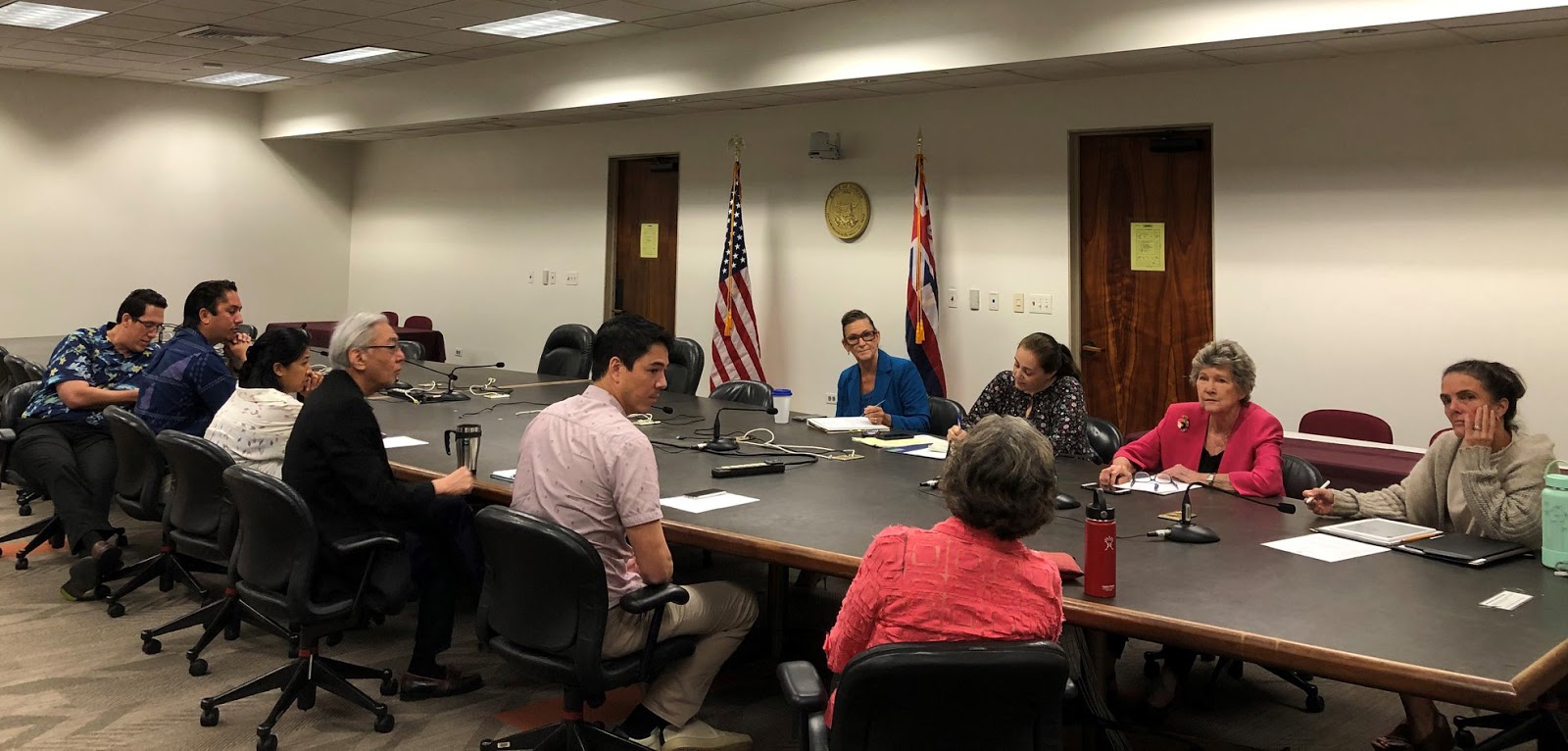
Sen. Dru Kanuha, second from left, during discussion on the Environmental Caucus. Photo from Facebook
     According to a statement from the Hawaiʻi House of Representatives, "The caucus will build on legislation passed in recent years that has made Hawaiʻi a leader in environmental policy. It was the first state to pass a 100 percent clean energy goal and to ban the toxic pesticide chlorpyrifos. Hawaiʻi was also the first place in the world to protect its reefs from harmful sunscreen chemicals. In recent years, the legislature has passed dozens of bills to protect the environment, advance renewable energy, expand clean transportation, and address the challenges of climate change, including establishing the Hawaiʻi Climate Commission, implementing the State's first appliance efficiency standards, and mandating the replacement of polluting cesspools by 2050.
     Kanuha said, "Excited to start important discussions about issues such as sea level rise, coastal erosion and mitigating the detriments of climate change in the islands."

To read comments, add your own, and like this story, see Facebook. Follow us on Instagram and Twitter. See our online calendars and our latest print edition at kaucalendar.com.

SOUTHWEST AIRLINES LAUNCHED FOUR DAILY FLIGHTS between Hilo and Honolulu today. The airline was blessed by Kahu Daniel "Kaniela" Akaka, Jr. just after landing at Hilo Airport. Kaʻū High Alumnus Tim Wright declared "game on" for lower interisland plane tickets prices. He caught the first Southwest Airlines interisland flight landing at Hilo today, and caught the moment of blessing the event.
     Flights from Hilo to Honolulu and back start at $39 each way, with one free bag and a surfboard, or two free bags. There are no charges for changing flights. See southwest.com.
     See more on the new flights on Friday's Kaʻū New Briefs.

To read comments, add your own, and like this story, see Facebook. Follow us on Instagram and Twitter. See our online calendars and our latest print edition at kaucalendar.com.

HAWAIIAN ELECTRIC SOURCED 21 PERCENT OF ITS ELECTRICITY IN 2019 FROM RENEWABLES. The utility made the announcement it its year end report released Friday. Hawaiʻi's solar generation capacity increased by the largest single-year margin since Hawaiian Electric began tracking solar capacity in 2005. The state's solar capacity grew from 745 cumulative installed megawatts in 2018 to 902 megawatts at the end of 2019.
Rooftop solar is increasing across the state. Photo by Julia Neal
     Hawaiʻi boasts the highest residential rooftop solar penetration in the nation, and rooftop solar use and installations are on the rise. On Hawaiʻi Island, 21 percent of single-family homes have rooftop solar, with 27 percent of Maui County single-family homes and 37 of Oʻahu single-family homes having rooftop solar. Residential customers across Hawaiian Electric's system are using one percent more rooftop solar, up from 18 percent in 2018. Use of residential rooftop solar installations rose 4.6 percent, to 77,801 in 2019 from 74,331 in 2018. New rooftop solar systems across Hawaiʻi Island, Maui County, and Oʻahu numbered about 3,500 in 2019. 
     The increases in use of renewable energy support the state's goal of 30 percent renewable energy by the end of 2020. Reinstatement of Puna Geothermal Venture, if approved by the Public Utilities Commission, will add toward that goal. Hawaiian Electric's five-island system sports about 3.5 million solar panels. This includes the West Loch solar array on Oʻahu, which came online last year, producing 20 megawatts.
     Shelee Kimura, Hawaiian Electric senior vice president of customer service, said, "The numbers show the adoption of residential rooftop solar remains strong, increasing year after year across all of our islands. Rooftop solar is a critical piece of the renewable mix, and our plans call for tripling the amount already installed to help move the state toward a clean energy future."

To read comments, add your own, and like this story, see Facebook. Follow us on Instagram and Twitter. See our online calendars and our latest print edition at kaucalendar.com.

A WARNING ABOUT A TELEPHONE SCAM circulating on Hawaiʻi Island is announced by Hawaiʻi Police Department.
     HPD stated a victim received a telephone recorded message call which stated the victim's Apple account had been hacked. The recording suggested staying on the line for further assistance. A male individual then told the victim "your Apple account has been hacked" and requested the victim's assistance in catching the hackers by purchasing gift cards, after which the cost would be immediately refunded back to the victim. The victim made the gift card purchases and provided the gift cards' security codes to the caller. The victim then received several emails, purportedly from Apple Care, telling the victim the gift card purchases had been refunded. The telephone call and the subsequent emails were deemed to be fraudulent, stated HPD.
     Police advise the public to verify that telephone calls are legitimate, especially those calls in which recorded messages are played upon answering. The Federal Trade Commission recommends hanging up on robocalls (automated phone calls that deliver a recorded message), then report the call to the FTC. These calls are illegal, and often the products being offered are bogus, stated HPD. "Don't press 1 to speak to a person or to be taken off the list as this could lead to more calls."
     More tips can be found at consumer.ftc.gov/articles/0060-10-things-you-can-do-avoid-fraud. Scams, such as this one, can be reported to the Federal Trade Commission at ftc.gov, and additional information about recently reported scams can also be found at consumer.ftc.gov/features/scam-alerts.

To read comments, add your own, and like this story, see Facebook. Follow us on Instagram and Twitter. See our online calendars and our latest print edition at kaucalendar.com.

Kaʻū Voices members Edna Montague, Tyler Schaeffer, and Laura Stern, during today's march. They consider every year
The Year of the Woman. Photo by Laurie Boyle
Kaʻū Voices: Candy Casper, Laura Stern, Edna Montague, 
Laurie Boyle, Missi Wheeler, Ed Giant, and Tyler Schaeffer. 
Photo from Kaʻū Voices
THE 4TH ANNUAL WOMEN'S MARCH IN HILO TODAY was "a fabulous day with an amazing group of activists," according to a statement from Kaʻū Voices. Organizer Laurie Boyle said, "We registered voters, sold reusable produce bags, had people submit their recycling and upcycling ideas, and offered buttons for people to create." Kaʻū Voices members were joined during the march by Volcano Community Action Network members.
     The theme of Hilo's 4th annual Women's March, according to hawaiipublicradio.org, was Hawaiʻi Counts! and the event focused on the importance of voting and engagement in this "critical election year."

To read comments, add your own, and like this story, see Facebook. Follow us on Instagram and Twitter. See our online calendars and our latest print edition at kaucalendar.com.

VARSITY TROJANS BASKETBALL at Hilo yesterday was a hard one for the Kaʻū Girls team, with Hilo taking the game, 72 to 7.

To read comments, add your own, and like this story, see Facebook. Follow us on Instagram and Twitter. See our online calendars and our latest print edition at kaucalendar.com.

Print edition of The Kaʻū Calendar is free to 5,500 mailboxes 
throughout Kaʻū, from Miloliʻi through Volcano, and free on 
stands throughout the district. Read online at kaucalendar.com
See monthly and weekly Kaʻū and Volcano Events, Meetings, Entertainment, Exercise, and Meditation at kaucalendar.com.

Kaʻū Winter Sports Schedule

Girls Basketball
Wed., Jan. 22 @HPA
Tue. and Wed., Jan. 28 and 29 BIIF @Civic
Wed. thru Sat., Feb. 5-8 HHSAA on Oʻahu

Boys Basketball
Mon., Jan. 20 @Honokaʻa
Mon., Jan. 27 @Kamehameha
Tue. and Wed., Feb. 4 and 5 BIIF @ Kealakehe

Soccer
Wed., Jan. 22 and Sat., Jan. 25 Girls BIIF
Wed. thru Sat., Feb. 5-8 Girls HHSAA on Oʻahu
Sat., Feb. 1 and 8 Boys BIIF

Wrestling
Sat., Jan. 25 @Kamehameha
Sat., Feb. 1 @Hilo
Sat., Feb. 8 BIIF @Konawaena

Swimming
Sat., Jan. 25 @Kona Community Aquatic Center
Fri., Jan. 31 and Sat., Feb. 1 BIIF @Kamehameha

UPCOMING
MONDAY, JAN. 20
Fee Free Day at Hawaiʻi Volcanoes National Park, Monday, Jan. 20, midnight-11:59p.m. Park entrance fees waived for Martin Luther King, Jr. Day. 985-6101, nps.gov/havo

AdvoCATS, Monday, Jan. 20, 7a.m.-4:30p.m., Ocean View Community Center. Free spay/neuter for cats. 895-9283, advocatshawaii.org

TUESDAY, JAN. 21
Cultural Understanding through Art & the Environment: Ti Leaf Lei Making with Jelena Clay, Tuesday, Jan. 21 – third Tuesday, Monthly – 11a.m.-1p.m., Volcano Art Center. Pre-registration required; class size limited. $10 per person supply fee. 967-8222, volcanoartcenter.org

After Dark in the Park – Kīlauea Lower East Rift Zone 2019: Quiet But Insightful, Tuesday, Jan. 21, 7-8p.m., Kīlauea Visitor Center Auditorium. Why did the fissures erupt along a linear pattern?  How long will it take for the lava to solidify? Why is vegetation still dying in the area? Join USGS HVO geologist Carolyn Parcheta as she explores these and other queries, and shares recent observations and findings by HVO scientists. Free; Park entrance fees apply. 985-6101, nps.gov/havo

WEDNESDAY, JAN. 22
Kuʻi Kalo: Pound Poi, Wednesday, Jan. 22, 10a.m.-noon, Kīlauea Visitor Center lanai, HVNP. Make poi, the staple food of the Hawaiian diet. The root of the kalo plant is cooked and ku‘i (pounded) to create this classic Hawaiian dish. Join Ranger Keoni Kaholo‘a‘a as he shares his knowledge of kalo. Part of Hawai‘i Volcanoes’ ‘Ike Hana No‘eau, Experience the Skillful Work, workshops. Free; Park entrance fess apply. 985-6011, nps.gov/havo

THURSDAY, JAN. 23
PETFIX Spay and Neuter Free Clinic for Cats and Dogs, Thursday and Friday, Jan. 23 and 24, Ocean View Ranchos. Registration: contact Bridget at (808)990-3548 or petfixbigisland@gmail.com.

Ka‘ū Community Children's Council, Thursday, Jan. 23, 3-4 p.m., Classroom 35, Building F, Nā‘ālehu Elementary School. Provides local forum for community members. Light refreshments will be served. RSVP to Chad Domingo, text 808-381-2584 or domingoc1975@yahoo.com.

FRIDAY, JAN. 24
Old Style Pau Hana Mele & Hula ‘Auana, Friday, Jan. 24 – fourth Friday, monthly – 4-5:30p.m., Volcano Art Center. Held outdoors, weather permitting. 967-8222, volcanoartcenter.org

SATURDAY, JAN. 25
Palm Trail, Saturday, Jan. 25, 9:30-12:30p.m., Kahuku Unit, HVNP. Free, relatively difficult, 2.6-mile, hike. Bring snack and water. nps.gov/havo

Sounds at the Summit: Hilo Jazz Orchestra Frank Zappa Tribute, Saturday, Jan. 25, 5:30-7:30p.m. Hawaiʻi Island musician and composer Trever Veilleux, director. Annual concert tends to sell out. 967-8222, volcanoartcenter.org

Blue Tattoo Band, Saturday, Jan. 25, 7-10p.m., Kīlauea Military Camp's Lava Lounge, in HVNP. $5 cover charge, free to in-house guests. Open to authorized patrons and sponsored guests. Park entrance fees apply. kilaueamilitarycamp.com

ONGOING
Apply for Mosaics of Science by Monday, Feb. 3. Hawai‘i Volcanoes National Park's 12-week paid summer internship position is designed to engage university students and recent graduates with on-the-ground work experience in the National Park Service. A $4,800 stipend, and all travel costs are covered, including a week-long career workshop in Washington,  D.C. to meet with NPS managers.
     The internship is open to U.S. citizens and permanent legal residents ages 18-30, and to military veterans up to age 35. Funding is provided under a cooperative agreement for youth conservation activities as part of the Public Lands Corps program, which mandates that these age ranges are followed. 
     The selected intern will assist with the development of education curriculum for Kīpukapuaulu and Pu‘u Loa trails in Hawai‘i Volcanoes National Park.
     For more information, contact Hawai‘i Volcanoes National Park Education Specialist Jody Anastasio by email at jody_anastasio@nps.gov. To apply go to go.nps.gov/mosaics or mosaicsinscience.org.

T-Ball and Coach Pitch Baseball League: Ocean View Team - Mondays and Wednesdays, Kahuku Park. Nā‘ālehu Team - Tuesdays and Thursdays, Nā‘ālehu Park. Pāhala Team (seeking coaches) - attend Nā‘ālehu practice. T-Ball, 3:30-4:30pm, ages 5-6. Coach Pitch, 4:30-6p.m., ages 7-8. Programs take place through April 16. Wear cleats or tennis shoes, bring a glove if possible. Extras gloves available for use. All skills and genders welcome. $35 per teammate. See Ka‘ū Youth Baseball on Facebook. Josh or Elizabeth Crook, 345-0511

Tūtū & Me Home Visiting Program is a free service to Pāhala families with keiki, birth to five years old. This caregiver support program offers those taking care of young keiki "a compassionate listening ear, helpful parenting tips and strategies, fun and exciting activities, and wonderful educational resources" from Tūtū & Me Traveling Preschool. Home visits are one hour in length, two to four times per month, for 12 to 15 visits. Snacks are provided. See pidfoundation.org or call 808-938-1088.

To read comments, add your own, and like this story, see Facebook. Follow us on Instagram and Twitter. See our online calendars and our latest print edition at kaucalendar.com.


Saturday, January 18, 2020

Ka‘ū News Briefs, Saturday, January 18, 2020

"Plastic Beach," Kamilo on the Kaʻū Coast, is a repository of marine debris, especially plastics and derelict fishing nets.
Read about a new Act, passed unanimously by the U.S. Senate, meant to help take care of more marine debris.
Photo from Hawaiʻi Wildlife Fund
KAʻŪ LEGISLATORS HAVE PROPOSED NUMEROUS BILLS to the 2020 Hawaiʻi Legislature. Find and follow their proposals at www.capitol.hawaii.gov. See the list of Senators' proposals. See the list of proposals from members of the House of Representatives. Click on the column entitled Introducers to find bills by Kaʻū's legislators in alphabetical order. They are: Sen. Russell Ruderman, Sen. Dru Kanuha, Rep. Richard Onishi, and Rep. Richard Creagan. Also search by specific legislators or keywords. The deadline to introduce bills for 2020 is this Thursday, Jan. 23.
     Examples of bills introduced or co-sponsored this session by Ruderman include SB1932, which would ban fifth-generation wireless technology until a definitive research base exists finding that 5G poses no significant public health hazard; SB2732, which would ban adding fluoride to any public water system; and SB2009, which would cap out-of-pocket prescription insulin at $100 for a thirty-day supply.
     Examples of bills introduced or co-sponsored this session by Kanuha include SB2042, which would establish a rent-to-own housing pilot program, and SB2052, which would forgive student loans for early childhood educators after a certain number of years of service.
     Examples of bills introduced or co-sponsored this session by Onishi includes House Bill 1671, which would fund capital improvement projects for District 3. Onishi's House Bill 1944      would allocate $5 million from Transient Accommodations Taxes to Hawaiʻi Tourism Authority for "protection, preservation, maintenance, and enhancement of natural resources."
     Examples of bills introduced or co-sponsored this session by Creagan include HB1887, which would prohibit importation of unroasted coffee into the state, makes it a class C felony, and imposes a fine for violation of the prohibition. It would authorize the state Department of Agriculture to adopt rules to allow for importation of partially roasted coffee into the state. Creagan also introduced HB1892, which would promote local foods and make them more easily accessible to all areas through food hubs.
     To look for bills that mention Kaʻū, Subject Search may be used. To see bills introduced or co-sponsored by each of Kaʻū's four legislators, go to Measures by Introducer and search by the last name of each legislator, or go to each person's main legislative page:
     Sen. Dru Kanuha, capitol.hawaii.gov, represents District 2, which includes Honuʻapo, Nāʻālehu, Green Sands, Mark Twain, Discovery Harbour, South Point, Waiʻōhinu, Ocean View, and Miloliʻi into Kona. He serves on the Housing, Education, Government Operations, and Ways & Means Committees. He can be contacted at 808-586-9385, senkanuha@capitol.hawaii.gov.
     Sen. Russell Ruderman, capitol.hawaii.gov, represents District 3, which includes Punaluʻu, Pāhala, WoodValley, and Volcano, through to Hawaiian Paradise Park and Puna. He serves on the Human Services, Agriculture & Environment, and the Commerce, Consumer Protection, & Health Committees. He can be contacted at 808-586-6890, senruderman@capitol.hawaii.gov.
     Rep. Richard Onishi, capitol.hawaii.gov, represents District 3, which includes Punaluʻu, Pāhala, WoodValley, and Volcano into South Hilo. He serves on the Tourism & International Affairs, Agriculture, and Consumer Protection & Commerce Committees. He can be contacted at 808-586-6120, reponishi@capitol.hawaii.gov.
     Rep. Richard Creagan, capitol.hawaii.gov, represents District 5, which includes Honuʻapo, Nāʻālehu, Green Sands, Mark Twain, Discovery Harbour, South Point, Waiʻōhinu, Ocean View, and Miloliʻi into South Kona. He serves on the Agriculture, Judiciary, and Tourism & International Affairs Committees. He can be contacted at 808-586-9605, repcreagan@Capitol.hawaii.gov.
     To track bills that are of interest, consider adding them to two lists – "Hearing Notification," which will generate an email if the measure comes up for a hearing; and "Measure Tracking," where the most current status of those bills can be seen at a glance. Call Public Access Room, the non-partisan Legislative Reference Bureau group for assistance, 808-587-0478, or email PAR, par@capitol.hawaii.gov.

To read comments, add your own, and like this story, see Facebook. Follow us on Instagram and Twitter. See our online calendars and our latest print edition at kaucalendar.com.

MANY KAʻŪ SCHOOL TEACHERS ENJOYED HIGHER PAY CHECKS ON FRIDAY. In December, the state school board approved more compensation for public school teachers in hard-to-staff positions in rural areas like Kaʻū, where living expenses are high and housing hard to come by. The highest increases go to special education and Hawaiian Immersion teachers. Salary hikes range from $3,000 to $10,000 a year.
     Statewide, pay raises go to about 1,690 special ed teachers and 2,100 regular teachers. They do not include public Charter School teachers. Gov. David Ige and the Department of Education took the plan to the school board, agreeing to pay for the hikes through the end of this school year with existing state funds. They propose that the 2020 Hawaiʻi Legislature fund the pay increases for next year.
     Hawaiʻi State Teacher's Association lauded the Board of Education for approving the pay hikes in the middle of this school year when many teachers are deciding where to teach next year.

To read comments, add your own, and like this story, see Facebook. Follow us on Instagram and Twitter. See our online calendars and our latest print edition at kaucalendar.com.

PAY HIKES FOR VETERAN PUBLIC SCHOOL TEACHERS in Hawaiʻi are proposed in the 2020 Hawaiʻi Legislature. This week, state Schools Superintendent Christina Kishimoto asked lawmakers to approve the funding as part of an Experimental Modernization Project. Pay increases would range from $900 to $17,000 a year, reflecting years of service. The teachers' union supports the proposal.
     In the past, whether years of teacher experience were taken into consideration depended on the outcome of union bargaining with the state. The state "refused to provide funding for increases during economic downturns," reported Hawaiʻi State Teachers Association.
     HSTA President Corey Rosenlee said, "Research shows that teachers become more effective the longer they are in the classroom. We have to do more to encourage educators, especially those who have years and even decades of experience, to keep teaching our children. This proposal is part of a multi-phased plan to ensure that all our keiki, regardless of where they live, what their special needs are or their ethnicity, are taught by highly qualified teachers."
     If state lawmakers fund the proposal, thousands of teachers serving the Department of Education for more than 10 years would receive an increase in pay. Increases would be based on a one-time step movement. Step 1 teachers moving to Step 2 would receive a 3 percent pay increase. Teachers moving from Step 14A to 14B would receive a 6 percent pay hike. (see chart)
     Hawaiʻi Department of Education is expected to soon release the overall cost of the proposed step movements for the 2020–21 school year. State lawmakers would need to appropriate "tens of millions of dollars for these adjustments to be implemented," reported HSTA. Thousands of educators hired within the last seven years who have received regular step increases most likely would not receive a pay adjustment, HSTA said.

To read comments, add your own, and like this story, see Facebook. Follow us on Instagram and Twitter. See our online calendars and our latest print edition at kaucalendar.com.

KAʻŪ VOICES will attend the Fourth annual Women's March in Hilo tomorrow, Sunday, Jan. 19, 11 a.m. to 2 p.m. at Moʻoheau Bandstand 329 Kamehameha Ave. Some members plan to arrive at the location at 10 a.m., and will set up a tent and tables. The group plans to lunch after the event. If interested in carpooling from Kaʻū, contact Laurie Boyle at 408-717-3072.
     The booth will be set up by 10:45 a.m. at the bandstand area, sharing space with the Volcano Community Action Network. The booth will include: Linda's mesh bags for vegetables and grains for sale; voter registration flyers; Kaʻū Voices buttons and button maker to make your own; information on Indivisible, of which Kaʻū Voices is a part, and target elections for 2020; a notepad available for recycling and other ideas; and postcards.
      Boyle, organizer for Kaʻū Voices, said the march is "a great way to show our solidarity, to connect with other activists from around the Island, and to share information, resources, plans, and a few laughs with each other."
Kaʻū Voices at an event. Photo from Laurie Boyle
To read comments, add your own, and like this story, see Facebook. Follow us on Instagram and Twitter. See our online calendars and our latest print edition at kaucalendar.com.

Kaʻū Coast's Kamilo Beach catches more than surf
on its shores. Photo from Hawaiʻi Wildlife Fund
SAVE OUR SEAS 2.0 ACT was unanimously passed this week by the U.S. Senate. The bipartisan legislation, co-introduced by Sen. Mazie Hirono, would create a National Oceanic and Atmospheric Administration trust foundation to respond to specific marine debris events. The foundation would create a prize for innovation and work toward international cooperation on dealing with marine debris. The legislation would work with the Environmental Protection Agency to develop a strategy within a year of the bill's enactment to prevent domestic debris from entering the environment in the first place. The legislation also authorizes studies on waste management and mitigation.
     Plastic can take hundreds of years to biodegrade, states the announcement from Hirono's office, and plastic debris cause the deaths of more than a million seabirds and 100,000 marine mammals annually, according to estimates from the United Nations. A recent study by the National Academy of Sciences found that fish in Hawaiʻi begin ingesting microplastics as early as the larval phase, which could have drastic impacts on marine ecology.
     Before consideration on the floor, sections of the bill passed through the Senate Commerce, Science & Transportation Committee, the Senate Foreign Relations Committee, and the Senate Environment and Public Works Committee. The bill now must pass the House of Representatives and any differences must be reconciled before being sent to the President.
Near-Threatened Laysan Albatross, more than 99 percent of which make
their homes in the northern Hawaiian Islands, ingest plastics, causing
death. Photo from ocean.si.edu
     Hirono said, "Marine debris from all over the world is found in Hawaiʻi's waters and washes up on our shores, including between 15 and 20 tons per year just on Hawaiʻi Island's Kamilo Beach. The Save Our Seas 2.0 Act provides critical resources for cleaning up our existing pollution, facilitating international collaboration to curtail marine debris globally, and improving infrastructure to keep debris from entering the environment. We must address this global crisis immediately to protect the health of Hawaiʻi's avian and marine life, including corals, fish, humpback whales, sea turtles, and monk seals."
     Hirono has supported funding for the NOAA Marine Debris Program through the annual appropriations process and also visited Kalaheo School in April 2019 to discuss the importance of addressing marine debris and make art out of marine debris.

To read comments, add your own, and like this story, see Facebook. Follow us on Instagram and Twitter. See our online calendars and our latest print edition at kaucalendar.com.

HVO'S TINA NEAL IS THE AUTHOR – AND SUBJECT – of this week's Volcano Watch, a weekly article and activity update written by U.S. Geological Survey's Hawaiian Volcano Observatory scientists and affiliates. This article is the second in a series of articles about HVO people and jobs during Volcano Awareness Month 2020. Next week, another HVO team will write about its work:
     HVO people and jobs, Part 2: Who and what is the Scientist-in-Charge?
Hawaiian Volcanoes Observatory Scientist-in-Charge
since 2015, Tina Neal
     Since HVO was founded by the visionary Dr. Thomas A. Jaggar in 1912, a senior scientist has been responsible for its work and staff. Over time, the leadership title has changed from "Director" to "Scientist-in-Charge", but the principal responsibilities endure: (1) ensure that HVO has funding, people, and equipment to research and monitor Hawaii’s volcanoes and warn of hazards; (2) lead observatory staff as they respond to, document, and study eruptions; and (3) engage with emergency managers, the public, and other government agencies to minimize negative impacts.
     I've been in this job for nearly five years, and no matter what the volcanoes are doing, no two days are the same! They do, however, all start early when, over coffee, I review email on my phone, which is never far from me in case of a monitoring alarm or call from Hawaiʻi County Civil Defense.
     Once in the office, email and phone calls are a constant backdrop as I review manuscripts and research plans, write reports, and respond to inquiries. Some days, I'm offsite to confer with the National Park Service or others to plan operations or discuss volcano status. When agency leadership or Congressional visitors arrive, I provide briefings and tours to explain our volcano hazards and HVO's mission.
     SICs hold many in-house meetings. Even with modern telecommunication tools, gathering staff in the same room is still critical to make sure operations are informed and coordinated. Every Monday morning, all HVO staff meet to discuss the week's developments and upcoming work plans. Other meetings may focus on our latest hazard assessment, plans for instrumentation expansion, or a particularly challenging science question.
     It's important for me to walk through the office nearly every day to talk with colleagues. As time permits, I join staff in the field to better understand what HVO scientists deal with on the landscape. During both eruptive and quiet times, it is critical to witness things first hand.
Thomas A. Jaggar, shown at his desk circa 1925, founded 
the Hawaiian Volcano Observatory in 1912 and served as 
its Director until he retired in 1940. Since then, volcano 
monitoring and research efforts in Hawaiʻi have 
been guided by 19 scientists who have served as 
HVO's "Director" or "Scientist-in-Charge." USGS photo
     A significant part of the SIC's job is the stuff of bureaucracy. As federal government employees, we must comply with federal regulations, ensure safe and efficient operations, and stay within budget. There seems to always be a new policy to digest and implement.
     Thomas Jaggar passionately believed that communicating with the world about both the wonder and hazards of volcanoes is one of the most important things HVO can do. All SICs have continued this tradition and try to provide the public and decision-makers with accurate and helpful information. This often means asking HVO staff hard questions about what's happening and what we know or don't know. Taking it all in, the SIC must decide what action(s) to take and what to say at the next public meeting.
     SICs are scientists first and foremost, and the love of volcanology is what we all have in common. Depending on who is in the job and the status of Hawaiʻi's volcanoes, each SIC may focus on different elements of HVO operations. Some spend much of their tenure doing basic research. Others have concentrated on emergency response, monitoring technique development, or plans for program growth. Most do a combination of these things.
     It's rare for SICs to disappear after their terms end. Two former SICs, Jim Kauahikaua and Don Swanson, are still at HVO doing important science and mentoring new colleagues.
     All SICs depend on the talented HVO team to get the job done. Increasingly, the extended HVO family includes volunteers, cooperators, and colleagues at sister observatories, universities, and other USGS offices.
     Despite the bureaucratic load, the mysteries and discoveries on Hawaiian volcanoes make the job worthwhile. The most fulfilling aspects for me are helping HVO accomplish its mission and supporting the next generation of volcano scientists.
    In 2018, I had the heartbreaking task of removing portraits of past HVO directors from inside HVO's earthquake-damaged Reggie Okamura Building at the summit of Kīlauea. Despite feeling profoundly sad, I knew that HVO would carry on without missing a beat.
SIC Tina Neal during the 2018 eruption.
     Being the leader of HVO in this inspirational place is arguably the best volcanology job in the world. We have learned an enormous amount about how Hawaiian volcanoes work, but there are important gaps yet to fill. Doing so on behalf of our island communities is a great motivator.
     Some days, I'm exhausted by my to-do-list and mountain of worry. But then, the volcanoes do something surprising and wondrous, and it's all new again.
     Volcano Activity Updates
     Kīlauea Volcano is not erupting and its USGS Volcano Alert level remains at NORMAL. Monitoring data showed no significant changes in seismicity and ground deformation. Sulfur dioxide emission rates remain low. The water lake at the bottom of Halema‘uma‘u continues to slowly expand and deepen.
     Mauna Loa is not erupting. Its USGS Volcano Alert level remains at ADVISORY. This alert level does not mean that an eruption is imminent or that progression to an eruption is certain.
     This past week, 52 small-magnitude earthquakes were recorded beneath the upper elevations of Mauna Loa. Deformation indicates continued slow summit inflation. Fumarole temperature and gas concentrations on the Southwest Rift Zone remain stable.
     One earthquake with three or more felt reports occurred on the Island of Hawai‘i this past week: a magnitude-3.3 quake 13 km (8 mi) southeast of Volcano at 6 km (4 mi) depth on Jan. 13 at 8:55 p.m.
     HVO continues to closely monitor both Kīlauea and Mauna Loa for any signs of increased activity.
     Visit volcanoes.usgs.gov/hvo for past Volcano Watch articles, Kīlauea and Mauna Loa updates, volcano photos, maps, recent earthquake info, and more. Email questions to askHVO@usgs.gov.

To read comments, add your own, and like this story, see Facebook. Follow us on Instagram and Twitter. See our online calendars and our latest print edition at kaucalendar.com.

Print edition of The Kaʻū Calendar is free to 5,500 mailboxes 
throughout Kaʻū, from Miloliʻi through Volcano, and free on 
stands throughout the district. Read online at kaucalendar.com
See monthly and weekly Kaʻū and Volcano Events, Meetings, Entertainment, Exercise, and Meditation at kaucalendar.com.

Kaʻū Winter Sports Schedule

Girls Basketball
Wed., Jan. 22 @HPA
Tue. and Wed., Jan. 28 and 29 BIIF @Civic
Wed. thru Sat., Feb. 5-8 HHSAA on Oʻahu

Boys Basketball
Mon., Jan. 20 @Honokaʻa
Mon., Jan. 27 @Kamehameha
Tue. and Wed., Feb. 4 and 5 BIIF @ Kealakehe
Thu. thru Sat., Feb. 13-15 HHSAA on Oʻahu

Soccer
Wed., Jan. 22 and Sat., Jan. 25 Girls BIIF
Wed. thru Sat., Feb. 5-8 Girls HHSAA on Oʻahu
Sat., Feb. 1 and 8 Boys BIIF
Thu. thru Sat., Feb. 13-15 Boys HHSAA on Oʻahu

Wrestling
Sat., Jan. 25 @Kamehameha
Sat., Feb. 1 @Hilo
Sat., Feb. 8 BIIF @Konawaena
Fri. and Sat., Feb. 21 and 22 HHSAA

Swimming
Sat., Jan. 25 @Kona Community Aquatic Center
Fri., Jan. 31 and Sat., Feb. 1 BIIF @Kamehameha
Fri. and Sat., Feb. 14 and 15 on Maui

UPCOMING
SUNDAY, JAN. 19
Hi‘iaka & Pele, Sunday, Jan. 19, 9:30-11:30a.m., Kahuku Unit, HVNP. Free, moderate, one-mile walk. 985-6101, nps.gov/havo

MONDAY, JAN. 20
Fee Free Day at Hawaiʻi Volcanoes National Park, Monday, Jan. 20, midnight-11:59p.m. Park entrance fees waived for Martin Luther King, Jr. Day. 985-6101, nps.gov/havo

AdvoCATS, Monday, Jan. 20, 7a.m.-4:30p.m., Ocean View Community Center. Free spay/neuter for cats. 895-9283, advocatshawaii.org

TUESDAY, JAN. 21
Cultural Understanding through Art & the Environment: Ti Leaf Lei Making with Jelena Clay, Tuesday, Jan. 21 – third Tuesday, Monthly – 11a.m.-1p.m., Volcano Art Center. Pre-registration required; class size limited. $10 per person supply fee. 967-8222, volcanoartcenter.org

After Dark in the Park – Kīlauea Lower East Rift Zone 2019: Quiet But Insightful, Tuesday, Jan. 21, 7-8p.m., Kīlauea Visitor Center Auditorium. Why did the fissures erupt along a linear pattern?  How long will it take for the lava to solidify? Why is vegetation still dying in the area? Join USGS HVO geologist Carolyn Parcheta as she explores these and other queries, and shares recent observations and findings by HVO scientists. Free; Park entrance fees apply. 985-6101, nps.gov/havo

WEDNESDAY, JAN. 22
Kuʻi Kalo: Pound Poi, Wednesday, Jan. 22, 10a.m.-noon, Kīlauea Visitor Center lanai, HVNP. Make poi, the staple food of the Hawaiian diet. The root of the kalo plant is cooked and ku‘i (pounded) to create this classic Hawaiian dish. Join Ranger Keoni Kaholo‘a‘a as he shares his knowledge of kalo. Part of Hawai‘i Volcanoes’ ‘Ike Hana No‘eau, Experience the Skillful Work, workshops. Free; Park entrance fess apply. 985-6011, nps.gov/havo

THURSDAY, JAN. 23
PETFIX Spay and Neuter Free Clinic for Cats and Dogs, Thursday and Friday, Jan. 23 and 24, Ocean View Ranchos. Registration: contact Bridget at (808)990-3548 or petfixbigisland@gmail.com.

FRIDAY, JAN. 24
Old Style Pau Hana Mele & Hula ‘Auana, Friday, Jan. 24 – fourth Friday, monthly – 4-5:30p.m., Volcano Art Center. Held outdoors, weather permitting. 967-8222, volcanoartcenter.org

SATURDAY, JAN. 25
Palm Trail, Saturday, Jan. 25, 9:30-12:30p.m., Kahuku Unit, HVNP. Free, relatively difficult, 2.6-mile, hike. Bring snack and water. nps.gov/havo

Sounds at the Summit: Hilo Jazz Orchestra Frank Zappa Tribute, Saturday, Jan. 25, 5:30-7:30p.m. Hawaiʻi Island musician and composer Trever Veilleux, director. Annual concert tends to sell out. 967-8222, volcanoartcenter.org

Blue Tattoo Band, Saturday, Jan. 25, 7-10p.m., Kīlauea Military Camp's Lava Lounge, in HVNP. $5 cover charge, free to in-house guests. Open to authorized patrons and sponsored guests. Park entrance fees apply. kilaueamilitarycamp.com

ONGOING
Apply for Mosaics of Science by Monday, Feb. 3. Hawai‘i Volcanoes National Park's 12-week paid summer internship position is designed to engage university students and recent graduates with on-the-ground work experience in the National Park Service. A $4,800 stipend, and all travel costs are covered, including a week-long career workshop in Washington,  D.C. to meet with NPS managers.
     The internship is open to U.S. citizens and permanent legal residents ages 18-30, and to military veterans up to age 35. Funding is provided under a cooperative agreement for youth conservation activities as part of the Public Lands Corps program, which mandates that these age ranges are followed. 
     The selected intern will assist with the development of education curriculum for Kīpukapuaulu and Pu‘u Loa trails in Hawai‘i Volcanoes National Park.
     For more information, contact Hawai‘i Volcanoes National Park Education Specialist Jody Anastasio by email at jody_anastasio@nps.gov. To apply go to go.nps.gov/mosaics or mosaicsinscience.org.

T-Ball and Coach Pitch Baseball League: Ocean View Team - Mondays and Wednesdays, Kahuku Park. Nā‘ālehu Team - Tuesdays and Thursdays, Nā‘ālehu Park. Pāhala Team (seeking coaches) - attend Nā‘ālehu practice. T-Ball, 3:30-4:30pm, ages 5-6. Coach Pitch, 4:30-6p.m., ages 7-8. Programs take place through April 16. Wear cleats or tennis shoes, bring a glove if possible. Extras gloves available for use. All skills and genders welcome. $35 per teammate. See Ka‘ū Youth Baseball on Facebook. Josh or Elizabeth Crook, 345-0511

Tūtū & Me Home Visiting Program is a free service to Pāhala families with keiki, birth to five years old. This caregiver support program offers those taking care of young keiki "a compassionate listening ear, helpful parenting tips and strategies, fun and exciting activities, and wonderful educational resources" from Tūtū & Me Traveling Preschool. Home visits are one hour in length, two to four times per month, for 12 to 15 visits. Snacks are provided. See pidfoundation.org or call 808-938-1088.

To read comments, add your own, and like this story, see Facebook. Follow us on Instagram and Twitter. See our online calendars and our latest print edition at kaucalendar.com.