About The Kaʻū Calendar

Saturday, February 05, 2022

Ka‘ū News Briefs, Saturday, Feb. 5, 2022

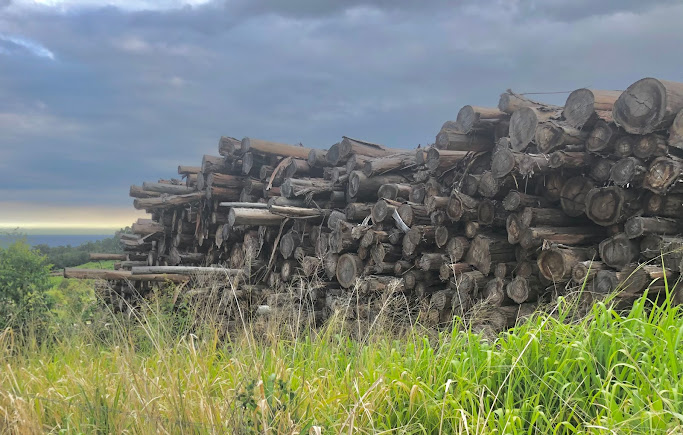
Eucalyptus logs piled up to send to the Hu Honua, which still seeks approval to open its biofuel plant north of Hilo on the coast.
The felled trees would be shipped through Hilo to burn them for electricity. Photo by Julia Neal

HAWAI'I SUPREME COURT DISMISSED BIOENERGY PLANT HU HONUA'S appeal this week to delay a Public Utilities Commission hearing on the greenhouse-gas impact of its 28-megawatt facility located on the coast north of Hilo that would burn wood to generate electricity. The hearing had been set for Jan. 31 and the court turned down the appeal to delay it further. 
    In Kaʻū, above Pahala, stands of farmed eucalyptus and piles of logs are slated to be trucked to the power plant to burn them. The harvested wood has been decaying on the ground as Hu Honua continues appeals to the state Public Utilities Commission and courts to start up the electric plant.
     With the hearing going forward, Life of the Land Executive Director Henry Curtis said, "Now we can finally cross-examine Hu Honua`s witnesses. Then the Commission will rule based on the documented facts including the higher costs, the climate change impacts, and the hidden environmental impacts," of the proposed bioenergy factory in Pepe'ekeo.    

    Opposition to the power plant's agreement to sell electricity to Hawaiian Electric includes assertions that it could pollute the ocean, contribute to climate change problems. and that burning wood was inappropriate and costly given cheaper wind, sun, hydroelectric and geothermal energy sources. Hu Honua contends that its method of making electricity by burning wood should be included in a portfolio of energy sources for the island for maximum energy security without dependence on oil and coal. Tawhiri Power, with its windmills in Kaʻū, opposes the Hu Honua plan.
    Life of the Land filed the motion with the Hawai'i Supreme Court against Hu Hunoa's appeal to require the PUC to delay its hearing on the matter. The court wrote, "any appeal by Hu Honua (including this one) merely creates unnecessary delay.”
    Life of the Land described the history of the latest court decision as follows: "Hu Honua BioEnergy LLC wants to cut down forests and burn the wood to generate electricity to be sold to HELCO. In January, Hu Honua sought an indefinite delay in the Hawai`i Public Utilities Commission's Evidentiary Hearing scheduled to have started on January 31, 2022. After the Commission rejected the idea, Hu Honua appealed to the Hawai`i Supreme Court. Life of the Land filed a motion to dismiss."
    The court issued its decision on Friday, upholding Life of the Land`s motion to dismiss.
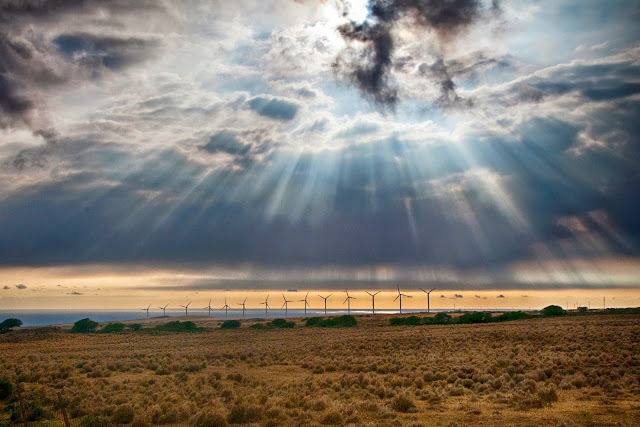
Tawhiri Power, with its windmills at South Point, opposes Hu Honua's wood burning model
for making electricity. Photo by Peter Anderson

To read comments, add your own, and like this story, see www.facebook.com/kaucalendar/. See latest print edition at www.kaucalendar.com. See February events and Kaʻū Calendar newspaper sponsors at http://kaunewsbriefs.blogspot.com/2022/02/events-of-february-2022.html

IN OVERTIME, THE TROJANS BEAT CHRISTIAN LIBERTY ACADEMY IN A PLAYOFF GAME in Girls Basketball on Saturday, Feb. 5. 
    The combined Kaʻū High and Volcano School of the Arts & Sciences team took the first two quarters over CLA with scores of 11-6 and 6-4. CLA come back with 11-3 in the third and the teams tied 11-11 in the fourth. The Trojans took the game with an 11-2 overtime. Final score was 43-34.
    Scoring for the Trojans were Tyra Wong Yuen - 25, Heidi Vidal - 7, Nalani Blanco-Louis - 4; Riley-Ann Brown - 3; Kawai Smith - 3 and Grace Smith - 1.
        For Girls Basketball, Big Island Interscholastic Semi's happen on Monday, Feb. 7 with Finals Wednesday, Feb. 9. State Finals are set for Wednesday, Feb. 16-19.
    In Boys Basketball, at home on Saturday, Feb. 5, the Trojans hosted Kohala Cowboys.
    In JV play, Cowboys took the first quarter 22 to 6. Ka'u took the second, 23-9. Kohala took the third 13 - 10 and the fourth 16 - 10. Scoring for the Trojans were: Tyson Junior Kuahuia-Faafia - 22; Collin Hanshew - 10; Keaka McDonald - 8; Ocean Nihipali-Sesson - 4; Jestin Panera - 3 and Patrick Riehle - 2.
    In Varsity play, Kohala swept through the quarters with 26-6, 15-6, 18-4 and 8-6. The final score was 67-22. Scoring for the Trojans were Kealiikoa Reyes-Nalu - 10; Ivan Ramos - 3; Michah /espejo - 3; cyrus Eder - 3; Keenan Toriano - 2 and Jonah Beck - 1.
    The next game remains at home taking on Kea'au Cougars on Thursday, Feb. 10 at 5 p.m. The Trojans travel to play the Pahoa Daggers on Friday, Feb. 11 at 5 p.m. and Waiakea Warriors on Monday, Feb. 14 at 6 p.m.

    BIIF Division II Semi Finals are Monday, Feb. 21. Finals are Wednesday, Feb. 23. The state Finals are March 3-5.
    Swimming took the Trojan team on Saturday, Feb. 5 for islandwide competition to be hosted at Kamehameha School in Kea'au. Swimmers travel again to Hawai'i Preparatory Academy on Saturday, Feb. 12.           BIIF finals are a two-day event on Friday Feb. 18 and Saturday, Feb. 19. State finals are March 4 and 5.

To read comments, add your own, and like this story, see www.facebook.com/kaucalendar/. See latest print edition at www.kaucalendar.com. See February events and Kaʻū Calendar newspaper sponsors at http://kaunewsbriefs.blogspot.com/2022/02/events-of-february-2022.html
     
FREE HELP WITH FAMILY HISTORY in Kaʻū  is available 4 p.m. to 7 p.m. every Tuesday. All are welcome to the Family History Center. The aim is to "Come Discover Your

Past," says the statement from The Church of Jesus Christ of Latter-day Saints, which hosts the weekly sessions at 95-5682 Hawai'i Belt Road in Na'alehu. The drop-in assistance includes free Ancestry.com, Family search.org, and other online resources.

To read comments, add your own, and like this story, see www.facebook.com/kaucalendar/. See latest print edition at www.kaucalendar.com. See February events and Kaʻū Calendar newspaper sponsors at http://kaunewsbriefs.blogspot.com/2022/02/events-of-february-2022.html.

APPRECIATIVE INQUIRY: LEARNING FROM EXCELLENCE IS THE KU'IKAHI MEDIATION CENTER topic for its free talk on Thursday, Feb. 17 as part of the Finding Solutions, Growing Peace Brown Bag Lunch Series. Talks are third Thursdays from noon to 1 p.m. via Zoom.

     This month's speaker is Suzanne Quinney, who explained:  "Appreciative Inquiry is a collaborative and highly participative approach to personal and community development. It identifies and enhances the 'life-

giving forces' that are present when a team, group, or business is working at its best. People become stronger when working from strengths, rather than weaknesses."
    In this talk, learn about a positive development tool for creating change, resilience, and creativity.
    Quinney specializes in appreciative and strength-based approaches, facilitating seminars and team events. Co-author of highly recommended training resources and articles on Appreciative Inquiry, she speaks at national events and international conferences. In 2019, Quinney moved back to live in NE Scotland, where she is part of the Findhorn intentional community.
    Ku'ikahi's Brown Bag Lunch Series is free and open to the public. Attendees are encouraged to enjoy an informal and educational talk-story session and connect with others interested in "Finding Solutions, Growing Peace."
    To get the Zoom link, register online at https://freebrownbagtalk.eventbrite.com. For more information, contact Ku'ikahi Mediation Center at (808) 935-7844 or info@hawaiimediation.org. Or visit www.hawaiimediation.org.
    This lunch-and-learn series is made possible thanks in part to funding from the County of Hawai'i and Hawai'i Island United Way.
To read comments, add your own, and like this story, see www.facebook.com/kaucalendar/. See latest print edition at www.kaucalendar.com. See February events and Kaʻū Calendar newspaper sponsors at http://kaunewsbriefs.blogspot.com/2022/02/events-of-february-2022.html

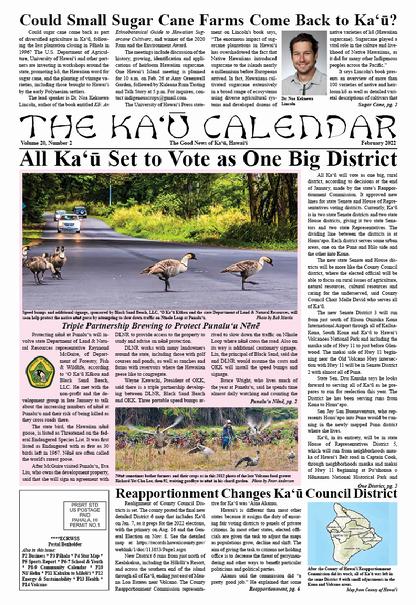
SEE FEBRUARY CALENDAR OF EVENTS & SPONSORS

See the February Print Edition of The Kaʻū Calendar at


Friday, February 04, 2022

Ka‘ū News Briefs, Friday, Feb. 4, 2022

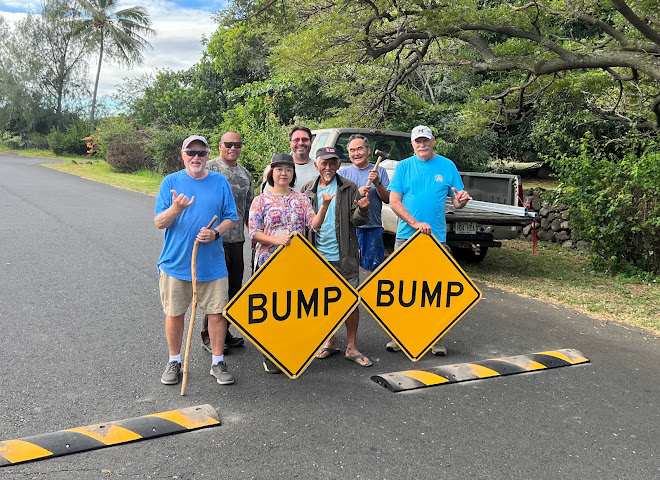
New speed bumps and signage  installed Friday on Ninole Loop aim to  slow down traffic to prevent the native nēnē goose
 from being hit by vehicles in the Punalu'u area. Helping with the installation were back row Halley Ka'awa, Jason Masters, Richard Oba and Taylor Spurcheon. Front Row Bruce Wright, Eva Liu and Wayne Kawachi, of O 
Kaʻū Kakou.
Photo by Jade Cabreros

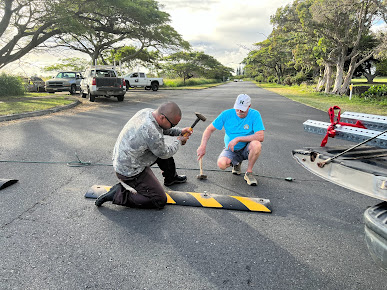
THREE SETS OF SPEED BUMPS TO PROTECT NENE that cross the road at Punalu'u were installed, along with additional signage on Friday in a three way partnership between the state Department of Land & Natural Resources, the community group O Kaʻū Kakou and land owners Eva Liu of Black Sand Beach, LLC. The aim is to slow down traffic and increase awareness that nēnē, the Hawaiian state, protected bird are in the area and walking across roads, trails and paths.
Installing the speed bumps near entrance to Punalu'u between Hwy 11
 and the condos to slow down traffic for nēnē. Photo by Jade Cabreros
      About a dozen nene are frequenting open lands at Punalu'u, particularly the golf course which was recently cleaned up and mowed by Liu and her crew. She asked that motorists going to the beach slow down to avoid hitting nēnē  that are crossing the roadways. The nene were near extinction and brought back with breeding and release programs. They enjoy golf course ponds and farm and ranch reservoirs and are spending more time at Punalu'u in recent years.

To read comments, add your own, and like this story, see www.facebook.com/kaucalendar/. See latest print edition at www.kaucalendar.com. See February events and Kaʻū Calendar newspaper sponsors at
http://kaunewsbriefs.blogspot.com/2022/02/events-of-february-2022.html
     
Nēnē geese numbers on the golf course at Punalu'u have been increasing. Photo by Eva Liu

THE RETIREMENT OF TRACKING CANINE FALCON has led to the introduction of canine Scout to the Hawai'i Police Department. Both were honored Friday at a ceremony at Onekahakaha Beach Park in Hilo.
Scout, a 20-month-old Belgian Malinois, is paired with Canine Handler Officer Corey Kaneko and assigned to the Area I (East Hawai‘i) Juvenile Aid Section, where he will help emergency responders in tracking missing children and endangered adults. Trained as a live find human tracking/cadaver canine, Scout was acquired by the department through a $16,000 donation from the Hawai‘i Island K9 Association. The donation covers purchasing Scout, his travel to Hawai‘i Island, and handler training.
    Scout began training as a live find and tracking/cadaver canine at the Houston K9 Academy in Texas, on Oct. 5, 2021. Born in the Netherlands, Scout was hand selected by Houston K9 Academy owner as a potential scent recognition dog.
    Later that same month, Officer Kaneko travelled to the Houston K9 Academy to meet a handful of potential canines for the department. He selected Scout based on the dogʻs temperament and willingness to work.
    “Every dog has the ability to track,” says Officer Kaneko. “It’s just that some track better than others and Scout shows a high drive to track. I’m thankful for getting the opportunity to go to the Houston K9 Academy and be able to make an in-person selection of Scout from three quality choices.”
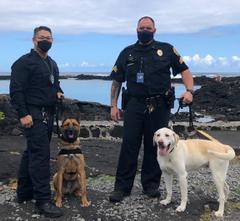
Officer Corey Kaneko and K9 Scout with Sergeant Steffen and K9 Falcon. Photo from HPD
    Once Scout was selected for the department, he received a series of vaccination shots over a period of time, further training, and received a final bill of health before arriving on island in late January.
    As Scout gets acclimated to Hawaiʻi and his new handler, both he and Officer Kaneko will undergo a final 40-hour training with a Honolulu-based certified K9 trainer, Corporal Wayne Silva, Special Services Division/Canine Unit, Honolulu Police Department (retired), the cost of which is covered by the Hawaiʻi Island K9 Association donation.
    Scout joins the department just as Falcon, a nine-year-old Labrador Retriever, retires. During his seven years with the department, Falcon was called out roughly 50 times and was responsible for the recovery of missing children who wandered away and assisted in finding endangered adults. In addition to finding people, Falcon provided valuable information on possible paths of travel concerning missing children and endangered adults, which assisted community members and/or law enforcement personnel in locating them.
    Falcon also participated in numerous educational talks with schools, community groups, and outreach programs, like Shop with a Cop. Falcon is set up to enjoy his retirement living with the family of Sgt. James Steffen, who was Falcon’s previous handler.
    “Time is always of the essence when searching for a critically missing child,” says Amanda Leonard, Coordinator/Branch Chief, Missing Child Center – Hawai'i, Crime Prevention and Justice Assistance Division, Department of the state Attorney General “Scent-tracking K9s like Scout are invaluable in helping police recover missing children quickly and safely. We appreciate Hawai‘i Island K9 Association and its supporters for this significant contribution to Hawai‘i Police Department and the Hawai‘i Island community.” Friends of Missing Children Center Hawai'i donated Scoutʻs predecessor, Falcon, to HPD and financially supported training for Falcon and another department canine.
    Police Chief Paul Ferreira said, “The police department is very grateful to the Hawai‘i Island K9 Association for their support for our department’s K9 program that allowed for the purchase of Scout and associated training for Officer Kaneko, as well as the support for our programs that we receive from MCCH and the Friends of MCCH. Through community partnerships such as these we are able to enhance our abilities in responding to calls for locating missing children and endangered adults here on Hawai‘i Island.”

To read comments, add your own, and like this story, see www.facebook.com/kaucalendar/. See latest print edition at www.kaucalendar.com. See February events and Kaʻū Calendar newspaper sponsors at
http://kaunewsbriefs.blogspot.com/2022/02/events-of-february-2022.html

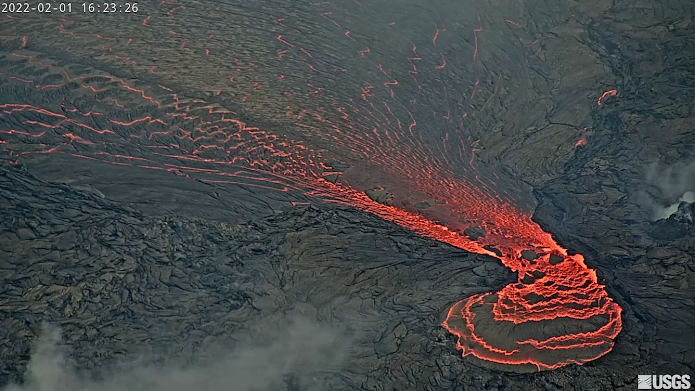
Recent activity at the lava lake in Halema‘uma‘u crater, at the summit of Kīlauea. Lava upwelling at the western vent flows into the lake, where bubbling is commonly present. USGS image by M. Patrick

KILAUEA'S SUMMIT THAT COMES AND GOES is the title of this week's Volcano Watch written by scientists and affiliates of USGS Hawaiian Volcanoes Observatory:
Kīlauea's summit glow comes and goes frequently these days. This is due to a pattern of pauses in lava lake activity within Halema'uma'u crater over the last two and a half months. Cycles last several days to a week and consist of a couple days of visible lava lake activity, followed by one to three days without lava.
    HVO is monitoring four main data streams to help us understand why Kīlauea is exhibiting this behavior. Tilt data records ground deformation of the volcano and is thought to reflect the pressurization level of Kīlauea's shallow summit magma chamber.
    Kīlauea's summit region has remained relatively flat since mid-October, but superimposed on the flat signal are small, pronounced deflation/inflation events. This is the first monitoring signal to show change when the cycle is beginning. On Nov. 7, 2021, Kīlauea summit tilt started showing larger deflation-inflation events (DI) than were seen in the previous month. At the bottom of each of these deflation cycles the lava drained from the vent and active lava lake, though it occasionally bubbled within an embayment immediately north of the west vent in Halema'uma'u.
    But lava is not gone for good when this happens, nor has it gone far. It sits just below the surface, far enough out of sight that the glow disappears, but close enough to reemerge at the end of the cycle. The tilt needs to "recover" the amount of deflation that stopped the glow (plus a little extra).
Plots of volcano monitoring data
 Plots showing the correlation between Kīlauea summit sulfur dioxide emissions (SO2) (top panel), ground tilt (middle panel), and seismic tremor (RSAM) (lower panel) for the period of November 1, 2021, to January 22, 2022.  Eruptive pauses and highly diminished activity are highlighted in blue. USGS plots
    Magma builds up pressure to reestablish the pathway to the surface and reappears near the top of the inflation cycle.Volcanic tremor, measured by seismometers, provides another set of clues. At the start of the deflationary trend the seismic tremor drops abruptly to very low levels. Tremor indicates that magma and gas are moving at very shallow levels in the volcano. When that signal dies off, we can infer that the magma is no longer trying to erupt.
    Tremor does not restart until near the top of the inflationary cycle, but once it does, lava reappears inside the west vent within 10 to 30 minutes.Gas data shows large fluctuations in sulfur dioxide (SO2) emissions that coincide with fluctuations in lava lake activity. When the lava lake is active during the peak of the inflationary cycle, the SO2 emission rate ranges anywhere from about 2,000–6,000 tonnes per day (t/d) of SO2.
    During decreased and paused parts of the cycle, emissions drop drastically to 100 to 300 t/d of SO2.Finally, let's discuss the geologic observations of what happens within Halema'uma'u crater as a cycle progresses. During the deflationary part of the cycle, the active lava lake surface motion begins to slow down, crust over, and the level of the active lava lake drops up to 10m (33 ft).

The small 20-meter (66 foot)-wide pond to the north of the west vent in Halema‘uma‘u crater. This pond feeds the active part of the lava lake at the summit of Kīlauea volcano via a small cascade of only a meter or two (several feet) down into the larger lava lake. This photo was taken around 9:30 a.m. on Tuesday, February 1, 2022, from the west rim of Halema‘uma‘u. USGS photo by D. Downs

    These "draining events" are often accompanied by dozens of small spattering sources within the lake and overturns of the newly-formed crust. The solidified surface texture of the lava takes on a more rough and jagged appearance instead of a smooth and flat texture. In some past cycles, once the lava reached a stable, minimum level, minor activity continued in the embayment including the occasional lava crust overturning.
    This activity, when present, is maintained until the inflationary period recovers the lost deflation, and tremor begins. Reappearance of the lava is followed by increased SO2 emissions.
    When lava returns, it arrives inside the west spatter cone first, often overflowing the cone. The eembayment north of the west vent cone fills with lava, which flows rapidly into the active lake area. This activity usually increases for several hours until the lava lake overflows its levee margins, building them up a little higher while also filling in lower sections of the older inactive lava crust from earlier in the eruption. The lava lake activity ultimately stabilizes within the levees until the next deflationary cycle begins.
    During the dozen cycles spanning November 2021 to present, these data streams have given us a pattern to anticipate both the disappearance and return of glow at Kīlauea summit (for now). So, if you're planning a visit to Hawaiʻi Volcanoes National Park to view the glow, be sure to check Kīlauea's eruption status and webcams at the USGS Hawaiian Volcano Observatory website: usgs.gov/hvo.

To read comments, add your own, and like this story, see www.facebook.com/kaucalendar/. See latest print edition at www.kaucalendar.com. See February events and Kaʻū Calendar newspaper sponsors at
http://kaunewsbriefs.blogspot.com/2022/02/events-of-february-2022.html


Thursday, February 03, 2022

Ka‘ū News Briefs, Thursday Feb. 3, 2022

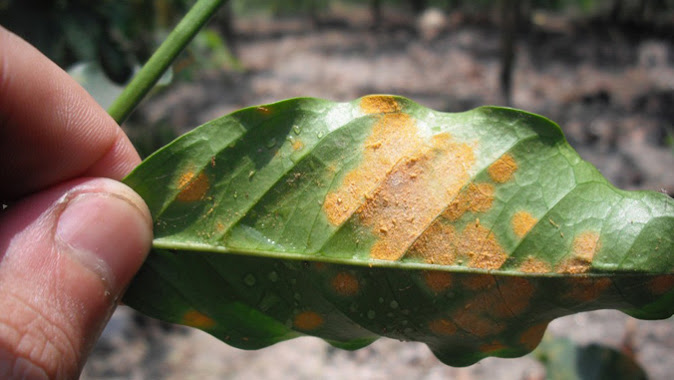
The Coffee Leaf Rust & Needs Assessment survey is open to all stakeholders until Feb. 15. The disease is in Kaʻū and has devastated coffee regions around the world.  See more below. Photo from U.H.

EIGHTEEN MAJOR TRAFFIC COLLISIONS IN ONE WEEK has led Mayor Mitch Roth to urge Hawaiʻi County residents to implore safe driving practices on Hawaiʻi Island's roadways. Two accidents were fatal. A motorcycle collision on Thursday, Jan. 27, left one person dead, and a three-car crash on Sunday, Jan. 30 left three dead. The motorcycle incident occurred on Highway 11 in Captain Cook, and police believe that speed was a possible factor in the collision. The operator was also not wearing a helmet. Inattention and speed are among the possible factors in a multi-vehicle incident that killed three along Highway 11 in Glenwood.
    Between January 1-31, there have been four fatal collisions, resulting in six fatalities. That is compared with three fatal collisions, resulting in three fatalities for the same time in 2021. This is an increase
of 33.3% for fatal collisions and 100% for fatalities. 
    “We are asking that our residents drive with aloha and great attention to ensure that everybody gets home to their families and loved ones safely,” said the Mayor. “It is incredibly saddening to know that better practices on our roadways could have saved the lives of six members of our community this past week. Our administration sends our deepest condolences to the families of those who lost their lives and asks the community to think about them, remember them, and ultimately honor them by following the rules of the road. These sorts of traffic collisions are preventable and can be limited by being alert, aware, and attentive to ourselves, the roadways, and each other. Together, we can make our roads a safer place for all.”
    Police Chief Paul Ferreira said, “Every fatal traffic collision on Hawai‘i Island roads is a tragedy that forever impacts the victim’s families, friends, and our community. Hawai‘i Police Department remains steadfast in its commitment to reducing these needless deaths via traffic enforcement, community outreach, and education. We need everyone to do their part. There’s #noexcuse for any form of dangerous driving.”

To read comments, add your own, and like this story, see www.facebook.com/kaucalendar/. See latest print edition at www.kaucalendar.com. See February events and Kaʻū Calendar newspaper sponsors at
http://kaunewsbriefs.blogspot.com/2022/02/events-of-february-2022.html

THE COFFEE LEAF RUST & NEEDS ASSESSMENT SURVEY IS DUE FEB. 15 and University of Hawai'i Extension Agent Andrea Kawabata is urging Kaʻū Coffee farmers, processors, producers, workers and other industry stakeholders to complete it and turn it in. Gift cards valued at $150 each will be given randomly to four of those who complete the survey.   
     Kawabata said, "I am conducting a 
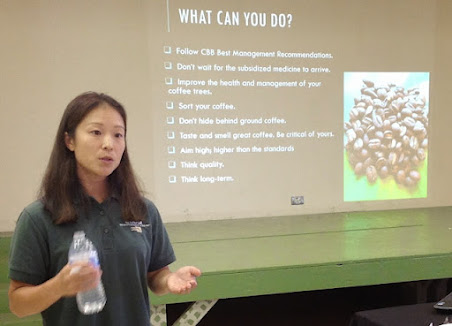
Andrea Kawabata giving a talk to Ka'u Coffee farmers during
pre-pandemic times. Photo by Julia Neal
Hawai'i coffee industry needs assessment and coffee leaf rust survey
 and seeking input from you. The purpose of this survey is to help me, Cooperative Extension, and researchers
develop a clearer picture of the current coffee industry situation in the state, in order to develop programs and strategies to help support the industry." 
    She said benefits of this coffee industry needs assessment include: Gaining a snapshot of opportunities and challenges of producing coffee in Hawaii; developing a clearer understanding of gaps in communication, education, and research; and providing Cooperative Extension, researchers, funding agencies, and other stakeholders with a resource that will help them develop programs that best meet the needs of Hawaii's coffee industry.
     The online survey takes about 30-45 minutes to complete. Those who close their browser or need to complete the survey at a later time will be able to pick up where they left off. Kawabata noted that "all information will be kept secure and precautions will be taken to ensure confidentiality of responses. The results will be shared in aggregate form in reports, presentations, and peer-reviewed publications."
    She said all stakeholders are encouraged to complete the survey "to ensure their challenges, successes, needs, concerns, and interests are heard and recorded." Deadline for responding to this survey is Feb. 15.
    Following survey completion, those choosing to enter their names into a drawing for a $150 gift card may do so by clicking a separate link and entering contact information and code provided at the end of the survey. The four winners of $150 gift cards will be randomly selected following the close of this survey.
    Survey: https://www.surveymonkey.com/r/hicoffeesurvey.

To read comments, add your own, and like this story, see www.facebook.com/kaucalendar/. See latest print edition at www.kaucalendar.com. See February events and Kaʻū Calendar newspaper sponsors at
http://kaunewsbriefs.blogspot.com/2022/02/events-of-february-2022.html

KA‘Ū RURAL HEALTH COMMUNITY ASSOCIATION will partner with Kaiser Permanente on Saturday Feb. 26 in Pahala to provide Covid 19 Vaccine Clinic.

A MONTHLY COOKING SHOW FROM U.H. COLLEGE OF TROPICAL AGRICULTURE  will be Friday, Feb 11, in advance of Valentine's Day. The event is free and anyone can join through 
form.jotform.com/220036652572148

DEADLINE TO APPLY FOR THE ORGANIC & TRANSITIONAL EDUCATION & CERTIFICATION funding is Feb. 4. The program is administered by USDA's Farm Service Agency.
    Certified operations and transitional operations may apply for OTECP for eligible expenses paid during the 2020 and 2021 fiscal years during this signup period. Signup for the 2022 fiscal year will be announced at a later date.
     For each year, OTECP covers 25% of a certified operation's eligible certification expenses, up to $250 per certification category (crop, livestock, wild crop, handling and State Organic Program fee). This includes application fees, inspection fees, USDA organic certification costs, state organic program fees and more.
    Crop and livestock operations transitioning to organic production may be eligible for 75% of a transitional operation's eligible expenses, up to $750, for each year. This includes fees charged by a certifying agent or consultant for pre-certification inspections and development of an organic system plan.
      For both certified operations and transitional operations, OTECP covers 75% of the registration fees, up to $200, per year, for educational events that include content related to organic production and handling in order to assist operations in increasing their knowledge of production and marketing practices that can improve their operations, increase resilience and expand available marketing opportunities. Additionally, both certified and transitional operations may be eligible for 75% of the expense of soil testing required under the National Organic Program to document micronutrient deficiency, not to exceed $100 per year.
     Producers apply through their local FSA office and can also obtain one-on-one support with applications by calling 877-508-8364. The program application and additional information can be found at farmers.gov/otecp.     
    Providing additional organic support, OTECP builds upon USDA's Organic Certification Cost Share Program, which offers cost share assistance of 50%, up to a maximum of $500 per scope, to producers and handlers of agricultural products who are obtaining or renewing their certification under the NOP. Although the application period for OCCSP ended Nov. 1, 2021, FSA will consider late-filed applications for those operations who still wish to apply.
    Meanwhile, USDA's Risk Management Agency (RMA) recently made improvements to Whole-Farm Revenue Protection to make it more flexible and accessible to organic producers.
    To learn more about USDA's broader assistance for organic producers, visit usda.gov/organic.

To read comments, add your own, and like this story, see www.facebook.com/kaucalendar/. See latest print edition at 
www.kaucalendar.com.  See February events and Kaʻū Calendar newspaper sponsors at

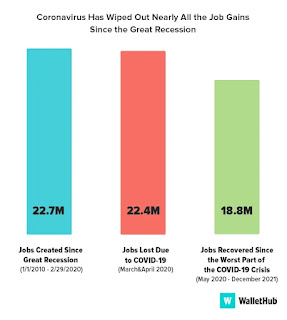
HAWAI'I IS ONE OF THE TEN LEAST EMPLOYMENT RECOVERED STATES, since the beginning of the pandemic, according to a WalletHub study released Thursday. The top ten most recovered states are Delaware, Rhode Island, New Hampshire, Maryland, Arkansas, South Carolina, Kansas, South Dakota, Arizona and Virginia.The least recovered are Hawai'i ranking 42nd, followed by Utah, West Virginia, Alabama, Michigan, California, Kentucky, District of Columbia, Tennessee and Indiana.The study is based on unemployment claims across the country last week. Every state had fewer unemployment claims last week that the same week last year and 29 nine had lower unemployment than before the pandemic. The study presents a graph showing that Coronavirus wiped about nearly all the jobs created between January of 2010 and March of 2020 - after the Great Recession.

To read comments, add your own, and like this story, see www.facebook.com/kaucalendar/. See latest print edition at www.kaucalendar.com.  See February events and Kaʻū Calendar newspaper sponsors at

TROJANS BEAT HILO VIKINGS in JV boys basketball at home  Thursday evening with the final score 46 - 42. Scoring for the Trojans were Collin Hanshew - 18, Tyson Junior Kuahuia-Faafia - 10, Jestin Penera - 8, Keaka McDonald - 6, Patrick Riehle - 2, and Triton Blanco - 2. Hilo took the first two quarters with 14-10 in each. Kaʻū took the third and fourth with 14-8 and 12-6.
    In the Varsity game, Hilo came up with 67 and Kaʻū 35. Trojans scoring were Micha Espejo - 8, Ivan Ramos - 6, Jensen Villa - 6, Kaimana Kaupu-Manini - 5, Cyrus Eder - 4, Kealiikoa Reyes-Nalu - 3, and Emman Badua - 2.  The first quarter saw Kaʻū with 7 and Hilo 18. Second and third quarters went to Hilo again with 27-6 and 18-13. Kaʻū took the fourth with 9-4.

To read comments, add your own, and like this story, see www.facebook.com/kaucalendar/. See latest print edition at www.kaucalendar.com.  See February events and Kaʻū Calendar newspaper sponsors at