
About The Kaʻū Calendar

Tuesday, February 08, 2022

Ka‘ū News Briefs, Tuesday Feb. 8, 2022

Healthier Organizations for Everyone is named HOE (Hoy) to reflect the Hawaiian meaning "to paddle,"  when every person
garners a critical role and is responsible for pulling their weight. Photo from Community First

HEALTHIER ORGANIZATIONS FOR EVERYONE, a Covid testing program for businesses, was announced by Mayor Mitch Roth on Tuesday. Healthier Organizations for Everyone, HOE - pronounced Hoy in Hawaiian, will be administered by County of Hawaiʻi in partnership with Community First  through its Our Kuleana Pledge Partners to help prevent workplace spread through travel-related testing.  
    Participating organizations are encouraged to provide a rapid test to all employees, vaccinated and unvaccinated, before traveling off-island and collect rapid test results 24-hours before the employee's anticipated return to the workplace. The statement from the county says, "Employees who receive a positive or inconclusive test result should inform their employer before returning to the workplace. Employees who receive a negative rapid test result may return to the workplace without additional testing."

    The Mayor said, "At the heart of a healthy economy is a healthy and vibrant workplace. We have reached a point in the pandemic where we must continue to march forward as a community. Through partnerships with our on-island businesses to test employees who travel off-island, we believe that we can prevent a majority of workplace spread and ultimately reduce community spread islandwide. That said, we are incredibly grateful for all of the businesses who jumped at the opportunity to join us in this effort and continue to welcome all Hawaiʻi Island businesses to sign up if they haven't already.
      "Our Kuleana Pledge Partners continue to help curb the spread of COVID-19 in our community through their safe workplace practices. The HOE Program allows businesses to take their effort to another level, for their organization, their family, and their community through this opportunity for testing employees who travel offisland." 
    Vanessa Carlson, Program Manager Community First, said that since the program's launch on Feb. 4, 18 partnerships have been created in agreement with the HOE testing program. In addition, the first 100 businesses to sign up for the program will receive 20 free rapid tests procured by Community First Hawaiʻi as part of an incentive to join the collective effort. Individual businesses are responsible for purchasing all other tests per the program. 
    To learn more about this program, visit: www.hawaiicounty.gov/healthyorg.

     Hawaiʻi Community First is a 501 (c) 3 non-profit founded by the late Barry Taniguchi in 2014 to serve as a neutral forum for the community to come together and as a catalyst for solutions to improve health and lower medical costs on Hawaiʻi Island based on the community good. 
    The county statement says, "Through its programs, Community First hopes to shift the healthcare model from reactively treating disease to proactively caring for the health of every person on Hawaiʻi Island." 
   It also says that the word hoe, pronounced "hoy" in ʻŌlelo Hawaiʻi, "translates to paddle. In a canoe or waʻa, every person garners a critical role and is responsible for pulling their weight. With each paddle stroke, the waʻa gets closer to its desired destination. However, if every paddle does not move in perfect harmony, the journey becomes much longer. Throughout this pandemic, we have seen every sector of our community paddling harmoniously, with one common goal – protecting each other and keeping each other safe. That is why we have been able to glide through the rough waters of this pandemic and are closer than ever to our destination. The word hoe can also mean to travel and is suiting since the purpose of the business testing is travel related."

To read comments, add your own, and like this story, see www.facebook.com/kaucalendar/. See latest print edition at www.kaucalendar.com. See February events and Kaʻū Calendar newspaper sponsors at http://kaunewsbriefs.blogspot.com/2022/02/events-of-february-2022.html.

NEWEST CANDIDATE ANNOUNCING FOR HAWAIʻI COUNTY COUNCIL DISTRICT 6 is Jordan J Anger of Hawaiian Ocean View Estates. The district runs from north of Captain Cook through all of Kaʻū to include much of Volcano Village. Anger graduated from Konawaena in the class of '99 and has lived in Ocean View for eight years with his wife, Ayla, son, Gavin, and mother-in-law, Joy. Although Anger has no political background or affiliation, he says he has a strong background in business. "I've worked for a fortune 500 company, mom-and-pop businesses, and have helped with the creation and development of successful businesses on this island."
Jordon C. Anger, of Ocean View,  has announced he
is running for County Council.
 
    Anger said he looks forward to addressing issues impacting the Kaʻū community, stating: "I believe in this community and am concerned about the abandoned vehicles that have come to line our roadways, the ever-rising crime rates, and the fact that there are so few local jobs in District 6."
    On Thursday, Feb. 3, Anger gave testimony before a state Senate Committee regarding SB3211. The bill was introduced by Sen. Dru Kanuha after his visit to Hawaiian Ocean View Estates in December 2021. The bill would appropriate funds to the County of Hawaiʻi for the plans, design, and construction of a police substation in HOVE. During his testimony, Anger said that since living in HOVE, "we have seen a dramatic increase in crime in the area... The need for a police substation in Hawaiian Ocean View Estates is felt by all in the community, those who have lived here for decades and those who are just moving to the area. Since moving here, we have witnessed abandoned cars being dumped, arson, stolen cars roaming around the area, cars without plates or windshields driving around with little consequence, drug usage, and we have read of countless burglaries, theft, and assaults." He concluded that, "it seems an awful unnecessary burden for the officers who work so hard in our community to have to travel all the way to the opposite end of Nāʻālehu to book and process. Our community in HOVE deserves the best response time our good officers can provide."

    To learn more about Anger's stance, visit his campaign page on Facebook at https://www.facebook.com/JordanJAnger/.

To read comments, add your own, and like this story, see www.facebook.com/kaucalendar/. See latest print edition at www.kaucalendar.com. See February events and Kaʻū Calendar newspaper sponsors at http://kaunewsbriefs.blogspot.com/2022/02/events-of-february-2022.html.

A post on Rep. Jeanne Kapelea's website,supporting working family legislation.
WORKING FAMILIES                LEGISLATIVE CAUCUS has been launched in the state House of Representatives and Senate under leadership of Rep. Jeanne Kapela and a diverse collection of lawmakers in the 2022 Hawai'i Legislature.
    Kapela represents the House of Representatives District from South Kona to Honu'apo.
    According to a post on Kapele's website at www.capitol.hawaii.gov/memberpage.aspx?member=Kapela, the coalition has formed "to elevate legislative efforts aimed at improving economic conditions for
much of the local working class, including households with children."
    Thirteen Democrats and the one Republican in the state House and Senate formed Working Families Caucus. They sponsored five bills, aiming to improve finances of lower-income residents through higher wage and benefits, plus changes in tax policy, says the post on Kapela's website.
Kapela, who represents Honu'apo into Captain Cook-Keauhou, led the formation of the caucus and serves as serves as chair. The post quotes her saying, “I think it’s about time that we push for, fight for and pass legislation that will uplift Hawaii’s working families.

To read comments, add your own, and like this story, see www.facebook.com/kaucalendar/. See latest print edition at www.kaucalendar.com. See February events and Kaʻū Calendar newspaper sponsors at http://kaunewsbriefs.blogspot.com/2022/02/events-of-february-2022.html.

HAWAI'I HOCHI, FOUNDED IN 1912 as a Japanese language newspaper, has opened a new print house on O'ahu. Hawai'i Hochi is the longtime printer for The Kaʻū Calendar newspaper and many other publications with independent voices. Hawai'i Hochi, LTD. held a blessing on Feb. 4 for its new 20,000 square foot facility.
    Hawai'i Hochi's parent company, Shizuoka Shimbun, based in Japan, prints the only Japanese language newspaper in Hawai'i. Its 110 year history in Hawai'i has included printing publications in Japanese and other languages for the Filipino, Hawaiian and other ethnic communities and specialty publications focusing on everything from fishing to surfing to church and school.
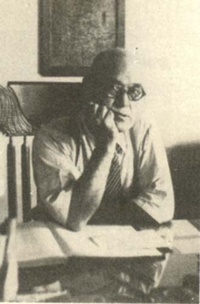
Kinzaburo Makino, who lived in Na'alehu, when he first arrived
 to the islands, founded Hawai'i Hochi in 1912.  The company
 prints The Ka'u Calendar newspaper and many other
publications. Photo from Hawai'i Hochi
     Japanese newspapering in Hawai'i began in 1892, seven years after the first major wave of contract laborers, with the Nippon Shuho (Japanese Weekly).
    Taro Yoshida, president of Hawai'i Hochi, LTD, said, "I am happy to say that Hawaii Hochi will continue its 110-year tradition of serving the Japanese community in Hawaii and strengthening the bridge between Hawaii and Japan through its publications — the Hawaii Hochi and the Hawaii Herald — while expanding our offerings of various types of printing services." 
    The Hawai'i Hochi was founded by Frederick Kinzaburo Makino as an independent newspaper in December of 1912. A journalism history from University of Hawai'i states that Makino "printed the first copies of what he hoped would become the voice of the Japanese community in Hawai'i."
    Makino was the son of an English merchant in Yokohama, Japan and a Japanese mother Kin Makino. His father died when he was young and his elder brother Joe Makino moved to Nāʻālehu and operated a store in Makino Camp. Kinzaburo Makino moved to Nāʻālehu when he was 21 and worked in his brothers store, until he became a bookkeeper for a sugar plantation. He moved on to Honolulu where he opened a drug store at Hotel Street and Nu'uanu Avenue and became a legal consultant for Japanese immigrants. 
    He involved himself in the Higher Wage Association, becoming its President and lobbying the Hawai'i Sugar Planters Association for higher pay. He was imprisoned for "conspiring to hinder plantation operations,' but pardoned after four months. With all of the Japanese and English language newspaper siding with the plantation on labor issues, Makino decided to publish Hawai'i Hochi.
         The University of Hawai'i report says that the Hawai'i Hochi (Hawai'i News) "became that brave -- and often lonely -- voice, supporting, as writer Wayne Muromoto said, 'the common people, women's rights, nonintervention ... restraint of American and Japanese Imperialism, the growth of labor unions and the preservation of ethnic cultures and languages ....' Makino's Hochi outlived three major competitors and numerous weekly and occasional publications to survive as Hawai'i's only remaining Japanese language daily newspaper."
    The expansion of Hawai'i Hochi today makes it possible in the future to print all of the pages for The Kaʻū Calendar and other small community and specialty publication in color.

To read comments, add your own, and like this story, see www.facebook.com/kaucalendar/. See latest print edition at www.kaucalendar.com. See February events and Kaʻū Calendar newspaper sponsors at http://kaunewsbriefs.blogspot.com/2022/02/events-of-february-2022.html.
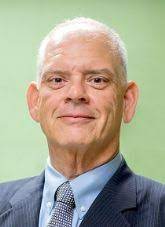
The late Brian DeLima
BRIAN DELIMA, A HILO ATTORNEY, WELL KNOWN IN KA'U, HAS DIED. U.S. Congressman Kaialiʻi Kahele issued the following statement upon the passing of Brian J. De Lima:
   "When it comes to Brian De Lima, many will remember him as a true servant leader. He lived to fight for his community, and provided a voice for those who felt they had none, in particular, as a champion and advocate of children with special needs. He served as a member of the Board of Education, Hawaiʻi County Council, and held leadership positions as part of the Democratic party of Hawaiʻi. Maria and I extend our heartfelt condolences to his family, especially his wife Paige, and daughters, Blaise and Blaire. We are forever grateful for his significant contributions to Hawaiʻi. He will be dearly missed."

To read comments, add your own, and like this story, see www.facebook.com/kaucalendar/. See latest print edition at www.kaucalendar.com. See February events and Kaʻū Calendar newspaper sponsors at http://kaunewsbriefs.blogspot.com/2022/02/events-of-february-2022.html.


SEE FEBRUARY CALENDAR OF EVENTS & SPONSORS

See the February Print Edition of The Kaʻū Calendar at
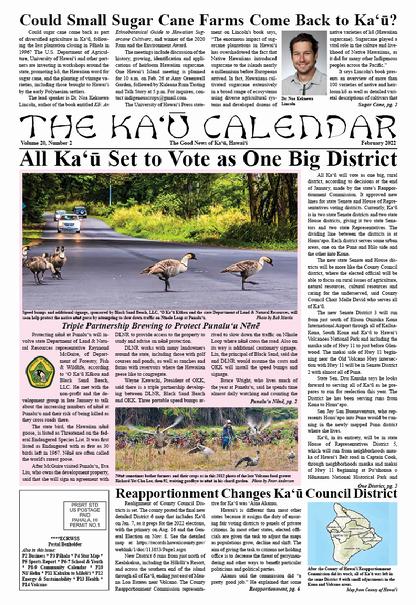

Monday, February 07, 2022

Ka‘ū News Briefs, Monday Feb. 7, 2022

Farm Dog of the Year contest celebrates farm dogs and the many ways they support farmers and ranchers in producing nutritious
food for families and their pets. Enter at
 https://www.fb.org/land/fdoty See more below. Photo from the Farm Bureau

HAWAI'I FARMERS UNION UNITED is encouraging folks to weigh in on agriculture related bills before the 2022 Hawai'i Legislature and is asking for people to send their approval for the ones listed below.
    See  www.capitol.hawaii.gov where citizens can search for any subject, any bill, and any sponsorsof legislation, as well as follow each Senate and House bill's progress. Click on the number of each House and Senate bill below to read them and give testimony. Farmers Union is asking for testimony by Tuesday  at 10 a.m. on the following:

    HB2028 - Relating to Raw Milk. Authorizes and decriminalizes the sale of raw milk and raw milk
products directly to consumers for human consumption, with certain restrictions. Requires the Board of Agriculture to adopt rules governing the direct sale of raw milk and raw milk products. Establishes labeling requirements. 

  HB2285 - Relating to Hemp. Repeals the 6/30/2022 sunset date of Act 14, SLH 2020, which established statutory provisions relating to hemp production and processing.

    HB2431 - Relating to Sustainable Food Systems. Establishes the sustainable food systems working group within the office of planning and sustainable development.

Tony Vera is the speaker at the first workshop of the year for Ka'u chapter of Hawai'i
 Farmers Union United this Thursaday, Feb. 10 at 10 a.m. at the Mamaki Farm in Wood
 Valley. The subject is Natural & Ancestral Farming Techniques.

    SB3004 - Relating to Composting. Establishes and appropriates funds for a compost reimbursement program within the department of agriculture and one full-time permanent compost reimbursement program manager position to oversee the program. Requires an annual progress report of the program to the legislature prior to each regular session.

   HB2493 - Relating to Carbon Sequestration Incentives. Establishes the Hawaii farmland and forest soil health carbon smart incentive program (program) to incentivize carbon sequestration activities through incentives contracts that provide for compensation for eligible practices by program participants. Appropriates funds for positions and for administering the program.

To read comments, add your own, and like this story, see www.facebook.com/kaucalendar/. See latest print edition at www.kaucalendar.com. See February events and Kaʻū Calendar newspaper sponsors at http://kaunewsbriefs.blogspot.com/2022/02/events-of-february-2022.html

A WORKSHOP ON NAURAL AND ANCESTRAL FARMING TECHNIQUES will be held this Thursday, Feb.10 at Wood Valley Mamaki Farm at 10 a.m. The speaker is Tony Vera, owner of Mayan World Farm. Cost is $10 for members and $25 for nonmembers. RSVP to kau@hfuu.org

To read comments, add your own, and like this story, see www.facebook.com/kaucalendar/. See latest print edition at www.kaucalendar.com. See February events and Kaʻū Calendar newspaper sponsors at http://kaunewsbriefs.blogspot.com/2022/02/events-of-february-2022.html

FARM BUREAU FARM DOG OF THE YEAR for 2023 competition is open with the deadline to submit photos, stories and videos of top farm and ranch dogs on July 1. The Hawai'i Farm Bureau made the announcement of the nationwide call to select best farm dogs. Hawai'i falls into the western district of the competition, which includes farm and ranch dogs from Alaska, Arizona, California, Colorado, Hawai'i, Idaho, Montana, New Mexico, Nevada, Oregon, Utah, Washington, Wyoming.
Ranchers and farmers can enter their dogs to the
Farm Bureau Farm Dog of the Year contest.
See https://www.fb.org/land/fdoty
    The Farm Dog of the Year contest celebrates farm dogs and the many ways they support farmers and ranchers in producing nutritious food for families and their pets across America. Farmers can can submit applications for the 2023 Farm Bureau Farm Dog of the Year contest, supported by Purina.
    The grand prize winner – Farm Bureau Farm Dog of the Year – will win a year’s worth of Purina Pro-Plan dog food and $5,000 in prize money. The winner will be recognized at a Farm Dog of the Year award ceremony at the American Farm Bureau Federation Convention in January 2023. Up to four regional runners-up will each win $1,000 in prize money.
    The 2022 Farm Bureau Farm Dog of the Year is Fit, who herds sheep on a Florida ranch.
    In addition to the Farm Dog of the Year competition, beginning in October, members of the public are invited to vote online for their favorite dog in the People’s Choice Pup part of the overall competition. The People’s Choice Pup will win bragging rights and Purina products including one year’s worth of Purina Pro-Plan dry dog food. The winner of People’s Choice Pup, along with the Farm Dog of the Year and runners-up, will be announced in January at AFBF’s Convention.
Learn about 2022 Farm Dog of the Year named Fit and the upcoming
contest for 2023 at https://www.fb.org/land/fdoty

    A panel of judges selected by the American Farm Bureau Federation shall select the winners. Judging of the contest will be based on nomination materials submitted. Desired attributes in the Farm Dog of the Year are helpfulness to the farmer and his/her family, playfulness and obedience. See more at https://www.fb.org/land/fdoty.  
    Learn about Fit, the 2022 Farm Dog of the Year at https://www.fb.org/land/fdoty.

To read comments, add your own, and like this story, see www.facebook.com/kaucalendar/. See latest print edition at www.kaucalendar.com. See February events and Kaʻū Calendar newspaper sponsors at http://kaunewsbriefs.blogspot.com/2022/02/events-of-february-2022.html.


A RECENT SURGE IN USE OF COUNTERFEIT BILLS ACROSS THE ISLAND has drawn Hawai‘i Police Department to warn the public.
The warning issued on Monday states that "Within the past three months, more than 14 separate investigations have been initiated islandwide involving the use of counterfeit bills ranging in denominations from $5 dollar to $100 bills. The counterfeit bills were presented to both private individuals and to retail employees in exchange for monetary goods or services.
    "In many instances, the counterfeit bills have markings indicating that the bill is 'prop' money with writing such as 'for motion picture purposes,' and 'this note is for motion picture purposes, it is not legal tender,' also 'motion picture purposes,' and 'in props we trust' on either the front or the back of the bill.
    The printing of counterfeit bills and the usage of counterfeit bills to obtain goods or services is prohibited under both state and federal law and are felony offenses punishable by up to ten years of incarceration and monetary fines.
    Hawai‘i Police Department "encourages the public and retail employees to thoroughly inspect all U.S. currency and to notify police if they come across fraudulent bills in order to prevent the monetary loss of goods or services. Taking note of individual characteristics of the person presenting the counterfeit bill along with their behavior patterns may assist law enforcement in identifying, apprehending, and prosecuting suspects."
People can also protect themselves against falling susceptible to counterfeit bills by learning about the different security features of denominations of U.S. currency at The Seven Denominations | U.S. Currency Education Program (uscurrency.gov). I
Those who have fallen victim to counterfeit bills, please contact the police department’s non-emergency line at (808) 935-3311.

To read comments, add your own, and like this story, see www.facebook.com/kaucalendar/. See latest print edition at www.kaucalendar.com. See February events and Kaʻū Calendar newspaper sponsors at http://kaunewsbriefs.blogspot.com/2022/02/events-of-february-2022.html.

SEE FEBRUARY CALENDAR OF EVENTS & SPONSORS

See the February Print Edition of The Kaʻū Calendar at


Sunday, February 06, 2022

Ka‘ū News Briefs, Sunday, Feb. 6, 2022

Miloli'i Canoe Club is back in action with practices starting this Tuesday. Its quiver of canoes includes the historic koa canoe,
 the Malolo, shown here. Photo from Miloli'i Canoe Club

MILOLI'I CANOE CLUB RELAUNCHED on Saturday, when more than 30 new and returning paddlers gathered near shore of the remote fishing village to sign up for the 2022 paddling season. The last competitive paddling events were held in 2019, before the pandemic shut down races statewide.
    President of Miloli'i Canoe Club, Elroy Reyes, was born and raised in Miloliʻi and was one of the founding members of the club when it reorganized in 2015, with help from Pa'a Pono Miloli'i. Reyes said the 2015 relaunch came after 81 years of no involvement in statewide canoe racing.
Saturday was registration day for the 2022 paddling
season. Photo from Miloli'i Canoe Club
    However, many Miloli'i villagers kept up their physical strength over the decades through paddling their own personal 'opelu canoes, often on a daily basis, to fish for 'opelu to feed their families and community. Hoe wa'a (canoe paddling) remains a longtime tradition for the families of the fishing village of Miloli'i. 
    The Miloli'i Canoe Club has carried this strength forward by doing well in the statewide paddling seasons before the pandemic. Many of the paddlers who signed up for the new season on Saturday have lineage to generations of kupuna of the village who paddled canoe.
    One of the sacred members of the Miloli'i Canoe Club is the Malolo, a 40-foot koa wood waʻa (canoe). Reyes said the Malolo may be the oldest canoe in the state of Hawaiʻi. His great grandfather, Kekumu Kawaauhau, built it in 1928. In 1954, the Malolo won the Molokaʻi Channel Race in record-breaking time. 
Miloli'i Canoe Club President Elroy Reyes, left, with the Malolo, a koa
 canoe built in 1928 by his great grandfather, Kekumu Kawaauhau.
Photo by Katie Graham
   The Malolo has a sister waʻa, Naiʻa, who is housed by the paddlers of Hui Waa O Waiakea in Hilo. "They are twins, carved from the same koa log. Malolo is the brother and Naiʻa is the sister," said Reyes.  The Malolo was restored in 2015 by Bill Rosehill. 
    Reyes said, "My job is to be the steward of the canoe," which continues to be a central part of the Miloliʻi Canoe Club. 
    To register and learn more about the club, email miloliicc@gmail.com. Adults and keiki ages 8 and up are welcome for membership. Current County pandemic guidelines will be followed for outdoor gatherings and practice.
    Those who would like to support the Miloliʻi Canoe Club, can consider a monetary donation. More details on donating can be found at paaponomilolii.org/projects/milolii-canoe-club.
Miloli'i Canoe Club paddlers celebrated a victory, one of many achievements before the pandemic. They start practice on Tuesday for the 2022 season. Photo from Pa`a Pono Miloli'i
To read comments, add your own, and like this story, see www.facebook.com/kaucalendar/. See latest print edition at www.kaucalendar.com. See February events and Kaʻū Calendar newspaper sponsors at http://kaunewsbriefs.blogspot.com/2022/02/events-of-february-2022.html

KA`U COFFEE FARMERS GRAB LAND - AND CONTROL OF THEIR FUTURES is the headline of a Honolulu Civil Beat article published during the past week. It is written by Civil Beat agriculture writer Thomas Heaton from New Zealand, who was on the ground recently in Kaʻū to talk with food, tea and coffee farmers, ranchers and other community members for a series of stories.
   The Kaʻū Coffee story notes that among the coffee growers, "Many are former sugarcane plantation workers who, when their employer went bust, started one of the most renowned coffee regions of the world."
    The story reports the coffee lands are being sold by Resource Land Holdings, which less than six years ago, paid $1,666.66 an acre for a 6,000 acre, $10 million purchase in Kaʻū. The coffee lands are about 300 acres within the large tracts of ranch and coastal lands, forested hillsides and gulches that Resource Land Holdings purchased. The coffee farms were started under licensing to growers by the former sugar plantation that shut down and later sold the lands.
   
Delvin Navarro, right, with his Ka'u Coffee being photographed for a 2019 cover story in Japan Airlines magazine, plans
 to purchase his farm. He talked to Civil Beat for its story published this past week on the sale of Ka'u Coffee farms.
See https://www.civilbeat.org/2022/02/kau-coffee-farmers-grab-land-and-control-of-their-futures/
Photo by Julia Neal

  The Civil Beat story reports RLH's subsidiary Kaʻū Mahi's representative Jim McCully saying the coffee farms have been valued, for sale to the farmers, between $12,000 to $21,000 an acre. 
    Using those prices, that means that the approximately 300 acres of coffee lands owned by RLH at the Pear Tree and Moa'ula coffee farms, selling for an average of $17,000 an acre, would provide the company with more than $5 million - more than half of the $10 million it paid for the entire 6,000 acres in 2016.
    Kaʻū Coffee farmers told The Kaʻū Calendar that the coffee lands are priced higher per acre than most of the other lands RLH has sold in Kaʻū because the coffee farms are smaller in acreage and the coffee trees increased the value, under the RLH model for selling them. Also the subdivision will allow houses on each property and the coffee trees will belong to the new owners.
     RLH expenses to hold the coffee lands have included its management of farmers renting it, the cost of subdividing the land, any financing it may have, and putting in paved roads to the some of the farms. 
    McCully told Civil Beat that when RLH bought the property, "it was still zoned in such a way it would have been classified as a 'luxury ag subdivision' which would have priced the farmers out entirely." The Civil Beat story reports McClully saying that "he worked with the Hawai'i County’s planning department to lower the prices and reclassify the lands as purely agricultural."
    The story says that dozens - nearly half the coffee farmers - are going for the purchase. Some told The Kaʻū Calendar they have no choice but to try to buy, as they fear other people will gobble up the properties. A few coffee growers are paying cash and others are going for low interest government and private loans. Some farmers said that they hope the loan payments will cost them only a little more than the rent they pay to Kaʻū Mahi for using the land.

Moa'ula is included in a Civil Beat story about Kaʻū Coffee lands being sold, with first option to farmers.
See https://www.civilbeat.org/2022/02/kau-coffee-farmers-grab-land-and-control-of-their-futures/
Photo by Julia Neal
    Some Kaʻū Coffee Growers Cooperative representatives told The Kaʻū Calendar that prices to the farmers might have been lower if Kaʻū Mahi offered the farmers "a first right of refusal," instead of "right of first offer," meaning that the market would have set the price rather than Kaʻū Mahi setting a take-it-or leave it price for the farmers with a deadline.
     Whether the properties would go fast to outsiders, given that there is no potable water and that most lots are tied up with licenses to rent the land to the existing farmers, is still to be seen, said the advisors. They also said that the risk of Coffee Leaf Rust, the devastating disease that has wiped out coffee in other regions, has come to Kaʻū and should be disclosed by the seller in any real estate negotiation for the coffee lands. According to some of the farmers applying for loans, most are waiting to find out if they are approved and the subdivision is in the final stages of being finalized.
     The Civil Beat story quotes Kaʻū Coffee Mill manager Lou Daniele, saying some farmers on Kaʻū Mahi lands are talking to him about leasing, but there is not enough land for everyone. A number of coffee farmers spread their risk by renting property on the Coffee Mill lands, owned by Olson Trust, years ago.
    Read the Civil Beat story with more quotes from the Kaʻū Mahi representative and coffee farmers Delvin Navarro and John Ah San. The story also quotes Chris Manfredi, a former Moa'ula and Pear Tree coffee land owners' representative, who is now a coffee broker, Hawai'i Coffee Association President, and an organizer of Kaʻū Coffee Festival.

To read comments, add your own, and like this story, see www.facebook.com/kaucalendar/. See latest print edition at www.kaucalendar.com. See February events and Kaʻū Calendar newspaper sponsors at http://kaunewsbriefs.blogspot.com/2022/02/events-of-february-2022.html

LOCALICIOUS HAWAI'I ART & VIDEO CONTEST for students K-12 is open for submissions through Feb. 28. Sponsored by the Hawai'i Agricultural Foundation, the competition is entitled Producing More than Produce. It is presented by Hawai'i 
Gas.
Students are invited to submit entries of original artwork or video to support Hawai'i's agricultural industry. "The contest challenges students to use their creativity to showcase the importance of our local farmers, ranchers, and fishermen to our community," says the call for submissions.

Hawai'i Agricultural Foundation's 2020-2021 Overall Art Winner, Aileen Kang's Hawaiian Poke Bowl
    New this year, the contest incorporates video content and extends the opportunity to secondary students. Art and videos are judged separately. The art contest is open to students in grades K-5, with poster entries incorporating the theme: Hawai'i Agriculture: Producing More Than Produce. The video contest is open to students in grades 6-12 with a 30 second Public Service Announcement (PSA) on HAF's mission to promote agriculture and farming. There will be four prizes per contest, with awarded gift cards as follows: 1st place - $200, 2nd place - $150, 3rd place - $100, 4th place - $50.
    All submissions must be exclusively student-created and cannot incorporate anything, in whole or in part, that is owned or created by any third party. The eight winning entries will be part of a special 
stationery set featuring the winning pieces of art and PSAs.
    To find out more and to enter see https://www.hawaiiagfoundation.org/localicious-hawai%CA%BBi-art-and-video-contest/

To read comments, add your own, and like this story, see www.facebook.com/kaucalendar/. See latest print edition at www.kaucalendar.com. See February events and Kaʻū Calendar newspaper sponsors at http://kaunewsbriefs.blogspot.com/2022/02/events-of-february-2022.html

SEE FEBRUARY CALENDAR OF EVENTS & SPONSORS

See the February Print Edition of The Kaʻū Calendar at