About The Kaʻū Calendar

Sunday, March 13, 2022

Ka‘ū News Briefs, Sunday, March 13, 2022

Kōkua Harvest is looking for fruit and other produce from Kaʻū that would otherwise go to waste.
See more below. Photo from Kōkua Harvest

TWO BILLS TO HIKE MINIMUM WAGE IN HAWAI'I TO $18 PER HOUR are before the state Senate. HB 2510 would raise minimum wage from $10.10 to $13 in 2023, adding another dollar per hour each  year, reaching $18 in 2028. A separate bill would hike minimum wage to $11 in 2023 and another dollar a year, reaching $18 in 2030.
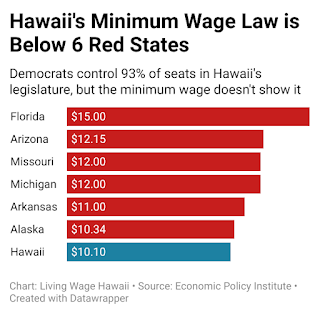
    HB 2510 would also change the minimum wage for tipped employees. Currently they can be paid 75 cents an hour less than minimum wage when wages and tips add up to a minimum of $7 more than minimum wage.
    New legislation that passed the state House would allow payment of $1.50 less than the minimum wage in 2023 with the margin increasing 25 cents a year  reaching $2.75 in 2028. Tipped employees would still make at least $7 more than minimum wage.
    Hawai'i County Council sent testimony to the state House of Representatives supporting the hike to $18 an hour, noting that post-pandemic about 59% of households in Hawai'i are ALICD - Asset Limited, Income Constrained and Employed. Some other testimony urged that the incremental hike in minimum wages reach $18 far sooner than 2028.

To read comments, add your own, and like this story, see www.facebook.com/kaucalendar/. See latest print edition at www.kaucalendar.com.  See upcoming events at https://kaunewsbriefs.blogspot.com/2022/03/upcoming-events-for-kau-and-volcano.html

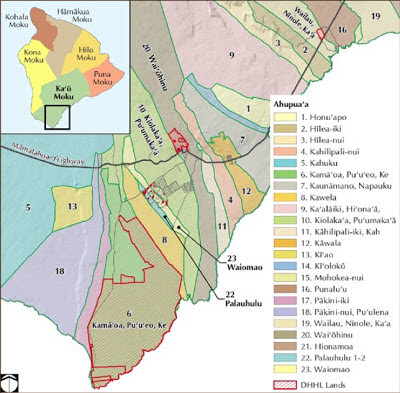
DEPARTMENT OF HAWAIIAN HOME LANDS will receive $22.3 million appropriated by Congress, according to a statement from Sen. Brian Schatz during the past week.
    In addition, other federal funding for Hawaiian programs includes $22 million for the Native Hawaiian
Hawaiian Home Lands are encircled in red. Hawaiian Home Lands has lots in
Discovery Harbour, land mauka of Punalu'u and mauka of Hwy 11 in Waiohinu,
in addition to Ka Lae Lands running to South Point. Map from State of Hawai'i

Health Care Systems; $39 million for Native Hawaiian education programs; $21.3 million for Native Hawaiian and Alaska Native-serving institutions; $1.5 million of Native Hawaiian and Alaska Native culture and art; $1.5 million for the Center for Indigenous Innovation and Equity; $1 million for the Native Hawaiian Resource Center on Domestic Violence; and $500,000 in new national funding for the Native American Language Resource Center.
    Schatz, who serves as chairman of both the Senate Committee on Indian Affairs and the Senate Appropriations Subcommittee on Housing and Urban Development, said the Department of Hawaiian Home Lands will receive $20.3 million more than allocated last year, directed to housing for Native Hawaiians. He said it is the highest level of funding for Native Hawaiian housing ever. This major increase in funding is a big win and means DHHL will have more resources to put people into homes.”
    To apply for Hawaiian Home Lands housing, applicants must be at least 18 years of age; and must be a native Hawaiian, defined as “any descendant of not less than one-half part of the blood of the races inhabiting the Hawaiian Islands previous to 1778.” This means applicants must have a blood quantum of at least 50 percent Hawaiian. This requirement remains unchanged since the HHCA’s passage in 1921.
    Tyler Iokepa Gomes, deputy to the chairman of the Department of Hawaiian Home Lands, issued a statement saying, “DHHL is grateful for Sen. Schatz and the Appropriations Committee’s confidence and faith in our ability to deploy these much needed federal funds. This money will enable DHHL to provide financing for home construction or repair, rental assistance, and other housing services aimed at reducing homelessness. We look forward to our increased capacity to deliver housing to Native Hawaiians and fulfill the mission of the Hawaiian Homes Commission Act of 1920.”


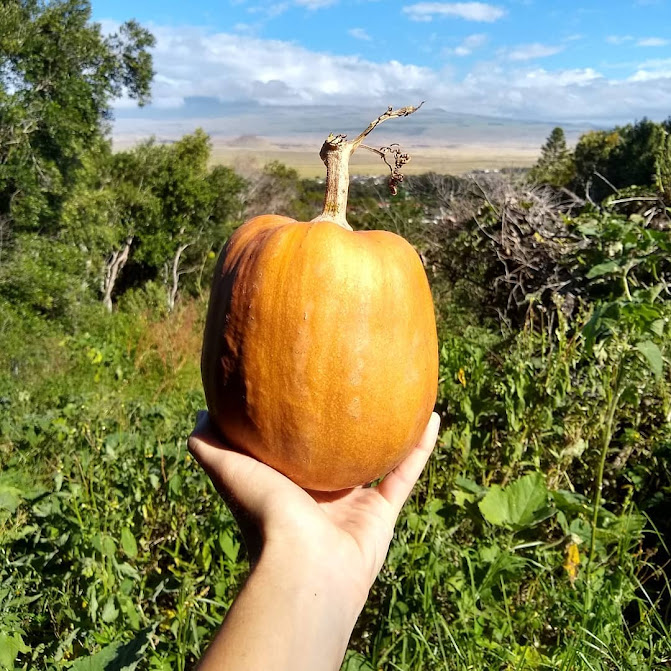
KŌKUA HARVEST IS LOOKING TO PICK UP FRUIT AND PRODUCE FROM KAʻŪ that would otherwise go to waste. Kōkua Harvest is the island-wide food rescue (also known as "gleaning") program of The Food Basket.
    Farms and private residences invite Kōkua Harvest onto their properties to harvest their extra produce.

    Those who participate have more produce than they can use or are unable to harvest themselves. Kōkua Harvest works to schedule a time to bring volunteers out to harvest and distribute the extra produce. Harvests last one to two hours, and Kōkua Harvest provides all tools, equipment, and volunteers. At the end of the day the harvest is split between volunteers, the property owner/farm, and our distribution partners including Kōkua Harvest's program home, The Food Basket.
    Those who want to schedule a harvest, learn how to volunteer, or are interested in hearing more can visit Kōkua Harvest's  website at kokuaharvest.org, email info@kokuaharvest.org, or call Lisa at 732-616-2460.

To read comments, add your own, and like this story, see www.facebook.com/kaucalendar/. See latest print edition at www.kaucalendar.com.  See upcoming events at https://kaunewsbriefs.blogspot.com/2022/03/upcoming-events-for-kau-and-volcano.html

                   SEE UPCOMING EVENTS IN KAʻŪ & VOLCANO
            at https://kaunewsbriefs.blogspot.com/2022/03/upcoming-events-for-kau-and-volcano.html.
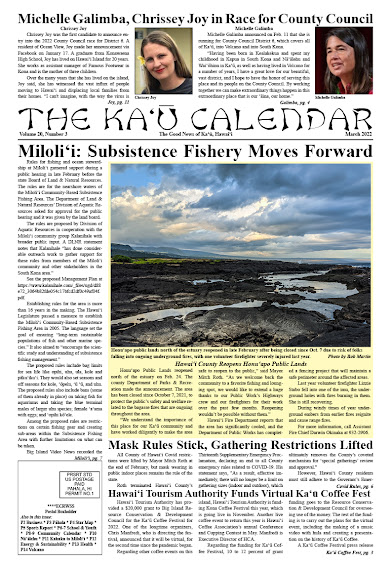
See March edition of The Kaʻū Calendar newspaper at 
www.kaucalendar.com


Saturday, March 12, 2022

Ka‘ū News Briefs, Saturday, March 12, 2022

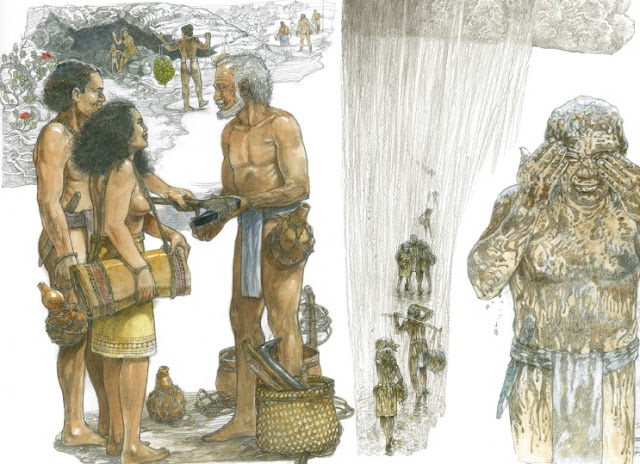
The 1790 Footprints Trail where travelers were caught in ashfall, leaving permanent footprints on the ground.
This is one of the historic places in Kaʻū recognized by the state, which is seeking input on its next five-year Statewide
Historic Preservation Plan. John Dawson illustration from Hawai'i Volcanoes National Park

THE STATEWIDE HISTORIC PRESERVATION PLAN goes to a virtual public meeting from 5 :30 p.m. to 7:30 p.m. on Tuesday, March 15. According to an announcement from the state Department of Land & Natural Resources, the State Historic Preservation Division is creating the next five-year strategic plan for 2022-2027. The planning aims to help create goals for historic preservation in the state and inform the activities of the State Historic Preservation Division. Completion of this plan is required for Hawaiʻi to remain eligible to receive federal funds from the National Park Service. The plan’s purpose is to bring together historic preservation professionals and interested community members to craft ways to better manage historic properties in the state. The plan assesses historic preservation needs, priorities, goals, challenges, and opportunities and will highlight recommendations for future management of historic properties in Hawaiʻi.
    Historic properties include, but are not limited to: historic buildings, archaeological sites, heiau and traditional cultural properties, fishponds, lo'i, burials, cultural landscapes, historic districts and aviation artifacts. 
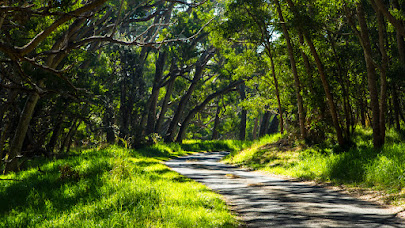
Mauna Loa Road is listed on the register of Hawai'i
Historic Places. NPS photo
    Historic places in Volcano already recognized on the Hawai'i Register of Historic Palaces include: Kilauea Lodge, Hale Ohia, Crater Rim Drive, the Whitney Seismograph Vault #29 under Volcano House, and Old Volcano House. In Kaʻū they include Puna-Ka'u Historic District, Mauna Loa Road, Wilkes Campsite, 1790 Footprints, Ainapo Trail, Kaʻū High & Pāhala Elementary and Nāʻālehu Elementary.
    See the 2017-2021 Statewide Historic Preservation plan at 
https://dlnr.hawaii.gov/shpd/files/2022/01/hawaii.state_.preservation.plan_.2012.2017.pdf
    The DLNR statement says, "Community input is essential to effective historic preservation planning and this plan will be informed by the overall comments from these meetings. All comments related to historic preservation are welcome during these meetings." The comments will be used to help develop future-focused and topical public meetings.
    The link to the March 15 meeting will be available on the SHPD website.
    Those who would like to provide public testimony, RSVP via the SHPD Preservation Plan email dlnr.hp.preservationplan@hawaii.gov by 5:30 p.m. on March 14. While SHPD staff will be unable to answer questions during the meeting, those who write to SHPD with questions ahead of time will likely receive a response. Those who do not wish to testify and wish to listen, are not required to RSVP.


SEASONALLY ADJUSTED UNEMPLOYMENT RATE IN HAWAI'I WAS 4.4 PERCENT for January,
compared to 4.3 percent in December. Statewide, 644,150 were employed and 29,500 unemployed in January for a total seasonally adjusted labor force of 673,700. Nationally, the seasonally adjusted unemployment rate was 4.0 percent in January, up from 3.9 percent in December. The state Department of Business, Economic Development & Tourism made the announcement Friday.

To read comments, add your own, and like this story, see www.facebook.com/kaucalendar/. See latest print edition at www.kaucalendar.com.  See upcoming events at https://kaunewsbriefs.blogspot.com/2022/03/upcoming-events-for-kau-and-volcano.html

NAOMI KUWAYE IS THE LATEST PUBLIC UTILITIES COMMISSION NOMINEE. Gov David Ige made the announcement on Friday. If confirmed, she will fill the seat currently held by PUC chairman James (Jay) Griffin, who announced he will step down at the end of his term, which expires on June 30. Kuwaye is an attorney at Ashford & Wriston, LLP where she has practiced since 2012. She has worked in private practice since 1988. Previously, Kuwaye worked as a law clerk in Oregon and was also an intern and legislative aide for then Honolulu City Councilmember Donna Mercado Kim.
Naomi Kuwaye is nominated to serve
 on the Public Utilities Commission
    
    Kuwaye earned her juris doctorate/certificate in environmental and natural resources law from Lewis & Clark Northwestern School of Law and her BA in journalism and political science from the University of Hawaiʻi Mānoa.
   Her appointment is subject to Senate confirmation. If confirmed, Kuwaye’s six-year term will run from July 1, 2022 through June 30, 2028.
   The PUC oversees regulations and rates for companies charing for delivering electricity by lines and gas by pipes; companies offering interisland shipping, telcom, private water and sewer; as well as motor transportation for humans and for goods.
    It approves such contracts as windmill, geothermal, hydroelectric, biofuel and solar farm owners selling power to Hawaiian Electric. An ongoing case involves the proposed use of eucalyptus growing in Ka'u to help power a biofuel plant on the coast north of Hilo. 

To read comments, add your own, and like this story, see www.facebook.com/kaucalendar/. See latest print edition at www.kaucalendar.com.  See upcoming events at https://kaunewsbriefs.blogspot.com/2022/03/upcoming-events-for-kau-and-volcano.html

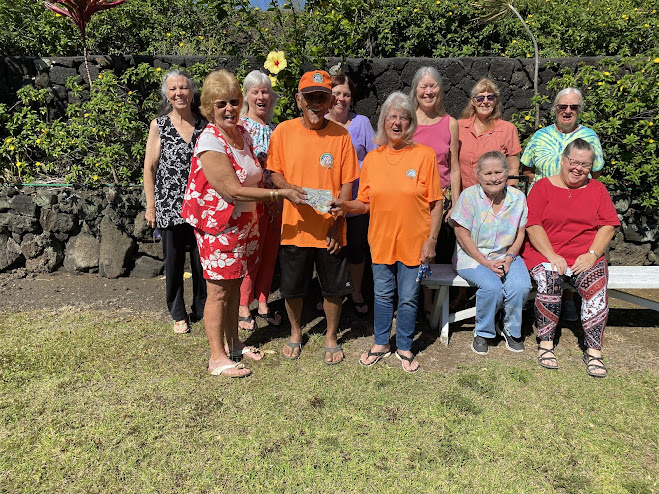
KA LAE QUILTERS RECENTLY PRESENTED $2,000 to O Kaʻū Kakou President Wayne Kawachi during its monthly gathering at Discovery Harbour Community Association meeting hall. Funds were earned by the quilters through craft sales in the Kaʻū District and by donations. These funds are intended for the OKK scholarship fund. Ka Lae Quilters have a history of supporting community needs such as: quilts for people experiencing trauma, distributed by the Kaʻū unit of the Hawai'i Police Department; Kaʻū Hospital Emergency Room Equipment; Camp Erin Quilts; Pink Pouches to Hilo Medical Center for patients recovering from breast cancer surgery. This dedicated group of ladies continue to support the community.
Ka Lae Quilters present $2,000 to O Kaʻū Kakou President Wayne Kawachi and OKK's Nadine Ebert.
Photo from Ka Lae Quilters
SEE UPCOMING EVENTS IN KAʻŪ & VOLCANO
          at https://kaunewsbriefs.blogspot.com/2022/03/upcoming-events-for-kau-and-volcano.html.
See March edition of The Kaʻū Calendar newspaper at 
www.kaucalendar.com

Friday, March 11, 2022

Ka‘ū News Briefs, Friday, March 11, 2022

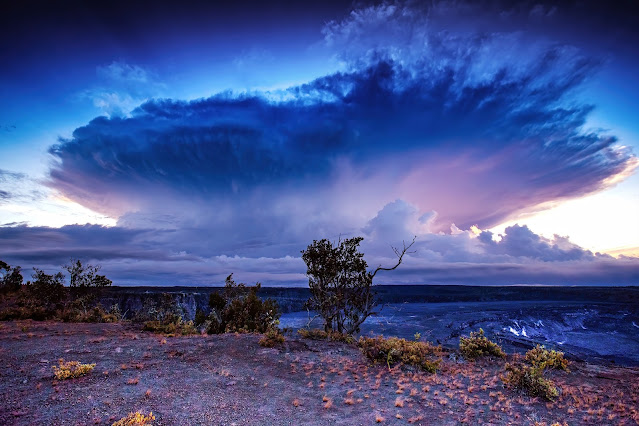
Storm Clouds Burst Over Kīlauea
Lava is not the only spectacular natural event at Kilauea Crater. Storm Clouds seem to burst
over Kīlauea on Thursday. See more at https://www.facebook.com/hawaiivolcanoesnps
 NPS photo by Janice Wei

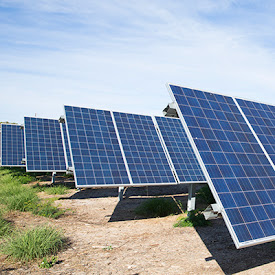
WITH ELECTRIC BILLS EXPECTED TO SOAR IN NEXT FEW MONTHS, Hawaiian Electric launched its Shared Solar Program on Friday. A statement from Hawaiian Electric says it is, "the latest phase of community-based renewable energy" for developers of small and large projects – including those tailored to low- and moderate-income customers. It is available for small projects (up to 250 kilowatts). Projects that qualify will be accepted in a four-month application window on a first-come basis up to the program’s capacity limit for each island.
    “We’re excited to launch shared solar, designed to bring savings and a chance to participate in the renewable energy movement to many more customers, especially those who aren’t able to install a private rooftop solar system,” said Lani Shinsato, director of customer energy resources, programs. “To get the most out of shared solar, we need subscriber organizations – including nonprofits, homeowner associations and churches – to get involved so that these groups and those they serve can share in the benefits."
     Shared solar provides a way for subscribers to benefit from the electricity generated by a solar energy facility located on the same island. Electricity from a shared solar project will enter the island grid to help the state achieve its renewable energy goals. Once a shared solar project is complete, tested and approved to begin sending electricity to the grid, subscribers will get credit on their monthly electric bill based on their level of participation in the project.
    The available solar capacity of the shared solar program is over 250 megawatts, potentially including energy storage, across the five islands Hawaiian Electric serves. Some project sizes are limited in capacity. But mid-tier and large projects tailored for low- and moderate-income customers are not capped. Organizations that primarily serve such customers can apply to be a subscriber organization, which will recruit participants, and/or anchor tenants that participate directly in the solar savings. Details of the program can be found on our CBRE Resources page. A program guide for subscriber organizations that outlines the small project process can be found at hawaiianelectric.com/sharedsolar.
Non-profits, churches, community groups can
 sponsor shared solar through Hawaiian Electric.
Image from Hawaiian Electric

    Larger projects (250 kW and above) will be procured through a formal RFP process. More details can be found on our Competitive Bidding for New Generation page. Potential solar developers and subscriber organizations that are able to recruit customers to be “subscribers” in a small project should register at https://communityenergyhawaii.com, the shared solar portal. Potential subscribers do not need to register until projects are approved.
    "After listening to community concerns about renewable energy project siting, regulators approved Hawaiian Electric’s request to allow residents who live near a large shared solar project the first chance at becoming subscribers," says the Hawaiian Electric statement.

To read comments, add your own, and like this story, see www.facebook.com/kaucalendar/. See latest print edition at www.kaucalendar.com

WHILE COVID MAY APPEAR TO BE IN THE REAR VIEW MIRROW, Sen. Mazie Hirono issued a statement today on the one-year anniversary of President Biden signing the American Rescue Plan: "The devastating impact of the COVID-19 pandemic has affected communities in Hawai'i and across the country. The American Rescue Plan allocated crucial funding to help lower costs for families, address the housing crisis, and provide resources and support to respond to this public health emergency. In Hawai'i, the ARP provided $4.6 billion in aid to help our schools provide safe, in-person learning and address 

learning loss, distribute vaccines, expand access to health care, and provide immediate and long-term relief to our state. Additionally, thanks to the advance Child Tax Credit payments, more than 150,000 families in Hawaii received $393 million between July and December of last year—with an average payment of $449 a month, per household.
    "All of this would not have been possible without Democrats passing and President Biden signing the American Rescue Plan," said Hirono. She noted that  Republican declined from voting "for this bill that helped American families. While this bill was a down payment to help families recover from COVID-19, there is still a lot of work to do. Families are still struggling with the impact of a global pandemic and a geopolitical crisis."

To read comments, add your own, and like this story, see www.facebook.com/kaucalendar/. See latest print edition at www.kaucalendar.com. See upcoming events at https://kaunewsbriefs.blogspot.com/2022/03/upcoming-events-for-kau-and-volcano.html.

MAGMA CHAMBER MUSIC CAN TELL A REVEALING TALE, according to Volcano Watch, the weekly column by U.S. Geological Survey Hawaiian Volcano Observatory scientists and affiliates. This week’s article was written by California Volcano Observatory research geophysicist Josh Crozier:
      In a lava lake, such as the one present from 2008–2018 in Kīlauea’s summit Halema‘uma‘u crater, we can sometimes visually observe these fluid motions as ripples or sloshing of the surface following disturbances from rockfalls or gas bursts.
    We can also detect deeper magma motion by using seismometers to measure ground vibrations. The seismic signals generated by magma motion, such as the example shown in the figure, are often distinct from other types of seismic signals. Compared to normal earthquakes, magma motion usually produces relatively slow vibrations, where the ground rises and falls over several seconds or tens of seconds.
A black and white figure showing two types of seismic signals

The top plot shows a 2013 seismic recording of a normal shallow magnitude-2 earthquake that occurred a few miles south of the summit of Kīlauea Volcano. The bottom plot shows a 2013 seismic recording of magma resonance after a large rock broke off the Halema‘uma‘u crater walls at the summit of Kīlauea Volcano and then impacted the lava lake surface. Note the different timescales; the normal earthquake only lasted for about 20 seconds in total, whereas each magma oscillation cycle lasted for 40 seconds and the vibrations continued for over 20 minutes in total.
    For decades scientists have been interpreting these seismic signals at volcanoes in Hawaiʻi and around the world as evidence of underground magma migration or accumulation, which can be used to look for signs that might indicate an impending eruption. In recent years, scientists have been learning new methods to use these seismic signals to resolve properties of underground magma systems that might not otherwise be measurable.
    Magma or lava bodies vibrate most strongly at certain frequencies, called resonant frequencies, that depend on the body’s geometry and the properties of the magma or lava it contains, such as temperature and gas content. This is similar to how the musical notes produced by an instrument like a pan flute, bell, or a kāʻekeʻeke depend on the instrument’s shape and the properties of the air in it.
  If a magma or lava is very fluid, for example like water rather than maple syrup, then a single perturbation can cause the magma body to resonate (vibrate or slosh at its strongest frequencies) for tens of minutes, such as the example shown in the figure.
Magma or lava bodies vibrate like musical notes.
Photo from Friends of Hawai'i Volcanoes National Park
    Changes in the resonance frequencies can indicate changes in the amount of gas contained within the magma or lava, which is important for understanding its eruptive potential. Additionally, changes in the resonance duration (how long vibrations last) can indicate changes in the magma or lava temperature, which tells us if fresh hot magma is being brought up from deeper in the earth.
    Such resonance has helped to reveal Kīlauea’s shallow summit magma system geometry, for example suggesting that the conduit connecting its shallow summit magma reservoir with the overlying lava lake in Halema‘uma‘u from 2008–2018 was more than 50 feet wide. It has also revealed complex magma dynamics over the past decade, including convective overturns and melt supply pulses, which inform the restless nature of Kīlauea Volcano.
    If you have a chance to stand near one of Hawaii’s active volcanoes, remember that the magma several kilometers beneath your feet could be subtly vibrating. And if visiting a volcano isn’t convenient, just tap on the side of a glass of water and watch the fluid resonance that results.
    See more from Hawaiian Volcano Observatory scientists at https://www.usgs.gov/observatories/hvo

To read comments, add your own, and like this story, see www.facebook.com/kaucalendar/. See latest print edition at www.kaucalendar.com

                SEE UPCOMING EVENTS IN KAʻŪ & VOLCANO


See March edition of The Kaʻū Calendar newspaper at 
www.kaucalendar.com