About The Kaʻū Calendar

Monday, August 15, 2022

Ka‘ū News Briefs, Monday, Aug. 15, 2022

A couple from Ranchos in Ocean View, Karen and Jay Shannon, discuss Cultural Resources with Merri Keli'ikuli, from  Hawai'i Alliance for Community-Based Economic Development. Behind them, many more Ocean View residents move between stations, filling the Ocean View Community Center. More than 125 people attended the event. Photo by Peter Bosted
THE KAHUKU-PŌHUE BAY PUBLIC MEETING, on Saturday, showed a strong community attendance, a reflection of Kaʻū’s concern for the National Park Service's newly acquired property, that stretches for five miles along the Kaʻū Coast makai of Ocean View.
    The attendance register drew 125 people signing in, though many more were observed skipping that formality as the Ocean View Community Center became packed by residents keen to visit the five information centers set up by Hawaiʻi Volcanoes National Park and its superintendent Rhonda Loh. The National Park Service is required to gather input from the public prior to writing a management plan for the 16,451- acre parcel called Kahuku-Pōhue Area. A second public meeting will be held this Wednesday, Aug. 17 from 6:30 p.m. to 8 p.m. on Zoom, https://zoom.us/j/97789413155; or call in to (346) 248-7799, webinar ID: 977 8941 3155.
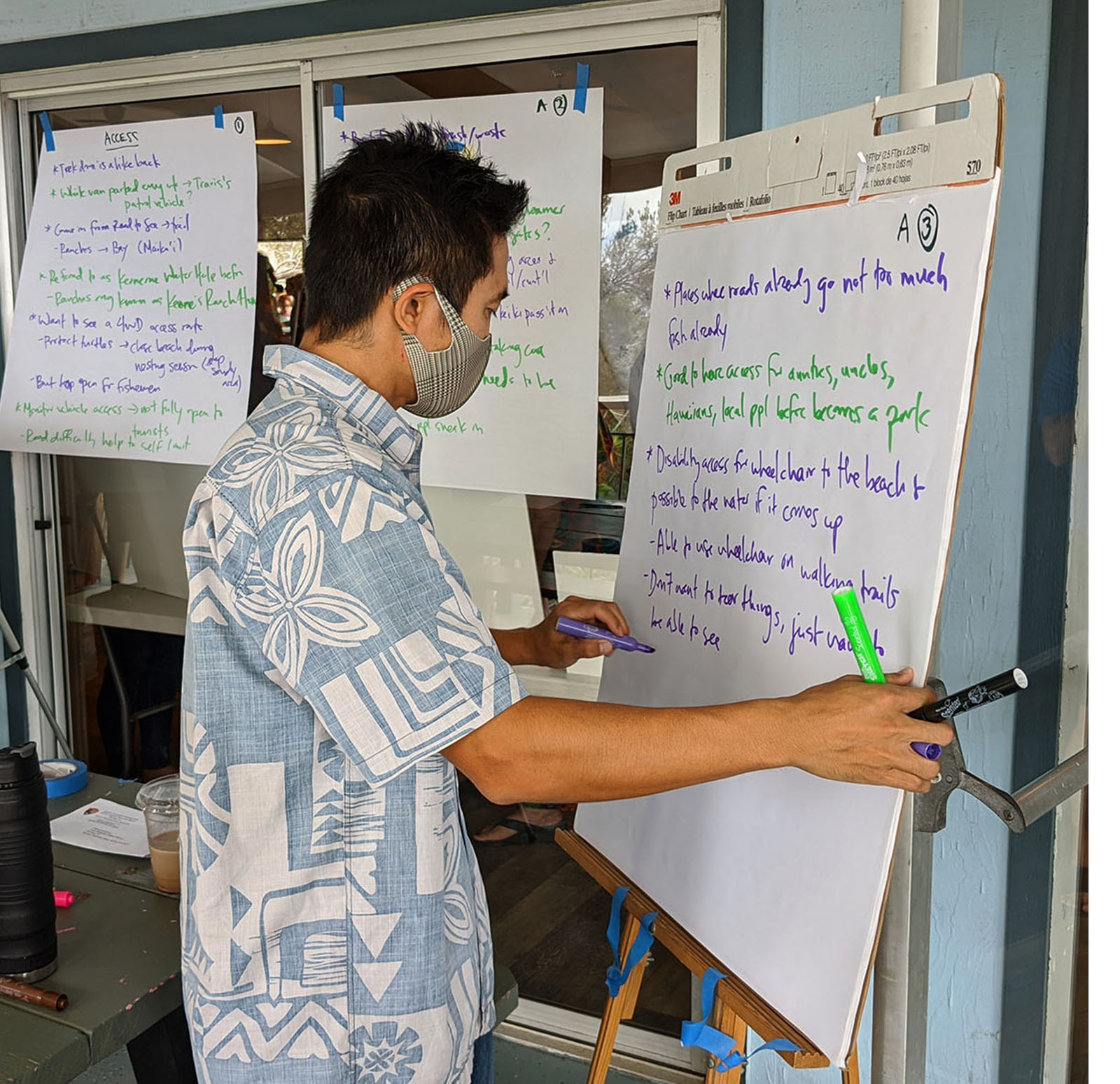
Brent Kakesako, who manned a part of the Access Management
 Station, makes notes on oversized paper mounted on an easel.
  Behind him, taped to the glass window of the lanai, are two sheets
  listing public comments made earlier.  Photo by Peter Bosted
    During Saturday's live meeting, rather than community speakers giving time-limited talks, as National Science Foundation allowed for the Thirty Meter Telescope public scoping in Nāʻālehu last week, the Park Service invited the public to interact with its representatives in small groups to discuss the subject assigned to each station. The public's suggestions were written down on oversize paper by NPS personnel.
    The five stations were titled General Information, Current and Future Use, Cultural Resources Management, Natural Resources Management, and Access Management. Each station displayed a large copy of a map of the property.
    The Access Management Station, situated on the lanai, drew large crowds as access to Pōhue Bay has long been desired by residents and tourists. Up until a month ago when the Trust for Public Land bought the property from a private owner and immediately donated it to NPS, anyone wanting vehicular access to Pōhue Bay paid the former property owner for the loan of a key to gates controlling access on a four-wheel road. The free option was to hike trails, including a mauka-makai trail that was used by native Hawaiians prior to the arrival of Europeans.
    According to a pre-printed display board, on which the NPS listed Access Considerations, a bulleted list of community comments included: “Need for more clarity around vehicular access,” “Considerations tied to managing pedestrian traffic,” “Desire for community led access for management of the parcel,” and “Limiting access and exposure to sites in the near term until NPS has a plan.”
On Ocean View Community Center lānai, manager of the 16,451 Kahuku-Pōhue Bay Area, Travis Heindrich, talks to residents
 about public access to the parcel. It was recently acquired by the National Park Service. In the background, Brent Kakesako,
of Hawai'i Alliance for Community Based Economic Development, answers questions on the same topic. Photo by Peter Bosted
    Recordings of public input on the board also stated: “All roads/trails to shore require going through private land,” and “No pedestrian trails have yet to be claimed by the State under the Highways Act of 1892”. The latter refers to legislation passed by Queen Liliokulani in 1892 when she declared that all
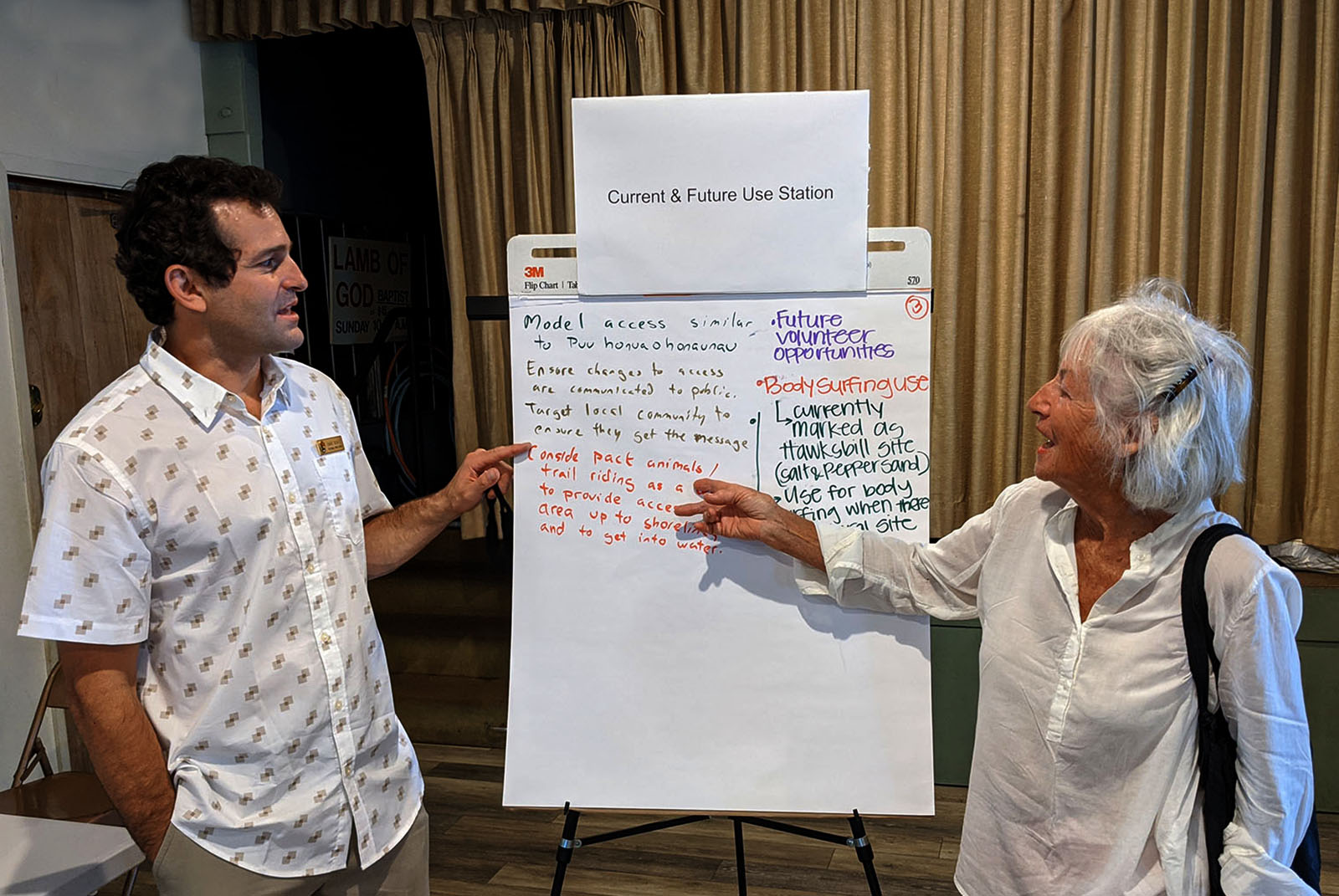
David Benitez, an NPS employee manning the Current and Future
 Use Station, discusses notes on public input with an Ocean View
 resident Lilo Denkhaus. Photo by Peter Bosted
trails and roads would be the property of the Kingdom. The State of Hawai’i has inherited and continued governmental ownership of those pre-1892 pathways. Hikers regularly use the mauka-makai trail and the Ala Kahakai Trail, both of which pre-date 1892, to cross the parcel.
    Another board at the Access Management Station listed Access Prompting Questions, such as “Given the resources in the area, what kind of access to the area is desired (i.e. pedestrian, vehicular, etc.)?” and “What has past access to Kahuku-Pōhue and the nearby area been? How has that worked or not worked?”.
    Copies of a one-page comment form were also distributed for the public to complete and either turn in at the meeting or mail in. The form list five questions with space for answers. It asked about Cultural, Natural and Geological resources that the NPS should be aware of, as well as asking what kind of access is desired. Another question asks about the types of facilities or infrastructure desired to be built on the parcel.
Sierra McDaniel, Acting Deputy Natural Resource Manager for the park, discusses natural resources
of the Pōhue Bay parcel, shown in pale buff, with Ranchos residents Kate and Henry Szadziowski.
Copies of this map were on easels at each station. The grey areas denote privately owned land.
The pink triangular shaped property is the open space owned by the County. The light blue-green
 area on the western edge of the map is Manuka State Park. The buff-colored area includes
part of the Kahuku Unit above Hwy 11, which the NPS acquired in 2004. Photo by Peter Bosted

To read comments, add your own, and like this story, see www.facebook.com/kaucalendar. See latest print edition at wwwkaucalendar.com. See upcoming events at https://kaunewsbriefs.blogspot.com/2022/04/upcoming-events-for-kau-and-volcano.htm

THE NEW DIRECTOR OF COUNTY DEPARTMENT OF PUBLIC WORKS IS STEPHEN PAUSE. Pause has served as Acting Director for DPW for the past two months, following his service as Deputy Director from May 2021. His previous employment for the County includes working in an engineering role for the Department of Environmental Management.
   Pause said his highest priority is to continue the ongoing effort of the Building Division to improve the permitting process using the EPIC system. Additionally, he listed attracting and retaining talent into the DPW organization and improving lines of communication with the public and all project stakeholders.    
    A statement from the county says, "Mr. Pause brings a wealth of engineering, project, and senior management experience from over 35 years of work with engineering firms and in corporate positions. He spent over 17 years in a senior project management role for BP Oil, including participating in several emergency response events. Before relocating to the Island, Mr. Pause was the Director of Capital Projects for eight years for Cleveland Cliffs, a
Stephen Pause, new Director of county Department of
 Public Works which handles building permits and
county infrastructure.

prominent US iron ore mining and steel company. In this role, he was responsible for planning, overseeing, and delivering significant maintenance and capital projects with values ranging between $10 million to $1 billion."
     Pause volunteered in several past roles in town governments, including a Zoning Commission in Ohio, a Wetlands Commission, and working with a Board of Health in Massachusetts. Pause holds BS and MS degrees from the University of Massachusetts at Amherst and is a licensed professional engineer (Civil) in the State of Hawaiʻi.
    “I am honored to assume the role of Director for DPW,” said Pause. “I look forward to the opportunity to lead a talented team that is tasked with improving and maintaining County infrastructure and seeing that minimum design and construction requirements are followed to ensure safe and resilient structures."
    Mayor Mitch Roth said, “Director Pause has proven himself extremely qualified for this position and has shown 
a keen ability to lead the department during this time of transition. Through his mix of professional and life experiences, we believe Steve is best suited to tackle the issues at hand, including improving building permitting, amplifying infrastructure repair and maintenance, and bolstering capitol improvement projects, ensuring that our 
residents can thrive and succeed for generations to come.”

To read comments, add your own, and like this story, see www.facebook.com/kaucalendar. See latest print edition at wwwkaucalendar.com. See upcoming events at https://kaunewsbriefs.blogspot.com/2022/04/upcoming-events-for-kau-and-volcano.htm
 

Sunday, August 14, 2022

Ka‘ū News Briefs, Sunday, Aug. 14, 2022


The summit of Mauna Loa on July 6, 1975, with Moku‘āweoweo caldera visible in the background. See story below on recent earthquake swarm, only the second time since electronic tiltmeters were installed in 1999 that a tiltmeter at Mauna Loa's summit has shown ground movement associated with volcanic activity. USGS Photo
LT. GOV. JOSH GREEN, FOLLOWING HIS ACHIEVEMENT ON SATURDAY, WINNING THE DEMOCRATIC NOMINATION FOR GOVERNOR, highlighted his Kaʻū start that led to life in Hawai'i.
Josh Green after winning Democratic nomination for Hawai'i
governor on Saturday. Photo from Josh Green for Hawai'i
    At his election party in Waikiki, Green said, "It was a humble beginning as a doctor in Kaʻū some 20 years ago. I never dreampt of politics. I never imagined that I would come from that very far away place. That place is far from O'ahu, and so different. 
    "To be lifted up by those families, as I cared for them as their doctor; to enter the House of Representatives, to meet Jamie, to become a father, a Senator and then Lieutenant Governor, I never imagined that would happen. But you have rewarded me more than I ever imagined or deserved. Those moments together with the people have always fulfilled me and I am profoundly grateful to people of our state, from Kaʻū to Maui, to O'ahu, Kaua'i, Moloka'i, Lana'i. Absolutely every corner of this state, people have welcomed us." 
    As he placed his hand over his heart, Green said, "We've taken the spirit of a doctor, as a Democrat, as someone who will unite all people, and we say to you, 'Now, please carry us across the finish line this Fall. We welcome everyone.'"

THE DEMOCRATIC NOMINEE FOR LIEUTENANT GOVERNOR Sylvia Luke congratulated Green and said she is excited to work on the Green/Luke ticket. The two worked together at the legislature.

To read comments, add your own, and like this story, see www.facebook.com/kaucalendar. See latest print edition at wwwkaucalendar.com. See upcoming events at https://kaunewsbriefs.blogspot.com/2022/04/upcoming-events-for-kau-and-volcano.htm

VICKY CAYETANO, who came in second in the Democratic primary for Governor of Hawai'i, issued this statement on Sunday: "I am so humbled and honored for all the friends, family and supporters, volunteers, and everybody who came out across the state to help in my campaign for change. We worked hard to give the voters a choice and I am very proud of the campaign we ran. I especially want to thank the volunteers who've worked tirelessly at the headquarters, signwaving, and hosting events. You have been the backbone of this campaign.

    "I congratulate Josh Green and Sylvia Luke for being the Democratic nominees for Governor and Lieutenant Governor and to all the candidates who ran a good campaign in this election. I wish them the best because Hawai'i’s future is at stake.
    "Thank you very much for supporting me and our campaign. I am grateful to each and everyone of you for being part of our journey to bring real and meaningful change to the Hawai'i we love."

To read comments, add your own, and like this story, see www.facebook.com/kaucalendar. See latest print edition at wwwkaucalendar.com. See upcoming events at https://kaunewsbriefs.blogspot.com/2022/04/upcoming-events-for-kau-and-volcano.htm

Congressman Kai Kahele with AARP's
 Audrey Suga-Nakagawa and state Director
Keali'i Lopez, Friday. Photo from Kahele

   
KAI KAHELE, who lost in the Democratic primary race for governor to Josh Green on Saturday, continues to serve in Congress the next four and a half months, until Jan. 3, 2023, after refraining from running for reelection in order to make his bid for governor.
     Kahele reported on his Congressional work on Friday, sharing that he met with AARP's Hawai'i State Director Kealiʻi Lopez and its Advocacy Associate Director Audrey Suga-Nakagawa to discuss the #Inflation Reduction Act’s "transformative health care benefits for our kūpuna. Finally, Medicare will be able to negotiate Rx prices and insulin will stay below $35!" reported Kahele.
    Kahele cast his aye vote for the Inflation Reduction Act on Friday from his congressional office in Hilo. He reminded constituents that he has never missed a vote, during his time spent in the rural Hawai'i district where he serves. He is the first member of the U.S Congress to establish a congressional in-state office on a Neighbor Island, in rural Hawai'i.
    Kahele said the Inflation Reduction Act is also "a historic victory for Hawai'i families and the future of our planet." He called it "the single largest investment in climate action in American history" and said it "will ensure our keiki inherit the Hawai'i they deserve."
    Sen. Mazie Hirono said, "From massive storm swells to flooded highways, rising sea levels are a growing threat in Hawai'i. The inflation Reduction Act contains $3 billion to increase coastal
Congressman Kai Kahele casts his vote
from Hilo in the first Neighbor Island office of a
member of the U.S. Congress. He serves there until Jan. 3.

resilience, upgrade infrastructure, and improve forecasts to help mitigate the effects of rising seas."
    Sen. Brian Schatz said the bill has unprecedented "investment in clean transportation, clean energy, home electrification, climate smart agriculture, U.S. manufacturing and environmental justice." He called it a "victory for the young people across the country....who demanded action." It aims to cut emissions 40 percent by the end of the decade.
    "And we’re going to pay for it all by making billion-dollar corporations finally pay their fair share of taxes. We’re also lowering the cost of prescription drugs for seniors and making health care more affordable – all while saving taxpayer dollars."
   The measure also provides $25 million for climate resilience funding to the Office of Native Hawaiian Relations at the Department of Interior, the biggest investment in climate justice ever, the money coming from corporate taxes.

To read comments, add your own, and like this story, see www.facebook.com/kaucalendar. See latest print edition at wwwkaucalendar.com. See upcoming events at https://kaunewsbriefs.blogspot.com/2022/04/upcoming-events-for-kau-and-volcano.htm

MAUNA LOA: THE SLEEPING GIANT is the title of this week's Volcano Watch, the weekly column by U.S. Geological Survey Hawaiian Volcano Observatory scientists and affiliates:
    Covering over half of the Island of Hawai'i, Mauna Loa is sometimes referred to as a "sleeping giant" because it hasn't erupted in 38 years after erupting nearly every seven years in the early 20th century. However, Mauna Loa occasionally stirs in its slumber and reminds us that it will someday awake and erupt again.

Earthquakes below Mauna Loa summit region between midnight
 Aug. 1 and midnight Aug. 3, 2022. Orange earthquakes are
  below sea level. Red earthquakes are above sea level;
earthquakes are sized by magnitude.
    Most recently, scientists at the USGS Hawaiian Volcano Observatory were kept up the evening of Aug. 2 and into the early hours of Aug. 3 monitoring Mauna Loa. Over a period of about ten hours, 90 earthquakes were located beneath Mauna Loa's summit region, and many more earthquakes were detected, but were too small to precisely locate. The total number of earthquakes peaked at over 200 per hour.
    As the swarm was happening, HVO scientists were interpreting the incoming data on-the-fly and trying to answer questions such as, "Where are the earthquakes happening? Is the activity migrating? Are there changes in other monitoring datasets?"
    The earthquakes occurred around 2 miles (3 km) below the surface of Mauna Loa's summit and their locations did not shift horizontally or vertically to another region or depth over time. The observation that the earthquakes did not get shallower was a comforting indicator that the swarm was unlikely to be from magma rapidly ascending into an eruption.
    An earthquake swarm in-and-of-itself is not unique—swarms have happened beneath Mauna Loa's summit in the past. During the Spring of 2021, an earthquake swarm beneath Mauna Loa's summit produced about a thousand earthquakes over a span of seven weeks with a peak rate of 40 earthquakes per day.
    Another unique occurrence was the change in another monitoring dataset. As the earthquakes were occurring from Aug. 2–3, a tiltmeter on the north side of Moku'āweoweo—Mauna Loa's summit caldera—showed a change of about 1.5 microradians.
   Tiltmeters measure changes in ground slope. The change associated with the earthquake swarm, although small and partly hidden by daily fluctuations resulting from changes in temperature, reflects a tiny expansion or inflation of Mauna Loa.
   This is only the second time since electronic tiltmeters were installed in 1999 that a tiltmeter at Mauna Loa's summit has shown ground movement associated with volcanic activity. The first time was during the Spring 2021 activity, which you can read about in this Volcano Watch article: https://www.usgs.gov/observatories/hvo/news/volcano-watch-tiny-changes-mauna-loas-summit-hold-big-clues.
    Mauna Loa's magma storage system has been slowly recharging for decades and these new observations over the past year and a half have HVO scientists seeking the answer to an additional question, "What do these observations indicate about processes occurring within Mauna Loa?"
 
Plots showing Mauna Loa ground deformation and earthquake monitoring data between midnight Aug. 1 and midnight Aug. 3, 2022. The top panel shows ground tilt in microradians at station MOK, on the northwest side of Mauna Loa's summit caldera. A histogram showing the number of located earthquakes that occurred per hour is shown in the middle panel. The bottom panel shows located earthquake depth, with different circle sizes representing different magnitudes and color representing depth relative to sea level.
   The changes observed in ground deformation reinforce an interpretation that shallower processes are occurring on Mauna Loa than we have seen in the past. Ideally, HVO scientists could review ground deformation events prior to previous Mauna Loa eruptions in order to place this recent activity in context. However, prior to 1984, deformation at Mauna Loa's summit was measured by a team painstakingly surveying relative benchmark positions using Electronic Distance Measurements (EDM). The high-precision, real-time instruments that HVO currently uses to detect such small changes weren't yet available.
    Mauna Loa earthquake activity and ground deformation have returned to previous levels following the Aug. 2–3 event and an eruption is not imminent. HVO continues to keep a close eye on diverse monitoring datasets, which may show other previously unobserved signals as Mauna Loa's magma chamber continues its slow refill.
    Hawaiian Volcano Observatory and USGS remind people: "It is never too early to consider how a future Mauna Loa eruption could affect you as a resident or visitor." See some tips for preparation: https://www.usgs.gov/observatories/hvo/news/volcano-watch-failing-prepare-you-are-preparing-fail-benjamin-franklin
    Mauna Loa may be in its longest slumber in at least two centuries but it remains restless, reminding us that it will certainly erupt again in the future.

To read comments, add your own, and like this story, see www.facebook.com/kaucalendar. See latest print edition at wwwkaucalendar.com. See upcoming events at https://kaunewsbriefs.blogspot.com/2022/04/upcoming-events-for-kau-and-volcano.htm


Ka‘ū News Briefs, Saturday, Aug. 13, 2022

County Council member-elect Michelle Galimba, right, with the Armando and Karina Rodriguez Kaʻū Coffee farmer
family, offering congratulations on Saturday evening. Galimba will represent Volcano through Kaʻū into Kona.
Photo by Julia Neal

MICHELLE GALIMBA WILL BE THE NEXT COUNTY COUNCIL MEMBER FOR KA'Ū into Volcano and South Kona. She received 54 percent of the vote Saturday, meaning there will be no runoff in the nonpartisan election. Galimba is a rancher and has served in numerous public positions, including the county Planning Commission, Kaʻū Community Development Plan Steering Committee and state Board of Agriculture. She thanked supporters and said she looks forward to serving all of her constituents.
    Galimba's 54 percent of the vote totaled 2,455, with runner up Colehour Bondera receiving 16 percent at 745, Henry Cho III 16 percent at 717 and Shane Palacat-Nelsen 14 percent at 626. 

LT. GOV. JOSH GREEN WON THE DEMOCRATIC NOMINATION FOR GOVERNOR OF HAWAI'I, the election results released Saturday night. Green said, "I will do the best I can to unite us, and lead Hawai'i forward to a better, stronger future." Green took 64 percent of the vote with 137,990 cast in his favor. Vicky
Josh Green posted this photo on Saturday before
becoming the Democratic nominee for governor.
Cayetano took 21 percent of the vote with 46,246 cast in her favor. Kai Kahele took 14 percent of the vote with 29,768 cast in his favor. After the results came in, Kahele tweeted "Mahalo Hawai'i. I love you," with a shaka sign. 
      Green faces former Lt. Gov. Duke Aiona in the General Election Nov. 8. The win for Green came on his wedding anniversary and he started his acceptance speech by thanking his wife, her Hawaiian family and his own family of "radicals from the old days," who "supported my dreams all along." He thanked numerous campaign staff, advisors and volunteers by name, including former governors Neil Abercrombie and John Waihee. He called his work "this mission we have to care for people."

FORMER LT. GOVERNOR AND JUDGE DUKE AIONA won the Republican nomination for governor with 52 percent of the votes, 30,672 cast for him, beating B.J. Penn, with 24 percent of the votes, 14,329 cast for him. 
     Aiona thanked all the candidates who ran for all of the posts up for election. "To step up and do something like this is not easy."
Duke Aiona posted this photo after becoming
the Republican nominee for governor of Hawai'i.
    He noted that only 30 percent of registered voters statewide cast ballots and said there are many people to talk to before the General Election to find out why they didn't vote. "Maybe they are fed up with the corruption, the bickering that was happening on the Democratic side."
    Aiona said he received a gracious message of aloha from B.J. Penn and that he is "hopeful that we can be united to move forward... We want to have a robust two-party system."
    He said he hopes to meet with many people between now and the General Election. He said the Democratic primary was about "trust, credibility and confidence." He said, "We have a broken moral compass" and that he wants to fix it.

KELEIONALANI TAYLOR TOOK THE NONPARTISAN VICTORY for the primary for governor, with 636 votes.

Sylvia Luke
SYLVIA LUKE BECAME DEMOCRATIC NOMINEE FOR LIEUTENANT GOVERNOR on Saturday, beating Ikaika Anderson. Luke took 37 percent of the votes with 78,020 cast for her. Anderson took 27 percent of the votes with 56,977 cast for him. Keith Amemiya took 23 percent of the votes with 48,554 cast for him. Luke was endorsed by former Hawai'i Island Mayor Harry Kim.

Tupai Seaula, Jr.
TUPAI SEAULA, JR. BECAME THE REPUBLICAN NOMINEE FOR LIEUTENANT GOVERNOR on Saturday, taking 51 percent of the votes, 26,531 cast for him. Runner up was Rob Burns, with 36 percent of the votes, 18,776 cast for him.

JILL TOKUDA BECAME THE DEMOCRATIC NOMINEE TO REPRESENT  KA'Ū AND ALL OF RURAL HAWAI'I IN THE U.S. CONGRESS.
Jill Tokuda
    She won the primary for the seat held by Kai Kahele who declined to seek reelection in order to run for governor, a race he lost in the primary on Saturday to Josh Green.
    Tokuda won with 59 percent of the votes, 54,203 cast for her. Patrick Branco took 25 percent of the votes, 22,796 cast for him. 
     After seeing early results, Tokuda said she was "blown away by the show of support in those numbers."
      
JOE AKANA BECAME THE REPUBLICAN NOMINEE TO REPRESENT KA'Ū AND ALL OF RURAL
Joe Akana
HAWAI'I IN CONGRESS. He won with 83 percent of the votes, 21,527 cast for him. Joseph Webster took 17 percent of the votes, with 4,454 cast for him.

MICHELLE ROSE TIPPENS RAN UNOPPOSED FOR THE GREEN Party nomination for U.S. Congress.
      
CONGRESSMAN ED CASE who represents urban O'ahu, won the Democratic nomination for reelection to Congress.  His Republican opponent will be Conrad Kress.
       
Brian Schatz
SENATOR BRIAN SCHATZ BECAME THE DEMOCRATIC NOMINEE FOR U.S. SENATE. The incumbent took 94 percent of the votes, with 197,173 cast for him. Steve Tataii took six percent, with 13,344 votes cast for him.

BOB MCDERMOTT BECAME THE REPUBLICAN NOMINEE FOR U.S. SENATE. He took 41 percent of the votes with 20,767 cast for him. Timothy Dalhouse received 25 percent of the votes with 12,847 cast for him.

EMMA POHLMAN RAN UNOPPOSED FOR THE GREEN PARTY nomination for U.S. Senate.

DAN DECKER RAN UNOPPOSED FOR THE ALOHA 'AINA Party nomination for U.S. Senate.  
 
FEENA BONOAN RAN UNOPPOSED FOR THE LIBERTARIAN Party nomination for U.
S. Senate.

DRU MAMO KANUHA RAN UNCONTESTED TO BECOME THE DEMOCRATIC NOMINEE FOR STATE SENATE, representing parts of Puna through Volcano, Kaʻū and into Kona.

JEANNE KAPELA RAN UNCONTESTED TO BECOME DEMOCRATIC NOMINATION FOR THE STATE HOUSE OF REPRESENTATIVES, representing parts of Puna, through Volcano, Kaʻū and into Kona. 

LOHI GOODWIN RAN UNCONTESTED TO BECOME THE REPUBLICAN NOMINEE FOR STATE HOUSE OF REPRESENTATIVES representing parts of Puna, through Volcano, Kaʻū and into Kona.

MICHAEL LAST RAN UNCONTESTED TO BECOME THE LIBERTARIAN NOMINEE FOR STATE HOUSE OF REPRESENTATIVES representing parts of Puna through Volcano, Kaʻū and into Kona.