About The Kaʻū Calendar

Monday, September 19, 2022

Ka‘ū News Briefs, Monday, Sept. 19, 2022

Hawaiian Volcano Observatory staff replaced the gas measurement station at Sulphur Cone on the Southwest Rift Zone of Mauna Loa in early September. Field staff (in orange) and the gas monitoring station are visible right of center in this aerial view, which also shows the 1950 fissure and Sulfur Cone. Sulfur Cone is at an elevation of 3,430 meters (11,240 feet) above sea level.See more below. USGS image by T. Elias

AN INTERNATIONAL PEACE POLE IN PĀHALA will be dedicated on the grounds of Kaʻū Hospital & Rural Health Clinic in Pāhala on Thursday.
   Sponsors include The Rotary Club of Volcano and Kaʻū Rural Heath Community Association and Kaʻū Hospital & Rural Health Clinic, who invite the community to dedication ceremonies this Thursday, Sept. 22 at 9 a.m., at the entrance to Kaʻū Hospital. The ceremonies will celebrate International Peace Day.
   A Peace Pole is an internationally recognized symbol of the hopes and dreams of the human family, standing vigil in silent prayer for peace on earth. Each Peace Pole bears the message "May Peace Prevail on Earth" in different languages on each of its four or six sides. There are estimated over 250,000 Peace Poles in every country in the world, including one outside the Volcano Art Center.
    Planting a Peace Pole is a way of bringing people together to inspire, awaken and uplift the human consciousness the world over. The Pāhala Peace Pole dedication ceremony includes Kupuna, local church leaders, Hawai'i County Mayor's Office, Rotary Club of Volcano, Kaʻū Rural Health Community Association, Kaʻū Hospital & Rural Health Clinic, Hilo Medical Center, HHSC East Hawai'i Board of Directors, elected officials and community.

To read comments, add your own, and like this story, see www.facebook.com/kaucalendar. See latest print edition at wwwkaucalendar.com. See upcoming events at https://kaunewsbriefs.blogspot.com/2022/04/upcoming-events-for-kau-and-volcano.html.

THE EMERGENCY SNAP PROGRAM CONNECTED TO FEDERAL COVID EMERGENCY FUNDING has been renewed. Gov. David Ige signed a fourth emergency proclamation on Monday to allow the continuation of Supplemental Nutrition Assistance Program emergency allotment benefits in line with the federal COVID emergency. The disaster emergency relief period continues through Nov. 18.
    "Food insecurity is just one of the lingering effects of the pandemic, and SNAP benefits provide Hawaiʻi families with nutritious food," said the governor. "It's important for families to reach out so they
can get the help they need."
    The SNAP program provides crucial food and nutritional support to qualifying low-income and needy households, and those making the transition from public assistance to self-sufficiency.
    In Hawaiʻi, the Department of Human Services Benefit, Employment & Support Services Division administers the program "and remains committed to providing food security for individuals and families in Hawaiʻi," says the statement from the governor.
    SNAP is managed by the U.S. Department of Agriculture and is the largest food nutrition assistance program in the country. DHS reminds the public that the federal government requires recipients of SNAP and Financial Assistance Programs (FAP) to recertify, or renew, their eligibility annually (for most households) to receive continued benefits.
    Households are now able to upload required documents at https://pais-benefits.dhs.hawaii.gov/. However, renewal interviews are completed via telephone, and recipients needing assistance with this process or information about the status of their recertification can call the Public Assistance Toll Free Information Line at 1-855-643-1643.

To read comments, add your own, and like this story, see www.facebook.com/kaucalendar. See latest print edition at wwwkaucalendar.com. See upcoming events at https://kaunewsbriefs.blogspot.com/2022/04/upcoming-events-for-kau-and-volcano.html.

A MENTAL HEALTH FIRST AID WORKSHOP is free online this Wednesday, Sept. 21 and is open for public participation. The sponsor, Vibrant Hawai'i, notes that the workshop aims to help participants: "Learn to identify, understand, and respond to signs of mental illnesses and challenges in adults." This online workshop is being offered through Vibrant Hawai'i's Resilience Hubs, including those in Kaʻū.
    Kalehua Kukahiko, of Vibrant Hawai'i, will lead this workshop and participants receive a digital badge certifying participation and training topics covered. The workshop covers sensitive topics including suicide and drug/alcohol addictions. "The intended outcome is to increase awareness of signs and symptoms of mental illnesses, reduce stigma, and increase community's confidence to start conversations with individuals experiencing mental health challenges and crisis to connect to appropriate professional supports," says the notice from Vibrant Hawai'i.  To register, see https://docs.google.com/forms/d/e/1FAIpQLSckrvXNzWKLapxo5S-AgA7x56voHVUYVJvu_tZB_67HnHgacQ/viewform. Provide email and answer questions to sign up. The class will also be available in November.

Trojan girls came back from being two sets
down to beat Kealakehe on Monday in 
volleyball at the Robert E. Herkes, Kaʻū
District Gym in Pahala. Photo by Julia Neal
To read comments, add your own, and like this story, see www.facebook.com/kaucalendar. See latest print edition at wwwkaucalendar.com. See upcoming events at https://kaunewsbriefs.blogspot.com/2022/04/upcoming-events-for-kau-and-volcano.html.

VARSITY AND JV GIRLS VOLLEYBALL DID IT AGAIN Monday night. They won. The Trojans took on the Waveriders from Kona's Kealakehe High at the Kaʻū District Gym, with JV beating them in two sets. Trojan Varsity lost the first two sets but came back to break the Waveriders in the final three sets. 
     After the match up, the Kaʻū team members were described as contrasting to privileged urban girls, and as scrappy and always hungry, hanging in there for the distance to make a comeback and win.
     See the kills and other accomplishments of the Trojan Girls volleyball players in Tuesday's Kaʻū News Briefs.
     The next game for Girls Volleyball is home again this Wednesday, Sept. 21 at 5 p.m. against Makua Lani Christian Academy at the Robert E. Herkes, Kaʻū District Gym.

To read comments, add your own, and like this story, see www.facebook.com/kaucalendar. See latest print edition at wwwkaucalendar.com. See upcoming events at https://kaunewsbriefs.blogspot.com/2022/04/upcoming-events-for-kau-and-volcano.html.

This sulphur cone is at 11,240 ft. elevation, up the side of Mauna Loa volcano, showing the evidence of eruptions
in this photo taken on Sept. 8. 
USGS Photo by T. Elias

The contrasting colors set against a backdrop
 of steam and fume make for a dramatic scene, 
during the mission to change a gas measuring
 station at a lava cone on Mauna Loa. 
USGS image by T. Elias
THE HISTORY OF AN ACTIVE MAUNA LOA VOLCANO was blatantly visible when scientists replaced the gas measurement station at Sulphur Cone on the Southwest Rift Zone of Mauna Loa earlier this month. 
    The Sulphur Cone, high on the Southwest Rift Zone of Mauna Loa, was blanketed by sulfur crystals when it was named in 1921. A subsequent visit noted that molten sulfur had flowed down the flank of the cinder and spatter cone.         The remnants of that yellow flow can be seen here on the flank of the cone. Heating along the fissure of the voluminous 1950 eruption of Mauna Loa may have melted the accumulated sulfur around the Cone creating molten flows. For more information, see a past Volcano Watch at: https://www.usgs.gov/observatories/hvo/news/volcano-watch-peculiar-flow-sulphur-cone-along-mauna-loa.
    During the Sept. 8 visit to replace the gas measurement station, a Hawaiian Volcano Observatory scientist peered into the fissure that erupted in 1950 from the Southwest Rift Zone of Mauna Loa near Sulphur Cone. 
   Water vapor and sulfur gases are still emitted from this fissure and surrounding area, which is at an elevation of 3,430 meters (11,240 feet) above sea level. The contrasting colors set against a backdrop of steam and fume "make for a dramatic and beautiful scene," says the USGS statement.

To read comments, add your own, and like this story, see www.facebook.com/kaucalendar. See latest print edition at wwwkaucalendar.com. See upcoming events at https://kaunewsbriefs.blogspot.com/2022/04/upcoming-events-for-kau-and-volcano.html.


See September issue of The Kaʻū Calendar
at www.kaucalendar.com, and in the
mail - Volcano, Kaʻū to South Kona.


Sunday, September 18, 2022

Ka‘ū News Briefs, Sunday, Sept. 18, 2022

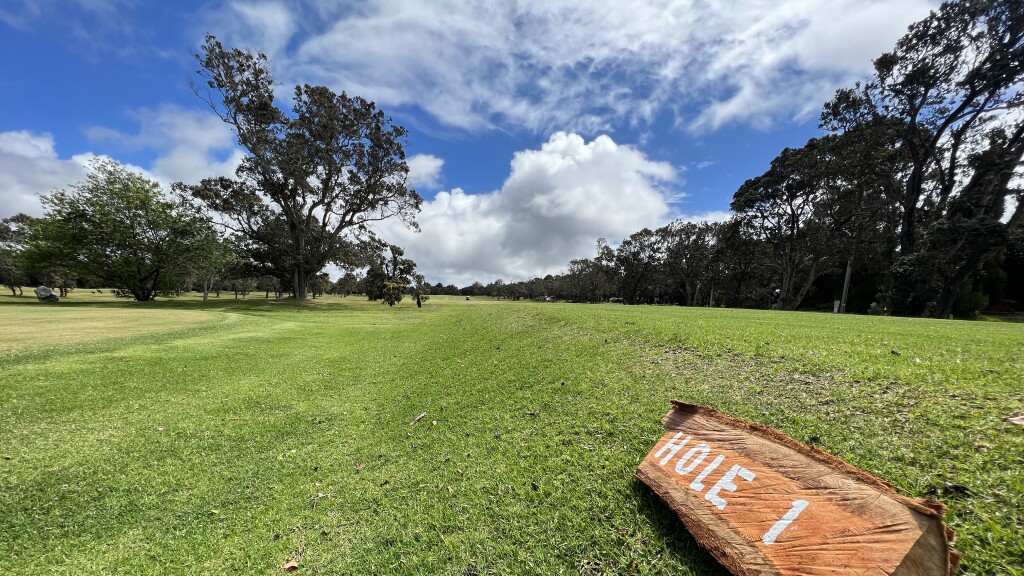
Volcano Golf Course reopened earlier this year under new oversight and has announced golf instruction and more, under
 the ownership of Kamehameha Schools and management of Troon Indigo Sports. Photo from Volcano Golf Course
VOLCANO GOLF COURSE has announced its new golf instructor, Richard "Joe" Zazzi. Volcano Golf Course is owned by Kamehameha Schools and is under the new management of Troon and its subsidiary Indigo Sports, which also manages the Mauna Lani golf course on this island. On Maui, it manages Ka'anapali Golf Courses, Kapalua Golf and King Kamehameha Gold Club.
KS Hawai‘i Kahu Kaunaloa Boshard, left, and two members
 of KS Hawai‘i Golf Team, Jayden Alonzo-Estrada and Adriana
 Lynn Volpe, take part in the blessing of reopening Volcano Golf
 Course earlier this year. Photo from Kamehameha Schools
    On Kaua'i, Troon manages Ocean Course at Hokuala, Princeville Makai Golf Club and Kukuiolona Park & Golf Course. On O'ahu it manages Kapolei Golf Cub and Pearl Country Club.
    Dawn Crozier, a General Manager at Indigo, said that "As part of Volcano Golf Course's continued evolution, we are happy to offer an acclaimed teaching professional to our club and community."
    She noted that growing up, Zazzi was a multi-sport athlete who played golf and semi-pro baseball. His teaching resume for golf includes diverse experiences at Discovery Harbour Golf Course, The Club at Hokuli'a,
Joe Zazzi offers individual and group
 lessons at Volcano Golf Course, under its
 new management. Photo from VGC

Mountain Falls Country Club in Nevada, Community College of Southern Nevada, 880 Driving Range in California and Lawrence Links McClellan Air Force Base Golf Course in California.
    Zazzi offers individual and group lessons to all ages and skill levels. "His holistic approach incorporates the full swing and short game," said Crozier. One-hour lessons are $50 for adults. A value package of three, one-hour lessons is $120 for adults.
   To book advanced tee times and lessons, visit wwwvolcanogc.com.
    Crozier also noted that Volcano is Hawai'i Island's first and oldest golf course. "Nestled next to Hawai'i Volcanoes National Park, we are ready to welcome you with friendly service, quality instruction and beautiful golf course scenery."
    A statement from Troon says that "For more than 100 years at Volcano Golf Course, guests have been treated to panoramic views of Mauna Loa and Mauna Kea while playing alongside endemic 'ohia trees that bloom vibrant red, and Nēnē, Hawai'i's state bird that nest throughout the property. This 18-hole golf course is set on the active Kīlauea volcano, 4,000 feet above the sea, making it a truly unique golfing experience."
Volcano Golf Course, the state's oldest, made international
 news in 2018 when Kīlauea erupted. Photo from CNN
   The notice describes the management company Troon, headquartered in Scottsdale, Arizona: "Troon is the world's largest golf management company providing services at 630-plus locations around the globe, including managing 65-plus 18-hole equivalent courses. In addition to golf, Troon specializes in homeowner association management, private residence clubs, estate management and associated hospitality venues. Troon's award-winning food and beverage division operates and manages 615-plus food and beverage operations located at golf resorts, private clubs, daily fee golf courses and recreational facilities, With properties located in 45-plus states and 30-plus countries, Troon's family of brands includes Troon Golf, Troon Prive', Troon International, Indigo Sports CADDIMASTER, True Cub Solutions, Cliff Drysdale Tennis, Peter Burwash International, Casa Verde Golf and RealFood Hospitality, Strategy and Design." See www.troon.com and www.volcanogc.com.

 To read comments, add your own, and like this story, see www.facebook.com/kaucalendar. See latest print edition at wwwkaucalendar.com. See upcoming events at https://kaunewsbriefs.blogspot.com/2022/04/upcoming-events-for-kau-and-volcano.html.

An interisland airfare war between Hawaiian Air and Southwest is ongoing with Southwest one way flights at $39
 each way through the end of the year. Photo by Tim Wright
AN INTERISLAND AIRFARE WAR is allowing locals to visit families, see their own Hawai'i and travel for business at a more affordable cost. Southwest is advertising $39 one-way tickets, every flight, every seat until the end of the year. It began with a Southwest $78 round trip, followed by Hawaiian cutting its fares in half. Southwest began competition in the interisland market with Hawaiian in 2019.

To read comments, add your own, and like this story, see www.facebook.com/kaucalendar. See latest print edition at wwwkaucalendar.com. See upcoming events at https://kaunewsbriefs.blogspot.com/2022/04/upcoming-events-for-kau-and-volcano.html.

KAʻŪ COFFEE TRAIL RUNS saw sunny skies Saturday after a night of rain. Participants, numbering 229 racers of all ages, entered 5K, 10K, Half Marathon and 50 K events that started and finished at Kaʻū Coffee Mill. See the times and much more at https://www.webscorer.com/startlist?raceid=290678.
Medals for Kaʻū Coffee Trail Runs events at Kaʻū 
Coffee Mill on Saturday. Photo by Julia Neal
    Race Director Kelly Muragin said, "Could not have had better weather for the 8th Annual Trail Run. We had a great turnout with helpful and enthusiastic volunteers. I was happy to have the return of the Youth Challenge Academy cadets this year volunteering throughout the entire course. Mahalo to Louis Daniele at the Kaʻū Coffee Mill and the 'O Kaʻū Kakou board members and organization for their outstanding support in this event. General feedback I receive is that, this event is a favorite amongst many, as the course is so unique and special. Myself as well as the entire race directing team and participants always enjoy the hospitality of the Pāhala community in welcoming everyone for the weekend."
    Overall winner in the 50K, with 14 competitors, is Sergio Florian, of O'ahu, in 4 hours, 40 minutes and 37.5 seconds. In the male age groups, Ryan Cochran won the 30-39, Michael Rains 40-49, and Shawn Mishler 50-59.      In the female age groups, Jolene Giles, of Lahaina, won in 6:52, also taking the 30-39 age group, with Judy Carluccio winning the 50-59 age group. 
    Overall winner the the Half Marathon, with 53 racers, is Bobby Brokmueller, of Souix Falls, South Dakota, in 1:42:45.6. In the male age groups, Nick Petelos won the 30-39, Patrick Baker 40-49, Keith Marrack 50-59, Tom Cross 60-69 and Delance Wiegele 70 and over.
    Overall female winner in the Half Marathon is Noe Waller, of Hilo, in 2:01. In the female age groups, Abby Obryant won the 20-29, Eva Schemmel 30-39, Julia Scharwaechter 40-49, Sally Marrack 50-59, and Teri Takahiro 60-69.
    Overall winner in the 10K, with 42 racers, is Matt Holton, of Volcano, in 44:27:6. In the male age groups, Dimas Rodriguez won 20-29, Brendan McQuillan 30-39, David Uriarte 40-49, Kurt Simon 50-59, Richard Gillingwater 60-69 and Joseph Loschiavo 70 and over.
Darcy May, running the half-marathon in the 50-59 age group at
 Kaʻū Coffee Trail Runs on Saturday. Photo by Julia Neal
    Overall 10K female winner is Stephanie M. Mlandinich, of Hilo, in 50:15. In the female age groups, Ashly Flores won 20-29, Molly Jaedtke 30-39, Michelle Young 40-49, Kristin Chiboucas 50-59, Cathy Dedak 60-69 and Morgan Bahurinsky 70 and over.
    Overall winner in the 5K, with 120 racers, is Thomas Djerboua, of Puteauz, France, in 18:01:6. In the male age groups, Shaydon Andrade-Aiona won 19 and under, Noah Hunt 20-29, Dylan Garrision 30-29, Mark Story 40-49, Jacob Head 50-59 and Gary Beuschel 60-69.
    Overall female 5K winner is Hulali Halpern, of Hilo, in 21:55. In the female age groups, Harman Nali'oaimoku won 19 and under, Anjulie Morales 20-29, Wiona Chen 30-39, Megan Denny 40-49, Kari Hock 50-59 and Maria Del Rocio Medina 60-89.
    To read comments, add your own, and like this story, see www.facebook.com/kaucalendar. See latest print edition at wwwkaucalendar.com. See upcoming events at https://kaunewsbriefs.blogspot.com/2022/04/upcoming-events-for-kau-and-volcano.html.
Tanya Ortega, President of National Parks Arts Foundation
 will give an overview of its Artists in Residence program
 at After Dark in the Park on Tuesday at Kīlauea Visitor
 Center auditorium. It's free. Photo from HVNP

AFTER DARK IN THE PARK on Tuesday will feature National Parks Arts Foundation President Tanya Ortega. She will provide an overview of National Parks Arts Foundation's Artist-in-Residence program with the National Park Service. Ortega plans to highlight some of the visiting artists to Hawai'i Volcanoes, sponsored by NPAF and Friends of Hawai`i Volcanoes National Park. 
   This After Dark in the Park series event is free; park entrance fees apply. It's Tuesday, Sept. 20 at 7 p.m. in Kīlauea Visitor Center auditorium.

To read comments, add your own, and like this story, see 
www.facebook.com/kaucalendar. See latest print edition at wwwkaucalendar.com. See upcoming events at https://kaunewsbriefs.blogspot.com/2022/04/upcoming-events-for-kau-and-volcano.html.

PACIFIC ISLAND CONFERENCE OF LEADERS last week focused on accessibility to food, climate change and other island issues. Called Puʻuhonua: The Pacific Way Forward, it was convened by the East-West Center’s Pacific Islands Development Program on O'ahu. The Conference of Leaders also prepared representatives for a meeting at the White House Sept. 28 and 29.
    David Panuelo, President of Federated States of Micronesia, said, “In the bigger countries, you may be going into the supermarkets to buy your food. But guess where your food is coming from? It’s coming from the farms and the ocean. And if we don’t work together to combat the challenges of climate change, we will all be impacted in the most negative ways we can imagine."

Major culture areas of Oceania: Micronesia, Melanesia, and Polynesia, with island nations
belonging to the Pacific Island Conference of Leaders. Image by Maximilian Dörrbecker
    Panuelo said climate change "is really the greatest threat to the existence of our island nations. We small island countries are the ones that are paying the price. We are the front-liners in terms of feeling the effects of climate change.”
    Pacific Island Conference of Leaders was founded in 1980 by Hawai'i Gov. George Ariyoshi and the late Fijian statesman Ratu Sir Kamisese Mara. This was the 12th annual meeting. In addition to the East West Center meetings, Gov. David Ige hosted the group for a dinner at Washington Place.
    Island countries participating were Cook Islands, Federated states of Micronesia, Fiji, French Polynesia, Guam, Kribati, Marshall Islands, Nauru, Niue, Northern Mariana Islands, Palau, Papua New Guinea, Samoa,
Gov. David Ige invited Pacific Island leaders to 
Washington Place last week during their conference
at the East West Center. Photo from Ige
Solomon Islands, Tonga, Tuavu and American Samoa. Representatives of Hawai'i, New Zealand, Australia, South Korea and Japan also attended and promised financial support.
    The U.S. Department of State sent a delegation to the conference and issued an advisory, saying, " The United States is a proud Pacific nation with a long coastline, a state, and territories in the Pacific. We have deep and longstanding ties to the countries of the Pacific: our neighbors, allies, and friends. The Pacific Islands are an essential part of the Indo-Pacific region. Our histories and futures are inextricably linked, and we are deeply committed to the security and prosperity of the region.
    "Just as we faced historical challenges together, we will address current and future challenges together, including by strengthening our shared democratic values and developing our economic links to combat the climate crisis, and the effects of the COVID-19 pandemic, and to protect the free and open Pacific."
Deputy Sec. of State Wendy Sherman
came to Honolulu last week to the 
Pacific Island Conference of Leaders. 
    Deputy Secretary of State Wendy Sherman, who traveled to Honolulu for the conference, reaffirmed the U.S. commitment to the Pacific Islands. She led a high-level U.S. interagency delegation, including representatives from the National Security Council, U.S. Department of the Interior, U.S. Department of Defense, U.S. Coast Guard, and U.S. Agency for International Development. During the sessions, Sherman highlighted areas of cooperation with the Pacific Islands and announced new programs that will provide assistance for governance, people-to-people programs, climate resilience, and information and communications technology. She also met with Tongan Prime Minister Siaosi Sovaleni to discuss the establishment of a U.S. Embassy in Tonga.
    Participants in the conference also talked about improving their scientific data gathering, storage and presentation regarding climate change effects on their islands. Various institutions promised help, which would enable them to more successfully apply for funding from such entities as the Green Climate Fund and U.S. government.

To read comments, add your own, and like this story, see www.facebook.com/kaucalendar. See latest print edition at wwwkaucalendar.com. See upcoming events at https://kaunewsbriefs.blogspot.com/2022/04/upcoming-events-for-kau-and-volcano.html.


See September issue of The Kaʻū Calendar
at www.kaucalendar.com, and in the
mail - Volcano, Kaʻū to South Kona.

Saturday, September 17, 2022

Ka‘ū News Briefs, Saturday, Sept. 17, 2022

Michelle Chacon Leon, of LDO Market, a coffee milling equipment company based in Pāhala and serving Hawai'i and beyond,
took time to finish a race in the Kaʻū Coffee Trail Runs on Saturday. See race results in Sunday's Kaʻū News Briefs.
Photo by Laura Diaz

VOLUNTEERS TO TRAVEL TO AN UNINHABITED NORTHERN HAWAIIAN ATOLL and stay for six months are needed. The state Department of Land & Natural Resources has put out a call, saying, "Have you ever dreamed of getting away from it all and spending the next six months on a nearly-pristine island in Hawai‘i? Plus, the bonus of doing something really cool and rewarding for nature and her creatures."
    DLNR Division of Forestry & Wildlife is partnering with the Kure Atoll Conservancy in seeking habitat restoration volunteers for work at the Kure Atoll State Wildlife Sanctuary, in the Northwestern Hawaiian Islands.
    Hōlanikū, Kure Atoll, is a part of the Papahānaumokuākea Marine National Monument and is located 1,400 miles northwest of Oʻahu. Hōlanikū provides important habitat for wildlife, including the endangered Laysan duck, Anas laysanensis, and ‘llioholoikauaua, the Hawaiian monk seal. Eighteen species of seabirds nest on Hōlanikū including Kaʻupu, the black footed albatross and ʻAoʻū, the Christmas Shearwater.
Volunteers are sought to live on Kure Atoll for six months. DLNR photo
    Over the course of six to eight months, volunteers will be trained to conduct: Invasive plant removal (manual and chemical); invasive species monitoring, plant identification; wildlife monitoring and species identification; native plant propagation and distribution; safe animal handling; and beach cleanups to remove wildlife entanglement and ingestion hazards.
   Although the program objectives are diverse, the majority of time is dedicated to invasive plant removal.
   Kure Atoll Conservancy Executive Director Cynthia Vanderlip said, “Over the last 20 years DLNR has been working to transform Kure Atoll State Wildlife Sanctuary from a tangled mess of weeds to a resilient functioning ecosystem that supports over one million nesting seabirds, hundreds of shorebirds and 80 endangered Laysan ducks. This work was done by many hands who worked year-round to remove the most destructive weeds and plant native Hawaiian plants. These natives prevent erosion and increase the nesting success of seabirds.”
    To apply, send resume, cover letter, and three references to kureatoll@gmail.com. For more information, see KureAtollConservancy.org. See a video at https://vimeo.com/124725648

To read comments, add your own, and like this story, see www.facebook.com/kaucalendar. See latest print edition at wwwkaucalendar.com. See upcoming events at https://kaunewsbriefs.blogspot.com/2022/04/upcoming-events-for-kau-and-volcano.html.

GROUND PENETRATING RADAR SHOWING INTERIOR OF THE FISSURE 8 CONE from the 2018 Kilauea Eruption is the focus of Volcano Watch, the weekly column by USGS Hawaiian Volcano Observatory scientists and affiliates. The following was written by National Science Foundation Postdoctoral Research Fellow Lis Gallant:
    Scientists from the USGS Hawaiian Volcano Observatory (HVO) and collaborators from the University of South Florida had the unique opportunity to get a peek at the layers inside Ahuʻailāʻau (the cone that formed around fissure 8) with ground penetrating radar (GPR) over the summer.
    GPR is a technique that uses small radar pulses to detect objects and changes beneath the ground. When these pulses are transmitted into the ground, they encounter things like faults or the boundary between different lava layers. They hit these obstacles and reflect back towards the surface, where they are captured by a receiving antenna. Unlike medical X-rays, GPR uses low-frequency radio waves no more powerful or harmful than those picked up by household radios. Essentially, GPR allows us to “see” inside of the cone in a way that does not damage it in the long-term.
The top panel shows a shaded relief map of Ahu'aila'au and the locations of the survey lines in black,
with the radar line below highlighted in yellow. The lower panel shows and annotated radargram, noting
where the GPR saw flecive boundaries in thicker black lines These boundaries indicate layers of basaltic
pumice and other tephra that are variably continuous and inconsistently thick.


    The transmitter and receiver are attached to a sled and guided along the ground surface and the data are collected in lines. We use different line directions and orientations to tie the lines together so we can get an idea of the layers beneath the surface in 3D.
   You may be wondering how deep into the cone we are able to see, and the answer to that question depends on two main things. The first is the wavelength of the energy we transmit with the GPR—the longer the wavelength, the larger the antennae size, and the deeper we can see. The second is the type of ground we run the survey on—very wet clays and soils generally make for poorer survey conditions, whereas dry and hard layers are better. Luckily, things like lava and tephra make for excellent survey conditions!
    We were able to image 50 feet (15 meters) into the cone for the Ahuʻailāʻau GPR survey using 100 megahertz (MHz) antennas. The data collected from GPR surveys are plotted on a “radargram.” Radargrams may look like modern art prints, but to the trained eye of a geophysicist these plots tell us a great deal about what is lurking beneath the surface.
    The main purpose of this GPR survey was to help HVO scientists better understand how cinder cones grow. The name “cinder cone” is a bit of a misnomer because features like Ahuʻailāʻau are not built entirely out of uniform piles of cinders. In fact, Ahuʻailāʻau is mostly basaltic pumice!
    Most cartoon drawings of cinder cones illustrate their insides like a multi-layered cake that slopes down and outwards from a central high point. Some of these layers are made of cinders (the cake), while others can be bits of lava that were still molten when they landed on the sides of the cone (the icing). As things like the fountain height and the wind direction change, so too do the thickness and location of the eruptive deposits.
    The pictured radargram shows that things are a little more complicated and not nearly as delicious as the simple sloped cake model. The upper part of the cone in this area is made mostly of tephra (fragments of lava that travel through the air before being deposited on the ground). These layers are variably thick and are not continuous down the flank of the cone. There is little spatter—globs of lava that stick together when they land—present, as well.
    Essentially, we have a very lumpy cake that lacks well defined layers and contains only a small amount
Ahuʻailāʻau overflight in May of 2022.  USGS photo

of icing. The sections of the cone that bound the opening into the spillway contain a greater amount of spatter than the section shown in the radargram.
    Combining our survey results with monitoring data and other geophysical surveys allows us to understand how this prominent feature formed during the three-month-long eruption of Kīlauea’s lower East Rift Zone in 2018. We plan to share the results of this Ahuʻailāʻau survey after we complete the data processing.
    Volcano Activity Updates: Kīlauea volcano is erupting. Its USGS Volcano Alert level is at WATCH (https://www.usgs.gov/natural-hazards/volcano-hazards/about-alert-levels). Kīlauea updates are issued daily.
    Over the past week, lava has continued to erupt from the western vent within Halemaʻumaʻu crater in Hawai‘i Volcanoes National Park. Sulfur dioxide emission rates remain elevated and were last measured at approximately 1,300 tonnes per day (t/d) on September 7. Seismicity is elevated but stable, with few earthquakes and ongoing volcanic tremor. Over the past week, summit tiltmeters recorded two deflation-inflation (DI) events. For more information on the current eruption of Kīlauea, see https://www.usgs.gov/volcanoes/kilauea/recent-eruption.
    Mauna Loa is not erupting and remains at Volcano Alert Level ADVISORY. This alert level does not mean that an eruption is imminent or that progression to an eruption from the current level of unrest is certain. Mauna Loa updates are issued weekly.
    This past week, about 158 small-magnitude earthquakes were recorded below the summit and upper elevation flanks of Mauna Loa—the majority of these occurred at shallow depths less than 15 kilometers (9 miles) below sea level. Global Positioning System (GPS) measurements show low rates of ground deformation over the past week. Gas concentrations and fumarole temperatures at both the summit and at Sulphur Cone on the Southwest Rift Zone have remained stable over the past week. Webcams show no changes to the landscape. For more information on current monitoring of Mauna Loa, see: https://www.usgs.gov/volcanoes/mauna-loa/monitoring.
    Two earthquakes were reported felt in the Hawaiian Islands during the past week: a M3.2 earthquake 11 km (7 mi) ENE of Pāhala at 31 km (19 mi) depth on September 14 at 4:20 a.m. HST and a M3.3 earthquake 18 km (11 mi) WSW of Hilo at 38 km (24 mi) depth occurred on September 13 at 1:39 a.m. HST.
    HVO continues to closely monitor Kīlauea's ongoing eruption and Mauna Loa for any signs of increased activity.

To read comments, add your own, and like this story, see www.facebook.com/kaucalendar. See latest print edition at wwwkaucalendar.com. See upcoming events at https://kaunewsbriefs.blogspot.com/2022/04/upcoming-events-for-kau-and-volcano.html.


Kaʻū Girls beat Kohala in Varsity and JV play on Saturday on the Trojan's home court. Photo by Julia Neal

Kaʻū Trojan Varsity and JV girls volleyball teams
  continued a winning streak, besting Kohala on
Saturday at home. Photo by Julia Neal
KA'Ū TROJAN GIRLS VOLLEYBALL TEAMS BEAT KOHALA on Saturday in JV and Varsity play at home in the Kaʻū District, Robert Herkes Gym. JV took down Kohala Cowgirls in two sets, 25-5 and 25-9. Varsity worked through four sets to earn the win, losing the first at 17-25 and winning the next three 55-16, 25-19, and 25-21.
    For the Trojans, Leahi Kaupu scored 18 kills and three aces. Jazmyn Navarro racked up 12 kills. Kyia Hashimoto managed 7 kills and 2 aces. Tehani-mae Espejo-Navarro achieved 2 kills and 3 aces, with Kamalyn Jara taking 2 kills and 2 aces.
    Kaʻū takes on Kealakehe at home this Monday, Sept. 19 at 6 p.m. and Makualani Christian Academy at home on Wednesday, Sept. 21 at 5 p.m.
    In football, Kaʻū Trojans traveled to Pahoa on Saturday and scored more than in any game played this season, coming up with 38 points to Pahoa's 40. Coach Greg Rush said Kaʻū has scored far more points during the beginning of this season than it accomplished in the entire season last year. Next Saturday at 1 p.m., Kaʻū takes on Hawai'i Preparatory Academy on home turf in Pāhala.

To read comments, add your own, and like this story, see www.facebook.com/kaucalendar. See latest print edition at wwwkaucalendar.com. See upcoming events at https://kaunewsbriefs.blogspot.com/2022/04/upcoming-events-for-kau-and-volcano.html.


See September issue of The Kaʻū Calendar
at www.kaucalendar.com, and in the
mail - Volcano, Kaʻū to South Kona.