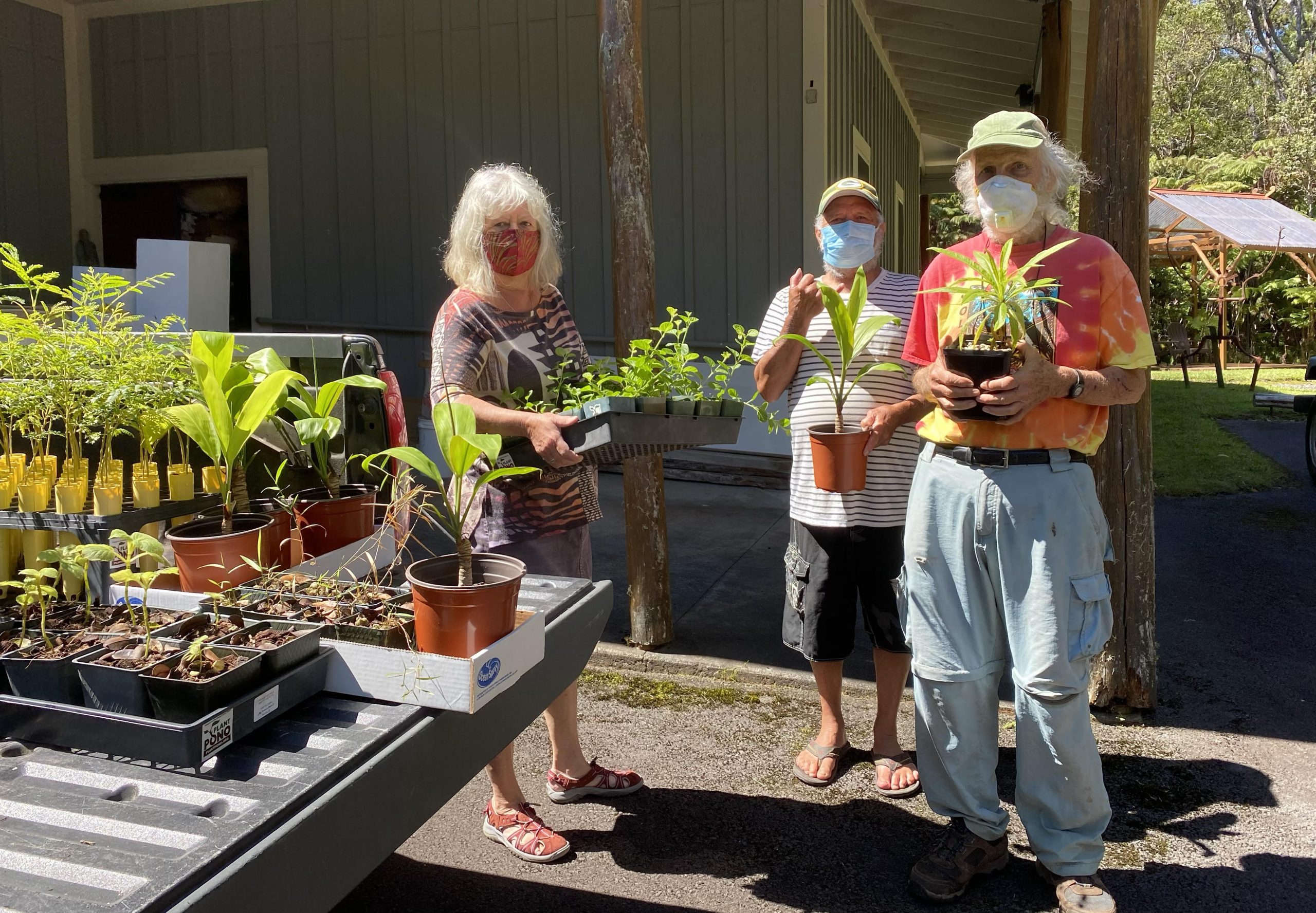
THE 32ND HAWAI'I INTERNATIONAL TROPICAL FRUIT CONFERENCE is set for Nov. 4-6 with the title Propagation! Send in the Clones. The 2022 conference returns to its annual in-person format with a full lineup of educational offerings, tours and a trade show. It will be held at the Royal Kona Resort.

"This year's conference offers a lineup of visiting researchers and agro experts, plus breakout sessions on a variety of fruit-related topics," shares Ken Love, HTFG executive director. "As our last two conferences were virtual, we look forward to networking, learning and having some fun."
Banana industry guru Gabe Sachter-Smith will discuss propagation techniques for enhanced banana production. Other conference topics cover shipping malama and finger limes to the US Mainland, controlling avocado lace bugs and fruit flies, passion fruit, understanding the USDA permitting system, increased fruit production via the Mango Loa Project and fertigation—the process of directly applying fertilizer through an irrigation system.
Interactive activities include a fruit tasting and fruit-themed dinner with Chef George Gomes, plus demonstrations by Preece, Love and Brian Lievens.
 The conference includes a visit to the South Kona Green Market, and the Hawai'i Tropical Fruit Growers' Containment Greenhouse & Nursery.
Research updates will be provided by Dr. Marisa Wall, director of the Pacific Basin Agricultural Research Center while state Sen. Mike Gabbard, committee chair on agriculture and environment, will offer a legislative update.
The featured presenter is Dr. John Preece, supervisory research leader at the USDA Agricultural Research Service National Clonal Germplasm Repository, who will share his expertise on propagation techniques for tropical fruit trees.
The conference is made possible with the support of the Hawai'i Department of Agriculture, County of Hawai'i and HTFG members from across the state.
Registration forms and fee schedule are available at www.HTFG.org or by contacting Love at kenlove@hawaiiantel.net or Mark Suiso at mark.suiso@gmail.com.
Hawai'i Tropical Fruit Growers was incorporated in 1989 to promote tropical fruit grown in Hawaii. It is a statewide association of tropical fruit growers, packers, distributors and hobbyists dedicated to tropical fruit research, education, marketing and promotion; www.HTFG.org.
To read comments, add your own, and like this story, see www.facebook.com/kaucalendar. See latest print edition at wwwkaucalendar.com. See upcoming events at https://kaunewsbriefs.blogspot.com/2022/04/upcoming-events-for-kau-and-volcano.html.
 |
| Kelson Gallano, Dusty Silva and Novi Czyscon, Guardians of the Trail Youth Interns at the Crater. FHVNP photo by Moses Espaniola III |
GUARDIANS OF THE TRAILS YOUTH INTERN PROGRAM has drawn another $60,000 awarded to Friends of Hawaiʻi Volcanoes National Park. Friends of Hawaiʻi Volcanoes National Park's Guardians of the Trails is in its third year. The National Park Foundation awarded $35k and Helen Wright provided an individual donation of $25k. This is the second 25k donation from Wright to the Friends.
This year, funds provide a five month paid salary to Hawai'i island youth to work in the park maintaining and rehabbing trails, as well as removing 300,000 invasive ginger plants. Led by Friendʻs Guardians of the Trails Youth Supervisor, Moses Espaniola, III, this program started July 1 and runs through Dec. 5.
In 2020, the Friends started the program with a grant from the National Park Foundation of $150k. Those funds employed six youth and purchase of a new 11 passenger van and equipment. The program successfully operated during COVID.
"We are grateful to the National Park Foundation and Ms. Helen Wright for their support of Hawai'i
island youth, which in turn benefits the park and our local community, said Friends CEO Elizabeth Fien.
In 2020, the Friends started the program with a grant from the National Park Foundation of $150k. Those funds employed six youth and purchase of a new 11 passenger van and equipment. The program successfully operated during COVID.
"We are grateful to the National Park Foundation and Ms. Helen Wright for their support of Hawai'i
 Elizabeth Fien, FHVNP CEO, Moses Espaniola III, Kelson Gallano, Dusty Silva and Novi Czyscon with Guardians of the Trail. FVNP Photo by Lynette Smith |
Hawai'i Volcanoes National Park Superintendent Rhonda Loh said, "We are thrilled to have the Guardians back with so many projects in the park - they are a great addition. The program gives opportunities for our community youth to learn new skills while supporting the park."
Friends is the official philanthropic partner of Hawaiʻi Volcanoes National Park, a 501 (c) 3 and operates under a formal partnership agreement with the National Park Service. "It supports the National Park Service in the protection, preservation and interpretation of the natural and cultural resources at Hawaiʻi Volcanoes National Park for the enjoyment of current and future generations," says a statement from Friends.
The National Park Foundation works to protect wildlife and park lands, preserve history and culture, educate and engage youth, and connect people everywhere to the wonder of parks. It operates in collaboration with the National Park Service, the park partner community, and with "generous support of donors, without whom our work would not be possible," says its statement. Learn more at
www.nationalparks.org.
The National Park Foundation's Service Corps. "opens the door to a world of opportunities to gain leadership skills and give back to national parks," said Will Shafroth, president and CEO of the National Park Foundation. "The National Park Foundation and our partners are proud to support programs that make lasting positive impacts for both parks and people."
The National Park Foundation is investing more than $4.1 million in service corps programs in fiscal year 2022, including support from Communities and Workforce program partners Carhartt, Winnebago and Winnebago Industries Foundation, and partners Nature Valley, Apple, REI Co-op, American Express, Free People, and Publix Super Markets. Additional funding is provided by The JPB Foundation, Annie and Kevin Parker, and many other donors. Select projects are also being leveraged with federal funds that were authorized and appropriated for the National Park Foundation under the 2016 National Park Service Centennial Act (PL 114-289).
CRATER FILLING AT KILAUEA IS LIKE INJECTING HAUPIA CREME INTO A CRISPY MALASADA. It's sometimes like pouring liquid into a mug. These are comparisons in this week's Volcano Watch, the weekly article and activity update written by U.S. Geological Survey Hawaiian Volcano Observatory scientists and affiliates:
This past week, over 400 small-magnitude earthquakes were recorded below the summit and upper elevation flanks of Mauna Loa—the majority of these occurred at shallow depths less than 15 kilometers (9 miles) below sea level. Global Positioning System (GPS) measurements show low rates of ground deformation over the past week. This increase in seismicity does not mean that an eruption is imminent nor that progression to an eruption is certain. Gas concentrations and fumarole temperatures at both the summit and at Sulphur Cone on the Southwest Rift Zone have remained stable over the past week. Webcams show no changes to the landscape. For more information on current monitoring of Mauna Loa, see: https://www.usgs.gov/volcanoes/mauna-loa/monitoring.
Five earthquakes were reported felt in the Hawaiian Islands during the past week: a M2.3 earthquake 11 km (6 mi) ENE of Pāhala at 32 km (19 mi) depth on Sept. 27 at 12:55 p.m. HST, a M4.5 earthquake 9 km (5 mi) ENE of Pāhala at 32 km (19 mi) depth on Sept. 27 at 12:43 p.m. HST, a M2.0 earthquake 10 km (6 mi) ENE of Pāhala at 29 km (18 mi) depth on Sept. 25 at 7:39 a.m. HST, a M3.5 earthquake 10 km (6 mi) ENE of Pāhala at 31 km (19 mi) depth on Sept. 23 at 8:43 p.m. HST, a M2.9 earthquake 2 km (1 mi) NNE of Kahaluu-Keauhou at 18 km (11 mi) depth on Sept. 22 at 6:00 a.m. HST.
HVO continues to closely monitor Kīlauea's ongoing eruption and Mauna Loa for any signs of increased activity. Visit HVO’s website for past Volcano Watch articles, Kīlauea and Mauna Loa updates, volcano photos, maps, recent earthquake info, and more. Email questions to askHVO@usgs.gov.
Friends is the official philanthropic partner of Hawaiʻi Volcanoes National Park, a 501 (c) 3 and operates under a formal partnership agreement with the National Park Service. "It supports the National Park Service in the protection, preservation and interpretation of the natural and cultural resources at Hawaiʻi Volcanoes National Park for the enjoyment of current and future generations," says a statement from Friends.
The National Park Foundation works to protect wildlife and park lands, preserve history and culture, educate and engage youth, and connect people everywhere to the wonder of parks. It operates in collaboration with the National Park Service, the park partner community, and with "generous support of donors, without whom our work would not be possible," says its statement. Learn more at
 |
| Guardian Novi Czyscon treats invasive ginger stumps after cutting them back. FHVNP photo by Moses Espaniola III |
The National Park Foundation's Service Corps. "opens the door to a world of opportunities to gain leadership skills and give back to national parks," said Will Shafroth, president and CEO of the National Park Foundation. "The National Park Foundation and our partners are proud to support programs that make lasting positive impacts for both parks and people."
The National Park Foundation is investing more than $4.1 million in service corps programs in fiscal year 2022, including support from Communities and Workforce program partners Carhartt, Winnebago and Winnebago Industries Foundation, and partners Nature Valley, Apple, REI Co-op, American Express, Free People, and Publix Super Markets. Additional funding is provided by The JPB Foundation, Annie and Kevin Parker, and many other donors. Select projects are also being leveraged with federal funds that were authorized and appropriated for the National Park Foundation under the 2016 National Park Service Centennial Act (PL 114-289).
To read comments, add your own, and like this story, see www.facebook.com/kaucalendar. See latest print edition at wwwkaucalendar.com. See upcoming events at https://kaunewsbriefs.blogspot.com/2022/04/upcoming-events-for-kau-and-volcano.html.
CRATER FILLING AT KILAUEA IS LIKE INJECTING HAUPIA CREME INTO A CRISPY MALASADA. It's sometimes like pouring liquid into a mug. These are comparisons in this week's Volcano Watch, the weekly article and activity update written by U.S. Geological Survey Hawaiian Volcano Observatory scientists and affiliates:
Since December 2020, two eruptions have been filling the deep pit crater left by the 2018 subsidence of Kīlauea caldera. The first eruption started in late December 2020 and lasted five months. The second eruption continues and reached one year old on Thursday, Sept. 29. As of this week, more than 150 million cubic meters (over 39 billion gallons) of new lava have filled that pit and lifted its floor almost 370 meters (1200 feet) higher than the deepest point of 2018 subsidence.
The first eruption started on Dec. 20, 2020, and by the new year, the lava level had risen more than 180 meters (590 feet). The last activity was observed on May 23, 2021, after lava had filled 225 meters (739 feet) of the pit. The crusted crater floor had an area of 45 hectares (111 acres) capping a volume of 41 million cubic meters (over 10 billion gallons) of mostly molten lava. The crater floor was adorned with a main island (formed in the first hours of the 2020-21 eruption), several smaller islands to the east, and a small vent cone at its west edge. The high point of the island was about 25 meters (82 feet) above the surrounding crater floor.
Activity picked up again on Sept. 29, 2021, from a new western cone and from the edges of the crater floor. As of Sept. 12, the 2021-22 eruption has added 111 million cubic meters (29.3 billion gallons) of lava, raised the crater floor another 140 meters (460 feet), and more-than-doubled the area of the 2020-21 crater floor.
Current views of Halemaʻumaʻu show a central oval-shaped plate of 2020-21 crust with its main island frozen into it. While the 2020-21 crater floor is being lifted, new floor is being added around its edges by the 2021-22 ongoing eruption. The erupting vent, called the west cone, seems to be frozen in the same position at the west edge of the 2020-21 crater floor. Currently, the small lava lake occupies less than 1 percent of the crater floor.
The crater floor continues to rise, with a few brief drops, like the top of a piston with the crust mostly intact at its top. Because the pit is shaped like a funnel, the uplifted crater floor must get larger as it moves upward.
While it may seem odd that more lava is not erupted over the crater floor to build it higher flow by flow, history shows us that this piston-like uplift from beneath the floor is a common mechanism by which Kīlauea fills its craters. Rev. Titus Coan recognized this in the 1800s when the central part of the caldera floor rose almost 60 meters (197 feet) between two of his semiannual visits. He deduced that it was uplifted from beneath because plants were undisturbed on the raised plateau.
Thomas Jaggar, founder of the Hawaiian Volcano Observatory, observed this process several times between 1916 and 1924. The crater floor would uplift at long-term rates of 0.5-1.5 meters (1.5-5 feet)/day over several months with the faster rates at the start of the uplift.
The 2020-21 and 2021-22 crater floors rose at similar rates. Daily rise rates were higher at the beginning of both recent eruptions but it’s too soon to tell whether the rates are constant or slowing.
On occasion, the 2021-22 eruption lava has covered substantial portions of the crater floor with new lava. The highest parts of the 2020-21 main island are still visible, but the island has been surrounded by about 10 meters (33 feet) of surface flows. Meanwhile, the crater floor was uplifted an additional 130 meters (427 feet) by lava beneath the crust. In other words, most of the molten lava added to Halemaʻumaʻu pit crater has not been seen by observers on the surface. Only a small fraction of it trickles out occasionally covering part of the crater floor.
Our malasada analogy breaks down when one considers what would happen if a malasada were injected with filling for more than a few seconds! The Halemaʻumaʻu crater floor will continue to rise with continued injection of lava but, sadly, the malasada would burst and become a puddle of pudding. But it would still be a good companion to your morning beverage.
Volcano Activity Updates: Kīlauea volcano is erupting. Its USGS Volcano Alert level is at WATCH (https://www.usgs.gov/natural-hazards/volcano-hazards/about-alert-levels). Kīlauea updates are issued daily.
Over the past week, lava has continued to erupt from the western vent within Halemaʻumaʻu crater in Hawai‘i Volcanoes National Park. Sulfur dioxide emission rates remain elevated and were last measured at approximately 970 tonnes per day (t/d) on September 28. Seismicity is elevated but stable, with few earthquakes and ongoing volcanic tremor. Over the past week, summit tiltmeters recorded several minor deflation-inflation (DI) events. For more information on the current eruption of Kīlauea, see https://www.usgs.gov/volcanoes/kilauea/recent-eruption Mauna Loa is not erupting and remains at Volcano Alert Level ADVISORY. This alert level does not mean that an eruption is imminent or that progression to an eruption from the current level of unrest is certain. Mauna Loa updates are issued weekly.
 |
| KWcam image taken on Sept. 28, 2021, before the eruption began in Halemaʻumaʻu on Sept. 29, 2021. Several islands, including the one in the center of the crater that formed on Dec. 20, 2020, are surrounded by younger lava flows erupted during the December 2020-May 2021 Kīlauea summit eruption. USGS photo |
The first eruption started on Dec. 20, 2020, and by the new year, the lava level had risen more than 180 meters (590 feet). The last activity was observed on May 23, 2021, after lava had filled 225 meters (739 feet) of the pit. The crusted crater floor had an area of 45 hectares (111 acres) capping a volume of 41 million cubic meters (over 10 billion gallons) of mostly molten lava. The crater floor was adorned with a main island (formed in the first hours of the 2020-21 eruption), several smaller islands to the east, and a small vent cone at its west edge. The high point of the island was about 25 meters (82 feet) above the surrounding crater floor.
Activity picked up again on Sept. 29, 2021, from a new western cone and from the edges of the crater floor. As of Sept. 12, the 2021-22 eruption has added 111 million cubic meters (29.3 billion gallons) of lava, raised the crater floor another 140 meters (460 feet), and more-than-doubled the area of the 2020-21 crater floor.
Current views of Halemaʻumaʻu show a central oval-shaped plate of 2020-21 crust with its main island frozen into it. While the 2020-21 crater floor is being lifted, new floor is being added around its edges by the 2021-22 ongoing eruption. The erupting vent, called the west cone, seems to be frozen in the same position at the west edge of the 2020-21 crater floor. Currently, the small lava lake occupies less than 1 percent of the crater floor.
The crater floor continues to rise, with a few brief drops, like the top of a piston with the crust mostly intact at its top. Because the pit is shaped like a funnel, the uplifted crater floor must get larger as it moves upward.
While it may seem odd that more lava is not erupted over the crater floor to build it higher flow by flow, history shows us that this piston-like uplift from beneath the floor is a common mechanism by which Kīlauea fills its craters. Rev. Titus Coan recognized this in the 1800s when the central part of the caldera floor rose almost 60 meters (197 feet) between two of his semiannual visits. He deduced that it was uplifted from beneath because plants were undisturbed on the raised plateau.
Thomas Jaggar, founder of the Hawaiian Volcano Observatory, observed this process several times between 1916 and 1924. The crater floor would uplift at long-term rates of 0.5-1.5 meters (1.5-5 feet)/day over several months with the faster rates at the start of the uplift.
 |
| KWcam image taken on Sept. 27, 2022. The floor of Halemaʻumaʻu has grown in area and elevation due to the ongoing eruption in crater. The island that formed on Dec. 20, 2020, is surrounded by younger lava flows so what is seen on the surface of Halemaʻumaʻu crater floor today represents the oldest and youngest deposits from these recent eruptions. USGS photo |
On occasion, the 2021-22 eruption lava has covered substantial portions of the crater floor with new lava. The highest parts of the 2020-21 main island are still visible, but the island has been surrounded by about 10 meters (33 feet) of surface flows. Meanwhile, the crater floor was uplifted an additional 130 meters (427 feet) by lava beneath the crust. In other words, most of the molten lava added to Halemaʻumaʻu pit crater has not been seen by observers on the surface. Only a small fraction of it trickles out occasionally covering part of the crater floor.
Our malasada analogy breaks down when one considers what would happen if a malasada were injected with filling for more than a few seconds! The Halemaʻumaʻu crater floor will continue to rise with continued injection of lava but, sadly, the malasada would burst and become a puddle of pudding. But it would still be a good companion to your morning beverage.
Volcano Activity Updates: Kīlauea volcano is erupting. Its USGS Volcano Alert level is at WATCH (https://www.usgs.gov/natural-hazards/volcano-hazards/about-alert-levels). Kīlauea updates are issued daily.
Over the past week, lava has continued to erupt from the western vent within Halemaʻumaʻu crater in Hawai‘i Volcanoes National Park. Sulfur dioxide emission rates remain elevated and were last measured at approximately 970 tonnes per day (t/d) on September 28. Seismicity is elevated but stable, with few earthquakes and ongoing volcanic tremor. Over the past week, summit tiltmeters recorded several minor deflation-inflation (DI) events. For more information on the current eruption of Kīlauea, see https://www.usgs.gov/volcanoes/kilauea/recent-eruption Mauna Loa is not erupting and remains at Volcano Alert Level ADVISORY. This alert level does not mean that an eruption is imminent or that progression to an eruption from the current level of unrest is certain. Mauna Loa updates are issued weekly.
 |
| See The Kaʻū Calendar print edition in mailboxes throughout Volcano, Pāhala, Nāʻālehu and Ocean View and on stands. |
Five earthquakes were reported felt in the Hawaiian Islands during the past week: a M2.3 earthquake 11 km (6 mi) ENE of Pāhala at 32 km (19 mi) depth on Sept. 27 at 12:55 p.m. HST, a M4.5 earthquake 9 km (5 mi) ENE of Pāhala at 32 km (19 mi) depth on Sept. 27 at 12:43 p.m. HST, a M2.0 earthquake 10 km (6 mi) ENE of Pāhala at 29 km (18 mi) depth on Sept. 25 at 7:39 a.m. HST, a M3.5 earthquake 10 km (6 mi) ENE of Pāhala at 31 km (19 mi) depth on Sept. 23 at 8:43 p.m. HST, a M2.9 earthquake 2 km (1 mi) NNE of Kahaluu-Keauhou at 18 km (11 mi) depth on Sept. 22 at 6:00 a.m. HST.
HVO continues to closely monitor Kīlauea's ongoing eruption and Mauna Loa for any signs of increased activity. Visit HVO’s website for past Volcano Watch articles, Kīlauea and Mauna Loa updates, volcano photos, maps, recent earthquake info, and more. Email questions to askHVO@usgs.gov.
To read comments, add your own, and like this story, see www.facebook.com/kaucalendar. See latest print edition at wwwkaucalendar.com. See upcoming events at https://kaunewsbriefs.blogspot.com/2022/04/upcoming-events-for-kau-and-volcano.html.


.jpg)