 |
| A chart of facial hair styles and their names, showing those allowed and prohibited when spraying organic and conventional pesticides using a respirator. University of Hawai'i is offering free medical checkups and respirator fitting tests for farmers to qualify to spray. Image from CDC |
To help with this requirement, University of Hawai'i Dept. of Agriculture Cooperative Extension Service has set up free medical appointments with physicians. Extension Agent Andrea Kawabata reports that 20-minute appointment slots are available with Dr. Lindborg on April 12 in Kona and April 14 in Hilo.

For additional free health screening for coffee farmers, partners from Hawai'i Community Health Center will be present from 9 a.m. to 3:30 p.m. on April 11, 12, 14, and 15 to measure blood pressure and glucose levels with no appointment needed.
Register for sprayer calibration, respirator use and fit testing, and medical evaluations at https://www.hawaiicoffeeed.com/calandrespfittest.html. With questions, contact Kawabata at andreak@hawaii.edu or 415-604-1511.
To read comments, add your own, and like this story, see facebook.com/kaucalendar. See latest print edition at kaucalendar.com, in the mail and on stands.
MAKALOA IS KAʻŪ NATIVE PLANT OF THE MONTH for Lāʻau Letters: Native Plants of Kaʻū by Jodie Rosam with art by Joan Yoshioka. Read about Kaʻū’s native plants and their moʻolelo (stories), uses, preferred habitats, and opportunities to adopt them for stewardship. This column seeks to encourage making new plant friends and to reunite with others.
Description: This month, we are heading to our beloved anchialine ecosystems and learning about makaloa (a.k.a. ehuʻawa), an indigenous flatsedge in the Cyperaceae family. This coastal sedge is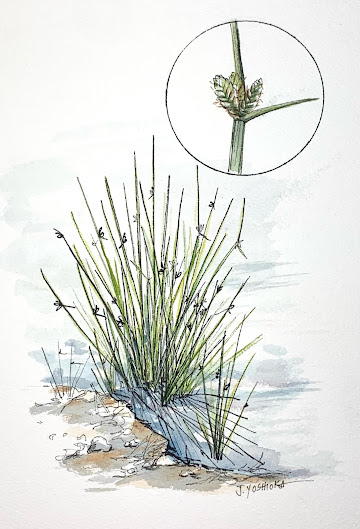
relatively small, with thin green culms (hollow stems) that grow to about two feet tall, ending with a sharp point. The flowers are barely noticeable and turn yellowish-brown when they are ripe, dangling from the tips of the culms. Makaloa is short-lived (lasting only about five years), but tends to regenerate as long as there is sufficient water in the area. Makaloa is an essential plant for our native pinao ʻula or damselflies (Megalagrion spp.), which rest on makaloa to observe their surroundings. What’s really cute is that the eyes of the pinao ʻula are perfectly designed to see either side and around the leaf blades of makaloa.
Uses: Perhaps the most well-known use of makaloa is for weaving. Makaloa stems were woven into mats and used for pāʻū (skirts), malo (loincloths), kīhei (cloaks), and also woven into the most prized Hawaiian sleeping mats. The makaloa mats from Niʻihau and Kauaʻi were considered to be the finest mats in all of Polynesia. ʻŌlelo Noʻeau #2176 by Mary Kawena Pukui reads, “Moena pāwehe o Niʻihau” (or patterned mat of Niʻihau), which is a poetic reference to the famed makaloa mats from Niʻihau which were known for their beautiful geometric motifs. If you have a chance to visit the Bishop Museum, there is a makaloa mat that measures 10.5 x 20 feet with 25 stems per inch, which was worn as a cloak by Kamehameha I. Makaloa can also be used medicinally by crushing the leaf blades into a fine powder and placed on cuts, boils, and skin ulcers to aid in healing. And interestingly, there is a natural wastewater treatment facility on Molokaʻi that is using makaloa as part of its treatment techniques!
Habitat: Makaloa (Cyperus laevigatus) grows in wetland habitats across Hawaiʻi, and can be found in mud flats, sandy coastal sites, and around or within fresh, brackish, and saltwater ponds and anchialine pools. In the center of Kamole (a.k.a. Kauō or Laysan), it is found around a 100-acre hypersaline lake, providing habitat for the endangered koloa pōhaka (Laysan ducks) and ʻainohu kauō (Laysan finches). In Kaʻū, you can appreciate makaloa near the water’s edge and anchialine pools and estuaries in Kiolakaʻa, Waiʻōhinu, and Honuʻapo.
Description: This month, we are heading to our beloved anchialine ecosystems and learning about makaloa (a.k.a. ehuʻawa), an indigenous flatsedge in the Cyperaceae family. This coastal sedge is
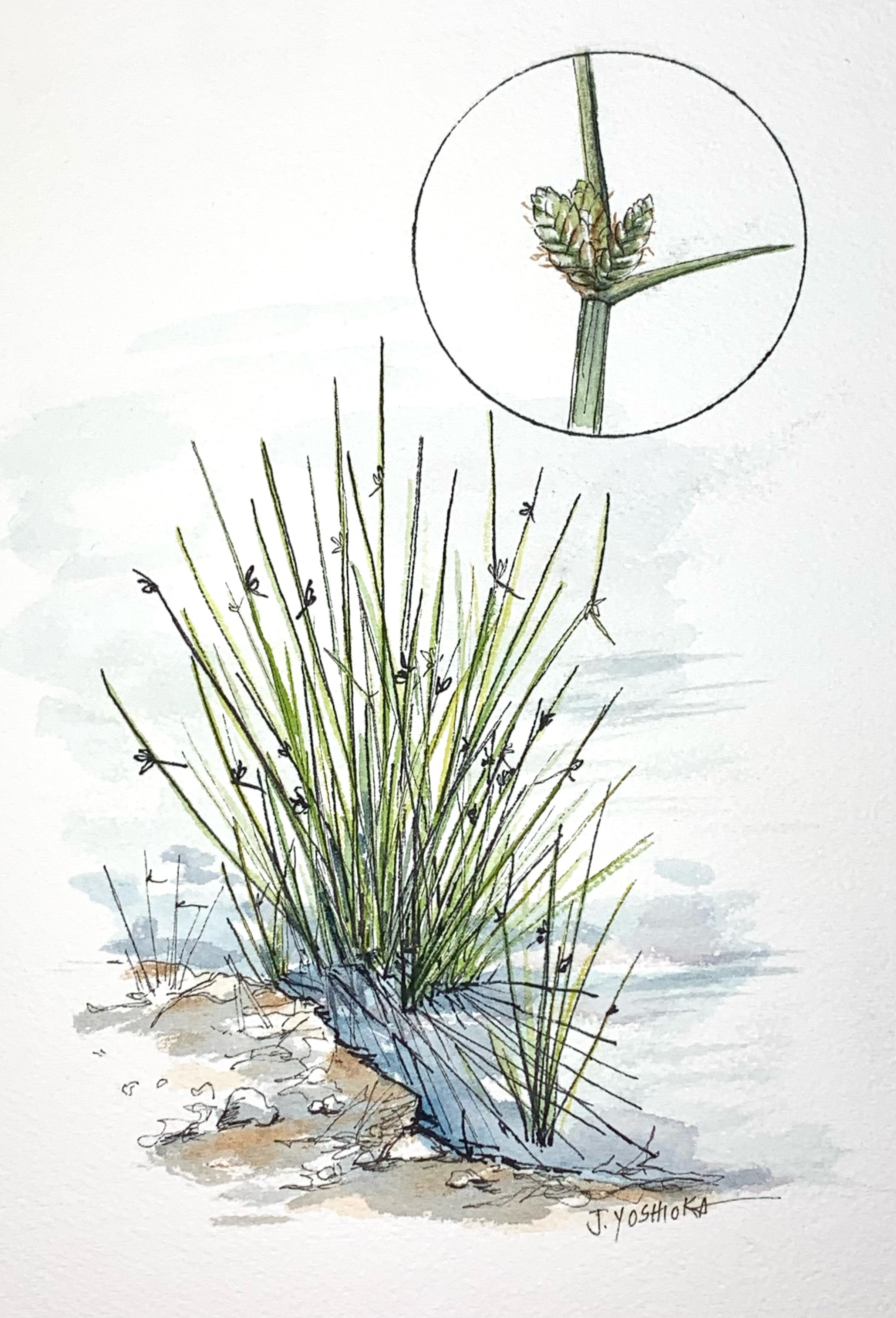
relatively small, with thin green culms (hollow stems) that grow to about two feet tall, ending with a sharp point. The flowers are barely noticeable and turn yellowish-brown when they are ripe, dangling from the tips of the culms. Makaloa is short-lived (lasting only about five years), but tends to regenerate as long as there is sufficient water in the area. Makaloa is an essential plant for our native pinao ʻula or damselflies (Megalagrion spp.), which rest on makaloa to observe their surroundings. What’s really cute is that the eyes of the pinao ʻula are perfectly designed to see either side and around the leaf blades of makaloa.
Uses: Perhaps the most well-known use of makaloa is for weaving. Makaloa stems were woven into mats and used for pāʻū (skirts), malo (loincloths), kīhei (cloaks), and also woven into the most prized Hawaiian sleeping mats. The makaloa mats from Niʻihau and Kauaʻi were considered to be the finest mats in all of Polynesia. ʻŌlelo Noʻeau #2176 by Mary Kawena Pukui reads, “Moena pāwehe o Niʻihau” (or patterned mat of Niʻihau), which is a poetic reference to the famed makaloa mats from Niʻihau which were known for their beautiful geometric motifs. If you have a chance to visit the Bishop Museum, there is a makaloa mat that measures 10.5 x 20 feet with 25 stems per inch, which was worn as a cloak by Kamehameha I. Makaloa can also be used medicinally by crushing the leaf blades into a fine powder and placed on cuts, boils, and skin ulcers to aid in healing. And interestingly, there is a natural wastewater treatment facility on Molokaʻi that is using makaloa as part of its treatment techniques!
Habitat: Makaloa (Cyperus laevigatus) grows in wetland habitats across Hawaiʻi, and can be found in mud flats, sandy coastal sites, and around or within fresh, brackish, and saltwater ponds and anchialine pools. In the center of Kamole (a.k.a. Kauō or Laysan), it is found around a 100-acre hypersaline lake, providing habitat for the endangered koloa pōhaka (Laysan ducks) and ʻainohu kauō (Laysan finches). In Kaʻū, you can appreciate makaloa near the water’s edge and anchialine pools and estuaries in Kiolakaʻa, Waiʻōhinu, and Honuʻapo.
Growing and Purchasing: Makaloa is sometimes available for purchase at big box stores like Home Depot (but not always), though it is also easily propagated by division of your favorite
makaloa friends. Choose a healthy clump with at least 20 stems and be sure you get a rhizome (horizontally-growing underground stem) when you divide the clump using a clean, sharp trowel. Plant the new clumps in water or in very wet locations and in full sun, and place them about 1-3 feet apart. Makaloa can be used to control erosion or as just an accent around rock or water features. As long as it is planted somewhere that remains continuously wet, your new makaloa friend will be a treat to grow, and may just inspire you to practice mat making!
makaloa friends. Choose a healthy clump with at least 20 stems and be sure you get a rhizome (horizontally-growing underground stem) when you divide the clump using a clean, sharp trowel. Plant the new clumps in water or in very wet locations and in full sun, and place them about 1-3 feet apart. Makaloa can be used to control erosion or as just an accent around rock or water features. As long as it is planted somewhere that remains continuously wet, your new makaloa friend will be a treat to grow, and may just inspire you to practice mat making!
To read comments, add your own, and like this story, see facebook.com/kaucalendar. See latest print edition at kaucalendar.com, in the mail and on stands.
KAʻŪ TROJANS TOOK DOWN ST. JOE'S, CHRISTIAN LIBERTY AND MAKUA LANI over the last week in Boys Volleyball, with one loss to Pahoa.
In the St. Joe's match, Kaʻū High won all three sets, 25-10, 25-13 and 25-16.
Tyson Junior Kuahuia-Faafia came up with 15 kills, 5 aces and 4 blocks. Vladimir Fedoruk made 2 kills and 9 aces. Adahdiyah Ellis Reyes scored with 8 kills and one 1 ace. Karsen Polido-Tuaifaiva achieved 3 kills and 3 aces. CyZeiah Silva-Kamei delivered 2 aces; Kayson Pagan 1 kill; and Triton Blanco - 1 block.
In the Makua Lani match, Kaʻū won in four sets. Trojans took the first and second, 25-2 and 25-14. Makua Lani came back to win the third 25-21. Kaʻū finished the match by winning the fourth 26-24.
 |
| Kaʻū Trojans won three of the last four BIIF boys volleyball matches. Photo from Coach Josh Ortega |
Tyson Junior Kuahuia-Faafia pounded 10 Kills, made 7 aces and 2 blocks. Adahdiyah Ellis Reyes managed 5 kills, 2 aces and 2 blocks. Karsen Polido-Tuaifaiva slammed 4 kills and made 9 aces. Vladimir Fedoruk had 3 kills and 2 aces. Kayson Pagan came up with 2 kills; CyZeiah Silva-Kamei 2 aces; Zayden Gallano 1 kill and Triton Blanco 1 kill.
In the Christian Liberty match, Kaʻū won the first set 25-16, lost the second set, 24-26, won the third set 25-22 and the fourth set 25-22.
Tyson Junior Kuahuia-Faafia managed 20 kills and 6 blocks. Vladimir Fedoruk came away with 4 kills, 1 ace and 1 block. Adahdiyah Ellis Reyes scored 9 kills and 1 block. Karsen Polido-Tuaifaiva achieved 6 kills and 2 aces. CyZeiah Silva-Kamei landed 1 ace; Kayson Pagan 1 kill and 1 block; Triton Blanco 4 kills and Patrick Riehle 1 kill.
Kaʻū lost to Pahoa in three sets, 14-25, 17-25 and 11-25. Vladimir Fedoruk nailed 4 kills. Tyson Junior Kuahuia-Faafia managed 2 kills, 1 ace and 3 blocks. Adahdiyah Ellis Reyes scored 2 kills. Patrick Riehle achieved 2 kills and 1 block. Karsen Polido-Tuaifaiva 1 kill and 1 ace; Kayson Pagan 1 kill and 2 blocks; CyZeiah Silva-Kamei 1 ace.

To read comments, add your own, and like this story, see facebook.com/kaucalendar. See latest print edition at kaucalendar.com, in the mail and on stands.

FREE FOOD
St. Jude's Hot Meals are free to those in need on Saturdays from 9 a.m. until food runs out, no later than noon. Volunteers from the community are welcome to help and can contact Karen at pooch53@gmail.com. Location is 96-8606 Paradise Circle Drive in Ocean View. Those in need can also take hot showers from 9 a.m. to noon and use the computer lab from 9:30 a.m. to 1 p.m.
Free Meals Mondays, Wednesdays, and Fridays are served from 12:30 p.m. to 3:30 p.m. at Nā'ālehu Hongwanji. Volunteers prepare the food provided by 'O Ka'ū Kākou with fresh produce from its gardens on the farm of Eva Liu, who supports the project. Other community members also make donations and approximately 150 meals are served each day.
OUTDOOR MARKETS
Volcano Thursday Market, Cooper Center, Volcano Village, Thursdays, 3 p.m. to 6 p.m., with live music, artisan crafts, ono grinds, and fresh produce. See Volcano Evening Market facebook.
Volcano Swap Meet, fourth Saturday of the month from 8 a.m. to noon. Large variety of vendors with numerous products. Tools, clothes, books, toys, local made healing extract and creams, antiques, jewelry, gemstones, crystals, food, music, plants, fruits, and vegetables. Also offered are cakes, coffee, and shave ice. Live music.
Volcano Farmers Market, Cooper Center, Volcano Village on Sundays, 6 a.m. to 10 a.m., with local produce, baked goods, food to go, island beef and Ka'ū Coffee. EBT is used for Supplemental Nutrition Assistance Program, formerly Food Stamps. Call 808-967-7800.
O Ka'ū Kākou Market, Nā'ālehu, Wednesdays, 8 a.m. to 2 p.m. Contact Nadine Ebert at 808-938-5124 or June Domondon 808-938-4875. See facebook.com/OKauKakouMarket.
Ocean View Community Market, Saturdays and Wednesdays, 6:30 a.m. to 2 p.m., corner Kona Dr. Drive and Hwy 11, near Thai Grindz. Masks mandatory. 100-person limit, social distancing required. Gate unlocked for vendors at 5:30 a.m., $15 dollars, no rez needed. Parking in the upper lot. Vendors must provide their own sanitizer. Food vendor permits required. Carpooling is encouraged.


