About The Kaʻū Calendar

Sunday, July 16, 2023

Kaʻū News Briefs, Sunday, July 16, 2023

Miloli'i's Kalanihale community organization which recently held its Lawai'a Camp with a focus on corals, welcomes a new
effort
called Ākoʻakoʻa to build and restore the reefs. Photo from Hawai'i Marine Education & Research Center

THE MILOLI'I COMMUNITY'S EFFORT TO PRESERVE AND RESTORE ITS CORAL REEF AND SUSTAINABLE NATIVE FISHERY is set to receive support from a new effort from Arizona State University and partners. It's called Ākoʻakoʻa and ASU describes it as "a new collaborative effort to seed renewed connection between human, coral communities in Hawai'i."
    ASU recently released an online story about the effort, quoting Ka'imi Kaupiko, President of Kalanihale in Miloli'i, who recently completed a Lawai'a Camp summer session with students focusing on coral. He said, “We support the work of ASU and the Hawai'i Marine Education & Research Center to malama (care for) the corals of west Hawai'i. The reefs from Ūpolu to Ka Lae are one of the most diverse systems in all of Hawai'i, but with the effects of climate change, we need to be proactive in caring for them.” ASU describes Kalanihale as "a grassroots organization designed to improve the educational, environmental and
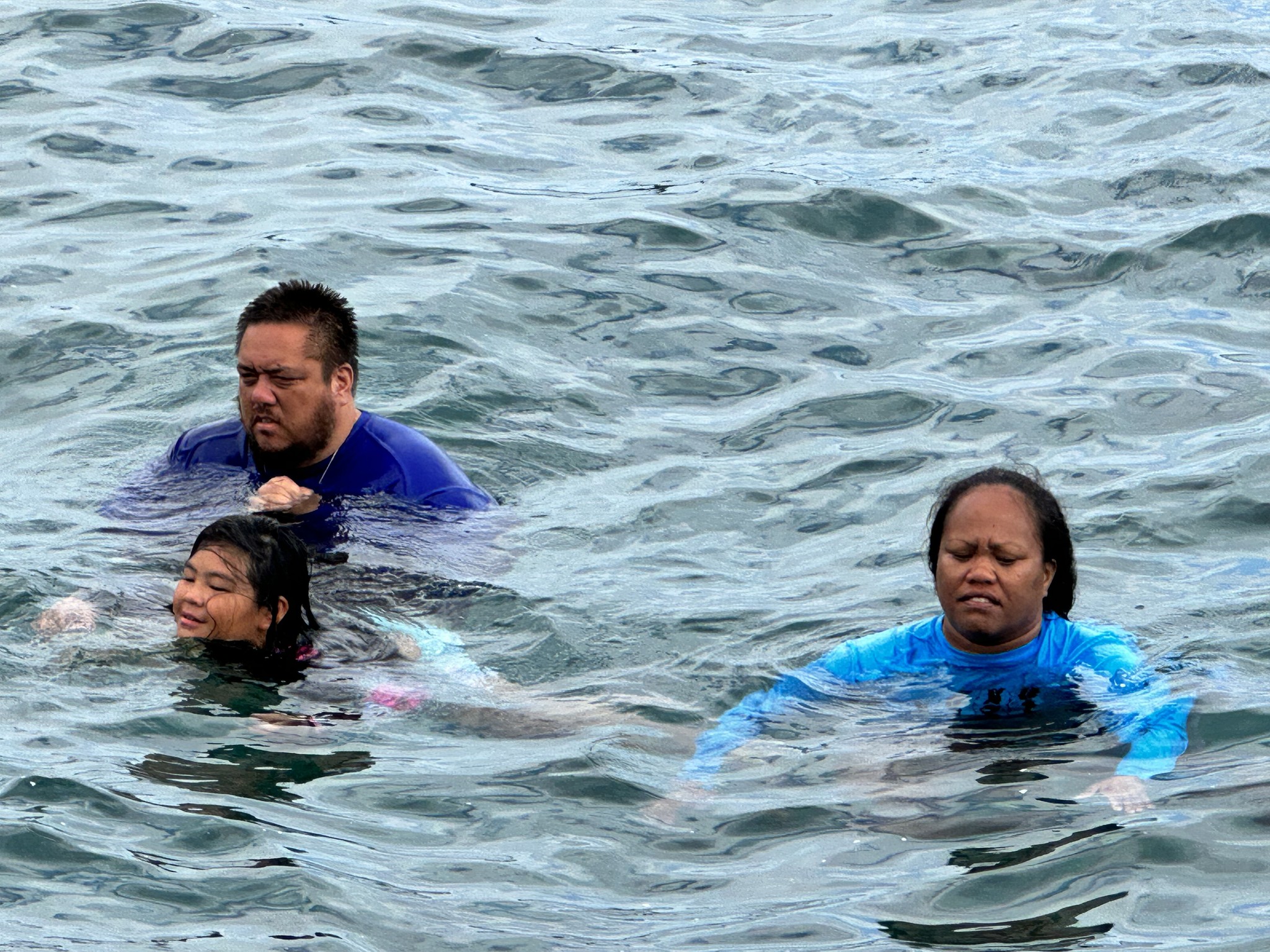
Ka'imi Kaupiko and Lawai'a Camp goers in the waters of Miloli'i.
Photo from Hawai'i Marine Education & Research Center

cultural well-being of community members of Miloliʻi and South Kona."
    ASU reports that a key part of the collaboration with communities like Miloli'i is a new state-of-the-art coral research and propagation facility located at the joint Ridge to Reef Restoration Center in Kailua-Kona. The center is under construction now in partnership with a land restoration organization called Terraformation. The coral facility will be the largest in the world when completed and will become the hub for testing corals for subsequent reef restoration. “These resources are an exciting development for the multiple partners and communities working closely together to scale up active coral restoration in Hawaii,” said Carrie Selberg Robinson, director of the NationalOceanic and Atmospheric Administration Fisheries Office of Habitat Conservation.
    ʻĀkoʻakoʻa shares a dual meaning: 'to assemble' and 'coral.' “For decades, our original program focused on diagnosing land and reef problems using high-tech satellite, airborne and field technologies,” said Greg Asner, director of ASU’s Center for Global Discovery and Conservation Science and a longtime resident of Hawai'i. “The new program further expands this diagnostic work, but it focuses far more effort on interventions that support Hawai'i’s communities, both coral and human, as one force.” Asner said lessons learned in ʻĀkoʻakoʻa will be shared with communities across the state and worldwide. “Our successes and failures will lead to new perspectives and know-how, which will be broadcast to a network of partners and participants through our Allen Coral Atlas program and ASU School of Ocean Futures. As a stage for the integration of cultural practice, management and science, ʻĀkoʻakoʻa will seed a deeper connection between human and coral communities in an era of climate change.”

Local students studying the Miloli'i Reef. Photo from Hawai'i Marine Education & Research Center
    Brian Neilson, head of Hawai'i state's Division of Aquatic Resources, said ʻĀkoʻakoʻa is a visionary program that can set a powerful path forward for the future. Restoring and enhancing our coral reefs takes a fusion of stewardship, management and high-tech science. ʻĀkoʻakoʻa will be a major example of this blended process for west Hawai'i. We are pleased to partner with ASU's education and research programs in developing and implementing restoration approaches that will benefit communities along the west Hawai'i coastline.”
   In its own publication, ASU stated that the aim of the new collaboration is to "preserve and restore vitality to Hawai'i's coral reefs and the health of its coastlines. The community-based effort looks to fuse state-of-the-art science programs with the leadership and cultural knowledge of Hawai'i’s community partners to enable coastal and reef sustainability for generations to come."
    ʻĀkoʻakoʻa will operate with a donation of $15 million from the Dorrance family and Dorrance Family Foundation, plus funds from U.S. Sen. Brian Schatz’s office, state Department of Land & Natural Resources' Division of Aquatic Resources, National Oceanic & Atmospheric Administration and ASU. “It is our kuleana to protect and care for what we love, our coral reefs and the species they harbor, and all of Hawai'i,” said Jacquie and Bennett Dorrance in a joint statement. “Success in saving our reefs relies on ‘laulima,’ many hands working together. The Dorrance family and the Dorrance Family Foundation hope this investment ignites action and vital funding, and we encourage others to join us in support of this tremendous effort. The time is now.”
    The ASU story further quotes Asner, an ASU
Students help to survey the health of the Miloli'i reef.
Photo from Hawai'i Marine Education & Research Center
Julie Ann Wrigley Global Futures Laboratory
scientist and director of ASU’s research program in Hawai'i. He said that said corals are critical to reef biodiversity and home to millions of marine species, which dot the seafloor with a dizzying array of shapes and sizes. He added that corals are also the “canary in the coal mine” when it comes to our collective behavior — where corals flourish, land and sea are usually well stewarded.
    The ASU story also notes that "over the past 50 years, Hawaiian coral communities have undergone an alarming decline due to pollution, climate change and overfishing. Asner's group has spent the last decade monitoring these impacts, from the land, sea and air; from ocean heat waves to agricultural runoff to the chemistry of the oceans. He said it’s finally time to turn the tide by more deeply connecting human and coral communities for a more resilient future. That notion was seconded by several of Hawaii’s most respected community leaders who are key partners in the initiative."

  According to the ASU story, Cindi Punihaole, of Kohala Center, said that her "elders stressed the 
importance of the relationship between the uplands and the sea, and that for everything in the ocean, there
is a partner on the land." She said, “The land partner is to protect its ocean partner. We are taught to ‘mālama i ka ʻāina’ (care for and respect the land. When the land is healthy and clean, water flows to the shores, then our corals and fish will flourish. We strive for a world of balance and righteousness.”
    ASU announced: "With major contributions from community leaders, cultural practitioners, ecologists, data scientists and global information systems experts, the initial core focus for restorative work will be on the western side of the Hawai'i Island, comprising 120 miles of reef and one of the largest coral communities in the Hawai'i Archipelago. 

   Dr. Greg Asner with Hawaiian students.          
Photo from Arizona State University.
   Collectively, the west Hawai'i coastline harbors a huge range of human and coral conditions. The responsibility for this type of ocean care is enormous but in proven collaborative hands, said one nonprofit leader who works closely with the university."
    ASU President Michael M. Crow said ʻĀkoʻakoʻa and the university’s engagement in Hawai'i stems from its official charter, which includes commitments to “advance research and discovery of public value” and to “assume fundamental responsibility for the economic, social, cultural and overall health of the communities it serves. We recognize that the health of our planet is tied to the health of countless interconnected systems,” Crow said. “What happens on land affects the health of our oceans, so threats to our coral reefs stand to impact everyone. This collaboration represents the vast potential to accelerate positive change by joining scientific knowledge and cultural wisdom to address a critically important challenge facing our world.”


CALVIN MAY ARRIVE SOON ENOUGH, says South Point resident Richard Taylor who caught this photo Sunday looking out to sea. "Two days ahead, all of a sudden the wind picks up a little, the horizon clears from the summer mist and the first breath of once Himmicane Calvin, now storm, is here. The thing spans half the distance to the mainland, the center is more than 750 nm away, and it has been traveling directly at us for more than fifteen hundred like an arrow for the last 5 days."
Before Calvin, a view from South Point out to sea.
Photo by Richard Taylor
    The National Weather Service 5 p.m. forcast says says that a Tropical Storm Watch may be required tonight:                  
    "Although water temperatures should increase slightly while the cyclone approaches Hawai'i, drier mid-level air as well as increasingly strong vertical shear should cause gradual weakening over the next couple of days.                                      "Nonetheless, the dynamical guidance, such as the HAFS and GFS models, suggests that Calvin will still be producing winds near tropical-storm-force, at least over its northern semicircle, when it nears the Hawaiian Islands....A mid-level ridge to the north of the tropical cyclone should maintain a generally westward motion for the next few days. On this track, Calvin should enter the central Pacific basin soon, and move near or over the Big Island of Hawai'i early Wednesday. It should then continue westward, becoming post-tropical on Thursday before dissipating. While the exact storm track near Hawai'i is still uncertain, there is potential for portions of the state to experience some heavy rainfall, dangerous surf and rip current conditions, along with minor wind impacts from Calvin."


REMEMBERING LAST WEEKEND'S RODEO: Here are some of the winners accepting their buckles from Rodeo Queen ShaniaLee Silva and Kaʻū Roping & Riding Association at the two-day event at Nā'ālehu Rodeo Grounds last Saturday and Sunday. The event was organized by Tammy Ka'apana who can be reached for sponsorship and entering future events at 808-854-7017. See more buckle winners in previous Ka'u News Briefs and The Ka'u Calendar facebook.

Alan Hanoa and Warren Hanoa win Century Team Roping at
the Kaʻū Roping & Riding Rodeo on July 8 and 9.
Photo by Joy Marie Ridgely

Hilai Karratti wins Youth Barrels at
Kaʻū Roping & Riding Rodeo.
Photo by Joy Marie Ridgely

Chiyono Ramos wins Goat Undecorating for the
5 to 8 year olds at Kaʻū Roping & Riding Rodeo.
Photo by Joy Marie Ridgley
Ella Mae Jose wins Goat Undecorating for the 4
and under group at Kaʻū Roping & Riding Rodeo.
Photo by Joy Marie Ridgley

Kaʻū Roping & Riding Dummy Roping
winner for 5-8 year olds is Whip Stevens.
Photo by Joy Marie Ridgely

Bronson Branco and Macey Lonado take the buckles for
the Kane Wahine Ribbon Mugging at the Kaʻū Roping
& Riding Rodeo. Photo by Joy Marie Ridgely

Five thousand in the mail, 2,500 on the street.
See the July edition of The Kaʻū Calendar Newspaper


Saturday, July 15, 2023

Kaʻū News Briefs, Saturday, July 15, 2023

The most recent eruption at the summit of Kīlauea began on June 7 and lasted about two weeks.  The current refilling phase
at the summit, following the 2018 collapse, is part of a cycle of draining and refilling that has occurred many times in the past
 200 years. 
USGS image
TWO HUNDRED YEARS OF WRITTEN OBSERVATIONS OF Kīlauea's summit activity is the focus of Volcano Watch this week, written by scientists and affiliates of Hawaiian Volcano Observatory:
    On August 1, 1823, an English missionary named William Ellis visited Kīlauea caldera with his Hawaiian guides on a tour of the Island of Hawaiʻi. He and his missionary companions were the first westerners to visit the summit of Kīlauea, and the book that Ellis later published includes the first contemporary written observations of Kīlauea’s eruptive activity.
    This summer marks 200 hundred years since that visit, and now is a good time to highlight the past two centuries of written records of Kīlauea’s summit activity.
An engraved version of a sketch by William Ellis showing Kilauea Volcano
 and onlookers in 1823.
    Of course, these writings follow the centuries of observations made by Native Hawaiians, reflected in rich oral traditions. Research in recent years has shown the close correspondence between the oral traditions and the geologic record. 
    The written descriptions began with Ellis and continued through the 1800s with sporadic visits by missionaries and others. In these early decades, the observers noted repeated episodes of subsidence of the caldera floor, sometimes related to rift zone eruptions. Titus Coan, a Hilo missionary, was a regular observer in this period and sent updates on Kīlauea’s activity to the American Journal of Science.
    Volcano tourism was another factor that drew people to Kīlauea’s summit in the latter half of the 1800s.  An important part of the written record is the Volcano House Register, a guestbook for the Volcano House hotel in which visitors could describe their stay.  Their notes often had valuable descriptions of the active lava lake in Halemaʻumaʻu crater.  Hawaiʻi Volcanoes National Park has a scanned version on their website (https://www.nps.gov/havo/learn/historyculture/volcano-house-registers.htm). 
    One of the most vivid descriptions of Kīlauea’s summit lava lake comes from Mark Twain, who stayed at the Volcano House and made the trek across the caldera floor to Halemaʻumaʻu in 1866.  He and his companions watched “a heaving sea of molten fire of seemingly limitless extent.”
    Notable scientists also made occasional visits in the 1800s. James Dana, a famous American geologist, visited in 1840 with the U.S. Exploring Expedition, and again years later in the 1880s, writing the book Characteristics of Volcanoes, based on these observations. An early U.S. Geological Survey geologist,
A vintage postcard from Hawai'i Volcanoes National Park archive.

Clarence Dutton, wrote a detailed report on Hawaiian volcanoes based on his expedition to the islands in the early 1880s. 
   Books including The volcanoes of Kīlauea and Mauna Loa on the Island of Hawai'i: their variously recorded history to the present time (1909), and Hawai'i and its volcanoes (1909) by American geologists William Brigham and Charles Hitchcock, respectively, each provided detailed summaries of activity in Kīlauea caldera during the previous decades.
    Regular, systematic reports on Kīlauea start with the arrival of Frank Perrett in 1911 and Thomas Jaggar in 1912, and the founding of the Hawaiian Volcano Observatory at that time. The early observatory published monthly bulletins that included visual descriptions of the Halemaʻumaʻu lava lake, measurements of the constantly changing lava lake height, and notes on earthquake activity. 
    In the modern era, eruption documentation is done with many different written products. Current HVO
updates on Kīlauea are generally daily to weekly, depending on activity levels. Reports in U.S. Geological Survey publications include detailed eruption chronologies, and papers in international science journals analyze the observations and data to try to understand the underlying processes.
    A useful summary of Kīlauea’s activity and observations is in the book Two hundred years of magma transport and storage at Kīlauea Volcano, Hawaiʻi, 1790-2008, written by Thomas Wright and Fred Klein (https://doi.org/10.3133/pp1806.  But things change quickly on Kīlauea, and there have already been numerous eruptive events since that book was published!
    In addition to writings, the early observers of the 1800s and early 1900s also drew maps, made sketches and took photographs of Kīlauea’s summit activity, and some of these are featured in a paper by Ben Gaddis and Jim Kauahikaua, titled Views of a century of activity at Kīlauea Caldera—A visual essay  (https://doi.org/10.3133/pp1867B).  These visuals are another important source of documentation.
    The British geologist Herbert Harold Read once said that the best geologist is the one who has “seen the most rocks.”  In a similar vein, the best possible understanding of Kīlauea hinges on the most observations. Although no amount of writing can produce a complete picture of Kīlauea’s complex processes, two hundred years is a respectable start. 
    Volcano Activity Updates: Kīlauea is not erupting. Its USGS Volcano Alert level is ADVISORY. 
Active lava has not been visible within Halemaʻumaʻu crater at the summit of Kīlauea since June 19. Earthquake activity in the summit region has been low over the past week. Summit tiltmeters generally showed gradual inflation for much of the past week. A sulfur dioxide (SO2) emission rate of approximately 145 tonnes per day was measured on July 12.
    Mauna Loa is not erupting. Its USGS Volcano Alert Level is at NORMAL. 
    Webcams show no signs of activity on Mauna Loa. Seismicity remains low. Summit ground deformation rates indicate slow inflation as magma replenishes the reservoir system following the recent eruption. SO2 emission rates are at background levels. 
    There was one earthquake with three or more felt reports in the Hawaiian Islands during the past week:a M3.8 earthquake 5 km (3 mi) SSW of Pāhala at 10 km (6 mi) depth on July 8 at 2:18 p.m. HST.
    HVO continues to closely monitor Kīlauea and Mauna Loa.

TROPICAL FORCE WINDS AND RAIN ARE EXPECTED TO ARRIVE ONTO THIS ISLAND OR NEAR IT by Tuesday evening, according to the 5 p.m. NOAA National Weather Service forecast on Saturday: 
    "Calvin is currently over 25C sea surface temperatures, and it should be over 24C water in about 24 h. This should cause weakening during the next 24-36 h. After that time, the sea surface temperatures start to increase under the forecast track, although they are expected to stay below 26C until the system passes near Hawai'i. During this period, the vertical wind shear is forecast to be light to moderate. The consensus of the guidance during this time is that Calvin will continue to weaken while producing intermittent bursts of convection, and that is the basis for keeping it a tropical storm. Regardless of how much convection is present, it appears likely that Calvin will maintain tropical-storm-force winds as it passes near the Big Island of Hawai'i. After 96 h, stronger shear should cause the cyclone to degenerate to a remnant low pressure area or trough."

Humpback out of season near Kealakekua Bay
on July 12. Photo from Hawaiian Adventures
A HUMPBACK OUT OF SEASON IN HAWAIIAN ISLAND WATERS: Scientists and whale watching enthusiasts are on the lookout for a humpback whale spotted off Hawaiian Island on July 12. A full time whale and dolphin watch crew from Hawaiian Adventures, on its new boat Artimis, spotted the humpback out of season.
    Humpback whales usually arrive from western Canadian and Alaskan waters in December and stay here until spring, giving birth and nursing their young until the long trip north to spend summer at home. Whales are most often spotted in Ka'u at Punalu'u, Honu'apo and the lookout above, as well as off South Point.
    Anyone seeing the out-of-season humpback whale can contact NOAA Marine Wildlife Hotline at 888-256-9840.
    Hawaiian Adventures reports that other recent sitings which are normal this time of year include melon headed whales, beaked whales and pilot whales, as well as manta rays at night. The humpback was seen near Kealakekua Bay. See www.hawianadventureskona.com/.


REMEMBERING LAST WEEKEND'S RODEO: Here are some of the winners accepting their buckles from Rodeo Queen ShaniaLee Silva and Kaʻū Roping & Riding Association at the two-day event at Nā'ālehu Rodeo Grounds last Saturday and Sunday. See more buckle winners in Sunday's Ka'u News Briefs and The Ka'u Calendar facebook.

Makayla Awa and Katie Andrade won buckles for Wahine Double
Mugging, with kudos from Rodeo Queen ShaniaLee Silva.
Photo by Joy Marie Ridgely

 Hunter Diego won Calf Riding at the Kaʻū Roping
& Riding Rodeo. Photo by Joy Marie Ridgely

Kama Kalaukoa and Michah Ching, congratulated by Rodeo Queen for
winning the Double Mugging competition. Photo by Joy Marie Ridgely

Ethan Awa accepts the buckles for
himself and Colton Kahano. They won Open
Dally Roping. Photo by Joy Marie Ridgely

Damien Flores and Rasha Grace won Kane
Wahine Breakaway with compliments from
Rodeo Queen ShaniaLee Silva.
Photo by Joy Marie Ridgely

Five thousand in the mail, 2,500 on the street.
See the July edition of The Kaʻū Calendar Newspaper
www.kaucalendar.com