About The Kaʻū Calendar

Thursday, December 14, 2023

Kaʻū News Briefs December 14, 2023

Opponents to deep seabed mining southeast of Hawai'i held a protest Thursday when the mining
ship Hidden Gem came into Hawaiian waters. Photo from Greenpeace

NATIVE HAWAIIAN GROUPS AND GREENPEACE PROTESTED the arrival of a deep seabed mining ship on Thursday, after it entered Hawaiian waters. The protesters said they oppose the mining of the bottom of the ocean southeast of Hawai'i and destruction of the seabed. Congressman Ed Case said he is looking for a ban, at least until studies on the impact are completed.
    According to a statement from Greenpeace, the "International Seabed Authority oversees the regulation of this industry and is responsible for protecting the deep sea as the common heritage of humanity. The Authority has granted 31 deep sea mining exploration contracts so far, covering a total of over 1.5 million km2 of the world’s seabed-an area four times the size of Germany. Seventeen of these contracts cover exploration in the Clarion-Clipperton Zone, which lies between Hawai'i and Mexico, placing many Pacific Island communities at the forefront of this harmful industry."
    The Greenpeace report noted that the ship is called Hidden Gem and is one of the world’s largest deep-sea mining vessels. Hidden Gem is 748 feet-long.
    Operated by Allseas, commissioned by Canadian miner The Metals Company, "the ship is believed to be carrying over 3,000 tons of potentially radioactive polymetallic nodules extracted during a deep sea mining trial operation conducted in waters southeast of Hawaiʻi between September and November 2022."
    According to Allseas, "The collected deep-sea polymetallic nodules contain high grades of nickel, manganese, copper and cobalt – key metals required for building electric vehicle batteries and renewable energy technologies."
    The protesters staged their opposition off Sand Island in O'ahu in traditional Hawaiian outrigger canoes and other small vessels and raised banners with the slogan “A’Ole (No) Deep Sea Mining,” while others onshore voiced opposition "to the blind destruction of fragile, pristine deep sea environments and the broader, interconnected ocean systems," said the Greenpeace statement.
    Solomon Pili Kahoʻohalahala, a member of the Papahānaumokuākea Marine National Monument Advisory Council and Native Hawaiian Cultural Working Group, was one of the protesters. He said that while the mining site is in international waters, not Hawaiian waters, “With the proximity of Hawai'i to the proposed mining zones, it would be foolhardy to be concerned with only what exists on our side of the boundary.”
     The protest followed Hawai'i Congressman Ed Case's efforts to halt deep-seabed mining until full consequences are understood and protective regulatory regimes are established.
     The Case bills before Congress would impose a moratorium on mining of the sea
Solomon Pili Kaho'ohalahala protested the arrival of the deep seabed mining
 ship Hidden Gem in Hawaiian waters. Photo from Greanpeace
bed under American jurisdiction and also call for a moratorium in international waters. “Our deep oceans and seabed are the last unexplored regions of our world, yet what we do know of them is that they are among our most intricate and fragile,” said Case. “Over half of all known coral species are found in the deep sea, and as many as 10 million marine species may inhabit the deep sea, a massive and interrelated biodiversity seen nearly nowhere else on the planet.
  “Some of these species have had surprising benefits to humanity, including enzymes from one microbe found in deep-sea hydrothermal vents being used to develop COVID-19 tests. In addition, the deep ocean is one of our planet’s largest and most important stores of carbon and could play a critical role in the fight against climate change.
    “Yet all of these species and natural processes, and in fact our entire marine ecosystem, are now imperiled by the imminent commencement of large-scale commercial seabed mining operations. Seabed mining could take a number of destructive forms, including methods which would shear off seamounts on the ocean floor, the functional equivalent of strip mining.”
    Case said the American Seabed Protection Act would  place a moratorium on deep-sea mining activities in American waters or by American companies on the high seas. It also tasks the National Oceanic and Atmospheric Administration and the National Academies of Science with conducting a comprehensive
One of the underwater machines of Hidden Gem, the deep seabed mining ship
 that met protests in Hawai'i on Thursday. Image from Seatools

assessment of how mining activities could affect ocean species, carbon sequestration processes and communities that rely on the ocean.
    The International Seabed Protection Act would require the United States to oppose international and other national seabed mining efforts until the President certifies that the International Seabed Authority has adopted a suitable regulatory framework which will guarantee protection for these unique ecosystems and the communities that rely on them.
    Deep Sea Conservation Coalition cofounder Matthew Gianni said, “There is a lot of misleading information and unsubstantiated hype about deep-sea mining being peddled by the proponents of this industry both in the United States and at the International Seabed Authority. He called for the National Academy of Science and others "to conduct an independent study to assess the environmental and social risks of this industry and for the US to promote a moratorium on any deep-sea mining to prevent the ISA from causing large-scale irreversible damage to the environment, including the ocean’s role as a carbon sink, and disruptions to fisheries and coastal communities in Hawaii and elsewhere in the Pacific.”
    Earthjustice Legislative Director for Lands, Wildlife and Oceans Addie Haughey said, “The deep seabed of our ocean is teeming with diverse ecosystems and species that scientists are still discovering and that are interconnected with shallow ocean waters and the climate.”
    Raúl Grijalva (D-AZ), House Natural Resources Committee Ranking Member, said,  “While deep sea mining holds potential to provide minerals for batteries and other renewable energy technology, we cannot blindly exploit the ocean floor. Our transition to renewable energy must be just and safe.
Hidden Gem, a 748 foot-long deep seabed mining ship was subject of protests when it came into Hawaiian waters on Thursday.
 Its operators plan to mine the seabed southeast of Hawai'i. Photo from Allseas

    “The studies outlined in Representative Case’s bill are an important first step in understanding the environmental and social impacts of mining the deep ocean seabed. This research will give us the information we need to make appropriate decisions about deep sea mining in U.S. waters and will be invaluable in combating the climate crisis and preserving the biodiversity and health of our oceans for future generations.“
    Congressman Jared Huffman (D-CA), said, “Mining in pristine, fragile ecosystems like the seabed could open a pandoras box of unintended consequences reaching far beyond the excavation sites. “This kind of activity could decimate fish and marine mammal populations, destroy ecosystems, and inhibit carbon sequestration. Extracting industries should not have carte blanche access to what are some of the last untouched places on our planet. I’m glad to be joining Rep. Case on these bills to prevent the exploitation of seabeds before the proper research and regulations can be established.”
    Case's legislation is endorsed by Zero Waste Hawai‘i Island, Conservation Council for Hawai‘i, Keiko Conservation, 350Hawai‘i, Greenpeace Hawai‘i, the Deep Sea Conservation Coalition, Earthjustice, Natural Resources Defense Council, National Ocean Protection Coalition, Sustainable Ocean Alliance, Greenpeace USA, Earthworks, Benioff Ocean Science Lab, Blue Climate Initiative, the Ocean Foundation, Marine Conservation Institute, Parley for the Oceans, Oceanic Preservation Society, Inland Ocean Coalition and FutureSwell.
     See more about the ship's operators and their plans at https://allseas.com/equipment/hidden-gem


CO2 EMISSIONS CAN HELP PREDICT VOLCANIC ERUPTIONS, according to Volcano Watch, the the weekly article by U.S. Geological Survey Hawaiian Volcano Observatory scientists and affiliates.
    Titled Sniffing out stealthy gas escape between Kīlauea's eruptions, it notes:
    Kīlauea has erupted three times in 2023—January–March, June, and September—and has also experienced significant intrusive activity to the southwest of the summit since the beginning of October.
    During eruptions, the USGS Hawaiian Volcano Observatory frequently reports sulfur dioxide (SO2) emission rates as a means of tracking the progression of eruptive activity. But for the periods before eruptions, or when there is an ongoing intrusion with no eruption, most of the data that HVO relies on is geophysical data, like deformation or seismicity, rather than geochemical data like SO2 emissions.

    However, as Volcano Watch has discussed before, there is another type of gas that can be important during non-eruptive periods—carbon dioxide (CO2).
    CO2 behaves very differently from SO2 in Kīlauea's magmatic system, and these differences can be exploited to help better understand processes occurring beneath the ground surface. For example, CO2 can begin to escape from Kīlauea's magma when it is still many kilometers (miles) beneath the surface even though SO2 is largely released when magma is just a few tens or hundreds of meters (yards) beneath the surface. In a practical sense, this often means that we don't see much SO2 being emitted until lava begins erupting at the surface.
    Because CO2 escapes the magma from deeper, we should be able to see changes in the amount of CO2 coming from Kīlauea as magma gets shallower, even if it's not shallow enough to erupt yet.
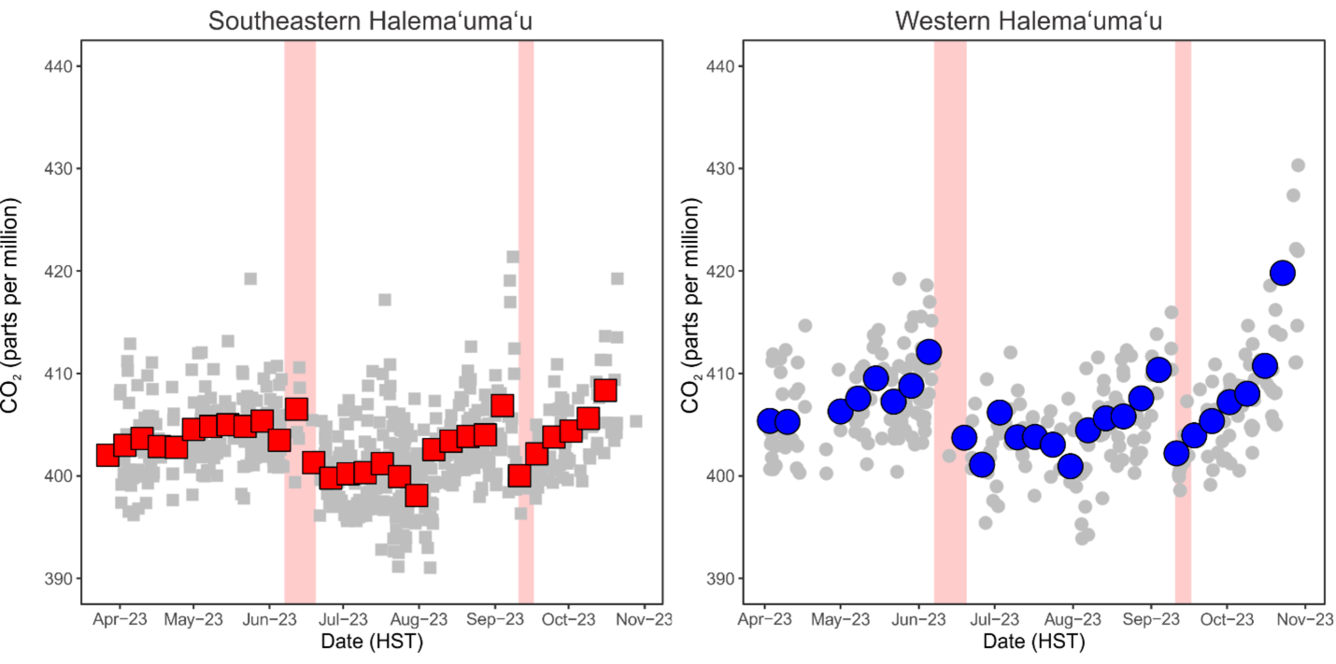
Color plots showing concentrations of volcanic gas over time

    The tricky thing about CO2, though, is that it is already present—and highly variable—in the atmosphere. This is different from SO2—SO2 is not normally present in background atmosphere, so it's easy to pick out a volcanic SO2 signal in ambient air measurements. But atmospheric CO2 can vary over the course of a day, as well as with the seasons. So, picking out a small volcanic CO2 signal from variable amounts in the background atmosphere can be tough, and it has indeed proved difficult over the years aboth Kīlauea and Mauna Loa.
    Recently, however, in cooperation with colleagues at the USGS Cascades Volcano Observatory, we have been looking a little closer at CO2 data from Kīlauea. We have a multi-GAS station just to the southwest of Halemaʻumaʻu that measures four volcanic gases (CO2, SO2, hydrogen sulfide, and water vapor) as well as meteorological data like wind speed and wind direction. Instead of using all the CO2 data from the multi-GAS, which can be noisy because of background variations in CO2, we separate out CO2 data that reaches the station from certain directions at certain wind speeds. This allows us to try to isolate the volcanic CO2 signal.
    What have we seen? Well, the data are still noisy, so instead of looking at individual data points (up to eight per day), we calculate weekly averages of the CO2 concentration. Once we do that, if we look only at data coming from two portions of Halemaʻumaʻu (roughly the western part of the crater and the southeastern part of the crater) at moderate wind speeds, we see patterns in the CO2 concentration relative to the recent summit eruptions.

USGS scientists measure CO2, SO2 and other gases using infrared technology. USGS photo

    For both wind directions we look at, we can see that CO2 coming from those directions appeared to increase—slowly and slightly—before the June and September Kīlauea summit eruptions. Once the eruptions occurred, CO2 concentrations dropped back down. Now, since the September eruption, those CO2 concentrations are increasing again, and the increase is likely related to the intrusion of magma into the shallow storage regions beneath the summit and south caldera regions.
    Often when Kīlauea erupts, HVO uses the low ratio of eruptive CO2 to SO2 to be able to say that the magma feeding the eruption was stored very shallow because that low ratio tells us the magma already degassed most of its CO2 before eruption. What we're seeing right now is that pre-eruptive CO2 loss in the form of these CO2 increases before eruptions as magma gets closer to the surface.
    The next step with this new data analysis method is to try to turn the CO2 concentration data into emission rates of CO2, which could then perhaps tell us not just that magma is rising to shallow depths beneath Kīlauea, but how much magma is rising.

To read comments, add your own, and like this story, see facebook.com/kaucalendar. See latest print edition at kaucalendar.com, in the mail and on stands.



Wednesday, December 13, 2023

Kaʻū News Briefs December 13, 2023

Hukihuki, Hawaiian tug of war at the Makahiki Grounds celebration on Tuesday. Photo from Ki'eki'e Ka'ū
 MAKAHIKI 2023 AT KAHUA 'OLOHŪ KAUNĀMANO AHUPUA'A welcomed many students on Tuesday to participate in Hawaiian games at the Makahiki grounds. Ki'eki'e Kaʻū sent out a statement saying that this year's Makahiki event featured 355 Keiki competitors including haumāna who assisted as Kia'i at differing stations for the games.

Hōlua, Hawaiian sliding was introduced to 
 the 2023 Makahiki. 
Photo from Ki'eki'e Ka'ū
   Haumāna of Kua o Ka Lā from as far as Miloli'i, Volcano School of the Arts & Sciences, Kaʻū High and Pāhala Elementary, Pāhoa High School and several haumāna of Nāʻālehu School attended.
    They competed in Kōnane, Kūkini, Hukihuki, Pala'ie, 'Ō'ō'ihe, Ulu Maika, Moa Pahe'e, Pōhaku Ho'oikaika, Pā 'Uma, Haka Moa and Hū.
    In addition, a new featured game station, the Hōlua, was introduced by 'Anakala Keone Kalawe of Puna. Tūtū Pele and Poli'ahu were known in mo'olelo for their expertise in the traditions of Hōlua, sled riding.
    Another new station featured Ku'i Kalo, implemented by Kamomi Bivings and his 'Ohana of Honaunau Momona. They also taught keiki how to weave lau niu.
    Kumu Hula Debbie Ryder, Demetrius Oliveira and Hālau Hula O Leonalani entertained, along with emcee Kumu Kiliona Moku.
    The statement from Ki'eki'e Kaʻū said, "Mahalo to many 'Ohana from Kaʻū, South Kona and Puna Moku and to our Kaʻū community along with all who contributed with helping hands to make this successful event happen for all of our keiki.
    "Special Mahalo to our collaborators: Kua O Ka Lā, Kahua 'Olohū Stewardship group, Ka 'Ohana o Honu'apo, Hawai'i Wildlife Fund, Waikapuna hui, The Nature Conservancy, Ho'omalu Kaʻū, to all of our Kumu Kula who brought their haumāna and mostly, to our Kupuna who continues to guide us in the work that we do! Lonoikamakahiki."
Haumana from numerous schools gather for the Makahiki on Tuesday.  Photo from Ki'eki'e Ka'ū
Kōnane, the Hawaiian board game. Photo from Ki'eki'e Ka'ū
Pā 'Uma, Hawaiian arm wrestling. Photo from Ki'eki'e Ka'ū

To read comments, add your own, and like this story, see facebook.com/kaucalendar. See latest print edition at kaucalendar.com, in the mail and on stands.

VOLUNTEER POSITIONS FOR 2024 ARE OPEN ON MIDWAY ATOLL. Friends of Midway Atoll announced on Wednesday that the organization is providing $1,000 stipends for each volunteer accepted to a six-month Biological Field Crew position. Applications are being taken by U.S. Fish & Wildlife Service. Volunteers will be serving in the biological program at Midway Atoll National Wildlife Refuge from early April 2024 to early September 2024.
2023 volunteers banding Laysan Albatross. Applications are open
 for 2024 volunteer positions. Photo from Friends of Midway Atoll
    The biological program focuses on controlling and removing non-native species and maintaining, conserving, and restoring quality habitat to support indigenous plants, seabirds, waterbirds, monk seals, and sea turtles. In addition to being a National Wildlife Refuge, Midway Atoll is also designated as the Battle of Midway National Memorial and is part of Papahānaumokuākea Marine National Monument. Midway Atoll is a remote field site located over 1,300 miles from the main Hawaiian Islands and is inhabited by a small community of ~50 residents comprising FWS staff, volunteers, and contractors. 
     Another opportunity to volunteer opens the application period on Jan. 1. It is for the December 2024 - January 2025 Albatross Census Volunteer positions. 
    It requires volunteers to pay for airfare to and from Honolulu, 40 percent of the round trip from Honolulu to Midway and $15 a day for food. Lodging is free to volunteers. Volunteers must be able to hike six to ten miles per day, sometimes in strong wind; lift 25 lbs. and carry a day pack. Each volunteer will serve approximately 20 days for the Census.

To read comments, add your own, and like this story, see facebook.com/kaucalendar. See latest print edition at kaucalendar.com, in the mail and on stands.

POLICE ARRESTED 23 MOTORISTS FOR DUI during the week of Dec. 4 through Dec. 10. Hawai‘i Island police arrested them for driving under the influence of an intoxicant. Five of the drivers were involved in a traffic collision. One was under the age of 21.
So far this year, there have been 888 DUI arrests compared with 923 during the same period last year, a decrease of 3.8 percent.
Hawai'i Police Department's Traffic Services Section reviewed all updated crashes and found 797 major collissions so far this year compared with 790 during the same period last year, an increase of 0.9 percent. To date, there have been 15 fatal crashes, resulting in 16 fatalities, one crash with multiple deaths; compared to 30 fatal crashes, resulting in 32 fatalities, one crash with multiple deaths and another reclassified to a medical condition for the same time last year. This represents a decrease of 50 percent for fatal crashes, and 50 percent for fatalities.
The non-traffic fatality count (not on a public roadway) so far this year is one compared to zero non-traffic fatalities for the same time last year.
Police promise that DUI roadblocks and patrols will continue island wide.


Tuesday, December 12, 2023

Kaʻū News Briefs December 12, 2023

Mayor Walks for Merry Christmas in Pāhala
Mayor Mitch Roth and First Lady Noriko Yamada Roth walk the inaugural Pāhala Town Lighted Christmas Parade last Saturday along side the County of Hawai'i float. See more photos of event in upcoming Kaʻū News Briefs. Photo by Stacyn Lopez Sakuma

PĀHALA IS THE FIRST FULLY FIBER-ENABLED ZIP CODE ON THE ISLAND. That is the announcement from Hawaiian Telcom on Tuesday. Pāhala has access to Hawaiian Tel's "reliable high-speed internet Fioptics that that offers 1 gigabit per second (Gbps) download, which is among the fastest speeds in Hawai'i, and the state's fastest upload speed of 500 megabits per second (Mbps)."
    In addition, Hawaiian Tel reminds residents that they may qualify for support to receive free internet through 
August 2024.
     Installation of the fiber internet service was an effort in "closing the state's digital divide," where wealthier, more populated places have good internet and rural, less wealthy areas are underserved, said Hawaiian Tel.
   The statement from Hawaiian Tel says, "Part of the Kaʻū District, Pāhala is a former sugar plantation town that is now home to many family-owned farms and ranches. It is considered one of the most remote, rural areas in Hawai'i. Hawaiian Telcom's fiber expansion extends into Na'alehu, including Wai'ōhinu Town and the Discovery Harbor subdivision, both of which incorporate some Hawaiian Home Lands."
   Other zip codes fully enabled with Hawaiian Tel Fiber include 96763 at Lāna'i City; 96751 at Kealia, Kaua'i; and 96765 at Lāwa'i, Kaua'i.

Kaʻū Desert Trail from Footprints Exhibit
to Pepeio Cabin and beyond has reopened.
NPS Photo by Jessica Ferracane

TWO ROADS, A BACKCOUNTRY TRAIL AND CABIN have reopened in Hawaiʻi Volcanoes National Park.
    Thanks to recent rainfall, wildland fire risk has decreased and Mauna Loa Road and Hilina Pali Road are now fully open to vehicles. Campfire and open flame cooking fire restrictions are also lifted in areas that allow them. Although the risk for wildfire is low, visitors are reminded to recreate responsibly. Campfires and cooking fires should be completely extinguished and are only allowed in specific areas of Hawaiʻi Volcanoes National Park.
     Kaʻū Desert Trail past the Footprints exhibit to Pepeiao Cabin, Hilina Pali overlook and the coastal backcountry areas has also reopened. The cabin is also open for overnight use with a permit. In addition, the backcountry trail crew recently cleared overgrown vegetation from the trail between Pepeiao Cabin and Hilina Pali overlook.
    The park temporarily closed Pepeiao Cabin and much of Kaʻū Desert Trail in October because of increased seismicity in the area south-southwest of Kīlauea caldera. Kīlauea volcano is not erupting but the unrest continues. According to USGS Hawaiian Volcano Observatory scientists, most of the earthquakes are now focused a cluster just southeast of Kaluapele (Kīlauea summit caldera).

To read comments, add your own, and like this story, see facebook.com/kaucalendar. See latest print edition at kaucalendar.com, in the mail and on stands.


PUBLIC INPUT FOR HAWAI'I VOLCANOES NATIONAL PARK is sought, including review and comment on recommendations for improving in-park access and timeframes to implement changes and such improvements as upgrades to park structures, programs and services. The document is called Draft Accessibility Self-Evaluation and Transition Plan
    The stated goals of the plan are to "document existing park barriers to accessibility for people with disabilities; provide an effective approach for upgrading facilities, services, activities, and programs; and instill a culture around creating universal access."
    The document is set to become available this week for public review and comment, following work by an NPS
Hawai'i Volcanoes National Park Superintendent Rhonda
Low invites the public to comment on the Park plan.
NPS photo by Janice Wei
interdisciplinary team, including individuals with expertise in planning, design, construction, and interpretive, resource, visitor safety, maintenance, and accessibility specialists. The team developed site plans identifying the location of accessibility barriers and crafted an implementation strategy to assist park staff in scheduling and performing required actions and documenting completed work.
    "It is important that visitors of all abilities are able to enjoy the incredible experience that Hawaiʻi Volcanoes National Park offers," said Superintendent Rhonda Loh. "This plan describes our proposed strategy to provide a welcoming and inclusive environment in popular locations throughout the park. We look forward to hearing from you."
    The Draft Accessibility Self-Evaluation and Transition Plan was prepared to provide analysis and an opportunity for public review and comment. The link to the draft plan is available on the NPS Planning, Environment and Public Comment website at https://parkplanning.nps.gov/HAVO-SETP.
    Comments may be submitted online at the project website by clicking on "Open for Comment." Comments will be accepted through Jan. 11, 2024.
    All comments, including personal identifying information, may be made publicly available at any time. Although respondents may request that their comments and personal information are withheld from public review, the park cannot guarantee that it will be able to do so.
    For more information on Hawaiʻi Volcanoes National Park, visit the park website, www.nps.gov/hawaiivolcanoes.

NPS Photo of a person in a wheelchair being assisted on a wooden boardwalk through a steaming volcanic landscape.