About The Kaʻū Calendar

Tuesday, October 15, 2024

Kaʻū News Briefs Oct. 15, 2024

May be an image of twilight and horizon
Nights of the Atlas Comet
Comet A3 Tsuchinshan-ATLAS seen over the Pacific Ocean from Chain of Craters Road in Hawaiʻi Volcanoes National Park on Monday evening with Hōkūloa (Venus) to the left. See story in Oct. 13
  Kaʻū News Briefs.  NPS Photo by Janice Wei 

INVASIVE SEAWEEDS ARE REPLACING LIMU IN MANY PLACES IN HAWAI'I, according to a new University of Hawai'i study, which states, "This could have an adverse effect on the seafood we eat to the health of coral reefs." Here is the story from University of Hawai'i News:
    Botanists from the University of Hawaiʻi recently uncovered key survival strategies used by invasive seaweed species in nearshore ecosystems, potentially explaining their dominance over native Hawaiian limu in certain habitats. Nearshore ecosystems extend up to 300 feet offshore, encompassing the shallow coastal waters where land and ocean environments interact and many marine species live and feed.
    An October 2024 study published in Scientific Reports found that invasive species such as “gorilla ogo” and “spiny seaweed” thrive in areas with submarine groundwater discharge, where daily tidal cycles create extreme salinity (salt level) fluctuations.

large patches of seaweed in the ocean
Invasive gorilla orgo has taken the place of native limu on some reefs in Hawai'i. U.H. photo
    “Understanding how invasive seaweed outcompetes native limu is crucial to furthering our knowledge about reefs and ocean environments,” said Veronica Gibson, a postdoctoral researcher at the UH Mānoa Hawaiʻi Institute of Marine Biology and Heʻeia National Estuarine Research Reserve, and UH Mānoa School of Life Sciences PhD graduate. “These spring-fed coastal areas are unique ecosystems that connect our land use practices directly to ocean health, and what happens to limu—which forms the base of our marine food web—affects everything from the fish we catch to the overall health of our coral reefs.”
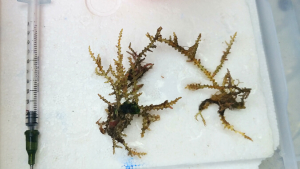
closeup of seaweed
Closeup of invasive spiny seaweed. Photo from U.H.

    The research team used advanced plant biology techniques to study how different seaweed species cope with these harsh conditions. Their key method involved measuring how seaweed cells adjust their internal chemistry when exposed to changing salt levels in the water.
    Much like a dried grape swells in water, seaweed cells react to changes in their environment. The scientists found that successful species can quickly change the concentration of dissolved substances inside their cells to match external changes. This ability to regulate internal water pressure is crucial for survival. Seaweed species that can’t adjust quickly enough suffer severe damage—their cells either burst from taking in too much water or shrivel up from losing too much water.
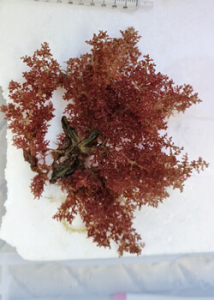
closeup of red seaweed
Closeup of native limu maneʻoneʻo. Photo from U.H.

    The invasive species showed remarkable adaptability and developed other survival tactics. Both types showed thinner cell walls in spring-affected areas, while gorilla ogo displayed peak photosynthesis near freshwater springs and developed smaller cells to better handle stress.
    Native species, including limu maneʻoneʻo, were notably absent from spring-influenced areas despite showing similar cellular characteristics to invasive species in offshore environments.
    The findings come as human activity continues to impact watershed systems and submarine groundwater discharge. Submarine groundwater discharge occurs when fresh water from underground aquifers seeps or flows directly into the ocean through the seafloor, creating areas where fresh and saltwater mix near the shore.
    Researchers emphasize the importance of understanding how native species survive in these conditions as changes in water quality and quantity affect nearshore ecosystems, potentially influencing food webs and coral cover. Further research will focus on native limu tolerance and linking findings to watershed management strategies, particularly in areas affected by nutrient pollution from groundwater springs.
    Other authors on the paper are Angelene Dedloff, who earned her bachelor’s degree from the UH Mānoa School of Life Sciences; Kapiʻolani Community College Assistant Professor Lisa Miller; and UH Mānoa School of Life Sciences Professor Celia Smith.
    The Hawaiʻi Institute of Marine Biology is housed in the UH Mānoa School of Ocean and Earth Science and Technology, and the School of Life Sciences is housed in the UH Mānoa College of Natural Sciences.

To read comments, add your own, and like this story, see facebook.com/kaucalendar. See upcoming events, print edition and archive at kaunews.com.

The Kaʻū Calendar News Briefs, Hawaiʻi Island: Kaʻū News Briefs Saturday,  Nov. 11, 2023

NANI O KAHUKU LIVING HISTORY PLAY will be live on Saturday, Oct. 19 at the Kahuku unit of Hawai'i Volcanoes National Park at 11 a.m. The encore of Nani o Kahuku is a first-person living history performance, the script taken from the diary of Hannah Piilani Jones (Nani). She was the daughter of George Jones, owner of Kahuku Ranch in the 1870s. It is a lyrical account of life on the ranch, including day-to-day activities as well as historic visits from Hawaiian royalty.

NIGHT-SKY PHOTOGRAPHER STAN HO presents his work on Saturday, Oct 26 at  9:30 a.m. at the Kahuku Unit of Hawai'i Volcanoes National Park. He is the National Park Arts Foundation's Artist-in-Residence and will present a talk with a PowerPoint of his photography. His month-long residency will culminate with this program featuring his artistic interpretations of the night skies at Volcano and Kahuku.

To read comments, add your own, and like this story, see facebook.com/kaucalendar. See upcoming events, print edition and archive at kaunews.com.


5,000 in the mail, 2,500 on the street.


Monday, October 14, 2024

Kaʻū News Briefs Oct. 14, 2024

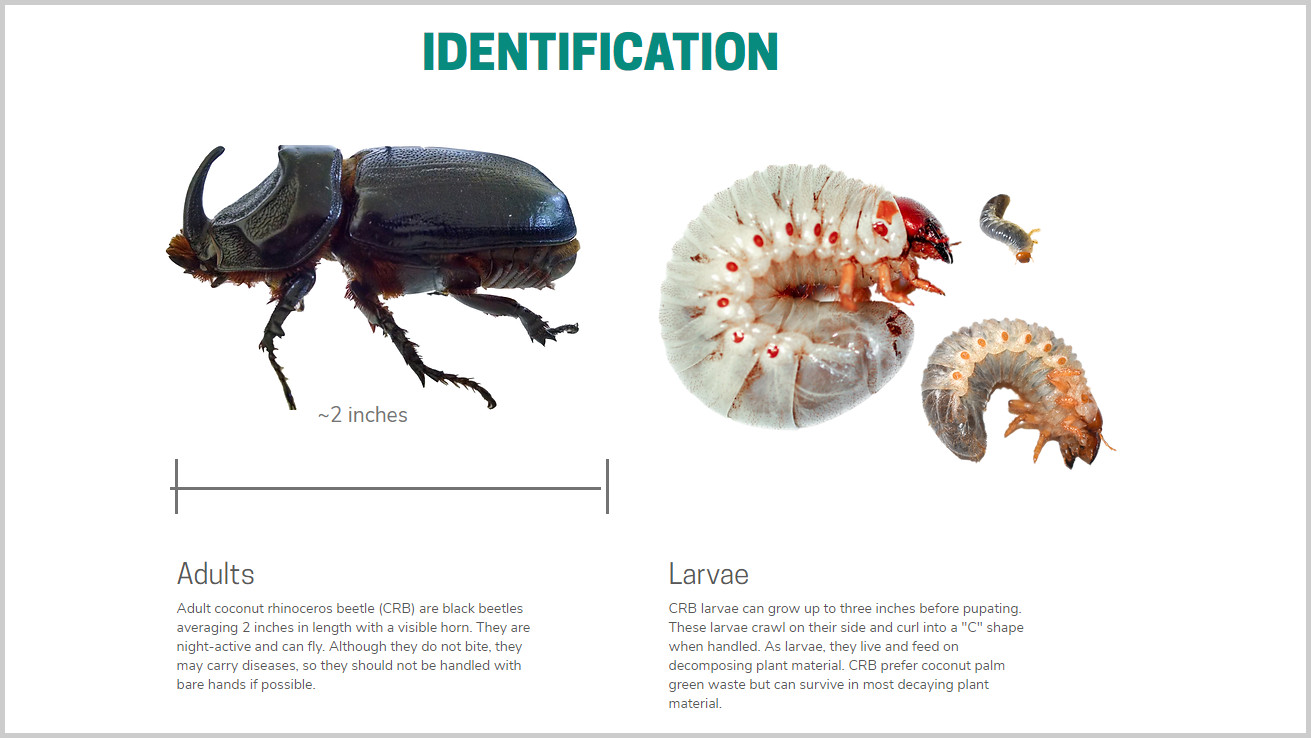
New restriction on moving palms is the result of invasive Coconut Rhinoceros Beetles. 
Image from state Department of Agriculture

GETTING RID OF INVASIVE COCONUT RHINOCEROS BEETLES is the aim of a new state Department of Agriculture restriction. It prohibits moving the following from infested areas to non-infested areas: Palm plants, decomposing plant material, such as compost, wood or tree chips; mulch; potting soil; other landscaping products that may harbor the Coconut Rhinoceros Beetle; Palm trees that are higher than 4 feet - smaller plants can be inspected.
     CRB is a major pest of palms in India, the Philippines, Palau, Fiji, Wallis and Futuna, Nukunono, American and Western Samoa and Guam. It is still not known exactly how the beetles arrived in Hawai‘i.
     All of O'ahu is designated as infested. The Coconut Rhinoceros Beetle was also found in Waikoloa on this island, on Kaua'i and in Kihei, Maui.
    The interim rule was signed last Friday by HDOA Chairperson Sharon Hurd and is effective immediately. It is valid for one year, while HDOA finalizes a permanent rule which is slated to be considered by the Hawai‘i Board of Agriculture later this month.
    Any individual, company, or organization that violates the rule will be charged with a misdemeanor and fined not less than $100 and up to $10,000. Penalties for a second offense committed within five years will require the violator to pay for the cost of clean-up and decontamination fees to remove contaminated materials, as well as the cost to fully eradicate any CRB infestations caused by the violation. Repeat violators will be fined not less than $500 and up to $25,000.
    HDOA’s Plant Quarantine Branch inspectors at all island ports are concentrating efforts on inspections of potential CRB host material transported between islands.
    Residents on all islands are asked to be vigilant when purchasing mulch, compost and soil products, and to inspect bags for evidence of entry holes. An adult beetle is about two inches long, all black and has a single horn on its head. CRB grubs live in decomposing plant and animal waste. Adult CRB prefer to feed on coconut and other larger palms and are a major threat to the health of these plants.
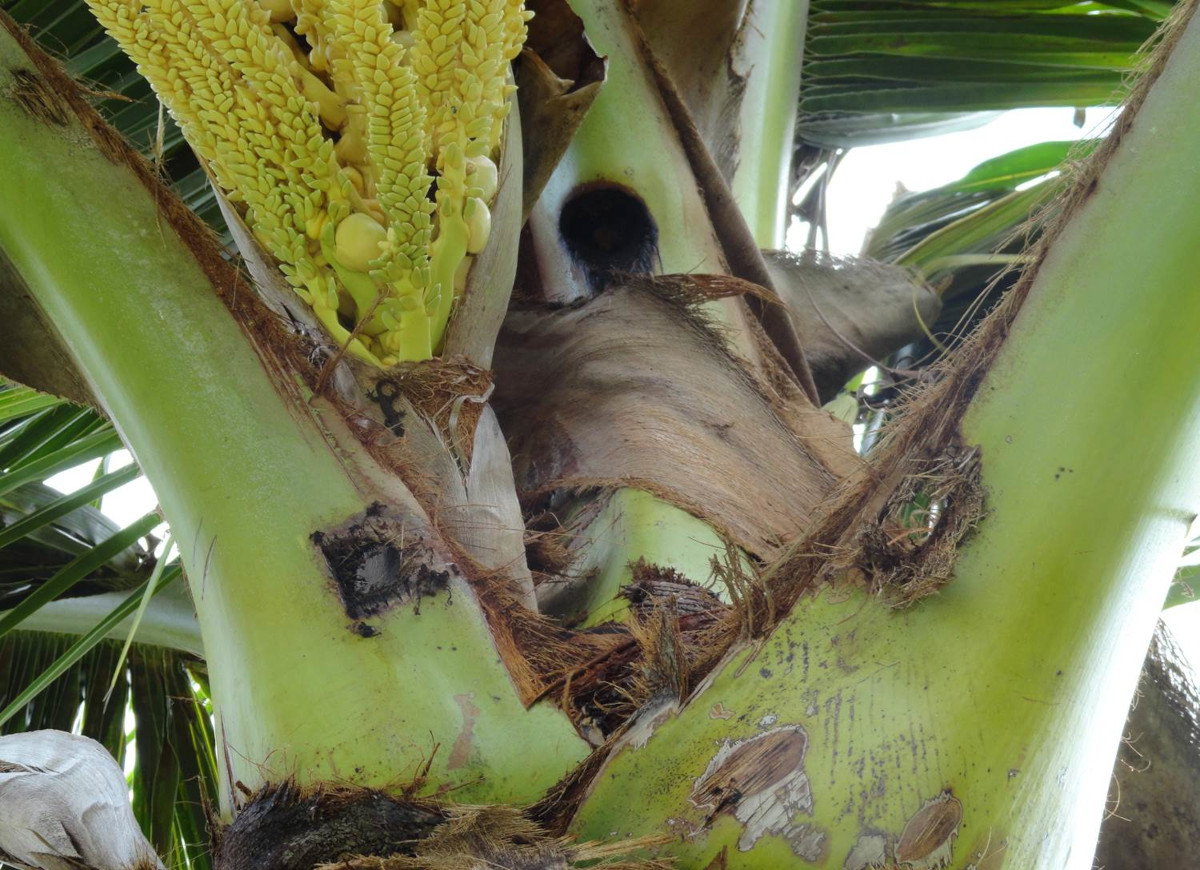
Damage from Rhinoceros Coconut Beetle will kill palm trees and moving plams and other plant materials from infected areas is restricted by state Department of Agriculture. Photo from DOA

    Residents may go to the CRB Response website at: https://www.crbhawaii.org/ to learn more about how to detect the signs of CRB damage and how to identify CRB life stages. Reports of possible CRB infestation may also be made to the state’s toll-free Pest Hotline at 808-643-PEST (7378).
   Surveillance for CRB has been ongoing on all neighbor islands, including pheromone traps at airports, harbors and other strategic locations. The traps are used for early detection of CRB infestations and are being monitored by HDOA, island Invasive Species Committees and the University of Hawai‘i.
    The CRB is a large scarab beetle that was first detected on O‘ahu in 2013. The beetle has since been detected in many neighborhoods on O‘ahu, In May 2023, CRB was detected on Kaua‘i and collaborative eradication efforts continue on the island. On Hawai‘i Island, CRB was detected in a palm tree stump Waikoloa in October 2023 and a single CRB was found dead in a trap last month in that same area. CRB grubs were found in Kīhei, Maui, in November 2023, but have not been detected on the island since.
    CRB is a serious pest of palm trees, primarily coconut palms, as the adult beetles bore into the crowns of the palms to feed on the trees’ sap. New unopened fronds are damaged in this way and when fully opened, may break and fall unexpectedly. .   If CRB kill or damage the growing point of the palm, the tree may die. Secondary fungal or bacterial pathogens may also attack the wounds caused by CRB, thereby killing the tree as well. Tree mortality after CRB attack has been reported to be anywhere from 10 percent to 50 percent. Dead trees then become a safety hazard as they may fall unexpectedly after the trunk rots, potentially resulting in bodily injury or property damage.

To read comments, add your own, and like this story, see facebook.com/kaucalendar. See upcoming events, print edition and archive at kaunews.com.

KAʻŪ HIGH BEAT PAHOA IN GIRLS VOLLEYBALL on Monday in four sets. Pahoa took the first set 25-21. Kaʻū Trojans took the second 25-13, the third 25-15 and the fourth 25-15,
     Coach is Josh Ortega, Assistant Coach and JV Coach is Sarah Ortega, Trainer is Moses Whitcomb and Athletic Director is Jaime Guerpo.      
    The varsity team is comprised of Mckenzie Decoito, Leahi Kaupu, Jezerie Rose Nurial-Dacalio, Kiara Ortega-Oliveira, Jazmyn Navarro, Aubrey Delos Santos-Graig, Alajshae Barrios, CaLiya Silva-Kamei and Zia Rae Wroblewski.
To read comments, add your own, and like this story, see facebook.com/kaucalendar. See upcoming events, print edition and archive at kaunews.com.

A MARTIAN INVASION is the theme of the radio play this weekend, Oct. 18 – 20 produced by Kilauea Drama & Entertainment Network as a special pre-Halloween treat. KDEN presents the radio play The War of the Worlds at KMC's Koa Room. 
     The War of the Worlds chronicles the events of a Martian invasion narrated by the "breaking news" style of storytelling. Based on the story by H.G. Wells and the radio script by Harold Koch, this updated, localized version of the 1938 classic was adapted by Hal Glatzer,
Under the direction of Suzi Bond, the cast of 14 will bring the excitement and the terror of this classic radio presentation to life. 
    Just like in the 30's the actors will be performing at microphones with scripts and will be creating the sound effects.
    Joel Kelley and Elizabeth Young lead the cast as Professor Pierson and Newscaster Connie DeSilva. They are joined by Arlene Araki, Stephen Bond, Deb Campbell, Lori DeMello, Dick Hershberger, James, Erin and Kendall Haddock, Roch Jones, Ariana Kelley, Alana Kirby-Corbett and Ray Ryan playing numerous roles.
    Performances are Friday and Saturday at 7:30 and Sunday at 2:30. Tickets are $15 and are available at the door, cash or check only. For more information call 808 982-7344 or email kdenhawaii@gmail.com.

To read comments, add your own, and like this story, see facebook.com/kaucalendar. See upcoming events, print edition and archive at kaunews.com.


5,000 in the mail, 2,500 on the street.


Sunday, October 13, 2024

Kaʻū News Briefs Oct. 13, 2024


Comet A3 Tsuchinshan-ATLAS as seen from Maunakea. See more below. Image from EarthSkyScience
THIS MONTH: SKY GAZERS FROM KAʻŪ and the rest of citizens of planet Earth are treated to the arrival of a special celestial visitor, Comet A3 Tsuchinshan-ATLAS, with photographers capturing the image from Kilauea Military Camp on Sunday evening.
Atlas Comet as seen Sunday evening from Kīlauea
Military Camp. Photo by Thea Calumpit
     Here is the explanation from Volcano resident and astronomer for Hawai'i Public Radio and Kaʻū Night Skies, Christopher Phillips: 
    The comet was discovered in February 2023, by the Asteroid Terrestrial-impact Last Alert System (ATLAS) sky survey. ATLAS has telescopes in both Hawaii and South Africa, enabling it to cover both the northern and southern hemispheres. 
     Comet A3 is currently visible in northern latitudes during sunset onwards. Its position in the sky, relative to the setting Sun, makes it a little tricky to spot, as sky conditions near the western horizon need to be quite clear. Once the Sun has set however, it should be visible to the naked eye as the sky darkens. Through a pair of binoculars or a small telescope, it should present quite the sight. To find the comet, look to the west and to the setting stars of Orion, if you are familiar with the faint constellations in that region, you will find the comet in the small constellation of Corona Borealis (The Northern Crown). See the finder image in this post for a helping hand. 
 
       The comet itself is quite fascinating. It's large, with a nucleus that's around 2 miles wide, almost as large as the object that wiped out the Dinosaurs, 65 million years ago. During its closest approach to the Earth it is around 44 million miles away from us, so nothing to worry about in terms of it impacting the Earth.            
    This is the first time in 80,000 years that Comet A3 Tsuchinshan-ATLAS has been visible to the inhabitants of planet Earth, and once it leaves our skies it won't be seen for another 80,000 years, so see it while you can! This type of comet is known as a 'long period' comet, because of its long orbital period around the Sun, in this case 80,000 years.
Image from The Sky Live https://theskylive.com
    Comets such as A3, along with the many asteroids in our skies, are left over construction material from the formation of the Solar system.
    However, there is one major difference between the two types of objects. Asteroids are mostly composed of rock and metals, comets on the other hand are dirty snowballs, mainly made of ice with some dirt thrown in for good measure. Comets in particular are thought to have been a major source of water in the early history of the Earth, bringing it to the surface during impacts.
    Seeing these beautiful celestial visitors in our skies is a reminder of the profound beauty of the cosmos, and also that the Solar system is still under construction, it is by no means finished. It's an enormous construction site with Mother Nature as the site foreman, and she's got plenty more work to do.

To read comments, add your own, and like this story, see facebook.com/kaucalendar. See upcoming events, print edition and archive at kaunews.com.

THE LOCATION OF THE PLANNED NĀ’ĀLEHU SEWAGE PLANT DREW SOME QUESTIONING from Ala Kahakai's Waikapuna manager Keoni Fox during the county's public meeting last Thursday on the Draft Environmental Information Document. Public comments can be made by Oct. 21 by emailing publiccomment@wilsonokamoto.com.
    Fox said that the county Department of Environmental Management has called for the condemnation of 28 acres of the Waikapuna land purchased for conservation with taxpayer money. The 28 acres, adjacent to the town of Nā'ālehu, is within the 2,317 acre Waikapuna preserve stewarded by the Ala Kahakai Trail Association.   

     Fox suggested that other lands be considered for the sewer plant, now that the county has chosen what he called an industrial style package plant rather than a system with lagoons friendly to native plants and wildlife. He pointed to adjacent properties that he said are owned by Eva Liu, Christina Taylor and partners and Michelle Galimba.
    Environmental Management Deputy Director Brenda Iokepa-Moses, who led the meeting, said that the 28 acres is a small portion of the 2,317 acres that has been preserved and that using that small portion to solve the sewer problem in Nā'ālehu would benefit the community. It is required by federal law that the old polluting gang cesspool system be abandoned. She stressed that time is of the essence, with the county on a deadline to get the old sugar camp houses off the gang cesspools.
    She pointed out that $4 million towards buying the Waikapuna preserve came from the County of Hawai'i's Public Access, Open Space & Natural Resources Preservation Program. She stressed that the county has decided through soil sampling and other studies that the 28 acres is the best location. She said it has been considered as the site for the project for years and that no other properties are being considered for the initial sewer plant. She also said no private money is involved.
    Fox also pointed to the use of tax money to purchase the 2,317 acres but stressed that it was specifically for conservation. The acquisition was to preserve the Waikapuna coast, the 2.3 miles of Ala Kahakai Trail along the coast, and adjacent lands. In addition to the county helping to purchase the preserve, the state Legacy Land Conservation Program contributed $2 million. He said that discussions of the 28 acres for the treatment plant during the time of purchase, were in the context of it being the lagoon system that would also serve wildlife.
    Another speaker asked whether the proposed site would interfere with public access to Waikapuna. Iokepa-Moses said it wouldn't and that access was from a different location.
    One speaker asked whether existing but unused underground piping among the houses could be used and whether it would be able to handle the new sewer system. Iokepa-Moses said the pipes will be inspected and if unusable would be capped and left in place with new sewer pipes installed beside them. She said that the county is fully responsible for the maintenance of the current and new system from the houses to the sewer plant.
    Nā'ālehu Draft Environmental Information Document (Draft EID) is available at the Nā'ālehu Public Library, and also on the website for Department of Environmental Management projects: www.dem.hawaiicounty.gov/projects.

 To read comments, add your own, and like this story, see facebook.com/kaucalendar. See upcoming events, print edition and archive at kaunews.com.
Zonta's Pay it Forward Committee Wilma Matsumura, Jessic Gauthier and Laurie Higashi with 2024 Pay it Forward microgrant recipients Dawn Patterson on screen, Rachel Erdman, Napua Arakaki-Heen, Megan Brady and Syd Wang. Photo from Zonta

TEN THOUSAND DOLLARS IN PAY IT FORWARD MICROGRANTS has been distributed for 2024 by The Zonta Club on Hawai'i Island. The award program supports women entrepreneurs who are starting a new business or working to expand an existing business.
    "For the third year in a row, we saw a record number of applicants for the grant. It's inspiring to see so many women entrepreneurs in our community," said Zonta president Julie Tulang. She said Zonta "is proud to provide a financial boost to these five well-deserving women-owned businesses."
    Pay It Forward microgrants are funded annually through the charitable Zonta Club of Hilo Foundation, donations to which are tax-deductible. 
    The 2024 microgrant recipients are Dawn Patterson of Dawn's Barber Shop, Rachel Edrman of LoveBug Farm LLC, Napua Arakaki-Heen of Nalani Farm Store, Megan Brady of Uproot Origin LLC, and Syd Wang of Wala'au Therapy LLC.
   Patterson has been a barber for 29 years and is sole proprietor of Dawn's Barber Shop in Hilo. She will use the grant to pay off her EIDL COVID loan and purchase tools for the shop.
    Erdman's LoveBug Farm raises hydroponic lettuce, microgreens, and produce as well as provides dog daycare, boarding, and training services. She will use the money to build a sink and a cleaning and processing area for the produce grown on her farm.
   Arakaki-Heen's Nalani Farm Store, located in downtown Hilo, is a boutique gift shop specializing in goods grown, made, and designed in Hawai'i. She estimates that around 70% of the products she stocks are produced by women-owned businesses. She will use the funds to purchase inventory for the store.
    Brady created her signature Uproot Origin elixir from organic ginger, organic turmeric, and organic honey sourced from small farms on the Big Island. She plans to use the grant to hire administrative support to help her business grow.
    Based in Hilo, Wang's Wala'au Therapy evaluates and treats speech, language, cognitive, and swallowing/feeding disorders. She plans to use the award to build an ADA-compliant entrance ramp at her practice.
    For more on Zonta and to donate, visit zontahilo.org.


5,000 in the mail, 2,500 on the street.