About The Kaʻū Calendar

Sunday, December 01, 2024

Kaʻū News Briefs Dec. 1, 2024

May be an image of 4 people, grass and tree
Three fulltime jobs are open at Hawai'i Volcanoes National Park for this kind of outdoor work.
This fence crew repairs fencing on Mauna Loa Road. Photo by Janice Wei/NPS

JOBS CLOSE TO HOME: Hawai'i Volcanoes National Park natural resources team announces three full-time jobs open for wildlife/botanical assistants on the park’s fence and vegetation crew. Among requirements are: Ability to hike and camp in remote areas and rugged terrain under inclement weather conditions for up to five consecutive days. Ability to backpack, lift, and carry up to 40 pounds unassisted. Must be able to use a compass and map, and able to drive a 4-wheel drive vehicle. Needs drivers license and must have graduated from high school or achieved a GED. Fence building and team leadership skills are valued.
    See all of the qualifications and more at: https://hr.rcuh.com/psp/hcmprd_exapp/EMPLOYEE/HRMS/c/HRS_HRAM.HRS_APP_SCHJOB.GBL?FOCUS=Applicant. Application period closes Dec. 6 and National Park Service urges persons to apply immediately if interested. The pay is $3,525 per month.
    Go to https://www.rcuh.com/work/careers/ to upload cover letter, resume and three supervisory reference. The posting is ID#224825.
    The job is described as follows: "Inspects, repairs, and constructs feral ungulate control fences. Drives to access field sites and occasionally travels to Hilo to make purchases. Will work in and around helicopters. Controls alien plants manually or with herbicides. Monitors pig activity transects and alien plant transects. Records field data on control and monitoring projects. May assist in native plant restoration and endangered sea turtle, nēnē, or petrel restoration programs, as assigned."

To read comments, add your own, and like this story, see facebook.com/kaucalendar. See upcoming events, print edition and archive at kaunews.com.

Pōhue Bay is an endangered Honuea, hawksbill turtle nesting site, with its small white sand beach. Public access is part of the planning with a virtual meeting on Tuesday. NPS photo

THE VIRTUAL MEETING FOR THE SITE MANAGEMENT PLAN FOR KAHUKU unit of Hawai'i Volcanoes National Park is this Tuesday, Dec. 3 from 6 p.m. to 8 p.m. Sign in at https://swca.zoom.us/j/91799290126. The plan covers Upper Kahuku , Lower Kahuku , and Kahuku-Pōhue, which includes the coastline and land around Pōhue Bay.

Two hikers walk on an uncrowded trail through the koa forest in Kahuku.
NPS photo

    The invitation to the public to join in the virtual meeting says, "Hawaiʻi Volcanoes National Park invites the community to provide input as it develops a plan to manage 132,000-plus acres in the Kahuku ahupuaʻa (traditional land division) in Kaʻū. The meeting format includes a presentation at 6 p.m., followed by time for comments.
"Description: During civic engagement for the site management plan, we will present ideas intended to balance the protection of cultural and natural resources with visitor access and recreation, and to nurture the connection generations of Kaʻū families have to these special places ma uka to ma kai."
In person public meetings were held on Nov. 14 at Pāhala Community Center and on Nov. 16 at Kahuku Visitor Contact Station.
A statement from National Park Service says, "The Site Management Plan (SMP) and the process of civic engagement are essential to define the types of visitor uses and functions for the Kahuku Unit. Called for in the 2016 General Management Plan, the SMP will refine the vision for the unit by assessing the facilities and access needs. The plan will also provide recommendations on implementing additional facilities and improving access."
Comments on the draft plan can be made through Dec. 6, online and at the virtual meeting. See maps, reports and make comments at https://storymaps.arcgis.com/stories/b644878ad55a4f75bac61f0098a93782

To read comments, add your own, and like this story, see facebook.com/kaucalendar. See upcoming events, print edition and archive at kaunews.com.

May be an image of grass, tree and road
Mauna Loa Road is a two-lane paved road, winding through tall koa trees. NPS photo
MAUNA LOA ROAD REOPENED  LAST WEEK after drilling and sampling material below the road. "That means motorists, hikers and cyclists can again enjoy the historic roadway from Kīpukapuaulu to Mauna Loa Lookout seven days a week," says the statement from Hawai'i Volcanoes National Park. "Surveyors will continue to work along the road and motorists are urged to drive slowly, safely and to obey all signs."

To read comments, add your own, and like this story, see facebook.com/kaucalendar. See upcoming events, print edition and archive at kaunews.com.

KAʻŪ SLAMMED PARKER in Boys Basketball 75-38 on Saturday. The game was held at Kaʻū Herkes District Gym. The next Trojan high school Boys Basketball game will be Hilo at Kaʻū on Tuesday, Dec. 10. Earlier in the season, on Nov. 21, Kaʻū lost to Kohala, 41-61.
    For Girls Trojan Basketball, next two games are at home on Monday, Dec. 2, with varsity only, hosting Honoka‘a at 6 p.m.; and  on Thursday, Dec. 5 with JV at 5:30 p.m. and varsity to follow, hosting Kamehameha.

To read comments, add your own, and like this story, see facebook.com/kaucalendar. See upcoming events, print edition and archive at kaunews.com.


May be an image of golf, golf course and text


Saturday, November 30, 2024

Kaʻū News Briefs Nov. 30, 2024

County Council member Michelle
Galimba invites the public to ceremonies
on Monday.
A PUBLIC INVITATION FROM KAʻŪ COUNCIL MEMBER MICHELLE GALIMBA TO SWEARING IN CEREMONIES on MONDAY, Dec. 2 says, "Our office would like to extend a warm invitation to attend the Inauguration ceremonies for the Mayor, Prosecuting Attorney, and County Council members."
    The event is a noon at Outrigger Keauhou Resort, 78-128 Ehukai Street, Kailua-Kona. "All are welcome to attend!" says her message. 
    Galimba also noted several grant opportunities open or opening up in early December. The County Department of Research & Developmentʻs Impact program has opened with a deadline of Jan. 8. The intent of the grant program is to support research, programs, or projects that positively impact the areas of agriculture and food systems, business and industry development, community well-being, energy, film and creative industries, and regenerative tourism, within Hawaiʻi Island communities. 
     See more information on the County 's Impact grant at
https://www.rd.hawaiicounty.gov/funding-grant-
resources/impact-grants. Call 808-961-8366.
    The County Councilʻs Waiwai grants are also open with a submission deadline of Jan. 31. The purpose of these County of Hawai‘i Nonprofit Grants-in-Aid is to support qualified nonprofit organizations to carry out programs or services that yield direct benefits to the public and accomplish public purposes within the County of Hawai‘i. Each organization is permitted to submit a total of two applications. Each application is limited to a request of up to $50,000.
See https:/haiicounty.gov/Forms/NPGrantApplication.
    Also available is the second round of the Expanding Agroforestry Project grant program, co-managed in Hawai'i by The Nature Conservancy and the Ulu Cooperative. See https://ulu.coop/eap

To read comments, add your own, and like this story, see facebook.com/kaucalendar. See upcoming events, print edition and archive at kaunews.com.

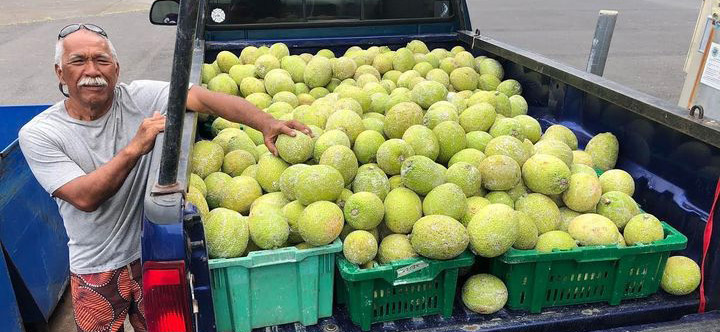
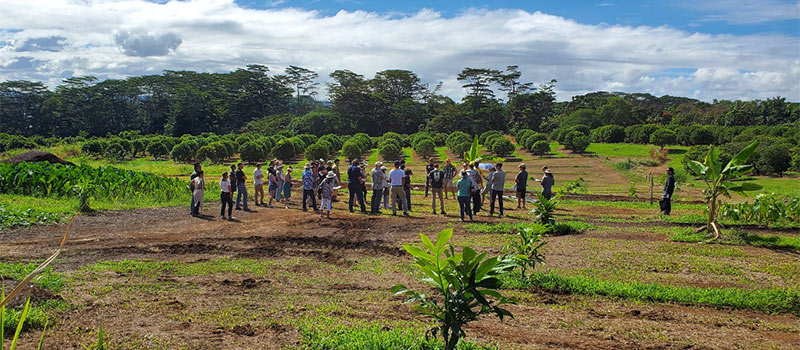
Planting ulu is one of the possible elements of an agroforestry plan. Funding is possible through the Expanding Agroforestry Project, managed in Hawai'i by The Nature Conservancy and the Ulu Cooperative. Photo from Ulu Cooperative

THE EXPANDING AGROFORESTRY PROJECT, co-managed by The Nature Conservancy and the Ulu Cooperative throughout Hawai'i, is open for applications, with the first round deadline Dec. 31.
    The program is funded through the USDA’s Partnerships for Climate-Smart Commodities initiative
Food from trees and plants on the ground grow
together in agroforestry. Photo from Ulu Coop
    In 2022, the USDA announced more than $3.1 billion in funding for 141 projects, including $60 million for this national agroforestry project. The overarching project goal is to add 30,000 new acres of agroforestry across 30 states while creating a network of demonstration sites. The project is also prioritizing a portion of funds to help producers from under-served populations.
    TNC, which is responsible for grant administration, has selected the Hawaiʻi ʻUlu Co-op to be its lead partner managing projects in the Hawaiʻi region. There are five other regions on the Continental U.S. which each have their own lead partner helping to expand financing and develop markets for agroforestry commodities.
    An in formational Webinar held on Friday can be viewed at:
https://us02web.zoom.us/rec/componentpage\action=viewdetailpage&sharelevel=meeting&useWhichPasswd=meeting&clusterId=us02&componentName=need-password&meetingId=ubF8L4PE7Sf4S8-Td1Lf7SXqBH8BvXcYvuiZWwEcapptVFFhKz1QzvDeeNbK6w.uT0Jvl9VydoO5UCF&originRequestUrl=https%3A%2F%Use code q.doy3Mi.

Agroforestry is distinguished from monocropping. It has a variety of trees and accompanying plants.
Photo from the Ulu Cooperative

To read comments, add your own, and like this story, see facebook.com/kaucalendar. See upcoming events, print edition and archive at kaunews.com.

THE WINTER SHOWCASE AT KAʻŪ HIGH & PĀHALA ELEMENTARY SCHOOL will be held Wednesday, Dec. 11 from 9:15 a.m. to 12:25 p.m. Program Coordinator Jennifer Makuakāne said, "Weʻre excited to announce the return of our 2nd Annual K-12 Winter Showcase here at Kaʻū High Pāhala Elementary School! Please join us as our students proudly present their work, projects and

achievements across all grade levels."
Here is the schedule: From 9:15 a.m. - 9:45.a.m., check in at Herkes Kaʻū District Gym Multipurpose Room. From 9:45 a.m. - 11:35 a.m,. visit Grade 7-12 Showcase Classrooms. From 11:35 a.m. - 12:25 p.m., visit K-6 Showcase Classrooms.
Makuakāne shared that the Showcase Learning Intentions are to:
Provide students an opportunity to practice their presentation skills and demonstrate their learning.
Create opportunities for students to share their class projects with other students, community partners, and family.
Build pride students, school, and community by showcasing student and school projects done in collaboration with the community such as project-based learning, technology integration, and other real-world projects.
Practice and prepare for Capstone presentations in grades 6, 8, and 12.
To RSVP, complete the sign-up form by Monday, Dec. 9 at: bit.l.y/24SSCOM. The school encourages its community partners and members to extend the invitation to three or more individuals to attend the Showcase. Contact Makuakāne at (808) 313-4141.

To read comments, add your own, and like this story, see facebook.com/kaucalendar. See upcoming events, print edition and archive at kaunews.com.

VOLCANO WATCH: WHAT SOUNDS THE AUTOMATED ALARMS AT HVO? That's the focus of
this week's column written by USGS Hawaiian Volcano Observatory scientists and affiliates:
    The USGS Hawaiian Volcano Observatory (HVO) keeps its eyes on active volcanoes in many ways. While old fashioned eyes and a notebook are used when field teams are near a volcano, modern volcano observatories also utilize rapidly collected data and computers to support monitoring.
Because it can be very expensive to have scientists watch the volcano data streams on a 24-hour basis, HVO computers are ‘trained’ to look for activity and alert when the volcano is changing or becoming active. They look at a wide array of observations including seismic (ground shaking), infrasound data (air pressure), ground deformation, as well as camera image assessments.
    As the data from these systems enter a computer, they can be assessed as close to the time of collection as possible. If an observation is unusual, the computer can send a message to make a scientist aware at any time of the day or night.
    At the core of many alarm systems is an often-simple computer program which looks for a change in energy from shaking of a seismometer or a burst of sound on an acoustic sensor. If the sensor is usually quiet and then the burst of energy occurs, then this can be detected by the computer which can send an automated message to a scientist. This type of energy burst detector is called a short-term average/long-term average (STA/LTA) detector.

Color plots showing infrasound data
Example plots of STA/LTA alarm on infrasound data for four possible alarm scenarios.
 A shows detection of a real eruption, B shows a false detection of non-volcanic change,
 C shows failure to detect a real eruption amid noisy data, and D shows no
 detection of any event of interest. USGS images

   During eruptions, changes in the air pressure are recorded on sound detecting sensors (like microphones), called an infrasound or acoustic array. The figure shows how a successful detection of an eruption might work using infrasound data and how the system may fail to detect an eruption.
    The first image (A) shows an eruption that creates pressure changes recorded by the sensor. The detection (marked by a red arrow) would be easy to determine using an STA/LTA method, discussed above and shown as the grey and red bar at the bottom of panel A. The long-term average (grey bar) is a period before the eruption and the short-term average (red bar) shows when the eruption energy is strong. In this case, the STA is much bigger than the LTA and we can set the computer to send a message when this specific condition occurs.
    If we next consider the same sensor which has detected another burst (B), but this burst came from a non-eruption source (say a car, a helicopter or another event away from our volcano). In this case, the volcano scientist might be alerted by an event that wasn’t volcanic (a false detection). Next, we show a cartoon example where we have introduced wind noise (C) into the same eruption recorded in (A). In this case, the wind would be so strong that the eruption can only just be seen in the data by the naked eye but may not be visible to the computer’s STA/LTA detector. In the final example wind noise was added to the example which may have been a car or helicopter but not an eruption (D); in this case the non-eruption can only barely be seen in the data and was not detected by the STA/LTA detector.
    The cartoon figures show four possible outcomes that can be used to assess how good an alarming system performs. They include: 1) detection of a real eruption (A), 2) a false detection of non-volcanic change (B), 3) failure to detect a real eruption (C) and, 4) not detecting any event of interest (D).
    These four examples show how HVO scientists can assess the performance of our alarm systems to improve detection of volcanic events and minimize the detection of noise or other activity. The four examples coincide with the concepts of test conditions for alarms using the terms: true-positive (A), false-positive (B), false-negative (C) and true-negative (D). A good alarm system should include true-positives (volcanic events) and true negatives (non-volcanic events) and try to minimize false-positives and false-negatives. Too many false alerts equate to unnecessary loss of sleep during quiet periods for a volcano. In summary, alarm systems are an important and evolving part of HVO operations and are an example of how computers and technology are incorporated in monitoring.

To read comments, add your own, and like this story, see facebook.com/kaucalendar. See upcoming events, print edition and archive at kaunews.com.

Volcano Activity Updates: Kīlauea is not erupting. Its USGS Volcano Alert level is ADVISORY.
   Over the past week, earthquake rates beneath Kīlauea summit and upper East Rift Zone were more than double that of the previous week. About 100 earthquakes were located beneath the summit, and about 226 were located in the upper East Rift Zone. Earthquake rates beneath the middle East Rift Zone were on par with the previous week. Ground deformation rates in the summit region showed increased inflation over the past week, while ground deformation rates near the September 15-20 middle East Rift Zone eruption site have slowed. Future intrusive episodes and eruptions could occur with continued magma supply.
    Mauna Loa is not erupting. Its USGS Volcano Alert Level is at NORMAL.
    Three earthquakes were reported felt in the Hawaiian Islands during the past week: a M3.1 earthquake 6 km (3 mi) SSW of Volcano at 1 km (1 mi) depth on Nov. 27 at 2:19 p.m. HST, a M3.5 earthquake 75 km (46 mi) ENE of Honomū at 32 km (20 mi) depth on Nov. 27 at 12:29 a.m. HST, a M3.1 earthquake 2 km (1 mi) SSW of Pāhala at 30 km (18 mi) depth on Nov. 22 at 2:02 p.m. HST.
    HVO continues to closely monitor Kīlauea and Mauna Loa.
    Visit HVO’s website for past Volcano Watch articles, Kīlauea and Mauna Loa updates, volcano photos, maps, recent earthquake information, and more. Email questions to askHVO@usgs.gov.

To read comments, add your own, and like this story, see facebook.com/kaucalendar. See upcoming events, print edition and archive at kaunews.com.


Friday, November 29, 2024

Kaʻū News Briefs Nov. 29, 2024

May be an image of grouse
Not Turkey Trotters
    These game birds are hunted and eaten locally. They are Kalij pheasants, which were introduced to a ranch on this island in the 1960s and spread rapidly. Hawai'i Volcanoes National Park reports they are frequently seen on park trails. Many visitors mistaken them for the state bird, the nēnē goose. The park post says, "Unfortunately, kalij , also spread the seeds of invasive non-native plants. We are especially grateful for our team that works hard behind the scenes to protect Hawaiʻi Volcanoes National Park from invasive, non-native introduced pests. While we do not remove Kalij from the park, we do go after invasive plants like Koster's curse, faya, Himalayan raspberry and many others that prevent native plants from thriving. A big mahalo to the volunteers, Guardians of the Trail, our park staff and cooperating partners who keep the heritage in your World Heritage Site!" NPS Photo by Janice Wei

MORE DEPARTMENT HEADS AND DEPUTIES are announced by Hawai‘i County Mayor-elect Kimo Alameda, who will be sworn-in at noon Monday. On Friday, he named administrators to lead four additional departments and offices. “I am excited to continue to grow our team, and I am confident in the skills and experience that each of these leaders brings to the County,” Alameda said. 

Wesley Segawa
    “With these appointees in place, we will work hard to improve our wastewater and solid waste infrastructure, grow our economy, expand affordable housing, and support sustainability across Hawai‘i Island.”
    Selected directors and deputy directors require County Council confirmation. Here are their descriptions from Alameda:
    Department of Environmental Management Director Wesley Segawa
Greg Kawaguchi
holds a Master’s Degree in Business Administration and a Bachelor’s Degree in Civil Engineering from University of Hawai‘i at Manoa and has decades of experience in engineering, administration, and project management. He began his professional career as an engineer with Hawaiian Dredging and Construction Company and later established Wesley R. Segawa and Associates, Inc., focusing on public and private engineering and construction management projects.
    Department of Environmental Management Acting Deputy Director Craig Kawaguchi has served as the County’s Recycling Coordinator since 2022 and received the award of County of Hawai‘i Supervisor of the Year in 2024. He
Kehaulani Costa

previously served as an Executive Assistant under Mayor Billy Kenoi and a Recycling Specialist where he assisted with the start of the HI-5 recycling program on Hawai‘i Island. Kawaguchi will serve as acting deputy director until a permanent appointment is made.
   Office of Housing & Community Development Director Kehaulani Costa has worked for the County of Hawai‘i as a Housing Planning Specialist and Division Manager for the Office of Housing & Community Development’s Existing Housing Division, which administers the federal Housing Choice Voucher (Section 8) Program. A graduate of Kamehameha Schools and University of Hawai‘i at Hilo, Costa brings decades of experience in non-profit management, education, and housing policy advocacy to the County.

Keiko Mercado
    Office of Housing & Community Development Deputy Director Keiko Mercado has dedicated her career to serving the people of Hawai‘i Island and nurturing relationships between community and government. Throughout her career, she’s learned that true leadership is rooted in a deep sense of responsibility to serve our community. This commitment has shaped her approach to government work, driving a passion for creating solutions that directly benefit residents and strengthen the fabric of communities across Hawai‘i Island.
   Department of Research & Development Director Benson Medina has served at an executive level in tourism, manufacturing, natural resource development, agricultural tourism and community education. Medina also serves as the President of Hui ʻOihana, the Hawaiʻi Island Native Hawaiian
Benson Medina
Chamber of Commerce, and is the District Governor Nominee for Rotary International in Hawai‘i. He directed the islandwide 2022 Access to Care survey that provides critical data for healthcare providers on Hawai‘i Island and was the principal grant writer and project manager for the Hawai‘i Ag-Tourism Association. Medina is an active member of Hula Halau O Kawananakoa and speaks frequently on the relationship between Native Hawaiian values and business.
   
Dennis Lin
Department of Research and Development Deputy Director Dennis Lin
was recently employed as the Community Relations Administrator for HPM Building Supply where he managed their community outreach and government relations. As an active member in his community, he has served as Chair of the Windward Planning Commission and on numerous community boards and councils. Lin is an active member of the Hawai‘i Island Chamber of Commerce as Vice President and Economic Development Chair, and the Japanese Chamber of Commerce and Industry of Hawai‘i.

Laura Acasio
    Office of Sustainability, Climate, Equity & Resilience Administrator Laura Acasio has served the people of Hawai‘i as a former state senator and public school teacher. She currently serves on the County’s Environmental Management Commission and is a member of numerous nonprofit boards, including the governing board for Ka 'Umeke Kāʻeo Hawaiian Immersion Public Charter School and the 
Hui ʻOihana Native Hawaiian Chamber of Commerce.
    See other administrative picks from earlier this month at http://kaunewsbriefs.blogspot.com/2024_11_22_archive.html.


To read comments, add your own, and like this story, see facebook.com/kaucalendar. See upcoming events, print edition and archive at kaunews.com.

CHARGED WITH IDENTY THEFT OF A PERSON OVER 60, a 36-year old Volcano woman is also charged with forging checks and depositing them into her account. Prosecuting Attorney Kelden Waltjen announced the charges against Rebecca Sutliff on Friday. He noted that it is a crime to possess confidential personal information of a person over the age of 60 without authorization.
    According to police reports, Sutliff is alleged to have forged six checks for a total of $1,950.00 and deposited the funds into her own personal account via ATM (automated teller machine) between July 20 and July 29, 2024.

Rebecca Sutliff

    A warrant of arrest was issued on Nov. 25 and Sutliff was arrested on Nov. 29. Sutliff made her initial appearance in Hilo District Court on Friday afternoon. Her bail was maintained at $116,000.00 and she was ordered to appear for preliminary hearing on Tuesday. As the Complaint alleges, Sutliff is charged with 19 offenses including six counts of Identity Theft in the Second Degree, five counts of Theft in the Second Degree (theft of property, the value of which exceeds $250, from a person 60 years of age or older), five counts of Forgery in the Second Degree, and a single count each of Unauthorized Possession of Confidential Personal Information, Theft in the Third Degree, and Theft in the Fourth Degree. 
    Identity Theft in the Second Degree is a class B felony offense which carries a penalty of either a ten-year prison term or four years probation and up to 18 months in jail. Forgery in the Second Degree and Theft in the Second Degree, are both class C felony offenses, which carry a penalty of either a five-year prison term or four years probation and up twelve months in jail. The charges are merely allegations, and the Defendant is presumed innocent unless and until proven guilty.
    The case was initiated by Officer Shaneil Azevedo, Puna Patrol, previously assigned to South Hilo Patrol, and Christopher Barto, South Hilo Patrol. The felony investigation was led by Detective Jenny Lee, Area I Criminal Investigation Section, Hawai‘i Police Department. The case is being prosecuted by Deputy Prosecuting Attorney Georgia Berrenberg.
    "The Office of the Prosecuting Attorney remains dedicated to the pursuit of justice with integrity and commitment," said Hawai'i' County's Prosecuting Attorney. "Anyone having information to assist local law enforcement should call Crime Stoppers at (808) 961-8300. #hawaiiprosecutors #hawaiipolicedepartment #."

To read comments, add your own, and like this story, see facebook.com/kaucalendar. See upcoming events, print edition and archive at kaunews.com.