About The Kaʻū Calendar

Showing posts sorted by relevance for query waikapuna. Sort by date Show all posts

Wednesday, March 22, 2023

Kaʻū News Briefs, Wednesday, March 22, 2023

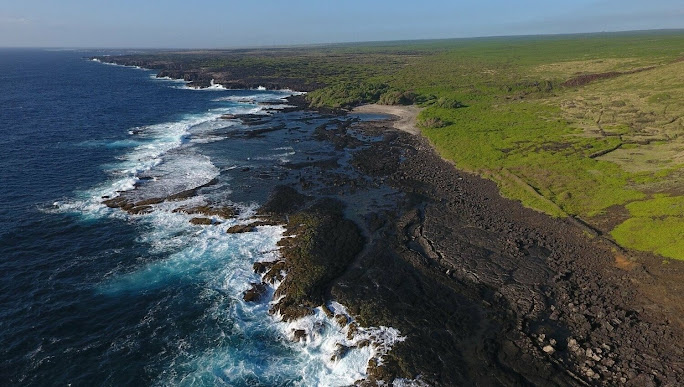
The coastlines of Waikapuna are an intricate network of native flora and fauna, to be protected in the new management plan.
See http://www.alakahakaitrail.org/ Photo from ATA

THE STEWARDSHIP PLAN FOR WAIKAPUNA drew Kaʻū citizens to an online meeting on Wednesday. Access to the place was a main topic in the discussion period. One speaker suggested that lineal descendants of the area come forward and make themselves known. She also suggested that those who own and steward the 2,317 Waikapuna acres along the Kaʻū Coast continue to seek out the descendants of those who lived on the land to welcome them into decisionmaking. The owner is Ala Kahakai Trail Association and an overseer with a conservation easement is County of Hawai'i.
     Gabrielle Sham, of Townscapes, Inc., who has been working on the draft management plan for Waikapuna, explained the plan to provide Kupuna Days, 'Ohana Days, and weekend overnight camping for one group at a time during three weekends per month. Volunteer Workdays would be held monthly on weekends with no overnight camping permitted. Volunteering would help individuals and groups earn higher priority for camping reservations.
Access to Waikapuna was a main topic in a 
zoom meeting about the draft management plan.
See http://www.alakahakaitrail.org/ Photo from ATA
     With high demand for overnight camping on weekends, and some folks reporting reservations a year in advance, the planners came up with an idea to make reservations more timely. Camping reservations would be made quarterly, opening up the first weekdays of the month before each quarter begins. Those who have volunteered at Waikapuna would be able to apply as early as the first Monday; those from Kaʻū as early as first Tuesday, and those from outside Kaʻū as early as first Wednesday of the month before the quarter begins.
     Kupuna Days and Ohana Days would be reserved as early as the first day of the week of the desired date. It would also be required that  least one person in the group has already gone to Waikapuna.
    For other day visits, those having already volunteered would receive priority and able make a booking on the first Monday of the month; Kaʻū residents second Monday; and non- Kaʻū residents third Monday. Sham said the intent is to incentivize volunteering for people to develop a role in stewardship at Waikapuna. Volunteering can  include maintaining roadways, removing invasives and cleaning up trash at the bay.
    She also said the Ala Kahakai Trail Association plans to seek funding and hire staff. Sham noted that the federal Ala Kakahai Trail, which runs through the property, is open to foot traffic, no permit required. It is the vehicular traffic and camping that require the reservations. The idea of an informal Community Makai Watch to discourage people from driving into Waikapuna without permits was discussed.
Ala Kahakai Trail is open to the public without permits. Vehicles
going to Waikapuna require permits and reservations
. See
 http://www.alakahakaitrail.org/ 
Photo from ATA

    Some speakers asked whether there could be a method for more flexible reservations, related to ocean and weather conditions. They said it is difficult for those fishing and gathering food to plan weeks in advance since the weather or sea state can change so quickly. It has been the tradition to call up the stewards of the land and ask them whether they could go down to the shore on that day, said fishermen commenting on the plan.
    Another participant in the zoom meeting suggested a live meeting in Nā'ālehu, noting tech connectivity difficulties for some folks in Kaʻū and recommending a face-to-face gathering. 
    Another asked about the definition of Kaʻū resident, someone who just moved here, or people with family ties? She noted that local people are being increasingly locked out of the places their families consider special in Kaʻū. A fisherman said that Waikapuna is important for feeding his family, with his children and grandchildren following the tradition. He said with new restrictions, it could be difficult. "Seems now we going to have to go to KTA, have to go to supermarket. No can bring the city to
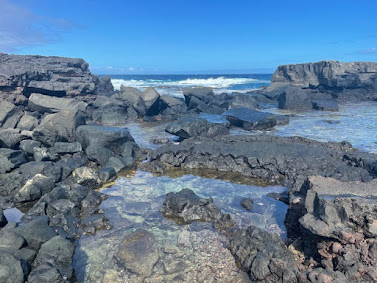
Native shoreline plants at Waikapuna.
See http://www.alakahakaitrail.org/ Photo from ATA
the country and tell country guys how to live."
    Another speaker said up on a cliff at Waikapuna there are special outcroppings, a "bubbly rock area." She asked "how to protect those pohaku?" Sham said it is a matter of working with Ala Kahakai Trail Association and educating the community. She also noted that the county's conservation easement on the property requires and annual report from ATA and an annual county review of the stewardship. She also noted that anyone interested in being involved in a stewardship committee for Waikapuna can reach out to ATA.
    The entire meeting is recorded and will be posted online. See earlier meetings and more on Ala Kahakai Trail Association at  http://www.alakahakaitrail.org/
    A hard copy of the draft plan is available at the Nāʻālehu Public Library and Pahala Public Library. Comments on the draft plan may be submitted online or e-mailed to gabrielle@townscapeinc.com through April 22, 2023.


GOV. JOSH GREEN SIGNED BILLS INTO LAW FOR THE FIRST TIME on Wednesday.
   Senate Bill 1 (SB1) advances Hawai'i's long civil rights history. Hawai'i's first civil rights protections against discrimination date back to pre-statehood days, when territorial lawmakers at the Constitutional Convention of 1950 ratified what is now an article in the state Constitution: Article I § 5 of the Hawai'i State Constitution states that no person "shall be denied the enjoyment of the person's civil rights or be discriminated against in the exercise thereof because of race, religion, sex, or ancestry."
The 1950 Hawai'i Constitutional convention, which
set forth civil rights protections, long before statehood. On
Wednesday Gov. Josh Green signed a bill to protect 
reproductive health care services.

    Hawai'i was the first state to ratify the Equal Rights Amendment, to recognize a woman's right to choose, and to seriously address the issue of same-sex marriage.
   Senate Bill 1 expands access to reproductive health care services in numerous ways; clarifies that the state will not deny or interfere with a pregnant person's right to choose to terminate a pregnancy and protects Hawai'i health care providers from punitive legal action from within or outside of the state relating to the provision of legally provided reproductive health care services. Additional protections, prohibitions and requirements are included.
    The Governor said, "This is one of the most important issues of our time and as Hawai'i's physician-governor, I tell you absolutely that this goes beyond a complex social issue for political discussion. This is 100-percent about fundamental, practical health care for our people."
Abortion has risen to the forefront since the 2022 U.S. Supreme Court (SCOTUS) Dobbs v. Jackson Woman's Health Organization decision that overturned Roe v. Wade. "Roe" was a 1973 SCOTUS decision that decriminalized abortion and protected the right to access the procedure legally across the country.
    Upon Green's signature, SB1 became Act 2.
    Senate Bill 36 (SB36) amends state law to allow county prosecutors to initiate felony cases by complaints following preliminary hearings and prohibits multiple attempts to initiate a felony prosecution for an offense, except in certain circumstances.
    "The people of Hawai'i want to feel safe in their homes and communities and have every right to expect
government leaders to provide public safety. This legislation is a tool that will help our law enforcement officers and county prosecutors continue their work toward that goal," said Green. Upon his signature, SB36 became Act 1.
    The measure resolves an issue resulting from the Hawai'i Supreme Court decision in State v. Obrero, in which the court ruled that HRS 801-1 did not permit initiation of felony criminal charges via preliminary hearing. The ruling came despite active use of the process for some 40 years.
    A subsection of SB36 limits the prosecution to one attempt to charge a felony case via grand jury indictment or complaint following preliminary hearing unless certain conditions are met, including presentation of additional material evidence, there is evidence of misconduct by the grand jury or grand jury counsel, or if a court finds good cause to allow another attempt.

To read comments, add your own, and like this story, see facebook.com/kaucalendar. See latest print edition at kaucalendar.com, in the mail and on stands.

SWEEPING CHANGES THAT ENABLE RESIDENTS WITH DISABILITIES AND OLDER ADULTS TO LIVE AND PARTICIPATE FULLY in their communities, and to engage in meaningful employment, is promised for Hawai' by its Department of Health and Gov. Josh Green. As of March 17, all states must be compliant with the Medicaid Home and Community-Based Services settings regulation. The changes are expected to impact more than one million people receiving Medicaid HCBS nationally, according to the Centers for Medicare and Medicaid Services.
    “The regulations protect each person’s rights and uphold the value of person-centered processes that make sure people are making their own choices and control the decisions in their lives — a right most people take for granted,” said Dr. Kenneth Fink, Director of Hawai‘i Department of Health. “This includes being treated with privacy, dignity and respect; freedom from coercion and restraint; deciding what and when to eat; having visitors, and having the protections of a lease or other legally enforceable residency agreement.”
   "DOH Developmental Disabilities Division, which operates Hawai‘i’s Medicaid waiver for individuals with intellectual and developmental disabilities, has been preparing to meet this compliance deadline despite the challenges of the pandemic," says a DOH statement. "It marks the beginning of a new phase of implementation of the rule, requiring ongoing evaluation, monitoring, and public engagement."
   Mary Brogan, Administrator of DOH Developmental Disabilities Division since 2014 and President of the National Association of State Directors of Development Disabilities Services, said, “It is not
enough to simply be living in the community; we need to make sure participants in our program with intellectual and developmental disabilities are fully integrated into the fabric of our community. We need to take our transformation to the next level so everyone we serve has access to the life they choose, and we are committed to continuously improving our services. Our entire system, including staff, participants, families and providers have worked tirelessly through the transition period to make the changes needed, and we are incredibly grateful for everyone’s efforts.”
   About 3,500 participants benefit from the services provided through the DOH Developmental Disabilities Division.
    Debbie Kobayakawa, a parent of an adult child who receives services from DOH, said her son's services have been game changing. “Person-centered planning allows my son to live and work fully integrated into his community, which is the life he wants. The whole point of these services is to provide individuals with the life they want,” Kobayakawa said.
    The waiver program has positive impacts on Hawai‘i, both in supporting better outcomes for people with significant disabilities, and the economic effect in the community. The State has agreements with more than 50 agencies providing services such as personal assistance, employment supports, and adult day programs. These agencies employ thousands of people statewide.
    A number of states including Hawai‘i, are investing resources to address the direct-care workforce crisis, essential to ensuring people have access to the services they need, especially on the neighbor islands. For example, because low wages make it very hard to recruit and retain the professionals who provide critical services, during the pandemic, many states increased payment rates and targeted those increases to apply to wages for direct-support professionals.
   “Our goal is to ensure the timely provision of quality services that truly make a difference in people’s lives,” said the DOH Director. “The support from the Governor and Legislature has been instrumental toward this shared goal.”


In the mail and on stands.

FREE FOOD

St. Jude's Hot Meals are free to those in need on Saturdays from 9 a.m. until food runs out, no later than noon. Volunteers from the community are welcome to help and can contact Karen at pooch53@gmail.com. Location is 96-8606 Paradise Circle Drive in Ocean View. Those in need can also take hot showers from 9 a.m. to noon and use the computer lab from 9:30 a.m. to 1 p.m.

Free Meals Mondays, Wednesdays, and Fridays are served from 12:30 p.m. to 3:30 p.m. at Nā'ālehu Hongwanji. Volunteers prepare the food provided by 'O Ka'ū Kākou with fresh produce from its gardens on the farm of Eva Liu, who supports the project. Other community members also make donations and approximately 150 meals are served each day.

OUTDOOR MARKETS

https://www.okaukakou.org/scholarships
-for-local-students
Volcano Evening Market, Cooper Center, Volcano Village, Thursdays, 3 p.m. to 6 p.m., with live music, artisan crafts, ono grinds, and fresh produce. See facebook.com.

Volcano Swap Meet, fourth Saturday of the month from 8 a.m. to noon. Large variety of vendors with numerous products. Tools, clothes, books, toys, local made healing extract and creams, antiques, jewelry, gemstones, crystals, food, music, plants, fruits, and vegetables. Also offered are cakes, coffee, and shave ice. Live music.                                                                                                                                  Volcano Farmers Market, Cooper Center, Volcano Village on Sundays, 6 a.m. to 10 a.m., with local produce, baked goods, food to go, island beef and Ka'ū Coffee. EBT is used for Supplemental Nutrition Assistance Program, formerly Food Stamps. Call 808-967-7800.

O Ka'ū Kākou Market, Nā'ālehu, Wednesdays, 8 a.m. to 2 p.m. Contact Nadine Ebert at 808-938-5124 or June Domondon 808-938-4875. See facebook.com/OKauKakouMarket.

Ocean View Community Market, Saturdays and Wednesdays, 6:30 a.m. to 2 p.m., corner Kona Dr. Drive and Hwy 11, near Thai Grindz. Masks mandatory. 100-person limit, social distancing required. Gate unlocked for vendors at 5:30 a.m., $15 dollars, no rez needed. Parking in the upper lot. Vendors must provide their own sanitizer. Food vendor permits required. Carpooling is encouraged.


Thursday, December 15, 2016

Ka`u News Briefs, Thursday, Dec. 15, 2016

Waikapuna, with 2,200 acres, is the target of community fundraising to preserve the four miles of
coast and the uplands. It is located off Hwy 11 between Honuʻapo and Nāʻālehu and extends to the
coast south of Kaunamano toward Ka Lae - South Point. Photo by Andrew Hara, courtesy of Ka`u Mahi
Photo from Department of Land & Natural Resources Legacy Land Conservation Program
THE KEANU ʻOHANA OF KAʻŪ has released a statement to the Trust for Public Land, the state Legacy Land Conservation Commission and others in support of the preservation of 2,200 acres at Waikapuna. The family members, who have historic ties to this Kaʻū Coast property between Honuʻapo and Ka Lae - South Point, say they “strongly support the acquisition of Waikapuna and its surrounding lands by the Ala Kahakai Trail Association and the Trust for Public Land in an effort to preserve and protect this natural and cultural treasure.”
Keoni Fox of the Keanu ʻOhana.
Photo by Ann Bosted
     This week the Legacy Land Conservation Commission agreed to partial funding for purchase of the Waikapuna property. Legacy Land has contributed in the past to the purchase of 785 acres at Kawa, the recent county acquisition of 3,128 Kahuku Coast acres makai of Ocean View and three acres of Caves above  Kipuka Kanohina lava tube system in Ocean View.
     According to the Keanu ʻOhana statement on Waikapuna, "As native descendants with genealogical ties to the ahupua’a of Kahilipali and its neighbors, we believe that the purchase of these lands will allow for perpetual protection of this wahi pana or storied place of our ancestors."
     "Waikapuna was once a thriving coastal community and its freshwater springs and abundant marine resources supported families who would exchange fish with relatives who farmed kalo (taro) and other goods in the fertile mauka communities of Nāʻālehu and Waiʻohinu."
   Family representative Keoni Fox stated that in an interview with Mary Kawena Pukui in 1960, his great-grandfather’s brother, Uncle Herbert Kuʻumi Kin In, described this unique relationship between extended ‘ohana in the Kaʻū uplands and lowlands: “Ina he nui kau ukana e lawe mai ana, aha ho’i no ʻoe me ka ukana. If you come down with a big bundle (from the mountains), you are going home with a big bundle (from the sea).”
      Fox wrote that "My great-grandfather, Alfred Kalama Kahakua and his brother spoke fondly of Waikapuna and other wahi pana of Kaʻū. Both were interviewed many times and their words often express sadness about the loss of our culture, our language, our birds, plants and sacred places. It is for this reason that our family became deeply concerned after the closure of Kaʻū Agribusiness and the sale of its properties.
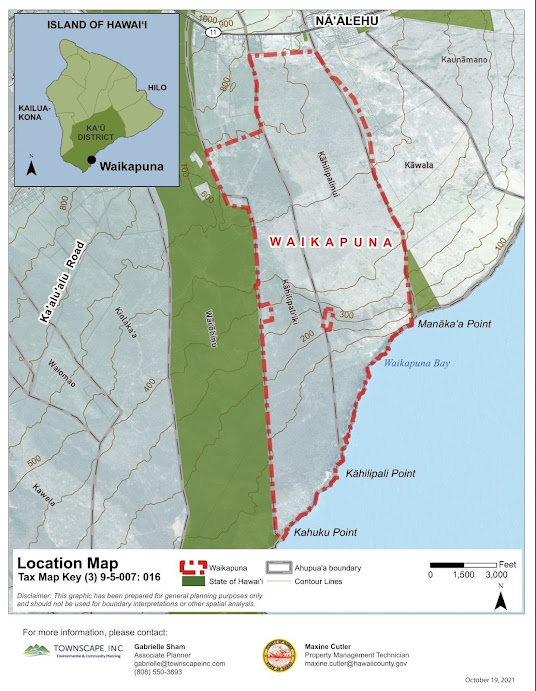
Waikapuna land encircled in red has received approval for partial funding from
Legacy Land Commission. More funds are sought to complete the purchase in
order to preserve the four miles of Ka`u Coast. 
    “For the last 20 years, many properties such as Waikapuna have been purchased by land speculators who propose new developments, threaten the rural nature and open view planes which are greatly cherished in Kaʻū. Our family actively supports initiatives to protect natural and cultural resources along the 80 miles of Kaʻū coastline from the impacts of development and urban sprawl.
     “Throughout history, the people of Kaʻū have practiced a lifestyle of subsistence. For many generations, the Keanu ‘Ohana has fished and gathered at Waikapuna, sometimes walking for miles along mauka-makai trails and coastal trails of the ala kahakai. We continue these traditions today. As children, it was here where we learned how to pick limu and ‘opihi. We were taught to ask permission before we gather and to take only what was needed. These were important lessons in resource protection, sustainability and humility.
   "When camping on Waikapuna’s sandy shores, we marvel at the many bright stars and constellations clearly visible at night from a coastline far from city lights. Together, we would wander through the village in awe of the expansive walled remains of where our ancestors lived, worked and played. For me, Waikapuna has always felt like home and it is this deep spiritual connection with my kupuna which I hope to perpetuate for the next generation.  
Legacy Land Conservation projects on Hawaiʻi Island include four in the
southern districts with 785 acres at Kawa (6 and 9), the 3,128 acres of
Kahuku Coaastal lands recently acquired (31) and three acres of Caves (4).
Map from Legacy Land Conservation Program
 “For the Keanu ‘Ohana, we believe that this acquisition will honor our kupuna, their history, their values and their legacy by protecting the entire cultural and natural landscape. There are few opportunities today where such large scale preservation of pristine lands is even possible. The purchase will help to safeguard our family’s many sacred sites including the iwi kupuna.”
   The statement also considers the wildlife, saying the “effort will also allow for the protection of Waikapuna’s dryland forest and extensive native coastal plant habitat which includes seabird nesting areas along the sea cliffs. Furthermore, the scenic shores of Waikapuna are known as a place where fish and other marine life spawn and its protected tide pools serve as nature’s nursery.
     "Waikapuna presents an opportunity for research and education on many levels. As native descendants, we hope to continue our traditional cultural and educational practices on the land and in its waters. Our family is committed to assisting the Ala Kahakai Trail Association and other community organizations with the stewardship of the property. We are very excited about this opportunity to protect Waikapuna,” the Keanu statement concludes.
To read comments, add your own, and like this story, see facebook.com/kaucalendar.

PROPOSED RATE HIKES BY HELCO drew mostly opposition testimony this week at  Hilo and Kona hearings before the Public Utilities Commission this week. East Kaʻū state Senator Russell Ruderman said he was testifying as a private citizen, rather than representing his senatorial post. He called the Hawai‘i Electric Light Co. rate hike a “civil rights issue,” and a “humanitarian issue.” He testified that the rate hikes fall on the poorest of the citizenry to the benefit of “one of the wealthiest corporations.” The argument pointed to the ability of the more prosperous businesses and families having capital to buy solar panels and other energy cost saving technology to get away from electric company bills. The trend leaves a larger burden of paying for electric company expenses to the less wealthy HELCO consumers. See more in tomorrow's Kaʻū News Briefs.
To read comments, add your own, and like this story, see facebook.com/kaucalendar.

THE FILIPINO VETERANS OF WORLD WAR II Congressional Gold Medal Act was signed into law yesterday by President Barack Obama. Sen. Mazie Hirono and Rep. Tulsi Gabbard introduced the legislation into Congress.
     “The Filipino veterans of World War II overcame many challenges in their fight for compensation, family reunification, and verification of wartime service. By signing our bill into law, President Obama recognized these veterans’ courage and perseverance, both during the war and in the decades of battles for benefits that followed,” said Hirono. “This day is only possible thanks to the commitment of veterans, families, and advocates in Hawaiʻi and across the country. While this recognition is long overdue, the Congressional Gold Medal is a fitting tribute to the sacrifice that these veterans made for our country.”
More than 200,000 Filipino and Filipino-American solders served
during WWII. About 18,000 are still living.
  Said Gabbard, “History has been made as President Obama signs into law our bill to honor the more than 200,000 Filipino and Filipino-American soldiers that served our country during World War II. These loyal and courageous soldiers suffered, fought, with many giving up their lives alongside their American counterparts throughout the war. Though less than 18,000 of our Filipino WWII veterans are still alive today, this recognition is a testament to each and every one of our Filipino WWII veterans who earned and deserve their place amongst our greatest generation. To our Filipino veterans, their families, and all who worked so hard to make today a reality, maraming salamat sa inyong lahat.”
     Members of the Congressional Asian Pacific American Caucus issued a statement applauding the legislation. 
To read comments, add your own, and like this story, see facebook.com/kaucalendar

THE CONGRESSIONAL ASIAN PACIFIC AMERICAN CAUCUS recently wrote to president-elect Donald Trump. Chair Judy Chu asks for a meeting to discuss “pertinent issues that affect the Asian American and Pacific Islander community.” The letter states that, “According to the U.S. Census Bureau, Asian Americans are now the fastest growing racial population in the country and account for over 19 million Americans. In addition, more immigrants now come from the Asia-Pacific region than from anywhere else in the world.”
     She explains that the “caucus is currently composed of 50 Members of Congress, including Members of Asian or Pacific Islander descent, representatives from the U.S. territories, and Members who represent large AAPI constituencies. Together, CAPAC works to establish legislation and policies that address the needs of the AAPI community and works to advance the civil and constitutional rights of all Americans.
   “CAPAC has been proud to work with prior Republican and Democratic Administrations on significant accomplishments that are vital to both our community and our country, and we look forward to sitting down with you before the end of this year to discuss these priorities. Thank you for your time and consideration, and we look forward to hearing from you soon.”
To read comments, add your own, and like this story, see facebook.com/kaucalendar.

New roof going onto the old courthouse yesterday
in Na`alehu. Photo by Cindy Cutts
THE OLD COURTHOUSE BUILDING, IN Nāʻālehu, where the community can observe and participate in County Council meetings by video feed, is receiving new roofing. The state-owned building is used by the county and various other government agencies.

THE PIG SILENT AUCTION for pork grown at Kaʻū High School continues through Dec. 20. Staring bid is $120 per pig and each pig is 70 to 100 lbs. in weight. The three highest bids give the bidders each a pig. Place bids at the office in Kaʻū High School, said teacher Michael Moe who is helping the students who raised the pigs at the campus. Raising the pigs along with hydroponic lettuce, macadamia and other foods are part of the rebounding of agriculture at Kaʻū High School.

FAMILY READING NIGHT is tonight, Thursday, Dec. 15 at 5 p.m. at Ocean View Community Center. 939-7033.

TODAY IS THE DEADLINE FOR THE DIRECTORY, to sign up for listings and advertising for businesses, community groups, churches and agencies. The annual business and community resource guide is sponsored by Kaʻū Chamber of Commerce and produced by The Kaʻū Calendar. It includes photography and art by Kaʻū residents, a calendar of events, listings and feature stories including winners of the recent Beauty of Kaʻū art show, sponsored by the Chamber. The Directory raises scholarship money for students from Kaʻū throughout their higher education in trades, college and university studies. Printed each January, 7,500 copies of The Directory are distributed throughout Kaʻū and Volcano. To sign up, contact geneveve.fyvie@gmail.com .

KA`U OHANA BAND will play Christmas music at 9:30 a.m. at the Ocean View Swap meet this Saturday, Dec. 17. The conductor is Steve Moon.

FRIEND-RAISER IS NĀʻĀLEHU ELEMENTARY SCHOOL’S Winter Fest theme for this Saturday. Dec. 17 from 10 a.m. to 2 p.m. “Make New Friends,” declares the poster, which also reports on opportunities to enjoy shave ice, drinks, hot dogs – all for $1. Games are 50 cents. Also featured is a bounce house, raffle, bake sale, splash booth, jail, face painting and information vendors. Winter Fest is sponsored by the Nāʻālehu School Council.

LEARN ABOUT THE JAPANESE DETAINMENT CAMP at Kilauea Military Camp,
during a walk this Saturday, Dec. 17 from 10:30 a.m. to 11:30 a.m. Hawai`i Volcanoes National Park Staff leads the way. Free. Park entrance fees apply. Meet at the flagpole.

REP. RICHARD CREAGAN’S OCEAN VIEW FORUM will be held at Ocean View Community Center next Monday, Dec. 19 at 6 p.m. Creagan represents District 5 in the Hawaiʻi House of Representatives and chairs the Committee on Agriculture. District 5 includes Honuʻapo to Nāʻālehu, to Ocean View, to Capt. Cook, Kealakekua and part of Kailua-Kona.

KEIKI FUN DAY AND OPEN HOUSE will be held at Pāhala Community Center on Tuesday, Dec. 20 fron 8:30 a.m. to 10:30 a.m., sponsored by Tutu & Me.

CHRISTMAS IN THE COUNTRY is ongoing through the holidays at Volcano Art Center in Hawaiʻi Volcanoes National Park. Free; park entrance fees apply.

OCEAN VIEW'S OWN MUSICAL CONDUCTOR Michael Cripps will lead the Chamber Orchestra of Kona in a Christmas Concert, Tuesday, Dec. 20 at Sheraton ballroom at 7 p.m. Tickets can be purchased at www.chamberorchestraofkona.com and at the door.

VOTE FOR THE BEST DECORATED Kilauea Military Camp through the holidays.

SUPPORT OUR SPONSORS AT PAHALAPLANTATIONCOTTAGES.COM AND KAUCOFFEEMILL.COM. KA`U COFFEE MILL IS OPEN SEVEN DAYS A WEEK.


Wednesday, August 23, 2017

Ka`u News Briefs Wednesday, Aug. 23, 2017

Waikapuna, where owner Resource Land Holdings has been cooperating with local conservation groups
and Hawaiian families in their efforts to purchase and preserve the land.
Photo by Andrew Richard Hara, courtesy of Hawai'i Legacy Land Conservation Program
WAIKAPUNA WAS THE DESTINATION of the county Public Access, Open Space and Natural Resources Commission on Wednesday. Commissioners Kekaulike Tomich and Susan Fischer traveled to the remote Ka'u Coast property to consider partial funding of the proposed 2,209 acre acquisition of the land located between Honu'apo and Ka Lae - South Point, makai of Na'alehu.
     Maxine Cutler, manager of PONC for the county; Keoni Fox of the Ala Kahakai Trail Association, which proposes to steward the land; Laura Ka'akua, of Trust for Public Land; and Megan Lamson, of Hawai'i Wildlife Fund, were among the community members who made the trek.    
     Nohea Ka'awa, a native Hawaiian descendent of the area; Ala Kahakai National Historic Trail superintendent Arik Arakaki and archeologist Rick Gmirkin, of the National Park Service; and Deborah Chang also made the trip.
       Ka'u Agriforestry Association members Bruce Raye, Olivia Ling, Noela Pritchard and
Kaneala Young attended and are proposing a purchase of the property that would transfer land to county ownership.
      Leilani Rodrigues, descendent of the area, Michelle Galimba, a rancher on the property, and The Nature Conservancy Hawai'i Island Director Shalan Crysdale met with the commissioners before their trip to the coast. 'Aina Akamu met after.
     The price tag on the property owned by Resource Land Holdings is about $6 million and the state Legacy Land Program has committed $2 million. The funding from PONC would come from two percent of the county's property taxes that is set aside each year to purchase, conserve and steward public lands, with approval from the County Council and the mayor.
     Waikapuna is on the PONC list and may receive a resolution from County Council member Maile David, asking for the county to help fund the purchase of the property, during PONC's meeting at 10 a.m. on Monday, Sept. 11, at West Hawai'i Civic Center, at the conference room in Building G.
Waikapuna land, extends from points near Hwy 11 on the Hilo side
of Na'alehu to the coast. The state Legacy Land Commission
has approved partial funding and the county Public Access, Open
Space and Natural Resources Commission will consider the
proposal on Sept. 11. Another proposal is for federal funding.
The steward would be Ala Kahakai National Public Trail and
is local Association.
     Citizens can weigh in on the matter at the PONC meeting or by sending testimony ahead.
     Resource Land Holdings bought about 5,800 acres, including Waikapuna, from Lehman Brothers, who foreclosed on developers of the property after the financial crash of 2008.
     The collection of RLH parcels purchased in Ka'u also includes mauka lands with pastures and most of the famous Ka'u Coffee farms, all of which which RLH is planning for subdivision.
      The PONC proposal focuses on Waikapuna and is supported by Trust for Public Land, Hawai'i Wildlife Fund, and the Legacy Land Fund of the state Department of Land and Natural Resources.
     Speaking of the acquisition proposal that he supports, Fox said, "The proposed stewards and owners of the property would be the Ala Kahakai Trail Association, which plans to engage with the Ka'u community by partnering with community organizations and descendants of the area to care for the land and its resources. We support a community based management model," he said.  Fox is the board member of the Ala Kahakai Association who represents the Ka'u District. "Waikapuna is a big kuleana and we hope to partner with Ka'u groups and families to help steward the land."
Resource Land Holdings owns Waikapuna, Honu'apo mauka,
and Ka'u Coffee land properties.
   Fox's family released a statement in December saying, “For the Keanu ‘Ohana, we believe that this acquisition will honor our kupuna, their history, their values and their legacy by protecting the entire cultural and natural landscape. There are few opportunities today where such large scale preservation of pristine lands is even possible. The purchase will help to safeguard our family’s many sacred sites including the iwi kupuna.”
        Regarding wildlife, the statement said, the “effort will also allow for the protection of Waikapuna’s dryland forest and extensive native coastal plant habitat which includes seabird nesting areas along the sea cliffs. Furthermore, the scenic shores of Waikapuna are known as a place where fish and other marine life spawn and its protected tide pools serve as nature’s nursery.
     "Waikapuna presents an opportunity for research and education on many levels. As native descendants, we hope to continue our traditional cultural and educational practices on the land and in its waters. Our family is committed to assisting the Ala Kahakai Trail Association and other community organizations with the stewardship of the property. We are very excited about this opportunity to protect Waikapuna,” the Keanu family statement concluded.
     Resource Land Holdings invests in resource rich properties. Other investments include an Alabama sand quarry, a large surface coal mine in the midwest, a Florida citrus operation seeking to diversify, an alliance with a Washington apple fruit packer, and timberland in California.
     RLH has been cooperating with the organizations attempting to conserve the Waikapuna property as they go through the process of finding the funding.

To read comments, add your own, and like this story, see Facebook. Follow us on Instagram and Twitter

An ancient coastal trail.
Photo from Ala Kahakahi National Historic Trail
ALA KAHAKAI TRAIL SUPERINTENDENT ARIC ARAKAKI will be back in Ka'u this Friday to give the Coffee Talk at the Visitor Contact Station of the Kahuku Unit of Hawai'i Volcanoes National Park from 9:30 a.m. to 11 a.m.
     The Alakaha Kai Trail Association is also involved in the proposed preservation of Ka'u Coast lands at Waikapuna.
     Used and maintained for an estimated 1,000 years, Ala Kahakai trails are still traveled by descendants of the original builders. Designated as a National Historic Trail in the year 2000, the Ala Kahakai protects and assures that access and cultural practices will continue into the future. Learn about the Trail and how NPS is working with descendants and communities to manage one of the oldest trails in the National Trails System.

To read comments, add your own, and like this story, see Facebook. Follow us on Instagram and Twitter

Hirono supports minority-owned
small businesses during a Business
Summit Conference in Hawai'i
MINORITY-OWNED SMALL BUSINESSES deserve federal partnerships and investments, according to Sen. Mazie Hirono. Today, she highlighted their importance during the third annual Native Hawaiian Organizations Association Business Summit Conference.
     “Small businesses have a unique perspective on not only growing their business, but growing our community,” said Hirono. “However, the Trump Administration’s budget proposal threatens the progress we’ve made for all native programs, including minority-owned business. As a member of the Small Business Committee, I will continue to fight to see these programs protected and enacted in a way that supports our local economy,” said the U.S. Senator representing Hawai'i.

To read comments, add your own, and like this story, see Facebook. Follow us on Instagram and Twitter

RESPONDING TO PRES. DONALD TRUMP'S THREAT today to shut down the government, if Congress won't approve building a wall between the U.S. and Mexico, Hawai'i Sen. Brian Schatz tweeted: "If the wall gets a Senate vote it loses badly. It's an expenseive talking point with federal government condemning and taking private land. I really think September is going to be the month that elected Republicans put their country first."

To read comments, add your own, and like this story, see Facebook. Follow us on Instagram and Twitter

KA'U TROJANS GIRLS VOLLEYBALL TEAM beat Parker School tonight at home. JV took Parker with 25-14 and 25-8. Varsity won over Parker with 22-25, 25-28, 25-13 and 25-16, reports Athletic Director Kalei Namohala.


REGISTER KEIKI, grades K-8, until August 29, to make a beaded key chain on Wednesday, August 30, from 3:30 p.m. to 5 p.m. at Pahala Community Center. Call 928-3102 for more.

CELEBRATE NATIONAL PARK SERVICE’S 101ST ANNIVERSARY on Friday, August 25, and enter Hawai’i Volcanoes National Park fee-free.

LIVE LONG AND PROSPER MIGHTY ‘OHI’A is the title of an art  show open daily from 9 a.m. to 5 p.m., Saturday, August 26, through October 8, at Volcano Art Center Gallery in Hawai'i Volcanoes National Park with paintings and illustrations by John D. Dawson. The artworks focus on the highly variable display of ‘ohi’a lehua trees found within the park. Gallery viewings are free, though park entrance fees apply.

DISCOVER HAWAIIAN GODDESSES HI’IAKA & PELE and the natural phenomenon they represent on a guided, moderate, one-mile hike through the Kahuku Unit of Hawai’i Volcanoes National Park Saturday, August 26, from 9:30 a.m. to 11:30 a.m. Free. Visit ups.gov/havo for more.

FEARLESS ABSTRACT PAINTING, a class in which Samantha DeSilva will share her unique method of painting, takes place Saturday, August 26, from 10 a.m. to 4 p.m. at the Volcano Art Center. The fee per person is $90 plus a $15 supply fee. Call 967-8222 for more.

NATURE & CULTURE: AN UNSEVERABLE RELATIONSHIP, a free moderate hike approximately two miles takes place Sunday, August 27, from 9:30 a.m. to 11:30 a.m. at Kahuku Unit of Hawai’i Volcanoes National Park. Palm Trail hikers visit a place where catastrophic change (hulihia) and subsequent restoration (kulia) can be observed as the land transitions from the 1868 lava flow with its pioneer plants to deeper soil with more diverse and older flora. Learn about native plants that play a vital role in Hawaiian culture. Visit nps.gov/havo for more.


Pick up the August edition of The Ka`u Calendar delivered
free to 5,500 mailboxes throughout Ka`u, from Miloli`i 
through Volcano. Also available on stands throughout
the district. See it online at www.kaucalendar.com
http://kaucalendar.com/TheDirectory_2017


Thursday, January 20, 2022

Ka‘ū News Briefs, Thursday, Jan. 20, 2022

Waikapuna is subject of a community planning meeting via Zoom on Wednesday, Jan. 26. Photo by Shalan Crysdale
 
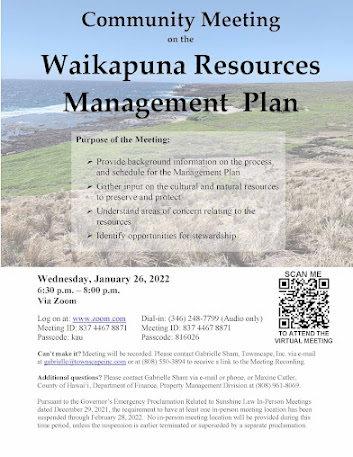
THE LAND MANAGEMENT PLAN FOR WAIKAPUNA IS OPEN FOR PUBLIC INPUT. Those assisting the community in making the plan sent out a notice this week to remind folks that a community meeting will be on Wednesday, Jan. 26 at 6:30 p.m. "to provide mana'o about the important cultural and natural resources of Waikapuna, critical issues relating to the resources, and ideas for stewardship." 

    Waikapuna is 2,317 acres, located south of Nāʻālehu in the ahupua'a of Kahailipalinui and Kahilipali'iki in the moku of Kaʻū.              Several developments have been proposed for this land, the most recent being a subdivision development planned by the previous landowner. 
    Seeking to protect its significant natural and cultural resources, the Ala Kahakai Trail Association, a non-profit organization, raised funds through The Trust for Public Land; the State Legacy Land Conservation Program; County of Hawai'i's Public access, Open Space and Natural Resources Preservation Fund; and private doors to acquire Waikapuna for conservation in 2019.
    County of Hawai'i holds a Conservation Easement over Waikapuna with the purpose to "conserve, preserve, and protect in perpetuity the historic, cultural, agricultural, natural, marine, scenic, open space, fresh water, and native and endemic plant and animal habitat values of the Easement Property." A conservation easement is a legal agreement that permanently limits uses of the land (such as development) in order to protect its conservation values.
    Ala Kahakai Trail Association, which holds title to the property, is required to establish a land management plan that is consistent with the purpose of the Waikapuna Conservation Easement and the State LLCP grant agreement.
Waikapuna's coastline is home to an intricate network
of flora and fauna. Photo from Ala Kahakai Trail Association
    Townscape, a consulting firm, is contracted to help make the plan with community input. Analysis of Waikapuna resources, issues and needs was done during the third quarter of 2022. Next step is to develop management strategies by the second quarter of 2022 and to complete the Final Waikapuna Management Plan by the fourth quarter of 2022. In addition to the community meeting by zoom on Jan. 26, there will be a community meeting regarding the Draft Waikapuna Management Plan during the third quarter of 2022.
    The Jan. 26 meeting is begin held on Zoom, due to ongoing health concerns regarding COVID-19.  The Meeting ID is 837 4467 8871. Passcode is kau. For audio only, dial (346) 248-7799
Meeting ID: 837 4467 887. Passcode : 816026.

To read comments, add your own, and like this story, see www.facebook.com/kaucalendar/. See latest print edition at www.kaucalendar.com.

MAUNA LOA'S EFFUSIVE ERUPTIONS AND SPECTACULAR LAVA FLOWS are the subject of this week's Volcano Watch, written by USGS Hawaiian Volcano Observatory scientists and affiliates:
Mauna Loa is known for its effusive eruptions that produce spectacular lava flows. However, some of the volcanic products found on Mauna Loa are pyroclastic or explosive in character.
Evidence of a more violent style of eruption has been identified in the form of debris fans. These deposits are largely made up of solidified blocks, lapilli (pieces <2.5 inches), and ash.
   The age and general location of the deposits were discussed in an earlierVolcano Watch article published in 2018.    Here, we describe the rock types and sizes, which are used to help constrain the vent locations and size of these unusual explosive eruptions.
    Generally, the ejected rocks are roughly equivalent in size and abundance along the central axis of each fan, and they decrease in size with increasing distance from the caldera rim.    We documented over 1,000 clasts from the debris fan on the northwest rim. The clasts were dominated by ponded lava, ejecta, both unaltered and altered, totaling 78 percent. Pāhoehoe clasts, both unaltered and altered, are the second most abundant, at 20 percent, while gabbroic xenoliths and bread-crust or crackle-surface rocks each comprise 1 percent of the deposit. Clasts in the northwest fan range in size from 3–220 cm (1–87 in) in diameter, with an average size of 26 cm (10 in). 

Types of explosive clasts found in the debris fan deposits at the summit of Mauna Loa: (A) unaltered pondedlavaflow, (B) unaltered pāhoehoe, (C) altered ponded lava flow, often has a red to pink hue, (D) thermally altered pāhoehoe, often has a red-to-pink hue, (E) gabbroic xenolith, the most crystalline rocks we found, (F) bread-crustouter surfaces and vesicular interiors or dense clasts with crackle or crazed surface rinds, (G) bread-crust due to quenching. USGS photos
    The east, or Mauna Loa Cabin apron, is also dominated by ponded lava ejecta, both unaltered and altered. We documented over 1,700 clasts, and ponded lava comprises 98 percent of the lithics, while pāhoehoe clasts, both unaltered and altered, comprise only about 1 percent of the deposit. Bread-crust or crackle-surfaced rocks also comprise 1 percent of this deposit, along with a single gabbroic lapillus that was noted.
        In the east fan, most larger-sized clasts (greater than 40 cm or 16 in) are found in the northern section of the fan. Lithic ejecta in the north ranges from 2–153 cm (0.8–60 in) in length, with an average of 21 cm (8 in). To the south, the clasts are much smaller and more abundant. The ash fraction is over 70 percent of the deposit, burying almost all of the underlying pāhoehoe flows. The clasts range in size from 1–66 cm (0.4–26 in), with an average size of 13 cm (5 in).
    West fan clasts, types, and sizes are randomly scattered at varying distances from the caldera rim, with no clear dispersal pattern. We cataloged over 340 clasts; pāhoehoe, both unaltered and altered, is the most abundant at 44 percent, followed by ponded lava, both unaltered and altered, at 24 percent. Clasts range from 2–90 cm (0.8–35 in), with an average of 20 cm (8 in).
Map of explosive deposits at the edge of Moku'āweoweo, the summit caldera of Mauna Loa. Map showing the size distribution of ejecta, sorted by maximum length in centimeters (one inch is about 2.5 cm). The colors indicate the different size fractions in centimeters. The largest blocks were found closest to the rim. In general, clast size diminished with increasing distance, but medium-sized blocks were found nearly at the distal extent of fan limits. The dark flows in the image outside the caldera are the youngest 'a'ā flows. USGS map.
    Surprisingly, the two most uncommon rocks in the other explosive fans are quite abundant in the west fan. Gabbros comprise 21 percent of the deposit, while bread-crust or crackled-surface rocks comprise 11 percent of the deposit.
    The flow samples indicate the explosions occurred at depth, and had to break through overlying lava flows. Many of the pahoehoe blocks are rounded, suggesting that they were tumbled in the vent or recycled a few times before ejection. Gabbros represent crystalized lava lake.    The most unusual blocks have "bread-crust" textures or have water-quenched-type outer surfaces (crackled). We interpret the bread-crust-textured clasts as the ejected clots of residual melts of crystallizing shallow magma bodies, similar to those that produced the gabbroic xenoliths. This residual melt was still molten or plastic when the explosive activity occurred. In contrast, the crackle-surfaced types are the result of hot rocks being rapidly quenched.

    So why is this information so important? Based on simple geometry of the arcuate shaped deposit fans, clast type, and size distribution, we can determine that the sources of these explosive eruptions were from vents on the caldera floor adjacent to the deposits found on the rim.
    We know that explosive eruptions have occurred on Mauna Loa before, and that this type of activity is likely to happen again. Although no one lives at the summit of Mauna Loa, explosive eruptions have the potential to pose a threat to hikers, aircraft, and communities downwind that could experience ashfall. This study adds another important dimension in reconstructing the long-term eruptive history of Mauna Loa.

is a weekly article and activity update written by U.S. Geological Survey Hawaiian Volcano Observatory scientists and affiliates.

To read comments, add your own, and like this story, see www.facebook.com/kaucalendar/. See latest print edition at www.kaucalendar.com.

See archives of The Ka`u Calendar at
www.kaucalendar.com and find the
monthly print copy in mailboxes from 
Volcano through Ocean View.