About The Kaʻū Calendar

Showing posts sorted by date for query mumps. Sort by relevance Show all posts

Wednesday, March 06, 2024

Kaʻū News Briefs March 6, 2024

Punalu‘u Black Sand Beach. Photo by Peter Anderson

THE CENTER FOR BIOLOGICAL DIVERSITY HAS FILED LEGAL INTERVENTION OPPOSING BLACK SAND BEACH, LLC'S request for a Special Management Area permit for its proposal for Punalu‘u. In representing itself and several community members, the Center issued a statement saying that the project would be at "one of Hawaiʻi's most renowned black sand beaches" and "would harm local residents and jeopardize threatened and endangered species, including green sea turtles and Hawaiian monk seals."
    The Windward Planning Commission will hold the public meeting this Thursday at  9 a.m. March 7 at Hawai'i County Council Chambers, 25 Aupuni St., in Hilo. It will be live-streamed on YouTube at  https://www.youtube.com/channel/UCAFoRMb3rfWLQMPd6TAkEGA?view_as=subscriber.
    Maxx Phillips, Hawai‘i Director and Staff Attorney at Center for Biological Diversity, said, "The vibrant biodiversity and rich cultural history of Punaluʻu needs to be protected for generations to come, not developed for private interests. Hundreds of people have mobilized to protect this spectacular place and protest this reckless development. The community and wildlife of Punaluʻu deserve so much more and we'll do everything possible to see they get it."
Maxx Phillips, Hawai‘i Director and Staff Attorney for
 Center for Biological Diversity, will testify for a contested
case for Punalu‘u at the SMA hearing on Thursday.
 If the contested case is approved by Hawai‘i County's Windward Planning Commission, "Thursday's action would allow the Center and local residents to formally challenge the 400-acre project site development in Punaluʻu, starting with the March 7 commission meeting. Developers want to build 225 residential and short-stay units, a commercial center, retail shops and a golf course that would harm local residents and Hawaiʻi's native threatened and endangered species," said the Center's statement.
    "Nestled on the southeastern Kaʻū coast, Punaluʻu is celebrated for its breathtaking beauty, cultural significance and unique ecological diversity. This coastal haven is home to rare and endangered native animals, including hawksbill sea turtles, green sea turtles, Hawaiian monk seals, native bees and orange-black damselflies. Punaluʻu's shores are vital nesting grounds for the sea turtles.
    "Developers are relying on an outdated environmental analysis and the permit application they filed with the county fails to consider harms to the local community. Increased traffic and a surge in visitors will compromise the residents' quality of life and exacerbate existing challenges faced by Punaluʻu's fragile ecosystem," said the Center's statement.
    "My beloved mother Pele Hanoa and sister, Keolalani Hanoa worked tirelessly for many years to preserve Punaluʻu," said Elsa Kalanikauleleiaiwi Dedman, a direct descendant of Punaluʻu and a Center for Biological Diversity member. "The magic of Punaluʻu, the piko of Kaʻū, is home to some of the rarest animals in the world. I am one with my ancestors to protect the legacy of our cultural treasures on Hawaiʻi island's longest undeveloped coastline."
    Nohea Ka‘awa, a community member supporting approval of the contested case, said "There are many issues that need to be addressed before even thinking about approving the special management area use permit or considering any type of development at Punaluʻu. Our Kaʻū community is expressing concerns about the lack of a disaster mitigation plan. Emergencies like fire, floods, tsunamis, earthquakes, and volcanic eruption have not been considered. There's no burial treatment plan in place to protect our ancestors. The sewage system is leaking into our ocean as we speak, yet the developer wants us to believe that there will be no impacts. This development will lead to overpopulation and a rise in land taxes so local people cannot stay. The decision-makers have a big responsibility on their shoulders, and with the proper steps taken beforehand, a disaster waiting to happen can be prevented."
    The legal challenge calls for "a thorough reevaluation of the potential environmental and cultural harms from the development. It aims to ensure that responsible and sustainable practices are adopted to protect the delicate balance of Punaluʻu's ecosystem and the native species that depend on it to survive," says the Center's statement. 
    Guy Enriques, President of Malama Pono Punalu‘u, said, "This development goes against all the values of the Kaʻū Community Development Plan, I strongly believe that the character of these developers will always put Kala (money) before the people and lands of Kaʻū. This development will put the place that we love and cherish in jeopardy."
    Black Sand Beach, LLC has been contacted for a response to the statement from the Center for Biological Diversity. The Black Sand Beach team contended earlier that its plan will help manage vehicular and pedestrian traffic to help protect wildlife and will maintain access to the entire shoreline for the local community.
    According to Deputy Planning Director Jeff Harrow, contested case proposals should not stop or delay pro and con testimonies from being heard at the hearing on Thursday. In addition to the filing from the Center for Biological Diversity, a contested case filing has come from the seven-member board of the condo association at Punalu'u, with several non-board members expressing to the Planning Commission their opposition to the filing. 

To read comments, add your own, and like this story, see facebook.com/kaucalendar. See latest print edition at kaucalendar.com, in the mail and on stands.
Reflections of Punalu‘u during its heyday as a destination for tourist dining and family events, with canoe in the pond, hale in the background. Black Sand Beach, LLC wants to bring back some of the elements of those times. Shoreline changes, visitor crowding, endangered species and other environmental considerations are also at hand, with public hearing coming up on a development plan at 9 a.m. Thursday in Hilo County Council Chambers, and by Zoom at Nāʻālehu Community Center and Kai'Lokis in Ocean View. Photo from Black Sand Beach, LLC

BLACK SAND BEACH, LLC, WHICH PROPOSES A PROJECT UP FOR PUBLIC HEARING THURSDAY, released this letter to the Kaʻū community on Wednesday evening:
    Dear Kaʻū Community,
    Over the past month, various opinions and demonstrations have emerged in our Kaʻū community regarding the public hearing on the Punalu‘u SMA, transforming our once beautiful and friendly town into a place filled with tension. Many in the community have expressed regret and sadness over this. We do not wish to see strife within the community; we have chosen to be quiet and listen.    
    Over the past four years, we have communicated numerous times with the community about our development plan for Punalu'u. We understand the situation and needs of our community. More importantly, we chose to come to Puanalu'u not just as developers, but also as individuals who aspire to be permanent residents and good neighbors. Therefore, we have strived to help our community with limited development, bringing convenience to everyday life and good job opportunities, allowing parents to avoid spending 3-4 hours commuting to work each day.
    In the past few years, when communicating our development plans with the community, the most common and heartfelt response we received was: "You can't please everyone." However, we have still tried to communicate as widely as possible with the community. After four years, we have finalized our current plan. We are grateful to the community for appreciating us as the first developer willing to communicate deeply with them.

Old days of the restaurant, museum, shop at Punalu‘u Black
 Sand Beach Pond. Photo from Black Sand Beach, LLC

    After extensive communication with the community, we know that the aspects of development in Punalu‘u that are of greatest concern to the community are: the coastal area, the number of units in the project, and the area of the old restaurant, which represents the history and culture of Punalu‘u.
    Here are the key decisions we have made for our Punalu‘u development plan:
    1. The entire coastline will be permanently open to the community and not privatized.
   2. The units will total 225, which is 7.5% of the 1967 development plan and 12.3% of the 2006 development plan.
   3. The old restaurant will be restored as the Punalu‘u Garden, primarily open to the community as an information center, a center for historical and cultural education, and a venue for various community gatherings. After multiple discussions with the principals of 
Nāʻālehu and Pāhala schools, part of the area will be made available to the schools as a base for student learning and education.
     It's important to note that on the other side of the old restaurant area, we plan to establish an open market. This will provide equal and favorable business opportunities for every small and medium-sized enterprise in the community.
    Additionally, we welcome and hope to hear various opinions and suggestions from the community. For example, a community member kindly raised issues about sewage treatment, clean energy, and sustainable development. We will answer these as best as we can. 
The feast in the days of the Punalu'u Village Restaurant. Photo from Black Sand, LLC

    We will present more details at the public hearing tomorrow through the Planning Department and our team. We look forward to your attention and participation, as well as hearing your views. Even if not everyone can speak, each person can fully hear about our Punalu'u development plan and the voices from the community.
    Friendly Reminder 1: We thank Uncle Guy for gathering friends from all over the Big Island and Hawai‘i last Saturday to attend the Punalu‘u public hearing. He also plans to provide bus services to bring interested attendees to the meeting center. We deeply appreciate this thoughtful arrangement, as it will enable them to understand the development plan for Punalu‘u correctly and make their own judgments and statements based on the information they hear.
    Friendly Reminder 2: In last Saturday's demonstration against the development of Punalu‘u organized by Uncle Guy, there was strong opposition to the open market plan. This issue is difficult to address because the open market plan was formed through communication with the community. It is specially designed for the entire community to have fair business opportunities and will belong to the whole community, not just one family.

To read comments, add your own, and like this story, see facebook.com/kaucalendar. See latest print edition at kaucalendar.com, in the mail and on stands.

TO COMBAT AGRICULTURAL THEFT, KAʻŪ'S COUNTY COUNCIL MEMBER MICHELLE GALIMBA and Councilwomen Heather Kimball and Cynthia Evans have funded three certified agricultural produce scales. 
    Hawai'i Police Department sent out a mahalo, noting that each portable scale can weigh more than 500 pounds of produce and print out a receipt showing the total poundage. The three scales, valued at $1,500 each, will be kept at the Hilo, Kona, and South Kohala police stations for use by police investigating agricultural thefts. “It’s a really great tool that helps both police and prosecutors,” said Lieutenant William Derr of HPD’s Hilo Community Policing Section.“We can take the scale to remote parts of the island or farmers markets, weigh the produce on the spot, and return it to its rightful owner.”
    The collaborative effort to procure the scales was spearheaded by retired Hawai‘i County Prosecutor and community advocate Charlene Iboshi, along with the County of Hawai‘i Office of the Prosecuting Attorney, and the County Office of Research & Development. Council members used their discretionary funds to pay for the equipment.
    The scales, which the police department received at the end of February, were quickly put to use and already instrumental in prosecuting a case, said the HPD statement. 
HPD Lieutenant William Derr, Glenn Sako, County Office of Research and Development, Charlene Iboshi, Councilwoman Heather Kimball District 1, Councilwoman Michelle Galimba District 6, Councilwoman Cindy Evans District 9, Shane
Muramaru, Office of the Prosecuting Attorney. Photo from HPD

    “The day after we received the scale at the Hilo station, we received a call from officers in the Hāmākua district requesting to use it in an agricultural theft case involving more than 100 pounds of bananas,” said Derr.
    Additionally, HPD recently collaborated with the Office of Research and Development on a new, online, and fillable self-reporting form regarding agricultural theft. The form is available on the County’s website, https://www.hawaiicounty.gov/Home/Components/News/News/3557/, and simplifies the reporting process for victims, police officers, and prosecutors.
    Hawai‘i Police Department is committed to working diligently on addressing agricultural theft, a frequently underreported, yet devastating crime that impacts our island’s farmers and ranchers.
    “With the certified scales the prosecution of offenders can now be carried out more successfully, thanks to the council members’ gracious contributions,” said Derr. “We are optimistic about our ongoing collaboration with Hawai‘i County Council members and fellow county departments as we continue to develop additional innovative solutions to combat this type of crime.”

To read comments, add your own, and like this story, see facebook.com/kaucalendar. See latest print edition at kaucalendar.com, in the mail and on stands.

BE ON THE ALERT FOR MEASLES, as international and continental U.S. outbreaks increase, That's the message from the state Department of Health on Wednesday. DOH noted that 16 states are affected as of Feb. 29. DOH also sent an advisory to physicians, urging them to be vigilant.

    "Hawai‘i has not experienced any recent outbreaks or spread of measles within the state, but infection can be just a plane ride away," said State Epidemiologist Dr. Sarah Kemble. "Current outbreaks in the U.S.

Measles can a rash all over and conjunctivitis in the eyes. Some cases
lead to death. Photo from American Optometric Association
and abroad are a serious concern because of our popularity as an international and domestic travel destination and our frequent traveler resident population. Both groups have the potential to introduce and spread measles."
    According to the Department of Health, "The best way to prevent measles is to get vaccinated with the measles-mumps-rubella (MMR) vaccine. DOH encourages everyone to check their records and contact their healthcare provider if they need to be immunized. Before international travel or travel to areas experiencing a measles outbreak, infants ages six through 11 months should receive one dose of MMR vaccine. Children ages 12 months and older, as well as teenagers and adults without evidence of immunity, should receive two doses of MMR vaccine separated by at least 28 days."
    MMR coverage rates have dropped among children globally, nationally, and locally here in Hawai‘i since pre-pandemic years. Based on recent data from the Centers for Disease Control and Prevention (CDC), Hawai‘i's 2022-2023 kindergarten coverage rate is estimated to be 86.4%, which is nearly 10% lower than the 95% coverage level recommended for community protection. Hawai‘i had the largest increase in non-medical kindergarten vaccine exemptions nationally from 2021-2022 to 2022-2023. "Staying up to date on routine vaccinations is an effective way of protecting our families and the larger community from measles outbreaks," said the DOH statement.
"The decline in routine childhood vaccination rates is concerning for a potential measles outbreak in Hawai‘i," said Dr. Kenneth Fink, Director of Health. "Whereas unvaccinated and immunocompromised individuals can be protected by community immunity, weʻre now below that threshold for measles putting this group at risk. Vaccination helps protect the person vaccinated and the community. I encourage parents who are hesitant about vaccination to discuss their concerns with their child's healthcare provider."
    Measles was declared eliminated in the United States in 2000, but remains a very contagious disease that is caused by a virus and can be serious. It spreads through the air when an infected person coughs or sneezes. Measles starts with fever, followed by cough, runny nose, and redness in the white parts of the eyes. Then a rash of tiny, red spots breaks out. It starts at the head and spreads to the rest of the body.
    Measles can cause serious health complications, especially in children less than a year old, pregnant individuals, and persons who have a weakened immune system. According to the CDC, one out of every 20 children with measles gets pneumonia, and one out of 1,000 develops encephalitis (swelling of the brain). Nearly one to three out of 1,000 children who become infected with measles, will die from respiratory and neurologic complications.
    More information about measles is available at https://www.cdc.gov/measles/index.html.


Thursday, November 09, 2023

Kaʻū News Briefs Thursday, Nov. 9, 2023

Hokulele Hosts First Veterans Day Weekend Basketball Tournament for Keiki
Hokulele Basketball Club, which trains keiki to teens in basketball, sportsmanship and teamwork, is raising funds for
 its mission through an islandwide tournament at the Herkes Kaʻū District Gym Friday and Saturday, Nov. 10 and 11.
Admission is free for the public. Photo by Julia Neal

HAWAI'I POSTED THE HIGHEST INCREASE IN EXEMPTING KINDERGARTEN KEIKI FROM VACCINATIONS among all the states, according to the Centers for Disease Control & Prevention. A story carried by Associated Press on Thursday said the rate in Hawai'i almost doubled, rising to 6.4 percent. The national rate rose to 3 percent. 
   "More parents are questioning routine childhood vaccinations that they used to automatically accept, an effect of the political schism that emerged during the pandemic around COVID-19 vaccines, experts say," according to AP. It also quoted Hawai‘i state Department of Health saying, “we have observed that there has been misinformation/disinformation impacting people’s decision to vaccinate or not via social media platforms.”
    The AP story reports on this week's Centers for Disease Control & Prevention report, which noted that the national vaccination rate remains at 93 percent, the same as 2021 but down from pre-covid years. "All U.S. states and territories require that children attending child care centers and schools be vaccinated against a number of diseases, including, measles, mumps, polio, tetanus, whooping cough and chickenpox. All states allow exemptions for children with medical conditions that prevents them from receiving certain vaccines. And most also permit exemptions for religious or other non-medical reasons."
    Idaho had the highest percentage of exemptions, with 12% of kindergartners receiving at least one exemption. In contrast, 0.1% had exemptions in New York. The AP story also notes that officials point to three groups of children in the vaccination statistics. "One is those who get all the shots. A second is those who get exemptions. The third are children who didn’t seek exemptions but also didn’t get all their shots and paperwork completed at the time the data was collected.

To read comments, add your own, and like this story, see facebook.com/kaucalendar. See latest print edition at kaucalendar.com, in the mail and on stands.

NIYORI NOELLE SORIANO, JOURNALISM STUDENT AT KAʻŪ HIGH, writes about visiting the historic Palace Theater in Hilo and seeing a film:
    Members of Kaʻū High School Drama Club traveled to the Hawai‘i Film Festival screenings at the historic Palace Theater on Nov. 3 in Hilo. The 43rd annual Hawai‘i International Film Festival presented
Niyori Soriano (front left) writes about a screening
during the Hawai'i International Film  Festival at The
Palace Theater. Photo from Kaʻū High School

11 films over four days at The Palace, with additional screenings around the state.
    The Drama Club viewed My Partner, directed by Keli‘i Grace. He wrote the play about the value of learning to understand one another's feelings and varying points of view among Native and Immigrant families; involving race, culture, poverty, privilege and well-being.
    The My Partner story focuses on a fishpond. A young Native Hawaiian man, known as a top athlete at high school, also shows his deep involvement with his culture. He sees the fishpond as a place for Native Hawaiian aquaculture to perpetuate Hawaiian history. His Filipino schoolmate, first-generation immigrant and high achiever, sees the fishpond as a place to go fish for as many fish as he can catch to feed his family.
    The film shows how the young men from two cultures learn that both views of the fishpond are valid. They get together to understand the importance of seeing the world from different perspectives. The Hawaiian takes the time to introduce the Filipino to the importance of natural resources, wai wai - water and values, taking him to kalo farms and up mountain to streams and forest. They eventually become close to one another.
    My Partner is expected to be shown at future festivals. The trailer can be seen at https://www.imdb.com/title/tt21329176/?ref_=tt_mv_close.

To read comments, add your own, and like this story, see facebook.com/kaucalendar. See latest print edition at kaucalendar.com, in the mail and on stands.

WHAT'S SHAKING BENEATH MAUNA LOA? is the title of this week's Volcano Watch, written by U.S. Geological Survey Hawaiian Volcano Observatory scientists and affiliates:
    It's hard to believe that nearly one year has passed since Mauna Loa erupted. Mauna Loa has been mostly quiet since the end of the 2022 eruption, but a small increase in seismic activity in late October 2023 reminds us that the volcano remains active.
    The 2022 event was significant in that it occurred following the longest noneruptive period—38 years—at Mauna Loa in the past two centuries. Like most Mauna Loa eruptions, the 2022 eruption started in Mokuʻāweoweo (the summit caldera). Within hours, activity moved into the Northeast Rift Zone, generating lava flows primarily in a north/northeast direction that crept to within 3 km (2 mi) of the Daniel K. Inouye Highway.
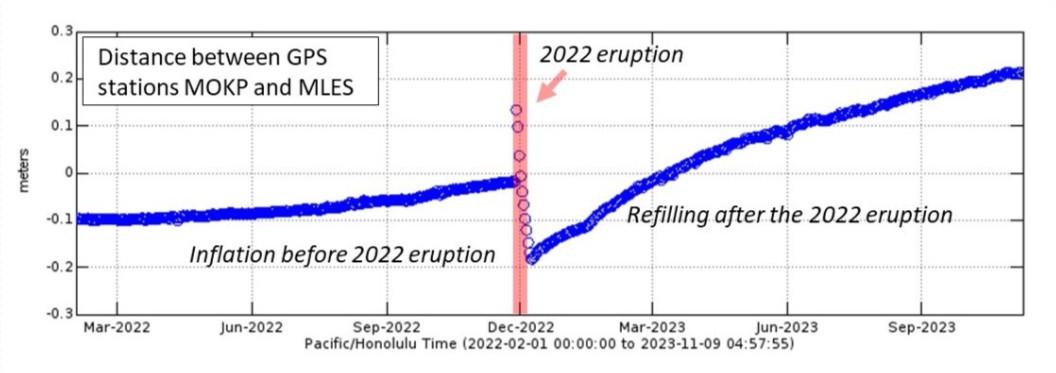
     Following the 2022 eruption, Mauna Loa quickly began to reinflate, indicating that magma continued to be supplied to the volcano's magma chamber. This observation is not unprecedented, as ground deformation rates on Mauna Loa were similarly high following the 1975 and 1984 eruptions, but eventually declined to background levels before the next volcanic unrest. In the months following the 2022 eruption, the deformation rates have slowly declined, though they remain relatively high.

Color plot of volcano deformation data
Plot showing the distance between two GPS stations on Mauna Loa from February 2022 to November 2023. Station MOKP is on the north side of Mokuʻāweoweo and station MLES is east of Mokuʻāweoweo. This plot shows how the distance between these two stations increased before the 2022 Mauna Loa eruption, indicating that the volcano was inflating. In the months following the 2022 eruption, the deformation rates have slowly declined, though they remain relatively high. USGS plot. 

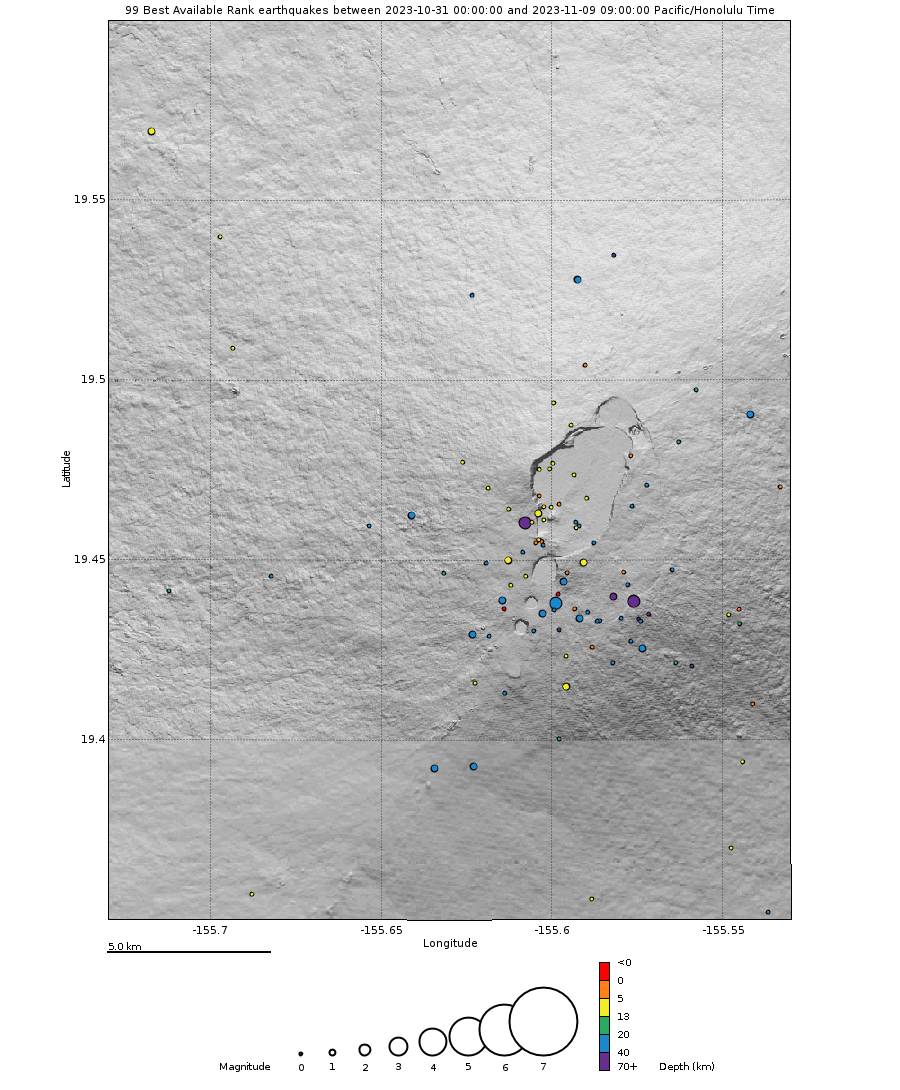
    New seismic observations over the past month include more frequent occurrences of signals associated with magma movement. Most of these signals have occurred at depths of 40–60 km (25–37 mi) beneath Mokuʻāweoweo, though some have occurred at shallower depths within 16 km (10 mi) of the ground surface. These observations are also not unprecedented: similar signals at deep depths occurred during 2002 and 2004.
    In the decades prior to the 2022 eruption, Mauna Loa exhibited several periods of prolonged and increasing unrest. Over the past week, the number of seismic events has decreased, but the rate of ground deformation remains high. If Mauna Loa seismic activity becomes more persistent—in combination with elevated rates of ground deformation—this may herald a shift back into a period of unrest.Mauna Loa's most recent eruptions in 2022, 1984, 1975, and 1950 have occurred years to decades apart. However, prior to 1950, Mauna Loa erupted more frequently. Only three Mauna Loa eruptions occurred in the second half of the 20th century, but twelve eruptions occurred in the first half of the century.
    Mauna Loa eruptions have varied in duration. The 1949 summit eruption, for example, lasted nearly five months; this was soon followed by the 1950 Southwest Rift Zone eruption that lasted several weeks, generating lava flows that swiftly descended steep slopes in South Kona to enter the ocean within a few hours of the eruption onset. Considering the past eruption patterns and current monitoring observations, is Mauna Loa entering another prolonged period of variable unrest like it had in the decades preceding the 2022 eruption?

Color map of volcano earthquakes
Map showing the locations of earthquakes beneath Mauna Loa between October 31, 2023, and November 9, 2023. The earthquake colors indicate their depth. Most earthquakes have occurred at depths of 40–60 km (25–37 mi) beneath Mokuʻāweoweo, though some have occurred at shallower depths within 16 km (10 mi) of the ground surface. USGS map. 
    Alternatively, is the volcano entering a phase of more frequent eruptions like it had prior to 1950? While the recent observations on Mauna Loa are not alarming, they are certainly thought-provoking.                       Contextualizing these observations relative to past eruptions is difficult because the unrest and subsequent run-up to the most recent eruption were monitored with a denser and more modern equipment network compared to those previous. In the months prior to the 2022 eruption, USGS Hawaiian Volcano Observatory staff were comparing earthquake activity to paper records from 1984, as well as comparing the tilt and GPS readings to relatively sparse ground deformation surveys from the years following the 1975 and 1984 eruptions.
   Although Mauna Loa's USGS volcano alert level and aviation color code have remained at NORMAL/GREEN since the eruption ended last year, the volcano remains active and will erupt again in the future. HVO will continue to keep a close eye on Mauna Loa's monitoring data, watching for additional signs that might indicate the volcano is entering a period of elevated unrest.
    Volcano Activity Updates: Kīlauea is not erupting. Its USGS Volcano Alert level is ADVISORY.
Southwest of Kīlauea's summit, unrest associated with an intrusion that began in early October has diminished over the past week, though a small cluster of earthquakes has persisted near the middle Southwest Rift Zone. Seismicity and ground deformation may continue to wax and wane with changes in the rate of magma input to the area, and eruptive activity could occur in the near future with little or no warning. The most recent sulfur dioxide (SO2) emission rate for the summit—approximately 100 tonnes per day—was measured on October 19.
    Mauna Loa is not erupting. Its USGS Volcano Alert Level is at NORMAL.
Webcams show no signs of activity on Mauna Loa. Summit seismicity has increased slightly in the past month, while ground deformation indicates slow inflation as magma replenishes the reservoir system following the 2022 eruption. These processes are described in greater detail in the above article. SO2 emission rates are at background levels.

    Four earthquakes were reported felt in the Hawaiian Islands during the past week: a M3.9 earthquake 76 km (47 mi) WNW of Kalaoa at 41 km (25 mi) depth on Nov. 3 at 1:31 p.m. HST, a M3.0 earthquake near Pāhala at 32 km (19 mi) depth on Nov. 3 at 2:53 p.m. HST, a M3.7 earthquake 11 km (7 mi) E of Pāhala at 33 km (20 mi) depth on Nov. 6 at 8:55 a.m. HST, and a M3.4 earthquake 17 km (10 mi) ESE of Leilani Estates at 43 km (27 mi) depth on Nov. 6 at 10:26 p.m. HST.  


THE EARTHSONG FOUNDATION venue at 94-2132 South Point Road will host Soul Sphere, a musical event with a farm fresh lunch on Saturday, Nov. 18 from noon to 3 p.m. A statement from organizers describes the event as "an intimate concert and conscious gathering to uplift and nourish our spirits."            The concert features electro-acoustic duo Spark of Spirit from Hawai‘i, spiritual jazz duo Sharon & Shelly from California and multi-instrumentalist Raphael Bowen from Australia. The cost is $25, which includes a plate of farm fresh food served at the end.
    The event is family-friendly with no alcohol. Reserve at

A VETERANS DAY CELEBRATION WILL BE HELD on Saturday, Nov. 11 at Nāʻālehu Hongwanji, from 10 a.m. to 2 p.m. sponsored by ‘O Ka‘ū Kākou. OKK President and veteran Wayne Kawachi said there will be music with Sonny Ramos, a free lunch and drinks as well as door prizes.

VETERANS DAY IS A FREE DAY AT HAWAI'I VOLCANOES NATIONAL PARK on Saturday, Nov. 11, with no admission fees for the public to honor all veterans.


Monday, May 17, 2021

Ka‘ū News Briefs, Monday, May 17, 2021

A guide to 84 varieties of taro is now online through University of Hawaiʻi. See more below.
Photo from University of Hawaiʻi 

TO PREVENT VOTE SUPPRESSION ON HAWAIʻI ISLAND, the Hawaiʻi County Democratic Party announced a campaign today to urge Gov. David Ige to veto a bill that just passed the Hawaiʻi Legislature. The bill is SB1350-CD1. At issue is which members of the military living here are considered permanent residents during reapportionment. 
    Hawaiʻi County Democratic Committee members voted unanimously on Sunday to ask the governor for the veto, stating concern with "the manner that the State Reapportionment Commission
interprets the 2020 Decennial population count. To ensure that the State Constitution is upheld when the 2022 Statewide Reapportionment Plan is drawn, the HCDC urged veto of SB1350 due to vague or contradictory language in the bill relating to the interpretation of 'permanent resident.'”
     The U.S. Census counts all residents who consider a state their primary residence – i.e., where they live and sleep most of the time. However, it’s often the case that military personnel, though stationed in Hawaiʻi, consider another state as permanent domicile where they vote.
    The Hawaiʻi State Supreme Court ruled in 2012 that these military personnel must be subtracted from the count before reapportionment decisions are made and lines drawn for State House of Representatives and State Senate seats. According to the Democratic Party, "SB1350-CD1 seems to contradict this decision." Those interested can email https://governor.hawaii.gov/contact-us/comments-on-legislation/
    The final bill, testimony and committee reports are at : https://www.capitol.hawaii.gov/measure_indiv.aspx?billtype=SB&billnumber=1350&year=2021.

To read comments, add your own, and like this story, see https://www.facebook.com/kaucalendar/. See latest print edition at kaucalendar.com. 

U.H. WILL REQUIRE COVID-19 VACCINES FOR ON-CAMPUS STUDENTS beginning this Fall, provided that the vaccine is licensed by the federal Food & Drug Administration. The policy covers state university and community colleges on this island.
    University of Hawaiʻi President David Lassner made the announcement today. One or more COVID vaccines are expected to move from emergency use to general use status this summer and will become a
student health requirement. Already required are TB clearance and immunizations for Measles Mumps, Rubella (MMR) and Tetanus-diphtheria-pertussis and Varicella. The Meningococcal Conjugate vaccination is also mandatory for first-year students living in on-campus housing. The policy means that a COVID vaccination will be an added requirement for students to go onto the campus, with the exception of those with approved medical and religious exemptions.
    “It is clear that a vaccinated campus is a safer campus for everyone, and a fully vaccinated student community enables the best opportunity for a healthy return to high-quality face-to-face teaching, learning and research,” said Lassner. “This decision does not come lightly, and is based on guidance from our own
Health and Well-Being Working Group as well as the American College Health Association
recommendation that all on-campus college students be required to be vaccinated.”
    Unvaccinated UH students will still be welcome and may enroll in online courses. Online learners will continue to be able to engage with student services online, as they have done over the past year, and will be able to participate in student activities virtually.
    All UH students and employees can sign up now to be vaccinated, and UH urges all members of the UH community to be vaccinated now. The university will also ensure there are vaccination opportunities over the summer and at the beginning of fall for members of the UH community who arrive from other
locations where they may not have been able to be vaccinated.
    Hawaiʻi Department of Health Director Libby Char says UH’s decision to add the COVID-19 vaccine is an important development for the university and the state.
    “Having fully vaccinated campuses will help tremendously to create a much safer learning environment and minimize any transmission of COVID-19 from person to person,” said Char.
According to the U.H. statement, the university will initiate formal discussions with the three unions that represent UH employees about possibly requiring COVID-19 vaccination.

To read comments, add your own, and like this story, see https://www.facebook.com/kaucalendar/. See latest print edition at kaucalendar.com. 

A kapu on entering waters at Kahaluʻu Beach Park aims to protect the reef-building cauliflower coral. See more on this coral at 
http://www.waikikiaquarium.org/experience/animal-guide/invertebrates/coral/cauliflower-coral/


A KAPU ON A MARINE AREA, A PRACTICE FROM ANCIENT HAWAIIAN DAYS, WILL BE IMPLEMENTED by the state Department of Land & Natural Parks in waters adjoining a county beach park. The kapu will be in Kona, when Kahalu‘u Beach Park closes to the public during the week of May 28 to June 5 to enhance the spawning cycle of vulnerable cauliflower coral in Kahalu‘u Bay. 
    According to the Center for Biological Diversity, which has sued to place it on the Endangered Species list, cauliflower coral coverage around the Hawaiian Islands declined 36 percent between 1999 and 2012. "Cauliflower coral is a major reef-building coral that protects Hawaiʻi’s shorelines and provides habitat for fish and crabs. New research indicates human-induced climate change and ocean warming could destroy most of the world’s coral reefs by 2100 if we do not make major reductions in fossil fuel use."
    Department of Land & Natural Resources Division of Aquatic Resources and The Kohala Center, which administers the Kahaluʻu Bay Education Center, ask the public’s cooperation to stay out of Kahaluʻu Bay during the critical time of cauliflower coral spawning May 28 to June 5.
    “While the park is closed, we are asking everyone to avoid snorkeling or swimming in the bay,” said Cindi Punihaole, KBEC director. “During these spawning events, corals emit reproductive materials known as gametes into the water column, which are carried by the tides to mix and generate planktonic coral larvae. When given a chance to settle undisturbed, the gametes have a greater chance of settling and growing in the bay.”
Hawai`i Wildlife Fund advocates for the protection of cauliflower coral. Photo by Lindsey Kramer from HWF

    Generations of kilo, the Hawaiian practice of keen environmental observation, have provided critical knowledge about the timing of natural spawning cycles of cauliflower coral in Kahaluʻu Bay. The County of Hawaiʻi has worked with The Kohala Center and community stewards over the past three years to close the park during specific moon phases in mid to late spring and to educate visitors about this natural phenomenon and the importance of minimizing disturbances to the corals during this time.
    “We totally support this voluntary measure as natural reproduction events are critically important,” said Brian Neilson, DLNR-DAR administrator. “With the absence of daily visitors and subsequent reduction in physical damage and impact of chemical sunscreens, growth and recovery along the shoreline has already been documented.
    Research has shown that it can take up to 24 hours for corals to successfully reproduce and settle properly.” According to DLNR-DAR and Eyes of the Reef Network, cauliflower coral was once abundant on shallow coral reefs along West Hawaiʻi, including Kahaluʻu Bay. Environmental stressors and elevated ocean temperatures impacted West Hawaiʻi in 2015 and again in 2019, leading to the catastrophic bleaching and mortality of more than 90 percent of the cauliflower coral population in Kahaluʻu Bay. “It is our hope that visitors and community members will honor this sacred, natural process by giving our cauliflower corals the peace and space they need in order to reproduce,” Punihaole said. “It is vital that we do everything we can to rebuild Kahaluʻu’s coral community so that we can all continue to enjoy and benefit from a healthy reef ecosystem for generations to come.” For more information, contact The Kohala Center at 808 887-6411.
    Waialea Bay at Puako, the location of a state park, is also expected to close for coral spawning. There are no planned closings in Kaʻū.
Also see Hawaiʻi Wildlife Fund's Coral Reefs page at https://www.wildhawaii.org/wildlife/coral-reefs/

To read comments, add your own, and like this story, see https://www.facebook.com/kaucalendar/. See latest print edition at kaucalendar.com. 

One of 86 taro varieties in the guide at https://www.ctahr.hawaii.edu/site/Taro.aspx

TARO VARIETIES IN HAWAIʻI, THE 1939 BOOK, is now offered online by University of Hawaiʻi. The information in this online catalog is extracted from the book and contains detailed descriptions of 84 varieties of taro then found in Hawaiʻi. The taro originate from Hawaiian Islands, Samoa, Japan and other places. See the descriptions, uses, origins, photos and more at https://www.ctahr.hawaii.edu/site/Taro.aspx

To read comments, add your own, and like this story, see https://www.facebook.com/kaucalendar/. See latest print edition at kaucalendar.com. 


WALK THROUGH A GUIDED NATURE TRAIL & Sculpture Garden, Mondays, 9:30 a.m. at Volcano Art Center Niʻaulani Campus in Volcano Village. No reservations for five or fewer – limited to ten people. Free; donations appreciated. Email programs@volcanoartcenter.org. Garden is open to walk through at one's own pace, 10 a.m. to 4 p.m. weekdays. www.volcanoartcenter.org. Call 967-8222. 

KAʻŪ ART GALLERY IS OPEN TO IN-PERSON TRAFFIC, Wednesdays and Saturdays from 9 a.m. - 3 p.m. in Nāʻālehu. It features and sells works by local artists and offers other gift items. Kaʻū Art Gallery's website has 24/7 access online and is frequently updated to show current inventory items. "We are always looking to collaborate with local artists in our community," said assistant Alexandra Kaupu. Artists with an interest in being featured at Kaʻū Art Gallery and Gift Shop, contact gallery owner and director Corrine Kaupu at kauartgallery@hawaiiantel.biz

GOLF & MEMBERSHIPS for Discovery Harbour Golf Course and its Clubhouse: The Club offers Social Memberships, with future use of the clubhouse and current use of the pickleball courts as well as walking and running on specified areas of the golf course before 8 a.m. and after 3 p.m. to enjoy the panoramic ocean views. Golf memberships range from unlimited play for the avid golfer to casual play options. Membership is required to play and practice golf on the course. All golf memberships include Social Membership amenities. Membership fees are designed to help underwrite programs and improvements to the facilities.
     Call 808-731-5122 or stop by the Clubhouse during business hours, 8 a.m. to 4 p.m. daily at 94-1581 Kaulua Circle. Email clubatdiscoveryharbour@gmail.com.
See The Club at Discovery Harbour Facebook page.

FREE LIFETIME ENTRY for Veterans and Gold Star Families to Hawaiʻi Volcanoes and other national parks available at the entry gate.


OUTDOOR MARKETS

ALOHA FRIDAY MARKETPLACE, hosted by Nāʻālehu Main Street, is from 8 a.m. to 1 p.m., grounds of Kauahaʻao Congregational Church in Waiʻohinu. "It's a Farmer's Market, Swap Meet, Food Court, Arts & Crafts, Health Practitioners, Entertainment and more sharing our Manao and Aloha," says a statement from Nāʻālehu Main Street. "Our intention and mission is to increase economic viability in Kaʻū by providing additional opportunities for entrepreneurs and businesses to share their products and services with the community. We welcome you to participate and help create a vibrant community!" Email AlohaFridayMarket@gmail.com for vendor inquiries, availability and application.

VOLCANO FARMERS MARKET, Cooper Center, Volcano Village on Sundays. 6 a.m. to 10 a.m., with much local produce, baked goods, food to go, island beef and Hawai‘i Coffee. Cooper Center's EBT Machine, used at the Farmer's Market, is out of service until further notice.  EBT is used for Supplemental Nutrition Assistance Program, formerly Food Stamps. Call 808-967-7800.

OCEAN VIEW COMMUNITY MARKET, open Saturdays and Thursdays, 6:30 a.m. to 2 p.m., on the corner of Kona Drive and Highway 11, where Thai Grindz is located. Managed by Mark Council. Masks mandatory. 100-person limit, social distancing required. Gate unlocked for vendors at 5:30 a.m., $15 dollars, no reservations needed. Parking in upper lot only. Vendors must provide own sanitizer. Food vendor permits required. Carpooling encouraged.

O KAʻŪ KĀKOU MARKET, in Nāʻālehu, open Wednesday, and Saturday, 8 a.m. to noon. Limit of 50 customers per hour, 20 vendor booths, with 20 feet of space between vendors. Masks and hand sanitizing required, social distancing enforced. Contact Sue Barnett, OKK Market Manager, at 808-345-9374 (voice or text) or kaufarmer@aol.com for more and to apply to vend. See facebook.com/OKauKakouMarket.

OCEAN VIEW SWAP MEET is open at Ocean View makai shopping center, near Mālama Market. Hours for patrons are 8 a.m. to 3 p.m. Saturday and Sunday. Vendor set-up time is 5 a.m. Masks required.

BUY LOCAL GIFTS ONLINE, IN-PERSON

VOLCANO ART CENTER ONLINE, in person. Shop at Niʻaulani Campus in Volcano Village, Monday through Friday, 10 a.m. to 4 p.m. Gallery in Hawaiʻi Volcanoes National Park, open Wednesday through Sunday, 9 a.m. to 4 p.m. Virtual Shopping Appointments offered via Skype or FaceTime. Book at volcanoartcenter.org/shop for $5. Shop online gallery 24/7. Orders shipped or free local pickup available. See the VAC Virtual Classroom, which features over 90 videos. See volcanoartcenter.org/events, call 967-8222.

KAʻŪ COFFEE MILL & VISITOR CENTER. Buy online at kaucoffeemill.com and in person at 96-2694 Wood Valley Road, Monday through Friday, 9 a.m. to 3 p.m.

PUNALUʻU BAKESHOP online at bakeshophawaii.com and in-person 8:30 a.m. to 5 p.m., seven days a week in Nāʻālehu.

ALIʻI HAWAIʻI HULA HANDS COFFEE. Order by calling 928-0608 or emailing alihhhcoffee@yahoo.com.

AIKANE PLANTATION COFFEE COMPANY. Order online at aikaneplantation.com. Call 808-927-2252

MIRANDA'S FARMS KAʻŪ COFFEE. Order online at mirandafarms.com or, in person at 73-7136 Mamalahoa Hwy, Nāʻālehu.

KUAHIWI RANCH STORE, in person. Shop weekdays, 10 a.m. to 5 p.m., Sunday, 11 am to 3 p.m. at 95-5520 Hwy 11. Locally processed grass-fed beef, live meat chickens, and feed for cattle, goats, sheep, chickens, horses, dogs, and pigs. Call 929-7333 of 938-1625, email kaohi@kuahiwiranch.com.

CHURCH SERVICES

OCEAN VIEW EVANGELICAL COMMUNITY CHURCH holds services on Sundays beginning with Sing-Along on the Square at 10:15 a.m., followed by Sunday Morning Service at 11 a.m. In-person services following CDC Guidelines and Hawaii mandates by using hand sanitizer, wearing face masks and practicing social distancing.
Music and Sermons are posted to FaceBook.com/OVECC. Also see FaceBook.com/OVECC for more. The church campus for Ocean View Evangelical Community Church is 92-8977 Leilani Circle. ovecchurch@gmail.com

ST. JUDE'S EPISCOPAL CHURCH SERVICES and worship are posted online at StJudesHawaii.org. Join the Aloha Hour via Zoom at 11 a.m. on Sundays, at rb.gy/3jfbzd, Meeting ID: 684 344 9828, Password: Aloha. Weekly hot meals, hot showers, the computer lab, and in-person services and bible studies are suspended. Check the webpage for Christmas services.

HOPE DIA-MEND MINISTRIES holds outdoor services Sundays at 9:45 a.m. at 92-898 Ginger Blossom Lane in Ocean View. Masks and distancing required. For help and/or to donate, call or text 808-937-6355, or call the Ministry at 808-920-8137. See Facebook and at hopedia-mendministries.com.

DEPRESSED, ANXIOUS, NEED SOMEONE TO TALK TO? Call Department of Health's expanded Hawai‘i C.A.R.E.S. program at 1-800-753-6879 – the same number previously used by Crisis Line of Hawai‘i. Individuals in crisis can also text ALOHA to 741741, available 24/7.

LEARN SELF-CARE THROUGH Big Island Substance Abuse Council's Practice Self-Care Series. For additional series that feature refreshing wellness tips, follow the Behavioral Health & Homelessness Statewide Unified Response Group at facebook.com/bhhsurg
KAʻŪ WOMEN'S COLLECTIVE OFFERS HEALTH PROGRAMS. Piko focuses on reproductive health; increasing access, respect, cultural competence, education, and choice. Pilina aims to grow membership and establish a culture of collaborative decision-making. Follow @kau_womens_health_collective. Contact rootsmedieshawaii@gmail.com. Call 808-450-0498.

YOGA WITH EMILY Catey Weiss, Mondays, Wednesdays, and Fridays, 8 a.m. to 9 a.m. at Volcano Art Center Niʻaulani Campus in Volcano Village. Advanced registration required; $5 per class. volcanoartcenter.org/events, 967-8222.

CHOOSE ALOHA FOR HOME is available to families, to provide a healthy way to grow together using neuroscience and positive psychology. Program uses a series of self-guided videos, activities, and "dinner table discussion topics." Sign up at chooselovemovement.org/choose-love-home.

FOOD RELIEF

PICK UP FOOD WEEKDAYS n the parking lot of ACE Hardware in Ocean View from Hope DIA-mendMinistries TLC at 4:45 p.m. About 300 meals available each day. For help or to donate, call or text Ako at 808-937-6355, or call 808-920-8137. See them on Facebook and at hopedia-mendministries.com.

EMERGENCY FOOD BOXES available at Cooper Center Tuesday through Saturday 8 a.m. to 11:15 a.m. Call ahead, 967-7800.

FREE FOOD FOR KEIKI offered at Resilience Hub, Nāʻālehu Hongwanji on Monday, Wednesday, and Friday, noon to 4 p.m. The Hub also features drop-in WiFi and laptop access. Location is 95-5695 Hawaiʻi Belt Rd. Contact Michelle Galimba, 808-430-4927, for more.

EDUCATION

Free WiFi Access for Students is available in Kaʻū, Nāʻālehu, and Ocean View through Kaʻū High & Pāhala Elementary. Questions? See khpes.org or call 313-4100.

Resilience Hub at Nāʻālehu Hongwanji, Monday-Wednesday-Friday, noon to 4 p.m. Drop-in wifi and laptop access, free meals for participating keiki. Follows all county, state, and federal COVID-19 guidelines. Contact Michelle Galimba, 808-430-4927. Register for Boys & Girls Club Mobile Outreach and Tutoring Programs at rb.gy/o1o2hy. For keiki grades 1-6. Contact Boys & Girls Club of the Big Island Administrative Office, Monday through Friday, 9 a.m. to 5 p.m., at (808) 961-5536 or email mobiletutoring@bgcbi.org or info@bgcbi.org.

ʻOhana Help Desk offers online How-To Guides for Chromebooks and iPads at rb.gy/8er9wm. ʻOhana Help Desk also available by phone, weekdays, 7 a.m. to 8 p.m., Sundays from 4 p.m. to 8 p.m.

Invite Park Rangers to Virtually Visit Classes, through connecting with teachers and home-schoolers with distance learning programs and virtual huakaʻi (field trips). Contact havo_education@nps.gov.

Weekly Virtual Town Meetings, hosted by Kaʻū High & Ka'ū Elementary, Wednesdays at 5:30 p.m. Discussion topics include attendance, best practices, Grab-n-Go meals, school updates, questions and feedback, and more. Go to KHPES.org for Live WebEx link.

Public Libraries are open for WiFi, pick-up, and other services. Nāʻālehu open Monday and Wednesday, 9 a.m. to 4 p.m., Friday, 11 a.m. to 4 p.m. Nāʻālehu open Tuesday, noon to 7 p.m., Thursday, 9 a.m. to 4 p.m., limited entry into library with Wiki Visits. Schedule a Library Take Out time at picktime.com/hspls. Open for library card account help and reference assistance from the front door. WiFi available to anyone with a library card, from each library parking lot. See librarieshawaii.org.

Free Book Exchanges, at laundromats in Ocean View and Nāʻālehu, provided by Friends of the Kaʻū Libraries. Open to all. Keep the books, pass them on to other readers, or return them. Selection of books replenished weekly at both sites.

Read Report on Public Input about Disaster Recovery from damage during the 2018 Kīlauea eruption.

View the Civic Engagement and Comment Analysis Report at rb.gy/awu65k.

Learn About Hawaiʻi's History & Culture through Papakilo Database, papakilodatabase.com.
Virtual Workshops on Hawaiʻi's Legislative Processes through Public Access Room. Sign up by contacting (808) 587-0478 or par@capitol.hawaii.gov. Ask questions and discuss all things legislative in a non-partisan environment. Attend Coffee Hour with PAR: Fridays at 3 p.m. on Zoom, meeting ID 990 4865 9652 or click zoom.us/j/99048659652. PAR staff will be available to answer questions and to discuss the legislative process. Anyone wanting to listen in without taking part in discussions is welcome. Learn more at lrb.hawaii.gov/public-access-room.

ECONOMIC RELIEF

Online Directory at shopbigisland.com, co-sponsored by County of Hawai‘i, has a signup sheet for local businesses to fill in the blanks. The only requirement is a physical address on this island.

COMMUNITY

Food Assistance: Apply for The Volcano School of Arts & Sciences COVID-19 Family Relief Funds. Funded by Volcano Community Association, and members of the VSAS Friends and Governing Boards, who have donated, the fund supplies KTA or Dimple Cheek Gift Cards, or gift cards to other locally owned business, to VSAS families in need. Contact Kim Miller at 985-8537, kmiller@volcanoschool.net. Contributions to the fund can be sent in by check to: VSAS, PO Box 845, Volcano, HI 96785 – write Relief Fund in the memo. See volcanoschool.net.

Marketing Assistance, for small businesses affected by COVID-19, from University of Hawaiʻi-Hilo faculty and the senior class at bit.ly/2YvFxsl.

Apply for Utility Assistance to pay for electricity, non-government water, or gas. Applicants must be a Hawaiʻi Island resident, at least 18 years old, lost income or work hours due to COVID-19, and not previously received assistance from other COVID-19 federal or state-funded programs. Funded by CARES Act and distributed by Hawaiʻi County Economic Opportunity Council, required documents for application are government-issued identification, income verification documents for all household members, utility statement with address of services, lease/rental agreement or mortgage document, and proof of hardship. Hardship may include, but not limited to, pay stubs documenting pre-COVID-19 income, unemployment approval letter, or layoff letter. Apply at HCEOC.net or call 808-961-2681.

Apply for Expanded Hawaiʻi County Rent and Mortgage Assistance Program. Contact RMAP partners: Hawaiian Community Assets/Hawaiʻi Community Lending, HawaiianCommunity.net, 808-934-0801; HOPE Services Hawaiʻi, hopeserviceshawaii.org/rmap, 808-935- 3050; Hawai‘i First Federal Credit Union, hawaiifirstfcu.com/pathways, 808-933- 6600; Neighborhood Place of Puna, neighborhoodplaceofpuna.org/coronavirus-rent-mortgage-relief, 808-965-5550; Hawai‘i Island Home for Recovery, hihrecovery.org/RMAP, 808-640-4443 or 808- 934-7852; Habitat for Humanity Hawai‘i Island, habitathawaiiisland.org/rmap.html, 808-450-2118.

Apply for Holomua Hawaiʻi Relief Grants for small businesses and nonprofits, up to $10,000, support core operations, safe on-going and reopening costs, personal protective equipment, and training and technical assistance. The business or nonprofit must employ 50 people or fewer. See rb.gy/v2x2vy.

Receive Help Over the Phone with Critical Financial Issues, through Cities for Financial Empowerment Fund Financial Navigators from County of Hawaiʻi, in partnership with Hawaiʻi First Federal Credit Union. Complete webform at hawaiifirstfcu.com/community-resource-center or call 808-933-6600. Contact Sharon Hirota at 808-961-8019 with questions.

AGRICULTURE
QUALIFY TO BECOME A BEGINNING FARMER OR RANCHER and receive benefits from the U.S. Department of Agriculture To qualify for status as a beginning farmer or rancher: Applicants must be an individual. Business entities may receive benefits only if all of the substantial beneficial interest holders (ten percent or more) of the business entity qualify as beginning farmers or ranchers. For example, a son moves home to take over the family farm and incorporates with his spouse and neither have previous farming experience. Their corporation would qualify as a beginning farmer/rancher. However, if a son moves home and forms a corporation with his father, who has had an insurable interest in crops or livestock for more than five crop years, the corporation cannot receive beginning farmer and rancher benefits. Although the son qualifies as a beginning farmer or rancher, the father does not so the corporation cannot receive benefits.
   Applicants must not have actively operated and managed a farm or ranch anywhere, with an insurable interest in any crop or livestock for more than five crop years (ten years for Whole-Farm Revenue Protection). This includes an insurable interest as an individual or as a substantial beneficial interest holder (ten percent or more) in another person who has an insurable interest in any crop or livestock. Applicants may exclude a crop year's insurable interest if they were under the age of 18, enrolled in post-secondary studies (not to exceed five crop years) or on active duty in the U.S. military.
    Women Farmers can Register with Hawaiʻi Women Farmers Directory, a statewide online directory of women-operated farms, ranches, and agribusinesses. Visit the program website to register, rb.gy/87fn9d.
    Coffee Growers are urged to take a survey on how the pandemic is affecting them by Hawaiʻi Coffee Association. Take the survey here: surveymonkey.com/r/638VWS6.
    Program to Sell Produce and Meats on Hawaiʻi Island from commercial farmers and livestock producers on Hawai‘i Island for distribution to families in need. Learn more at rb.gy/exzuk1.

Native Hawaiian Farmers and Ranchers urged to use U.S. Dept. of Ag On-Farm Market Directory. Visit the program website, ams.usda.gov/local-food-directories/onfarm.

Read About Seed Biodiversity for Hawaiʻi's Local Food System in It all Begin and Ends with Seed, where Education by Outreach Coordinator Nancy Redfeather shares her insights. Read the blog at rb.gy/ijai3y.

Find Grants and Loans Offered to Farmers and Ranchers, at oahuaca.org. The website has a new search feature. Find Rangeland Management Resources at globalrangelands.org/state/hawaii.

Learn Basics of Organic Farming, via free modules at rb.gy/4wio2y.

PETS & WILDLIFE
One-Time Emergency Food For Pets is available through KARES. Call David or Barbara Breskin at 319-8333.

Report Humpback Whales in Trouble at NOAA Fisheries 24 hour hotline, 1-888- 256-984. Also report distressed sea turtles, monk seals and dolphins.

For free Veterinary Care, Spay & Neuter, visit hihs.org, Services Tab, Spay and Neuter or Community Vet Care, or email petsupport@hihs.org. Call 808-217- 0154. All appointments must be scheduled in advance and are open to healthy dogs and cats. Two pets per family will be accommodated, each pet with own appointment. Unavailable to animals other than dogs and cats. Unavailable to strays and those with contagious illnesses.

Wai‘ōhinu Transfer Station is open Mondays, Thursdays, and Saturdays, 6 a.m. to 6 p.m. Recycling services available 8 a.m. to 4 p.m. HI-5 deposit beverage container collection Saturdays only, 8 a.m. to 3:30 p.m. "White goods" appliance collection services will accept one appliance per resident per day. Customers need to check in with the facility attendant before dropping an appliance off at the facility. No unattended drop-offs allowed. Visit hawaiizerowaste.org or call 961-8270.
Ocean View Transfer Station is open Mondays, Thursdays, and Saturdays, 8 a.m. to 4 p.m. HI-5 deposit beverage container collection will continue as usual on Saturdays only, 8 a.m. to 3 p.m. Visit hawaiizerowaste.org or call 961-8270.

Sign Up for Solid Waste Operations Alerts at rb.gy/iemgrc for site closures, service hours, and more.