About The Kaʻū Calendar

Saturday, February 02, 2013

Ka`u News Briefs Feb. 2, 2013

Gas emissions from Pu`u `O`o, in the foreground, and Halema`uma`u, in the background, are the topic at a USGS Hawaiian Volcano Observatory program Wednesday at Pahala Community Center. Photo from USGS/HVO
A ROCKET LAUNCHED FROM A FLOATING Sea Launch Pad 1,311 miles south of the Big Island fell into the ocean shortly after lift-off yesterday. The 6.2-ton Ukranian Zenit-3SL rocket was carrying an American-made Intelsat-27 communications satellite that was headed for a stationary position over the Atlantic, but its flight time lasted under a minute. Sea Launch representatives reported no injuries to the crew on the support vessel that serves as a command center for the launch pad, which is located on the Equator.
      “We are very disappointed with the outcome of the launch and offer our sincere regrets to our customer, Intelsat, and their spacecraft provider, Boeing,” Kjell Karlsen, president of Sea Launch AG, said in a statement.
Sea Launch rocket lifted off yesterday from the Odyssey floating launch
pad 1,311 miles south of Ka Lae, but fell back into the Pacific Ocean.
Photo from Sea Launch
      “The cause of the failure is unknown, but we are evaluating it and working closely with Intelsat, Boeing, Energia Logistics, Ltd and our Zenit-3SL suppliers. We will do everything reasonably possible to recover from this unexpected and unfortunate event.”
      According to a BBC report, “Sea Launch had not long returned from Chapter 11 bankruptcy protection. A spectacular rocket failure on its converted oil rig in 2007 forced the firm to restructure its finances as orders slowed and debts mounted. It re-emerged in 2011 and had lofted four satellites successfully from the Odyssey platform before Friday’s loss,” wrote BBC.
      Sea Launch says it “offers the most direct and cost-effective route to geostationary orbit for commercial communications satellites, providing diversity of supply, affordability and flexibility for the industry’s satellite operators.” See www.sea-launch.com.


HAWAI`I’S DEPARTMENT OF EDUCATION has received recognition from the U.S. Department of Education for a number of major accomplishments made through August 2012 in the Race to the Top program.
      HIDOE received recognition for a number of major accomplishments over that time period in the following areas:
  • Transitioning to College and Career-Ready Standards
 
  • Building Better Data Systems
 
  • Supporting Great Teachers and School Leaders
 
  • Turning Around Low-Performing Schools
 
  • Expanding Science, Technology, Engineering and Mathematics (STEM) Education
      “Hawai`i has shown promising growth in their second year under Race to the Top, and we are optimistic about their framework for continuing this progress,” U.S. Secretary of Education Arne Duncan said. “We will continue to work closely with Hawai`i to ensure they are enacting reforms that will improve student achievement and empower teachers to prepare all students for college and careers.” 
      “We are pleased that federal officials recognize the continued progress in our schools and the ongoing transformation of the Hawai`i State Department of Education,” superintendent Kathryn Matayoshi said.
      Gov. Neil Abercrombie stated, “Secretary Duncan’s comments about Hawai`i’s progress are reassuring and demonstrate the positive transformations taking place in our public schools. We will continue to work collaboratively with the U.S. Department of Education to further improve Hawai`i’s status. Race to the Top has served as a catalyst to improve Hawai`i’s public education system and represents an immense opportunity to invest in the professional growth of Hawai`i’s educators by providing measurable, long-term benefits for our students.”

Sen. Josh Green
STATE SENATOR JOSH GREEN yesterday announced his package of bills intended to address the epidemic of childhood obesity in Hawai`i. 
     “Childhood obesity has a terrible human cost,” Green said. “It can lead to diabetes, heart disease, high blood pressure, cancer and other deadly diseases. We cannot stand by and do nothing while our children are getting sicker and their lives are getting shorter, so today I am declaring war on childhood obesity.”
     Green, a practicing physician and chair of the Senate Committee on Health, is proposing a variety of measures to combat childhood obesity in Hawai`i, including legislation that would require public schools to offer healthier beverage choices to students allowing only milk and juice to be served during school hours, a ban on the use of harmful trans-fats in schools and a measure that would allow a tax exemption for fresh fruits and vegetables.
     “Nutritional literacy and education is important for every family and school in Hawai`i, and exercise has a vital role to play in our children’s health, but as parents and responsible adults, we must address the consumption of harmful substances by our children,” Green said. “The epidemic of childhood obesity we see today is the result of our children consuming too many refined sugars and harmful fats. Eating a calorie of broccoli does not have the same effect on human health as eating a calorie of refined sugar. Sugar is bad for the body.”
     On Wednesday, Feb. 6 the Senate Committee on Health will hear legislation proposed by the governor that would establish a fee on sugar-sweetened beverages and a Special Fund on Obesity Prevention under the Department of Health.
     “We are facing an extremely serious problem that requires a comprehensive approach,” Green said. “A healthy diet, exercise, and nutritional education all have a part to play, but consumption of refined sugars and harmful fats is at the root of the problem. Doctors, parents, teachers, elected officials and nutrition professionals must all be fully involved in fighting this epidemic. Our children’s lives are at stake.”

Pueo McGuire describes surfing at Kawa as a Native Hawaiian cultural activity.
Photo by Julia Neal
PUEO MCGUIRE and the group Na Mamo O Kawa have started meeting with members of families associated with Kawa in an attempt to become a liaison between the county and every interest group. McGuire said, “We want to see what they want done, how they want to see Kawa managed. He said he and other members of the new organization are talking with “the families, the young, the recreational users and surfers. McGuire talked about surfing at Kawa as more than recreation. “It is not like we are out there playing. It is a spiritual activity. It is a Native Hawaiian cultural activity that we do down there.” He and member Lui Sales said that in addition to the families, the group  will be talking with Karen Teshima and other representatives of Kawa as the planning goes forward. 

MANAGEMENT SERVICES FOR KAWA BAY will be hired by the county Department of Parks & Recreation, according to an invitation for Bid NO. 2881from Hawai`i County. The bids were opened last Tuesday, and the low bidder was announced as Ali`i Security for $552 per night, followed by RMP Enterprise at $566.40 and Global Protective, with a bid of $840 a night, according to a report in West Hawai`i Today. See more at www.westhawaiitoday.com.

Gladys Yonemitsu
GLADYS’ KITCHEN is the new cookbook that honors Gladys Yonemitsu, a teacher for many years at Na`alehu School. Yonemitsu died last year, and her love of cooking is remembered in a cookbook dedicated to her memory. Many of Gladys’ favorite recipes were collected by another Gladys, friend Gladys Nakamura, and these form the core of the publication. Many of Gladys Yonemitsu’s friends contributed favorite recipes of their own. The book contains 240 recipes, all someone’s favorites. 
      Gladys’ Kitchen has an emphasis on Japanese cuisine, with a chapter called The Art of Japanese Cooking by the Rev. Earl Ikeda. Many recipes are adapted to Hawaiian tastes and availability of spices and other ingredients. Many recipes come from other cultures. The recipes were compiled and edited by the Rev. David Fujimoto, Carol Tsunezumi and Marge and Dennis Elwell. Each section is introduced by a line drawing by Masako Sakata.
      Gladys’ Kitchen sells for $10.00 plus shipping, and orders can be sent to Marge Elwell at PO Box 1043, Na`alehu HI 96772. They can also be placed by phone at 929-7236 or by email at marge@hawaii.rr.com. Checks should be made out to Gladys’ Kitchen. Proceeds go to the Buddhist Women’s Association scholarship fund.

USGS HAWAIIAN VOLCANO OBSERVATORY geochemists Jeff Sutton and Tamar Elias explain how vog forms and what has been learned about its effects on our island environment during a program at Pahala Community Center Wednesday at 6:30 p.m. This is HVO’s second program in Pahala, and they hope to have more in the area depending on interest from the local communities.

A WALK INTO THE PAST is again being performed in Hawai`i Volcanoes National Park after ending a seven-year run in May 2012, due in part to construction at Volcano House. Kilauea Drama & Entertainment Network presents the living history program that features Ka`u resident Dick Hershberger, dressed in period costume, bringing back to life Dr. Thomas A. Jaggar, founder of Hawaiian Volcano Observatory and a prominent figure in the history of the study of volcanoes. Free performances are held Feb. 5 and 19 and every other Tuesday at 10 a.m., 12 p.m. and 2 p.m. Meet at Kilauea Visitor Center. The program is free, and park entrance fees apply.

KILAUEA DRAMA & ENTERTAINMENT NETWORK also presents the musical comedy Nunsense by Dan Goggin at Kilauea Military Camp’s Kilauea Theater beginning Friday and running through Sunday, Feb. 24. Nunsense begins when the Little Sisters of Hoboken discover that their cook, Sister Julia, Child of God, accidentally killed the other fifty-two residents of the convent with her tainted vichyssoise. The nuns decide to stage a variety show to raise funds for the last four burials. Performances are Fridays and Saturdays at 7:30 p.m. and Sundays at 2:30 p.m. Tickets are available at Kilauea General Store, Kea`au Natural Foods, Paradise Plants, The Most Irresistible Shop in Hilo and at the door. For ticket information and reservations, call 982-7344 or email kden73@aol.com

SUPPORT OUR SPONSORS AT PAHALAPLANTATIONCOTTAGES.COM AND KAUCOFFEEMILL.COM. KA`U COFFEE MILL IS OPEN SEVEN DAYS A WEEK.

Friday, February 01, 2013

Ka`u News Briefs Feb. 1, 2013

USGS Hawaiian Volcano Observatory presents a program about Kilauea's volcanic gases and their environment impact at Pahala Community Center Wednesday. Photo from USGS/HVO
`AINA KOA PONO public relations representative Barbara Hastings responded to questions this morning about the plan to bring from the mainland a 33-ton-per-day microwave depolymerization test unit to make diesel from biomass. `Aina Koa Pono was asked to confirm that the proposed refinery test site would be located in Ka`u off Wood Valley Road. `Aina Koa Pono was also asked the following: 
      From where would the feedstock come? Is the 33 tons that would be needed per day comprised of the dry pellets or the wet feedstock? Would the feedstock be made into pellets at the test site? What kind of infrastructure would be needed for the test plant? Mill yard to store the biomass? Pellet making plant? Cooling tower? Electricity upgrades to accommodate the test plant?
      How much existing feedstock can be retrieved for the test plant – i.e. trees, brush, grasses that are on the land and would AKP be clearing these for the test unit? Would AKP be replanting as AKP clears the land?
      The response from the PR firm was: “For the present, we are issuing periodic eNews, which is what you received. As AKP has information to share, that will be our vehicle for the time being.”
      Here is the complete eNews release:

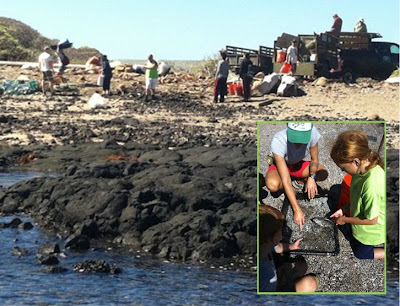
FESTIVAL GROUP CAMPING AT KAMILO drew the concern of a number of community members including a group that regularly volunteers with Hawai`i Wildlife Fund. According to Megan Lamson, who organizes regular community cleanup days, a small group of people visited Kamilo on Friday, Jan. 18 and found that there were about 100 people and more arriving for a Rainbow Festival scheduled for Jan. 16 through Jan. 28. 
      The invitation can be seen at www.welcomehomehawaii.com. Lamson said her group passed out some 50 letters to people who had already arrived, explaining to them the problems with such a large group camping there without permits and without necessary health facilities. Some volunteers also stationed themselves at Ka`alu`alu Bay turnoff from South Point Road to encourage people to change their minds about participating in the 12-day campout.
Regular volunteers, shown cleaning and counting marine debris at Kamilo
in early January, said they were concerned about a large group camping
for a Rainbow Festival in late January.  Photo from Hawai`i Wildlife Fund
           “While we weren’t outright successful in our mission to dissuade the group (they weren’t leaving in flocks), some of them were willing to listen to us and take our letters. We definitely started a discussion,” said Lamson. She said that one of the “elders” associated with the event who lives on Hawai`i Island, “unlike 75 percent of them who have flown in just for this event,” said they would not likely come back next year.
           The volunteer Ka`u group took down license plate numbers to report them to the state Department of Land & Natural Resources, which is responsible for permitting and permissions for camping and other uses of the public coastal resources. Lamson reported that large containers of water were being filled at the Wai`ohinu spigots for the group’s use. She also said it appeared that many of the people hitchhiked from the Kona or Hilo airports and hiked in from South Point Road. She said that the organizers of the event dug holes three to four feet deep for the luas and used bleach for sanitation.  
          She said that any such use of the coast that draws a large crowd requires a permit from the DLNR.
      The letter distributed to the campers says in part, “We know you do not intentionally mean to harm the environment and your goal to ‘be one with the earth’ is an admirable one. However, the truth of the matter is that you are damaging an area that is rich in natural and cultural resources - which puts you at odds with the earth, rather than at one with it.
      “It is impossible for you to gather here in such a number without causing serious problems for the ecosystem. Some examples from your past Rainbow Gatherings at Kamilo include: tramping of native plants (by parking/camping on them); killing of native plants (by cutting new trails into the coastal strand vegetation for campsites and lighting fires that threaten the entire shoreline ecosystem); having large groups of people leave their urine and fecal matter along the coastline; creating a human health hazard and increasing the spread of toxic diseases; feeding the non-native populations of feral cats, mongoose and rats (with food scraps & waste).”

Nainoa Keana`aina NPS photo by Jay Robinson
HAWAI`I VOLCANOES NATIONAL PARK law enforcement ranger Nainoa Keana`aina, who has served Hawai`i Volcanoes National Park since 2007, is the first-ever recipient of the Honor Graduate Award from the National Search and Rescue Academy. The intensive six-week program was conducted at Marine Corps Mountain Warfare Training Center near Bridgeport, CA in the Sierra Nevada Mountains. The training provides participants with essential field rescue skills in ground search operations, incident command systems, swiftwater rescue, technical rope rescue, helicopter rescue techniques, remote emergency medical responder training and more.
      Keana`aina served as class president and incident commander and was selected by his fellow classmates for the Honor Graduate Award.
      “Nainoa exemplified personal leadership skills and a commitment to learning during the intensive six-week academy,” said NARSA coordinator Ken Phillips. “He is the sort of professional responder that a search and rescue coordinator desires to have on an SAR team.”
      The physically demanding NSARA training was conducted by the National Park Service in conjunction with the Department of Defense. To broaden inter-agency cooperation, allied and federal agency personnel jointly attended the academy.

KILAUEA DRAMA & ENTERTAINMENT NETWORK’S A Walk into the Past is again being performed in Hawai`i Volcanoes National Park. The living history program features Ka`u resident Dick Hershberger, dressed in period costume, who brings back to life Dr. Thomas A. Jaggar, founder of Hawaiian Volcano Observatory and a prominent figure in the history of the study of volcanoes.
Ocean View resident Dick Hershberger portrays Thomas Jaggar in KDEN's
production of A Walk into the Past. Photo from KDEN
      Hershberger has performed with Aloha Performing Arts Company, Waimea Community Theater, The Palace and University of Hawai`i-Hilo and KDEN. “When first approached to undertake the Living History Presentation of Thomas A. Jaggar, I was initially intimidated by the enormity of the task,” Hershberger said. “Playing Jaggar in front of a live audience three times a day is daunting enough without the additional work of playing this real life character without a script.
      “The more that I explored Dr. Jaggar’s life, the closer I have become one with him,” said Hershberger. “He was originally from Pennsylvania; me, too. His father was a clergyman; mine, also. His family traveled extensively in Europe, and another similarity, he resided in Naples, Italy for a time. It’s about this point where the similarities in our lives began to creep me out a bit.”
      The program was conceived by local actor-director-playwright Peter Charlot, who portrayed Jaggar for the first seven years. Alongside Charlot, local storyteller Sandra MacLees played his assistant (and eventually Jaggar’s wife) Isabel Maydwell. That program came to a conclusion in May 2012, due in part to construction at Volcano House.
      Set in 1912, A Walk into the Past takes place in the Whitney Vault, a 16’ x 12’ underground laboratory that still has original seismograph equipment and is located under a mound in front of Volcano House. Free performances are held Feb. 5 and 19 and every other Tuesday at 10 a.m., 12 p.m. and 2 p.m. Meet at Kilauea Visitor Center. Park entrance fees apply.

KA`U COFFEE FESTIVAL COMMITTEE invites vendors to apply for food, arts, coffee and educational booths for the annual ho`olaule`a to be held Saturday, May 5 at Pahala Community Center. Food booths are first-come, first-served, as the festival will present only one booth of each type of food. Fees are $100 per food vendor; $50 for non-food vendors including arts, crafts and packaged Ka`u Coffee and coffee samples. The fee is $25 for pre-approved informational displays. 
      In all categories, there is a 50 percent discount for cooperatives, their members and bona fide nonprofit booths.
      Vendors are responsible for Department of Health permits if serving food items, vendor permits from the county and proof of general excise tax license and must supply a 10’X10’-foot tent and any needed tables, chairs, signage and other equipment.
      The Ka`u Coffee Festival is a green event, and vendors are required to use biodegradable products where possible. Application deadline is Friday, April 12. See more at www.kaucoffeefest.com.

KILAUEA’S VOLCANIC GASES and Their Environmental Impact is the topic at Pahala Community Center Wednesday at 6:30 p.m. when USGS Hawaiian Volcano Observatory geochemists Jeff Sutton and Tamar Elias explain how vog forms and what has been learned about its effects on our island environment. This is HVO’s second program in Pahala, and they hope to have more in the area depending on interest from the local communities.

SUPPORT OUR SPONSORS AT PAHALAPLANTATIONCOTTAGES.COM AND KAUCOFFEEMILL.COM. KA`U COFFEE MILL IS OPEN SEVEN DAYS A WEEK.

Thursday, January 31, 2013

Ka`u News Briefs Jan. 31, 2013

 Volunteers removed more that 7,300 plastic fragments from Kamilo Beach during Hawai`i Wildlife Fund's first Ka`u Coast cleanup for 2013 on Jan. 12.  Photo from Hawai`i Wildlife Fund
`AINA KOA PONO is planning to bring a 33-ton-a-day microwave depolymerization unit to its planned refinery site off Wood Valley Road for testing within the “next several months,” according to a press release issued by AKP this morning. “As you may recall,” says the press release, “AKP’s plan is to convert biomass into a crude oil using modular units of a microwave process, compressing to about an hour what in nature takes thousands, even millions of years. Our goal is a drop-in biofuel that will replace fossil fuels and provide a co-product of biochar which can be used as a soil amendment.
`Aina Koa Pono plans to bring a 33-ton per day Micro
Dee unit to Ka`u within the next several months. Shown
here is a 5-ton unit in North Carolina.
      “Our plan is to start with one 33-ton-a-day unit so the community can see and understand the Micro Dee (Microwave Thermo Catalytic Depolymerization) process in place. AKP and its engineering, construction and procurement partner, AECOM Technology, are focused on final plans for this trailerable unit; we’re performing final validation on technology so investors are confident as we move ahead. We expect to locate the 33-ton unit in Hawai`i within the next several months and be operational before second quarter, 2014.
      “We will use the unit to run further engineering tests, perfect energy balances and test local feedstock to see which is most appropriate. The 33-ton unit will serve as the basis for expansion to our larger biofuel operation. “Once the unit is operational, we will be better able to determine if an Environmental Assessment or an Environmental Impact Statement is required,” the press release states.

NA MAMO O KAWA is the tentative name of a community group that hopes to work with all parties involved with the future of Kawa. Local fireman Lui Sales and University of Hawai`i land use student Pueo McGuire, grandson of Pele Hanoa, both grew up in Ka`u and surf Kawa. They spoke yesterday during a county-sponsored meeting on the future of Kawa.
       The more than 700 acres along the coast between Punalu`u and Honu`apo is now in county hands. The two young men talked about bringing about peace between families and all those who claim rights to the place. They talked about Kawa staying low-key and respecting its traditional use by people who live in Ka`u.
      Karen Teshima, an executive assistant to Mayor Billy Kenoi who led the meeting, described Kawa as a “special place” and said her own family heritage has ties there.
      Teshima said that the county, as the steward of Kawa since its purchase from private property owners, decided to conduct an archaeological survey and “let Kawa settle.” She said she was there to listen to all the people.
The future of Kawa drew a large crowd with many points of view to Na`alehu Community Center last night. Photo by Julia Neal
      Wilma Holi flew in from Hanapepe, Kaua`i and said a similar situation is taking place at Hanapepe surrounding the native Hawaiian salt pan area along the coast. She said that while Hawaiian families want to continue the traditional use of the area, newer community members want a bicycle trail and a place to walk their dogs.
      She also called for peace among Hawaiians who are making claims to the area. “Don’t quibble,” she advised. Those families who don’t want to participate in the future of Kawa should step back. Those who want to be involved should work together, she recommended.
      People speaking at the meeting presented many points of view. A large group came to support Abel Simeona Lui, who lived at Kawa for more than 20 years when it was owned by several private property owners. They talked about “Uncle Abel” providing lua (portable restrooms) at the beach and welcoming the surfers there over the years. Some said that Lui should be returned to live there.
    One woman said that her family had Native Hawaiian ties and burials at Kawa and had been friendly with him in the past but that “Uncle Abel” more recently became hostile and intimidating to the family.
      Lui denied being hostile and talked about his children being “born on the land,” at Kawa. “My children’s piko is over there on the land.” He talked about growing sweet potatoes for the surf meets and said there are about 100 ipo (gourds used for hula instruments) drying there. Lui claimed that he is in the Supreme Court still fighting over ownership of Kawa.
Wilma Holi flew in from Kaua`i and said to the
community, "Don't bicker." Photo by Julia Neal
      Several of his supporters talked about his eviction, calling it illegal, saying there should have been more notice and that evicting a native person off the land is illegal under federal law.
       “Who like me off the land? Who like me off the land?” asked Lui. He read from letters of support urging the return of “Uncle Moses and Uncle Abel to the land at Kawa to take care of it.” His supporters clapped their hands and blew conch shells.
      A number of people talked about the current county practice of Kawa being gated and closed from 6 p.m. to 6 a.m. and hiring police to protect it, saying there was never any need to pay anyone to protect Kawa in the past.
      Kauanoa Hoomanawanui, state burial site specialist for the Big Island, said she is also a descendant of Ka`u. She said during a site inspection for reconnaissance, a two-day sweep, archaeologists came across many burials, which make Kawa “almost useless to development.” She called it a “burial preserve.”
      She said she wants to open a discussion with the community. “If you know of anyone buried there, fill out a descendency claim. She urged the community to become part of the planning for Kawa.
      Several speakers noted that in 1980 the courts decided that there will be permanent public access to Kawa, but the county recently blocked access. Surfers, fishermen and other community groups filed suit to recover traditional access more than 30 years ago and won.
    Pueo McGuire, who worked for Sen. Dan Akaka in Washington, D.C. and currently works for Office of Hawaiian Affairs in land planning while finishing his college work, said he has been going to Kawa his whole life to “surf, fish and practice my religion. I learned what it means to be from Ka`u there. I learned what it means to be Hawaiian there. The only time I have been prohibited from going to Kawa is this winter when county put up their (gates).”
      He called for cooperation. “We are all looking for common ground. It is about Kawa, not about us…. The plan should be about those who really use it…. Twenty-four hour beach access is essential to Hawaiian culture. It does not start at 6 a.m. and stop at 6 p.m.,” said McGuire. He called for inclusive, cooperative planning.
      John Kahiapo, from the state Department of Land & Natural Resources, said his agency is particularly interested in water – the anchialine pools and estuary. He said there is a plan to survey native fish, estuaries and habitats. “We don’t have any baseline study. We don’t know what is in the estuary or anchialine pools.” He said this kind of survey sometimes “comes up with organisms you can’t find anywhere else.”
      Several speakers brought up the redevelopment of old plantation water sources mauka of the coast. “How about streams that have been shut down?” one speaker asked, claiming that by putting all the water in pipes, there are streams that are no longer being fed.
      Lui Sales cautioned the county about planning too much infrastructure at Kawa. “Building big roads will invite plenty guys. We don’t want publicity,” he said. “For many of us, it it is kind of bummers.” He said the local people want continued access to surf, camp and fish. “Keep Ka`u country, and keep Kawa low-key and solid,” he said. He sized up the needed infrastructure as rubbish bins and luas. The mayor’s representative said there will be more community input as the surveys are completed.

Joni Mae Makuakane-Jarrell NPS photo by Jay Robinson
RANGER JONI MAE MAKUAKANE-JARRELL is the new chief of Interpretation at Hawai`i Volcanoes National Park and oversees visitor services and educational and cultural programs at the park. She is the first native Hawaiian to serve in the position. 
      Makuakane-Jarrell has worked at all five national park units on Hawai`i Island during her 32-year park service career. She began as an interpretive ranger at Hawai`i Volcanoes through the Young Adult Conservation Corps and worked her way through the ranks, becoming the park’s supervisory ranger. Makuakane-Jarrell then worked as the interpretative specialist at Kaloko-Honokohau National Historical Park with her late husband, park ranger Steve Makuakane-Jarrell and served as a law enforcement specialist at Pu`ukohola Heiau National Historic Site.
      “One of my visions for the park is sharing all the traditional Hawaiian names of places here,” Makuakane-Jarrell said. “Hawaiians are very keen observers, and when they name things, it usually tells the story or history of the area. By using these given names, it helps protect, honor and perpetuate the Hawaiian culture.”
      Before becoming chief of Interpretation, Makuakane-Jarrell served for eight years as educational specialist for Hawai`i Volcanoes National Park. She coordinates the annual Cultural Festival, now in its 33rd year, and piloted the first Summer Junior Ranger Program. She also started the Na Leo Manu concerts and `Ike Hana No`eau cultural workshops at the park.
      “Joni Mae brings an ideal combination of perspective into the important position of chief of Interpretation,” said park superintendent Cindy Orlando. “Her strong background of Hawaiian values and culture, combined with her leadership skills and dedication to the park’s mission, and significance as a World Heritage Site, will serve the park and its visitors very well.”

More than 1.5 tons of debris were removed from Kamilo Point Jan. 12.
Photo from Hawai`i Wildlife Fund
FIFTY-ONE VOLUNTEERS JOINED Hawai`i Wildlife Fund on Saturday, Jan. 12 to help remove more than 1.5 tons of marine debris from Kamilo Point along the Ka`u Coast. Twelve volunteers from the Japanese Environmental Action Network, the Japan Ministry of the Environment, the University of Kagoshima and other Japanese NGOs concerned about March 11, 2011 tsunami debris helped out. A representative from the Ocean Conservancy in Washington, D.C. and a designer from London volunteered. 
      On Saturday, Feb 23 - Ocean Day - Malama Kanaloa will be held at Hilo Bayfront. Saturday, March 16 brings a cleanup event to the Ka`u Coast. Saturday. May 25 is Hawai`i Wildlife Fund’s Annual Manuka NARs Cleanup Event. Space is limited, so RSVP soon.
      Ongoing anchialine pool restoration and invasive plant species removal workdays are held every month. Contact Megan Lamson at kahakai.cleanups@gmail.com or call 769-7629.

EVERY FEBRUARY, Ka Lae Quilters and Red Hat Ladies of Ka`u raise funds to support improvements to the Ka`u Hospital’s emergency room. Tomorrow, they hold a bake and craft Sale at the hospital at 10 a.m. Another sale is set for next Friday and Saturday at 8 a.m. at Punalu`u. Contributions are welcome. Call Barbara Beatty at 929-9072.

Author Tom Peek holds a writing workshop Saturday.
Image from Volcano Art Center
TOM PEEK, AUTHOR OF Daughters of Fire, offers a workshop open to all levels and genres Saturday from 9 a.m. to 5 p.m. at Volcano Art Center’s Ni`aulani Campus in Volcano Village. No writing experience is necessary. Fee is $85 or $76.50 for VAC members. Call 967-8222 to sign up. 

BOYS & GIRLS CLUB supporters can cheer on Youth of the Year winners and raise money for the club through the purchase of tickets to the Youth of the Year banquet a week from tomorrow on Friday, Feb. 8 at 5:30 p.m. at `Imiloa Astronomy Center in Hilo. The event features inspirational speakers, awards, food and auction items. Individual tickets are $70 each. To purchase tickets in Ka`u, call Boys & Girls Club board member Julia Neal at 928-9811.

SUPPORT OUR SPONSORS AT PAHALAPLANTATIONCOTTAGES.COM AND KAUCOFFEEMILL.COM. KA`U COFFEE MILL IS OPEN SEVEN DAYS A WEEK.