About The Kaʻū Calendar

Friday, August 01, 2014

Ka`u News Briefs Friday, Aug. 1, 2014

Kawika Yahiro, CEO of Uhane Pohaku No Moku O Hawai`i, gave a presentation about working with Ka`u youth during last night's
meeting at the Old Pahala Clubhouse. Photo by Julia Neal
YOUTH EDUCATION ORGANIZATION representatives met with Ka`u residents last night at the Old Pahala Clubhouse, introducing programs it hopes to establish locally. Uhane Pohaku Na Moku O Hawai`i, Inc. chief executive officer Kawika Yahiro said that founders Kawehi and Debbie Ryder accomplished such work elsewhere in Hawai`i by taking at-risk youth from 13 to 21 years of age into the outdoors to work in taro patches, fishponds and other cultural and natural environments. He gave a presentation of their work on Lana`i, showing restoration of lo`i and feedback from students.
      Yahiro said the organization helps youth avoid risky behavior. He called it a community- and family-centered approach for project- and place-based learning. Uhane Pohaku offers cultural and spiritual appreciation along with experiential and self-discovery activities.
      Restoration, conservation and preservation efforts bring students into their culture, where they can feel safe and build self-confidence, he explained. The students learn respect and caring for kupuna. They also learn how to keep waterways and the ocean clean.
A Pahala youth named Kyle works with Kawika Yahiro at the presentation
last night. Photo by Julia Neal
      He and the Ryders talked about high-risk kids and more secure young people working together and bonding positively with the right adults leading the way.
      One student wrote, “It took me away from the city life and got me very into my culture … people so friendly … so generous.” Two gang members and leaders immersed in outdoor education never went back to their gangs and are now working, Yahiro said. 
      Program organizers said the land “gives the opportunity to heal” and referred to the common practice within indigenous cultures: “One great task of all teenagers coming of age is to tell a story … their meaning in life, why they make a difference.”
      The word "sustainability" was used a lot, and Yahiro talked about a young person who learned to farm and whom he asked, with his business hat on, “Where are you going to sell your product?” The young farmer said he was going to use his skills to feed his immediate family and his larger family, Yahiro said, leading Yahiro to think about sustainability in a different way.
      He talked about the importance of rites of passage for all ages. “Celebrate birth; celebrate adulthood; celebrated marriage; celebrate death,” he said.
      The organizers of the educational program said they hope to someday align with the schools here.
      From the state Office of Youth Services, Edralyn Caberto said, to the surprise of many in attendance, that Ka`u has more youth in the criminal justice system per capita than in any other place in Hawai`i. She said that land- and ocean-based programs are healing. She said that working with kalo (taro) can be magic. “We want to create a place where people can be healthy,” she said and referred to Ryders’ programs that she witnessed on Lana`i.
     Kawehi Ryder said he is starting to prepare for planting dry land taro in Wood Valley and for possible fishpond and lo`i restoration projects along the Ka`u Coast, approaching government agencies, private nonprofit organizations, Native Hawaiian groups and private landowners. 
     The organizers also talked about the term kino`ole, which most attending recognized as a street in Hilo. Yahiro said it means patience, which will be needed to immerse the program into the Ka`u community with good timing and meeting many members of the community, he noted.
    The Ryders recently moved from Lana`i to Pahala, and Debbie Ryder is a kumu hula here. Contact them at 808-315-7033.

Spiral pattern indicates vog being wrapped into Hurricane Flossie.
Image from UH-Manoa 
VOG CAN CONTRIBUTE TO FORMATION of thunderstorms and lightning, according to a study by atmospheric scientists at University of Hawai‘i at Manoa. UH-Manoa graduate assistant Andre Pattantyus and Atmospheric Science Professor Dr. Steven Businger found that microscopic gasses and particles from Kilauea exerted an influence on Tropical Storm Flossie in July of last year.
      Pattantyus and Businger researched data from satellites that monitored lightning, rainfall, cloud cover, temperature and winds during Flossie. In addition, they maintained their vog model that provides guidance on the location of the vog plume and concentrations of sulfur dioxide and sulfate aerosol for Hawaiian Island communities.
      They found that prior to Flossie’s passage over Hawai`i Island, there was no lightning in the storm. One hour later, vigorous lightning occurred as Flossie approached the island. “As volcanic emissions were wrapped into this moist environment, sulfate aerosols promoted the formation of a greater number of smaller than normal cloud droplets, which favored charge separation in the upper cloud region and the occurrence of lightning,” Businger said.
      “This is the first interaction between an active, vigorously degassing volcano and a tropical cyclone captured by a vog model run over the Hawaiian Islands – providing a unique opportunity to analyze the influence of robust volcanic emissions entrained into a tropical storm system,” Businger said.
      He also said the observations of Flossie’s changing dynamics as it encountered Kilauea’s vog has implications for the impact of polluted air on hurricanes as they approach the mainland coast. 
      “The Hawaiian Islands provide a unique environment to study this interaction in relative isolation from other influences,” according to Businger. He plans to model the interaction of the vog plume and Hurricane Flossie with a more complex model that integrates chemistry into the predictions to better understand the processes at work in this unique confluence.

Kamehameha Hawai`i campus covers 300 acres in Kea`au.
Photo from Kamehameha Schools
KAMEHAMEHA SCHOOLS HAWAI`I K-12 PROGRAM applications for the 2015-16 school year are now available online at ksbe.edu/admissions. The deadline to apply is Sept. 30, 2014. 
      The primary admission points are kindergarten and grades six and nine.
      For kindergarteners, eligible applicants are born between Aug. 1, 2009 and July 31, 2010. As part of the transition from the previous age requirement, this year KS will also accept kindergarten applications from boys born in July 2009.
      Applications for grades 10, 11 and 12 for are accepted, but spaces are limited and based on availability.
      For more information, call 982-0100.

THE U.S. CONGRESS HAS APPROVED BIPARTISAN LEGISLATION taking a strong step toward overhauling the Veterans Administration. The bill incorporates the framework proposed by Ka`u’s U.S. Rep. Tulsi Gabbard, requiring the VA to allow eligible veterans to visit doctors in their communities to receive care so they don’t have to wait months to see a doctor. It authorizes funding to hire more doctors and care providers and also gives the new VA secretary tools and flexibility to hold employees accountable and hire those who can lead the VA through the reforms.
Rep. Tulsi Gabbard is a veteran of two tours of duty in the Middle East.
Photo from Office of Rep. Tulsi Gabbard
      Gabbard said, “I won’t stop fighting until we uphold the commitment our nation made to our veterans, honoring their service and sacrifice.”  
      Sen. Brian Schatz said, “If there’s one area where Democrats and Republicans should be able to come together to find common ground, it’s making sure veterans have the health care they need.”
      Sen. Mazie Hirono said, “We’ve reached a deal that will help Hawai`i veterans access the care they need, reform the way we hold VA officials accountable and work to recruit more doctors and health care professionals to care for our veterans – but our work doesn’t stop here. … There are many issues within the VA that need to be addressed. I’m proud that we were able to work together with our colleagues in the House and look forward to continuing to improve VA care and services – our veterans deserve nothing less.”

ZENTANGLE: THE BASICS are taught tomorrow from 10 a.m. to 1 p.m. at Volcano Art Center’s Niaulani Campus in Volcano Village. This pre-requisite for subsequent Zentangle classes provides a foundation in the philosophy, ceremony and benefits of tangling. $40 VAC members/$45 nonmembers. 
      Call 967-8222 to register.

`Ohi`a Lehua is the topic at a program Sunday. NPS Photo by Dave Boyle
KAHUKU UNIT OF HAWAI`I VOLCANOES NATIONAL PARK offers its free `Ohi`a Lehua program Sunday at 9:30 a.m. Participants bring lunch and learn about the vital role of `ohi`a lehua in native Hawaiian forests, the many forms of the `ohi`a lehua tree and its flower. 
      For more information, call 985-6011.

OCEAN VIEW COMMUNITY CENTER PRESENTS a candidate forum Monday at 6 p.m. County Council candidates Richard Abbett, Maile Medeiros David and Jim Wilson participate. This is their final forum before the Aug. 9 primary election.
      Call 939-7033 for more information.

SUPPORT OUR SPONSORS AT PAHALAPLANTATIONCOTTAGES.COM AND KAUCOFFEEMILL.COM. KA`U COFFEE MILL IS OPEN SEVEN DAYS A WEEK.

See kaucalendar.com/Directory2014.swf.


Thursday, July 31, 2014

Ka`u News Briefs, Thursday, July 31, 2014

Berta Miranda clutches her Bible, fearing her coffee farm was obliterated during the 2012 fires around Pahala. Fortunately
 she was spared. Photo by William Neal
FUNDING IS AVAILABLE FOR FIRE PREVENTION projects in Ka`u, according to Elizabeth Pickett, Executive Director of Hawai`i Wildlife Management Organization. At a presentation about wildland fires given at Ka`u High & Pahala Elementary School this week, Pickett said residents and groups can come up with ideas and apply for funding with a match in volunteer time. One idea she mentioned was chipping of waste to reduce vegetation. An idea brought up at the meeting was using fire resistant plants to beautify and protect the east entrance to Pahala, where a fire in 2012 jumped mauka over Hwy 11 and marched up Kamani Street to threaten Ka`u Hospital.
Firefighters spray retardant to
protect entrance to Pahala town.
Photo by Julia Neal
      Percentage-wise compared to every other state, at least as much, and perhaps more, land burns in Hawai`i every year. Between 2002 and 2011, Hawai`i experienced 900 wildland fire ignitions per year, and 17,000 acres burned per year. Also, the number of large fires is increasing along with their intensity. While in such places as California, the natural maturation and renewal of the wildlands can be through range fires, Hawai`i's native plants are not built to reproduce after fires.
      One quarter of state land in Hawai`i is now covered in nonnative grasses that are prone to fire, Pickett said. These grasses grow during rainy seasons, then dry out during dry periods and create fuel for wildfires. They also crowd out seedlings of native plants that are less fire-prone. Fire prone grasses can even become a problem in areas fenced off from ungulates to protect native species.
      Pickett and her colleague Pablo Beimler focused on the organization’s Ready, Set, Go Wildland Fire Action Guide, with information about saving lives and property through advanced planning.
The 2012 fires around Pahala threatened the hospital and homes, burning
macadamia orchards, some coffee lands and pasture. Photo by Julia Neal


     Preparing property for fire threat includes landscaping and limiting access points where fire can enter homes. Creating defensible space around homes involves removing dead and dying vegetation within 100 feet of homes and managing vegetation where fire could jump from grass to shrubs to trees.
      Windows are the most vulnerable entry points, Beimler said, because they break from heat of fires. He suggested remove shrubbery from under windows or cutting it low and maintaining it well. Screening lattice below houses will help prevent the embers from blowing through the pukas.
      Securing any point that is vulnerable to embers is also important, he said. Gutter guards and vents covers with openings one-quarter inch or less prevent embers from entering. Enclosing eaves also prevents embers from landing in rafters, where they can easily ignite lumber.
      During a wildland fire, being aware of the situation and changing conditions is crucial. The HWMO personnel emphasized that smoke, wind and fire conditions can change rapidly and residents need to have and evacuation plan. “Find out where you should go, and leave early,” they said.
      HWMO is planning a Ka`u Fire Preparedness meeting in November when experts will update a list of community concerns, priorities and project ideas.
      Established in 2002, HVMO is the only nonprofit organization in Hawai`i that focuses specifically on wildfire prevention, preparedness and mitigation projects. It was started by fire chiefs, fire captains, land owners, land managers and conservationists. See more about it and the Ready, Set, Go program at hawaiiwildfire.org.  To comment on or like this story, go tofacebook.com/kaucalendar.


Range fire swept to the shore from macadamia orchards below Pahala in 2012. Photo by Geneveve Fyvie
WALK IN VOTING CONTINUES IN KA`U TODAY at Pahala Community Center from 9 a.m until noon and 1 p.m. until 3 p.m. on weekdays through Thursday, Aug. 7. On Saturday, Aug. 9, the Primary Election will take place at local polling places: Miloli‘i Halau, Ocean View Community Center, Nā‘ālehu Elementary School Cafeteria, Ka‘ū High & Pāhala Elementary School Cafeteria and Cooper Center in Volcano. Polls are open on election days from 7 a.m. to 6 p.m. 
Maile David campaigned yesterday in Pahala with her supporters.
Photo by Julia Neal
     Registered Ka‘ū voters cast ballots for the following offices in the primary election: U.S. Senate, U.S. House of Representatives District Two, Governor, Lieutenant Governor, state Senate District Three, state House of Representatives Districts Three and Five, Office of Hawaiian Affairs At-Large Trustees and Hawai‘i County Council District Six. Sample ballots are available at hawaii.gov/elections.
     On the ballot for Hawai‘i County Council District Six are Richard Abbett, of Ocean View; Maile Medeiros David, of Captain Cook; and Jim Wilson, of Volcano. 
     On the ballot for state Senate District Three are incumbent Josh Green, of Kailua-Kona, and Michael Last, of Nā‘ālehu.
      State House of Representatives District Three candidates are Bill Dickson, of Mountain View; Fred Fogel, of Volcano; and incumbent Richard Onishi, of Hilo.
Richard Abbett runs in the primary for council and Dave Bateman, along with
 Jon Lalanne and Randy Ruis, takes on the winner of the House Democratic
primary contest between Bucky Leslie and Richard Creagan.  Photo by Julia Neal
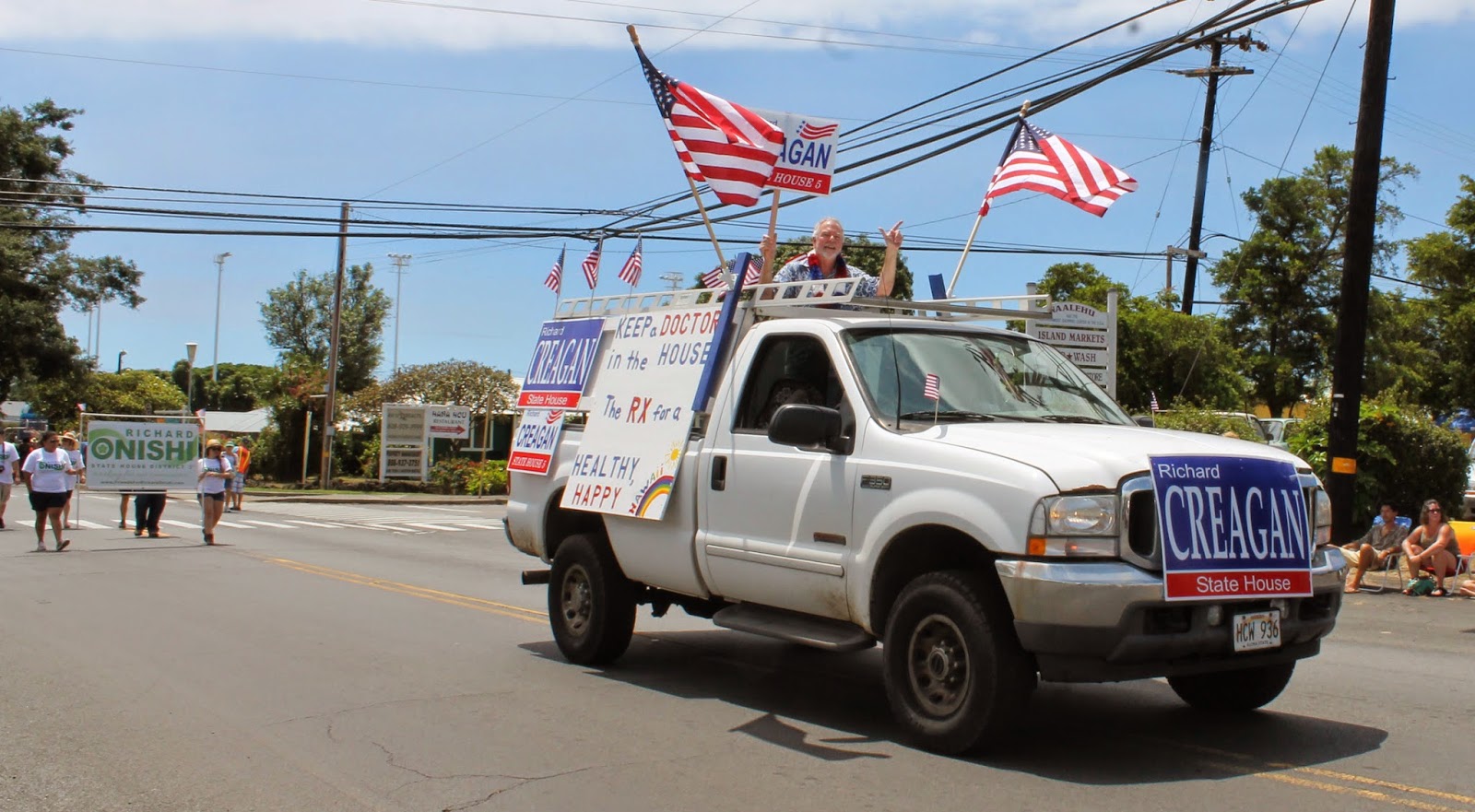
   Incumbent state Rep. Richard Creagan, of Nā‘ālehu, faces a challenge in the primary by fellow Democrat Gene “Bucky” Leslie, of Holualoa, in state House District Five. The winner goes on to the general election to face Republican Dave Bateman, of Holualoa, Libertarian Jon Lalanne and nonpartisan Randy Ruis, both of Ocean View.
   Creagan said that during the League of Women Voters forum, he talked about his goals for the next legislative session, should he be elected. They include working on health care, integrating affordable health care with prepaid health care and getting a new hospital for Kona. He said one issue is the possible privatization of the Ka‘ū, Hilo and Kona Hospitals. Creagan said he and others support privatization but only if the company is Hawai‘i-based and unionized. He said that the private, mainland company that proposed taking over the system of Hawai‘i Health Systems Corp. clinics and hospitals statewide is non-union and its “anti-union rhetoric can be found on its website.”
       Creagan said another concern is that an outside hospital corporation could close Ka‘ū Hospital. “The safety net hospitals such as Ka‘ū and Kohala have to be preserved. One of the fears of bringing in the outside organizations is that they might want to shut them down.”
       Creagan said that a more agreeable merger would be with a hospital like Queens Medical System, based on O‘ahu. Queens is already unionized and would not have a problem preserving the union jobs at Ka‘ū, Hilo and Kona, he said.
        During the forum, Creagan, a physician, brought up the medical marijuana issue, saying he supports the expansion of indications for medical marijuana. He said later that he sees it as important especially in the case of veterans with post traumatic stress disorder. “Marijuana can be very helpful. It is approved for PTSD in five or six other states,” he told The Ka‘ū Calendar newspaper. Creagan is on the House task force to study setting up dispensaries for medical marijuana.
Incumbent Richard Creagan is on the ballot for the state House for West Ka`u,
incumbent Richard Onishi for East Ka`u. Photo by Julia Neal
       A topic with consensus of apparently all the candidates is labeling of GMO foods. Creagan said that among the candidates, there are some differences, such as whether the federal government should take the lead on the issue – with federal proposals initiated by Ka‘ū’s U.S. Rep. Tulsi Gabbard. Creagan said that in addition to federal measures, Hawai‘i should lead and establish a state requirement. “Hawai‘i should lead, not follow, but in the future the federal government should do it, too.”
         Creagan said after the forum that one important issue not discussed was public funding for elections. He said that he supports public funding, but it is hard to pass at the Legislature because it does not favor incumbents. He said he will continue to push for it. “Our experience on the Big Island showed the power of public funding, brought more candidates out, allowed them to really compete with the big money interests. That is why Brittany Smart was able to win against candidates supported by big money. Brittany (Smart), Maile (Medeiros David) and Brenda (Ford) were able to get over $30,000 in funding.” Their campaigns for County Council brought out local issues and built awareness in the public, with Maile Medeiros David well recognized as she competes for County Council this year following two races with public funding. There is no public funding for any political positions in Hawai‘i this year, he noted.
            Leslie said he wants to have a fresh approach to campaigning. He emphasized how his ‘ohana approach influences his way of getting things done.
            Leslie said he wants to listen to constituents’ thoughts, concerns and ideas, “finding productive ways of working together as we strive and sometimes struggle to accommodate the change in our history.”
             Leslie mentioned his experience as president of the Hawai‘i Council of Hawaiian Civic Clubs and said he and the club have written and sent bills and resolutions to the Legislature that have passed.  He said his top priority in the Legislature would be “working with other people” and referred to the Legislature as an “elected ‘ohana.” He said, “Working together, we’ll get much more done than we can (individually). Together we can; together as one.” 
Bucky Leslie, a Democrat, is running in the primary against Richard
Creagan for the west Ka`u House seat. Photo by Nalani Parlin
             Regarding education, Leslie said educational opportunities for everyone – keiki and kūpuna – are important. He said, “The system is not working with us” and suggested reinstating programs “issued many years ago. Revise them and bring them back to the table.” He also said, “We need people who leave for education to come back.”
             On the topic of health, Leslie said he thinks Kona Hospital is adequate but that more doctors and nurses are needed.
              Leslie said he wants to “bring balance to the Legislature.” He characterized balance of working with legislators as “knowing how we can get things done.” He said the Legislature has “cut this balance off, that balance off” regarding bills that get modified to the point that they are no longer recognizable.
             When asked how he would make Hawai‘i a more attractive state to do business in, Leslie answered, “How do they balance?” He again stressed his ‘ohana approach to how to work on the issue.
             Regarding labeling of GMOs, Leslie said, “We should stand up and say ‘let’s go for it – let’s label this.’” Pointing to the audience, he said, “It’s all about you; it’s not about us.”
             When asked about legalized gambling in Hawai‘i, Leslie said he had previously written a resolution for the Association of Hawaiian Civic Clubs supporting gambling, but that he now doesn’t support it and wants more education about it.
             In closing, Leslie stressed his desire to “continue to work with our people here and bring home a plate of wonderful things.” To comment on or like this story, go tofacebook.com/kaucalendar.

SUNSET HULA TOMORROW AT 6 P.M. graces the kahua hula (platform) near Volcano Art Center Gallery in Hawai`i Volcanoes National Park. This month’s event features Manu Josiah and Leilehua Yuen, who are known for their blending of storytelling, science, chant and hula to create a journey through Hawaiian history and culture. Some of their students join them for an evening of traditional chant and hula. Free; park entrance fees apply.

ZENTANGLE: THE BASICS are taught Saturday from 10 a.m. to 1 p.m. at Volcano Art Center’s Niaulani Campus in Volcano Village. This pre-requisite for subsequent Zentangle classes provides a foundation in the philosophy, ceremony and benefits of tangling. $40 VAC members/$45 nonmembers. Call 967-8222 to register.

SUPPORT OUR SPONSORS AT PAHALAPLANTATIONCOTTAGES.COM AND KAUCOFFEEMILL.COM. KA`U COFFEE MILL IS OPEN SEVEN DAYS A WEEK.


See kaucalendar.com/Directory2014.swf.


Wednesday, July 30, 2014

Ka`u News Briefs Wednesday, July 30, 2014

A tour at Kilauea Military Camp yesterday highlighted its history as an internment camp where Hawai`i Island Japanese Americans were detained during the first five months after the attack on Pearl Harbor. Photos by Ron Johnson 
SIGNAGE AT SITES USED FOR INTERNMENT of Japanese Americans at Kilauea Military Camp during World War II is being developed, according to Laura Schuster, Chief of Cultural Resources Division for Hawai`i Volcanoes National Park. The signs will commemorate KMC’s history as a temporary internment camp of Japanese Issei, first generation immigrants, and Nissei, second generation. Schuster announced the effort during a tour of the facilities yesterday.
Jadelyn Moniz-Nakamura, with red backpack, shows historic photos outside
KMC's Recreation Hall which served as barracks for detainees during WWII.
      HVNP archaeologist Jadelyn Moniz-Nakamura and archive technician Geoffrey Mowrer led tours of KMC’s facilities where more than 100 Hawai`i Island residents were detained during the first five months following the attack on Pearl Harbor. The first detainees arrived at KMC on the afternoon of the attack on Pearl Harbor, Dec. 7, 1941. Beginning on Feb. 20, 1942, they began to be transferred to other internment camps on O`ahu and the mainland. More continued to arrive, and the last left KMC on May 7, 1942.
      The current Recreation Center housed the internees in a room 100 feet long by 50 feet wide. Internees came from a Custodial Detention List, created by the FBI prior to the outbreak of war with Japan, of citizens, enemy aliens and foreign nationals who were considered dangerous. The list focused on businessmen, consular agents, Japanese language school teachers and principals, Buddhist and Shinto priests and those who had Japanese military service or who were deemed to have extreme nationalistic sentiments and were therefore considered a danger to American security. According to written accounts of detainee Yoshio Hoshida that Moniz-Nakamura shared, the common thing among he and seven other men picked up at the same time was their participation in an organization that promoted judo and other Japanese self-defense arts. 
      While at KMC, detainees were confined to their barracks and were marched to the adjacent mess hall, now Crater Rim Café, for meals. Guards on foot surrounded them. Also, a bell tower that stood in front of the mess hall was converted to a guard tower, on top of which a machine-gun position was erected. The men were allowed outside one hour per day, when the would play basketball and throw balls to each other, and the older men would sit on benches in the sun. Their averages ages were from 50 to 60 years old.
Filmmaker Ryan Kawamoto, HVNP Cultural Resources chief Laura
Schuster and Carole Hayashino, of Japanese Cultural Center of
Hawai`i, joined the Kilauea Military Camp tour yesterday.
      During their detention at KMC, some of the Japanese Americans got to visit family members once. On Feb. 15 and 16 of 1942, families traveled to KMC for three-hour visits. The first day, families were allowed into the barracks. On the second day, however, because of an infraction that happened the day before, families had to view their loved ones through wire mesh across the porch.
      Filmmaker Ryan Kawamoto and Carole Hayashino, president and director of the Japanese Cultural Center of Hawai`i, presented screenings of The Untold Story: Internment of Japanese Americans in Hawai`i before and after the tours. Hayashino said the center is working to find ways to memorialize WWII internment sites throughout Hawai`i. When the film was made, 13 sites were known. There are now 17 known sites, with three on Hawai`i Island.
      To comment on or like this story, go to facebook.com/kaucalendar.

HAWAIIAN ELECTRIC COMPANIES ARE PROPOSING programs to provide customers more options for saving on their electric bills while supporting adoption of more clean energy, reducing the use of more expensive fossil-fueled generation and relieving stress on the electric grid. The programs are outlined in the utilities’ Integrated Demand Response Portfolio Plan filed with the Public Utilities Commission yesterday.
      The plan lays out new and enhanced “demand response” programs for residential, commercial, industrial and water pumping customers. Under the programs, customers receive financial incentives for shifting energy use to certain times of the day or voluntarily allowing the output of certain appliances or equipment to be adjusted if necessary to help maintain reliable service for island grids.
      Traditionally, when demand for electricity fluctuates throughout the day, utilities have focused on meeting that demand by adjusting the supply of power. This becomes more challenging as variable renewable energy resources, such as wind and solar, continue to increase. The possibility of power outages increases when these resources suddenly stop producing power. Demand response programs allow utilities to adjust demand to help maintain the balance between customer use (demand) and generation (supply).
      Also, according to HECO, demand response programs can be a more cost-effective option than using energy storage or oil-fired generation to balance demand and supply.
      In addition, by offering lower or higher prices during certain times of the day, some demand response programs encourage customers to shift energy use to specific times, such as when solar and wind systems are producing the most power. This can maximize use of wind and solar power that might otherwise be wasted.
      “Demand response programs are a win-win for our customers and the environment,” said Shelee Kimura, Hawaiian Electric vice president for corporate planning and business development. “With demand response, customers get financial rewards that lower their monthly bills. We reduce the use of more expensive generators to meet electricity needs. And together we can unlock the potential for more low-cost renewable energy.”
      To help enroll customers, Hawaiian Electric Companies plan to work with independent companies that also have experience implementing demand response. This includes coordinating with Hawai`i Energy, the PUC-appointed public benefits fund administrator that manages energy efficiency programs, including rebates for solar water heating and energy efficient appliances.
      Subject to review and approval by the PUC, existing programs will be revised and new ones developed and rolled out in 2015.
      The new demand response portfolio complements the use of large-scale energy storage as another way to support clean energy while maintaining reliable service. HECO recently issued a request for proposals for large-scale energy storage and is currently reviewing bids.
      To comment on or like this story, go to facebook.com/kaucalendar.

Map from DLNR/DFW
HAWAI`I DEPARTMENT OF LAND AND NATURAL RESOURCES is seeking new projects for the Hawai`i Forest Legacy Program to protect important working forest lands from the threat of conversion to non-forest uses. The U.S. Forest Service-funded Forest Legacy Program, administered through DLNR’s Division of Forestry and Wildlife, welcomes applications for conservation acquisition assistance.
      Hawai`i Forest Legacy Program works with private landowners, conservation nonprofit groups, the counties and other state agencies to promote sustainable, healthy forests.
      DFW is also currently working on projects that will protect an additional 5,000 acres of important forested watershed lands through the establishment of conservation easements.
      A conservation easement allow a landowner to retain ownership of the restricted title to their property while providing permanent protection from development or unsustainable uses, providing landowners with an alternative to selling their land to development companies. While entering into a conservation easement is voluntary, restrictions are binding to all future owners in perpetuity.
      Hawai`i Forest Legacy Program has identified forest lands throughout the state as important and in need of permanent protection, complementing the state’s broader watershed initiative, The Rain Follows the Forest. See dlnr.hawaii.gov/forestry/lap/forest-legacy.
      The Hawai`i program accepts both fee title and conservation easement acquisitions. Fee title acquisitions are voluntary and can provide landowners with the knowledge that their property will be managed and owned in perpetuity by the state.
      The deadline for the next round of applications is Wednesday, Aug. 20. Applications can be found at the website above and should be submitted to Irene Sprecher by email at Irene.M.Sprecher@Hawaii.gov. Landowners and nonprofits entities who are interested in participating in the Forest Legacy Program are encouraged to contact Sprecher at 808-587-4167 or by email to discuss their property and interest in the program.

Manu Josiah and Leilehua Yuen present Sunset Hula Friday. Photo from VAC
EARLY WALK-IN VOTING CONTINUES AT PAHALA COMMUNITY CENTER weekdays from 9 a.m. to 12 p.m. and 1 p.m. to 3 p.m. through Thursday, Aug. 7.  

SUNSET HULA BEGINS AT 6 P.M. ON FRIDAY at the kahua hula (platform) near Volcano Art Center Gallery in Hawai`i Volcanoes National Park. This month’s event features Manu Josiah and Leilehua Yuen, who are known for their blending of storytelling, science, chant and hula to create a journey through Hawaiian history and culture. Some of their students join them for an evening of traditional chant and hula. Free; park entrance fees apply.

ZENTANGLE: THE BASICS TAKES PLACE Saturday from 10 a.m. to 1 p.m. at Volcano Art Center’s Niaulani Campus in Volcano Village. This pre-requisite for subsequent Zentangle classes provides a foundation in the philosophy, ceremony and benefits of tangling. $40 VAC members/$45 nonmembers. Call 967-8222 to register.

SUPPORT OUR SPONSORS AT PAHALAPLANTATIONCOTTAGES.COM AND KAUCOFFEEMILL.COM. KA`U COFFEE MILL IS OPEN SEVEN DAYS A WEEK.


See kaucalendar.com/Directory2014.swf.