About The Kaʻū Calendar

Thursday, September 11, 2014

Ka`u News Briefs Thursday, Sept. 11, 2014

Aikane Plantation Coffee from Ka`u is now the namesake of a coffee shop and dinner house in Osaka, Japan.
Photos from Aikane Plantation
NEW WASTEWATER SYSTEM RULES for residences and businesses could raise the price of homes and commercial entities that currently use cesspools in Ka`u. The proposed state Department of Health regulations are aimed at further protecting drinking water sources and the environment.
Effects of new wastewater rules on Ka`u homes connected to gang cesspools
are still to be determined. Photo by Julia Neal
      One proposed new rule would not only prohibit the use of new cesspools but also require an upgrade to a septic system or connection to a sewer system within 180 days of the sale of any property with a cesspool. Whether this would affect property owners in such places as Na`alehu and Pahala where many homes are on gang cesspools left over from the plantation days but waiting for new sewage treatment plants to be built is still to be determined.
      Those selling or buying homes with existing cesspools would be told to install septic systems and within a few years could again have to pay to hook up to new community sewer lines.
      Ka`u’s County Council member-elect Maile Medeiros David said yesterday that she hopes Ka`u residents will weigh in with public comment. Written comments will be accepted through Thursday, Oct. 2, when a statewide public hearing will be held with videoconferencing at the Hawai`i District Health Office conference room at 1582 Kamehameha Ave. in Hilo. Doors opening at 10 a.m., and the hearing starts at 10:30 a.m.
      Among the many proposed wastewater regulations covered by the hearing are:
  • Prohibiting individual wastewater systems for developments with greater than 15 subdivided lots even when each home is on a lot that is an acre or larger; 
  • Restrictions to prevent direct discharge of effluent from an aerobic treatment unit into groundwater; 
  • Clarifying when a building modification would trigger an upgrade from a cesspool or other treatment system; 
  • Revising the flow per capita requirements for restaurants, barber shops and beauty salons; and 
  • Revising spill reporting requirements.
      To send comments by email and read the proposal, see health.hawaii.gov/wastewater/home/public_notice. Written comments can be sent to Wastewater Branch, Environmental Management Division, State Department of Health, 919 Ala Moana Blvd, Room 309, Honolulu, HI 96814-4920.
      To comment on or like this story, go to facebook.com/kaucalendar.

Bilingual sign shows offerings at
new business in Osaka, Japan.
AIKANE PLANTATION, one of Ka`u’s original coffee companies, its history dating back into the 1800s, headlines a new coffee shop and dinner house in Osaka, Japan. Partner Phil Becker said, “On opening day, customers had to wait two and a half to three hours to get in. We served Huli Huli chicken to get their attention.
      “It’s not your normal coffee shop you see in Japan. We offer a variety of food and have several tables for customers to sit down and relax.”
      Aikane Plantation Coffee farm is located between Pahala and Na`alehu on the old sugar cane haul route called Ka`alaiki Road.
      Aikane has represented Ka`u for the last decade at the Made in Hawai`i show in Honolulu each year and served up more than 4,800 sample cups of coffee over the three-day event this August. Customers came from as far away as New York and New Jersey, Becker said.
      See www.aikaneplantation.com. Call 808-927-2252.
      To comment on or like this story, go to facebook.com/kaucalendar.

LAVA FROM KILAUEA VOLCANO was .3 miles from Kaohe Homesteads and headed that way this morning, according to a report from Hawai`i County Civil Defense, which launched door-to-door visits to Kaohe homes today. The county started work today on an alternate road for residents to reach communities that could be cut off by the lava flow should it cross Hwy 130 near or within Pahoa. The road will include Railroad Avenue and Government Beach Road, as well as the Hawaiian Beaches and Hawaiian Paradise Park communities. For films of the lava flow, maps and frequent updates, see www.bigislandvideonews.com. Also see daily updates at http://hvo.wr.usgs.gov/activity/kilaueastatus.php.
   To comment on or like this story, go to facebook.com/kaucalendar.  

COFFEE BERRY BORER RESEARCHERS are asking for participation from Ka`u Coffee growers. Goals of the research are to better understand Square-necked Grain Beetle (Cathartus quadricollis) ecology and predation and explore ways to increase its role in CBB Integrated Pest Management and suppression of CBB populations in coffee.
Carthartus quadricollis
Photo from BugGuide
      Cathartus quadricollis, a storage grain pest, is established in Hawai`i and has been found to assist in the control of Tropical Nut Borer on macadamia nut. TNB is a very close relative to CBB and is found in the same genus. They look very much alike. However, CBB is found on coffee, and TNB is found on macadamia nut.
      According to the researchers, cathartus has been found in coffee raisins that were infested by CBB. When these beetles were found in coffee raisins, many questions arose. Were they eating CBB, eggs and larvae? Are they found on all coffee farms? Do they feed on CBB in cherry, also?
      One objective for the research project is to determine the geographical distribution of cathartus by surveying for its presence or absence on coffee farms.
      Starting this week, research support staff will begin on-farm sampling of coffee raisins. Staff will be taking appointments via email and making phone calls to set-up farm visits. During these farm visits, staff will take a representative sample of raisins from the farms and take the samples back to the research station in Kainaliu to search for Cathartus in the sample. “Since CBB control techniques highly recommend the removal of all raisins from a coffee farm prior to the next coffee season, our sampling will also help you with raisin removal. We can’t remove raisin from the entire farm, but we can certainly get you started,” said UH-CTAHR assistant extension agent Andrea Kawabata.
      Email cathartusproject@gmail.com to set up an appointment for staff to visit and collect raisins to sample for Cathartus. Include name or name of the on-site farm manager, farm address, directions to the farm, TMK and phone number or best method of contact.
      To comment on or like this story, go to facebook.com/kaucalendar.

State Sen. Mike Gabbard
STATE SENATE AND HOUSE LAWMAKERS have scheduled a hearing to get an update from the Hawaiian Electric Company and various solar organizations on the current status of solar interconnection and future plans for distributed generation. 
      Last September, HECO notified its customers of a policy change that would require permission from the company to proceed with the installation of a PV system. Since the policy change, many solar customers have been facing delays in getting their PV systems connected to the grid.
     “There are a lot of moving pieces right now, and we need to bring all stakeholders together to connect the dots,” said Sen. Mike Gabbard, chair of the Energy and Environment Committee. “We have solar companies and customers still very unhappy that they can’t connect to the grid. The bottom line is we want to know more about what has already been done and what’s planned for the future to ensure that solar continues to be an option for our residents.”
    The hearing is scheduled for Friday, Sept. 19 at 1 p.m. in Conference Room 325 of the Hawai`i State Capitol with Senate and House committees on energy and environment, and commerce and consumer protection. It can be viewed live on Olelo Channel 49.
      To comment on or like this story, go to facebook.com/kaucalendar.  

THE PUBLIC IS INVITED TO KA`U SCENIC BYWAY Committee’s meeting today at 5 p.m. at Na`alehu Methodist Church. On the agenda is finishing design of the Na`alehu Park kiosk. This is the last chance for input.
      For more information, email richmorrow@alohabroadband.net.

Friends of the Ka`u Libraries, who participate at Ka`u Plantation Days,
meet this evening at Pahala Plantation House.
FRIENDS OF THE KA`U LIBRARIES MEET TODAY from 6 p.m. to 8 p.m. at Pahala Plantation House. Light refreshments are served for current and new members.
      Call Doris Davis at 928- 0919 or Ann Fontes at 987-7448 for more

IN SPORTS, THE TROJANS’ EIGHT-MAN football team hosts Pahoa tomorrow at 6:30 p.m., Ka`u High girls volleyball teams host Konawaena Saturday at 10 a.m. and bowling teams travel to play Kealakehe in Hilo.

KA`U’S STATE REP. RICHARD CREAGAN holds a public meeting Saturday at 10 a.m. at Ocean View Community Center. To be discussed will be money from the state Legislature that has already been approved. Creagan said he wants input from the community on how to use the funding. He will also take questions on other issues concerning Ka`u.

INTRODUCTION TO NATURAL FARMING is a presentation Saturday at 10 a.m. at Ka Lae Gardens, 92-8395 Mamalahoa Hwy in Ocean View on the makai side of Hwy 11, accessible from Kohala Street. Richard Perea, of Ka`u Natural Farming, said he is soliciting interest in natural farming and aims to make training and certification available to all at an affordable price.
      See Ka`u Natural Farming on Facebook or call 937-3010 for more information.

VOLCANO WINERY’S GRAPE HARVEST FESTIVAL is Sunday from 4 p.m. to 7 p.m. All proceeds benefit STEAM (Science, Technology, Engineering, Arts and Math) programs at Volcano School of Arts & Sciences. 
     The event includes music by Keoki Kahumoku and Friends, pupus by Volcano House and other area businesses, wine and a souvenir wine glass.
     Call 967-7772 to purchase $40 tickets. Last year’s event sold out.

SUPPORT OUR SPONSORS AT PAHALAPLANTATIONCOTTAGES.COM AND KAUCOFFEEMILL.COM. KA`U COFFEE MILL IS OPEN SEVEN DAYS A WEEK.


See kaucalendar.com/Directory2014.swf.


Wednesday, September 10, 2014

Ka`u News Briefs Wednesday, Sept. 10, 2014


Horseback riders, walkers, trucks and floats are invited to participate in next month's Ka`u Plantation Days Parade. Photo by Julia Neal
TIM ORR, OF USGS HAWAIIAN VOLCANO OBSERVATORY, described last night at a community meeting in Puna how scientists predict where lava may go. He used a topographical map to show Puna residents possible routes that lava from Kilauea Volcano may take as it progresses toward Hwy 130 near Pahoa. He said lava may reach the highway in 16 to 18 days, based on its current flow rate.
Blue lines represent low-lying sections along which lava could flow.
Map from USGS/HVO
      Flow routes are generally downhill and follow low areas such as gulches or dropped-down spots that are lower than surrounding areas. Blue lines on the map show such possible routes of lava flow.
      Orr said the maps are useful in predicting flow routes but do not show all possibilities. “Uncertainty in base data” translates into a broader downslope path, where lava covers a wider area than just the blue lines.
      To comment on or like this story, go to facebook.com/kaucalendar.

KA`U PLANTATION DAYS, which held an organizing meeting this week, is welcoming more representatives of ranches, farms and dairies to participate in the annual pa`u parade on horseback, foot, car, truck or float. The event, sponsored by the Ka`u Multicultural Society and chaired by Darlyne Vierra and Liz Kuluwaimaka, will be held on Saturday, Oct. 11 along the streets of Pahala and on the grounds of the old sugar company manager’s manor – Pahala Plantation House – beginning at 9 a.m.
      Ethnic foods and dances will be presented, including Japanese, Filipino and Hawaiian offerings. Historic displays from plantation days will be presented by families and heritage groups. Emcee is Clyde Siva.
      Vierra said Ka`u Multicultural Society invites families and sugar, farm, ranch and dairy retirees and employees to bring historic photos of life in Ka`u to be copied for the organization’s collection which is displayed at various community events and places in Ka`u.
      Participants include Pahala Filipino Association, Aikane Plantation Coffee, Na`alehu Hongwanji, Pahala Karate Dojo, Wong Yuen Chinese family, Kauaha`ao Church, Ka `Ohana O Honu`apo, The Nature Conservancy, Friends of Ka`u Libraries, Ka`u Chamber of Commerce, Halau Hula O Leionalani, Keoki Kahumoku and the Center for Hawaiian Music Education, `O Ka`u Kakou and several nutrition and health organizations.
      The final two organizing meetings will be Monday, Sept. 22 and Monday, Oct. 6 at Pahala Community Center at 6:30 p.m.
      For more information, call Vierra at 640-8740.
      To comment on or like this story, go to facebook.com/kaucalendar.

Henry Curtis
ELECTRICITY STORAGE IS A TOPIC Henry Curtis, Executive Director of Life of the Land, discusses on his blog at ililanimedia.blogspot.com. He says new energy storage facilities are needed to integrate intermittent wind and solar onto transmission grids and for conversion of fossil-fuel based transportation to electric-powered vehicles.
      Batteries are old. The design and use of reusable batteries predates the electric grid. Thomas Alva Edison was about 12 years old when Raymond Gaston Planté produced the first lead acid battery, which has become the most widely used rechargeable battery in world history.
      But batteries are not the primary storage mechanism for electric grids. Practically all transmission grid-connected energy storage is composed of water and dams. Pumped storage hydro involves pumping water uphill from a lower reservoir to an upper reservoir and dropping it when power is needed. Pumped storage hydro accounts for over 95 percent of all storage on the grid. The use of commercial-scale pumped storage hydro in the United States is at least 80 years old.
      Batteries represent a mere 1.3 percent of energy storage on the U.S. grid. Other niche players are Thermal Storage, Compressed Air and Flywheels.
      Many energy players believe that batteries will play a major role in future storage technology.
      Just as car tires used for the Indy 500 are very different than snow tires, grid-connected batteries are not of one flavor. There are multiple designs, which serve multiple purposes.

In pumped storage hydro, water is pumped uphill at low-demand times and
released into turbines to create electricity during high-demand times.
Image from wikipedia
      There are at least twenty-six major types of reusable batteries. Most battery types have sub-types.
      Some energy storage systems provide voltage support or frequency stability, while others provide smoothing out of micro-second disturbances, smoothing out of multi-minute disturbances and transferring blocks of day-time power to serve evening demand.
      A given energy storage system might be very effective for one area of the grid and ineffective for another area. Some energy storage systems may be more effective in large-scale grid applications while others would better serve individual buildings on the customer’s side of the meter.
      Grid-connected energy storage in Hawai`i includes advanced lead-acid batteries, zinc-bromide flow batteries and a variety of lithium batteries including Lithium Ion Titinate (Li4Ti5O12), Lithium Nickel Cobalt Aluminum (NI-CO-Al) and Lithium Iron Phosphate (Li-Fe-PO4).
      The U.S. Department of Energy December 2013 publication
Grid Energy Storage notes that “there are four challenges related to the widespread deployment of energy storage: cost competitive energy storage technologies (including manufacturing and grid integration), validated reliability and safety, equitable regulatory environment and industry acceptance.”
      Battery research is taking off. But before widespread deployment occurs, we must decide what the future energy delivery system will look like.
      To comment on or like this story, go to facebook.com/kaucalendar.

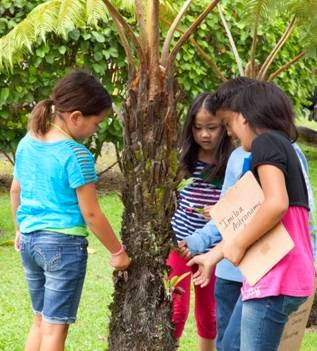
Ka`u keiki can explore the natural world during an `Imiloa
program next month. Photo from Imiloa Astronomy Center
`IMILOA ASTRONOMY CENTER IS LOOKING for keen-eyed Ka`u keiki who enjoy observing the natural world for the next Camp `IMI-Possible fall intersession program, Fun-novations of the Sky, slated for Oct, 6 – 10, 2014. Students will be immersed in a weeklong adventure of science experiments and activities relating to native birds and insects and their unique adaptations to Hawai`i. 
      The camp runs Monday to Friday from 8:30 a.m. to 3:30 p.m. Drop off is available as early as 7:30 a.m. with pick up by 4:15 p.m. Lunch and snacks are not included, so participants should pack a snack and healthy lunch to keep up with each day of exploration.
      Enrollment for the intersession program is open, but space is limited. Tuition for the program is $225 for members and $250 for nonmembers.
      A limited number of need-based scholarships are available. Applications and scholarship information can be found at www.imiloahawaii.org/183. Submit completed applications and payment at front desk.
      To comment on or like this story, go to facebook.com/kaucalendar.  

IN SPORTS, KA`U HIGH GIRLS VOLLEYBALL teams won their home matches against East Pac yesterday. Junior varsity scores were 25 – 14 and 25 – 12. Varsity won in three straight sets, 25 – 18, 25 – 12 and 25 – 17.
      The teams host Konawaena Saturday at 10 a.m.
      After returning from Maui where they played a game against Seabury Hall, the Trojans’ eight-man football team hosts Pahoa Friday at 6:30 p.m.
      Ka`u High bowlers meet Kea`au at Kilauea Military Camp today.
      To comment on or like this story, go to facebook.com/kaucalendar.

Ka`u photographer Peter Anderson caught this image of last night's supermoon
just before midnight, when skies cleared after being cloudy all evening.
THE LAST OF THREE CONSECUTIVE SUPERMOONS traveled across the sky last night. According to Wikipedia, “a supermoon is the coincidence of a full moon or a new moon with the closest approach the moon makes to the Earth on its elliptical orbit, resulting in the largest apparent size of the lunar disk as seen from Earth. The technical name is the perigee-syzygy of the Earth-Moon-Sun system. The term supermoon is not astronomical, but originated in modern astrology. The association of the moon with both oceanic and crustal tides has led to claims that the supermoon phenomenon may be associated with increased risk of events such as earthquakes and volcanic eruptions, but the evidence of such a link is widely held to be unconvincing.”
      To comment on or like this story, go to facebook.com/kaucalendar.

FOUR MORE DAYS REMAIN TO GET DISCOUNTED RATES for Ka`u Coffee Trail Run. After Saturday, Sept. 13, fees increase by $20 for the 5K, 10K and Half Marathon coming up on Saturday, Sept. 20.
      Register online at race360.com/21357.

THE PUBLIC IS INVITED TO KA`U SCENIC BYWAY Committee’s meeting tomorrow at 5 p.m. at Na`alehu Methodist Church. On the agenda is finishing design of the Na`alehu Park kiosk, and this is the last chance for input. For more information, email richmorrow@alohabroadband.net.

LIGHT REFRESHMENTS FOR CURRENT and new members will be served at Friends of Ka`u Libraries’ member meeting tomorrow from 6 p.m. to 8 p.m. at Pahala Plantation House.
      Call Doris Davis at 928- 0919 or Ann Fontes at 987-7448 for more information.

SUPPORT OUR SPONSORS AT PAHALAPLANTATIONCOTTAGES.COM AND KAUCOFFEEMILL.COM. KA`U COFFEE MILL IS OPEN SEVEN DAYS A WEEK.


See kaucalendar.com/Directory2014.swf.


Tuesday, September 09, 2014

Ka`u News Briefs Tuesday, Sept. 9, 2014

Ka`u's aspiring farmers, ranchers, high school students and recent graduates can apply for agricultural training programs through The Kohala Center. Photos from The Kohala Center
BIOTECH COFFEE COULD POSSIBLY SOLVE the coffee berry borer problem, statewide Hawai`i Farm Bureau Federation President Chris Manfredi said in a video posted yesterday by Big Island Video News. Manfredi, who is described by the American Farm Bureau as a coffee farmer and by Big Island Video News as “active in Ka`u coffee farming,” was speaking to Hawai`i Coffee Association at its annual meeting in July. He said that research in other parts of the world is ongoing to create biotech coffee that could stand up to the pest that is devastating the industry.
Hawai`i Farm Bureau Federation President Chris Manfredi told Hawai`i
Coffee Association that biotech coffee could "make our CBB crisis
go away." Photo from Big Island Video News
      Manfredi said HFBF is also “pretty active at the (state) Capitol.” He said the organization has a full-time lobbyist on O`ahu and works in partnership with HCA and state Department of Agriculture “on legislative issues that are important to agriculture.”
      Manfredi also talked about a Farm Bureau public relations campaign called Small Farmers, Big Stories, which he described as “a virtual farm tour in the media.” He contended that those promoting GMO restrictions and further regulating pesticides are against biotech. “Of late, non-farmers have been trying to impose their will on farmers and set food and farm policy,” he said.
      He told the audience that HFBF had gotten about $150,000 pledged for the campaign, which has an annual budget of $400,000.
      Manfredi also announced at the conference that he had recently traveled to Washington, D.C. and discussed the campaign with Hawai`i’s congressional delegation.
      See bigislandvideonews.com.
      To comment on or like this story, go to facebook.com/kaucalendar.

TWO PROGRAMS AIMED AT INTRODUCING high school students and aspiring farmers on Hawai`i Island to agricultural careers are seeking applicants for upcoming cohorts in October.
      Ku I Ka Mana, a beginning farmer and rancher training program administered by The Kohala Center, is accepting applications from prospective students for its fourth cohort. The 30-session course begins on Friday, Oct. 17 and is conducted in Honoka`a on Friday evenings from 5:30 p.m. to 8:30 p.m. and Saturday mornings from 9 a.m. to 12 p.m.
Ku I Ka Mana's fourth cohort begins in October. Photo from The Kohala Center
      Although no previous farming experience is required, preference is given to U.S. veterans and to applicants who have taken steps to become agricultural producers but would benefit from a comprehensive, hands-on curriculum. The course covers a wide range of critical subject areas such as soil management, irrigation, composting, cover cropping and pest management, as well as the business side of farming—marketing, accounting, budgeting, and record-keeping. Students who successfully complete the course and create viable farm and business plans will be able to work with program staff to obtain leasable farmland, should they not already have land on which to farm or ranch.
      The deadline to apply is Friday, Oct. 10.
      The second program is open to Hawai`i Island high school students and recent graduates. The fourth cohort of The Center’s weeklong High School Agriculture Internship Program runs from 8 a.m. to 5 p.m. daily from Oct. 6 through Oct. 10.
      With the `aina serving as their classroom, interns are introduced to various aspects of agriculture in Hawai`i through site visits to Waipi`o, Kohala, Hamakua, Kona and Hilo. Participants gain hands-on experience in sustainable agriculture, learn about island food systems and receive a $125 stipend upon completion. The High School Agriculture Internship Program is co-sponsored by Kamehameha Schools’ `Aina Ulu Program.
      The deadline to apply is Wednesday, Oct. 1.
      “These programs were designed in an effort to move Hawai`i toward greater food self-reliance by training and motivating the next generations of local food producers,” said Derrick Kiyabu, director of The Kohala Center’s Ku I Ka Mana Beginning Farmer-Rancher Development Program. “We and our partners are dedicated to training and supporting new farming families on Hawai`i Island and inspiring island youth to consider careers in agriculture in an effort to increase local food production, decrease dependency on imports, diversify our rural economy and create meaningful jobs.”
      More information and application materials are available at kohalacenter.org or by calling 887-6411.
      To comment on or like this story, go to facebook.com/kaucalendar.

Among others, Tango is one product to battle
little fire ant colonies.
FACULTY AND STAFF AT THE UNIVERSITY OF HAWAI`I’S College of Tropical Agriculture and Human Resources and the Hawai`i Department of Agriculture have tips for identifying and controlling little fire ants. Wasmannia auropunctata is a serious pest because this tiny ant can easily spread undetected into yards and homes, parks, landscapes, vacant properties and forests. LFA deliver very painful stings similar to electric shocks to people, pets, livestock and even marine wildlife such as sea turtles and ground-nesting birds. LFA are attracted to eye fluids and typically sting near animals’ eyes, which can lead to blindness due to clouding of the cornea, or keratopathy.
      Areas where LFA are commonly found are in trees and shrubs, especially any fork at bases of trunks, in crotches of branches and under moss growing on trees or shrubs; in stamens and pistils of flowers; near edges of building foundations and concrete slabs; in cracks in concrete; in electrical outlets; in fallen logs and piles of plant debris; under potted plants; in dumpsters, trash cans and rubbish piles; and in stockpiles of seldom-used flower pots, lumber, hollow tiles, rocks, etc.
      Ka`u residents can use peanut butter as an attractant for detection of LFA. Check for ants by smearing a thin layer of peanut butter on one end of a chopstick or any wooden or plastic stake. Place a stake on the ground every 10 to 12 paces, including in potted plants and at the base and in branch crotches of trees. The best times are in the morning or on overcast days, avoiding heavy rain or mid-day sun and heat.
      After about 40 to 45 minutes, check for LFA on the stake. LFA are red-orange, slow-moving and less than 1/16 of an inch long (thickness of a penny). If LFA are on the chopstick, place the chopstick with ants into a zip-top bag and place it in the freezer for at least 24 hours to kill the ants.
      Bring bagged ant samples to one of the following locations for confirmation: UH-CTAHR Komohana Research and Extension Center, 875 Komohana Street, Hilo or Hawai`i Department of Agriculture, 16 East Lanikaula Street, Hilo.
      If an agency positively identifies LFA, treat with ant bait insecticide. Ant food bait mixed with a slow-acting insecticide is the only effective way to kill and eliminate an LFA colony because it allows worker ants to carry poison to queens. A free publications entitled Little Fire Ant Products Available for Homeowner Use is available online at ctahr.hawaii.edu/haraa/arthropod.asp (click on first publication), at UH-CTAHR’s Extension Office in Hilo or by calling 981-5199.
      One product mentioned is Tango. Information about how to use it is available at littlefireants.com.
Ka`u High's cross county team plans to participate in and volunteer at `Ohana Day
and the Ka`u Coffee Trail Run, which crosses scenic pastures.
Photo from `O Ka`u Kakou
      “Check, treat, recheck, repeat,” is UH’s advice. It may take several reapplications of bait over a six- to 12-month period to kill an LFA colony. Recheck with peanut butter regularly and treat with insecticidal bait when necessary. It is critical that infested plants, building materials, trash, etc. be treated on-site and not moved or dumped, which will further spread the ants.
      The Nature Conservancy also offers assistance to Ka`u residents with LFA infestations. Contact John Replogle at 939-7171.
      To comment on or like this story, go to facebook.com/kaucalendar.

KA`U HIGH’S CROSS-COUNTRY ATHLETES are doing great, reports Head Coach Erin Cole. At Hawai`i Preparatory Academy on Aug. 30, the fastest Ka`u boy was Chadwick Pajimola with a time of 27:25.66, and the fastest Ka`u girl was Chloe Gan with a time of 29:36.55. The race is three miles long, “and HPA has a grueling hill the athletes have to run up twice,” Cole said. “All team members came in strong, and I am looking forward to seeing everyone’s times improve over the season, as the team is training hard.”
      Team members will be volunteering and/or running in the Ka`u Coffee Trail Run on Saturday, Sept. 20 instead of running in the meet at Waiakea. The team did not participate in the race at Kamehameha on Sept. 6 due to a schedule conflict.
      Another meet at HPA is scheduled for Saturday, Sept. 27.

KA`OHU MONFORT SHARES HER KNOWLEDGE and love of the island’s native plants and their medicinal uses during a la`au lapa`au demonstration tomorrow from 10 a.m. to 12 p.m. at Kilauea Visitor Center lanai in Hawai`i Volcanoes National Park. Free; park entrance fees apply.

THE NEXT MEETING OF THE KA`U SCENIC BYWAY Task Force will be Thursday at 5 p.m. at Na`alehu Methodist Church. The task force is about to finish design on the Na`alehu Park kiosk, and this is the last chance for input. The public is invited.
      For more information, email richmorrow@alohabroadband.net.

LIGHT REFRESHMENTS FOR CURRENT and new members will be served at Friends of Ka`u Libraries’ member meeting Thursday from 6 p.m. to 8 p.m. at Pahala Plantation House.
      Call Doris Davis at 928- 0919 or Ann Fontes at 987-7448 for more information.

HAWAI`I FARMERS UNION UNITED’S KA`U CHAPTER holds its next potluck meeting at Na`alehu Community Center on Saturday, Sept. 27 at 5 p.m. Farmers can drop off homegrown items and pick up something that neighbors are growing at the swap table.
      HFUU state President Vincent Mina will talk about his recent trip to Washington for the National Farmer’s Union Fly-In event.
      Voter registration forms will be available. The deadline to register to vote is Oct. 6 for the Nov. 4 general election.
      For more information, email Malian Lahey at malian@kauspecialtycoffee.com.

SUPPORT OUR SPONSORS AT PAHALAPLANTATIONCOTTAGES.COM AND KAUCOFFEEMILL.COM. KA`U COFFEE MILL IS OPEN SEVEN DAYS A WEEK.


See kaucalendar.com/Directory2014.swf.