About The Kaʻū Calendar

Sunday, July 03, 2016

Ka`u Calendar News Briefs Sunday, July 3, 2016

Thy Word Ministries-Ka`u won Most Patriotic in Na`alehu's Independence Day Parade yesterday.
Photos by Ron Johnson
KA`U FAMILIES ENJOYED A FUN-FILLED Independence Day celebration in Na`alehu yesterday. The parade, sponsored by `O Ka`u Kakou, drew pa`u riders on horseback, along with community groups and candidates for public office walking and riding on decorated vehicles and floats. Participants competed for Most Elaborate and Most Patriotic categories. Thy Word Ministries-Ka`u won Most Patriotic, and South Side Shaka was Most Elaborate.
Darlyne Vierra, of Ka`u Multicultural Society, was emcee
for Na`alehu's parade.
      Miss Ka`u Coffee Rochelle Koi, Miss Peaberry Chazlynn Pua-Queja and 2016 princesses graced the parade, representing Ka`u Coffee growers. Pa`u Queen Teani Souza led horse riders representing Hawaiian islands. 
      Activities at Na`alehu Park followed the parade. Keiki enjoyed water slides and bounce houses, as well as the brand new playground that opened last Wednesday.
      `O Ka`u Kakou also offered shave ice and other goodies at the park. Kupuna enjoyed Bingo and lunch out of the sun inside breezy Na`alehu Community Center.
      The celebration continues in Na`alehu today at Ka`u Roping & Riding Association's Fourth of July Rodeo.
      See more in future Ka`u Calendar News Briefs.
      To read comments, add your own, and like this story, see Facebook. Follow us on Instagram and Twitter.

Miss Ka`u Peaberry 2016 Chazlynn Pua-Queja greets parade watchers.
SEN. MAZIE HIRONO YESTERDAY HOSTED the first in a series of outreach events to assist Filipino World War II veterans in applying to reunite with family members still living in the Philippines. Hirono brought together close to 50 Filipino veterans and family members with U.S. Citizenship and Immigration Services District Director David Gulick and members of the Hawai`i Chapter of the American Immigration Lawyers Association to provide information and assistance on the USCIS Filipino WWII Veterans Parole Program. 
      Under the program, Filipino veterans whose service has been recognized by the U.S. Department of Defense, or their surviving spouses, may apply to bring their children and certain other family members to the United States.
Miss Ka`u Coffee 2016, Rochelle Koi, waves to onlookers.
      “Filipino World War II veterans have waited decades for the opportunity to be reunited with their family from the Philippines. I appreciate the Obama Administration’s recognition of the importance of family reunification for Filipino WWII veterans. A key part to this is the implementation of FWVP, and I will work with USCIS and nonprofit organizations to make sure these veterans receive timely information and assistance,” Hirono said. “I plan to host outreach events and share information throughout the summer with Filipino WWII veterans across the state.” 
      Filipino veterans were granted citizenship in recognition of their service to the United States during World War II. Many of their children, however, were not. Due to backlogs in the U.S. immigration system, it can take more than 20 years for immigration applications to be reviewed. Under the FWVP program, families, some of whom have been waiting decades, can finally be together in the United States while their applications are processed. FWVP is an additional process for families of Filipino World War II veterans who have already received approval for their immigrant visas but continue to wait for a visa number to become available.
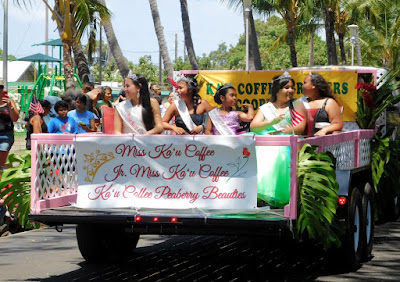
Miss Ka`u Coffee princesses ride a float sponsored by Ka`u Coffee
Growers Cooperative.
      Hirono has been the leader in Congress of the effort to reunite Filipino World War II veterans with their families. After years of her advocacy, the Obama Administration announced last July that it would create a parole program to reunite the families of Filipino World War II veterans. Hirono then pushed the Administration to quickly implement the program and make children eligible for expedited consideration to come to the United States. To read comments, add your own, and like this story, see Facebook. Follow us on Instagram and Twitter.

HAWAIIAN VOLCANO OBSERVATORY’S current issue of Volcano Watch focuses special attention on gravity, which scientists use to study and monitor Hawai`i’s active volcanoes.
Pa`u Queen Teani Souza and her escorts.
      “We tend to think of gravity as a constant – a force that pulls on everyone equally, everywhere,” the article states. “But this is not quite true. In fact, the force of gravity depends on the mass beneath your feet, and your distance from that mass. 
      “If there is something very dense beneath the ground, like a solidified magma chamber, gravity is a bit stronger in that area. Conversely, the farther you are from the Earth’s center, the weaker gravity is. For example, you weigh slightly less (by a small fraction of a pound) at the 4169-meter (13,678-foot) summit of Mauna Loa than at sea level in Hilo!

Walking in the parade was one of many activities for this year's Summer Fun participants.
      “Gravity can also change over time. As magma accumulates beneath the ground, it pushes the ground upward, causing gravity to decrease. This change is counterbalanced, however, by the new mass of magma beneath the ground, which causes gravity to increase.
Barrel train carries keiki along the parade route.
      “By measuring gravity and surface deformation at the same time, these effects can be separated. This makes it possible to use gravity to measure just how much magma may be moving beneath the ground. 
      “Measurements of gravity change have been conducted at Kilauea since the 1970s, usually by surveying a network of points conducted every year or so. A noteworthy result of these studies is the recognition that there are void spaces – probably a network of interconnected cracks rather than a single large cavern –beneath the volcano’s surface. Magma accumulation in these voids causes a gravity increase due to the addition of mass, but there is little associated surface uplift.
Statuesque-lei-bedecked horse carries keiki rider in Na`alehu's
Independence Day parade.
      “In the past several years, gravity changes have also been measured by continuously recording instruments installed at three locations on Kilauea. These measurements allow volcanologists to detect rapid changes in mass beneath the surface that might otherwise go undetected. They have also revealed surprising insights about Kilauea’s summit lava lake. 
      “Island residents might remember the eventful volcanic activity at Kilauea in 2011. In March that year, the summit lava lake within Halema`uma`u Crater drained due to the onset of the Kamoamoa fissure eruption near Pu`u `O`o on the volcano’s East Rift Zone. The dropping lava lake level was associated with a major decrease in gravity measured by an instrument on the rim of Halema`uma`u.
      “A nearby thermal camera also tracked the lowering lava lake level, making it possible to calculate the volume of lava that drained from the lake. Knowing the mass and volume, we can determine an important physical property of lava: density.
Most Elaborate went to Na`alehu's South Side Shaka Restaurant.
      “The density of the basaltic rocks that make up most of the Island of Hawai`i is about 2.5 times the density of water. HVO scientists expected Kilauea’s summit lava lake to be slightly less dense than the rock, given the gases contained in the lava, but not by much. 
      “The gravity and thermal camera data from the draining of the lava lake in March 2011, however, revealed that the upper 200 m (650 ft) or so of the lake has a density less than that of water! Apparently, the upper part of the lava lake is frothier than expected due to the large amount of gas in the lava.
      “The Kilauea summit vent gravity station has recorded changes over several years since 2011, through many cycles of lava lake level rise and fall. These data clearly demonstrate that the lava lake density has remained low, roughly equal to that of water.
After the parade, keiki kept cool riding
a giant water slide.
      “Abrupt changes in gravity have also occurred a few times since 2011, signaling the arrival of fresh batches of magma near the summit. These gravity data, therefore, provide important information, not just about lava lake characteristics, but also about subsurface magma movement that might otherwise be overlooked. 
      “Kilauea is a wonderful ‘natural laboratory’ in which we can develop advanced methods of volcano monitoring and research, like continuous gravity. In the years to come, HVO looks forward to refining our techniques for measuring gravity change and sharing them with scientists who are studying other U.S. volcanoes, such as Mount St. Helens.”
      See hvo.wr.usgs.gov.
      To read comments, add your own, and like this story, see Facebook. Follow us on Instagram and Twitter.

LIVE & LOCAL COMEDY for all ages comes to Pahala Community Center today at 7 p.m., featuring Augie T, Frank De Lima and Mel Cabang. Tickets are $20 in advance and $25 at the door.
      Call 990-0474, or see AugieT.com.

FOURTH OF JULY BREAKFAST BUFFET is available tomorrow from 6 a.m. to 11 a.m. at Kilauea Military Camp’s Crater Rim Café in Hawai`i 
      Volcanoes National Park. Menu includes Punalu`u Sweet Bread French Toast, Omelet Station, breakfast meats, breakfast potatoes and more. Adults $12; child 6-11 years old $6.
      KMC is open to authorized patrons and sponsored guests; 967-8371.
      Park entrance fees apply.

Keiki volunteers help their `O Ka`u Kakou kupuna counterparts
set up lunch for seniors at Na`alehu Community Center.
VOLCANO FOURTH OF JULY PARADE & Celebration is tomorrow. The parade begins at 9 a.m. at the post office and travels along Old Volcano Road to Cooper Center. Activities there continue to 1 p.m.

FOURTH OF JULY SILENT AUCTION tomorrow from 9 a.m. to 11:30 a.m. at Cooper Center in Volcano Village benefits Friends of Hawai`i Volcanoes National Park. Items include tours, hotel stays, gift baskets, gift certificates and much more.

SUPPORT OUR SPONSORS AT PAHALAPLANTATIONCOTTAGES.COM AND KAUCOFFEEMILL.COM. KA`U COFFEE MILL IS OPEN SEVEN DAYS A WEEK.

See kaucalendar.com/KauCalendar_July_2016.pdf.

See kaucalendar.com/TheDirectory2016.html
and kaucalendar.com/TheDirectory2016.pdf.


Saturday, July 02, 2016

Ka`u Calendar News Briefs Saturday, July 2, 2016

Ka`u Auto Repair issues drunken driving and other road risk warnings every year by parading a smashed vehicle. This
morning's offering at the Na`alehu Independence Day Parade was a sporty sedan with a crushed front end.
Photo by Ron Johnson
FOURTH OF JULY WEEKEND is one of the two busiest challenging times for first responders. The other is the New Year holidays. Irresponsible firecracker and illegal fireworks use can not only lead to injury, but also to brush fires that endanger homes, ranches, macadamia orchards, coffee and vegetable farms, as well as native forests and parklands. This weekend’s forecast is for high winds that heighten the fire danger in Ka`u.
Pahala volunteer Fire Captain Ron Ebert and volunteer
firefighter Liz Polido are ready for summer fire season
and joined the Na`alehu Independence Day parade this
morning. Photo by Ron Johnson
     Hawai`i County police and fire departments warn in a statement: "Fireworks can be dangerous, causing serious burns and eye injuries. Young children and fireworks do not mix. Never give fireworks, even sparklers to young children. Sparklers burn at temperatures of 2,000 degrees Fahrenheit. Older children should only use fireworks under the direct supervision of an adult. Always read and follow all warnings and instructions listed by the manufacturer for the safe use and handling of fireworks. Make sure you have a clear, flat area to use the fireworks; away from structures, dry grass or brush, or other readily ignitable materials. Have a water hose or bucket of water readily available in case of a fire."
     Increased traffic on the roads can also add fuel to the fire this weekend, particularly when cigarettes are thrown out the windows.
   To read comments, add your own, and like this story, see Facebook. Follow us on Instagram and Twitter.

 OBJECTIONS TO HIGH VOLTAGE OVERHEAD ELECTRIC LINES for a proposed industrial solar project on numerous empty lots among homes in the Hawaiian Ranchos community have come from state Consumer Advocate Jeffrey Ono.
     In recommendations to the state Public Utilities Commission, tasked with approving or disapproving the project, Ono recommended that developers of the solar farms in Ranchos install underground instead of overhead lines. He wrote that underground lines would minimize impact on the community and address its concerns. The cost of the underground transmission lines, however, would be $1.375 million, more than eight times the $168,000 cost of running overhead lines. It would be the first underground high voltage transmission on Hawai`i Island.
Consumer Advocate Jeffrey Ono recommends underground
lines for the Ranchos solar project, and much more.
Photo from Big Island Video News
   Ono also recommended the developers shoulder additional equipment and maintenance costs, plus a promise of removal of the solar project facilities, should the endeavor fail.  Ono pointed to the solar developers’ “failure to conduct an adequate and effective community outreach program.”
     The solar project is permitted by Hawai`i’s Feed In Tariff, in 2009 conceived as a procurement method for cheap renewable energy. The state issued 32 permits for 32 mid-size projects on the Big Island. Twenty-six of the 32 permits were obtained by two developers who intended to combine them to create an industrial scale 6.5 megawatt project on 26 housing lots in Ocean View. When they applied for the FIT permits, the developers agreed to a project completion date of Sept. 15, 2012. No site work is done and developers still need a contract with the local utility, Hawai`i Electric Light Co.
    Many Ocean view residents voiced opposition at public meetings and in testimony submitted to the PUC. Concerns included a view that forested lots cleared for a massive solar project within a neighborhood would industrialize the rural town, spoil views and ambiance, push up the cost of power, attract vandalism, increase fire danger, and force many to sell their homes at a loss and move out. 
     The developers, claim numerous residents, could qualify for lucrative federal and state tax credits totaling 65 percent. If they were to “flip” the projects they could create huge profit without generating any of the promised solar power.  
Ranchos and other Ocean View residents testify before the PUC about
industrial solar proposed on lots in their neighborhood.
Photo from Big Island Video News
      Other concerns included: the developers’ long delay in starting; ambivalent commitments to the project; accusations of opportunism; the view that such expensive power is no longer needed; locating the project in three adjacent housing subdivisions to the detriment of residents, and accusations that developers have attempted to circumvent the competitive bidding process by creating an industrial-size  6.5 megawatt project.
     The Consumer Advocate routinely offers advice to the PUC.  In the case of the Ocean View application, Ono wrote a 24-page Statement of Position to list concerns, many of them mirroring those of the community. He wrote: “The FIT process was deemed necessary at the time to encourage renewable energy project development, but the need for the FIT projects, at compensation rates that are no longer reasonable, may not be consistent with the public interest at this time. Ono referred to the wholesale price of 23.8 cents per kwh that HELCO would pay and the 28.5 cents per kwh that HELCO charges consumers."  
    Ono also suggested the substation location be reviewed to “ensure that optimal, and not convenient, placement occurs before substation construction work occurs.” Ono challenges HELCO’s decision to locate the substation at the entrance to Ranchos. Residents have objected, calling it an eyesore and urging HELCO to revert to the an original plan to locate it on the developer’s land, where ‘Ohi’a trees can screen the substation.
 
A ground-mounted solar array on one lot, similar to those planned for Ranchos on 26 separate lots,
 this one from enspisolar.com.
     Ono recommended extra equipment, “such as security cameras, fencing or walls,” and monitors to be paid for by developers. Another Ono recommendation, a large expense if the PUC agrees: “developers should also be required to provide assurances that the costs to remove, if and as necessary, the substation, transmission lines and the FIT projects themselves will be paid for by the developers.” Ono writes that the assurances must be “meaningful.”
     “The removal of the proposed substation and transmission line should not fall upon the general ratepayers.” wrote Ono. “Whether by performance bonds, escrow accounting, or some other alternative, the Commission should require an acceptable means of addressing this concern . . . customers [should not be] required to fund removal because the responsible parties are no longer available or capable of meeting this obligation.”
   Ono also recommended that developers be responsible for all operating and maintenance expenses associated with the substation, transmission line and supporting infrastructure.
Local vendors like Millie Akau sell at farmers markets but could also
apply to sell to schools. Photo by Julia Neal
    Ono concluded: “In this instance it is apparent that the Solar Project Owners effectively 'gamed' the FIT process in order to avoid going through the more rigorous competitive bidding framework. Furthermore, the failure of the Solar Project Owners to conduct an effective community outreach program with mere promises of a community benefits package should not be condoned.”
     To read comments, add your own, and like this story, see Facebook. Follow us on Instagram and Twitter.

LOCAL FARMERS CAN HELP SCHOOLS SERVE HEALTHY FOOD and reduce dependency on imports by applying to deliver fresh fruits and vegetables. The state Department of Education is seeking qualified local farmers and vendors to submit bids by July 13. See invitation for bids at http://spo3.hawaii.gov/notices/notices/ifb-d17-005.
    The initiative is spearheaded by Lt. Governor Shan Tsutsui, who said: “With Hawai`i importing about 85 percent of our food, the Farm to School Initiative is one way we are working towards becoming food sustainable in our state. While supporting local farmers and our economy, we are also feeding our students with locally-grown fresh fruit and vegetables.”
Earth Matters Farm at Kama`oa and South Point Roads.
Photo from Earth Matters 
     The state education and ag departments are working to address supply and demand issues surrounding purchasing local food for school cafeterias. Ka`u has two public school cafeterias, one in Na`alehu and one in Pahala. State licensed charter schools, Ka`u Learning Center in Discovery Harbour and Volcano School for the Arts & Sciences, also serve food to students. The state school system operates 256 public schools and its School Food Services Branch feeds approximately 100,000 students and staff each day.
     The Initiative aims not only to increase state purchasing of local food for school menus. It attempts to connect keiki with local agriculture through using food products produced here.
     “We’ve made it a priority to purchase local produce, however, our options have been limited,” said Superintendent Kathryn Matayoshi. “We are hopeful that this initiative will allow for more locally based products to be used in our schools’ food services while keeping costs reasonable.”
     Hawai`i Board of Agriculture Chair Scott Enright said, “We encourage local farmers to participate in this program. One of the challenges farmers face is the uncertainty of supply and demand and this program will help farmers plan and grow their crops with the knowledge that there will be a market for their produce. In addition, keiki will be able to grow up with an appreciation of locally grown fruits and vegetables.”
     Across the nation, farm to school programs are reconnecting students to a better understanding of the food system and where their food comes from. Farm to school programs introduce students to healthier eating habits and help them become familiar with new vegetables and fruits that they and their families will then be more willing to incorporate into their own diets.
Rodeo finals are Sunday in Na`alehu. Photo by Julia Neal
     In April, organizers of the Farm to School Initiative gathered information from farmers and ranchers. After farmers and ranchers apply to participate, vendors will be chosen. The Farm to School Initiative Pilot Project is expected to begin in 2017.

FINALS FOR THE FOURTH OF JULY RODEO in Na`alehu are tomorrow, Sunday July 3, with gold buckles sponsored by local businesses and citizens.  Events include youth barrels, dummy roping and goat undecorating for keiki. Adult contests include po`o wai u, bull riding, tied down roping, wahine breakaway, wahine mugging, double mugging, open dally, team 90s and kane-wahine mugging. Ticket prices are $8 at the gate. Food and non-alcoholic drink will be available
    Slack roping starts at 8 a.m. with the rodeo at noon. This annual event is sponsored by Ka`u Roping & Riding Association.
Augie T, Frank De Lima,
Mel Cabang in Pahala
on Sunday.

LIVE & LOCAL COMEDY for all ages comes to Pahala Community Center Sunday at 7 p.m., featuring Augie T, Frank De Lima and Mel Cabang. Tickets are $20 in advance and $25 at the door.
      Call 990-0474, or see AugieT.com.


SUPPORT OUR SPONSORS AT PAHALAPLANTATIONCOTTAGES.COM AND KAUCOFFEEMILL.COM. KA`U COFFEE MILL IS OPEN SEVEN DAYS A WEEK.
See www.kaucalendar.com/KauCalendar_June_2016


Friday, July 01, 2016

Ka`u Calendar News Briefs Friday, July 1, 2016

The Nature Conservancy divers assess coral bleaching in West Hawai`i to determine what can be done
to best assure reefs survive in a changing climate. See more below. TNC Photo by David Slater
HAWAI`I COUNTY MAYOR BILLY KENOI joined Gov. David Ige and other county mayors and officials to demonstrate a concerted statewide effort to “Fight the Bite” and keep Hawai`i free of diseases spread by mosquitoes. The public education campaign has been relaunched by the state Department of Health and expanded to include all mosquito-borne diseases that pose a threat to Hawai`i, such as Zika, dengue and chikungunya.
      “Hawai`i is fortunate none of these diseases are endemic or native to our state, and we need to work together to make sure it stays this way,” Ige said. “We are part of a nationwide effort to combat diseases spread by mosquitoes, and with the Department of Health leading the charge to bring partners together to raise awareness about mosquito prevention, I’m confident that communities will come together, as our state and county leadership have done, to ensure the safety of our islands.”
State and county officials, including Mayor Billy Kenoi, support
a statewide effort to "Fight the Bite."
Photo from Office of Gov. Ige
      “Mosquito season in Hawai`i is year-round, but with increased travel and more outdoor activities during the summer months, we need to be on our guard and keep residents and visitors well-informed about mosquito-borne diseases and how to reduce the chances of outbreaks in our state,” Health Department Director Dr. Virginia Pressler said. “Hawai`i has been identified as one of the nation’s higher risk areas for the potential spread of the Zika virus, so we hope people will keep mosquito prevention and control top-of-mind all year long.”
      The revamped “Fight the Bite” campaign has two key components. As a follow-up to the response to 264 cases of dengue fever on Hawai`i Island that likely began as a result of an infected traveler, DOH coordinated with Hawai`i Emergency Management Agency and county emergency management/civil defense agencies to develop a response plan specifically for mosquito-borne diseases. It outlines ongoing preparedness activities to take place when there are no cases, as well as response measures for all imported cases and measures in the event of infected mosquitoes transmitting a disease locally.
      The second component includes a research-based public education campaign that leverages numerous broadcast and social media channels to build awareness about mosquito-borne disease prevention. Starting early this month, Hawai`i residents can expect to hear “Fight the Bite” messages on local radio and television stations statewide and see graphics in malls and shopping centers. The $250,000 media campaign is being funded by the state and will include community engagement activities to spearhead and encourage grassroots efforts to reduce mosquito breeding areas across the state. All resources will be made available to the public at the redesigned campaign website at www.FightTheBiteHawaii.com.
      With support of Hawai`i Tourism Authority and state Department of Transportation, people can also expect to see updated “Fight the Bite” information this year in key points-of-entry, such as airports and harbors. “We are working together with our travel industry partners to educate their workers, guests and customers,” said George D. Szigeti, Hawai`i Tourism Authority President and CEO. “We all need to do our part to protect Hawai`i from mosquito-borne illnesses.”
      Educational outreach to youth is also an important piece of the campaign. “Many educators working at the Department of Education already offer information about mosquito-borne disease prevention to students,” Deputy Superintendent Stephen Schatz said. “DOH and DOE are working to identify new opportunities and to train staff so that they may better educate Hawai`i’s students.”
      For more information about the education campaign, response plan and mosquito-borne diseases and how to prevent them, see www.FightTheBiteHawaii.com.
      To read comments, add your own, and like this story, see Facebook. Follow us on Instagram and Twitter.

Man-made threats add more stress to already unhealthy
coral reefs, according to researchers.
TNC Photo by David Slater
CORAL REEFS’ VARIATIONS in response to climate change can help managers develop strategies to keep the reefs alive, according to a new study conducted by The Nature Conservancy of Hawai`i in partnership with the National Oceanic and Atmospheric Administration and Marine Applied Research Center.
      Researchers sought to assess the condition of reefs of South Kohala and North Kona and to identify factors that lead to resilience, or the ability of a reef to recover from extreme events such as coral bleaching.
      The study looked at West Hawai`i reefs after a major bleaching event last year caused significant damage. At sites surveyed, rates of partially or fully bleached coral colonies ranged from 38 percent to 92 percent, with more than 90 percent mortality in some sites.
      “Ocean waters are getting hotter and more acidic, and that’s bad news for coral reefs,” said Dr. Eric Conklin, TNC’s director of Marine Science, who presented the study results at the 13th International Coral Reef Symposium. “What we have been doing is not sufficient to protect reefs into the future, so the fundamental question is: What can we do to best assure reefs survive in a changing climate?”
      Researchers determined that three major factors are most important in determining resilience in West Hawai`i: which corals handle increases in water temperature best, which reefs have new corals readily settling on available surfaces, and how much of the reef has already been invaded by algae, which compete with coral.
      According to Conklin, “Rising sea surface temperatures are a threat to corals globally, but man-made threats are adding more stress to reefs in West Hawai`i. To make our reefs more resilient, we need to manage the threats that we can, like reducing fishing pressure on fish that protect reef health by keeping them clean of harmful algae, or reducing runoff of sediments from coastal development and nutrients from outdated wastewater treatment systems.”
      The Conservancy selected the Kona Coast in part because it has been identified by both NOAA and the state as a particularly important coral reef site, and because the area’s community groups are concerned and engaged in managing their reefs. The immediate next step is to present the survey results to government and community partners, so they can begin incorporating resilience into their management actions.
      To read comments, add your own, and like this story, see Facebook. Follow us on Instagram and Twitter.

Lava follows several courses on its way down Pulama Pali.
Photo from USGS/HVO
THE ACTIVE LAVA FLOW southeast of Pu`u `O`o continued to advance during the past day, Hawaiian Volcano Observatory reported this morning. Yesterday afternoon, the flow front was beyond the base of Pulama pali, a steep, lava-mantled fault scarp on Kilauea’s south flank along the western boundary of the abandoned Royal Gardens subdivision. The flow is about 4.7 miles long as measured along the tube’s axis.
      Hawai`i County opened a lava viewing area to the public yesterday. From 3 p.m. to 9 p.m., visitors can park near the end of Hwy 130 in Puna and walk three miles on a gravel road to the area.
      To read comments, add your own, and like this story, see Facebook. Follow us on Instagram and Twitter.

HAWAI`I COUNTY ECONOMIC Opportunity Council is requesting letters from residents, organizations and community leaders that can support its application for funding from USDA Rural Development to help purchase a mini-bus to serve Ka`u. The mini-bus would enable HCEOC to provide essential transportation services to underserved Ka`u residents. It would have seating for twelve passengers, plus room for two passengers in wheelchairs. If possible, it would be configured at higher safety standards of school buses.
      HCEOC’s free transportation services would provide door-to-door service within a flexible route and schedule that strives to accommodate needs of low-income clients. Service would usually be offered Monday through Friday from 5 a.m. to 6 p.m., adjusted for passenger convenience and scheduling necessities. Instead of clients needing to go to a designated bus stop at certain times, clients could be picked up at and returned to their residence at requested times, subject to road conditions and scheduling needs. Door-to-door convenience would also be provided at destinations, such as doctors’ offices, hospitals, government offices, financial institutions, senior centers, shops, funerals and other locations.
      A public information meeting about the application will be held on Tuesday, July 5 at 1 p.m. at HCEOC’s office in back of Na`alehu Community Center.
      To read comments, add your own, and like this story, see Facebook. Follow us on Instagram and Twitter.

DR. RHONDA LOH LEADS an easy, 1.2-mile hike through Kipukapuaulu in Hawai`i Volcanoes National Park tomorrow at 9:30 a.m. The park’s inaugural Special Ecological Area is a hot spot of biological diversity, with more native tree species per acre than any other forest in the park.
      Free; park entrance fees apply.
      See nps.gov/havo.

NA`ALEHU INDEPENDENCE DAY parade and celebration is tomorrow. The parade begins at 11 a.m., with activities, food and senior Bingo following at Na`alehu Park.

THE FOURTH OF JULY RODEO in Na`alehu is tomorrow, Saturday, July 2 and Sunday July 3 with gold buckles for the winners of such traditional paniolo, Hawaiian cowboy events as Po`o Wai U.  Youth barrels, dummy roping, and goat undecorating are on tap for keiki. For adults the contests include bull riding, tied down roping,  wahine breakaway, wahine mugging, double mugging, open dally, team 90s and kane-waihine mugging. Ticket prices are $8 at the gate. Slack roping starts at 8 a.m. with the rodeo at noon both days. It is sponsored by Ka`u Roping & Riding Association.
Ka`u Roping & Riding Association hosts its annual Fourth of July Rodeo on Saturday and Sunday.
Photo by Julia Neal
LIVE & LOCAL COMEDY for all ages comes to Pahala Community Center Sunday at 7 p.m., featuring Augie T, Frank De Lima and Mel Cabang. Tickets are $20 in advance and $25 at the door.
      Call 990-0474, or see AugieT.com.

THE LEGACY OF MARY KAWENA PUKUI, of Her Beloved Ka`u is the topic a week from today, 
on Friday, July 8 from 5 p.m. to 8 p.m. at Na`alehu Community Center. Pukui’s grandson La`akea Suganuma, president of Mary Kawena Pukui Cultural Preservation Society, presents the program along with Pukui’s great grandchildren and great-great grandchildren.
      Sponsored by Uhane Pohaku Na Moku O Hawai`i, Inc., along with Debbie & Kawehi Ryder.
      Refreshments will be served.

SUPPORT OUR SPONSORS AT PAHALAPLANTATIONCOTTAGES.COM AND KAUCOFFEEMILL.COM. KA`U COFFEE MILL IS OPEN SEVEN DAYS A WEEK.

See kaucalendar.com/KauCalendar_July_2016.pdf.

See kaucalendar.com/TheDirectory2016.html
and kaucalendar.com/TheDirectory2016.pdf.