About The Kaʻū Calendar

Tuesday, September 13, 2016

Ka`u Calendar News Briefs Tuesday, Sept. 13, 2016

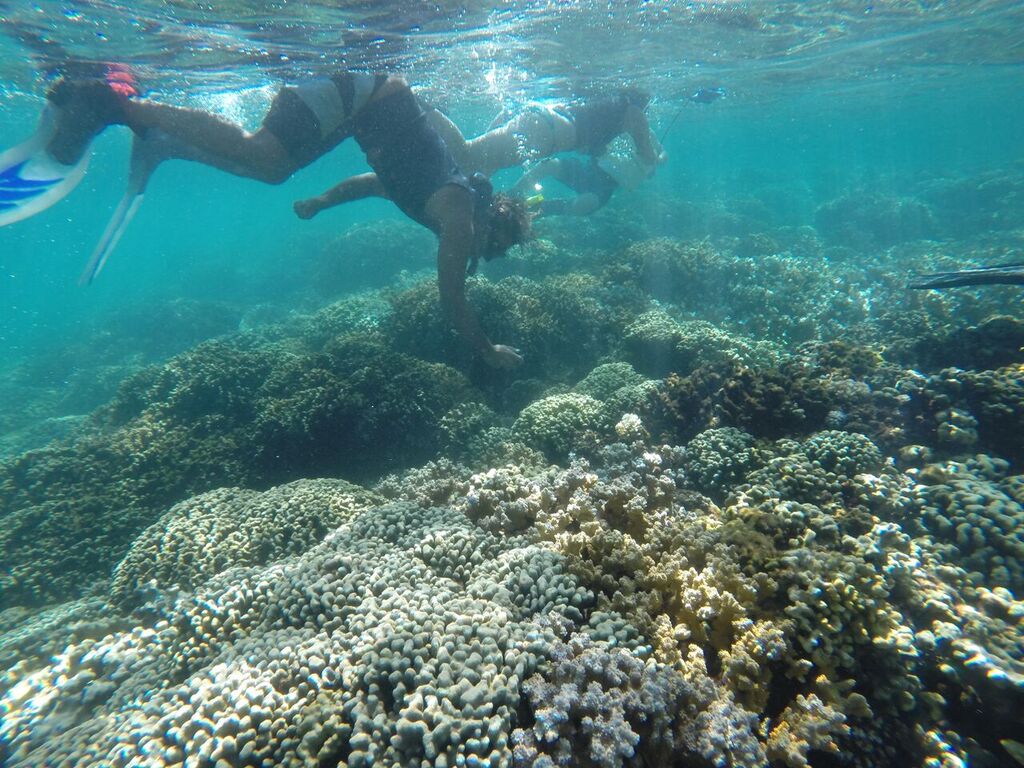
Aquatic biologists research sever coral bleaching events in Hawai`i's ocean waters.
Photo from Hawai`i Department of Land & Natural Resources
FOLLOWING SEVERE CORAL BLEACHING EVENTS in 2014 and 2015 within Hawai`i’s ocean waters, the state Department of Land and Natural Resources Division of Aquatic Resources has been working to identify management actions that can be taken to promote post-coral bleaching recovery and resiliency in Hawai`i’s coral reefs.
      “The state is currently on the cutting edge of applying climate resiliency-based management, and benefits from its close partnerships with coral science experts both here and around the world,” DAR administrator Bruce Anderson said. “DAR is committed to implementing effective management strategies within its abilities, including fisheries and habitat rules.”
      Dr. Ruth Gates, Director and Researcher at the University of Hawai`i’s Institute of Marine Biology, said, “Coral bleaching is an increasing threat to the health of corals reefs both in Hawai`i and globally. The state of Hawai`i has taken a very proactive stance in convening the management, conservation and scientific communities and developing a coordinated response to protect Hawai`i’s critical coral reef assets in the face of this urgent problem.”
      Coral bleaching is a stress response in which the coral animal expels algae-producing organisms called zooxanthellae that live within their tissue. Once the zooxanthellae are expelled, the coral is in a weakened state and is more vulnerable to stressors including disease. If high temperatures are sustained, a coral bleaching event can lead to coral mortality.
Dr. William Walsh 
      To address this, DAR aquatic biologists began by gathering information and surveying more than 80 coral experts and scientists. Additionally they reviewed all existing scientific literature – a synthesis of over 200 articles.
      DAR biologist Dr. William Walsh said of his team’s findings from in-water surveys in West Hawai`i, “We observed an average coral mortality of 50 percent in the West Hawai`i region, which holds some of the state’s richest coral reefs. Unfortunately, this area also experienced the highest sustained ocean temperatures during the 2015 coral bleaching event.” On Maui, DAR biologist Russell Sparks reports, “coral mortality in the hardest hit areas on Maui were between 20-30 percent.”
      Last month, a workshop involving 44 Hawai`i-based scientists and managers applied a Hawai`i lens to the information previously gathered as well as to identify management recommendations in four priority locations: West Hawai`i, West Maui, Kane`ohe Bay, and North Kaua`i. These areas were chosen because they were exposed to the most severe thermal stress during the 2014 and 2015 bleaching events.
      One of the outputs of this workshop was a list of top statewide management recommendations to promote coral recovery. The top-rated action in this exercise was to “establish a network of permanent, fully protected, no-take Marine Protected Areas.” According to DAR, MPAs may help corals recover from a bleaching event by removing additional environmental and human-caused stressors, including overfishing.
      Reduction of land-based pollution including sediment and nutrient runoff, which can smother corals or introduce toxic substances into the environment, was also a high priority.
      Additionally, protection and efficient management of herbivorous, or algae-eating, fish and invertebrates was discussed as a critical action. Herbivores remove excess algae, which can quickly take over a coral reef affected by bleaching.
      To read comments, add your own, and like this story, see Facebook. Follow us on Instagram and Twitter.

Joshua Corbin
HAWAI`I ISLAND POLICE ARE SEARCHING for a 30-year-old man who frequents Ocean View wanted for sexual assault.
      Joshua Corbin has no permanent address. He also has been seen in Kona and Hilo.
      In addition to the sexual assault on Hawai`i Island, Corbin is wanted in Texas for sexual assault and in Kona for traffic incidents.
      He is described as six feet tall, 160 pounds with brown hair and brown eyes. He may have a mustache and goatee.
      Two female campers at Manuka said they received advice from an official not to stay there because of possible danger.
      Police caution the public not to approach Corbin, as he is considered a danger to the community.
      Instead, anyone who sees him or knows his whereabouts is asked to call the Police Department’s non-emergency line at 935-3311.
      Tipsters who prefer to remain anonymous may call the islandwide Crime Stoppers number at 961-8300 and may be eligible for a reward of up to $1,000. Crime Stoppers is a volunteer program run by ordinary citizens who want to keep their community safe. Crime Stoppers doesn’t record calls or subscribe to caller ID. Crime Stoppers information is kept confidential.
      To read comments, add your own, and like this story, see Facebook. Follow us on Instagram and Twitter.

THE U.S. HOUSE OF REPRESENTATIVES passed the Native American Tourism and Improving Visitor Experience Act, bipartisan legislation co-introduced by U.S. Sen. Brian Schatz that will enhance and integrate native tourism, empower native communities and expand unique cultural tourism opportunities in the United States. The bill, which passed in the Senate in April, now heads to President Obama for his signature.
U.S. Sen. Brian Schatz
      “This bill will empower native communities to tell their own stories and build their own economic opportunities,” Schatz said. “For too long, tourism has focused on so-called major destinations, and while that’s important, we have the opportunity to support cultural revitalization and economic renewal through the passage of this bill. “Visitors are increasingly seeking out a more authentic and historically rich travel experience, and there is nothing more authentic and unique than the cultural tourism experience our native communities provide.”
      The NATIVE Act would require federal agencies with tourism assets and responsibilities to include tribes and native organizations in national tourism efforts and strategic planning. It would also provide Native Hawaiian, Alaska Native and American Indian communities with access to resources and technical assistance needed to build sustainable recreational and cultural travel and tourism infrastructure and capacity, spur economic development and create good jobs, Schatz said.
      “The NATIVE Act is a strong piece of legislation that will drive economic growth not only in areas that house Native lands and cultural attractions, but also for communities in every corner of the country,” said U.S. Travel Association President and CEO Roger Dow. “We are pleased to see our lawmakers prioritize a measure that expands travel and tourism promotion opportunities for these lands – particularly allowing them to attract more international visitors, whose trips often have a tremendous positive ripple effect on the surrounding local economy.”
      To read comments, add your own, and like this story, see Facebook. Follow us on Instagram and Twitter.

Mauli Ola Festival takes place at Malian Lahey's
Wood Valley Farm.
TICKETS ARE STILL AVAILABLE for the Mauli Ola Festival later this month in Wood Valley. The event brings together a global tribe to celebrate, learn and generate new conversations about coffee, human rights and earth-friendly practices like permaculture and Leave No Trace. “Conversations like these are powerful force multipliers that can create real shifts in how the world works,” organizer Malian Lahey said. “Help us launch the first-ever Mauli Ola Festival.”
      According to www.wehewehe.org, Mauli Ola is the Hawaiian term for sacred, healing energy. Similar to Qi, Prana, Mana and other terms, Mauli Ola is specifically the sacred light of healing.
      The festival begins on Thursday, Sept. 22 with workshops and a bonfire and continues with music and workshops on Friday and
Saturday.
      The Coffee And Human Rights Circle Sept. 21-23 is a community discussion about how to improve human rights in our industry in the spirit of open dialogue and partnership.
      Barista Magazine, Ka`u Specialty LLC, Sunalini Menon, Sarah Allen, Sarah Grant and more are sponsors. Tickets include screenings of The Coffee Man, about Sasa Sestic’s WBC journey, and The Land Of Eb, about Marshallese coffee pickers in Hawai`i.
      See mauliolafestival.com for more information and to purchase tickets.
      To read comments, add your own, and like this story, see Facebook. Follow us on Instagram and Twitter.

Kamehameha Schools offers One-Stop-Shops in Ka`u
today and next Tuesday. Photo from KS
KAMEHAMEHA SCHOOLS OFFERS One-Stop-Shops today and next Tuesday from 4 p.m. to 6 p.m. at Na`alehu Methodist Church Hall. Staff help with admissions, Ho`oulu Hawaiian Data Center, financial aid and scholarships.
      For more information, call 982-0851, or see apps.ksbe.edu/admissions.

ORAL ABIHAI SHARES HIS PASSION for making `ukulele from discarded or naturally fallen pieces of wood tomorrow from 10 a.m. to 12 p.m. at Kilauea Visitor Center in Hawai`i Volcanoes National Park.
      Free; park entrance fees apply.

SUPPORT OUR SPONSORS AT PAHALAPLANTATIONCOTTAGES.COM AND KAUCOFFEEMILL.COM. KA`U COFFEE MILL IS OPEN SEVEN DAYS A WEEK.

Click on document to enlarge.


See kaucalendar.com.
See kaucalendar.com/TheDirectory2016.html
and kaucalendar.com/TheDirectory2016.pdf.


Monday, September 12, 2016

Ka`u Calendar News Briefs Monday, Sept. 12, 2016

The state of conservation in Hawai`i and what it means to have hosted the 2016 IUCN World Conservation Congress
are topics at After Dark in the Park tomorrow. Image from IUCN
THE IUCN WORLD CONSERVATION CONGRESS closed Saturday in Honolulu, setting the global conservation agenda for the next four years and defining a roadmap for implementation of historic agreements adopted in 2015.
      “Clearly Hawai`i’s commitments to conservation and sustainability are aligned with the world’s priorities and with the strategic issues of importance to the International Union for Conservation of Nature,” observed Gov. David Ige, on the last day of the IUCN World Conservation Congress, Hawai`i 2016. Thousands of delegates and members from 192 member countries spent ten days in Hawai`i at the planet’s most important and high-level conservation gathering. Ige deemed it a tremendous success and thanked state and federal agencies, elected officials, conservation organizations and volunteers who consistently spread the message: “What is clear now, more than ever before, is that we are in this together – one canoe navigating Island Earth.”
Photo from DLNR
      The congress provided dozens of opportunities to share the message of aloha and malama honua and to show the world why Hawai’i is so special. At the opening ceremony, Ige emphasized this continuing theme by announcing the state’s Sustainable Hawai`i Initiative. It includes the governor’s commitment to protect 30 percent of priority watersheds and effectively manage 30 percent of our nearshore ocean waters by 2030.
      “My Sustainable Hawai`i Initiative, and the efforts of the Department of Land and Natural Resources and all of our partners, are very much in line with the global agenda discussed during the IUCN Members’ Assembly,” Ige said. “Effective management of our lands and ocean and the importance of youth and indigenous culture to conservation efforts were focal points of discussion. By fulfilling our promises here in Hawai`i, we are directly contributing to the global agenda of achieving a more resilient and sustainable Island Earth.”
      During the congress, Ige also announced that Hawai`i is joining the Global Island Partnership and will take the Aloha+ Challenge sustainability model to other island communities. These efforts were supported through one of the seven Hawai`i motions, drafted by students from the University of Hawai`i Richardson School of Law, that received international support and were passed unanimously at the Congress.
      “The Congress created an unprecedented opportunity to build on the successes of DLNR and other state agencies, the Legislature and our many partners to show the world that we are committed to our core conservation programs and to maintaining our unique way of life,” said DLNR Chair Suzanne Case. “In the days leading up to the congress and over the past ten days, Hawai`i’s conservation efforts received an unparalleled level of attention and awareness. Now the challenge is to continue the momentum created by this experience and engage every single person in Hawai`i and our millions of visitors in doing their part to help protect, preserve and restore the natural and cultural attributes that make our island home such a special place.”
      To read comments, add your own, and like this story, see Facebook. Follow us on Instagram and Twitter.

Ka`u Learning Academy seeks county approval
to increase enrollment. Photo from KLA
EXPANSION OF KA`U LEARNING ACADEMY in on the agenda of Hawai`i County Windward Planning Commission’s next meeting.
      KLA founder Kathryn Tydlacka filed a request to amend a special permit to increase permitted enrollment at the public charter school from 65 students to 100 students and to allow for related facility improvements to accommodate the increase in enrollment. Special Permit No. 14-172 was originally approved to allow establishment of a public charter school and related uses with a maximum enrollment of 65 students within the former Discovery Harbour Golf Course clubhouse situated on 3.69 acres of land within the state Land Use Agricultural District. The property is located at 94-1581 Kaulua Circle.
      The meeting takes place on Thursday, Oct. 6 at 9 a.m. at Aupuni Center Conference Room in Hilo.
      To read comments, add your own, and like this story, see Facebook. Follow us on Instagram and Twitter.

HAWAI`I DEPARTMENT OF HEALTH’S Alcohol and Substance Abuse Division has received an $8.4 million federal grant to launch a large-scale, integrated substance abuse treatment program involving a number of community partners to reverse alarming trends in alcohol and substance abuse among adults, particularly Native Hawaiians and Pacific Islanders.
      The announcement of the Screening, Brief Intervention, Referral and Treatment grant award from the Substance Abuse and Mental Health Services Administration coincides with National Recovery Month in September.
      “This is great news for Hawai`i because we need to stem the tide,” said Edward Mersereau, chief of the Alcohol and Substance Abuse Division. “The federal funds will augment state funding to expand Hawai`i’s capacity to address the needs of individuals at risk for and those who are living with substance abuse and co-existing disorders.”
      According to statistics from the U.S. Centers for Disease Control and Prevention, Hawai`i ranks among the highest in the nation for excessive drinking rates. In 2015, Hawai`i’s rate increased to 21 percent of residents engaged in excessive drinking, while the national average declined to 17 percent.
      The CDC data also showed there was a steady increase in the percentage of women in Hawai`i who drink alcohol during their last three months of pregnancy, climbing from 4.3 percent to 7.9 percent from 2000 to 2015.
      According to the 2013 National Survey on Drug Use and Health, among individuals who are 12 years and older, 11.3 percent of Native Hawaiians or Pacific Islanders abuse or are dependent upon substances.
      In Hawai`i, there are gaps in service that make access to quality healthcare challenging for residents in geographically remote locations. This is often exacerbated by provider shortages and disconnected systems of care. This results in a small number of the state’s population consuming a proportionately higher percent of Hawai`i’s healthcare resources.
      “It will take collaboration with various partners to usher in positive change,” Mersereau said. “The grant will greatly enhance the coordination between primary care and substance abuse treatment providers across the spectrum of care and begin to tear down the historical silos between these provider communities. These partnerships will create a stronger, more effective and sustainable continuum of care. We have to reinvent the current system to have a more integrated, prevention-oriented approach.”
      The grant will cover a five-year period and involve screenings, brief interventions and referrals to specialty treatment services in primary care clinics. The plan is to initiate the project at a small number of Hawai`i’s 14 federally qualified health centers, which would be selected based on the diverse ethnic populations they serve and the high need for substance abuse treatment in their geographical area. The project also intends to expand to a minimum of 25 smaller primary care providers during the course of the grant. The goal is to partner with various health plans and providers in order to increase the capacity of SBIRT in primary care settings.
      “We believe we are on the right path toward improving overall health outcomes and reduce healthcare costs in communities across our state, and we will continue to work toward identifying systemic policy changes that increase access to treatment in primary care and behavioral health specialist settings,” Mersereau said.
Karen Masaki Photo from VAC
      To read comments, add your own, and like this story, see Facebook. Follow us on Instagram and Twitter.

KAREN MASAKI GETS PARTICIPANTS’ BODIES moving in a four-session workshop on for consecutive Tuesdays beginning tomorrow from 10 a.m. to 11:30 a.m. at Volcano Art Center in Volcano Village.
      The Dance Imagined classes explore basic dance technique combined with the pure exhilaration of movement. “Smooth, spikey, graceful, flailing, focused, indirect – whatever can be imagined within provides the source for movement without,” Masaki said.
      Classes start with a general warm up, moving through all body parts to get the blood flowing and joints loosened. Focus then shifts to basics of modern dance technique with emphasis on alignment, strengthening legs and feet, working from the core and increasing expressive potential through the torso and arms. A free dance segment follows, accompanied by music ranging from classical to rock to jazz to alternative. Classes end with a movement and breathing exercise.
Former HVNP Superintendent Bryan Harry
Photo from NPS
      This workshop is appropriate for all who love to move. No dance experience is necessary, and the technique portion will be a basic introduction.
      Register at 967-8222 or volcanoartcenter.org.

CONSERVATION IN HAWAI`I: A Living Legacy is the topic tomorrow at 7 p.m. at Kilauea Visitor Center Auditorium in Hawai`i Volcanoes National Park. Bryan Harry, former superintendent of the park and founding member of Hawai`i Conservation Alliance, discusses the state of conservation in Hawai`i and what it means for Hawai`i to host the International Union for the Conservation of Nature.
      $2 donations support After Dark in the Park programs; park entrance fees apply.

SUPPORT OUR SPONSORS AT PAHALAPLANTATIONCOTTAGES.COM AND KAUCOFFEEMILL.COM. KA`U COFFEE MILL IS OPEN SEVEN DAYS A WEEK.


See kaucalendar.com.

See kaucalendar.com/TheDirectory2016.html
and kaucalendar.com/TheDirectory2016.pdf.


Sunday, September 11, 2016

Ka`u Calendar News Briefs Sunday, Sept. 11, 2016

Kilauea's summit lava lake continues to maintain high levels. The black rim visible on the crater wall
occurred when it rose to within 16 feet of the floor of Halema`uma`u Crater. Photo from USGS/HVO  
KILAUEA’S SUMMIT LAVA LAKE ROSE to within about 16 feet of the floor of Halema`uma`u Crater this morning before dropping back down slightly with the onset of spattering, USGS Hawaiian Volcano Observatory reported.
According to HVO, increased seismic activity at the summit is
related to high pressurization there. Map from USGS/HVO
      Summit inflation switched to deflation late yesterday afternoon, which continued overnight and stopped this morning. The lake level, generally tracking the deflation, dropped to about 66 feet below the floor of Halema`uma`u Crater by this morning. However, it is likely that the summit will begin to inflate, and the lava lake will begin to rise again sometime today, according to HVO.
      An increase in summit seismicity occurred during the day yesterday, probably in response to the relatively high summit pressurization, as illustrated by the high lava lake level. There was also a burst of seismicity, with one felt earthquake and several smaller events, early this morning along Kilauea’s upper East Rift Zone.
      To read comments, add your own, and like this story, see Facebook. Follow us on Instagram and Twitter.

TODAY MARKS THE 15TH ANNIVERSARY of attacks when terrorists commandeered planes and crashed them into the World Trade Center in New York and the Pentagon. Another plane crashed into a Pennsylvania field after passengers stormed the cockpit and kept terrorists from achieving their goal.
Sen. Josh Green
      “As Americans, we remember the tragic events of Sept. 11, 2001,” Ka`u’s state Sen. Josh Green said. “We remember the horror of being attacked at home. We remember the anger of an unprovoked act of terrible violence. We remember the crushing sadness of 2,977 lives lost.
      “We also remember the bravery of the first responders who risked their own lives to save the lives of others. We remember the outpouring of compassion and generosity from all corners of this country and the world over to help the victims and their loved ones. We remember the courageous men and women who were inspired to join our armed services and protect the values that fell under attack that Tuesday morning 15 years ago.
      “It was for these same values that we fought in World War II: That all people are deserving of certain, inalienable freedoms, and have the right to live their lives peacefully with dignity and respect. We believed this then, we believed this on Sept. 11th, 2001, and now, more than ever, despite any attempts to derail those beliefs or scare us away from them, we believe this today.
Sen. Mazie Hirono
      “Today I want to extend a sincere ‘Thank you’ to everyone who has fought for and promoted these freedoms across the globe. Not only in an American way, but in a human way.
      “I ask you today to consider a kind act in support of anyone who has suffered loss as a result of 9/11, be it a child who lost a parent, a firefighter, policeman or medic who rushed to the towers, or a young soldier who continues to stand up for us and fight for deserved human freedoms worldwide.”
      U.S. Sen. Mazie Hirono said, “Fifteen years ago, our nation stood stunned as we learned about attacks on the World Trade Center and Pentagon. Today, we again stand together, in memory of the thousands who were killed on Sept. 11, and gratitude for the heroism of first responders and ordinary Americans who showed extraordinary bravery and resilience in one of our darkest hours.
      “In the wake of immense tragedy, our nation came together with unity and aloha to support the loved ones of those we lost, and resolved to rebuild and bring the perpetrators to justice. We owe a great debt to those who gave their lives fighting terrorism, those who continue to defend our communities today at home and abroad, and the families of those who served. In their honor, we must continue to fight for first responders, service members and veterans to ensure that they have timely access to the benefits and support they have earned.”
Rep. Tulsi Gabbard
      U.S. Rep. Tulsi Gabbard co-introduced a bipartisan House resolution on Friday marking the anniversary and honoring the innocent men, women, children and first responders killed on 9/11 and the more than one million men and women who have served in the U.S. military since 9/11, including more than 6,800 who have made the ultimate sacrifice. The resolution also honors the sacrifices made by military families and reaffirms the responsibility of the U.S. Congress to honor the generation of post-9/11 veterans. 
      Members of Congress also gathered on the House steps to remember the victims of 9/11 and hold a moment of silence in their memory.
      “Fifteen years after our nation experienced one of the most horrific attacks in our history, we must remember the cost of war and those who have sacrificed so much in service to our country,” said Gabbard, a twice-deployed combat veteran of the Iraq War. “As we stand together to defend our nation against those who wish to do us harm, we must strengthen our commitment to those who continue to serve our nation at home and abroad, honor our veterans, and focus on the common values and principles that bind us together as we do the people’s work.”
      To read comments, add your own, and like this story, see Facebook. Follow us on Instagram and Twitter.

HAWAIIAN VOLCANO OBSERVATORY scientists discuss a prediction by founder Thomas Jaggar that came true in the current issue of Volcano Watch.
      “After working for 20 years building the Hawaiian Volcano Observatory, Thomas Jaggar had achieved almost everything he set out to do,” the article states. “He had directed continuous observations of Kilauea Volcano, installed seismic monitoring instruments at four locations around the Island of Hawai`i, and published these findings regularly. His budget for the fiscal year 1931–1932 from the U.S. Geological Survey was his largest ever—$35,000.
      “But these were the years of the Great Depression. Over the next two years, HVO’s budget was slashed to $6,000, forcing a reduction in publishing and requiring supplemental funding from HVO’s private funding source, the Hawaiian Volcano Research Association, to pay salaries.
      “While government funding was being cut, volcanic and seismic activity on Hawai`i did not diminish. In late 1933, a six-week-long swarm of earthquakes culminated in a 17-day-long eruption within Moku`aweoweo, the summit caldera of Mauna Loa. Almost a year later, Halema`uma`u Crater at the summit of Kilauea erupted for a month.
      “On March 26, 1934, Jaggar gave a bold speech titled The Coming Lava Flow, in which he predicted – based on analyses of 60 years of Mauna Loa eruptions – that ‘a lava flow from Mauna Loa, or else another summit eruption, is expected within two years.’ He further predicted that, if it was a Mauna Loa lava flow, it would break out along the Northeast Rift Zone and flow in the ‘likely direction’ of Hilo.
      “Jaggar also pointed out that, despite the coming lava flow, HVO had been reduced to two staff, including himself. He further campaigned for increased membership in HVRA to hopefully make up for the federal funding cuts. 
      “The HVRA funding did not come, and, as of July 1, 1935, HVO was transferred from the USGS to the National Park Service under what was then known as Hawai`i National Park. While this looked like defeat for Jaggar, it may have been a blessing.
      “Edward G. Wingate, a USGS topographical engineer, had worked at HVO for two years before being selected as HNP Superintendent in November 1933. After HVO was transferred to the park, he was able to provide Jaggar with additional staff and funds when needed. So, when Mauna Loa erupted on Nov. 21, 1935, as Jaggar had predicted, Wingate directed park staff to the eruption site to make observations and relay information to HVO.
      “The 1935 Mauna Loa eruption started from a four-mile-long fissure that extended from the summit caldera down the Northeast Rift Zone. Several lava flows moved northward down the flank of the volcano toward the Saddle area between Mauna Loa and Mauna Kea.
      “Contrary to Jaggar’s prediction, these flows would probably flow toward Kona if they continued, not toward Hilo. Still, Jaggar’s predicted time frame and location of the eruption source were spot-on.
      “But then, on Nov. 27, smoke was observed from a patch of ground east of the 1935 lava flows, well away from the Northeast Rift Zone, at the 8,500 feet elevation. `A`a lava (later called the Humuula flow) soon issued from that location and flowed north into the Saddle area. It stalled, but was followed by a pahoehoe flow that ponded in a flat area between Mauna Loa’s 1843 `a`a flow and Pu`uhuluhulu, an ancient cinder cone.
      “After ponding for two weeks, the Humuula flow began moving and advanced eastward past Pu`uhuluhulu. The increasingly steep slope resulted in a narrow flow advancing at an alarming rate of one mile per day.
      “Fearing that the flow would reach the headwaters of the Wailuku River, which supplied water for the town of Hilo, Jaggar called on the Army Air Service on Dec. 22 to bomb the lava flow source. His hope was that the lava tubes or channels could be destroyed, robbing the advancing flow to feed another flow that would re-cover the same area. The flow was bombed on Dec. 27, and the flow stopped during the night or early morning of Dec. 30-31.
      “Despite severely reduced funding and staffing, Jaggar made an important and successful prediction based on Mauna Loa’s past pattern of eruptions. Whether or not the bombing caused the 1935 lava flow to stop is still a controversial topic.”
      To read comments, add your own, and like this story, see Facebook. Follow us on Instagram and Twitter.

KA`U HIGH GIRLS VOLLEYBALL teams hosted Christian Liberty yesterday. Junior varsity kept scores close but couldn’t overcome their opponents. Final scores were 20-25 and 22-25.
      Varsity also made valiant efforts but lost, 24-26, 16-25 and 18-25.

TOMORROW IS FAMILY MOVIE NIGHT at Pahala Community Center. The show begins at 6 p.m. Call 928-3012 for more information.

SUPPORT OUR SPONSORS AT PAHALAPLANTATIONCOTTAGES.COM AND KAUCOFFEEMILL.COM. KA`U COFFEE MILL IS OPEN SEVEN DAYS A WEEK.


Click on document to enlarge.


See kaucalendar.com.

See kaucalendar.com/TheDirectory2016.html
and kaucalendar.com/TheDirectory2016.pdf.