About The Kaʻū Calendar

Friday, March 24, 2017

Ka`u News Briefs Friday, March 24, 2017

Explosive eruptions, like this one from Halema`uma`u on May 23, 1924, produce downwind ash that can become 
rich soil if abundant enough. In Ka`u, it's called Pahala ash and also helped channel water to old sugar 
plantation tunnels. See story below. Photo from USGS
CELEBRATING THE SURVIVAL OF OBAMACARE on Friday after Republicans pulled President Donald Trump's American Health Care Act from the vote in the U.S. House of Representatives, Sen. Mazie Hirono tweeted, "Today was a victory for the #resistance, but it's only the first of many battles to come. Stay vigilant, keep calling us. #Trumpcare." 
     She released the following statement: "For the past few weeks, Republicans have been fighting with each other to see how many people they can kick off insurance rolls, and how they can raise health care costs for our kupuna, working families, and women in order to provide more tax cuts for the wealthy. Today, after seven years of vowing to repeal the Affordable Care Act, the crowning achievement in a crusade to serve Republicans' radical anti-government agenda – passing Trumpcare – failed.      
     "This is a good day for the people in Hawai`i and across the country who have benefitted from the Affordable Care Act, but we must remain vigilant. I'll continue to stand strong and speak out against the President and his Congressional cronies' efforts to roll back the progress we've made."
     Before the bill was pulled, Rep. Tulsi Gabbard tweeted, "With changes in the #AHCA one thing remains clear - corporations get tax cuts while people who need care the most suffer. We must do better."
     AARP, which opposed the bill and decried it as an “age tax” on older Americans, applauded the decision to pull it. “The leadership’s decision to withdraw the bill from consideration proves that the voices of Americans are very powerful. This harmful legislation would have added an age tax on older Americans and put vulnerable populations at risk,” said AARP Executive Vice President Nancy LeaMond.
    Since debate on the AHCA began, AARP had been urging all House members to vote against the legislation because it would have raised insurance costs on older Americans.
     AARP also said the AHCA would have done nothing to lower prescription drug prices and instead would have given tax breaks to pharmaceutical and insurance companies.
      A report by the nonpartisan Congressional Budget Office estimated that under the AHCA, 14 million Americans would have lost health coverage next year, and a total of 24 million would have lost coverage over the next decade. For older Americans in particular, this legislation "would have dealt a serious financial blow," said AARP in a statement. Its Public Policy Institute found that the AHCA could have raised premiums on Americans between 50 and 64 years old by as much as $8,400 a year. The CBO found that for a 64-year-old earning $26,500 a year, health care premiums would have risen by almost $13,000 a year.
     "While the bill would have harmed older Americans, it would have provided generous benefits to special interests. The bill included tax breaks worth $200 billion for insurance companies, drugmakers and other industries," said the AARP statement.

To read comments, add your own, and like this story, see Facebook. Follow us on Instagram and Twitter.

BARACK OBAMA RELEASED A STATEMENT ON OBAMACARE on Thursday, the seventh anniversary of its enactment as the Affordable Care Act:
     "When I took office, millions of Americans were locked out of our health care system. So, just as leaders in both parties had tried to do since the days of Teddy Roosevelt, we took up the cause of health reform. It was a long battle, carried out in Congressional hearings and in the public square for more than a year. But ultimately, after a century of talk, decades of trying, and a year of bipartisan debate, our generation was the one that succeeded. We finally declared that in America, health care is not a privilege for a few, but a right for everybody.
Barack Obama signed the Affordable Care Act seven years ago
March 23. The former President released a statement on its
progress on Thursday. Photo from Wikipidea 
      "The result was the Affordable Care Act, which I signed into law seven years ago today. Thanks to this law, more than twenty million Americans have gained the security and peace of mind of health insurance. Thanks to this law, more than ninety percent of Americans are insured – the highest rate in our history.
     "Thanks to this law, the days when women could be charged more than men and Americans with pre-existing conditions could be denied coverage altogether are relics of the past. Seniors have bigger discounts on their prescription drugs. Young people can stay on their parents’ plans until they turn 26 years old. And Americans who already had insurance received an upgrade as well – from free preventive care, like mammograms and vaccines, to improvements in the quality of care in hospitals that has averted nearly 100,000 deaths so far.
Mazie Hirono and Barack Obama worked on the
evolution and preservation of the Affordable
Care Act. Photo from Mazie Hirono
     "All of that is thanks to the Affordable Care Act. And all the while, since the law passed, the pace of health care inflation has slowed dramatically. Prices are still rising, just as they have every year for decades – but under this law, they’ve been rising at the slowest rate in fifty years. Families who get coverage through their employer are paying, on average, thousands of dollars less per year than if costs kept rising as fast as they were before the law. And reality continues to discredit the false claim that this law is in a “death spiral,” because while it's true that some premiums have risen, the vast majority of Marketplace enrollees have experienced no average premium hike at all. And so long as the law is properly administered, this market will remain stable. Likewise, this law is no “job-killer,” because America’s businesses went on a record-breaking streak of job growth in the seven years since I signed it.
     "So the reality is clear: America is stronger because of the Affordable Care Act. There will always be work to do to reduce costs, stabilize markets, improve quality, and help the millions of Americans who remain uninsured in states that have so far refused to expand Medicaid. I’ve always said we should build on this law, just as Americans of both parties worked to improve Social Security, Medicare, and Medicaid over the years. So if Republicans are serious about lowering costs while expanding coverage to those who need it, and if they’re prepared to work with Democrats and objective evaluators in finding solutions that accomplish those goals – that’s something we all should welcome. But we should start from the baseline that any changes will make our health care system better, not worse for hardworking Americans. That should always be our priority.
     "The Affordable Care Act is law only because millions of Americans mobilized, and organized, and decided that this fight was about more than health care – it was about the character of our country. It was about whether the wealthiest nation on Earth would make sure that neither illness nor twist of fate would rob us of everything we’ve worked so hard to build. It was about whether we look out for one another, as neighbors, and fellow citizens, who care about each other’s success. This fight is still about all that today. And Americans who love their country still have the power to change it."

To read comments, add your own, and like this story, see Facebook. Follow us on Instagram and Twitter.

Interior of a water tunnel though ash layers in Ka'ū. 
Water collects near the tunnel entrance and is transported by PVC
 pipe for agricultural use. USGS Photo
PAHALA ASH FROM THE VOLCANOES AND ITS ROLL IN OLD PLANTATION WATER TUNNELS are subjects of this week's Volcano Watch by scientists at Hawaiian Volcano Observatory. The article is entitled Volcanic Explosions Provide the Foundation for Agriculture:
     "Around Pāhala are several ash layers composed of fine-grained volcanic deposits, generally called "soil." The ashes are a mixture of altered glass, rare vitric (glassy) shards, Pele's hair, pumice, and olivine crystals. They are derived from pristine ash-fall deposits, weathered and reworked ash, and sediments. Ancient soil horizons are present in some localities.
     "In dry areas, these ashy soils are friable, in some places dense and compact, but in most cases, they are sandy, loose, and dusty. In higher-rainfall areas, the ash appears clay-like. The clay was important to the sugar industry, not only as a growing medium, but also as a control on groundwater circulation in the region.
Pahala ash is the bed for diversified agriculture in Ka`u.
Photo by Geneveve Fyvie
     "Collectively, these ash deposits were, in many ways, the underpinnings of the Ka'ū sugar cane industry. The soils formed from these ashes sustained cane growth on relatively young flows, especially on the southeastern part of the Big Island. Volcanic ash has been interlayered with the agricultural development of the Pāhala to Nā'ālehu region of the Big Island since the beginning of the plantation era.
     "The weathered ash, which has transformed to clay, is semi-permeable and alters the flow of groundwater. Rain that falls on lava flows trickles through the flows until it encounters a weathered ash layer. Because the ash acts as a barrier, the water flows across the top of the ash in the form of underground streams.
     "Hydrologists hired by plantations came to recognize that the ash beds were mostly impervious to water and would cause the rainfall to move horizontally. The ash layers mantled the existing topography, and water migrated to the low spots. Exploiting this fact, they constructed tunnels at the contact between the overlying flow and the underlying ash bed. The tunnels were built along the contour of the slope to intersect as many subterranean streams as possible.
     "Since it is easier to excavate ash than lava rock, most of the tunnels were dug within the ash layers. Due to the impervious nature of the ash, workers were careful, in their excavations, to keep the floor of the tunnel intact; otherwise, the floor had to be lined with concrete. Sometimes, where more than one ash horizon was stacked upon another, workers purposefully penetrated the overlying layers to harvest additional water.
In 2011, Edmund Olson, Glenn Panglao and John Cross celebrated
one of the first water restoration projects from old plantation tunnels.
Photo by Julia Neal
     "In the plantation era, a great amount of effort and capital was invested in creating a series of water tunnels to capture groundwater. The tunnels have such names as Mountain House, Clark, Noguchi, Fukuda, Weda, 'Alili, Makakupu, Plantation Spring, and Moa'ula Gulch. Each supplied between 80,000 to 1,200,000 gallons of water per month.
     "The plantations were very pleased to have water for irrigation, but with annual rainfalls of 100-130 inches of rain per year, the water could be used for other purposes. In the early days of the plantation, from 1880 to 1948, bundles of sugar cane were floated to mills through flumes. In its heyday, the Nā'ālehu sugar company had over 70 miles of permanent flumes floating cane to two mills—one at Honu'apo and the other at Nā'ālehu!
     "After 1948, roads and trucks were used to transport cane and the flume system was abandoned. Although the water was not used for the transport of cane, it remained a community resource for potable water and agricultural purposes.
     "Today, water from the Mountain House tunnel and Ha`ao Springs is still used by the community. In addition, the Olson Trust is trying to obtain the necessary permits to use the water from tunnels closer to Wood Valley to generate electricity and irrigate crops."

To read comments, add your own, and like this story, see Facebook. Follow us on Instagram and Twitter.

MURDER ON THE NILE continues this weekend and next weekend at Kilauea Theatre in Volcano. The Agatha Christie murder mystery takes place on a paddleboat steamer going down the Nile in Africa. Director is  Suzi Bond. The cast is led by Hayley Pereira and Stephen Bond as Kay and Simon Mostyn, with Stephanie Becher as Jacqueline, and Ray Ryan as Canon Pennefather. Supporting characters are Lezleigh Bignami as Aunt Helen, Erin Smith as Christina, Mark Rawlings as Smith, Barbara Johnson as Louise and Steve Peyton as Dr. Bessner. Also appearing in the show are Lowden Borgens, Carol Denecker and Roch Jones.


    Performances through April 2 are Fridays and Saturdays at 7:30 p.m. and Sundays at 2:30 p.m. Tickets prices are $15 general, $12 seniors and students and $10 for children 12 and under. Tickets are available at Kilauea General Store, Kea'au Natural Foods, the Most Irresistible Shop in Hilo and at the door. For reservations and more information call 982-7344 or email kden73@aol.com.

To read comments, add your own, and like this story, see Facebook. Follow us on Instagram and Twitter.

Exploring Tunnel Books, Sat, Mar 25, 9 a.m. – 12 p.m., Volcano Art Center. Participants take a trip down the rabbit hole with Charlene Asato. $35/$32 VAC members plus $10 material fee. 967-8222

Ecstatic Dance, Sat, Mar 25, 2 – 4 p.m., Volcano Art Center. Participants discover a dynamic way to work out and meditate with Jo Caron. $15 or $20 at the door. 967-8222

Mongolian BBQ, Sat, Mar 25, 5 – 8 p.m., in the Crater Rim Café, located in Hawaii Volcanoes National Park. Pick what you want for $.85 per ounce from an array of veggies and proteins. Call       967-8356 for more details. KMC is open to all authorized KMC patrons and sponsored guests.             Park entrance fees apply.


Ka`u News Briefs Thursday, March 23, 2017

A 4.4 earthquake struck in the Hilina Pali area of Hawai`i Volcanoes National Park on Thursday.
Photo from HVNP
A MAGNITUDE 4.4 EARTHQUAKE struck the Hilina Pali area at 10:27 a.m. on Thursday beneath the south flank of Kīlauea Volcano in Hawai`i Volcanoes National Park. The U.S. Geological Survey's Hawaiian Volcano Observatory reported that the non-damaging temblor was widely felt across the island. It was located about 3 miles WSW of Kaena Point and 12 miles south of Volcano, at a depth of 3.4 miles. A map showing the location is posted on HVO's website at http://hvo.wr.usgs.gov/seismic/volcweb/earthquakes/. The Pacific Tsunami Warning Center reported no tsunami threat. There was one minor (M2.6) foreshock and several minor aftershocks following the earthquake.

To read comments, add your own, and like this story, see Facebook. Follow us on Instagram and Twitter.

Congresswoman Tulsi Gabbard said that money spent on prosecuting and
incarcerating citizens for marijuana crimes uses funding needed to improve
prisons and conduct rehabilitation programs.
Photo from Tulsi Gabbard
ENDING FEDERAL MARIJUANA PROHIBITION ACT (HR1227) is the latest bill introduced to Congress by Rep. Tulsi Gabbard. The measure would take marijuana off the federal controlled substances list. Gabbard co-sponsored the bill this week with Republican Congressman Tom Garrett, of Virginia. Garrett is a former prosecutor. Like Gabbard, he is an Army veteran.
     Gabbard pointed to contradiction between federal and state laws. She noted that Hawai`i recently legalized dispensaries to grow, process and dispense medical marijuana, but federal law prohibits banks and credit unions from offering any type of financial services to businesses and individuals whose financial transactions have anything to do with marijuana. She said that recently formed Hawai`i state-licensed medical marijuana businesses and their employees can't open a bank account and have to hold thousands, if not millions, of dollars to conduct business.
Federal law prohibits financial institutions form handling loans, accounts
or any transactions with owners of marijuana businesses, even if
allowed by the state of Hawai`i. Photo from Wikipedia
   In Ka`u, holders of licenses for growing marijuana under the new state law have been arriving to look at possible locations and talking to landowners about leasing and buying property for their new agricultural ventures.
     Gabbard noted that Hawai`i is one of 28 states allowing medical use of marijuana and called for removing it from Schedule 1 under the United States Controlled Substances Act. The Act defines illegal drugs, such as heroin, based on their high potential for abuse, a lack of accepted medical use, and lack of safety, even under medical supervision. The removal of marijuana from the Schedule 1 list would be based on state-accepted medical use, said Gabbard, who also contended that marijuana "has been proven time and time again to be far less dangerous than alcohol, both for individual consumers and the people around them."
     Gabbard said that FBI reports show that in 2011 alone, an individual in the United States was arrested for marijuana use, sale or possession every 42 seconds, mostly in poor and minority communities. “Our current laws are turning everyday Americans into criminals, sending them to jail, ruining their lives, tearing apart families, and wasting huge amounts of taxpayer dollars to arrest, prosecute, and incarcerate people for marijuana use.
     "Over the years, we've spent hundreds of billions of dollars locking people up for nonviolent marijuana offenses, creating strain within our criminal justice system, clogging court calendars and resulting in further overcrowding our prisons," said Gabbard. She recently visited Hawai`i prisons and saw "crumbling infrastructure, extreme overcrowding and facilities in dire need of upgrade." She pointed to "the shortage of services that are actually needed to help rehabilitate people and reduce our recidivism rate."
The vast agricultural lands of Ka`u have drawn the attention of some
prospective marijuana growers  recently licensed by the state.
Photo by Julia Neal
     Gabbard said, "Whether you personally think that marijuana use is good or bad, whether you would choose to use marijuana or not, the question is, 'Should we really be sending people to jail and turning them into criminals for it?' The answer is no. The fiscal impact, the social impact of our current policy are having devastating ripple effects on individuals and our communities and are only continuing to perpetuate the problem."
To read comments, add your own, and like this story, see Facebook. Follow us on Instagram and Twitter.

OLDER CITIZENS OPPOSE AGE TAX IN ANY NEW HEALTH CARE BILL, according to the AARP with its 38 million members across the nation and many hundreds in Ka`u. One proposal in the American Health Care Act now before Congress would allow insurers to charge Americans 50 to 65 years of age five times more than younger people. Current law limits insurers to upping premiums for older Americans to three times the cost charged to younger people.
     AARP hired both Republican and Democrat polling firms that found that "the vast majority of older Americans, including those who voted for President Donald Trump, are opposed to the 'age tax.'" The poll also found that the majority, including Trump supporters, believe Congress should keep Medicaid funding where it is now and let Medicare negotiate prescription drug prices, rather than provide vouchers.
    The state director for AARP in Hawai`i said, “Congress should not rush this bill through. Health care and ensuring access to health care is too important. AARP is strongly against the age tax and other aspects of the bill that will give tax breaks to drug companies and increases profits for insurance companies while cutting tax credits and dramatically increasing costs and risks for older Americans.”
     AARP national Executive Vice President Nancy LeaMond said, “Older Americans want affordable health care, including less-expensive prescription drugs and continued protections for the most vulnerable. When Americans over age 50 look at the details of the House health care reform plan, they don’t like what they see. They don’t want big insurance and drug companies to reap massive profits at their expense.”
    The legislation that was scheduled for a vote in the U.S. House of Representatives on Thursday, but delayed in the House of Representatives, drew outright opposition from AARP, which stated, "AARP has urged all members of Congress to vote 'no' to the proposed bill, and has vowed to make it an 'accountability' vote —meaning the association will let its nearly 38 million members know how their representatives voted."

To read comments, add your own, and like this story, see Facebook. Follow us on Instagram and Twitter.

THE FUTURE OF THE FINANCES OF KA`U HOSPITAL and many other rural medical facilities throughout the country are in question as Congress works on the American Health Care Act, designed to replace the Affordable Care Act (Obamacare). Health insurance and health care are in play.
    With voting in Congress planned, then delayed, the American Medical Association, comprised of physicians across the country, posted an Action Alert on its website, prompting patients and doctors to "Urge Congress to protect patients currently insured, enable low and moderate income people to secure adequate coverage and maintain Medicaid and other safety net programs."
Ka`u Hospital is one of many rural hospitals whose finances could be
impacted by new health care legislation. Photo by Julia Neal

     In January, the AMA wrote to Congress and President Donald Trump's administration asking them "to lay out for the American people, in reasonable detail, what will replace current policies. Patients and other stakeholders should be able to clearly compare current policy to new proposals so they can make informed decisions about whether it represents a step forward in the ongoing process of health reform."
     The AMA offered to work with government "to continue the process of improving our health care system and ensuring that all Americans have access to high quality, affordable health care coverage." 

     An opinion piece by Howard Bauchner, MD, Editor of the Journal of the American Medical Association, is entitled  Health Care in the United States A Right or a Privilege?" Until this question is debated and answered, predicts the author, "it may not be possible to reach consensus on the ultimate goal of further health care reform. Without agreeing to the goal, measuring success will be nearly impossible."
    The American Dental Association also sent out an alert to urge Congress to maintain Early and Periodic Screening, Diagnostic and Treatment for children through Medicaid; allow states to continue to provide adult dental benefits in Medicaid; and increase transparency in dental insurance plans.
   The American Hospital Association, American Nurses Association and many other health care organizations are asking citizens to give their opinions to Congress and for Congress to take its time with new legislation for the health care system.


To read comments, add your own, and like this story, see Facebook. Follow us on Instagram and Twitter.

Joyce Suenobu
THE KA`U HOSPITAL CHARITABLE FOUNDATION has shared a letter from the late Kazu Suenobu, written when he made a donation to Ka`u Hospital's Garden Lanai project to provide outdoor space and activity for long-term care residents. Wrote Suenobu, “This proposed raised bed garden area with roses and other flowers will be a wonderful addition to the Ka`u Hospital. A rose plant is like a pretty woman. To keep her happy she needs lots of loving care and attention."
     Suenobu, a lifelong gardener, also shared his method of caring for roses: "To make a rose bush thrive you need to: Plant it in a fertile ground with good drainage. (Roses don’t like wet feet). Don’t tell the 'Chinese rose beetles.' To control [them], dust with pyrethrum, a plant derivative that is non-toxic to animals. Shelter from the strong Ka`u wind. Plant in a sunny area. Water generously when needed. Enjoy!" He noted that his wife Joyce’s favorite rose is a long-stemmed fragrant red rose."
     Donations can be made for the project and to the foundation. See https://www.kauhospital.org/kau-hospital-charitable-foundation.html

Exploring Tunnel Books, Sat, Mar 25, 9 a.m. – 12 p.m., Volcano Art Center. Participants take a trip down the rabbit hole with Charlene Asato. $35/$32 VAC members plus $10 material fee. 967-8222

Ecstatic Dance, Sat, Mar 25, 2 – 4 p.m., Volcano Art Center. Participants discover a dynamic way to work out and meditate with Jo Caron. $15 or $20 at the door. 967-8222

Mongolian BBQ, Sat, Mar 25, 5 – 8 p.m., in the Crater Rim Café, located in Hawaii Volcanoes National Park. Pick what you want for $.85 per ounce from an array of veggies and proteins. Call 967-8356 for more details. KMC is open to all authorized KMC patrons and sponsored guests. Park entrance fees apply.

www.kaucalendar.com


Wednesday, March 22, 2017

Ka`u News Briefs Wednesday, March 22, 2017

Ka`u Coffee Festival kicks off with the Miss Ka`u Coffee Pageant at Ka`u Coffee Mill on May 13.
Photo by Pam Taylor
KA`U COFFEE FESTIVAL ORGANIZERS have announced their ninth year of events. The 2017 calendar begins May 13 with the Miss Ka`u Coffee Pageant at Ka`u Coffee Mill, followed by many activities in the district, leading up to the annual all-day Ka`u Coffee Festival Ho`olaulea at Pahala Community Center on Saturday, May 27.
    Supported by the Hawai‘i Tourism Authority, the Ka`u Coffee Growers Cooperative, the Edmund C. Olson Trust II, and "a bevy of sponsors and volunteers, the Ka‘u Coffee Festival is designed to celebrate Ka‘u as a premium coffee growing origin and a unique visitor destination," says a statement from organizers. "Many events are free, while others require a nominal fee and reservations. All activities feature the exceptional flavor and aroma of Ka‘u coffee and the remarkable people and special place that produces it," says organizer Chris Manfredi.
     Saturday, May 13, the annual Miss Ka‘u Coffee Pageant showcases the crowning of 2017 Miss Ka‘u Coffee and her court. 6 p.m. at the Ka‘u Coffee Mill. $10 admission. Contact 808-928-0606 or trinimarques@yahoo.com.
Ka`u Coffee Recipe Contest at Ka`u Coffee Mill on May 21.
Photo by Julia Neal
     Friday, May 19, Pa‘ina & Open House at historic Pahala Plantation House features music, hula, food and house tours 5:30 p.m. – 9:30 p.m. Corner of Maile and Pikake in Pahala. Hosted by Pahala Plantation Cottages, Ka‘u Chamber of Commerce and The Ka‘u Calendar newspaper. Free. Donations accepted for Miss Ka‘u Coffee Scholarship Fund. mahalo@aloha.net,  808-928-9811.
     Sunday May 21, the Ka‘u Coffee Recipe Contest offers a free, 2 p.m. cooking competition with cash prizes at Ka‘u Coffee Mill. Entries are accepted in pupu, entree and dessert categories and all recipes are made with Ka‘u coffee. Free coffee tasting and meet Miss Ka‘u Coffee. Find contest entry info at www.kaucoffeemill.com or call 808-928-0550.
     Monday, May 22, observe the heavens from the summit of Makanau at Ka‘u Star Gazing, 5:30-10 p.m. $35 with refreshments and shuttle transportation departing from Ka‘u Coffee Mill. Sign up at www.kaucoffeemill.com or call 808-928-0550. 
Ka`u Mountain Water System Hike on May 24 and 25.
Photo by Jesse Tunison
     Wednesday, May 24 and Thursday, May 25, Explore historic flume systems of the sugarcane era and development of hydroelectric power on a Ka‘u Mountain Water System Hike in the Wood Valley rainforest 9 a.m.-2 p.m. Limited to 30, $40 includes lunch. Visit www.kaucoffeemill.com or phone 808-928-0550.
     Saturday, May 27, festival fun bubbles over with the free Ka‘u Coffee Festival Ho‘olaule‘a—a full day of live music, hula, food booths, local crafts, keiki activities, educational displays, guided coffee tastings and farm/mill tours headquartered inside and out of the Pahala Community Center, 9 a.m.-5 p.m. Talk story with Ka‘u coffee growers and buy their coffee. The Ka‘u Coffee Experience offers Ka‘u coffees prepared using a variety of methods by professionals from 9:30 a.m.-noon and 1 p.m.-3:30 p.m. Farm tours with shuttle transport are 9:30 and 11 a.m., plus 12:30, 2 and 3:30 p.m., $20. Call 808-929-9550 or visit www.kaucoffeefest.com.
Ka`u Coffee farmers like Lorie Obra and Ralph Gaston
present their famous brew to the public.
Photo by Julia Neal
     Sunday, May 28, learn about the specialty coffee industry with presentations given by notable coffee experts at the Ka‘u Coffee College at Pahala Community Center. The Ka‘u Coffee College has become known for hosting some of the most renowned industry professionals from around the globe. Free, donations appreciated. Call 808-929-9550 or www.kaucoffeefest.com.
      The organizers are reaching beyond Ka`u to invite visitors to the festival events and to explore the district. "During the week visit Ka‘u coffee farms. Enjoy the scenic and historic beauty of Ka‘u, Punalu‘u Black Sand Beach, Honu‘apo fishponds, the cliffs of Ka Lae—the southernmost place in the U.S.—and the nearby Hawai‘i Volcanoes National Park. Stay in one of the many accommodations in Ka‘u," says the broadly distributed festival statement. Visit www.kaucoffeefest.com for participating coffee farms and accommodations.
     "Founded in coffee traditions dating to the 1800s—Ka‘u coffee burst onto the specialty coffee scene by winning numerous coffee quality awards. These accolades highlight the unique combination of people and place that makes Ka‘u coffee a favorite across the globe. The festival’s mission is to raise awareness of Ka‘u as a world-class, coffee-growing origin," states the festival release.
    Ka‘u Coffee Festival vendor and sponsorship opportunities are available. For more information and festival updates, visit www.kaucoffeefest.com, follow Ka‘u Coffee Festival on Facebook and @kaucoffeefest on Twitter, or call 808-929-9550. 

To read comments, add your own, and like this story, see Facebook. Follow us on Instagram and Twitter.

ALLOWING IMPORTATION OF PRESCRIPTION DRUGS FROM CANADA is the title of a  bill in Congress. Rep. Tulsi Gabbard asks Ka`u residents to support it. A statement from her on Wednesday said, "The fight over health care right now is messy" but allowing in prescription drugs from Canada "will lower prices for prescription drugs and we can all agree that’s a good thing.
     "Big pharma has been enriching themselves on the backs of the American people for far too long. According to a former pharmaceutical company pricing official, 'The U.S. is responsible for the majority of profits for most large pharmaceutical companies.' Meanwhile, big pharma spends far more on advertising than they do on research. The Affordable and Safe Prescription Drug Importation Act is an important first step in reining in this insanity," said a release from the Gabbard team.
     She provided a chart comparing drug costs in Canada and the U.S. and a link for constituents to support it. See Affordable and Safe Prescription Drug Importation Act.
     To read comments, add your own, and like this story, see Facebook. Follow us on Instagram and Twitter.

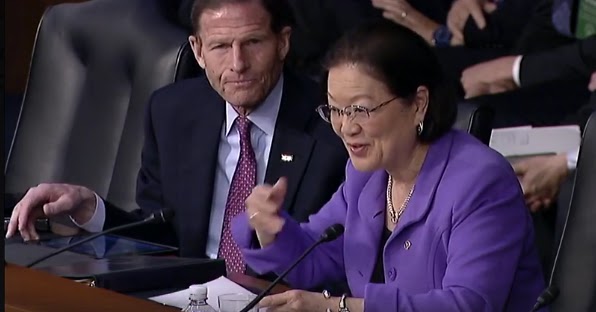
SEN. MAZIE HIRONO TRIED TO DRAW out Judge Neil Gorsuch's judicial philosophy during the third day of  the Supreme Court nominee's confirmation hearings on Wednesday. Gorsuch held back and declined to opine.
    During the hearing, Hirono said that many of her colleagues across the aisle called the Gorsuch confirmation hearing an endurance test. "The real endurance test," she told Gorsuch, "is about the struggle facing working families, women, people of color, the LBGTQ community, immigrants and native peoples. It's about the struggles that everyday Americans have to face. These are the people who will be impacted by the decisions you would make on the Supreme Court. These are the people for whom the need for justice is often most urgent. These are the people I'm focused on when I consider your nomination and any nomination to the Supreme Court. It remains to be seen if you would be a justice for all or a justice for some." 
Sen. Mazie Hirono questioning Judge Neil Gorsuch during his confirmation hearing Wednesday,
alongside Sen. Richard Blumenthal
     Hirono continued to ask Gorsuch for his personal feelings about issues: "Over the last few days you have often told us about what counts and what does not in terms of what a justice should do and how we should assess your nomination. When other senators and I have asked about your opinions... "you have told us to look at your whole record. When we asked about decisions where you seemed to adopt strange interpretations that narrowed laws meant to protect worker safety, you said you are a judge and don't take sides. And that if a statute was too limited, Congress should do better."
     She gave examples of decisions for him to explain, including "a decision that left thousands of women being without health care" when a company said religious beliefs prevented it from offering family planning health services.
     Hirono also said it was particularly important to know Gorsuch's judicial philosophy since President Donald Trump said he wanted a justice who "would adhere to a broad view of the Second Amendment and would overturn Roe v Wade for him, automatically." Gorsuch refused to comment on Trump and throughout the three days of hearings, insisted he was his own man and would make decisions independent of the President.
    Hirono pressed Gorsuch, saying he knows that judicial philosophy matters. "Of course it does," she said. "That is why we are so focused on understanding your judicial philosophy and getting beyond platitudes about the judicial role. That is why this confirmation process matters. This is serious business," stated Hirono.
    She pointed out that Gorsuch asked the Senate confirmation committee over and over again to focus on his whole record as a judge and not certain cases, "or certain of your writings and books or articles and emails." She said Republican colleagues suggested that it is "unfair to look at those things to discern how you would approach cases if confirmed. Some have even gone so far as to conflate the questions we are raising about your record in the courts in our advice and consent responsibility with Donald Trump's abhorrent attacks on federal judges." She noted that Trump repeated his attack on Judge Derrick Kahala Watson - the Hawaiian judge who ruled to stop the nationwide travel ban - during a Tuesday night  $30 million fundraiser for congressional Republicans.
     Hirono said she is particularly concerned with voting rights and pointed to the landmark 2013 Shelby County case. This case eliminated a Voting Rights Act provision that required federal clearance for certain states that had practiced discrimination to change voting laws and practices. She asked for Gorsuch's opinion and he declined. He said there were other remedies, including Congressional legislation.
Judge Neil Gorsuch, responding to Hawai`i Senator Mazie Hirono's questioning during his
Senate confirmation hearing Wednesday.
     Regarding the voting rights case, Hirono contended that the Supreme Court got it wrong and Congress got it right. "The real life impact of the Shelby county decision was that 13 states passed laws that could be deemed voter suppression laws." She said "the first state was Texas, which intentionally passed a discriminatory law."   
     Said Hirono, "We learned in that decision that it matters a great deal for our rights what is the judicial philosophy or .....core beliefs of the judges to serve on the Supreme Court.  She talked about judicial philosophy being developed through life experiences and education. She said the if judges were mainly using precedent, then "why would we have so many five to four decisions in critical cases?"
     Hirono concluded her questioning by saying, "Judge Gorsuch, I wish I could say that this hearing has been illuminating by what was said by you. Instead, I'm left to judge your nomination largely by what you refused to say." 
    The testimony of Gorsuch was completed Wednesday, the Senate committee will hear statements on his behalf Thursday and his confirmation vote is expected April 3.

To read comments, add your own, and like this story, see Facebook. Follow us on Instagram and Twitter.


Exploring Tunnel Books, Sat, Mar 25, 9 a.m. – 12 p.m., Volcano Art Center. Participants take a trip down the rabbit hole with Charlene Asato. $35/$32 VAC members plus $10 material fee. 967-8222

Ecstatic Dance, Sat, Mar 25, 2 – 4 p.m., Volcano Art Center. Participants discover a dynamic way to work out and meditate with Jo Caron. $15 or $20 at the door. 967-8222

Mongolian BBQ, Sat, Mar 25, 5 – 8 p.m., in the Crater Rim Café, located in Hawaii Volcanoes National Park. Pick what you want for $.85 per ounce from an array of veggies and proteins. Call 967-8356 for more details. KMC is open to all authorized KMC patrons and sponsored guests. Park entrance fees apply.

Coffee Talk, Fri, Mar 31, 9:30 – 11 a.m., Kahuku Unit of Hawai`i Volcanoes National Park. A monthly series of talks on various subjects. nps.gov/havo or 985-6011
www.kaucalendar.com