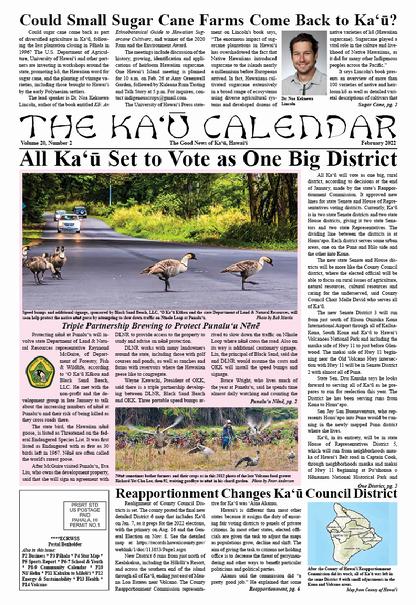
About The Kaʻū Calendar

Tuesday, February 15, 2022

Ka‘ū News Briefs, Monday, Feb. 14, 2022

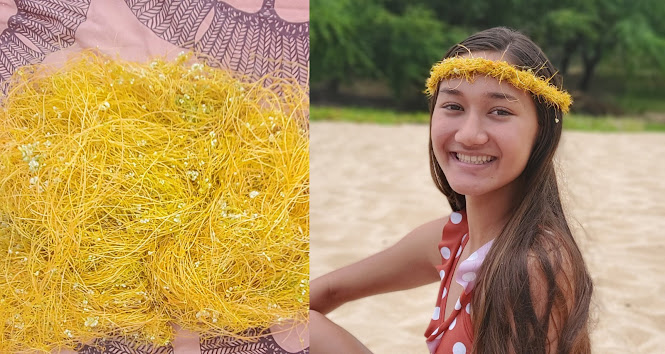
Haumana Pōmai Kauahi-Daniels learned to make lei hili kaunaʻoa from her mother and is included in Kamehameha Schools
online description of lei making at https://www.ksbe.edu/article/na-ano-hana-lei-types-of-lei-making/

KAUNA'OA IS THE PLANT OF THE MONTH for the February edition of La'au Letters: Native Plants of Ka'u. The monthly column invites an artist to illustrate Kaʻū's native plants and a writer for their moʻolelo (stories), uses, preferred habitats, and opportunities to adopt them for stewardship. It seeks to 
encourage making new plant friends and to reunite with others.
    Description: Kaunaʻoa Cuscuta sandwichiana is the only endemic member of the Cuscuta (Dodder) genus in the morning glory family, Convolvulaceae (along with last month's feature and long-time friend 
of kaunaʻoa, pōhuehue).
    This vine has thin and leafless stems which are a bright yellow-orange and lack chlorophyll, thus unable to photosynthesize (in other words, it cannot make its own food necessary for survival like most plants). Instead, it parasitizes a host plant by winding its above-ground root-like organs (called haustoria) tightly around its stem, penetrating the plant stems and extracting sustenance for continued growth, flowering, fruiting, and seed production.
Marine kinolau (forms) of kaunaʻoa include the variable worm snail Serpulorbis variabilis, the medusa spaghetti worm Loimia medusa, and the calcified seaweed Galaxaura rugosa.

    Uses: Medicinally, kaunaʻoa can be combined with other lāʻau to treat chest colds, flush the gastrointestinal tract, and assist women in pre and post childbirth. Non-medicinally, the slender orange stems are used in lei to represent the island of Lānaʻi, as well as used in lei haku.
Historically, kaunaʻoa was spread over mālolo (flying fish) in the canoe to prevent them from escaping.          
    Habitat: Kaunaʻoa grows in coastal areas with sandy soils, from sea level to almost 1,000 feet elevation, where it parasitizes a variety of indigenous and endemic plant species on all of the main Hawaiian Islands (except Kauaʻi and Kahoʻolawe).
An ʻōlelo noʻeau from Mary Kawena Pukui refers to the ability of kaunaʻoa to grow so thickly in some places that it covers the leaves of kukui and other trees: "Kaunaʻoa pālaha kukui o Kamehaʻikana." Locally, kaunaʻoa can be seen growing among the pōhuehue (and other native coastal species) along the less impacted portions of the Kaʻū coastline.
    Growing and Purchasing: Small (1/16"), white, bell-shaped flowers dangle in clusters along the golden vines containing even smaller seeds which are dark reddish brown. Seeds can be germinated by simply smearing onto the stems of a host plant (think: smear them on that weed patch or invasive tree).
    Kaunaʻoa also grows easily from cuttings. When growing kaunaʻoa for home gardens / landscaping, please be mindful of what it is growing on, and avoid planting on rare or prized plants. It may be difficult to purchase kaunaʻoa from a nursery, so if interested in kaunaʻoa caretaking and befriending, please contact the author. 
    About the artist: Joan Yoshioka says she is a conservationist at heart and has dedicated her life to preserving the native plants and animals of Hawaiʻi through her work with federal, state, and private organizations over the past 30+ years. She describes herself as an outdoor-lovin' optimist, biologist/ botanist, and habitual creator of art-stuff. She says the key to our most fundamental and truest part of ourselves is found in nature and she constantly draws on it for inspiration.
    About the author: Jodie Rosam says she has a deep love for native plants and a passion for exploration, with over 15 years of experience in working in the restoration of Hawaiʻi's forests. As a mother and an educator, she says the next generation has the power to lead the world to a sustainable future, and is committed to teaching her children (and others) from a place-based perspective.

To read comments, add your own, and like this story, see www.facebook.com/kaucalendar/. See latest print edition at www.kaucalendar.com. See upcoming events and Kaʻū Calendar newspaper sponsors at http://kaunewsbriefs.blogspot.com/2022/02/events-of-february-2022.html.

One of the many live Kaʻū Coffee Festivals before COVID, which led the event to go virtual.
Hawai'i Tourism Authority has announced funding for this year. Photo from 
Kaʻū Coffee Festival

HAWAI'I TOURISM AUTHORITY HAS PROVIDED A GRANT FOR THIS YEAR'S KAʻŪ COFFEE FESTIVAL as part of its $2.9 million in funding for its Community Enrichment Program for 2022.
     According to an announcement from HTA, Big Island Resource Conservation and Development Council was selected to receive an HTA grant to provide funds for the Kaʻū Coffee Festival for 2022.
    More details will go public as plans evolve, according to organizers. Due to Covid, the last live Kaʻū Coffee Festival was 2019, with the 2020 Festival a virtual event going online at the end of 2020, also with funding from Hawai'i Tourism Authority.              
    The 2020 presentation includes a farm tour video with interviews of several growers, including Melchor Fernandez, Willie Tabios, Bong Aquino, Gloria Camba and Delvin Navarro. See https://www.facebook.com/Kaucoffeefestival/videos/397455951517930
     The Kaʻū Coffee Festival website also provides photos and short descriptions of Cory and Connie Koi's Elepoki Enterprises coffee farm, Joseph Ashley's J&W Farm, Carlos Predez's K&J Farm, and Widow Martinez's Widow Farm. See https://www.kaucoffeefestival.com/farms.
     The virtual Festival also included separate videos of Lorie Obra and family's Rusty's Hawaiian Coffee, Miles Mayne of Sliver Cloud Coffee Farm, Delvin Navarro and his Monarch Coffee and Dennis Albert's Kaʻū Mountain Farm with manager Alla Kostenko. 
    Also featured is one of the long-time organizers of Kaʻū Coffee Festival, Chris Manfredi; a Brewing Demonstration; the virtual Coffee College; and a video of Kumu Hula Debbie Ryder's Halau Hula O Leionalani with music by the local group Keaiwa.  See www.kaucoffeefest.com.
Lorie Obra is one of the featured farmers in the online Kaʻū
Coffee Festival of 2020. Photo from 
Kaʻū Coffee Festival
    Links to buy Kaʻū Coffee go to Big Island Coffee Roasters, Kaʻū Coffee Mill, Kona Roasted, Paradise Roasters, Rusty's Hawaiian, and Silver Cloud Coffee Farm. The stores and cafe's listed as selling Kaʻū Coffee are: HiCo and Starbucks - Reserve Line. See https://www.kaucoffeefestival.com/buykaucoffee.
    Regarding other coffee events on this island, Hawai'i Tourism Authority is funding Kona Coffee Festival this year, which is going live in November. Another live coffee event to return this year is Hawai'i Coffee Association's annual Conference and Cupping Contest in May.  
    A statement from Hawai'i Tourism Authority says funding this year is supporting community-based projects, festivals and events. "Recipients include nonprofit organizations that are supporting quality experiences created by the communities to be shared with residents and visitors. The Community Enrichment Program supports an array of festivals, events and programs in the areas of agriculture, culture, culinary, nature, education, health and wellness, sports, and voluntourism."
    Kalani Ka‘anā‘anā, HTA’s Chief Brand Officer, said, “Our Community Enrichment Program enables the Hawai'i Tourism Authority to serve as the connecting point between tourism and meaningful economic diversification by reinvesting in these community-based experiences spanning various industries. We are proud to support the efforts of our residents in their communities, as these festivals and events are an integral part of Hawaii’s lifestyle and multi-cultural brand.”
Funding from Hawai'i Tourism Authority has been approved
to go to Big Island Resource Conservation and Development
 Council for this year's Kaʻū Coffee Festival.
Photo from 
Kaʻū Coffee Festival
    The HTA statement says, "The Community Enrichment Program is a part of HTA’s commitment toward Malama Kuu Home (caring for my beloved home) and the Community pillar of its 2025 Strategic Plan. Since 2017, HTA has invested over $3.8 million to support more than 200 community projects and events.
    "HTA partnered with the Hawai'i Visitors and Convention Bureau and the Island Chapters to administer its Community Enrichment Program for 2022. A request for proposals was issued on Sept. 27, 2021 with submittals from applicants received by Nov. 5. Proposals were reviewed thoroughly by a committee on each island comprised of representatives from the respective Island Chapter, County, and HTA," says the HTA statement.
    John Monahan, HVCB’s President and CEO, said, “The Community Enrichment Program supports events and programming organized and implemented by members of our own Hawai'i communities. From a hospitality standpoint, these events not only provide our visitors with authentic and meaningful experiences, but also create opportunities for the community to participate in actively shaping Hawai'i’s visitor industry. It is a privilege to support these local events that bring people together in celebration of our islands’ diverse culture.”
    See more projects in Kaʻū and Volcano supported by the HTA Community Enrichment Program in upcoming stories.

To read comments, add your own, and like this story, see www.facebook.com/kaucalendar/. See latest print edition at www.kaucalendar.com. See upcoming events and Kaʻū Calendar newspaper sponsors at http://kaunewsbriefs.blogspot.com/2022/02/events-of-february-2022.html.

FREE HELP WITH FAMILY HISTORY in Kaʻū is available 4 p.m. to 7 p.m. every Tuesday. All are welcome to the Family History Center. The aim is to "Come Discover Your Past," says the statement from The Church of Jesus Christ of Latter-day Saints, which hosts the weekly sessions at 95-5682 Hawaiʻi Belt Road in Nāʻālehu. The drop-in assistance includes free Ancestry.com, Familysearch.org, and other online resources.

PRESIDENT’S DAY EAGLE CRAFT at Kaʻū District Gym & Pāhala Community Center. Wednesday, Feb. 16, 2:30 - 4 p.m. Open to grades K to 6. Register for free from Feb. 10 to 15. For more information and to register, contact Recreation Director, Nona Makuakane at (808) 928-3102.

ROOT & RISE PRESENTS: NATURE AND ART AS THERAPY, Friday, Feb. 18, 10:30 a.m. - 12 p.m. This is a free group that uses interaction with nature, creativity, and community to address mental health wellness, awareness, and destigmatization. To reserve a spot or for more info, call 617-543-8065.

MASK MAKING AT VOLCANO ART CENTER, Saturday, Feb. 19, 10 a.m. - 1 p.m. Learn the basics of paper mask-making with artist Lee Michael Walczuk at Volcano Art Center, Niaulani Campus. Workshop fee is $35/$30 VAC member plus a $8 supply fee. Register online at volcanoartcenter.org/events/.

Sunday, February 13, 2022

Ka‘ū News Briefs, Sunday, Feb. 13, 2022

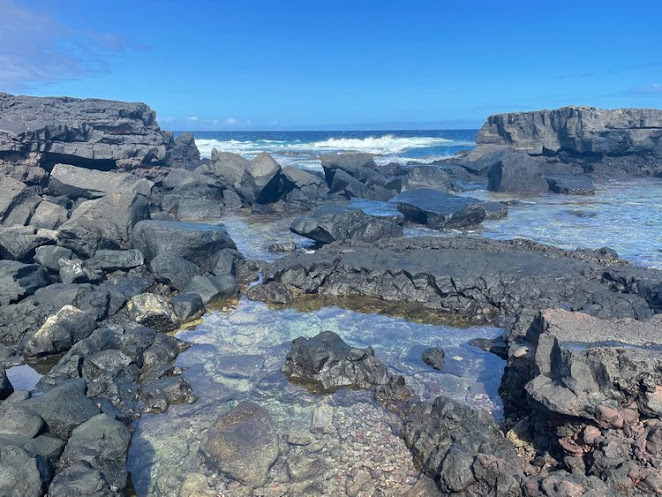
The coastlines of Waikapuna "are an intricate network of native flora and fauna, to be protected and cherished by our 
community," says the non-profit stewardship group Ala Kahakai Trail Association. Public input on the 
Waikapuna Resource Management Plan for this area along the Kaʻū Coast is welcomed. Photo from ATA

WAIKAPUNA RESOURCE MANAGEMENT PLAN materials are online for folks who want to help determine the future stewardship for the 2,317 acres in the ahupua'a of Kahilipalinui and Kalihipali'iki. The planning resources include meeting notes, a slideshow and recording of an online gathering that was held Jan. 26 to explain the process of developing a Resource Management Plan and to receive public input.
    The lands include a section of the Kaʻū Coast toward South Point from Honu'apo, makai of Nāʻālehu. The land was recently preserved with county, state and private donations through a purchase that puts it under the ownership of Ala Kahakai Trail Association with a conservation easement owned by Hawai'i County that protects it from development. The process of acquiring the land was facilitated by The Trust for Public Land.
    Gabrielle Sham, representing Townscape, a small community and environmental planning firm, was hired to help develop the Management Plan, noting some of the history of Waikapuna. She said that "Waikapuna has been subject to the threat of development, especially after the closure of the plantation. There were proposed plans for a spaceport in this area in the late 1980s. Several years later, there were proposed plans for a commuter airport facility. The most recent proposed development consisted of a subdivision development with 22 lots."

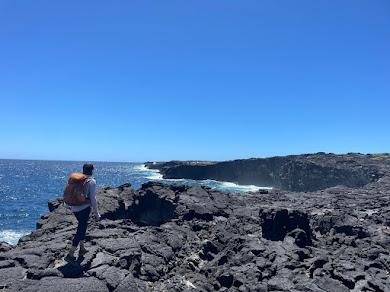
How open and closed should the access be to Waikapuna?
This is one of the many subjects being studied in the
process of creating its Resource Management Plan.
Photo form ATA
    She also noted that "There were previous discussions with the State, County, and National Park Service to see if they would be interested in taking ownership of these lands, but at that time, these entities did not feel they had the capacity to oversee and manage these lands. In 2016, Ala Kahakai Trail Association was approached and asked if they would accept this kuleana of ownership."
    Elements to be addressed by the management plan include: the wahi pana and cultural landscape: marine and coastal resources; native and endangered bird species habitat; native and endangered plant species; ranching; and managed community access.
    The Townscape representative said areas of concern shared by stakeholders include: Community access; fire risk; damage to cultural and. historic sites; marine debris and trash; invasive plant and animal species; climate change and safety.
    The online presentation documents many comments, questions and concerns from the community, including: "There is a lot of talk and worry about if this place is for subsistence gathering...why is there a locked gate? But I think that the gate is good because it protects it. South Point is an example of a place that has been desecrated. Controlled access would keep the integrity and beauty of the place."
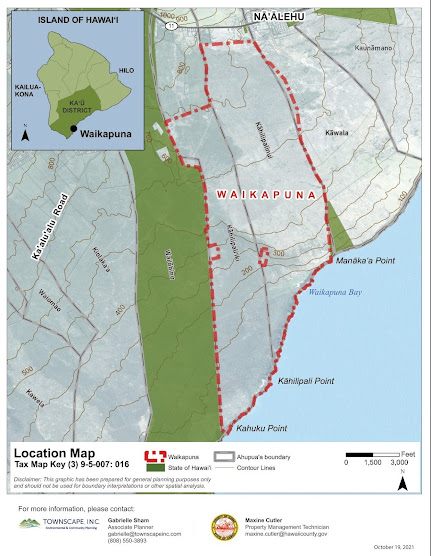
Waikapuna covers two ahupua'a and is subject of a community
driven creation of a Resource Management Plan.
Map from Townscape
    Another of the many suggestions is to involve "Kupuna of these places who can educate people of the sacredness of these gathering area." Another comment: "I have been going to Waikapuna over the last 50 years. Born and raised in Nāʻālehu. It's a small place, as far as the beach is concerned, so I favor limited access because it's easy to overrun this place. Overnight camping: no more than three vehicles at a time There's no more room."
    Another commenter recommended preference for local people to access during the week. "My understanding is only weekends are allowed for camping. People who live in Nāʻālehu, Waiohinu and Pāhala deserve some special preference. Especially those who are subsistence gatherers. Not sure how to do that."
    Another said, "A lot of these people at these meetings are not talkers. I'm most worried about the young men who are listening and hearing that they cannot go hunt or fish. When you take away hunting and fishing from our young people; that's how they save money and feed their families and share with other families."
    Watch a YouTube recording of the meeting at https://www.youtube.com/watch?v=_xhcq-tS3N0
    Find links for commenting and read many more of the comments from the participants at www.records.hawaiicounty.gov/weblink/1/edoc/114396/Waikapuna%20-%20Community%20Meeting%20Notes%20-%20Townscape%20Draft%20(2022-01-26).pdf.
    See a slideshow with maps and other planning tools at http://records.hawaiicounty.gov/weblink/1/edoc/114397/Waikapuna%20RMP_Community%20Mtg%201_Townscape%20Slideshow%20(2022-01-26).pdf

To read comments, add your own, and like this story, see www.facebook.com/kaucalendar/. See latest print edition at www.kaucalendar.com. See upcoming events and Kaʻū Calendar newspaper sponsors at http://kaunewsbriefs.blogspot.com/2022/02/events-of-february-2022.html.

GOING LIVE FOR 2022 IS THE HAWAI'I COFFEE ASSOCIATION'S CONFERENCE, TRADE SHOW AND CUPPING CONTEST, May 19 - 21 at Outrigger Keauhou Bay Hotel in Kailua-Kona. 
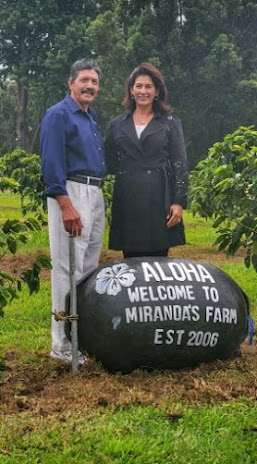
Jose and Berta Miranda took first for the Kaʻū region
in the HCA cupping contest last year. Registration
 is open for 2022. Photo from Miranda's Farm
      During last year's HCA Cupping Contest, Miranda's Farm, with orchards above Pāhala and near South Point Road, took first in Kaʻū with its Red Catuai Natural scoring 86.60. It was followed by Rusty's Hawaiian’s Red Bourbon Natural scoring 86.22 with coffee grown above Pāhala. Tied for third were Kaʻū Mountain Farm with its Typica & Caturra Natural scoring 84.25, its coffee grown in Wood Valley, and Aloha Star, with its Typica Washed, scoring 84.25 with coffee grown above Nāʻālehu.
    For the 2022 cupping competition, coffee growers can register now and submit their green coffee later. Submissions of the coffee begin on Friday, April 1 and must be received by Friday, April 29 at 4 p.m. The fee is $75 per entry.
    The fee to attend the Hawai'i Coffee Association convention, with full registration, is $300 per person, with day passes $135 per person on Friday and $235 on Saturday, which includes the conference dinner. 
    Sponsorships range from $75 to be listed in the Conference program with mention on social media to $2,000 to be the named sponsor of the welcome reception plus other benefits.
    Kaʻū Coffee growers listed as members on the HCA website are: Kaʻū Coffee Mill, Kaʻū Mountain Farm, Island Custom Coffees, Rusty's Hawaiian Coffee snd Waiohinu Farms.       
    Coffee broker Chris Manfredi, of Kaʻū Farm & Ranch, who served as HCA president for years, is the Executive Director, and Alla Kastenko, of Kaʻū Mountain Farm, is the administrator. Tommy Greenwell is the new President of HCA.
     To register for the convention, sponsor and join HTA, see https://hawaiicoffeeassoc.org/

To read comments, add your own, and like this story, see www.facebook.com/kaucalendar/. See latest print edition at www.kaucalendar.com. See upcoming events and Kaʻū Calendar newspaper sponsors at http://kaunewsbriefs.blogspot.com/2022/02/events-of-february-2022.html.

ENTREPRENEURS, STARTUPS, AND THE BOOMING FOOD WASTE BUSINESS, Monday, Feb. 14, 10 - 11:30 a.m. A virtual forum hosted by Maui Business Brainstormers to generate solutions for food waste on a local and global scale. To RSVP, visit https://www.natleshipweek-hawaii.org/feb-14-2022---food-waste---maui-hawaii.html.

VALENTINE CARDS at Nāʻālehu Community Center, Monday, Feb. 14, 4 - 5 p.m. Open to ages 8 through 12 years old. Register for free from Feb. 3 - 7. For more information, contact Recreation Director, Richard Karasuda at (808) 939-2510.

CELEBRATION OF LOVE, Monday, Feb. 14, 6 - 9 p.m. Hosted at Earthsong Foundation on South Point Road, this special event will feature sound healing, cacao, and a fire circle. Event is by donation $22-$33.

FREE HELP WITH FAMILY HISTORY in Kaʻū is available 4 p.m. to 7 p.m. every Tuesday. All are welcome to the Family History Center. The aim is to "Come Discover Your Past," says the statement from The Church of Jesus Christ of Latter-day Saints, which hosts the weekly sessions at 95-5682 Hawai'i Belt Road in Na'alehu. The drop-in assistance includes free Ancestry.com, Family search.org, and other online resources.

PRESIDENT’S DAY EAGLE CRAFT at Kaʻū District Gym & Pāhala Community Center. Wednesday, Feb. 16, 2:30 - 4 p.m. Open to grades K to 6. Register for free from Feb. 10 to 15. For more information and to register, contact Recreation Director, Nona Makuakane at (808) 928-3102.


SEE MORE CALENDAR OF EVENTS & SPONSORS
See the February Print Edition of The 


Saturday, February 12, 2022

Ka‘ū News Briefs, Saturday, Feb. 12, 2022

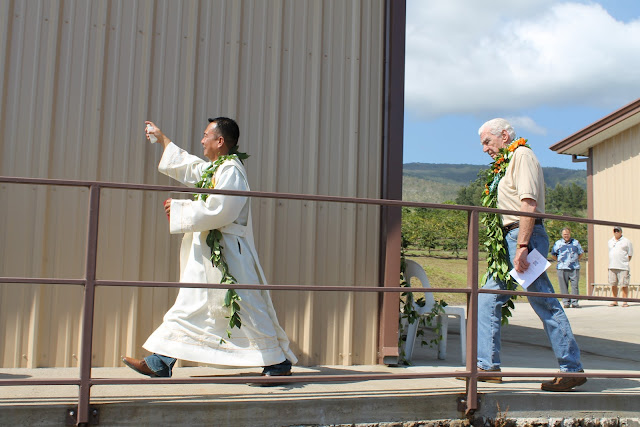
Father Joel blessed Kaʻū Coffee Mill for owner Edmund C. Olson in 2012. This week, Olson closed on selling
 his Olson Trust headquarters at Wainaku in Hilo for another agricultural processing venture, Okolehao
 by Ola Brew. Photo by Geneveve Fyvie

AN OKOLEHAO DISTILLERY is the plan for Edmund C. Olson's headquarters on Hilo Bay. The owner of Kaʻū Coffee Mill, coffee farms and macadamia orchards, including some 8,000 acres in Kaʻū, sold its Wainaku Executive Center to Ola Brew, the maker of beers, ciders, hard seltzers and hard teas. The deal closed Friday morning, said Olson.
     Wainaku Executive Center is a former sugar warehouse that was renovated by the late J.W.A "Doc" Buyers, the last CEO of the C. Brewer & Co. agricultural company. He moved moved the C. Brewer headquarters from Honolulu to to Wainaku in Hilo.
    C. Brewer owned some 38,000 acres in Kaʻū, including some 8,000 around Kaʻū purchased by Olson. Olson bought macadamia orchards, pastures and sugar lands from Brewer and started  processing and growing coffee and macadamia. He also bought Brewer's headquarters at Wainaku in 2012 after C. Brewer shut down.    
    The new venture at Wainaku will be owned and led by Ola Brew, and preliminary plans call for a distillery and growing ti plants on the property. A tasting room for Okolehao and Ola Brew's other products is planned, according to Olson Trust representatives.
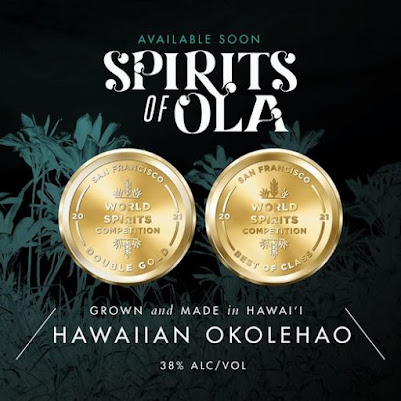
    Ti used for Okolehao also provides the leaf for wrapping food for cooking in imu and steaming laulau, as well as making ti leaf lei. For Okolehao, ti provides the root from which distilling makes the alcoholic drink. Ola Brew has already started growing ti on the island and has won awards. For its Okolehao spriits, Ola Brew last year took Double Gold and Best in Class in the @sfworldspiritscompetition. An Ola Brew statement explains the background: 
    "What is Okolehao? Brewed and then distilled from 100% Hawaiian grown ti root. Okolehao was the first alcohol produced and consumed in Hawai'i centuries ago. Once the ti root is harvested, we roast it to
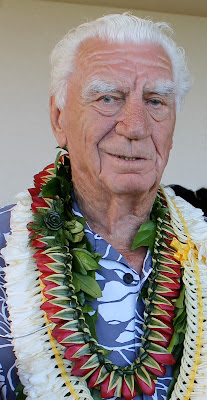
Ed Olson at the blessing of the Wainaku
 Center in 2012. It is soon to become a
distillery for Okolehao. Photo by Julia Neal


break down and release its sugars, giving us a caramelization that enhances the unique earthiness of the spirit with layers of flavor and a lingering subtle sweetness.
    "Every part of the ti plant, from the root to the leaves, has been used for centuries throughout Polynesia. In Hawai'i we use them for lei making, food preservation, medicinally and in ceremony, and of course in Okolehao. But here is the kicker! Ti just so happens to be in the same family as agave, which is the signature crop for the production of tequila!
    "Ola Brew is so very excited to perpetuate the traditions of Okolehao production using organically and responsibly grown ti, cultivated right here on Hawai'i Island!"
    Ola Brew's facilities already include a brewery, taproom and restaurant in Kona and a taproom and restaurant in Hilo. 
    According to Ola Brew, "Hawaiian Ola Brewing Corporation (dba Ola Brew) is a brewery with a focus on ethical and growth-oriented sourcing, working every day to help Hawai'i farmers increase their demand by ensuring a guaranteed market for their crops. We’ve successfully grown a brand of over 25 beverages in Hawai'i, including beers, hard ciders, and hard seltzers."
    See more on Ola Brew at www.olabrewco.com.

To read comments, add your own, and like this story, see www.facebook.com/kaucalendar/. See latest print edition at www.kaucalendar.com. See upcoming events and Kaʻū Calendar newspaper sponsors at http://kaunewsbriefs.blogspot.com/2022/02/events-of-february-2022.html.


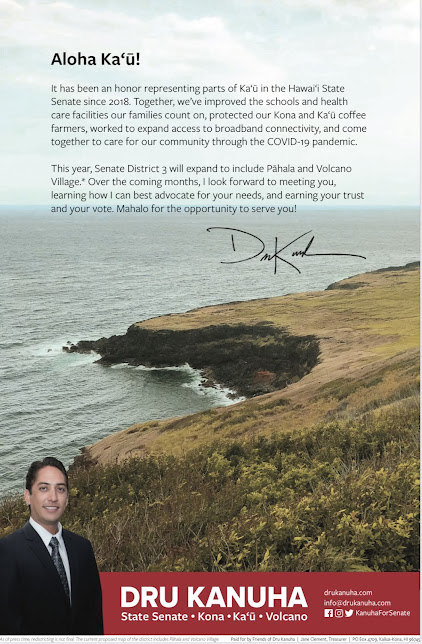
STATE SENATOR DRU KANUHA who represents west Kaʻū into Kona, is reaching out to all of Kaʻū in anticipation of running for reelection. He has placed a message in The Kaʻū Calendar newspaper, February edition, saying:
      "It has been an honor representing parts of Kaʻū in the Hawai'i State Senate since 2018. Together, we've improved the schools and health care facilities our families count on, protected our Kona and Kaʻū coffee farmers, worked to expand access to broadband connectivity, and come together to care for our community through the COVID-19 pandemic."
     This year, Senate District 3 will expand to include Pāhala and Volcano Village. Over the coming months, I look forward to meeting you, and learning how I can best advocate for our needs, and earning your trust and your vote. Mahalo for the opportunity to serve you!"

To read comments, add your own, and like this story, see www.facebook.com/kaucalendar/. See latest print edition at www.kaucalendar.com. See upcoming events and Kaʻū Calendar newspaper sponsors at http://kaunewsbriefs.blogspot.com/2022/02/events-of-february-2022.html.

STATE SENATOR JOY SAN BUENAVENTURA continues to serve east Kaʻū through the 2022 Hawai'i Legislature. This year, she is expected to run for reelection for a district outside of Kaʻū, following  reapportionment changing district lines. The district now served by Sen. Dru Kanuha will change to reach into Volcano and include all of  Kaʻū.
     In wrapping up her service here, San Buenaventura sent out a survey card through U.S. Mail this week and asks:
Sen. Joy San Buenaventura is in her
last term serving Kaʻū, with her
district borders moving east
.
      "What do you think is the most important issue facing our community?" The choices are Food Insecurity, Lack of Support for Educatio, Lack of Childcare, Lack or Work Opportunities/Trainin; Traffic, No Internet Access - No Coverage Area, and Increase of Crimes.
      San Buenaventura also asks about infrastructure needs, including Poor Internet Access, No Alternate Roads and a fill-in-the-blank. "What is your biggest issue?" asks the senator, with the query, "What would promote a better quality of life for you in our community?"
      The answers can be given online at https://tinyurl.com/202202-D2survey.

To read comments, add your own, and like this story, see www.facebook.com/kaucalendar/. See latest print edition at www.kaucalendar.com. See upcoming events and Kaʻū Calendar newspaper sponsors at http://kaunewsbriefs.blogspot.com/2022/02/events-of-february-2022.html.
 
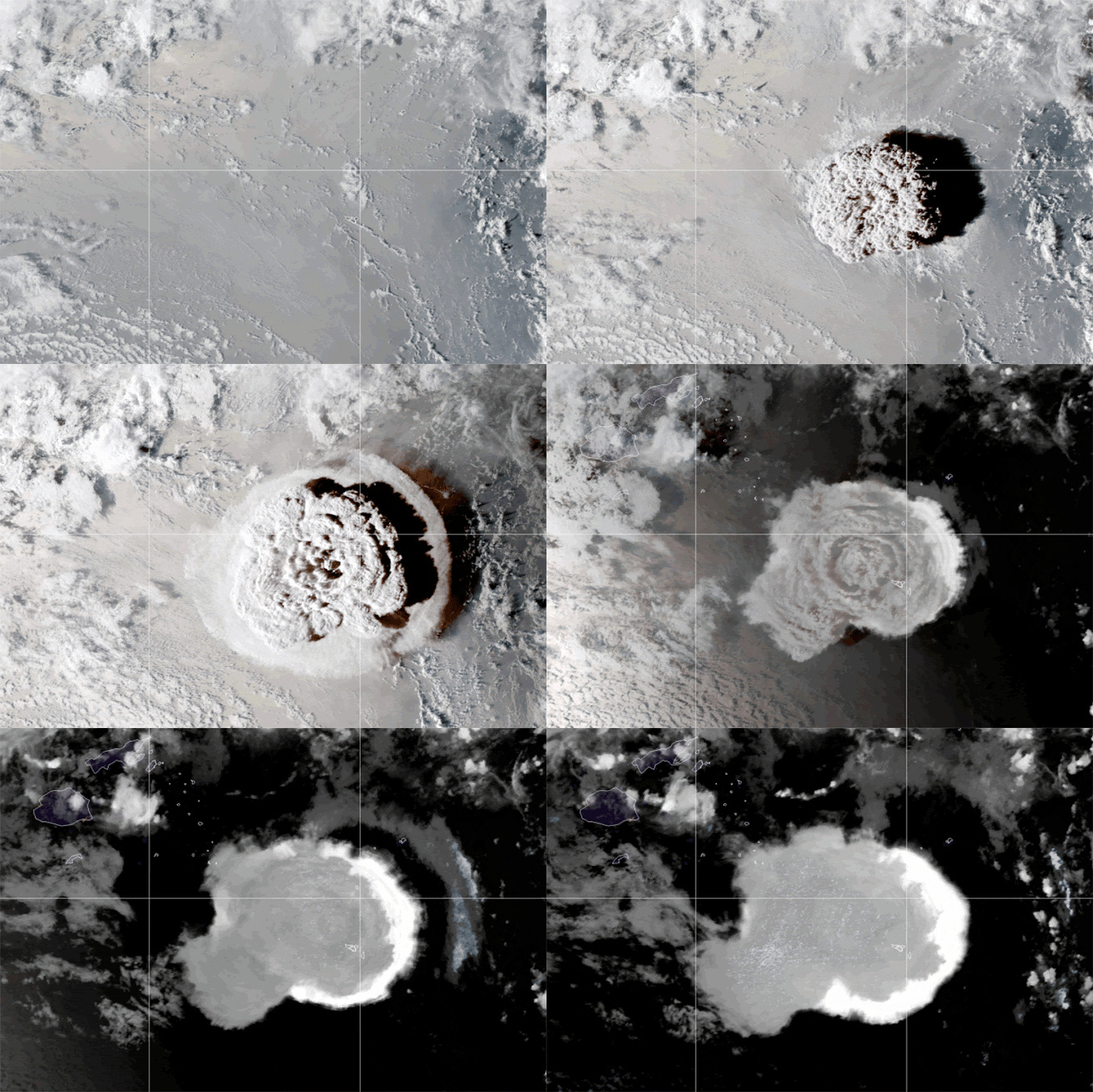
THE VOLCANO ERUPTION AT HUNGA TONGA-HUNGA HA'APAI on Jan. 15 was recorded on this island. That is the subject of this week's Volcano Watch, written by USGS Hawaiian Volcano Observatory scientists and affiliates:
    Hunga Tonga-Hunga Ha’apai volcano located in the Kingdom of Tonga produced a powerful eruption on Jan. 15 just after 5 p.m. Tonga Time. The Tonga eruption was recorded on pressure sensors over a wide number of places around the world, including the Island of Hawai‘i about 4,900 kilometers (3,000 miles) away.
Eruption of Hunga Tonga-Hunga Ha'apai captured by NASA satellites and by pressure 
sensors on Hawai'i Island. Images from NASA


   Hunga Tonga-Hunga Ha’apai is located about 64 kilometers (40 miles) north of the Tongan capital city of Nuku’alofa. As with many volcanoes in Tonga, the part of the volcano that is visible above water is small compared to the submarine extent of the edifice and eruptions can alternately grow new land or destroy any islands that are formed.
   The volcano previously erupted in 2014-2015 in an extended sequence that created one larger island by connecting two separate islets. After this episode, the volcano went into a quiet period but it re-awakened in mid-December 2021.
   The largest eruption occurred on Jan. 15 from about 5:10 to 5:30 p.m. TOT, about 6:10 to 6:30 p.m. Hawaii Standard Time on January 14, and shot ash and hot gas tens of kilometers (several miles) into the atmosphere. Several centimeters (about 1 to 3 inches) of ash was deposited on the main island of Tongatapu and Nuku’alofa.
   The skyward rushing ash column was amongst highest observed in modern times and this column generated strong air pressure waves which moved up from the volcano and spread outward from Tonga. Incredibly, the air pressure waves were observed over the entire Earth and people in Alaska (nearly 10,000 kilometers or 6,000 miles away) heard sounds from the eruption. How was this possible?
    Volcanic eruptions produce significant pressure waves from the ejection of rocks and ash. These pressure waves in the air can occur at many different frequencies, from very high frequencies that we hear as sounds (audible) and at lower frequencies that we cannot hear at all (called infrasound). Both types of waves were generated by the recent eruption in Tonga.
    The pressure waves might dissipate quickly if the Earth's atmosphere were uniform. Instead, the atmosphere is layered, and these layers help sound to move efficiently. For pressure waves, the layers relate mostly to the temperature and wind speed of the air and the efficient movement of these waves occurs in the layers called the troposphere, stratosphere and thermosphere.
    The speed that pressure waves travel through the Earth’s atmospheric layers is about 1,100 kilometers or 700 miles per hour. At those speeds it would take a little more than 4 hours for the sound to travel from Tonga to Hawaii.
    The USGS Hawaiian Volcano Observatory operates a set of microphone-like pressure sensors that are deployed to "listen" to our own volcanoes. If there is a large global eruption, and the atmospheric conditions allow, then that eruption can also be captured on the HVO pressure sensor network.

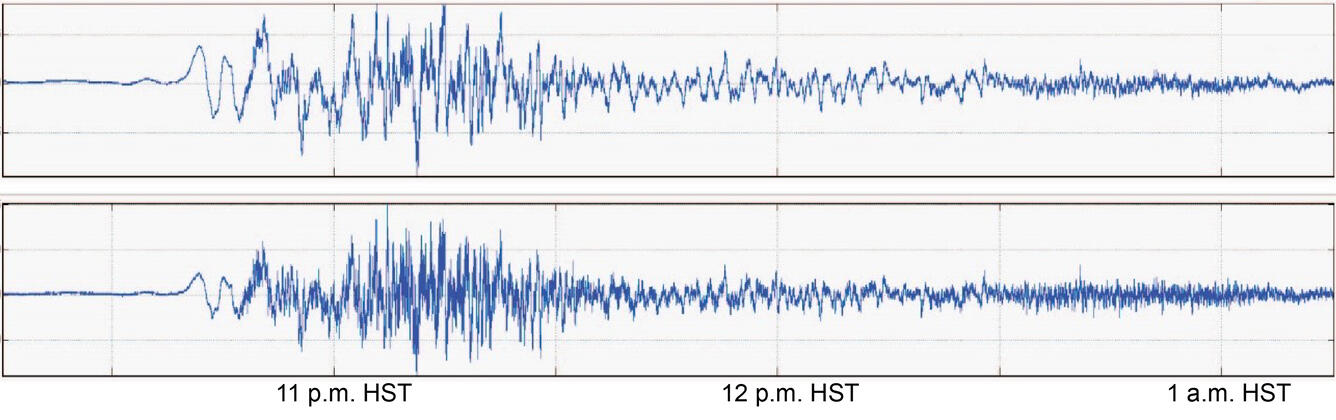
Pressure waves from the Hunga Tonga-Hunga Ha’apai eruption on Jan.  15 recorded on two USGS Hawaiian Volcano Observatory infrasound sensors located south of Kīlauea volcano summit. The record is about four hours long. USGS graphic.

    If we look at the pressure sensor data for the time about four hours after the recent Tonga eruption, we see a large pressure pulse moving over Hawaii (see the two sensor recordings in the figure) at 10:40 p.m. HST on January 14. While Hawaii’s pressure sensor network is designed to detect eruptive activity for Mauna Loa, Kīlauea, and along the Hawaiian rift zones, it also captured the sound waves from the distant Tonga eruption.
    Close inspection of the waves observed in the figure illustrates the idea of audible and infrasound waves discussed earlier.
    The pressure waves are wider at the start of the event and become narrower with time. Since the plot shows wave size with time, this means the earlier waves (left side of the plot) show slow changes of pressure with time. With more time passing, the wave pressure oscillates more quickly. This means that the first waves are low frequency, and the later waves are higher frequency.
    The human ear can generally hear pressure changes higher than about 20 cycles per second (or 20 hertz). Most of the waves shown in the plots are very low frequency and would not be detected by the human ear.
   In Hawai'i, there were no reports of the Tonga eruption being heard, but they were seen traversing the atmosphere on top of Mauna Kea.
    The observation of audible sound waves in Alaska and inaudible waves elsewhere is a topic of interest from scientists, who are looking at the ways that pressure waves propagate in the atmosphere. Regardless, the observation of sound waves moving over the entire Earth is remarkable.

To read comments, add your own, and like this story, see www.facebook.com/kaucalendar/. See latest print edition at www.kaucalendar.com. See upcoming events and Kaʻū Calendar newspaper sponsors at http://kaunewsbriefs.blogspot.com/2022/02/events-of-february-2022.html.


SEE CALENDAR OF EVENTS & SPONSORS
See the February Print Edition of The