About The Kaʻū Calendar

Wednesday, August 31, 2022

Ka‘ū News Briefs, Tuesday, Aug. 30, 2022

A shortage of ammonia on the world market has likely caused the shutdown of Hamakua Energy, which burns biofuel and naphtha at its Honoka'a plant and uses ammonia to control pollution. The shutdown led Hawaiian Electric to call for energy conservation in homes and businesses to prevent rolling blackouts. Photo from Hamakua Energy

AN ELECTRICITY CONSERVATION ALERT CAME FROM HAWAIIAN ELECTRIC on Tuesday. It was the second consecutive day that the utility urged customers to limit use of electricity in the evening, especially from 5 p.m. to 9 p.m. "The need for conservation is prompted by the shutdown of the island's largest independent power producer, Hamakua Energy, LLC, and will likely be needed all week," said the statement.
    HECO reported that on Monday night, "conservation efforts helped ensure sufficient power was available to meet the early evening peak demand and prevented the need for rolling outages."
    Hawaiian Electric spokesperson Kristen Okinaka said, "We're all in this together. The best way to avoid the inconvenience of a brief outage is to minimize the use of appliances, especially air conditioning and anything that generates heat. Consider shutting off your water heater for a few hours – the water will still be hot later. Every bit you conserve is a big help."
    Hawaiian Electric also asked its larger commercial customers, including government, hotels and retail, to voluntarily reduce electricity use. The Hawaiian Electric statement says it "thanks businesses for their help and asks the public to continue to patronize stores and restaurants – they'll still be open."

    The reason given by Hawaiian Electric for the reduced power capability is that "Hamakua Energy normally supplies 60 megawatts of power but is currently shut down due to the unavailability of ammonia used for pollution control. It is not known when the facility will be returned to service." The world's largest chemical production company BASF recently announced several cutbacks in production of ammonia as the cost of natural gas used to make ammonia recently soared.
    Another reason for the call to conserve electricity, said Hawaiian Electric, is that its Hill Plant Unit No. 5 is undergoing annual scheduled maintenance. "It normally supplies 14 megawatts of power. The company's 15 megawatt Puna Steam plant is also offline for extensive mechanical repairs. In addition, wind resources are forecast to be lower than usual," said the company statement.
    "By reducing demand, Hawaiian Electric can ensure enough electricity is available and prevent the need to initiate rolling, 30-minute outages to prevent a loss of power to an even greater number of customers. If outages are necessary, Hawaiian Electric will notify customers in advance through social media. Please check @ HIElectricLight on Twitter for updates," concludes that message from Hawaiian Electric.

To read comments, add your own, and like this story, see www.facebook.com/kaucalendar. See latest print edition at wwwkaucalendar.com. See upcoming events at https://kaunewsbriefs.blogspot.com/2022/04/upcoming-events-for-kau-and-volcano.html.

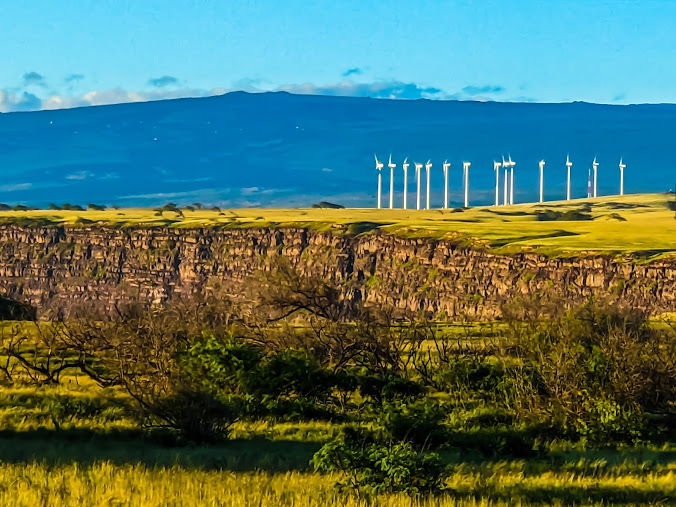
Kaʻū's contribution to the diversity of electrical power sources for this island is the often fierce
wind at South Point, with windmills operated by Tawhiri Power. Photo by Peter Anderson

HERE IS A LIST OF SOURCES FOR ELECTRICITY used by Hawaiian Electric, posted on its website:    Hawaiian Electric uses oil to make firm electricity at the following plants that it owns, and in the following amounts: Keahole - 77.7 MW; Puna - 36.7 MW; Kanoelehua - 21 MW; Waimea: 7.5 MW; Hill - 14.2 MW; and Dispersed Generation- 4 MW.
    Hawaiian Electric purchases "firm electricity" from independent power producers at the following places in the following amounts, using the following fuels: Hamakua Energy - 60 MW from oil and biodiesel, and Puna Geothermal Venture - 38 MW from geothermal.
    Hawaiian Electric uses variable, as available electricity, from its own Puueo Hydro - 3.4 MW and Waiau Hydro - 1.1 MW.
    Hawaiian Electric purchases electricity from independent power producers: Pakinui Wind - 20.5 MW, Wailuku River Hydro - 1.1 MW and Hawi Renewable Development - 10.5 MW. It also buys renewables from customers - 116 MW.
    The utility lists the following "in development" sources for the future as: ES Waikoloa Solar - 30 MW + 120 MWh storage; Hale Kuawehi Solar - 30 MW + 120 MWh storage; Hu Honua (biomass)- 21.5 MW; Keahole Battery Energy Storage- 12 MW (12 MWh) storage only; and Shared solar: 0.750 MW.

To read comments, add your own, and like this story, see www.facebook.com/kaucalendar. See latest print edition at wwwkaucalendar.com. See upcoming events at https://kaunewsbriefs.blogspot.com/2022/04/upcoming-events-for-kau-and-volcano.html.

A PUBLIC MEETING ON PROPOSED NEW SEWAGE TREATMENT PLANS for Nāʻālehu and Pāhala will be held by the County of Hawai'i Department of Environmental Management on Wednesday, Aug. 31 at 6 p.m. at Nāʻālehu Community Center. The Environmental Protection Agency has been working with the county on options for closing old gang cesspools that serve old sugar company housing that has been sold for homes in both towns. Options range from sewage treatment plants to individual septic systems in each yard.

To read comments, add your own, and like this story, see www.facebook.com/kaucalendar. See latest print edition at wwwkaucalendar.com. See upcoming events at https://kaunewsbriefs.blogspot.com/2022/04/upcoming-events-for-kau-and-volcano.html.

EATING OR ACCIDENTALLY INGESTING RAW FRESHWATER FISH, PRAWNS, SHRIMP, crayfish, crabs, flatworms, sea snakes, frogs, toads, lizards, centipedes and coqui frogs can subject people to rat lungworm disease. Raw beef and raw pork can carry the disease but not lead to an infection in humans. This is according to new research from University of Hawai'i and partners. The report from U.H. says: "While many people know that rat lungworm disease can be spread to humans by slugs and snails, new research shows those creatures are not the only ones that have been transmitting the illness." See the report at https://manoa.hawaii.edu/news/article.php?aId=12115
    Researchers from University of Hawaiʻi at Mānoa and University of London combed through
Ingesting raw coqui frogs can give people rat worm
 lung disease, according to a new study. Photo from U.H.
nearly  140 scientific studies published between 1962–2022 and found 32 species that can act as carriers of the rat lungworm parasite Angiostrongylus cantonensis.
The report states that the "32 species of freshwater prawns/shrimp, crayfish, crabs, flatworms, fish, sea snakes, frogs, toads, lizards, centipedes, cattle, pigs and snails can act as carriers of the rat lungworm parasite (Angiostrongylus cantonensis). Of these, at least 13 species of prawns/shrimp, crabs, flatworms, fish, frogs, toads, lizards and centipedes have been associated with causing rat lungworm disease in humans."
    Robert Cowie, senior author on the study and faculty member in UH Mānoa’s School of Ocean and Earth Science and Technology, supervised Helena Turck, first author and graduate student at the University of London, who did this study as her master’s degree thesis research, remotely during the pandemic. Professor Mark Fox of the Royal Veterinary College also collaborated.
    Cowie explained that rat lungworm has a complex life cycle that involves slugs and snails as so-called “intermediate” hosts and rats as “definitive” hosts in which the worms reach maturity and reproduce. Rats become infected when they eat an infected snail or slug. People also become infected when they eat an infected snail or slug, and this can lead to serious illness and occasionally death.
    “But people can also get infected if they eat so-called paratenic hosts, which are also known as carrier hosts,” said Cowie, a professor in SOEST’s Pacific Biosciences Research Center. “These are animals that become infected by eating infected snails or slugs, but in which the worms cannot develop to maturity as they do in a rat. However, in such hosts the worms become dormant, but still infective. And if one of these hosts, or part of one, is then eaten raw by a person—an accidental host—development can continue, but only up to a point.”
    Rat lungworm development happens when they are in the person’s brain, where they are moving around, feeding and growing, but then the worms die without completing their life cycle. The damage to the brain and the massive inflammation that results when they die is primarily what causes the symptoms of rat lungworm disease.
    “It is important to know not only that snails and slugs can transmit rat lungworm parasites to humans but also which other animals—which paratenic hosts—can also do so,” Cowie said. “The goal of the study was to pull all the information on paratenic hosts and their role in transmission of rat lungworm disease, previously scattered in diverse publications and obscure reports, together into one place and develop a global understanding of their diversity and role in disease transmission.”
   Globally, rat lungworm disease is confined largely to the tropics and subtropics. Hawaiʻi is a global center of the incidence of rat lungworm disease, and it was in Hawaiʻi where the connection between the parasite and the disease was first discovered, by UH and U.S. government scientists in the early 1960s.
Infected slugs and snails, raw freshwater prawns and raw fish, can infect
 dogs, horses and humans with rat lungworm disease in Hawai'i.
Raw pork and raw beef can be carriers, says a new study. 
Photo from U.H.
    “Several species capable of acting as carriers (paratenic hosts) are present in Hawaiʻi, including flatworms, centipedes, coqui frogs and cane toads,” said Cowie. “While people in Hawaiʻi are unlikely to eat these animals, it is not unknown for people to do so on a dare, and become seriously ill. Elsewhere, certain paratenic hosts are eaten for supposed health reasons—frogs in Taiwan and Japan, or to enhance virility—lizards in Thailand.”
    Domestic animals, especially dogs and horses, can also become infected by the rat lungworm parasite, including in Hawaiʻi, probably mostly from accidentally or deliberately eating snails or slugs.
    Other notable regions where rat lungworm disease is prevalent include South and Southeast Asia, where it probably originated, southern China, Taiwan, southern Japan, various Pacific islands and archipelagos, Brazil, the Caribbean islands and Australia. The parasite has also been reported from the Canary Islands and Balearic Islands of Spain, as well as southeastern parts of the U.S. "Climate change may lead to its further spread into currently more temperate regions," says the U.H. report.
    The report also notes several recommendations to prevent infection by rat lungworm.
    “Awareness of which species may harbor the parasite is critically important both in Hawaiʻi and more widely,” said Cowie. “These animals should not be consumed raw. Additionally, wash all fruits and vegetables well under running water and inspect them for slugs, snails and possible other hosts such as flatworms so as to avoid inadvertently eating them or parts of them.”

To read comments, add your own, and like this story, see www.facebook.com/kaucalendar. See latest print edition at wwwkaucalendar.com. See upcoming events at https://kaunewsbriefs.blogspot.com/2022/04/upcoming-events-for-kau-and-volcano.html.


Kaʻū High, Sept. 1 - for students.


Monday, August 29, 2022

Ka‘ū News Briefs, Monday, Aug. 29, 2022

Even with such renewable energy sources as Tawhiri wind farm at South Point, Hawaiian Electric is asking customers to conserve power, as an oil and biofuel fired plant temporarily goes offline in Hamakua. Photo by Bob Martin

CONSERVE ELECTRICITY THIS WEEK FROM 5 P.M. TO 9 P.M. each day. That's the request issued by Hawaiian Electric on Monday, which send out the message for Hawai'i Island customers. The statement from the utility says, "The need to conserve is prompted by the unavailability of the island's largest independent power producer, Hamakua Energy Partners." Hamakua Energy Partners operates the largest independent power plant on the island that has been run in recent years on diesel, naphtha and biodiesel, providing nearly a quarter of the electricity used on the island.
     Hawaiian Electric also says, as winds have died down on the island this week, its wind resources over the next week "are forecast to be low."
Hamakua Energy Partners power plant is offline, prompting
Hawaiian Electric to ask customers to reduce energy use.

    
    Hawaiian Electric stated that it "expects to have enough generating capacity available to meet the early evening peak demand. Energy conservation by the public can help ensure sufficient power is available to meet demand, which increases in the early evening. Suggested steps include turning off or reducing use of lights and air conditioners, delaying showers, laundry and dishwashing activities, and going out for dinner or minimizing cooking until later in the evening."
    Hawaiian Electric said it is also taking these steps:
    Asking large commercial customers, including hotels and resorts, to voluntarily reduce energy use, especially heavy equipment and air conditioning;
    Accelerating repair and maintenance on its own units;
    Running units longer and on different schedules than usual to ensure sufficient generation is available; 
    Requesting maximum output available from Puna Geothermal Venture.
    Hamakua Energy Partners, "an independent power producer, normally supplies 60 megawatts of power, but is currently unavailable. It is not known when the units will be returned to service. In addition, Hawaiian Electric's Hill Plant Unit No. 5 is undergoing annual scheduled maintenance. It normally supplies 14 megawatts of power," said Hawaiian Electric.    
    "By reducing demand, Hawaiian Electric can ensure enough electricity is available and prevent the need to initiate rolling, 30-minute outages. If rolling outages are necessary, Hawaiian Electric will make every effort to use social media to notify customers in the affected areas in advance. Please check @HIElectricLight on Twitter for updates," stated Hawaiian Electric.

To read comments, add your own, and like this story, see www.facebook.com/kaucalendar. See latest print edition at wwwkaucalendar.com. See upcoming events at https://kaunewsbriefs.blogspot.com/2022/04/upcoming-events-for-kau-and-volcano.html.

EDITH KANAKA'OLE IS HONORED BY HER IMAGE ON QUARTERS TO BE RELEASED BY THE U.S. MINT.  She is one of five prominent women in American history to be depicted on quarters in 2023. The designs were unveiled on Monday. The others are Bessie Coleman, Jovita Idar, Eleanor Roosevelt, and Maria Tallchief.
    Sen. Mazie Hirono urged the inclusion of Kanaka'ole' image through the Mint’s American Women Quarters Program.
    Hirono said, “Edith Kanaka`ole was a prominent leader in the revitalization of Hawaiian language and culture—notably as a renowned kumu hula. She helped preserve and spread Hawaiian language, traditions, and history, contributing so much to the Native Hawaiian community, Hawai'i, and our nation. It is fitting that she be honored with this special recognition. I’m pleased to see the design for her commemorative quarter today, and I look forward to seeing these quarters put into circulation, so that people in every corner of our country can learn more about Edith Kanaka`ole and her remarkable life.”
    Hawaiian wording on the coin says, "E hō mai Ka 'ike," which means, "Grant us Knowledge."
    Authorized by the Circulating Collectible Coin Redesign Act of 2020, the American Women Quarters Program features coins with designs emblematic of the accomplishments and contributions of prominent American women.
    Contributions come from a wide spectrum of fields including, but not limited to, suffrage, civil rights, abolition, government, humanities, science, space, and the arts. The women honored come from ethnically, racially, and geographically diverse backgrounds. As required by the law, no living person will be featured in the coin designs, and thus all the women honored must be deceased. The Mint is issuing five coins with different reverse designs annually over the four-year period from 2022 through 2025.

To read comments, add your own, and like this story, see www.facebook.com/kaucalendar. See latest print edition at wwwkaucalendar.com. See upcoming events at https://kaunewsbriefs.blogspot.com/2022/04/upcoming-events-for-kau-and-volcano.html.

TWELVE STUDENTS FROM A SISTER CITY IN OKINAWA VISITED HAWAI'I VOLCANOES and  returned home to Nago City, Japan safely on Sunday, after an action-packed week around the island. A statement from the office of Mayor Mitch Roth said, "The students came to the island through the County's Sister Cities program, which aims to bolster ties between Hawaiʻi County and other cities worldwide. Students were selected from four middle schools in Nago City and came as part of an ongoing exchange to sharpen their English-speaking skills by the opportunity to speak to native English speakers and learn about Hawaiian culture."
Students from Sister City of Nago, Japan visit Hawai'i
 Volcanoes National Park. Photo from the Mayor's Office
   The mayor said, "We are excited to have had the opportunity to join Hui Okinawa in welcoming such eager learners from Nago City. It's always great to share our island with guests, and it's even better when they're students who show a genuine interest in our rich host culture. Mahalo to all the individuals and organizations who came together to help make this exchange between the County and our Sister City a great success."  
    The program was created in partnership with Hui Okinawa, which has helped organize these student visits since 2012, including finding the families to host them. In addition to visiting Hawai'i Volcanoes National Park, the students interacted with Hilo High School and West Hawaiʻi Explorations Academy middle school students, visited ʻImiloa, Parker Ranch, Amy Greenwell Botanical Garden and Huliheʻe They also picked coffee. Nago City students also learned the basics of hula dancing with Kumu Keala Ching and were treated to a canoe paddling.
    "Hui Okinawa has supported this Nago Study abroad program since its inception in 2012 and appreciates all those that coordinated the program, including Hawaii Community College, Tours by Charlie, and now the County of Hawaii," said Robert Kaneshiro, President of Hui Okinawa. "We also would like to thank the many host families, teachers, volunteers, and organizations that supported Nago's program."

To read comments, add your own, and like this story, see www.facebook.com/kaucalendar. See latest print edition at wwwkaucalendar.com. See upcoming events at https://kaunewsbriefs.blogspot.com/2022/04/upcoming-events-for-kau-and-volcano.html.


Kaʻū High, Sept. 1 - for students.


Sunday, August 28, 2022

Ka‘ū News Briefs, Sunday, Aug. 28, 2022

A  GNSS monitoring site deployed by the USGS Hawaiian Volcano Observatory on the floor of Kīlauea caldera is part of the
 rapid response to the December 2020 Halema‘uma‘u eruption. With funding from the Additional Supplemental Appropriations
 for Disaster Relief Act of 2019, this site will be upgraded to continuously operate, complete with state-of-the-art
instrumentation and engineered antenna mast. USGS photo by A.P Ellis.
THE GEODETIC NETWORK IS UPGRADING to help USGS Hawaiian Volcano Observatory scientists monitor and respond to volcanic activity. That's the topic of this week's Volcano Watch by U.S. Geological Survey Hawaiian Volcano Observatory scientists and affiliates: 
    In the four years since the 2018 Kīlauea lower East Rift Zone eruption and summit collapse, HVO has been working to rebuild the monitoring network and provide other updates as part of the Additional Supplemental Appropriations for Disaster Relief Act of 2019 (H.R. 2157).
    Before describing specific updates to the geodetic network at HVO, let’s first explore and define what we mean by ‘geodesy’ and the way we measure surface deformation in geoscience.
    Geodesy is the study of measuring and understanding how the Earth’s surface deforms and changes. The main geodetic datasets currently used by HVO scientists to measure surface deformation (ground movements) are GNSS (global navigation satellite system, which includes GPS), tilt, and satellite radar (InSAR) imagery.
More than 70 Global Navigation Satellite System
Stations record and transmit data on this island.
Photo from USGS
    HVO's geodetic monitoring network includes over 70 GNSS stations and 15 tiltmeters on the Island of Hawai'i that continuously record and transmit data. These instruments require routine maintenance, must be upgraded periodically due to age, and must be replaced if destroyed by volcanic activity such as in 2018.
    Current upgrades focus on rebuilding and improving HVO’s geodetic network in order to better detect, assess, and respond to volcanic hazards related to Hawaiian Volcanoes. Some of the network upgrades include replacing out-of-date instruments and improving HVO’s network of near real-time monitoring instruments at critical areas on Kīlauea’s summit and rift zones to support early detection of magma movement and associated hazards.
    In 2018, lava flows destroyed 3 GNSS stations in the lower East Rift Zone. Another three GNSS stations were destroyed in the caldera collapses at Kīlauea’s summit. HVO staff rapidly deployed new GNSS stations at nearby locations to allow for continued monitoring during the 2018 crisis. These rapidly deployed sites included GNSS antennas mounted on surveys tripods, which is a set-up typically only used for temporary deployments that last several days to weeks.
    Many of these rapidly deployed sites were decommissioned and removed after 2018. However, approximately 13 of them are still being used for critical monitoring and remain on temporary tripods. These sites will be upgraded and hardened using engineered fixed monuments and masts instead. New sites will also be installed to replace sites destroyed in 2018.
    GNSS receivers acquired by Supplemental funds have already supported emergency monitoring of active eruptions and other volcano-related activity. Data from these instruments help HVO detect volcanic activity and inform partners at Hawai’i Volcanoes National Park, Hawai’i County Civil Defense and Hawai’i Emergency Management Agency.
    For example, HVO rapidly deployed three new semi-continuous GNSS stations in response to the
Seventeen tiltmeters continuously record data for
Hawaiian Volcano Observatory. Photo from USGS
December 2020 Kīlauea eruption. These stations gave scientists a more complete view of magma returning to Kīlauea's summit.
    Similarly, HVO deployed rapid-response GNSS equipment at two pre-existing benchmarks during the Kīlauea south caldera intrusion event in August 2021, allowing scientists to track the migration of magma from the south caldera to farther south. New instruments give HVO a more detailed understanding of and ability to monitor Kīlauea’s volcanic processes.
    HVO’s geodesy program plays a critical role in monitoring Hawaiian volcanoes. HVO’s updated geodetic network ensures that scientists can monitor changes in the shape of volcanoes, respond to eruptions, and understand magma storage and movement underground.
    Thanks to Supplemental funding, HVO is in the best position ever to leverage our state-of-the-art geodetic network to gain insights into the active volcanoes in Hawai’i, assess their hazards, issue warnings, and advance scientific understanding to reduce the impacts of volcanic eruptions.

Volcano Activity Updates: Kīlauea volcano is erupting. Its USGS Volcano Alert level is at WATCH (https://www.usgs.gov/natural-hazards/volcano-hazards/about-alert-levels). Kīlauea updates are issued daily.
    Over the past week, lava has continued to erupt from the western vent within Halemaʻumaʻu crater. All lava is confined within Halemaʻumaʻu crater in Hawai‘i Volcanoes National Park. Sulfur dioxide emission rates remain elevated and were last measured at approximately 1,250 tonnes per day (t/d) on August 19. Seismicity is elevated but stable, with few earthquakes and ongoing volcanic tremor. Over the past week, summit tiltmeters recorded two deflation-inflation sequences (DI-events). For more information on the current eruption of Kīlauea, see https://www.usgs.gov/volcanoes/kilauea/recent-eruption.
Mauna Loa Summit in August. Photo by Calder Randolph
   Mauna Loa is not erupting and remains at Volcano Alert Level ADVISORY. This alert level does not mean that an eruption is imminent or that progression to an eruption from the current level of unrest is certain. Mauna Loa updates are issued weekly.
    This past week, about 118 small-magnitude earthquakes were recorded below the summit and upper elevation flanks of Mauna Loa—the majority of these occurred at shallow depths less than 15 kilometers (9 miles) below sea level. Global Positioning System measurements show low rates of ground deformation over the past week. Gas concentrations and fumarole temperatures at both the summit and at Sulphur Cone on the Southwest Rift Zone have remained stable over the past week. Webcams show no changes to the landscape. For more information on current monitoring of Mauna Loa, see: https://www.usgs.gov/volcanoes/mauna-loa/monitoring.
Three earthquakes were reported felt in the Hawaiian Islands during the past week: a M3.0 earthquake 21  km (13 mi) SSE of Waimea at 24 km (15 mi) depth on August 23 at 12:58 p.m. HST, a M2.0 earthquake 9 km (5 mi) E of Pāhala at 31 km (19 mi) depth on August 22 at 7:19 p.m. HST, and a M4.0 earthquake 9 km (5 mi) E of Pāhala at 31 km (19 mi) depth on August, 22 at 7:11 p.m. HST.
    HVO continues to closely monitor Kīlauea's ongoing eruption and Mauna Loa for any signs of increased activity.

To read comments, add your own, and like this story, see www.facebook.com/kaucalendar. See latest print edition at wwwkaucalendar.com. See upcoming events at https://kaunewsbriefs.blogspot.com/2022/04/upcoming-events-for-kau-and-volcano.html.

A gift of flowers from Daydrie Nurial Dacalio, a member of Kumu Debbie Ryder's Halau Hula O Leionalani, to attendees
at the 50th Anniversary of Discovery Harbour Golf Course, with Tony Llanes looking on. Photo by Adryana Lorenzo
 
THE FIFTIETH ANNIVERSARY OF DISCOVERY HARBOUR GOLF COURSE was a rounding success and its organizers applaud the community. The Club at Discovery Harbour Board President Doug Phillips and managers Andrew and Ann Lorenzo said they have never seen such a large gathering of people at the clubhouse. Andrew Lorenzo received a certificate of acknowledgment for the celebration from representative of Mayor Mitch Roth, Pomai Bartolome.
    The 50th anniversary on Aug. 13 saw an outdoor, open house at The Club at Discovery Harbour. A slew of local artisans, food vendors and service providers, along with live bands and a hula, contributed to the celebration.
    Phillips noted that The Club at Discovery Harbour, LLC manages the golf course, leasing it from its
Folks of all ages practiced their swings at Doug Phillip's booth
booth at the 50th Anniversary of Discovery Harbour Golf Course.
Photo by Noalani Barmachia
owners. "The Club is a locally formed corporation with the goal of improving upon the current facilities, while maintaining a naturalist philosophy," said Phillips. "The club is committed to providing a venue that is accessible and affordable to the community." Services include DaBomb meals with Chef Jason with lunch on Thursdays and Sundays from 11 a.m. to 3 p.m. and dinner on Friday & Saturday from 5 p.m. to 8 p.m. Live entertainment fills the space on Friday and Saturday.
    Phillips said said that an emphasis on the golf course grounds is placed on preserving historical sites and nesting areas for the such birds as Gray Francolins and Kalij Pheasants. The Club is committed to a golf course that maintains a minimal amount of water waste along with a minimal use of pesticides, said Phillips.
   The use of The Club and its facilities are based upon a members and guest system. Memberships are open to everyone at an economical price, said Phillips. "The current business model is similar to a fitness club membership, with different tiers of membership that provide various levels of access to club amenities. The Club offers pickle ball courts, golf, a pro shop, a bar, along with weekend dinners and live music. Members may also apply to rent out the facilities for weddings, family reunions and private parties.
 
Triple 7 Shave Ice, with Tyler Blanco, Malia Corpuz and Chloe,
Abero, brought many flavors to the Club at Discovery Harbour
for the 50th Anniversary. Photo by Adryana Lorenzo
  Plans to host more events featuring local artisans, craftsman, musicians and food vendors are underway and will be announced soon, said Phillips. Also assisting in the evolution of The Club at Discovery Harbour are its General Manager Andrew Lorenzo and Ann Lorenzo, who helps to manage the golf course and clubhouse.
   Board members are: President Douglas Phillips, Ron and Thelma Hughes, Mark Peters, Paul Morris and Sharon and Tom Shinings.
    The 50th Anniversary drew support from hundreds of attendees, the vendors and entertainers. Halau Hula O Leionalani and its Kumu Debbie Ryder performed, accompanied by musicians Demetrius Oliveira and Gene Beck of The Band Kaʻū. Musical groups Shootz opened the event, the day ending with a a dinner by Da Bomb, Chef Jason Lofland.
    Offerings from vendors came from: Triple 7 Shave Ice; Club Tec with Hawaiʻi's personalized golf clubs; Bea Padrigo with lunches; Donna Masaniai with quilts and wallets; Looking Glass; Island Swanky; Fused Fragments; P&L Farms, with dried macadamia nuts, dried and fresh picked mangoes, bananas, and other fruits; Mai Treats 808 with Pastries; Tanya Ibara Design; Maile Design; K's Green House; Kapu's Hawaiian Makana; Kealaʻikoa Coffee Company; Paradise Kettle Corn; South Point Creations; and Have Tools Will Travel yard games, professional repair and home maintenance. Also on hand were Kami Takacs of ESP Realty and Jamie Kalua with handmade jewelry.
   The address of The Club at Discovery Harbour is 94-1581 Kaulua Circle in Discovery Harbour, Nāʻālehu. Any questions call 808-731-5122.

Pomai Bartolome, center, delivers a message and certificate of congratulations from Mayor Mitch Roth to the 50th anniversary celebration of Discovery Harbour Golf Course. At right are Ann and Andrew Lorenzo who manage the Club at Discovery Harbour. At right is Board President Doug Phillips and board member Ron Hughes. Photo by Adryana Lorenzo

To read comments, add your own, and like this story, see www.facebook.com/kaucalendar. See latest print edition at wwwkaucalendar.com. See upcoming events at https://kaunewsbriefs.blogspot.com/2022/04/upcoming-events-for-kau-and-volcano.html.


Kaʻū High, Sept. 1 - for students.