 |
| Hawaiian land snails, kāhuli, once numbered 750 species on the island and are the subject of an art contest for the state Wildlife Conservation Stamp. Photo from DLNR |
This year's chosen species for the artwork for the Wildlife Conservation stamp are kāhuli, Hawaiian land snails. Hawaiʻi once harbored over 750 species of land snails, almost all unique to individual islands. "These jewels of nature and culture are important components of island ecosystems from mauka to makai, and come in a variety of spectacular colors, shell shapes, and sizes," says the DLNR statement.
The Game Bird Stamp will feature the chestnut-bellied sandgrouse, Pterocles exustus, a native to Africa

The art must be oil or acrylic and show the snail or gamebird in its Hawai'i habitat and be a maximun size of 24" X 36". The submission must be the painting itself or an 8.5 X 11" photo, print or photocopy. Entries must be received by Feb. 25, 2023. Notification of the winner will be made in March 2023.
All entries must be received by February 25, 2023. Notification of the winner will be made in March 2023. Each winner will receive a maximum award of $1,000. The winner of the Conservation Stamp will also get a behind-the-scenes tour (for themselves and 10 family or friends) of a captive rearing snail lab.
Funds from Hawaii Wildlife Conservation Stamp sales go into the state Wildlife Revolving Fund to support wildlife populations and habitat, and to manage the states hunting program.
Last year revenues from both stamps were used to cover some of the costs of maintaining hunting units and to add game bird and game mammal hunting opportunities where possible. Proceeds from the sales of wildlife conservation stamps will also provide funds for the annual lease rental of the Lānaʻi Cooperative Game Management Area and several other hunting leases while also supporting wildlife diversity programs.
TAKING OF PĀKU‘IKU‘I, ACHILLES TANG, IS TEMPORARILY BANNED from South point up the west coast of the island. On Friday, the State Board of Land & Natural Resources approved the prohibition of harvesting pāku‘iku‘i, a popular aquarium collecting fish, within the West Hawai‘i Regional Fishery Management Area. This is the first time that the DLNR Division of Aquatic Resources (DAR) has adopted rules under the new adaptive management rulemaking authority, which allows the Department to approve temporary management measures in response to rapidly changing resource conditions. In revising the rules, DAR stated that "the change will allow for replenishment of the dangerously depleted pāku‘iku‘i fish population in the area as the Division works towards longer-term regulations for sustainable pāku‘iku‘i take"
The new rules are set to begin Dec. 19, effective for a maximum of two years with the option to extend up to one year at a time upon approval by the BLNR and the Hawai‘i State Legislature.
Department of Aquatic Resources is already working with coastal communities, including the community of Miloli'i, University of Hawaiʻi at Hilo, United States Geological Survey, and National Oceanic & Atmospheric Administration "to better understand pāku‘iku‘i life history traits that will support a more robust understanding of their stocks," says the DLNR statement.
Funds from Hawaii Wildlife Conservation Stamp sales go into the state Wildlife Revolving Fund to support wildlife populations and habitat, and to manage the states hunting program.
Last year revenues from both stamps were used to cover some of the costs of maintaining hunting units and to add game bird and game mammal hunting opportunities where possible. Proceeds from the sales of wildlife conservation stamps will also provide funds for the annual lease rental of the Lānaʻi Cooperative Game Management Area and several other hunting leases while also supporting wildlife diversity programs.
See the application form at: https://dlnr.hawaii.gov/recreation/files/2022/11/FY23-24-artist-application.pdf
TAKING OF PĀKU‘IKU‘I, ACHILLES TANG, IS TEMPORARILY BANNED from South point up the west coast of the island. On Friday, the State Board of Land & Natural Resources approved the prohibition of harvesting pāku‘iku‘i, a popular aquarium collecting fish, within the West Hawai‘i Regional Fishery Management Area. This is the first time that the DLNR Division of Aquatic Resources (DAR) has adopted rules under the new adaptive management rulemaking authority, which allows the Department to approve temporary management measures in response to rapidly changing resource conditions.
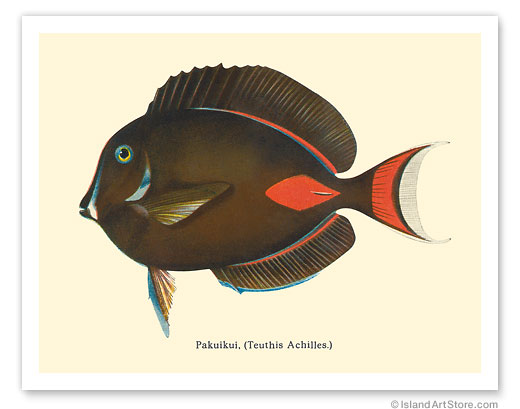
The new rules are set to begin Dec. 19, effective for a maximum of two years with the option to extend up to one year at a time upon approval by the BLNR and the Hawai‘i State Legislature.
Department of Aquatic Resources is already working with coastal communities, including the community of Miloli'i, University of Hawaiʻi at Hilo, United States Geological Survey, and National Oceanic & Atmospheric Administration "to better understand pāku‘iku‘i life history traits that will support a more robust understanding of their stocks," says the DLNR statement.
A WIND ADVISORY FOR Hawaii Island is in place through Saturday morning. Sustained winds of 20 to 35 mph with localized gusts up to 55 mph are forecast. The National Weather Service also extended the High Surf Advisory for East facing shores of Hawai'i Island through Saturday morning.
MONITORING OF MAUNA LOA is the subject of this week's Volcano Watch, written by scientists and affiliates of USGS Hawaiian Volcano Observatory:
The first few hours of Mauna Loa's eruption were dynamic, and volcanologists intently watched monitoring data to track changing conditions and understand how the eruption was developing. This monitoring is crucial to issuing hazards notifications to communities that may be at risk and is why we continue to closely monitor this new eruption.
For months, monitoring data had indicated that Mauna Loa was inching closer to an eruption. The volcano had been inflating for years, and the past few months had seen an uptick in the rate of earthquakes. In late September 2022, HVO issued an Information Statement summarizing the increased activity, and by early October, daily, instead of weekly, activity updates were initiated. HVO also began holding community meetings in areas of the island that might be impacted by a Mauna Loa eruption, including Hawaiian Ocean View Estates, South Kona, and Pāhala.
The eruption started in Mokuʻāweoweo, Mauna Loa's summit caldera, at about 11:30 p.m. HST. The handful of scientists that responded to alarms about 45 minutes before the eruption quickly turned into an online meeting of 15–20 experts in seismology, deformation, geology, and satellite imagery. Additionally, Hawaiʻi County Civil Defense Agency (HCCDA) was immediately appraised of the volcano's behavior, both via the online meeting and with the addition of a volcanologist who quickly went to the HCCDA Emergency Operations Center in Hilo. Scientists from USGS volcano observatories in Alaska, California, and Washington also joined to assist.
The primary concern was that the eruption might shift toward the Southwest Rift Zone (SWRZ). Lava from Southwest Rift Zone eruptions can reach populated areas within hours, so recognizing the early signs of a rift zone eruption is key.
A few hours after the eruption started, images began to appear on social media of lava flows visible from Kona. In the dark, these flows looked menacing, and the public had clear concerns that the eruption had made its way into the Southwest Rift Zone. Indeed, the fissure that first opened in Moku'aweoweo continued opening towards the south, outside the topographic caldera, but still inside Mauna Loa's summit region. This produced the lava flow on the southwest side of the summit that was visible from the Kona coast. These flows did not threaten any populated areas and were ultimately short-lived.
Monitoring data—ground tilt, seismic, cameras, thermal satellite, and infrasound (low-frequency sound)—continued to show that the eruption was focused at the summit. Volcanologists remained glued to their computer screens...
By about 6 a.m. HST on November 28, reports from observers on the ground, as well as thermal satellite data, indicated that the eruption had moved into the Northeast Rift Zone. A few minutes later, this was confirmed by infrasound (low-frequency sound waves) and seismicity, and cameras showed that the summit-area eruption had stopped. With first light, volcanologists
were in the air, on overflights and being shuttled to the eruption site to gather additional data and observations. But they began to breathe a bit easier. History suggests that once a Mauna Loa eruption moves into one rift zone, it stays there.
Those tense first several hours served as a good test of how HVO is able to work with HCCDA officials and volcanologists from other USGS offices to rapidly respond to volcanic activity. Together, these agencies continue to monitor the Northeast Rift Zone eruption of Mauna Loa and keep the public informed on the activity.
As of December 8, the main lava flow front that was approaching the Daniel K. Inouye Highway (Saddle Road) stalled about 1.7 mi (2.8 km) away. Lava continues to erupt from fissure 3 but these flows are now closer to the vent and are working their way downslope again.
Future Mauna Loa eruptions, from the summit, either rift zone, or radial vents, are inevitable, but it is impossible to forecast precisely when those might happen. HVO's monitoring networks plus the high level of community awareness provide the best mitigation for hazards from any such eruption.
HVO is grateful to the Island of Hawaiʻi for your support, awareness, and engagement during this latest eruption crisis. Mahalo nui loa and mālama pono.


.jpg)


The first few hours of Mauna Loa's eruption were dynamic, and volcanologists intently watched monitoring data to track changing conditions and understand how the eruption was developing. This monitoring is crucial to issuing hazards notifications to communities that may be at risk and is why we continue to closely monitor this new eruption.
For months, monitoring data had indicated that Mauna Loa was inching closer to an eruption. The volcano had been inflating for years, and the past few months had seen an uptick in the rate of earthquakes. In late September 2022, HVO issued an Information Statement summarizing the increased activity, and by early October, daily, instead of weekly, activity updates were initiated. HVO also began holding community meetings in areas of the island that might be impacted by a Mauna Loa eruption, including Hawaiian Ocean View Estates, South Kona, and Pāhala.
 |
| Aerial view of Mauna Loa summit with Luahou in the foreground followed by Luahohonu, South Pit, and Mokuʻāweoweo summit caldera. A small dusting of snow covers the ground east of the summit. The steaming fissure was active during the beginning of the eruption, but this morning the lava in the summit caldera had already cooled to a black color. The white plume in the background is rising from the fissures in the Northeast Rift Zone. USGS photo J. Schmith |
.png) |
| The Northeast Rift Zone eruption of Mauna Loa continue into its twelfth full day of Friday. One active fissure, fissure 3, feeds lava flows downslope to the north. USGS analysts mapped some of the most active flows, displayed in red , along with older flows further uprift, in part of Mokuʻāweoweo caldera, and in the upper summit region southwest of the caldera. Lava flow length was measured by tracing the continuous active channel shown in yellow here and then extending the measurement to the distal lava flow extent measured in satellite data. |
A few hours after the eruption started, images began to appear on social media of lava flows visible from Kona. In the dark, these flows looked menacing, and the public had clear concerns that the eruption had made its way into the Southwest Rift Zone. Indeed, the fissure that first opened in Moku'aweoweo continued opening towards the south, outside the topographic caldera, but still inside Mauna Loa's summit region. This produced the lava flow on the southwest side of the summit that was visible from the Kona coast. These flows did not threaten any populated areas and were ultimately short-lived.
Monitoring data—ground tilt, seismic, cameras, thermal satellite, and infrasound (low-frequency sound)—continued to show that the eruption was focused at the summit. Volcanologists remained glued to their computer screens...
By about 6 a.m. HST on November 28, reports from observers on the ground, as well as thermal satellite data, indicated that the eruption had moved into the Northeast Rift Zone. A few minutes later, this was confirmed by infrasound (low-frequency sound waves) and seismicity, and cameras showed that the summit-area eruption had stopped. With first light, volcanologists
.jpg) |
| Aerial image of the lava channel issuing from fissure 3, erupting high on the Northeast Rift Zone of Mauna Loa. The reduced lava output at fissure 3 is evident in the low level of lava in the channel. Mauna Kea is visible in the background of the image. USGS image by P. Dotray |
were in the air, on overflights and being shuttled to the eruption site to gather additional data and observations. But they began to breathe a bit easier. History suggests that once a Mauna Loa eruption moves into one rift zone, it stays there.
Those tense first several hours served as a good test of how HVO is able to work with HCCDA officials and volcanologists from other USGS offices to rapidly respond to volcanic activity. Together, these agencies continue to monitor the Northeast Rift Zone eruption of Mauna Loa and keep the public informed on the activity.
As of December 8, the main lava flow front that was approaching the Daniel K. Inouye Highway (Saddle Road) stalled about 1.7 mi (2.8 km) away. Lava continues to erupt from fissure 3 but these flows are now closer to the vent and are working their way downslope again.
Future Mauna Loa eruptions, from the summit, either rift zone, or radial vents, are inevitable, but it is impossible to forecast precisely when those might happen. HVO's monitoring networks plus the high level of community awareness provide the best mitigation for hazards from any such eruption.
HVO is grateful to the Island of Hawaiʻi for your support, awareness, and engagement during this latest eruption crisis. Mahalo nui loa and mālama pono.
 |
| PICTURES WITH SANTA AT OV COMMUNITY CENTER CHRISTMAS EVE, 1 P.M. TO 3 P.M. |
 |
| See The Ka'u Calendar in the mail and in stands from Volcano through Miloli'i. Also see stories daily on facebook and at www.kaunewsbriefs.blogspot.com |


.jpg)


.heic)


.jpg)

