 |
Hawaiian Macadamia Nut Co. blossoms. The local mac nut industry, one of the largest employers in Kaʻū, is seeking truth in labeling as some companies sell macadamia grown elsewhere while boasting the Hawaiian reputation. See more below. Photo from Hawaiian Macadamia Nut Co. |
 |
| Mayor Mitch Roth and Brenda Iokepa Moses |
Roth was joined by Gov. Josh Green, Mayor Derek Kawakami from Kauaʻi, Council Chair Heather Kimball, members of the Hawaiʻi County Council, representatives from Maui County, and Hawai'i County department heads, as well as Roth's executive assistants and Deputy of Department of Environmental Management Brenda Iokepa Moses of Pāhala.
The Address touched on a myriad of successes and setbacks that took listeners on a journey of what the state of the County of Hawaiʻi was, where it is currently, and where it's going.
The Mayor's comments touched on: Homelessness; Economic Development; Affordable Housing; Building Permitting; Critical Infrastructure Projects; Kīlauea Eruption Recovery; Public Safety; Mauna Loa Eruption; Public Transportation; and Sustainability.
Watch Roth's 2023 State of the County Address on naleo.tv or @himayormitch on Facebook.
GROWERS OF MACADAMIA, ONE OF THE LARGEST EMPLOYMENT SECTORS IN KAʻŪ, are testifying at the Hawai'i Legislature in support of a bill to require stronger labeling of origin of country for consumer processed and raw macadamia nuts. The bill HB1348 goes to a public hearing this Friday, March 17 at 10 a.m. at the state Capitol.
Read the bill, committee reports and testimony; see a link to the live feed of the hearing and submit testimony ahead of the hearing at https://www.capitol.hawaii.gov/session/measure_indiv.aspx....
John Cross, an agricultural and land use expert, who has long worked in Kaʻū, submitted testimony saying, "My whole life has been involved in someway or another with Hawaiian grown Macadamia Nuts. My father was manager of Royal Hawaiian Macadamia Nut company and planted the first trees at Keaau on the Big Island in 1949. This orchard would become the epi-center of the largest macadamia operation in the world. The State of Hawai'i became the world leader in growing and producing macadamia nuts for consumption.
"Other countries started to grow macadamias seeing the success in Hawai'i. Sadly, now some of those countries are threatening to destroy the industry where it all started. Unscrupulous processors are blending cheap foreign grown kernel into bags of what is supposedly a Hawai'i labeled product! This must stop. "The Hawaiian kernel is known to be of superior quality and taste to that grown in other world locations. These sub-quality foreign grown macadmias are threatening the industry in Hawai'i. Local Hawaiian growers are finding no where to sell their Hawai'i grown nuts due to processors shutting their doors to local grown nuts and having replaced them with foreign grown kernel.
"Hawai'i has made a name for itself as being leaders in the macadamia nut industry. Our University of Hawaii CTAHR has developed some of the best varieties of trees, as well as improved methods of cultivation, disease control and even processing methods. Don't let all this wonderful research and decades of dedication to the soil and the orchards go the way of sugarcane and pineapple. Please support this bill and the Macadamia growers of Hawai'i!"
The Address touched on a myriad of successes and setbacks that took listeners on a journey of what the state of the County of Hawaiʻi was, where it is currently, and where it's going.
The Mayor's comments touched on: Homelessness; Economic Development; Affordable Housing; Building Permitting; Critical Infrastructure Projects; Kīlauea Eruption Recovery; Public Safety; Mauna Loa Eruption; Public Transportation; and Sustainability.
Watch Roth's 2023 State of the County Address on naleo.tv or @himayormitch on Facebook.
To read comments, add your own, and like this story, see facebook.com/kaucalendar. See latest print edition at kaucalendar.com, in the mail and on stands.
Read the bill, committee reports and testimony; see a link to the live feed of the hearing and submit testimony ahead of the hearing at https://www.capitol.hawaii.gov/session/measure_indiv.aspx....
John Cross, an agricultural and land use expert, who has long worked in Kaʻū, submitted testimony saying, "My whole life has been involved in someway or another with Hawaiian grown Macadamia Nuts. My father was manager of Royal Hawaiian Macadamia Nut company and planted the first trees

"Other countries started to grow macadamias seeing the success in Hawai'i. Sadly, now some of those countries are threatening to destroy the industry where it all started. Unscrupulous processors are blending cheap foreign grown kernel into bags of what is supposedly a Hawai'i labeled product! This must stop. "The Hawaiian kernel is known to be of superior quality and taste to that grown in other world locations. These sub-quality foreign grown macadmias are threatening the industry in Hawai'i. Local Hawaiian growers are finding no where to sell their Hawai'i grown nuts due to processors shutting their doors to local grown nuts and having replaced them with foreign grown kernel.
"Hawai'i has made a name for itself as being leaders in the macadamia nut industry. Our University of Hawaii CTAHR has developed some of the best varieties of trees, as well as improved methods of cultivation, disease control and even processing methods. Don't let all this wonderful research and decades of dedication to the soil and the orchards go the way of sugarcane and pineapple. Please support this bill and the Macadamia growers of Hawai'i!"
Reggie Souza, who has worked in macadamia in Kaʻū and Keaau for 35 years, wrote that his company, Macadamia Nut Services, employs 150 workers. "We have local processing companies currently putting foreign nut kernels in their products, which truly affects the local farmers, as we just can't compete with the kernel prices from foreign countries. I would like to see more transparency from the Hawaiian Processors on the labeling of macadamia products. I have seen generations of local families depend on farming macadamia locally and their livelihoods are now being threatened."
Bonnie Self's family lives in Wood Valley and she works for Hawaiian Macadamia Orchards with its more than 5,000 acres of trees in Kaʻū and Keaau. She sent in this testimony:
"The macadamia nut industry in Hawai'i is under threat from low-cost foreign nuts being quietly inserted into packages bearing the imagery, names, and appearance of being Hawai'i-sourced. These brands are benefiting from the implication of being from Hawai'i and being of higher quality while undercutting brands that are actually using 100% Hawai'i grown nuts and supporting the local industry. Not only is this a threat to small farmers who grow macadamias as a part of their livelihood, but also to larger farmers who employ hundreds of people within the state, specifically in rural areas with very few alternative work opportunities if the industry disappears."
She also noted, "Hawai’i macadamias are an iconic part of Hawai’i’s agricultural identity. We seek to preserve this identity and its integrity. Without these protections, the industry is in danger of disappearing."
Many who work with Hawaiian Macadamia Nut Services sent letters of support, including: Cara Souza, Noel Sebastian, Jennifer Navarro, Oliver Asistin, Desiree Salmo, Imelda Aurelio, Ruby Manantan, Esmenia Garo, Raul Simulata, Roscoe Young, Emelda Bilog, Robert Aurelio, Imelda Asistin, Wilbert Malepe, Christina Echalas, Donna Shibuya, Brian Davis-Natividad, Ezra Keohuloa, Eugenio Asistin, Samuel Mangoba, Jonathan Navarro, Maverick Mariano, Marlon Biason, Arnold Abellera, Jezekial Jara, Marcelena Mangoba, Ernesto Gallarde, Dillin Ballo, Pablo Sebastian, Jordan Ancheta, Alfred Keanu, Laureno Galban, Phillip Alaoan, Clife Galban, Victor Salmo, Kenneth Salmo, Ernesto Abellera, Sally Rose Aguinaldo, Kerman Dilipau, Almaliz Tuzon, and Marciel Aguinaldo.
Bradford Nelson, Director of Macadamia Growers of Hawai'i, wrote, "We are concerned the era of Hawai‘i’s macadamia nut industry is at risk of coming to a close. For the past few years, our industry has faced increasingly intense global competition and now dumping of foreign nuts into the U.S. market. This has been exacerbated by companies that undermine the value of Hawai‘i-grown macadamia nuts through their labeling practices. As a result, for the current 2022-2023 crop year, millions of pounds of nuts have gone unharvested, and growers are facing millions of dollars of losses due to unsold or unharvested inventories. Many of the workers are at home with no work."
Nelson compared the locally grown macadamia to the locally grown coffee situation. "Companies are using low-cost foreign macadamia nuts in their products with images and packaging that portray them as authentic Hawai‘i product to capitalize on the brand and value of Hawai'i-grown macadamia nuts. This unsavory practice allows them to sell their products at prices that yield better margins, but misleads customers into believing they are buying Hawai‘i-origin products. The practice also wreaks havoc on the local macadamia nut industry, and robs multiple generations of Hawai'i residents of quality jobs."
Troy Keolanui, of Ok Farms, Kaʻū Farms Management and Hamakua
Macadamia, wrote: "Our Hawaiian Macadamia industry is on its heels and in dire danger of total collapse. We farm over 3,000 acres on the Big Island and employ 75 residents at our farm and processing facility. This bill, while long overdue, is a step in the right direction and will make a difference in protecting our crop that is uniquely Hawaiian and the best in the world."
Jeff Clark, COO of Olson Trust II, wrote, "Our organization farms macadamia nuts in Kaʻū on approximately 1,500 acres of land. We also process macadamia nuts in our factory at Hamakua Macadamia Nut Company in Kawaihae. Our factory had always purchased 100% Hawai'i-grown macadamia nuts from about 150 small independent farmers from around the island up until a few years ago. Since then, the factory has not purchased nuts from small farmers which left many of them with nowhere to sell their crop. Hamakua Macadamia Nut Company has a hard time competing with brands that use cheaply grown foreign nuts that do not identify where their nuts are grown, yet continue to use Hawaiian imagery and Hawaiian place names to promote their brand. Consumers have no idea where those nuts were grown.
"If this is allowed to continue, more brands may be forced to purchase foreign-grown nuts to compete, which would be the end oft he Hawaii-grown macadamia nut farming industry.The amount of foreign grown macadamia nuts entering the state is threatening the future of Hawai'i-grown macadamia nut farmers and the industry as a whole.
"The macadamia nut industry is a significant contributor to Hawaii's agricultural economy. There are currently about 16,000 acres of macadamia nuts statewide on roughly 620 farms. In 2021, the industry generated $62.73 million (51 million pounds of wet-in shell sales), and in 2020, it was the 2nd largest agricultural commodity produced in Hawai'i, behind only seed crops."
Bonnie Self's family lives in Wood Valley and she works for Hawaiian Macadamia Orchards with its more than 5,000 acres of trees in Kaʻū and Keaau. She sent in this testimony:
"The macadamia nut industry in Hawai'i is under threat from low-cost foreign nuts

She also noted, "Hawai’i macadamias are an iconic part of Hawai’i’s agricultural identity. We seek to preserve this identity and its integrity. Without these protections, the industry is in danger of disappearing."
Many who work with Hawaiian Macadamia Nut Services sent letters of support, including: Cara Souza, Noel Sebastian, Jennifer Navarro, Oliver Asistin, Desiree Salmo, Imelda Aurelio, Ruby Manantan, Esmenia Garo, Raul Simulata, Roscoe Young, Emelda Bilog, Robert Aurelio, Imelda Asistin, Wilbert Malepe, Christina Echalas, Donna Shibuya, Brian Davis-Natividad, Ezra Keohuloa, Eugenio Asistin, Samuel Mangoba, Jonathan Navarro, Maverick Mariano, Marlon Biason, Arnold Abellera, Jezekial Jara, Marcelena Mangoba, Ernesto Gallarde, Dillin Ballo, Pablo Sebastian, Jordan Ancheta, Alfred Keanu, Laureno Galban, Phillip Alaoan, Clife Galban, Victor Salmo, Kenneth Salmo, Ernesto Abellera, Sally Rose Aguinaldo, Kerman Dilipau, Almaliz Tuzon, and Marciel Aguinaldo.
Bradford Nelson, Director of Macadamia Growers of Hawai'i, wrote, "We are concerned the era of

Nelson compared the locally grown macadamia to the locally grown coffee situation. "Companies are using low-cost foreign macadamia nuts in their products with images and packaging that portray them as authentic Hawai‘i product to capitalize on the brand and value of Hawai'i-grown macadamia nuts. This unsavory practice allows them to sell their products at prices that yield better margins, but misleads customers into believing they are buying Hawai‘i-origin products. The practice also wreaks havoc on the local macadamia nut industry, and robs multiple generations of Hawai'i residents of quality jobs."
Troy Keolanui, of Ok Farms, Kaʻū Farms Management and Hamakua
Macadamia, wrote: "Our Hawaiian Macadamia industry is on its heels and in dire danger of total collapse. We farm over 3,000 acres on the Big Island and employ 75 residents at our farm and processing facility. This bill, while long overdue, is a step in the right direction and will make a difference in protecting our crop that is uniquely Hawaiian and the best in the world."
 |
| Hawai'i macadamia growers may receive help from Hawai'i Legislature in restricting labeling so that macadamias grown elsewhere cannot be labeled as Hawaiian. Photo from Olson Trust |
Jeff Clark, COO of Olson Trust II, wrote, "Our organization farms macadamia nuts in Kaʻū on approximately 1,500 acres of land. We also process macadamia nuts in our factory at Hamakua Macadamia Nut Company in Kawaihae. Our factory had always purchased 100% Hawai'i-grown macadamia nuts from about 150 small independent farmers from around the island up until a few years ago. Since then, the factory has not purchased nuts from small farmers which left many of them with nowhere to sell their crop. Hamakua Macadamia Nut Company has a hard time competing with brands that use cheaply grown foreign nuts that do not identify where their nuts are grown, yet continue to use Hawaiian imagery and Hawaiian place names to promote their brand. Consumers have no idea where those nuts were grown.
"If this is allowed to continue, more brands may be forced to purchase foreign-grown nuts to compete, which would be the end oft he Hawaii-grown macadamia nut farming industry.The amount of foreign grown macadamia nuts entering the state is threatening the future of Hawai'i-grown macadamia nut farmers and the industry as a whole.
"The macadamia nut industry is a significant contributor to Hawaii's agricultural economy. There are currently about 16,000 acres of macadamia nuts statewide on roughly 620 farms. In 2021, the industry generated $62.73 million (51 million pounds of wet-in shell sales), and in 2020, it was the 2nd largest agricultural commodity produced in Hawai'i, behind only seed crops."
To read comments, add your own, and like this story, see facebook.com/kaucalendar. See latest print edition at kaucalendar.com, in the mail and on stands.
objection to a special permit for overnight camping on prime agricultural land. The high
Nearby residents, fearing a homeless camp would be built near their houses and Lahainaluna High School, took the nonprofit to court and won, using the argument that the prime Class B agricultural land should be preserved for farming. The neighborhood is near Lahaina, Maui. The state Supreme court held that the Ho'omoana project would require changing the state designation of the land, which is now classified as agriculture.
To read comments, add your own, and like this story, see facebook.com/kaucalendar. See latest print edition at kaucalendar.com, in the mail and on stands.
 |
| In the mail and on stands. |

St. Jude's Hot Meals are free to those in need on Saturdays from 9 a.m. until food runs out, no later than noon. Volunteers from the community are welcome to help and can contact Karen at pooch53@gmail.com. Location is 96-8606 Paradise Circle Drive in Ocean View. Those in need can also take hot showers from 9 a.m. to noon and use the computer lab from 9:30 a.m. to 1 p.m.
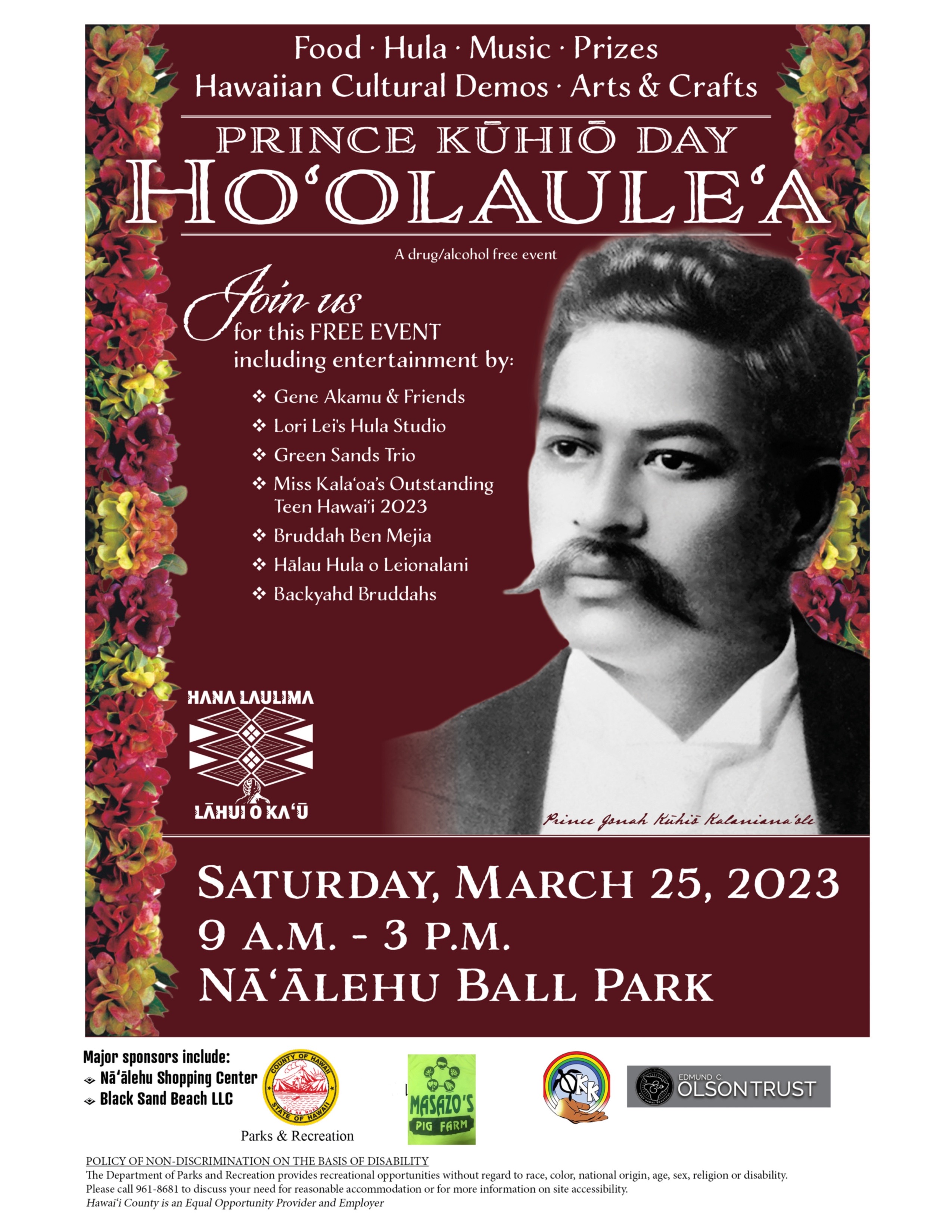
Free Meals Mondays, Wednesdays, and Fridays are served from 12:30 p.m. to 3:30 p.m. at Nā'ālehu Hongwanji. Volunteers prepare the food provided by 'O Ka'ū Kākou with fresh produce from its gardens on the farm of Eva Liu, who supports the project. Other community members also make donations and approximately 150 meals are served each day.
OUTDOOR MARKETS
-1.jpg) |
| https://www.okaukakou.org/scholarships -for-local-students |
Volcano Swap Meet, fourth Saturday of the month from 8 a.m. to noon. Large variety of vendors with numerous products. Tools, clothes, books, toys, local made healing extract and creams, antiques, jewelry, gemstones, crystals, food, music, plants, fruits, and vegetables. Also offered are cakes, coffee, and shave ice. Live music. Volcano Farmers Market, Cooper Center, Volcano Village on Sundays, 6 a.m. to 10 a.m., with local produce, baked goods, food to go, island beef and Ka'ū Coffee. EBT is used for Supplemental Nutrition Assistance Program, formerly Food Stamps. Call 808-967-7800.
O Ka'ū Kākou Market, Nā'ālehu, Wednesdays, 8 a.m. to 2 p.m. Contact Nadine Ebert at 808-938-5124 or June Domondon 808-938-4875. See facebook.com/OKauKakouMarket.
Ocean View Community Market, Saturdays and Wednesdays, 6:30 a.m. to 2 p.m., corner Kona Dr. Drive and Hwy 11, near Thai Grindz. Masks mandatory. 100-person limit, social distancing required. Gate unlocked for vendors at 5:30 a.m., $15 dollars, no rez needed. Parking in the upper lot. Vendors must provide their own sanitizer. Food vendor permits required. Carpooling is encouraged.


.jpg)


