About The Kaʻū Calendar

Monday, March 20, 2023

Kaʻū News Briefs, Monday, March 20, 2023

Red Hill Cabin has reopened along with the trail going there in Hawai'i Volcanoes National Park.
NPS Photo
 RED HILL CABIN AND PART OF MAUNA LOA TRAIL ARE OPEN. Hawai'i Volcanoes National Park made the announcement Monday about the reopening from the trailhead near Mauna Loa Lookout to Puʻuʻulaʻula (Red Hill).
    Mauna Loa Trail and the backcountry wilderness above Red Hill Cabin remain closed due to hazards from the eruption which started Nov. 27 and ended Dec. 10, 2022.
    Although USGS Hawaiian Volcano Observatory downgraded the status of Mauna Loa, the world's most massive volcano, to Green/Normal last week, serious hazards remain in closed areas particularly near recent flows and vents, including the following:
    Above Puʻuʻulaʻula, significant sections of trail and trail markers are covered in new lava, increasing the risk of getting lost.
    Thin layers of solidified lava can collapse if walked on causing lacerations or injury by falling into a cavity.
    Closed areas are in a remote, high-elevation location that often has poor weather and visibility, increasing the risk of getting lost and delayed response time by first responders
    Localized pockets of volcanic gas and particles may remain and present a danger to everyone. Face masks do not protect against gas or particles
    The Park reports: "The steep, 7.5-mile (12.1 km) hike from Mauna Lookout to Red Hill Cabin at the 10,035-ft (3,059 m) elevation "is not for everyone. Know your limits. Overnight use of Red Hill Cabin requires a backcountry permit. For more information, visit the park website."
Mauna Loa Trail to Red Hill Cabin has reopened. Photo from NPS


To read comments, add your own, and like this story, see facebook.com/kaucalendar. See latest print edition at kaucalendar.com, in the mail and on stands.

A GO FUND ME CAMPAIGN FOR THE FAMILY OF THE LATE NELLIE SALMO DAVIS, of Nā'ālehu, who taught school in Kaʻū, danced hula, served her church and family with four children and her husband, is launched. See https://www.gofundme.com/f/nellie-salmo-davis Go und Me organizer Willma Roddy said that Nellie Salmo Davis, "gained her angel wings." She was in her early 40's, with three daughters, a son and her husband who runs his own plumbing business in Kaʻū. "In October, she found out that she had three brain tumors. In December, Nellie underwent brain surgery in Seattle with the full support of her family and friends but unfortunately, she suffered a stroke 

A Go Fund Me campaign is launched for the late Nellie Salmo Davis (center) for her four
children and husband. See https://www.gofundme.com/f/nellie-salmo-davis.
the next day. This amazing woman defied the odds and she continued to fight hard everyday, despite other complications that followed. Her fighting spirit and faith never wavered as she battled with every ounce of willpower and love till the end!
    "Nellie raised four beautiful children, ranging in ages 8-19 with her husband Kahula, along with countless other nephews and nieces who would also consider her a second mom. Her family poured our their love and generosity to so many people. She was the backbone for many of us and loved her family more than anything in this world!
    "For those of us who are blessed to have known Nellie, we truly are the lucky ones! She was an amazing teacher who inspired many students and staff with over 15 years of service to her community. "She gave her all to her students with unforgettable experiences like schools trips to Dolphin quest, Pacific Aviation Flight School, Fairbanks, Alaska, and more. She was active in church, taught religious education and also danced hula with Halau o Leionalani. Her goodness and compassion made her a beautiful person inside and out. Nellie welcomed everyone and had the most loving heart! Nellie and Kahula were always willing to help anyone in need without asking for anything in return.
    "We are sharing only a part of Nellie’s wonderful life story because she has touched so many lives. At this time, they now need our help. We humbly ask for and would appreciate any support that will go towards her medical bills and funeral costs. Nellie will be flown back home, reunited with her loved ones and be laid to rest in Nā'ālehu, Hawai’i.
    "We thank you for your support and prayers to comfort Nellie's family and friends during this difficult time. God bless!"Contribute at https://www.gofundme.com/f/nellie-salmo-davis

To read comments, add your own, and like this story, see facebook.com/kaucalendar. See latest print edition at kaucalendar.com, in the mail and on stands.

HAWAI'I IS THE WORST STATE FOR DOCTORS TO PRACTICE MEDICINE according the WalletHub, which released its report on Monday. The study showed that the median physician's salary is
around $208,000 nationwide. Hawai'i ranked second lowest wage for physicians in the country when adjusted for housing. Washington, D.C. was worst.
    The top five places for Doctors to work are Montana, South Dakota, Idaho, Wisconsin and Minnesota. The worst is Hawai'i, followed by Rhode Island, Alaska, New Jersey and District of Columbia. In a category called Opportunity & Competition, Hawai'i ranked dead last.
The data set ranges from the average annual wage of physicians to hospitals per capita to the quality of the public hospital system.
    See the complete list of rankings and more at https://wallethub.com/edu/best-and-worst-states-for-doctors/11376.
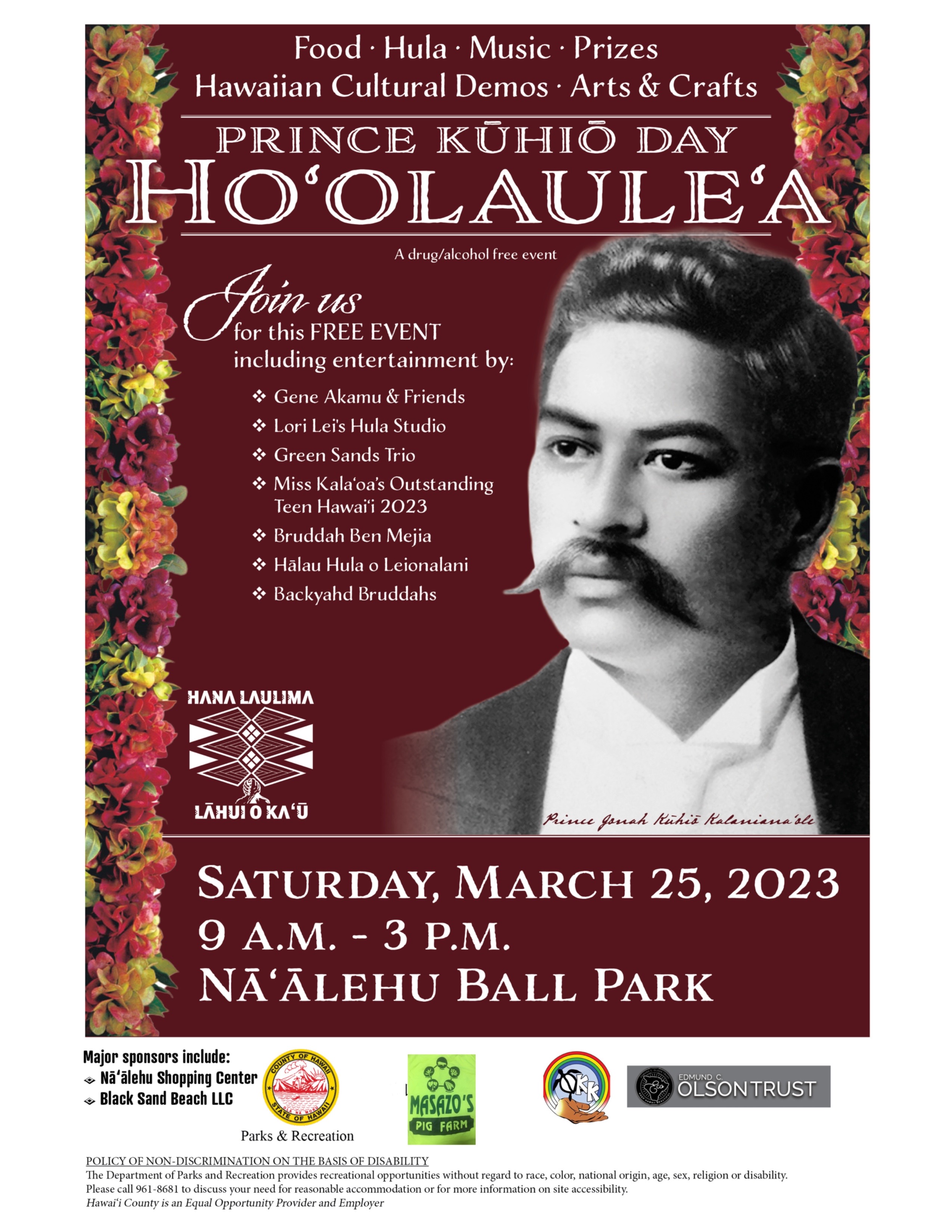
To read comments, add your own, and like this story, see facebook.com/kaucalendar. See latest print edition at kaucalendar.com, in the mail and on stands.

In the mail and on stands.

FREE FOOD

St. Jude's Hot Meals are free to those in need on Saturdays from 9 a.m. until food runs out, no later than noon. Volunteers from the community are welcome to help and can contact Karen at pooch53@gmail.com. Location is 96-8606 Paradise Circle Drive in Ocean View. Those in need can also take hot showers from 9 a.m. to noon and use the computer lab from 9:30 a.m. to 1 p.m.

Free Meals Mondays, Wednesdays, and Fridays are served from 12:30 p.m. to 3:30 p.m. at Nā'ālehu Hongwanji. Volunteers prepare the food provided by 'O Ka'ū Kākou with fresh produce from its gardens on the farm of Eva Liu, who supports the project. Other community members also make donations and approximately 150 meals are served each day.

OUTDOOR MARKETS

https://www.okaukakou.org/scholarships
-for-local-students
Volcano Evening Market, Cooper Center, Volcano Village, Thursdays, 3 p.m. to 6 p.m., with live music, artisan crafts, ono grinds, and fresh produce. See facebook.com.

Volcano Swap Meet, fourth Saturday of the month from 8 a.m. to noon. Large variety of vendors with numerous products. Tools, clothes, books, toys, local made healing extract and creams, antiques, jewelry, gemstones, crystals, food, music, plants, fruits, and vegetables. Also offered are cakes, coffee, and shave ice. Live music.                                                                                                                                  Volcano Farmers Market, Cooper Center, Volcano Village on Sundays, 6 a.m. to 10 a.m., with local produce, baked goods, food to go, island beef and Ka'ū Coffee. EBT is used for Supplemental Nutrition Assistance Program, formerly Food Stamps. Call 808-967-7800.

O Ka'ū Kākou Market, Nā'ālehu, Wednesdays, 8 a.m. to 2 p.m. Contact Nadine Ebert at 808-938-5124 or June Domondon 808-938-4875. See facebook.com/OKauKakouMarket.

Ocean View Community Market, Saturdays and Wednesdays, 6:30 a.m. to 2 p.m., corner Kona Dr. Drive and Hwy 11, near Thai Grindz. Masks mandatory. 100-person limit, social distancing required. Gate unlocked for vendors at 5:30 a.m., $15 dollars, no rez needed. Parking in the upper lot. Vendors must provide their own sanitizer. Food vendor permits required. Carpooling is encouraged.


Sunday, March 19, 2023

Kaʻū News Briefs, Sunday, March 19, 2023

Kaʻū Coffee Growers Cooperative President Gloria Camba and Bong Aquino, two of many farmers who recently purchased
 the coffee lands where they have been building a reputation for decades growing high quality Kaʻū Coffee. The coffees' value,
say supporters of truth in labeling, can be diminished when buyers dilute the local coffee with cheap foreign beans.
Photo from Kaʻū Coffee Festival

MORE TRUTH-IN-LABELING COFFEE LEGISLATION is up for a public hearing. The hearing is this Tuesday, March 21 at 9:55 a.m. before the state Senate Commerce & Consumer Protection Committee. It is the only Senate committee that has scheduled a hearing the matter. It already passed the House of Representatives as HB 259. Kaʻū's member of the House of Representatives Jeanne Kapela co-introduced the measure.
    HB259 provides for a phased-in 51% minimum of Hawaii-grown content, and label identification of the percentage of foreign-grown coffee included in all Hawaiian coffee blended with foreign coffee. For example, if 49% is foreign-grown coffee, the label would make full disclosure of all the coffee origins to consumers. 
    Citizens can give live Zoom testimony by signing up when submitting written testimony on the website. To testify, read the text of the bill, committee reports and all testimony, see https://www.capitol.hawaii.gov/session/measure_indiv.aspx?billtype=HB&billnumber=259&year=2023&mc_cid=637e587ec3&mc_eid=563999cc96
    Chair of the state Board of Agriculture Sharon Hurd gave testimony on HB259: "This measure prohibits using geographic origins of coffee in labeling or advertising for roasted or instant coffee that contains less than a certain percentage of coffee by weight from that geographic origin, phased in to a minimum of 51 percent after 7/1/2025." It prohibits use of the term All Hawaiian in labeling and advertising for roasted or instant coffee not produced entirely from green coffee beans grown and processed in Hawai'i. 
    Jeffrey Clark, Chief Operating Officer for Edmund C. Olson Trust, which owns and operates Kaʻū Coffee Mill and coffee orchards, sells only 100% Kaʻū Coffee. He wrote: "I can see the devastating result of blended coffees on the Hawai'i-grown coffee industry. Blended coffees, using as little as 10% of Hawaiian coffee, creates a real problem for local farmers. Blended coffees do not provide the consumer with the proper taste profile and mislead the consumer about the region's flavor qualities. Blended coffees also depress the price of 100% Hawaii-grown coffees... Products need to be properly labeled to inform the consumer not only of the percentage of Hawai'i-grown coffee, but also the percentage of foreign-grown coffee." 
    Clark noted that the coffee industry in Hawai'i started over 100 years ago and represents one of the largest crops grown in the state of Hawai'i. "Hawai'i farmers have built a reputation for growing high quality, specialty coffees that command premium prices. Blenders have taken advantage of this reputation" by blending Hawai'i-grown coffee with lower quality, cheaper coffees from elsewhere, said Clark.
    Hawai'i Farmers Union United stated that "Coffee farmers have been seeking these changes for more than 30 years. And consumers deserve full and clear disclosure of what is in the package."
     Hawai'i's Thousand Friends sent in testimony saying, "Farmers who produce high-quality coffee in a
local region deserve the right to defend their area brand by requiring that coffee sold under a local regional name contains at least 51% of coffee grown from that region. Allowing anything less neither support nor appreciates Hawai'i's coffee farmers and the value of their product."
    Bruce Silverglade, former legal director of Center for Science in the Public Interest and fulltime Hawai'i resident, wrote: "At the present time, coffee blenders in Hawai'i are engaging in what food regulatory lawyers call economic adulteration, i.e. diluting a premium product with inferior coffee varieties. Such practices have long plagued segments of the food industry since the days that unscrupulous businesses would sell watered-down milk."
     He also testified: "This measure is essential to protect consumers, ranging from Hawai'i residents to unsuspecting visitors to the islands. The goodwill generated from this requirement to prevent non-misleading labeling will benefit the State of Hawai'i, protect the general public and ensure fair treatment of
coffee farmers. 
    "Some parties opposed to the bill say it will be difficult to enforce given the lack of technological capacity in the State to test blended coffees to determine their authenticity. The U.S. Food & Drug Administration faced an analogous challenge when it promulgated regulations requiring the amount of 'added,' as opposed to naturally occurring, sugars to be listed on the Nutrition Facts label. It was argued that testing methods could not distinguish between naturally occurring and added sugars in a product like apple sauce. 
    "The U.S. Food & Drug Administration solved the problem by requiring food processors to keep and maintain records as to the amounts of added sugars they were using. The same type of record keeping requirement could be instituted for food manufacturers engaged in coffee blending. The State could require records to be kept and made available for inspection. This approach would help ensure that the bill is enforceable."
    To read more testimony submitted on truth in labeling for Hawaiian coffee, see http://kaunewsbriefs.blogspot.com/2023_03_18_archive.html,   http://kaunewsbriefs.blogspot.com/2023_02_21_archive.html and http://kaunewsbriefs.blogspot.com/2023/02/kau-news-briefs-tuesday-feb-28-2023.html
Hawai'i Island has 14 new Conservation Resources Enforcement Officers who just graduated from a class of 41 recruits. They are expected to beef up protection of natural resources in remote places like Kaʻū.  Photo from DLNR


FOURTEEN NEW HAWAI'I CONSERVATION RESOURCES ENFORCEMENT OFFICERS are assigned to Hawai'i Island. These CREOs are among the 41 women and men in the largest recruit class in the history of the state Department of Land & Natural Resources' Division of Conservation & Resources Enforcement. The class was sworn in and commissioned in a ceremony at Leeward Community College on Friday and presented commission certificates and badges.
    DOCARE Chief Jason Redulla said, “If you combine the skills of a police officer, game warden, park ranger, marine patrol officer, educator, medic and counselor, that’s a DOCARE officer. These officers have a broad skillset and the academy was the vehicle to get them equipped so they can best serve Hawai‘i in protecting its natural and cultural resources.”
    DOCARE Lt. Carlton Helm, who led the academy, said, “To the visitor mindset, Hawai‘i’s natural resources are elements of paradise – clear ocean waters, sandy beaches, warm sun, tropical fish, but to residents with ties to this place it means a lot more, it’s our identity. Without the resources, little by little, we start to lose that identity. CREOs are committed to our communities and to protecting our resources.”
Carlton Helm led the academy to train new
Conservation Resources Enforcement officers.
    The class trained for more than eight months in more than 100 disciplines combining classroom work and intense field exercises. The new CREOs deploy to O‘ahu (14), Hawai‘i Island (14), Maui (7), and Kaua‘i (6). "Their presence is expected to make an immediate impact in conservation enforcement and will bolster patrol needs and staff ranks," says a statement from DLNR.
    DLNR Chair Dawn Chang said, “I’m greatly appreciative for the kuleana that these men and women have accepted. I welcome them to the DLNR ‘Ohana.” Other speakers at the graduation included Lt. Gov. Sylvia Luke, Sen. Donovan Dela Cruz, and Lt. Oscar Diaz (DPS Retired). The graduates’ family members participated to pin badges on the officers’ uniforms.
    CREO duties include enforcing rules and laws, educating residents and visitors and interacting with the community. DOCARE officers cover large geographic areas, often working independently with little or no oversight. According to DLNR, "They’re expected to command a firm understanding of natural resource laws, and to work in challenging conditions on land and at sea.
    "The academy program is a community effort with stakeholders including Honolulu Community College, elected officials, DLNR and other state department leadership, conservation nonprofits, subject
matter experts, other partner organizations, and residents. The program is unique in that it offers both a public safety and a natural resources component.
    "Recruits who have no law or conservation enforcement experience are developed into competent officers, learning skills to perform the job and keeping the values of kuleana, community service, and being pono, top of mind."
     Next for these newly commissioned CREOs is their field-training phase, working alongside seasoned officers at their respective island posts. They will have the opportunity to apply what they’ve learned, with guidance, in real world situations. “Learning in a classroom is one thing,” Helm explained. “Having role players and stopping to provide remedial training for the sake of recruit development is good, but in the real world there are no timeouts. That’s where the seasoned officers come in – to provide support, safety, and proper direction if need be.”


In the mail and on stands.

FREE FOOD

St. Jude's Hot Meals are free to those in need on Saturdays from 9 a.m. until food runs out, no later than noon. Volunteers from the community are welcome to help and can contact Karen at pooch53@gmail.com. Location is 96-8606 Paradise Circle Drive in Ocean View. Those in need can also take hot showers from 9 a.m. to noon and use the computer lab from 9:30 a.m. to 1 p.m.

Free Meals Mondays, Wednesdays, and Fridays are served from 12:30 p.m. to 3:30 p.m. at Nā'ālehu Hongwanji. Volunteers prepare the food provided by 'O Ka'ū Kākou with fresh produce from its gardens on the farm of Eva Liu, who supports the project. Other community members also make donations and approximately 150 meals are served each day.

OUTDOOR MARKETS

https://www.okaukakou.org/scholarships
-for-local-students
Volcano Evening Market, Cooper Center, Volcano Village, Thursdays, 3 p.m. to 6 p.m., with live music, artisan crafts, ono grinds, and fresh produce. See facebook.com.

Volcano Swap Meet, fourth Saturday of the month from 8 a.m. to noon. Large variety of vendors with numerous products. Tools, clothes, books, toys, local made healing extract and creams, antiques, jewelry, gemstones, crystals, food, music, plants, fruits, and vegetables. Also offered are cakes, coffee, and shave ice. Live music.                                                                                                                                  Volcano Farmers Market, Cooper Center, Volcano Village on Sundays, 6 a.m. to 10 a.m., with local produce, baked goods, food to go, island beef and Ka'ū Coffee. EBT is used for Supplemental Nutrition Assistance Program, formerly Food Stamps. Call 808-967-7800.

O Ka'ū Kākou Market, Nā'ālehu, Wednesdays, 8 a.m. to 2 p.m. Contact Nadine Ebert at 808-938-5124 or June Domondon 808-938-4875. See facebook.com/OKauKakouMarket.

Ocean View Community Market, Saturdays and Wednesdays, 6:30 a.m. to 2 p.m., corner Kona Dr. Drive and Hwy 11, near Thai Grindz. Masks mandatory. 100-person limit, social distancing required. Gate unlocked for vendors at 5:30 a.m., $15 dollars, no rez needed. Parking in the upper lot. Vendors must provide their own sanitizer. Food vendor permits required. Carpooling is encouraged.


Saturday, March 18, 2023

Kaʻū News Briefs, Saturday, March 18, 2023

Leo Norberte, winner of the 2022 Hawai'i Coffee Association's cupping contest for Kaʻū, is one of the
many Hawaiian coffee farmers who depend on truth in labeling to keep their 100 percent Hawaiian grown brands
 viable in the market. Photo by Julia Neal

THE TRUTH IN LABELING BILL FOR COFFEE GROWN IN HAWAI'I passed second reading in the state House of Representatives on Friday after passing the Senate and is apparently headed toward becoming law. Senate Bill 745 would extend the offense of false labeling of Hawai'i-grown coffee to include roasted coffee, impose a $10,000 fine for each separate offense of false labeling of Hawai'i-grown coffee, and make an appropriation to fund enforcement. Kaʻū's Sen. Dru Kanuha co-introduced the measure.
    Executive Director of Hawai'i Coffee Association, Chris Manfredi, sent in testimony in support. "Hawai'i’s growers work tirelessly to produce some of the finest coffee grown anywhere. Exceptionally high quality is vital so producers can earn a relatively high price for their products - to stay in business, pay their employees and feed their families. When they visit the supermarket, they are

outraged that counterfeit Hawai'i grown coffee is offered on the same shelves as their own at a price less than their cost of production.
    "Unethical sellers introduce foreign grown coffee into the market to defraud consumers by representing these fakes as Hawai'i-grown products. Hawai'i’s coffee growers are squeezed between a high cost of production and unfair price competition. Moreover, these inferior fakes do not share the same quality attributes of the genuine product, further undermining Hawai'i’s reputation and brands, and they are not required to comply with Hawai'i’s minimum grade standards. When someone cashes in on our hard-fought reputation by offering fake products in a package labeled as being of Hawaiian origin, it undermines the work of our entire industry."
     Volcano resident Marsha Hee wrote: "This bill closes an important loophole where counterfeiters have been escaping oversight. By granting Hawai'i Department of Agriculture the ability to verify the authenticity of a roasted coffee’s origin, it opens the door for better enforcement and higher profits to farmers. The less counterfeit coffee in the marketplace, the greater the demand for real Hawaiian coffee."
    Sharon Hurd, Chair of the state Board of Agriculture, wrote: "DOA supports the appropriation of funds to hire one full time measurement standards specialist/inspector (approximate appropriation request of
$100,000) for the purpose of labeling and packaging enforcement and inspection. The inspector will help rebuild DOA’s capability to address labeling enforcement challenges in various Hawai'i products especially with roasted coffee. The inspector will take the lead in researching and utilizing new recognized testing measures to identify different products geographically such as Oritain technology (https://oritain.com), which can generate science-based data from specific coffee growing regions as a proof and confirmation of truth or false labeling."
  Suzanne Shriner, Administrator of Synergistic Hawai'i Agriculture Council wrote: "SHAC receives Federal marketing funds to promote 100% Hawaiian origin products around the world, including coffee, papaya, floriculture and macadamia nuts. Frequently we find that the demand for 100% Hawaiian products far exceeds available supply. Quite simply, there is not enough Kona, Kaʻū or Maui coffee to meet the global desire for Hawaiian coffee. This makes our coffees highly vulnerable to counterfeiting.
    "We appreciate the Legislature working with the coffee industry through protection of origin products from cherry all the way through roasted coffee. The technology exists to test the authenticity of both grade and origin of Hawaiian coffee. Enforcement of this bill is expected to be on an as-needed basis, such as a consumer complaint. Having said that, inclusion of a FTE position is necessary to protect coffee and other crops from fraud."
    Hawai'i Farm Bureau Executive Director Brian Miyamoto noted: "Hawai'i-grown coffee is recognized
for its high quality and aromatic flavor. Hawaiʿ'i-grown coffee is held to a set of quality standards that makes it one of the most expensive coffees in the world. It is one of Hawai'i’s signature crops. The 2021-2022 USDA National Agriculture Statistics Service (NASS) of Hawai'i Agriculture estimated the value of Hawaiʿi-grown coffee at $61.9 million and ranked as coffee fifth in the top twenty agricultural commodities in the State." Miyamoto testified that "in addition to the geographic origin, stricter enforcement of the labeling restrictions based on the quality of the coffee being sold is critical to prevent further counterfeiting of Hawaiʿi’s recognized high-quality coffee. Furthermore, the criminal penalties for false labeling should apply not only to cherry, parchment, and green coffee but also to roasted coffee."
    Hawai'i Farmers Union President Kaipo Kekono testified: "We believe that it is time for Hawai'i's coffee industry to have the same protections as the many other agricultural industries in the state. We understand that honest labeling in the coffee industry is widely regarded as important in maintaining trust among consumers, and this bill will help ensure that all coffee labeled as Hawai'i Grown is actually grown in the islands. This level of transparency is necessary in order to protect the reputation of Hawai'i’s coffee industry."
    For earlier testimony submitted on this issue, see http://kaunewsbriefs.blogspot.com/2023_02_21_archive.html and http://kaunewsbriefs.blogspot.com/2023/02/kau-news-briefs-tuesday-feb-28-2023.html

To read comments, add your own, and like this story, see facebook.com/kaucalendar. See latest print edition at kaucalendar.com, in the mail and on stands.

A MAC NUT LABELING BILL THAT PASSED THE STATE HOUSE OF REPRESENTATIVES AND FIRST READING IN THE SENATE was scheduled for a public hearing in the Senate on Friday, but the hearing was delayed. The delay may indicate it will not be heard at all this legislative session in the Senate. It would need passage by the Senate after succeeding in the House in order to become Hawai'i law.
    The measure, introduced in the Senate by Kaʻū's Sen. Dru Kanuha, would clarify labeling requirements for macadamia nuts, mandating that country of origin to be included on the principal display panel of a consumer package of raw and processed macadamia nuts.
    Crissa Uluwehi Midori Okamura wrote: "The legislature threw out the bill HB1348 (3/17/23). Our 'ohana put in our testimonies but to no avail! Very sad for our local farmers & upsetting to know they will sell under the premise of 'Being MADE in Hawai'i' when mac nuts come from Africa!!! Like sugarcane, soon macadamia will be gone too."
    See more testimony at http://kaunewsbriefs.blogspot.com/2023_03_14_archive.html.


To read comments, add your own, and like this story, see facebook.com/kaucalendar. See latest print edition at kaucalendar.com, in the mail and on stands.


Palila, the endangered finch-billed honeycreepers, were found in most mamane dry forest trees on this island. Photo from DLNR

HAWAI'I'S CONGRESSIONAL DELEGATION IS URGING THE NATIONAL PARK SERVICE to prioritize its efforts to protect critically endangered Native Hawaiian forest birds. A letter from Sen. Mazie Hirono, Sen. Brian Schatz, Rep. Ed Case and Rep. Jill Tokuda asks NPS to use funding from the Inflation Reduction Act passed last year to continue efforts to protect native forest birds.

    The letter to National Park Service Director Charles Sams says, "Native Hawaiian forest birds are

imperiled by the spread of avian malaria, which is carried into their last remaining habitat and transmitted to the birds by invasive mosquitoes. Warming temperatures due to climate change have allowed mosquitoes to reach elevations that were previously refuge for the birds. Avian malaria caused waves of extinctions after it was introduced in the early 1900s and the continued impacts have been tracked for decades by researchers, land managers, and cultural practitioners alike.
    "As pollinators and seed dispersal agents, Hawaiian honeycreepers fill an irreplaceable niche within Hawai'i's native forests, which are the source of all our islands' freshwater. Four Hawaiian honeycreepers are at risk of extinction within the next ten years: akikiki ~1 year; kiwikiu ~6 years; akekee ~8 years; and akohekohe ~10 years. If we lose these special birds, we also lose the essential roles they perform within the native ecosystem and a piece of Hawaiian culture. Unless we take significant action now, they will be gone forever."
     The letter urges the Park Service to concentrate on reducing avian malaria with mosquito suppression programs.

To read comments, add your own, and like this story, see facebook.com/kaucalendar. See latest print edition at kaucalendar.com, in the mail and on stands.

In the mail and on stands.

FREE FOOD

St. Jude's Hot Meals are free to those in need on Saturdays from 9 a.m. until food runs out, no later than noon. Volunteers from the community are welcome to help and can contact Karen at pooch53@gmail.com. Location is 96-8606 Paradise Circle Drive in Ocean View. Those in need can also take hot showers from 9 a.m. to noon and use the computer lab from 9:30 a.m. to 1 p.m.

Free Meals Mondays, Wednesdays, and Fridays are served from 12:30 p.m. to 3:30 p.m. at Nā'ālehu Hongwanji. Volunteers prepare the food provided by 'O Ka'ū Kākou with fresh produce from its gardens on the farm of Eva Liu, who supports the project. Other community members also make donations and approximately 150 meals are served each day.

OUTDOOR MARKETS

https://www.okaukakou.org/scholarships
-for-local-students
Volcano Evening Market, Cooper Center, Volcano Village, Thursdays, 3 p.m. to 6 p.m., with live music, artisan crafts, ono grinds, and fresh produce. See facebook.com.

Volcano Swap Meet, fourth Saturday of the month from 8 a.m. to noon. Large variety of vendors with numerous products. Tools, clothes, books, toys, local made healing extract and creams, antiques, jewelry, gemstones, crystals, food, music, plants, fruits, and vegetables. Also offered are cakes, coffee, and shave ice. Live music.                                                                                                                                  Volcano Farmers Market, Cooper Center, Volcano Village on Sundays, 6 a.m. to 10 a.m., with local produce, baked goods, food to go, island beef and Ka'ū Coffee. EBT is used for Supplemental Nutrition Assistance Program, formerly Food Stamps. Call 808-967-7800.

O Ka'ū Kākou Market, Nā'ālehu, Wednesdays, 8 a.m. to 2 p.m. Contact Nadine Ebert at 808-938-5124 or June Domondon 808-938-4875. See facebook.com/OKauKakouMarket.

Ocean View Community Market, Saturdays and Wednesdays, 6:30 a.m. to 2 p.m., corner Kona Dr. Drive and Hwy 11, near Thai Grindz. Masks mandatory. 100-person limit, social distancing required. Gate unlocked for vendors at 5:30 a.m., $15 dollars, no rez needed. Parking in the upper lot. Vendors must provide their own sanitizer. Food vendor permits required. Carpooling is encouraged.