About The Kaʻū Calendar

Saturday, April 01, 2023

Kaʻū News Briefs, Saturday, April 1, 2023

Catimor is a hybrid coffee that could replace local coffee trees devastated by Coffee Leaf Rust.
Catimor and several other hybrids are being tested for distribution here. Photo from typescoffee.com

NEW HOPE FOR NEW VARIETIES OF COFFEE TREES is coming from University of Hawai'i, which has been growing, harvesting and collecting data on Coffee Leaf Rust-resistant varieties of coffee plants. Rust is devastating farms in Kona and has spread to Kaʻū. 
    The resistant varieties are Catimor hybrids, False Tup and Obata. According to typescoffee.com,  Catamor "is a hybrid coffee variety that was developed in Portugal in the late 1960s. It's a cross between the Timor Hybrid and Caturra varieties, and is known for its high yields, disease resistance, and good cup quality. Catimor is widely grown in Central and South America, as well as in India and Indonesia."
Andrea Kawabata
    According to Andrea Kawabata, of U.H. Agricultural Extension Service, the testing for Hawai'i has gone on for two seasons, keeping track of the yield and cherry size data and cupping the coffee from the trees. It's taking place at the UH Kona Research Station in Kainaliu. The next cupping is this month.   
    Kaʻū farmers interested in the Catimor hybrid project can review a recorded presentation at https://youtu.be/11-ytPT2jFU.
    Regarding the testing of the resistant varieties, Kawabata reports that CLR has not caused sporulating lesions on any of the 20 of trees and eight of the top Catimor hybrid trees have been confirmed by USDA ARS PBARC as CLR-resistant. "Two seasons of observations and harvests have also given us a better understanding of the top producing and top quality trees from this field. In addition, we have False Tupi and Obata varieties which are also showing resistance to CLR," said Kawabata.
   Kawabata said that the researchers are ready to determine if growers are interested in receiving plant materials from these top Catimor hybrid trees, False Tupi, and/or Obata trees, and how growers prefer to receive the plant materials if they are made available to the industry.
    While distributing seed or plant materials to the industry has not begun, a survey is set up to help determine next steps. Kawabata asks farmers to "please complete this survey and provide us with your feedback." She noted that the survey is open to all coffee producers in Hawai'i, but is not anonymous. Contact Kawabata at andreak@hawaii.edu, 808-322-4892, or 415-604-1511 (text ok).

Coffee Leaf Rust has devastated Kona coffee farms and spread to Kaʻū. Resistant varieties are
being tested by University of Hawai'i for distribution here. Photo from U.H.

FEDERAL CREDITS OF $8.1 MILLION WENT TO THOUSANDS OF HAWAIIAN ELECTRIC CUSTOMERS this year to reduce their energy bills, about $2.5 million more than last year, says a statement from the utility.
   More than 7,500 residential customers across the five islands Hawaiian Electric serves received credits from the Hawaiʻi Department of Human Services’(DHS) Low-Income Home Energy Assistance Program, or LIHEAP. Customers with household incomes below a certain level apply for a one-time credit on their electric bills to help offset energy costs. The $8.1 million LIHEAP total received includes additional monies for applicants through various COVID relief funds.
    The minimum Energy Credit was $550, and the amount of the credit varies each year based on factors including income level, total number of people per eligible household and available funds. For the Energy Crisis Intervention credit, the amount varies depending on the customer’s past due balance.
    “Our goal is to keep customers connected, and LIHEAP credits provide welcome relief for thousands of households,” said Brendan Bailey, Hawaiian Electric vice president of customer service. “With the cost of just about everything on the rise, LIHEAP and other assistance programs can make a significant impact.”
    DHS LIHEAP Coordinator Elisa Furtado-Fischer said, “We know how critically important this program is for so many Hawaiʻi residents. It takes many partners, including nonprofit agencies and Hawaiian Electric, to provide this much needed energy assistance.” LIHEAP Energy Credit applications are taken annually only during the month of June by Honolulu Community Action Program, Maui Economic Opportunity and Hawaiʻi County Economic Opportunity Council. LIHEAP Energy Crisis Intervention applications are accepted year-round for households facing service disconnection, but there is a limited number of approvals granted each month. For more information visit hawaiianelectric.com/liheap.
EIGHTEEN WERE ARRESTED FOR DUI from March 20 through March 26. Hawai‘i Island police made the arrests for driving under the influence of an intoxicant. Three of the drivers were involved in a traffic accident. None were under the age of 21. So far this year, there have been 248 DUI arrests

compared with 266 during the same period last year, a decrease of 6.8 percent. Hawai‘i Police Department’s Traffic Services Section reviewed all updated crashes and found 220 major crashes so far this year compared with 172 during the same period last year, an increase of 27.9 percent.
    To date, there have been four fatal crashes, resulting in five fatalities, (Rvsd. 02/07/23: one fatal crash reclassified—manner of death was due to natural causes) and (one fatal crash had multiple deaths); compared with nine fatal crashes, resulting in 11 fatalities (one of which had multiple deaths) for the same time last year. This represents a decrease of 55.6 percent for fatal crashes, and 54.5 percent for fatalities.


LATERALLY DIRECTED ERUPTIONS are the subject of this week's Volcano Watch column by USGS Hawaiian Volcano Observatory scientists and affiliates:
     The 1980 Mount St. Helens eruption in Washington State illustrated the hazards and impacts of lateral (ground-hugging) volcanic blasts on natural landscapes and human infrastructure. The eruption devastated hundreds of square miles and killed 57 people. In the more than forty years since, several additional laterally directed explosive eruptions have occurred world-wide.
    An eruption at Ontake, Japan in 2014 showed the tragic impacts of laterally directed eruptions in near vent environments. But lateral eruptions at volcanoes are not only confined to the main eruption blast. Hot gas, ash, and mud can flow laterally from a mostly vertical eruption located in confining topography (like a valley) focusing ground-hugging volcanic flows (known as pyroclastic density currents) which may impact the near vent environment even for small eruptions. If a valley or other topography exists, these types of flows can move several miles from the eruption vent. In some cases, such events can produce mudflows, called lahars, which can be particularly dangerous even farther (tens of miles) from the source of the eruption.
The experiment was completed in 2016 and included a setup to measure
 acoustic signals from human-made blasts which could improve our
understanding and early detection of real volcanic eruptions. The upper left
 image shows a simple plastic soda-pop bottle being filled with super cold liquid
 nitrogen. The bottle is subsequently sealed with a cap and placed in the
 ambient water-filled barrel. The difference in temperatures between the bottle
 and barrel water causes a rapid discharge explosion (lower left image)
 which is recorded on a pressure sensor near the cannon. Each waveform (right)
 shows a different eruption experiment.
Images from video by Julian Thompson, formerly GNS Science. 
    Due to the devastating impacts, these events can have on nearby areas, the global volcano monitoring community wants to improve the detection and characterization of hazards posed by explosive eruptions using automated sensors like seismometers and microphones for early warning systems.
    A new preliminary field-scale experiment was recently completed by a U.S. and New Zealand research team, where the energy characteristics of a human-made ‘volcanic’ eruption was measured on a surrounding microphone ‘acoustic’ recording system. The experiment used a tiltable water cannon which was surrounded by pressure sensors like those used for volcano monitoring, both globally and here at the Hawaiian Volcano Observatory (HVO). The scientists wanted to determine if there were differences in the sound measured in the direction of the eruption blast, compared to the sounds measured behind the cannon. These differences may give scientists insight into the eruption processes and better understand the hazards associated with real ground-hugging eruptions.
    The figure shows an example explosion from the inclined water cannon experiment. The barrel is comprised of a standard 55-gallon drum with one end open, filled one-third full of water at ambient temperature. A sealed soda-pop bottle filled with liquid nitrogen is dropped into the water. Because the liquid nitrogen is at a temperature of -196 degrees Celsius (-320 degrees Fahrenheit), it will expand in the

warmer surrounding water. Shortly after the bottle is immersed, it rapidly bursts, producing a small, controlled explosion. Normally an explosion would expand in all directions, but because the bottle is at the bottom of an open-ended barrel, the energy is focused out of the barrel opening. The preferential direction of energy expansion and the explosion direction is then recorded on the surrounding sensors.
    Each experiment was recorded with video cameras facing in three unique directions to document the blast direction and speed. Vertically directed blasts were found to have similar acoustic recordings on all the surrounding microphones. For more ground-hugging eruptions, the experiments suggest that the strongest blasts show higher frequency energy in the direction of the blast while lower frequency energy is recorded behind the blast source (in this case the cannon).
    While more tests are required, the observations might reflect features of eruption blast dynamics that can be used as part of future eruption detection systems near hazardous eruption vents. The observational data may also have implications for hazardous mass flow events including pyroclastic-flows and lahar monitoring. While our Hawaiian volcanoes have fewer explosive eruptions in general, the observation results may be useful to understand the lateral migration of our Hawaiian fissure eruptions.
    If you want to learn more about this experiment, check out this recent publication in Earth, Planets, and Space!


Friday, March 31, 2023

Kaʻū News Briefs, Friday, March 31, 2023

Mauna Loa Cabin and trail and a radio repeater at the summit will be assessed through one of 
the planned helicopter service flights in April by Hawai'i Volcanoes National Park.
See flight dates for April below. NPS Photo

COUNTY PROSECUTING ATTORNEY KELDEN WALTJEN RELEASED A SURVEY on Friday, concerning public opinion on proposed legislative changes. He stated "The survey results indicate that Hawai‘i Island residents agree with our Office’s position to establish harsher penalties for domestic abuse, fentanyl possession, drug distribution resulting in serious injury or death, felons in possession of firearms, and driving under the influence.
Prosecuting Attorney Kelden Waltjen
    "A majority also support creation of new offenses criminalizing fraud and corruption by public officials and employees, establishing a class of negligent or involuntary manslaughter offenses, and adoption of the felony murder rule.
    "Results also showed that an overwhelming number of participants support the relocation of the Hawai‘i Community Correctional Center and the construction of new correctional facilities on Hawai‘i Island.
    "A large percentage agree on the importance of prioritizing increased funding for substance abuse and mental health treatment on Hawai‘i Island. Lastly, the results demonstrate that a large majority of Hawai‘i Island residents agree with our Office that custody determinations should be evaluated on a case-by-case basis. Hawai‘i Island residents do not believe that defendants should be automatically released even if charged with only 'non-violent' misdemeanor and/or felony offenses."
    The Prosecuting Attorney said data from the survey has been shared with Hawai‘i Island state Representatives and Fenators, Hawai‘i County Council, and the Mayor’s Office. "We hope this data assists our state lawmakers and county officials in advocating for the best interests of Hawai‘i Island. Data from our Office’s survey last year was instrumental in the passage of new legislation, including a class B felony offense for automobile and motorcycle theft and a new felony offense for dog attacks resulting in serious bodily injury or death."


"HAWAI'I COUNTY HAS A SEVERE HOUSING CRISIS. The lack of affordable housing often forces residents to leave the state." Those are words from an audit report that was recently posted, concerning county Office of Housing & Community Development Affordable Housing Credits.
     Affordable Housing Credits are designed to help to provide "decent housing, suitable living environments, and the expansion of economic opportunities." OHCD’s Planning Branch administers the
affordable housing policy through Chapter 11, Hawaiʻi County’s Affordable Housing Policy, which mandates inclusion of affordable housing in and throughout various market developments, including rezoning. It provides a means for developers to satisfy affordable housing obligation through seven options: developing finished lots, selling, or renting the required units on or off-site, conveying land or infrastructure, or purchasing affordable housing credits.
    The report notes that in July 2022, media outlets reported a fraud scheme committed by a now-former employee of the Office of Housing and Community Development, questioning the efficacy of Chapter 11.
    In September 2022, Hawai‘i County Council’s Resolution No. 467-22 requested the Office of the County Auditor conduct the performance audit.The report lists deficiencies and improvements.
  
AFFORDABLE HOUSING IS ONE REASON FOR A VETO OF A COUNTY COUNCIL BILL by
Mayor Mitch Roth. He vetoed Bill 194 this week, citing concerns over the Bill's potential impact "on the County's ability to condition rezoning ordinances, provide affordable housing, and facilitate development projects."
   The Bill proposed to remove the Planning Commission's, Council's, and Department's authority to grant and/or add administrative time extensions for the performance of conditions within rezoning ordinances. Instead, any request for a time extension would require an additional Council approval, turning what was once an administrative procedure into a political process.
    In correspondence to the Council, the Mayor contended that the Bill "would add expense, uncertainty, and difficulty to the rezoning process, limiting the County's flexibility to condition rezoning ordinances appropriately. Furthermore, the Bill would impede the County's ability to provide residents with housing and facilities like hospitals, schools, and job centers, ultimately punishing unsophisticated applicants and adding unnecessary costs to the development process."
    The Mayor's recommendation is not to pass Bill 194 in any form and allow the existing process to remain in place. He emphasized his administration's commitment to providing housing for residents and noted that the Bill would impede the County's ability to achieve that goal.
    "The decision to veto the Bill comes after careful consideration of its potential impact on the County's planning and zoning processes. Mayor Roth hopes that the Council will work collaboratively with his administration to find alternative solutions to address the issues the Bill aimed to resolve," says the statement from his office.

To read comments, add your own, and like this story, see facebook.com/kaucalendar. See latest print edition at kaucalendar.com, in the mail and on stands.

"GOOD GOVERNMENT BILLS" is the term Gov. Josh Green, M.D. used for seven that he signed into law on Friday, "to advance the goals of ethics, lobbying, and campaign spending laws in Hawai'i.'
    Green said, "The people of Hawaiʻi deserve a transparent and accountable government. I said it during my time as Lt. Governor, I said it during my campaign, and I have repeated it many times, including in my State of the State address, because I believe it is a critical part of effective government that delivers for our people.
    "The bills I have signed into law today were crafted by many great and collaborative minds and will
Gov. Josh Green signs seven bills into law on Friday regarding validation
of ballots, campaign spending, fundraisers, lobbying and gifts
to public officials. Photo from Gov. Green
allow even more sunshine into the executive and legislative branches of government. They will increase our transparency and accountability to our residents."
    The State's Campaign Spending Commission, Ethics Commission, and Office of Elections asked House Speaker Scott Saiki to introduce them.
    Hawai'i Island's Rep. David Tarnas, who serves as House Judiciary and Hawaiian Affairs Committee chair, and Sen. Karl Rhoads, chair of the Senate Judiciary Committee, attended the bill signing along with collaborators, including retired judge Daniel Foley, who served as Chair of the Commission to Improve Standards of Conduct; Robert Harris, executive director of the State Ethics Commission; Kristin Izumi-Nitao, executive director of the Campaign Spending Commission, and Janet Mason, member of the League of Women Voters of Hawaiʻi Legislative Committee, among others. Here are the bills signed into law:
    HB90, Relating to committee fundraisers: Amends the definition of "fundraiser" under Election Laws to include all functions held for the benefit of candidates, candidate committees, and noncandidate committees, regardless of the price or suggested contribution for attending the function. The aim is to further public transparency and improve public confidence in campaigns by requiring a notice of intent to hold a fundraiser for which any price is charged or any contribution is suggested for attendance.
    
HB93, Relating to organizational reports: Requires the Campaign Spending Commission to publish on its website the names of candidate and persons who qualify as noncandidate committees who fail to file an organizational report or a corrected organizational report with the Commission. The aim is to improve compliance with filing requirements and bring awareness of noncompliance to the public. Publishing the names of noncandidate committees who fail to file an organizational report will motivate these committees to do so.
    
HB99, Relating to limiting a campaign's acceptance of cash contributions: Limits to $100 the total amount of cash a candidate, candidate committee, or noncandidate committee may accept from a single person during each election period. The aim is to imposes limitations similar to those placed on anonymous cash contributions, thereby making violations of campaign finance law easier to detect and prevent.
    HB130, HD1, Relating to validation of ballots: Shortens the deadline for the validation of ballots following an election. The aim is to align the deadline by which voters must cure any deficiency with the return envelope with the deadline for the county election divisions to validate ballots.
    HB137, HD1, Relating to lobbyists: Beginning 1/1/2025, requires the statement of expenditures filed by

lobbyists and other persons who engage in lobbying activities to include certain information on the identity of the legislative or administrative action that was commented on, supported by, or opposed by the person filing the statement during the statement period.
    The aim is to provide greater transparency on lobbying activities by requiring specific information on the legislative or administrative action lobbied on, instead of a broad subject area.
    HB140, Relating to record disposition: Provides the State Ethics Commission with the discretion to maintain or destroy records of financial disclosure statements beyond the current six-year statutory requirement. Applies retroactively to applicable disclosures that are in the Commission's possession and control.
    HB142, Relating to gifts from lobbyists: Prohibits lobbyists from making gifts that are prohibited under state ethics law. Improves standards of conduct by prohibiting lobbyists from making certain gifts to legislators and state employees. The law lessens the number of situations where a legislator or state employee must refuse a prohibited gift.

To read comments, add your own, and like this story, see facebook.com/kaucalendar. See latest print edition at kaucalendar.com, in the mail and on stands.

HAWAI'I VOLCANOES NATIONAL PARK FLIGHT OPERATIONS FOR APRIL ARE ANNOUNCED:
    April 3 between 7:30 a.m. and 1 p.m. to service the radio repeater near Mauna Loa summit, and to assess Mauna Loa Cabin and trail.
    April 11 between 6:30 a.m. and 8:30 a.m. for Kahuku ungulate survey between 4,000- and 6,500-ft. elevation.
    April 19, 24 and 27 between 7 a.m. and 1 p.m. to remove old fence material at the Great Crack fence line between 1,000- and 2,500-ft. elevation.

The Great Crack area of Hawai'i Volcanoes  will receive a cleanup
 of old fencing on its boundary by helicopter in April. USGS photo
    A statement from the Park offers "regrets any noise impact to residents and park visitors. Dates and times are subject to change based on aircraft availability and weather. Management of the park requires the use of aircraft to monitor and research volcanic activity, conduct search-and-rescue missions and law enforcement operations, support management of natural and cultural resources, and to maintain backcountry facilities.

LOW-LEVEL HELICOPTER FIGHTS OVER KILAUEA CALDERA, the volcano's summit area, and rift zones will be conducted by U.S. Geological Survey Hawaiian Volcano Observatory on the following dates:
    April 17 and 18 between 7 a.m. and 2 p.m. multiple flights are planned by USGS to deploy temporary seismic instruments in Kīlauea caldera areas south of the crater to the 3,300-ft. elevation, and in the upper  East Rift Zone to the 3,200-ft. elevation.
    April 28 between 11 a.m. and 12 p.m. multiple flights with several external loads are planned by USGS to deploy temporary seismic instruments in areas south of Kīlauea caldera to the 3,250-ft. elevation.
    USGS may conduct additional flight operations over Kīlauea and Mauna Loa to assess volcanic activity and maintain instrumentation. See more at www.nps.gov/havo


DEADLINE TO APPLY FOR SCHOLARSHIPS FROM 'O KAʻŪ KAKOU is this Saturday. The applications must be postmarked by April 1. See https://www.okaukakou.org/scholarships-for-local-students. 
    OKK, the nonprofit service organization, is 
https://www.okaukakou.org/scholarships-for-local-students
offering scholarships for the 2023-2024 school year to high school and home-schooled graduating seniors and to undergraduate college students. 
    Individual scholarship awards are $1,000 ($500.00 per semester) for students enrolled full-time at any accredited trade school or two-year or four-year college to assist with tuition costs. Applicant must be residents of Ka'ū district, or if attending an out-of-state college, applicant must be claimed as a dependent whose parent or legal guardian's principal residence remains in the district of Ka'ū. 
    Instructions, guidelines, and information regarding eligibility, selection criteria, and the application process are detailed in the Application for Scholarship instructions and guidelines at https://www.okaukakou.org/scholarships-for-local-students.
    OKK advises that applicants thoroughly complete the application and carefully follow all instructions. Incomplete applications will not be considered. 
    Only hard copies of applications and supporting documents will be accepted (no electronic submissions) and must be postmarked on or before April 1. Late submissions will not be considered.          
    Recipients of previous scholarships who have not submitted their mahalo letter to OKK will not be considered for further scholarship funding. Any questions regarding this application can be directed to the OKK Scholarship Committee via email: okaukakou.org.scholarship@gmail.com and expect that it may take up to 24-36 hours for the Committee to respond.


Thursday, March 30, 2023

Kaʻū News Briefs, Thursday, March 30, 2023


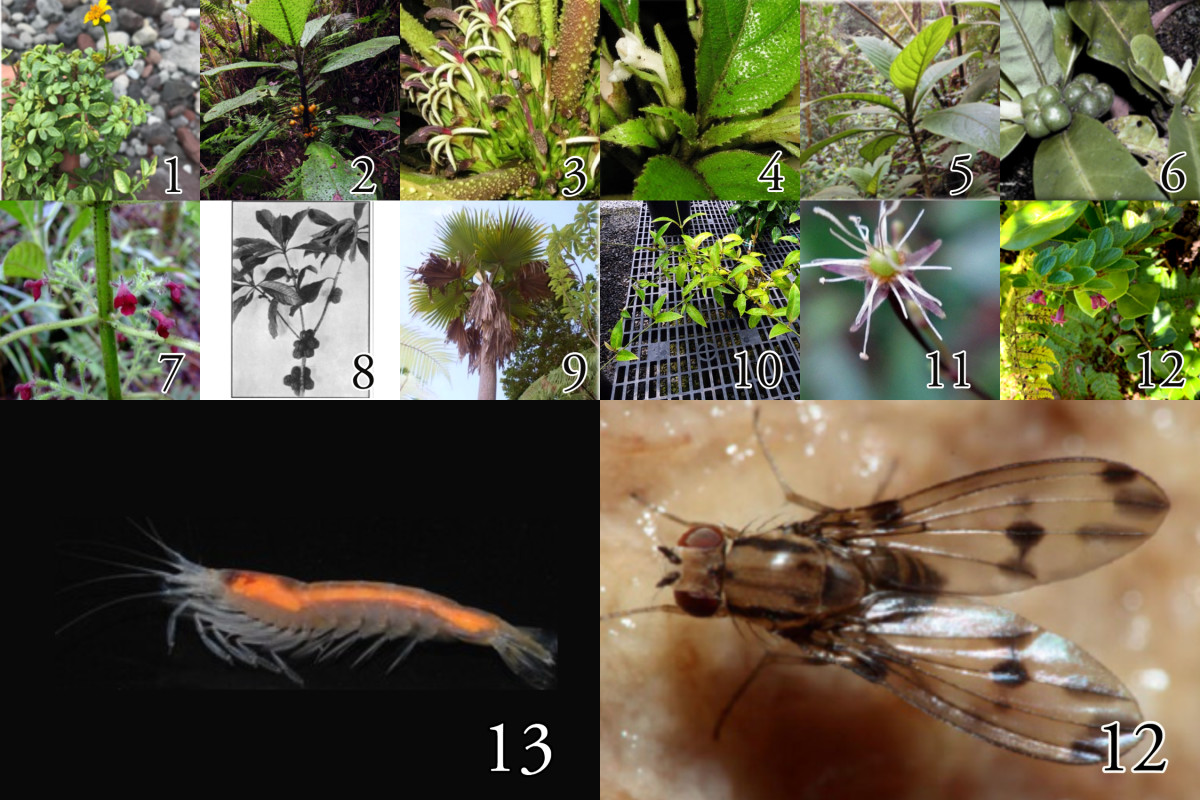
Endangered species on this island with proposed habitat protection by the federal government include 1. koʻokoʻolau photo from DLNR; 2. hāhā photo by K. Magnacca; 3. ‘akū photo by K. Magnacca; 4. ha‘iwale photo by K. Magnacca; 5. ha‘iwale, kanawao ke‘oke‘o photo by J. BVanDeMark; 6. Melicope remyi photo by J. Obata; 7. Phyllostegia floribunda photo by M. Bruegmann; 8. hōʻawa, hāʻawa photo by J. Rock; 9. loulu photo by E. Naboa; 10. Schiedea diffusa ssp. macraei photo by Forest and Kim Starr; 11. māʻoliʻoli photo from DOD; 12. Stenogyne cranwelliae photo by J. VanDeMark; 13.ʻopāe photo  by T. Sakihara; and 14. Hawaiʻi picture-wing fly photo by K. Magnacca,
CRITICAL HABITAT WOULD BE THE NEW DESIGNATION FOR 122,277 acres of federal, state and private lands on Hawai'i Island, under a U.S. Fish & Wildlife proposal. The designation aims to protect 11 native plants and one insect. All are endangered species found only on this island. Another two, the lolu palm and 'opae pond shrimp were considered but there was concern that designating their habitats would incentivize overharvesting and damage the chances for survival.
    Comments will be received through May 30, 11:59 p.m. eastern time. See the proposed rule in the Federal Register at https://www.federalregister.gov/documents/2023/03/29/2023-04088/endangered-and-threatened-wildlife-and-plants-designation-of-critical-habitat-for-12-species-and-not.
    Fish & Wildlife Service will hold one virtual public informational meeting and public hearing on Thursday, April 20 from 6 p.m. to 8 p.m. Hawaiʻi Standard Time. To register for the virtual public scoping meeting, visit the Pacific Islands Fish and Wildlife Office website: Critical Habitat for Hawaiʻi Island Species.
       The 12 species with proposed critical habitat protection across the island are:
    Vetericaris chaceorum (ʻopāe), the small shrimp found in inland anchialine pools of mixed salinity formed by coastal lava flows or limestone exposures.
    Drosophila digressa (Hawaiʻi picture-wing fly), historically been found in five locations on the island in elevations from 2,000 to 4,500 feet in mesic forest and wet forest habitats.
  Phyllostegia floribunda (no common name), a perennial shrub found in mesic forest and wet forest ecosystems along the eastern side of the island.
    Pittosporum hawaiiense (hōʻawa, hāʻawa), a small tree found in mesic and wet ecosystems on the island.
    Schiedea diffusa ssp. macraei (no common name) is a perennial climbing herb found in the wet forest ecosystem of the Kohala Mountains and the windward slopes of Mauna Loa.
 
  Schiedea hawaiiensis (māʻoliʻoli) is a perennial herb, and at the time of listing, occurs only at a single site in dry forest habitat between Mauna Loa and Mauna Kea mountains.
    Bidens hillebrandiana ssp. hillebrandiana (koʻokoʻolau) is a short-lived perennial herb that occurs in coastal and dry cliff ecosystems on rocky substrate near the shoreline. It is found on the windward eastern coast of Kohala near the northern tip of the island.
    Cyanea marksii (hāhā) is a short-lived perennial, shrub or palm-like tree and is found on the west side of the island in the district of South Kona.
    Cyanea tritomantha (‘akū) is a palm-like shrub distributed across the windward slopes of Mauna Kea, Mauna Loa, Kīlauea, and the Kohala Mountains.
    Cyrtandrananawaleensis (ha‘iwale) is a shrub or small tree found in wet forest ecosystems in the Puna district.
    Cyrtandra wagneri (ha‘iwale, kanawao ke‘oke‘o) is a shrub or small tree found in wet forest ecosystems along the northeast side of the island.
    Melicope remyi (no common name) is a long-lived perennial shrub found on the windward slopes of the Kohala Mountains and Mauna Kea.
    Stenogyne cranwelliae (no common name) is a vine found in the Kohala Mountains in wet forest habitat.
    According to U.S. Forest Service, "Critical habitat is a tool that supports the continued conservation
of imperiled species by guiding cooperation within the federal government. Identifying critical habitat also informs landowners and the public which specific areas are important to a species’ conservation and recovery. The Service can also make the determination to not designate critical habitat when a designation would likely increase the threat of collection, vandalism, or incidental habitat degradation by curiosity seekers.
    The announcement of the proposed critical habitat areas on Hawai'i Island "comes as the ESA turns 50 years old and is the most significant piece of endangered species legislation and is considered one of the world’s most important conservation laws. When Congress passed the ESA in 1973, it recognized that our rich natural heritage is of “esthetic, ecological, educational, recreational, and scientific value to our Nation and its people.” Currently, the ESA protects 1,662 U.S. species and 638 foreign species. With ongoing threats such as habitat loss and new threats like climate change , a commitment to species conservation and the ESA continues to be vital. In every state across the country, there is staff working to conserve endangered species and the habitat they depend on," says the Fish & Wildlife statement.
Ben Mejia sang and emceed, accompanied by Dane Sesson. Photo by Nalani Parlin

MEMBERS OF HANA LAULIMA LĀHUI O KAʻŪ said they are looking forward to next year's 8th Annual Prince Kūhiō Hoʻolauleʻa. The local nonprofit welcomed throngs of people from Kaʻū and beyond, who gathered at the 7th Annual Prince Kūhiō Hoʻolauleʻa last Saturday at Nāʻālehu Ball Park. They put on the event to showcase their plan to create a Kaʻū Hawaiian Cultural Center.
    "We had a lot of comments like 'Thank you for bringing the community back together again.' Food vendors were very happy, with many of them selling out. There were a lot of smiling faces and people enjoying the moments," said Terry Shibuya, president of the the organization. Although this year's event came after a quick turnaround in planning after being on pause for some years, many community members and groups quickly heeded the call to pitch in to make the event a reality. Shibuya said she hopes to welcome more vendors and activities to participate in future hoʻolauleʻa.
    The hoʻolauleʻa featured hula, from keiki to kūpuna dancers, as well as traditional Hawaiian music to golden oldies and local favorites. The hula halau of Kumu Lorie Lei Katahara performed. Debbie Ryder's Hula Hālau O Leionalani  performed and keiki gave out small packets of kalo.
     Entertainers were Gene Akamu & Friends, Green Sands Trio, Bruddah Ben Mejia and the Backyahd Braddahs. Miss Kalaʻoa's Outstanding Teen Hawaiʻi 2023 Karly-Rose Kawaauhau-Aiona, also a Teen Miss Hawaiʻi Pageant candidate, delighted with a Samoan dance.
    Mejia, who grew up in Kaʻū also doubled as emcee, joked with the crowd and helped Hana Laulima Lāhui O Kaʻū President Terry Shibuya call out lucky number prizes. Fishing gear, gift certificates, laulau 
Capt. Kiko Kitazawa Johnston's double-hull sailing canoe.
Photo by Nalani Parlin
and a grand prize stay at SCP Hilo Hotel were given out throughout the day. Of special note was handcrafted wooden box by master woodworker Thomas King, of Honu`apo. Others providing prize donations included Ocean View Market, Lau Lau Man Clyde Madaquit, Nāʻālehu ACE Hardware, Ocean View ACe Hardware, Big Island Candies, S. Tokunaga Store and Wal-Mart (Hilo and Kona).
   Kumu 'Āina Akamu, representing the Kaʻū Hawaiian Civic Club, passed out packets detailing Prince Kūhiōʻs biography, and spoke on the significance of Kūhiō's contribution to Hawaiʻi and its people. Bobby Command, from Mayor Mitch Roth's office, read a letter from the Mayor commemorating the day's events. Lt Governor Sylvia Luke and Kaʻū County Councilmember Michelle Galimba also stopped the hoʻolauleʻa to enjoy the festivities.
    A special highlight included museum exhibits, featuring Hawaiian culture and Kaʻū ʻohana, curated by the Kaʻū Multicultural Society and led by local historian Darlyne Vierra and Liz Kuluwaimaka. Hundreds of artifacts, implements, newspaper clippings and photos were displayed in the building behind the tennis courts. Vierra noted that the Kaʻū Multicultural Society is looking for a permanent space for its collections.    
Vendors sold papale and other creations at the Ho'olaulea. Photo by Nalani Parlin
    In the community center, a meeting about kuleana lands, organized by Earl Louis, took place.
    Kapena (Captain) Kiko Kitazawa's waʻa kaulua double-hull canoe could be seen on the field from the highway. Sailor James Akau also set up his one-man canoe and both shared about canoe-making and voyaging. Uncle Keoki Sereno taught about playing the ʻukulele and strung up pictures of finger placements for ʻukulele chords. Hawaiʻi Volcanoes National Park set up Konane (like Hawaiian checkers) and Palaʻie (Hawaiian loop and ball game) to play, while the Hawaiian Civic Club invited folks to try Hawaiian Makahiki games of ulu maika and moa pahe'e.
 
Ikaika Anderson, Terry Shibuya and Kumu
Debbie Ryder. Photo by Nalani Parlin
 The Hawaiʻi Wildlife Fund passed out free native plants in their booth. Kaʻū Rural Health Community Association teamed up with Hilo Medical Center to give blood pressure checks and pass out COVID
information and test kits. Black Sands Beach, LLC gave out garden starters, while state Division of Aquatic Resources officers shared about safe practices for shoreline and fishing activities.
    Hui Mālama Ola Nā ʻŌiwi shared free go Aquatic Resources officers shared about safe practices for shoreline and fishing activities.
    Hui Mālama Ola Nā ʻŌiwi shared free goodies and info about health classes, as well as a Mālama Nā Keiki Festival to be held in Pāhala June 24.      
    Liliʻuokalani Trust reps taught about Queen Liliʻuokalani and provided a coloring activity of the Queen's likeness. Premier Benefit Consultants invited participants to spin a wheel to win prizes and helped to enroll kūpuna in Medicare. Alu Like shared information about its programs for Hawaiians, while Hawaiʻi County Economic Opportunity Council signed up qualifying 'ohana for free refrigerators. Aquatic Resources officers shared about safe practices for shoreline and fishing activities.
   Hana Laulima Lāhui O Kaʻū thanked everyone who sponsored and donated to the event, as well as volunteered their time, talents and skills for Kaʻū. Event co-sponsors included Nāʻālehu Shopping Center, Black Sands Beach LLC, Masazo Pig Farm, County of Hawaii Parks & Recreation/Mayor Mitch Roth, ʻO Kaʻū Kākou, Edmund C. Olson Trust and Friends of Ikaika Anderson.

To read comments, add your own, and like this story, see facebook.com/kaucalendar. See latest print edition at kaucalendar.com, in the mail and on stands.


DEADLINE TO APPLY FOR SCHOLARSHIPS FROM 'O KAʻŪ KAKOU is this Saturday. The applications must be postmarked by April 1. See https://www.okaukakou.org/scholarships-for-local-students. 
    OKK, the nonprofit service organization, is 
https://www.okaukakou.org/scholarships-for-local-students
offering scholarships for the 2023-2024 school year to high school and home-schooled graduating seniors and to undergraduate college students. 
    Individual scholarship awards are $1,000 ($500.00 per semester) for students enrolled full-time at any accredited trade school or two-year or four-year college to assist with tuition costs. Applicant must be residents of Ka'ū district, or if attending an out-of-state college, applicant must be claimed as a dependent whose parent or legal guardian's principal residence remains in the district of Ka'ū. 
    Instructions, guidelines, and information regarding eligibility, selection criteria, and the application process are detailed in the Application for Scholarship instructions and guidelines at https://www.okaukakou.org/scholarships-for-local-students.
    OKK advises that applicants thoroughly complete the application and carefully follow all instructions. Incomplete applications will not be considered. 
    Only hard copies of applications and supporting documents will be accepted (no electronic submissions) and must be postmarked on or before April 1. Late submissions will not be considered.          
    Recipients of previous scholarships who have not submitted their mahalo letter to OKK will not be considered for further scholarship funding. Any questions regarding this application can be directed to the OKK Scholarship Committee via email: okaukakou.org.scholarship@gmail.com and expect that it may take up to 24-36 hours for the Committee to respond.


In the mail and on stands.


FREE FOOD

St. Jude's Hot Meals are free to those in need on Saturdays from 9 a.m. until food runs out, no later than noon. Volunteers from the community are welcome to help and can contact Karen at pooch53@gmail.com. Location is 96-8606 Paradise Circle Drive in Ocean View. Those in need can also take hot showers from 9 a.m. to noon and use the computer lab from 9:30 a.m. to 1 p.m.


Free Meals Mondays, Wednesdays, and Fridays are served from 12:30 p.m. to 3:30 p.m. at Nā'ālehu Hongwanji. Volunteers prepare the food provided by 'O Ka'ū Kākou with fresh produce from its gardens on the farm of Eva Liu, who supports the project. Other community members also make donations and approximately 150 meals are served each day.

OUTDOOR MARKETS

Volcano Evening Market, Cooper Center, Volcano Village, Thursdays, 3 p.m. to 6 p.m., with live music, artisan crafts, ono grinds, and fresh produce. See facebook.com.

Volcano Swap Meet, fourth Saturday of the month from 8 a.m. to noon. Large variety of vendors with numerous products. Tools, clothes, books, toys, local made healing extract and creams, antiques, jewelry, gemstones, crystals, food, music, plants, fruits, and vegetables. Also offered are cakes, coffee, and shave ice. Live music. Volcano Farmers Market, Cooper Center, Volcano Village on Sundays, 6 a.m. to 10 a.m., with local produce, baked goods, food to go, island beef and Ka'ū Coffee. EBT is used for Supplemental Nutrition Assistance Program, formerly Food Stamps. Call 808-967-7800.
O Ka'ū Kākou Market, Nā'ālehu, Wednesdays, 8 a.m. to 2 p.m. Contact Nadine Ebert at 808-938-5124 or June Domondon 808-938-4875. See facebook.com/OKauKakouMarket.

Ocean View Community Market, Saturdays and Wednesdays, 6:30 a.m. to 2 p.m., corner Kona Dr. Drive and Hwy 11, near Thai Grindz. Masks mandatory. 100-person limit, social distancing required. Gate unlocked for vendors at 5:30 a.m., $15 dollars, no rez needed. Parking in the upper lot. Vendors must provide their own sanitizer. Food vendor permits required. Carpooling is encouraged.