About The Kaʻū Calendar

Sunday, September 24, 2023

Kaʻū News Briefs Sunday, Sept. 24, 2023

Ocean Nihipali-Sesson runs the ball around the end for the gain, helping the Trojans break the school
record for points earned in 11-man football and beating Kohala 60 to 13 on Saturday at home. Photo by Mark Peters 

Steve Adler intercepts and carried the ball 73
yards for a touchdown. Photo by Mark Peters.
KAʻŪ TROJANS EARNED A 60-14 VICTORY OVER KOHALA COWBOYS, Saturday on home turf. Trojans offense helped set a new school record of 60 points for 11-man football, scored on a strong running game totaling 318 yards. 
    Ocean Nihipali-Sesson led all runners with 11 carries for 217 yards and four touchdowns. He averaged 19.7 yards per carry. Joe Buyuan also contributed to a TD run.
   Kaʻū Trojans defense was led by a 70-yard interception return for a touchdown by Stephen Adler. There was also an interception by Keaka McDonnell and one by Diya Ellis-Reyes. Sacks were recorded by Desmond Camba, Blake Self-Ah Yee and Dakota Seaver. McDonnell led the Defense in tackles with six. 
    Next game is Saturday, Sept. 30 in Pāhala at 1 p.m. against Pahoa. 

Cowboy defender breaks up a deep pass attempt
 to TJ Kuahuia-Faafia. Photo by Mark Peters

A HIT AND RUN IN OCEAN VIEW on Saturday has led Hawai‘i Island police to search for the driver in the traffic collision that left a 26-year-old female with life-threatening injuries. 
    HPD reported: "The single-vehicle collision occurred on Saturday evening, Sept. 23, 2023, near the intersection of Paradise Parkway and Lu'au Drive in the Hawaiian Ocean View Estates subdivision. The female pedestrian has not been positively identified, but is believed to be from the Ocean View area.
    "Responding to a 10:26 p.m. call, police determined that an unknown pickup truck or SUV ran over the woman, who was possibly lying in the middle of the roadway. Investigators are not able to determine the direction of travel of the unknown vehicle at this time."
    The female pedestrian was transported to the Kona Community Hospital for treatment and later transferred to the Queens Medical Center on O'ahu for further treatment, where she is currently listed in critical condition.
    The driver of the vehicle fled the scene and failed to render aid to the pedestrian. Failure to render aid when a person is seriously injured or killed in a traffic collision is a Class “B” felony that may be punishable by up to 10 years in prison and fines up to $25,000. Failure to render aid is covered under section 291C-14 of the Hawai'i Revised Statutes.
A solid block by Senior lineman Dakota Seaver
 helps open a hole for the Trojan running backs.
Photo by Mark Peters
    The Area II Traffic Enforcement Unit has initiated a negligent injury investigation and is asking for anyone who may have witnessed the collision to contact Officer Adam Roberg at (808) 326-4646, ext. 229 or email at adam.roberg@hawaiicounty.gov. Tipsters who prefer to remain anonymous may call Crime Stoppers at (808) 961-8300.

To read comments, add your own, and like this story, see facebook.com/kaucalendar. See latest print edition at kaucalendar.com, in the mail and on stands.

LT. GOV. SYLVIA LUKE is covering for Gov. Josh Green who is on the mainland again, away four nights from Thursday until Monday afternoon. A statement from his office says that he is in Nevada "to attend meetings with various business and trade leaders."
    The Governor is on the the mainland after being back in Hawai'i for a few days last week following his visit to New York the previous weekend to participate in the United Nations Sustainable Development Goals meeting and a followup presentation for the Brookings Institution and United Nations Foundation.
    The Lt. Governor is Acting Governor from late afternoon of Thursday Sept. 21 through midday Sept. 25. She was also acting governor the previous weekend and was scheduled to be Acting Governor for a portion of Green's trip out of state July 30 to Aug. 15 but Green came back to Hawai'i after the Maui firestorm disaster.
   Green was also in New York in July for a United Nations High Level Political Forum on Sustainable Development.

To read comments, add your own, and like this story, see facebook.com/kaucalendar. See latest print edition at kaucalendar.com, in the mail and on stands.

Senior Dominic Nurial-Dacalio closes in on the Kohala ball carrier with support from teammates. He achieves
another solid game in the trenches, playing offense and defense. Photo by Mark Peters


Saturday, September 23, 2023

Kaʻū News Briefs Saturday, Sept. 23, 2023

The ninth annual Kaʻū Coffee Trail Run took to the macadamia orchards and coffee fields surrounding
Kaʻū Coffee Mill on Saturday with competitors from around the world. Photo by Julia Neal
Hina Barcia, of Nāʻālehu, who works for Punalu'u
 Livestock, won the Female 5K. Photo by Julia Neal

THE NINTH KAʻŪ COFFEE TRAIL RUN results on Saturday featured the top female contender Chanelle Schmid taking the top overall time in the Half Marathon in 1 hour, 4 minutes and 34 seconds. She was followed by Daniel Hill in 1:47:23, Nicholas Civitano in 2:10:34, Jennifer Henricks in 2:11:48, and Morgan Gerdel in 2:17:20. 
     The Female 5K winner, in 29:19, was Hina Barcia, of Nāʻālehu who works with Nonie Soares at Punalu'u Livestock. The female 10K winner was Molly Rasmussen who moved with her family to this island this week to work for University of the Nations.
     The events drew people from around the world to run from farm to rainforest and back with start and finish at Kaʻū Coffee Mill. Money raised from the event goes to O Kaʻū Kakou community group. Overseeing the start and welcoming the finishers was high school student Kalia Andrade, of Nāʻālehu, and of rodeo circuit fame, a former Junior High State Rodeo Champion.
Kalia Andrade, of Nāʻālehu and rodeo fame, welcomed
 the finishers at the Trail Run. Photo by Julia Neal
    The toughest race was the 50K, won by Justin Young in 5 hours, 35 minutes and 11 seconds, followed by Sean Warner in 5:37:46, Lyman Perry in 5:56:17, Chiara Warner in 5:00:37 and Steve Schaffer in 6:07:26. 
    Overall times for the 10K were first place finisher Noah Hunt in 42 minutes and 26 seconds, followed by Trevor Quandt in 43:00, John Kolander in 45:07, Molly Jarvis in 48:36 and Tim Heaton in 48:58.
    Overall times for the 5K were first place finisher Collin Saxby in 23 minutes and 16 seconds, followed by Aaron Harness in 23:48, Cody Rasmussen in 24:03, Peaman Peaman in 24:17 and Matthew King in 24:33.
     See more results upcoming Kaʻū News Briefs.

KAʻŪ TROJANS GIRLS VARSITY VOLLEYBALL TEAM REMAINS UNDEFEATED this season, with a win at home Saturday afternoon against Hawai'i Preparatory Academy from Waimea. Kaʻū won in four sets, 28-26, 18-25, 25-23, and 25-16. Junior Varsity lost in two sets, 17-25 and 15-25. 
    The next match is on Wednesday, Sept. 27 at home against Kanu O Ka 'Aina  at 5 p.m. at the Herkes Kaʻū District Gym.

Hokulele will raise money for its sixth grade traveling basketball team
 when 22 teams from around the island come to Herkes Kaʻū District Gym
 for a tournament Oct. 7. Photo from Hokulele
TWENTY-TWO YOUTH BASKETBALL TEAMS PLAN TO COME TO KAʻŪ for the Hokulele Basketball Club tournament on Saturday, Oct. 7 at the Herkes Kaʻū  District Gym. Players six to ten years of age will compete and funds raised will go to Hokulele's sixth grade travel team. 
    Hokulele is a Kaʻū based basketball training organization for youth. It is led by Hokulele Club & Organization President & Head Coach Ravel Kaupu Jr., Vice President Jan Kaeza Penera and Coaches Chrysa Dacalio and Jaron Garcia.
    To join the club, register for a tournament, volunteer, and sponsor, contact Kaeza Penera by email at kaeza.hokulele@gmail.com.

Skatepark advocate Travis Aucoin, County Parks & Rec
 Director Maurice Messina and Skatepark Project Treasurer
 Laura Roberts. Photo from Ocean View Skatepark Project
OCEAN VIEW SKATEPARK PLANS ARE MOVING ALONG, according to its community organizers.
    Following the community meeting in May with Hawai'i County Parks & Recreation Director Maurice Messina, Bow Engineering was hired for the Environmental Assessment. It is underway and archeological inspections were completed without issue, said the organizers.
      The EA is expected to be completed by end of the year. The group is working on funding for the actual construction of the skatepark, applying for grants and hosting fundraising. The organization is seeking those able to assist in land clearing and additional volunteers to fundraise. 
    A community meeting for input on details in the design of the skatepark is expected soon.  
   Once built, the skatepark will be available to BMX, rollerblades, rollerskates, scooters, wheelchairs and skateboards. Also in the planning are a bike/walking path, community garden, workout bars and mini Folf course for Frisbee Golf, also known as Disc Golf. For Folf, there are multiple "holes" set up that are usually on a tree,  rock or Folf course basket. It can be played with just a few people, alone, or with a group. A "hole" is scored with the hit of the tree or target. It is the same concept as golf, just with special frisbees.                  
    As with many of the plans, what's built is all dependent on the fundraising. 
   Donations can be made at oceanviewskatepark.org and folks can purchase tees, hats, stickers at Lisa's Kahuku Gift and Garden in Ocean View. To volunteer, donate, help plan or with questions, contact Laura Roberts at 406-249-3351 or oceanviewskatepark@gmail.com.

To read comments, add your own, and like this story, see facebook.com/kaucalendar. See latest print edition at kaucalendar.com, in the mail and on stands.

Keoki Sereno will teach ‘ukulele in a nine-week
course starting Oct. 18 in Nāʻālehu. Photo by Julia Neal
FREE ‘UKULELE LESSONS for anyone of any age will be offered at Nāʻālehu Methodist Church, in preparation for Christmas. Beginning Oct. 18, two classes will be held concurrently each Wednesday at 2:30 p.m., one for beginners, one for intermediates.
    After the nine-weeks of classes, students will be able to play Mele Kalikimaka and dozens of favorite Christmas Songs. Teachers are Scott Taylor and Keoki Sereno.        
    The hosts sent out a statement saying, "All we ask is that you show up and give it your best and have funWhat could be better than strumming an uke and singing with your friends?"


SIXTEEN WERE ARRESTED FOR DUI the week of Sept. 11 through Sept. 17. Hawai‘i Island police arrested the motorists for driving under the influence of an intoxicant. 
    Two were involved in a traffic collision. One driver arrested was under the age of 21. So far this year, there have been 692 DUI arrests compared with 717 during the same period last year, a decrease of 3.5 percent.
    Hawai‘i Police Department’s Traffic Services Section reviewed all updated crashes and found 593 major collisions so far this year compared with 585 during the same period last year, an increase of 1.4 percent.    
    To date, there have been 12 fatal crashes, resulting in 13 fatalities, (one of which had multiple deaths); compared with 23 fatal crashes, resulting in 25 fatalities (one with multiple deaths, and one reclassified to a medical condition) for the same time last year. This represents a decrease of 47.8 percent for fatal crashes, and 48 percent for fatalities.
    To date, the non-traffic fatality count (not on a public roadway) so far this year is one compared to zero for the same time last year.
    Police promise that DUI roadblocks and patrols will continue island wide.

Friday, September 22, 2023

Kaʻū News Briefs Friday, Sept. 22, 2023

A section of the Great Crack that shows the 1823 lava flow that flowed to the ocean. A 1,500 to 3,000 year
 old cinder cone is in the background. A National Park Service public meeting from noon to 2 p.m. Saturday at Pāhala 
Community Center aims to draw community comment to plan management of the area.  NPS Photo by Janice Wei

THE GREAT CRACK AND ALA WA'I PUBLIC INPUT MEETING IS SATURDAY noon to 2 p.m. at Pāhala Community Center. The National Park Service posted the following: "Your input is needed. Come talk story with the park this Saturday in Pāhala about future access and use of the Great Crack and Ala Waiʻi parcels." These new park lands totaling more than 4,700 acres are located makai of Hwy 11 between Pāhala and Volcano.
    The park recently accepted stewardship of the 1,951-acre Great Crack and the adjacent 2,750-acre Ala Waiʻi area to protect them from development.
    "The areas, located in the remote southwest rift zone of Kīlauea, harbor unique geologic, biological and cultural resources and are managed as wilderness. Bring your manaʻo and join us at the Pāhala Community Center this Saturday, Sept. 23 from noon to 2 p.m. to talk-story with park staff about these special areas."
     The public is also invited to email input at havo_planning@nps.gov.


This landscape image was taken in Ala Waiʻi looking east across an old pāhoehoe lava flow fronting a deep, prominent earth crack with vegetation in the far distance. NPS Photo by D. Foster
MAUNA LOA SUMMIT CABIN REOPENED FRIDAY. The remote, high-elevation cabin in Hawaiʻi Volcanoes National Park near the summit of Mauna Loa volcano had been closed since November of 2022 when the volcano was getting ready to erupt.
    The cabin is accessible from ʻĀinapō Trail and Kapāpala Ranch. A statement from Hawai'i Volcanoes says, "This extremely grueling, rocky and steep 10.2-mile hike is not for everyone. Hikers are urged to be prepared and know their limits. Water is available at the cabin, but must be treated before drinking."
    Cabin permits and gate access through the ranch are required and a high-clearance 4WD is needed for ʻĀinapō Road. Safety information, preparedness tips and directions to obtain a permit for Mauna Loa Summit Cabin are on the park website. Permits cost $10 (plus the park entrance fee) and can include up to 12 people for as many as three nights.
Mauna Loa Summit Cabin reopened Friday, September 22, 2023. It had been closed
since October 5, 2022, preceding the anticipated Mauna Loa eruption of
November 2022. NPS Photo by A. LaValle

    State of Hawaiʻi manages ʻĀinapō Trail and ʻĀinapō Cabin at Halewai (7,750 feet), where most hikers spend the night before heading to Mauna Loa Summit Cabin (13,250 feet). Overnight use of ʻĀinapō Cabin requires a state permit, the per-night fees are $30 for Hawaiʻi residents; $50 for non-residents. Visit the Hawaiʻi State Parks' Wiki Permits webpage for reservation information.ʻĀinapō Trailhead and ʻĀinapō Cabin are accessed via the rough and bumpy eight-mile ʻĀinapō Road, an infrequently maintained 4WD road that passes through Kapāpala Ranch for 5.7 miles and continues another 2.3 miles through the Kapāpala Forest Reserve to the ʻĀinapō Trailhead. Limited parking is available. From ʻĀinapō Trailhead it is a challenging 2.7-mile hike to ʻĀinapō Cabin. From ʻĀinapō Cabin it is another difficult 7.5-mile hike to reach Mauna Loa Summit Cabin.
    For access through Kapāpala Ranch, go to Forest Reserve Access (Kapāpalaranch.com) and submit the new online form. Although some hikers have trekked up from Highway 11 to Mauna Loa Summit Cabin, this adds an additional eight miles on foot to the 10.2-mile hike and still requires cabin permits and gate access.
    To prepare the cabin for reopening, Hawaiʻi Volcanoes National Park staff replaced the solar charger and batteries in the main lua (pit toilet), replaced the lua roof, installed rain catchment gutters on the cabin roof and shoveled out 565 pounds of waste that was flown off the mountain. Hawaiʻi State Trails staff recently conducted cabin maintenance and reflagged ʻĀinapō Trail.
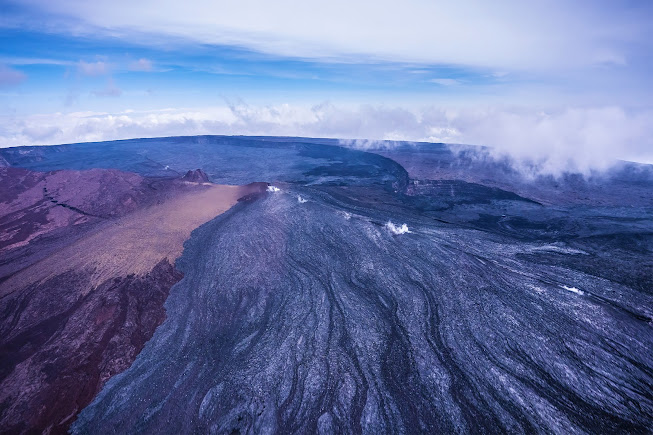
Aerial photo of northern rim of Mauna Loa showing extensive lava extrusion from the November 2022 eruption.
 NPS Photo by Janice Wei
    Mauna Loa Trail above Red Hill Cabin remains closed due to damage and hazards from the November 2022 Mauna Loa eruption.
    Lava from the eruption covered the floor of Mokuʻāweoweo caldera and about four miles of Mauna Loa Trail in eight different areas. Flow thickness ranges from a few feet to almost 70 feet and presents significant hazards. In addition to increasing the risk of getting lost in the absence of a trail, thin layers of solidified lava can collapse if walked on, causing lacerations or injury by falling into a cavity.
    More information, a video and a story map about the 2022 Mauna Loa eruption is available on the park website.


TSUNAMIS POSE A MAJOR THREAT TO HAWAI'I, says this week's Volcano Watch, sponsored by USGS Hawaiian Volcano Observatory and written by Jonathan R. Weiss, a geophysisist with NOAA/NWS/Pacific Tsunami Warning Center: Weiss sets the stage:

    It's 3 a.m. and you're halfway through a 12-6 a.m. graveyard shift at the NOAA Pacific Tsunami Warning Center in Honolulu, Hawaii. Fortunately, you slept before your shift began so you're feeling alert while you alternate between performing checks on the global seismic and sea level data analysis systems and doing research aimed at improving the speed and accuracy of earthquake magnitude estimation.

Color map of tsunami wave runups
The locations, years, and maximum reported Hawai'i runups (i.e., wave heights) for significant Pacific-wide tsunamis. Red-orange-yellow contours indicate the travel time to Honolulu for a tsunami with different origins. For example, an earthquake generated locally on the southeast coast of the Island of Hawaiʻi would arrive in Honolulu in less than an hour. Waves generated by a Japan earthquake might take 8 hours to reach Honolulu. Tsunami waves from the Aleutians would arrive in Honolulu in about 5 hours. The inset map in the upper right corner shows maximum runups for waves generated by the 1946 Aleutian Islands earthquake (meters/feet).
See this link for map credits and more information.

    The Inouye Regional Center, located on Ford Island in the middle of Pearl Harbor, is quiet and the lights are dim. This time of day at PTWC can be spooky; you and your colleague (asleep in one of the standby rooms) are the only people in the repurposed and modernized World War II-era airplane hangar. Every glimmer and rattle raises your eyebrows.
   You brew some coffee and as you wait one of your beepers goes off notifying you that an earthquake has just occurred in the southwest Pacific Ocean. You abandon your warm beverage and hustle to the operations center. You have one minute to perform a preliminary assessment before the standby scientist is alerted.
    There are only a few seismic stations on remote islands in the southwest Pacific, so it is critical to work fast as the seismic waves propagate outwards from the source. A quick visual inspection of the data scrolling across one of the monitors indicates that a large and potentially tsunamigenic event has just occurred.
    The computer-generated automatic solutions confirm your suspicion. The earthquake was shallow and probably had a magnitude (M) greater than 8.5. Your stress level increases but your training has prepared you to handle the event. You immediately send a "PLEASE RESPOND" page to your teammate and you begin to further analyze the seismic information to better constrain the earthquake location and magnitude.
Two people sit on the remains of a building looking at debris on a street with bent-over parking meter in foreground.
Aftermath of 1960 Chilean tsunami in Hilo. The 1960 M9.5 Chile earthquake (the largest ever recorded) and tsunami caused Pacific-wide destruction and killed 61 Hawaii residents. Photo courtesy of U.S. Army Corps of Engineers. 
    A moment later your coworker emerges ready to assist you with issuing initial tsunami threat messages, forecasting tsunami wave arrival times and amplitudes using numerical models, and monitoring coastal sea-level gauges and seafloor pressure sensors to confirm that a tsunami was generated. The phone rings and you hear the voice of a concerned colleague from the Tonga Meteorological Office on the line. Two minutes have passed since the initial pager alarm sounded. It's going to be a long and nerve-racking day.
    The scenario described above is hypothetical and intended to paint a picture of life working at PTWC. An M8.5 or greater earthquake in the southwest Pacific would likely be deadly; the 2009 M8.1 Samoa Islands earthquake and tsunami killed hundreds of people and caused catastrophic damage to Samoan and Tongan coastal communities and marine ecosystems.
    Despite ongoing enhancements to the global network of seismic instruments and continued efforts aimed at improving community preparedness, tsunamis, whether caused by a submarine earthquake, volcanic eruption, or landslide, still pose a major threat globally. The Hawaiian Islands, located in the center of the Pacific Ocean, are in a precarious position. The largest tsunamigenic earthquakes, which typically occur in places like Japan, the Aleutian Islands, and Chile, generate waves that more often than not head directly to Hawai'i.
   The 1946 M8.6 Aleutian Islands earthquake and tsunami, which led to the establishment of PTWC, killed 159 people in Hawaii. The 1960 M9.5 Chile earthquake (the largest ever recorded) and tsunami caused Pacific-wide destruction and killed 61 Hawai'i residents. However, it has been well over half a century since Hawai'i was heavily impacted by a damaging tsunami. Even the 2011 M9.1 Japan earthquake and tsunami, which wreaked havoc across large swaths of the Pacific, caused relatively minor damage in Hawai'i.
    The recent wildfires in Maui have focused a spotlight on natural disaster preparedness and response. In addition, September is National Preparedness Month. Hawai'i will likely be threatened again by a potentially deadly tsunami considering the frequency of past events. PTWC, the NOAA National Tsunami Warning Center in Alaska, and Tsunami Service Providers around the world serve as the first line of defense but coastal community residents can do their part to educate themselves about all natural hazards, including earthquakes and tsunamis. For more information visit tsunami.gov and tsunamiwave.org.

Volcano Activity Updates: Kīlauea is not erupting. Its USGS Volcano Alert level is ADVISORY.
The Kīlauea summit eruption that began on September 10th stopped on September 16. Summit seismicity has remained low, with very few earthquakes over the past week, and tremor is at background levels. Since the eruption, summit tilt has alternated between minor deflation and inflation. A sulfur dioxide (SO2) emission rate of approximately 240 tonnes per day was measured on September 19.
April is Tsunami Awareness Month in Hawaii...
Wreckage of a clubhouse on Kamehameha Avenue in Hilo, Hawai'i, caused by a tsunami generated by the April 1, 1946, earthquake in the Aleutian Islands. Portions of downtown Hilo were devastated by the tsunami associated with the 1946 Aleutian Islands earthquake. Coastal communities in Hawaii are not immune to such an event happening again. Photo courtesy of the U.S. Army Corps of Engineers. 

    Mauna Loa is not erupting. Its USGS Volcano Alert Level is at NORMAL.Webcams show no signs of activity on Mauna Loa. Seismicity remains low. Summit ground deformation rates indicate slow inflation as magma replenishes the reservoir system following the recent eruption. SO2 emission rates are at background levels.
   One earthquake was reported felt in the Hawaiian Islands during the past week: a M3.3 earthquake 10 km (6 mi) E of Pāhala at 31 km (19 mi) depth on Sept 14 at 7:07 p.m. HST.
    HVO continues to closely monitor Kīlauea and Mauna Loa. Visit HVO's website for past Volcano Watch articles, Kīlauea and Mauna Loa updates, volcano photos, maps, recent earthquake information, and more. Email questions to askHVO@usgs.gov.


-