About The Kaʻū Calendar

Tuesday, October 03, 2023

Kaʻū News Briefs Tuesday, Oct. 3, 2023

Water tank above Pāhala near a well drilled by the county for some 11 miles of pipe to serve some 459 connections.
Photo by Julia Neal

FORECASTED DRY CONDITIONS HEIGHTEN: Need to Use Drinking Water Wisely. That's the word from the Department of Water Supply, which sent out the following message on Tuesday morning:
    The latest U.S. Drought Monitor map shows nearly the entire island of Hawai‘i to be under at least moderate drought conditions (https://droughtmonitor.unl.edu/data/png/20230912/20230912_hi_trd.png).
    The National Weather Service's forecast calls for the existing drought conditions to expand over the entire island and intensify over the upcoming months due to the ongoing El Niño event. Peak dryness is expected to occur from around January through February 2024. The El Niño event will likely persist well into spring 2024. The majority of the Department of Water Supply's public water systems rely on water pumped from underground aquifers that are more resilient to drought than surface water sources. However, due to the drought forecast, DWS will continue to closely monitor its 23 water systems, especially those
Winning art by Kira Aguiar in the 2022 Water Conservation Poster Contest,
sponsored by Department of Water Supply,
relying primarily on rainfall to replenish stream or spring water sources which are more susceptible to drought conditions.
    If DWS' pumping capabilities cannot sustain the water needs of all customers and the public served by a respective water system, DWS will ask those customers to reduce their water use. Measures could include a request to cut back on irrigation, undertake 10 percent voluntary conservation, or comply with a mandatory 25 percent reduction notice so DWS can maintain an adequate supply of safe drinking water for all customers.
    Water customers can do their part by fixing common household water leaks, irrigating efficiently, and switching to low-flow toilets. Other helpful water conservation tips can be found at the Department's website, www.hawaiidws.org, by clicking on the "Conservation" tab in the homepage drop-down menu.
    Updated messaging will be posted at www.hawaiidws.org and on the DWS Facebook page at www.facebook.com/HawaiiDWS/.
To reach the DWS, call (808) 961-8050 during normal business hours, (808) 961-8790 for after-hour emergencies, or email: dws@hawaiidws.org.

To read comments, add your own, and like this story, see facebook.com/kaucalendar. See latest print edition at kaucalendar.com, in the mail and on stands.

A HOUSE IN OCEAN VIEW BURNED DOWN and the two occupants suffered burns on Sunday. Hawai‘i Fire Department reported the cause as the 18-year-old man lighting a cigarette after spilling gas on himself when filling a portable generator. The single-family residence on Keaka Pkwy and Orchid Pkwy was destroyed on the night of October 1st. It was a “total loss of the structure and personal belongings.” Medics took the victims to Kona Community Hospital for treatment. They were listed in stable condition.


DUANE SANTIAGO WAS ARRESTED AND CHARGED AND HAWAI‘I POLICE ISSUE A MAHALO TO THE PUBLIC. Hawaiʻi Island police report that 48-year-old Duane “Segundo” Santiago of Pāhala, who was previously wanted for two outstanding warrants, was arrested and charged.
    Santiago was located on Saturday, Aug. 12,  in Pāhala after officers followed up on a tip from the public. He was arrested without incident and charged with one count each of contempt of court and a revocation of his supervised release, with total bail set at $5,250.
    Santiago had also been wanted for questioning in a separate ongoing criminal investigation, which, upon completion, will be forwarded to the Office of the Prosecuting Attorney to be reviewed.
    The Hawai‘i Police Department would like to thank the public’s assistance in locating Santiago.

To read comments, add your own, and like this story, see facebook.com/kaucalendar. See latest print edition at kaucalendar.com, in the mail and on stands.

MAMAKI IS THE PLANT OF THE MONTH for Lāʻau Letters: Native Plants of Kaʻū, the monthly column by author Jodie Rosam and artist Joan Yoshioka. Read about Kaʻū’s native plants and their moʻolelo (stories), uses, preferred habitats, and opportunities to adopt them for stewardship. This column seeks to encourage making new plant friends and to reunite with others.
    Description: Māmaki, Pipturus albidusm, is an endemic shrub (and sometimes small tree) in the Urticaceae or Nettle family, but unlike its continental relatives, māmaki evolved in its island ecosystem without stinging hairs. Māmaki is easily identified by its almost heart- or diamond-shaped and papery light green leaves with beautiful pink or red veins (although there is a green-veined variety). These colorful leaves can range from as small as 2” to as long as 10”. The small, pale-green flowers bloom year-round and appear in tiny clusters, producing white fruits resembling small raspberries. A juicy māmaki fruit is a sweet treat so don’t hesitate to try one!
    Uses: Māmaki should be a staple plant in everyone’s garden or property, as its magical uses are plentiful. Māmaki wood was used as iʻe kuku (kapa beaters), but more commonly, māmaki was used to make kapa. While wauke (Broussonetia papyrifera or paper mulberry) was the primary source for making kapa, kapa māmaki was also quite common, especially on Hawaiʻi Island. Medicinally, māmaki fruits and seeds were eaten by mothers during pregnancy and by infants, young children, and even adults as a mild tonic. The berries can also be used topically to treat sores and wounds. Today, fresh or dried māmaki leaves are used to make a delicious tea which is good for cleansing the liver, bladder, and kidneys, and can even assist in lowering blood pressure and reducing inflammation. Māmaki tea can be very useful in times of high vog emissions to keep you feeling and breathing your best.
    Habitat: Generally speaking, māmaki grows on all of the main Hawaiian Islands except Niʻihau and Kahoʻolawe, typically within mesic to wet forests from about 100-6,000 feet elevation. Māmaki is often a colonizer of disturbed areas, so if you do any hand or mechanical clearing, please learn how to recognize māmaki seedlings so that they are not misidentified as weeds and pulled! Because of its usefulness, māmaki is often cultivated and planted, though in some instances you may find wild populations. The tiny seeds are easily dispersed by birds and can remain viable in the seed bank for a relatively long amount of time. In Kaʻū, māmaki can be found along roadsides and even in subdivisions, so again, learn to identify and begin to acquaint yourself with this wonderful plant (if you have not yet already). Just remember, always ask the landowner before you harvest any leaves on private property, and always ask the plant for permission, too!
    Growing and Purchasing: Although you can often find māmaki for sale in garden departments of big box stores and local nurseries, māmaki is easy to grow and will propagate readily from seeds or cuttings. Seeds can be separated from pulp using a strainer or by hand by loosening them in a bowl of fresh water. Once in water, the viable seeds will sink and the pulp (and any non-viable seeds) can be poured off. At this point, seeds can either be dried to store, or poured (with water) over a relatively dense media and kept moist and shaded until they germinate, which takes about 2 weeks. Cuttings should be taken from 4-6” material, and soaked in water until roots appear, then transferred to media. While māmaki prefers wet feet (a place that is well-watered), it can also thrive in drier locations once it becomes established. To keep your māmaki at a height for optimal leaf harvesting, pinch-prune the upper growing tips to encourage vigor and keep leaves within reach. Cheers to māmaki tea in everyone’s future!

TROJANS GIRLS VARSITY VOLLEYBALL TEAM REMAINS UNDEFEATED, beating Konawaena on Monday, on the road. The scores were 25-21, 25-22, and 25-10.





Kaʻū News Briefs Monday, Oct. 2, 2023

 
Low-angle aerial view of the Great Crack and surrounding 1823 lava flows (dark gray) along Kīlauea’s lower Southwest Rift Zone. The crack is about 50 feet (15 meters) wide in this area with similar but variable depth, depending on the amount of rock rubble filling the opening. USGS photo by D. Downs.
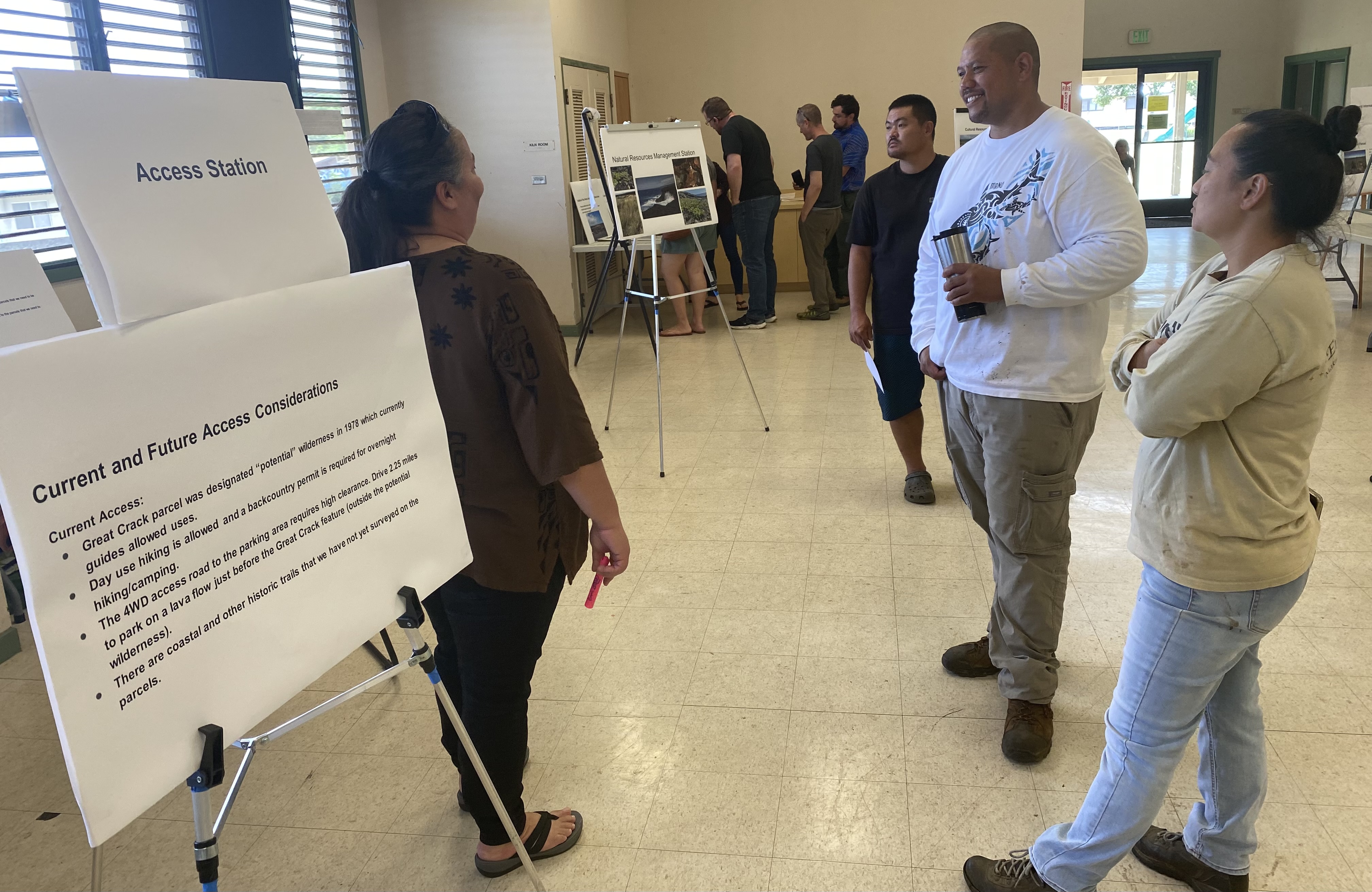
THE GREAT CRACK MEETING DREW QUESTIONS OF ACCESS. The public meeting on The Great Crack and Ala Wai‘i, makai of Hwy 11 between Volcano and Pāhala, drew many questions and comments about local access to the place and how access could change to include more people.
    National Park Service sponsored the gathering at Pāhala Community Center on Sept. 23. Hawai‘i Volcanoes National Park acquired the 1,951-acre Great Crack lands in 2018 and adjacent 2,750-acre Ala Wai'i in 2022. Ala Wai‘i was described as needing more studies to determine its future use. Both areas are managed by the park as wilderness backcountry, open to the public for day hiking. Overnight use is allowed with a backcountry permit obtained through Hawaiʻi Volcanoes National Park Backcountry Office.
    Signage in the gathering place for public input said "The Great Crack parcel was designated potential wilderness in 1978, which dictates current allowed uses." The Wilderness Act says wilderness character encompasses four intrinsic qualities:
Locals ask about continued public access to the lands around The
Great Crack for hunting, and fishing. Photo by Julia Neal
                          Untrammeled - Wilderness is essential unhindered and free from the actions of modern human control or manipulation.
    Natural - Wilderness ecological systems are substantially free from the effects of modern civilization.
    Undeveloped - Wilderness retains its primeval character and influence and is essentially without permanent improvement or modern human occupation.
    Solitude - Wilderness provides outstanding opportunities for connection that is not disrupted by sights and sounds of people (that are not wanted.)
    Members of the public wrote notes such as asking how collecting opihi and fishing in the area might be affected by the Park management. Would pig and goat hunting be allowed to continue? Will there be access to the ocean on the trail between Hwy 11 mile markers 40 and 42? Will there be access to Keawe Tree Road? Do not block it, said a commenter who reported he uses it for fishing twice a week and wants vehicular access. Will there be access to The Great Crack between mile markers 45 and 46? It was also suggested to ban ATVs, and to manage but not eradicate animals to include fish plus limu.
    Other comments posted on boards in the public meeting place included the consideration of any two-wheel drive access and the possibility of a parking place for people to leave vehicles and hike. Will there be restrooms? A water station? Would vehicles be able to go all the way to the coast? Would limitations be
Hawai'i Volcanoes National Park Superintendent
Rhonda Loh shows maps of the planning area.
Photo by Julia Neal
imposed, only if necessary, for protecting a special place within the area? Will there be online reservations for permits? Will locals get the priority? Will the Park accommodate traditional fishing and gathering? Will there be flexibility in adjusting permit dates, given weather, surf and other situations for locals who fish and gather?
    No buildings or infrastructure to obstruct the viewshed urged another commenter. Another suggestion was "No permit for overnight stay." and giving local access by ID or driver's license. Making no road improvements was another.
    Hawaiian cultural expert Jesse Ke suggested to connect park representatives to families in the area. It was also suggested that a longtime paniolo of the area, Anthony Oliveira, be contacted to connect with families with knowledge of the place.
    See natural and human history of the lands, planning ideas and a portal for more input at https://www.nps.gov/havo/learn/historyculture/the-great-crack-and-ala-waii.htm. Written comments can be sent to Superintendent, Hawai‘i Volcanoes National Park, P.O. Box 52, Hawai‘i National Park, HI 96718.


Kekuhi Kealiʻikanakaoleohaililani
AFTER DARK IN THE. PARK: Long before Hawaiian people had a written language, they passed along traditional knowledge and culture through moʻolelo (story), hula (dance), mele (song & poetry), and oli (chanting.)
     On Tuesday, Oct. 17 in Kīlauea Visitor Center auditorium at 7 p.m. during After Dark in the Park, Kekuhi Kealiʻikanakaoleohaililani of Hālau O Kekuhi guides participants to connect to the landscapes of Hawai‘i on a deeper level. Passed down from her grandmother, Edith Kekuhi Kanakaʻole, her hula, chant, and stage performances have touched thousands of lives. This event is expected to be well attended. Doors will open for seating beginning at 6:30pm.

    Program is co-sponsored by Friends of Hawai‘i Volcanoes National Park. Your $2 donation helps to support park programs. Admission is free but Park entrance fees apply.

Sunday, October 01, 2023

Kaʻū News Briefs Sunday, Oct. 1, 2023

Volunteer Coach,  Pastor Kevin Brown, leads a prayer before Trojans beat the Daggars 54-28 on Saturday. See more below.
Photo by Mark Peters

ELECTRICITY BILLS WOULD GO UP IF THE INDUSTRIAL SOLAR PROJECT GOES FORWARD at Ocean View, according to the state Consumer Advocate who works for the Department of Commerce & Consumer Affairs. The opinion of Consumer Advocate was provided on Friday as four parties to a Formal Complaint to the Public Utilities Commission filed post-hearing briefs on the matter. The Consumer Advocate filed a 14-page brief while the industrial solar developer filed 25 pages and the 
utility companies Hawaiian Electric and Hawaiian Electric Light Co. filed a single page.

    The industrial solar project is dependent on a Feed In Tarif which allows higher prices to be charged for alternative energy. However, the project has been delayed for so long that the price of electricity to the consumer would be higher islandwide should the project be built.
    The Consumer Advocate argued that all 26 projects on 26 separate lots in Ocean View that are in the FIT program under one owner should be reviewed and subjected to the Competitive Bidding Framework. The FIT program was established in 2008 as an agreement between the electric company and the state as "a policy designed to support the development of renewable energy sources by providing a guaranteed, above-market price for producers."

     HECO set the FIT rates high, at 23.8c per kWh, which resulted in a "feeding frenzy" according to Big Island energy guru, Mark Mangelsdorf.
    The FIT Program opened to applicants in December 2011, and 10 megawatts were allocated to the Big Island. However, one developer, Solar Hub, was allocated 4.5 megawatts and another, Mr. Braunthal, was allocated 2.25 megawatts, all to be sited in three makai subdivisions in Ocean View. This meant that 65 percent of all the power intended for generation on the Big Island, under the FIT program, was slated for generation in Ocean View. In 2015, SPI, a large solar company based in Shanghai acquired the applications from both developers, creating a 6.5-megawatt project on 26 sites.
    Since 2011, the price for solar power projects with battery storage has dropped to 9c per kWh – the rate negotiated for the new Waikaloa Project. It has been calculated that the difference between 23.8c per kWh and 9c per kWh amounts to $60 million over the 20-year life of the project – an amount that would be passed through to ratepayers.

    In 2016, two Ranchos residents filed a Formal Complaint against the project claiming many instances of mismanagement by HECO and HELCO, the administrators of the FIT Program. In 2021, the PUC decided that the complaint should be narrowed down to a single issue – was the Competitive Bidding Framework circumvented when the project was admitted to the FIT Program? The difference between FIT and the Competitive Bidding process depends largely on the size limits – 2.72 megawatts is the largest size for the FIT project on either HELCO or MECO grids. This dovetails with the competitive bidding threshold, which requires that any project over 2.72 megawatts must be competitively bid.
    The Complainants, Peter and Ann Bosted, argued that since Solar Hub's initial project had a capacity of 4.5 MW, and since SPI's current project has a capacity of 6.5 MW the project should not be in the FIT Program. However, the attorneys for SPI argue that since 17 of the projects are in the name of 17 shell companies, all owned by SPI, they are not required to be competitively bid.
    The most recent Consumer Advocate's brief arguing that the project should be competitively bid became the third brief it has filed in support of the Complainants who wish to have the Ocean View project removed from FIT.
    In 2016, when the construction of a new Transmission Line to cross Highway 11 was needed by the project, the Consumer Advocate criticized the project. At that time, the Consumer Advocate wrote:
    "With the understanding that 26 of the 27 remaining projects are owned or controlled by the same entity/entities, these projects may have been an attempt to circumvent the competitive bidding process since the combined capacity of the 26 projects in question exceeds the competitive bidding threshold for the Island of Hawai'i."
    In 2020, the Consumer Advocate filed a Statement of Position urging the PUC to "consider 1) current market conditions that support a lower price per kWh for renewable energy projects, 2) the realization of recent market prices that were attained through a competitive bidding process, 3) the value of moving on from legacy programs or past parameters, as evidenced by the Commission's recent decision in the CBRE 
proceeding; and 4) most importantly, how the public interest might best be served."
    On Friday the Consumer Advocate cited a precedent set in 2011 when the Commission decided that a developer who planned to create multiple TMKs or lots from a single large agricultural lot, using the condominium property regime (CPR), locating one FIT project on each lot. The PUC decided against his proposal, citing the fact that it would resemble a large project that had been segmented to qualify for FIT.
    The Consumer Advocate noted that the "petitioner proactively sought a Commission decision before the FIT rules were finalized and presumably before any substantial investments were made on his part".
    The Consumer Advocate added "Treating the facts in this matter any differently from the Commission's 2011 order would send a very concerning message to all persons that come before the Commission. It would signal that, rather than seeking clarification from the Commission up front, persons might be better off relying upon 'technical maneuvering and hyper-literal attempts to parse the language of various regulatory decisions' in order to act in a manner that is potentially inconsistent with the policies that the Commission seeks to promote, while pointing to whatever investments they are able to make in their project as a justification for avoiding adverse decision by the Commission after the fact."
    The CA argued that, if the Commission had been asked first, the Commission would have refused permission, it concluded: "The Commission should find in favor of the Complainants, by finding that the 26 projects are subject to the competitive bidding and not eligible for the FIT Program."


Ocean Nihipali-Sesson rolls out to pass with Camdon Higbee in pass protection. Photo by Mark Peters

KAʻŪ TROJANS DEFEATED PAHOA DAGGERS 54-28 at the home football game on Saturday in front of a supportive home fanbase at Pāhala Ballfield. It's the second win in a row, with the last two games racking up 118 points, a school record. Next Saturday, Trojans travel to Waimea to take on Hawai‘i Preparatory Academy, with game time set for 2 p.m. The final two games are home games, the first on Saturday, Oct. 14 against Kamehameha High School at 1 p.m. and Friday, Oct. 20 against Honoka‘a, with game time set for 6 p.m.

Records broken as the Trojans nail their second straight win,
racking up 118 points in two games.
Photo by Mark Peters
    On Saturday, Trojans offense was on full display, gaining a total of 539 yards. The run netted a whopping 405 yards led by Ocean Nihipali-Sesson with 24 carries for over 179 yards.
    Adahdlyah Ellis-Reyes turned 12 carries into 164 yards. Jaestin Karasuda added five carries for 54 yards. The 134-yard gained in passing was led by Adahdiya Reyes-Ellis with 121 yards and two touchdowns, both caught by TJ Kuahuia-Faafia. He achieved five catches for 106 yards to lead the Trojan receivers.

Trojan offense clears the way for Kaʻū ground game. Photo by Mark Peters

Jaestin Karasuda carries the ball around the end for a touchdown. Photo by Mark Peters

HAWAIIAN CRAFT VENDORS are sought for Ho‘okupu Hula No Kaʻū Cultural Festival to be held on Saturday, Nov. 4 at Keola Pu‘uhonua cultural grounds behind Nāʻālehu Bake Shop. The celebration of hula, craft and culture will feature performers from Mexico, Japan, Virginia, O’ahu, Maui and Hawai‘i Island and will be sponsored by Hālau Hula ‘O Leionālani.  It is a free event and the public is invited to bring lawn chairs.
    Any interested Hawaiian craft vendors can call Kumu Hula Debbie Ryder at 808 -649-9334.

Ho‘okupu Hula No Kaʻū Cultural Festival returns live after COVID with dancers and singers from
Hawai‘i, Mexico, Japan and the mainland. Hawaiian vendors are sought for the Nov. 4 date at
Keola Pu'uhonua cultural grounds behind Nāʻālehu Bake Shop. Photo by Julia Neal