About The Kaʻū Calendar

Sunday, May 12, 2024

Kaʻū News Briefs May 12, 2024

Another solar flare on Sunday is expected to bring colorful skies again to Earth on Sunday night,
perhaps reaching Hawai'i again. Image from NASA

Discovery Harbour resident Eric
Dugase captured this in Canada.
KAʻŪ RESIDENTS CAUGHT THE COLORS IN CANADA & NA'ALEHU on Saturday as the solar storm from flares erupting from the sun came this way. 
    Eric Dugas of Discovery Harbour in Kaʻū captured his image at Nanose Bay in Canada while Brenda Towbridge captured hers outside her home in Nāʻālehu, early Saturday morning. 
    Flares from the sun erupted again on Sunday and were expected to bring the colorful skies again to Earth, reaching as far south as Hawai'i in the Pacific and southern Florida on the U.S. mainland. 
    Earth.com noted that Sunday's flare "originated from a region on the Sun’s surface called sunspot Region 3664, which has been quite active lately." NASA’s Solar Dynamics Observatory, a spacecraft that keeps a constant eye on the sun - the nearest star to the earth, was able to capture the image of a Sunday solar outburst, shown above.

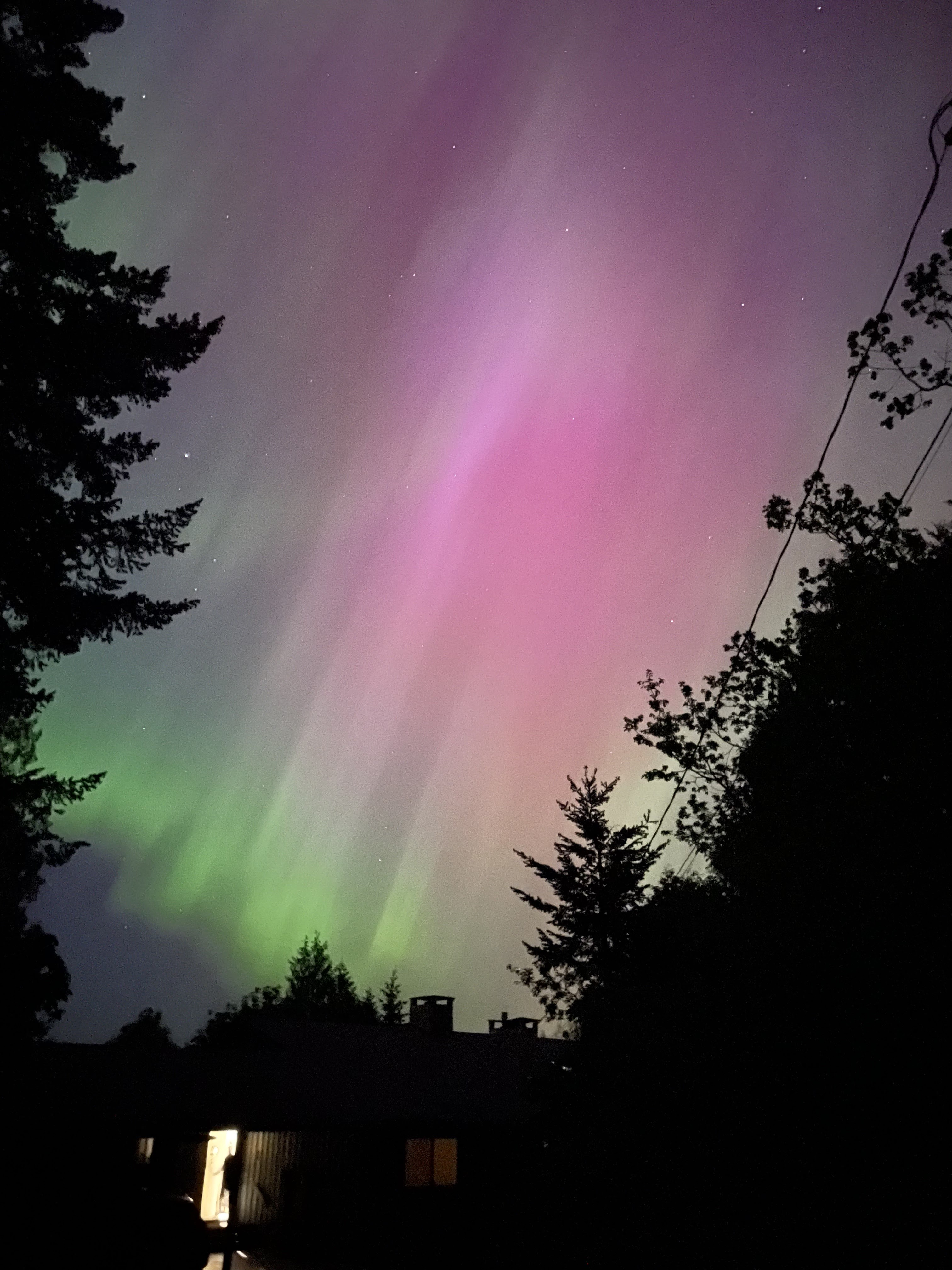
Brenda Towbridge of Nāʻālehu
captured this image on Saturday.
    Earth.com explains: "Solar flares are immense explosions on the Sun that send energy, light and high speed particles into space. They occur when the magnetic fields in and around the Sun reconnect, releasing huge amounts of stored magnetic energy. Flares are our solar system’s most powerful explosive events." NOAA’s Space Weather Prediction Center (SWPC) extended the Geomagnetic Storm Warning until Monday afternoon, May 13.
    People photographing the skies have noted that their phone cameras can come up with the colors, ever so faint, better than their human eyesight.

Phone cameras can capture the colors, sometimes, better than the human eye. This photo is from Nāʻālehu on Saturday.
Photo by Brenda Towbridge


To read comments, add your own, and like this story, see facebook.com/kaucalendar. See upcoming events, print edition and archive at kaunews.com. Support this news service with advertising at kaunews.com. 7,500 copies the mail and on stands. 

Traven Apiki leads a group of volunteers from the non-profit
 GIVE to help remove invasive glycine vines threatening
 the iconic Norfolk pine tree lane coming into Pahala.
Photo by Julia Neal
 MAY IS HAWAI'I INVASIVE SPECIES AWARENESS MONTH. It is the seventh year of Hawaiʻi Invasive Species Council hosting the program, in coordination with Hawaiʻi Department of Agriculture, island invasive species committees, and state Department of Land & Natural Resources. What started as a seven-day experience has grown into a month-long community event dedicated to educating and mobilizing Hawaiʻi residents and visitors to help protect the islands against invasives. Festivities include in-person activities, webinars, volunteer trips, individual and business awards, keiki games, and more.
     A statement from the organizers says, "Invasive species can have devastating and long-lasting impacts on communities and the natural environment if not managed properly. For an island state where 80-90 percent of our food and goods are imported and the threat of new pests entering the landscape is always present, biosecurity is a pressing issue. Within the past year, little fire ant infestations have increased on Oʻahu, coconut rhinoceros beetles have spread to Kauaʻi, and invasive grasses played a major role in devastating fires on Maui and Hawaiʻi Island. Strong coordination and collaboration among state
Cecilia Kauwe cleans up guinea grass along the
pine tree lane in Pāhala. 
departments, federal agencies, organizations, and communities is key to better invasive species management and a more biosecure state."
    The theme of HISAM 2024 is “Who protects Hawaiʻi from invasive species? You do.” The aim is to shed light on the personal actions everyone can take to help prevent and manage invasive species in Hawai'i's  communities. Simple efforts like not planting invasives in gardens, reporting new pests, and volunteering with local organizations "goes a long way. A shared kuleana and collective mindset is what gives Hawaiʻi the best chance for lasting success," says the statement.

 To read comments, add your own, and like this story, see facebook.com/kaucalendar. See upcoming events, print edition and archive at kaunews.com. Support this news service with advertising at kaunews.com. 7,500 copies the mail and on stands.

NAUPAKA KUAHIWI IS THE KAʻŪ NATIVE PLANT OF THE MONTH in the Column Lāʻau Letters: Native Plants of Kaʻū by Jodie Rosam with illustration by Joan Yoshioka.  The scientific name for Naupaka kuahiwi, the mountai naupaka, is Scaevola gaudichaudii.
Naupaka Kuahiwi, the mountain naupaka and relative of naupaka kahakai
 on the seashore. Art by Joan Yoshioka

    Description: Last month, you met naupaka kahakai.  This month, I want
to introduce you to another 
Scaevola species known as naupaka kuahiwi or “mountain naupaka,” a name it shares with five other species. Unlike the indigenous naupaka kahakai, this naupaka is endemic to Hawaiʻi and grows mauka rather than along the coast.  It stands upright (typically around 3-4 feet but can grow taller) and has thick green leaves around 2” long that are slightly serrated near the tips. But the most beautiful and defining characteristic of this Scaevola is the gorgeous deep orange or yellow half flowers with a fragrance that will be forever tied to your memory. In fact, only one other species of naupaka has yellow flowers, S. glabra, but S. glabra flowers are shaped more like a native lobelia rather than the typical naupaka half flowers that we all know and love. The flowers, once pollinated, give way to small, round, deep black fruits that hold a single seed within.
    Uses: With their beauty and sweet fragrance, flowers of naupaka kuahiwi can be used in lei making. The fruits can be used to make a dark dye. The nectar of the beautiful half flowers can also be a source of nutrition for endemic birds and insects. Surely there are other lāʻau lapaʻau uses of this species that I am unaware of, so if you know of any, please share!
    Habitat: This species of naupaka kuahiwi can be found in dry to mesic areas on all of the main Hawaiian islands aside fromd Kahoʻolawe, and grows in dry ridges and open shrublands and forests from about 250 to 2,600 feet in elevation. Unfortunately, their habitat is quickly being lost to development, and whatever plants remain are being threatened and/or impacted by feral ungulate pressures such as grazing and bark stripping (does this sound familiar yet?). In Kaʻū, plants have been recorded from Kahuku to Kapāpala, though today they are quite uncommon and only a few wild plants remain in an unmanaged area in Kahuku.
    Growing and Purchasing: While I have never seen S. gaudichaudii for sale, I believe some nurseries like Future Forests would be able to propagate this species upon request. If you happen to find a plant with ripe fruits, remove the seeds from the fruit, sow in a well-drained media, and be patient while they germinate. Your naupaka kuahiwi will be a hardy addition to the Kaʻū landscape, and requires little water once it establishes in the ground. Feel free to plant it in full sun and offer it a mild fertilizer every year to keep it happy. And when your naupaka kuahiwi fruits, try growing them from seed so you can share the love with a friend.  

To read comments, add your own, and like this story, see facebook.com/kaucalendar. See upcoming events, print edition and archive at kaunews.com. Support this news service with advertising at kaunews.com. 7,500 copies the mail and on stands.

KAʻŪ IS UNDER A FLOOD ADVISORY SUNDAY EVENING. CIVIL DEFENSE reminds residents and travelers a Flood Advisory means minor flooding is imminent or occurring.
    Due to the Flood Advisory, be advised:
    Flooding can be life-threatening. Residents in flood prone areas are asked to remain alert for flooding conditions. 
   Please drive with caution. Be on the alert for run-off, ponding of water, debris, and poor visibility.
   Do not attempt to cross flowing water in a vehicle or on foot; turn around, don't drown.
   Remember, if lightning threatens, the safest place to be is indoors.
   For more information, visit County of Hawaii Hazard Impact Map

HAWAI'I COUNTY CIVIL DEFENSE ASKS THOSE WITH STORM DAMAGE from the current rains and flooding to visit the Civil Defense webpage and submit a damage report by using the Public Damage Report form at https://survey123.arcgis.com/share/13ffdc337b544dc0a8665fcdf9e67957 or call 808-935-0031. The form is not for receiving assistance. It states, "The information you provide in this report will ensure that the County of Hawaii can send a damage assessor to assess the damage caused by a natural or man-made disaster. The data collected will allow County officials to determine if our jurisdiction qualifies for any state or federal assistance, as well as to assist with hazard mitigation planning.
    "This report is strictly for reporting damage or loss of personal property. It does not constitute an application for assistance and affected parties still need to file claims with their Insurance companies. Utility outages should still be report to your local utility provider. If this is a life-threatening emergency, call 9-1-1."

    Civil Defense advises that "Rain continues in the forecast through the week. Exercise caution as flooding is possible." For more information, visit the County of Hawaii Hazard Impact Map.


To read comments, add your own, and like this story, see facebook.com/kaucalendar. See upcoming events, print edition and archive at kaunews.com. Support this news service with advertising at kaunews.com. 7,500 copies the mail and on stands.


Saturday, May 11, 2024

Kaʻū News Briefs May 11, 2024

May 22nd, 1924 explosion as seen from Volcano House. Photo by Tai Sing Loo

KĪLAUEA ERUPTED EXPLOSIVELY 100 YEARS AGO THIS WEEK. It was the first time in nearly a century, reports Volcano Watch in its weekly column written by U.S. Geological Survey Hawaiian Volcano Observatory scientists an affiliates:
    The eruption lasted for about 17 days, killing one person and injuring others. Learn more about the 1924 eruption.
    The eruption took place from Halemaʻumaʻu at the summit of Kīlauea but was foreshadowed by a seismic crisis and intrusion of magma in lower Puna, 30 miles (50 km) away. In February 1924, the lava lake in Halemaʻumaʻu began to drain back underground. In mid-April, lower Puna was shaking almost constantly, and the ground was cracking open as lava from the emptying lake traveled underground into the lower East Rift Zone. The crisis died by April 28 before lava could erupt, and agricultural field hands that had been evacuated resumed their work.
    At Kīlauea’s summit, the floor of Halemaʻumaʻu began dropping on or before April 29 and was lower by 328 ft (100 m) on May 7, the last measurement date. Rock falls from the crater wall generated thick dust clouds. Red-hot “ʻaʻā paste” left over from the drained lava lake
Explosive eruption column from Halema‘uma‘u Crater 11:15 a.m. May 18, 1924 -
one of many in a series of similar events during May 11-27. Photo from northwest
rim of Kīlauea summit. Photo by K Maehara
peeled away from the wall, but observers noted no wholesale collapse.
    The first explosion was unobserved during the night of May 10–11 and ejected blocks weighing more than 330 pounds (150 kg) as far as 200 ft (60 m) from the crater. After relative calm on May 11–12, the eruption took off in earnest on May 13. Thereafter, more than 50 distinct explosions occurred until May 27, when the eruption ended.
    Thousands of rocks were tossed high in the air, littering the caldera floor. Intense electrical storms accompanied some of the explosions, and lightning took out powerlines far down the road to Hilo. Earthquakes shook the ground, and mud rains with pellets the size of peas (called accretionary lapilli) pummeled the summit. Blocks weighing several tons landed more than half a mile (1 km) from the crater; one 8-ton block that landed about a mile (2 km) southeast of the crater became a signed visitor site for many years, even surviving the caldera collapse of 2018.
    The explosive crescendo was on Sunday, May 18, when the two largest explosions occurred. A number of observers were on the caldera floor during the first, and one, Truman Taylor, was fatally injured by a falling rock. By remarkable coincidence, 56 years later the devastating eruption of Mount Saint Helens occurred on Sunday, May 18, 1980, and both eruptions killed a man named Truman. Truth is sometimes stranger than fiction.
    Most of the ash from the explosions was blown southwestward by the trade wind, but some, perhaps supplied by higher eruption columns that overtopped the trade wind regime, fell from South Hilo to lower Puna. Railroad travel in Makuʻu was disrupted when the tracks became slippery from wet ash. Rain washed ash from the roof of the Glenwood store, tearing off the gutters. Overall, though, the production of ash was modest, and, after only 20 years, it was hard to find ash deposits outside the caldera, as wind and water swept them away.
View looks away from Halema‘uma‘u, in the direction the block was falling. Left to
 right: Oliver Emerson, Tai Sing Loo (in crater, holding camera), John Stokes.
Photo taken 9:30 a.m. May 22, 1924. Photo by H.T. Stearns
    During the eruption, Halemaʻumaʻu doubled its diameter to about half a mile (1 km), and its floor dropped more than 1640 ft (500 m).
    What powered the explosions? For years the interpretation was that they resulted from steam explosions generated as groundwater encountered hot rock. This interpretation, suggested at the time, served well until the 2018 collapse of Halemaʻumaʻu and the adjacent caldera produced nothing comparable to the 1924 explosions.
    Theoretical modeling indicates that months to years are required for the conduit wall to cool enough for groundwater to return after draining of a lava lake. Is there any way to overcome this theoretical requirement? What role did magmatic gas—dissolved in magma and released explosively by sudden drop in pressure—play in 1924 or in 2018? Ongoing work by USGS Hawaiian Volcano Observatory (HVO) researchers on the 1924 ash is providing new information bearing on these questions. Next week’s “Volcano Watch” article will describe this research.
    Finally, a sad, deeply personal, note. Thomas Jaggar, esteemed head of HVO, was in New York when the eruption started, not returning home to Hawaii until May 28. In a private letter written 23 years later, he lamented "...1924 was my responsibility, and my absence was a pity, the most fatal disappointment of my life."
    On Tuesday, May 14 at 7 p.m., join Don Swanson, HVO geologist emeritus, and Ben Gaddis, HVO volunteer, as they describe the 1924 explosive eruption of Kīlauea in an After Dark in the Park presentation at Hawai‘i Volcanoes National Park. Park entrance fees apply. See here for more information: https://www.nps.gov/havo/learn/news/20240329_may-2024-events.htm. This program will be repeated on May 20 and 21 at Lyman Museum in Hilo. See here for more information: https://lymanmuseum.org/events/.

 To read comments, add your own, and like this story, see facebook.com/kaucalendar. See upcoming events, print edition and archive at kaunews.com. Support this news service with advertising at kaunews.com. 7,500 copies the mail and on stands.

VOLCANO ACTIVITY UPDATES FROM USGS: Kīlauea is not erupting. Its USGS Volcano Alert level is ADVISORY.  Unrest that began on April 27 continues beneath the upper East Rift Zone and the summit caldera south of Halemaʻumaʻu. Up to 280 events, most magnitude-2 and smaller, have been detected per day over the past week between the south part of Kīlauea caldera and the intersection with Hilina Pali Road; depths remain concentrated between 2-4 km (1.2-3.1 miles) beneath the surface. Tiltmeters near Sand Hill and Uēkahuna bluff continued to record inflationary trends. Kīlauea's summit region is pressurized, and changes could occur quickly moving forward. See the Information Statement published on May 2 for background information: https://volcanoes.usgs.gov/hans-public/notice/DOI-USGS-HVO-2024-05-03T07:42:02+00:00.
    Mauna Loa is not erupting. Its USGS Volcano Alert Level is at NORMAL.
    Webcams show no signs of activity on Mauna Loa. Summit seismicity has remained at low levels over the past month. Ground deformation indicates continuing slow inflation as magma replenishes the reservoir system following the 2022 eruption. SO2 emission rates are at background levels.
    Six earthquakes were reported felt in the Hawaiian Islands during the past week: a M3.3 earthquake 6
Thomas Jaggar standing amid ash and blocks of the May 1924 eruption,
looking east-northeast toward Kīlauea Iki. Note the fresh cracks that opened
 as Halema‘uma‘u was widening during its collapse. Photo by Tai Sing Loo

km (3 mi) S of Volcano at 1 km (1 mi) depth on May 7 at 9:26 a.m. HST, a M1.9 earthquake 6 km (3 mi) SSW of Honoka‘a at 6 km (3 mi) depth on May 6 at 9:11 p.m. HST, a M2.5 earthquake 5 km (3 mi) SSW of Volcano at 1 km (1 mi) depth on May 2 at 4:16 p.m. HST, a M3.1 earthquake 6 km (3 mi) S of Volcano at 1 km (0 mi) depth on May 2 at 4:07 p.m. HST, a M3.0 earthquake 6 km (3 mi) S of Volcano at 0 km (0 mi) depth on May 2 at 3:56 p.m. HST, and a M2.9 earthquake 6 km (3 mi) S of Volcano at 1 km (0 mi) depth on May 2 at 3:48 p.m. HST.
    HVO continues to closely monitor Kīlauea and Mauna Loa.
    Visit HVO’s website for past Volcano Watch articles, Kīlauea and Mauna Loa updates, volcano photos, maps, recent earthquake information, and more. Email questions to askHVO@usgs.gov.

To read comments, add your own, and like this story, see facebook.com/kaucalendar. See upcoming events, print edition and archive at kaunews.com. Support this news service with advertising at kaunews.com. 7,500 copies the mail and on stands.

SEVERE AND EXTREME (G4-G5) GEOMAGNETIC STORMS LIKELY ON 12 MAY 2024, according to NOAA, which reported, "Another series of CMEs associated with flare activity from Region 3664 over the past several days are expected to merge and arrive at Earth by midday (UTC) on 12 May. Periods of G4-G5 (Severe-Extreme) geomagnetic storms are likely to follow the arrival of these CMEs."
    None of the colorful skies seen on the continent and in Europe have reached Hawai'i to date.

VOLCANO WINERY'S MOTHER'S DAY MARKET is Sunday, May 12 from 12 p.m. - 4 p.m. at Volcano Winery, 35 Piʻi Mauna Drive, Volcano. Featuring wine, crafts, food and more. More information at https://m.facebook.com/volcanowinery/.

MOTHER'S DAY CONCERT: FEATURING THE VOLCANO CHAMBER PLAYERS is Sunday, May 12 from 4 p.m. - 6 p.m. at Volcano Art Center's Dietrich Varez Hall in Hawai'i Volcanoes National Park. The concert is a special tribute to mothers. Beverages and pupu will be available for purchase. Tickets available at https://volcanoartcenter.org/classes-and-workshops/purchase-tickets-to-vac-events/.


Friday, May 10, 2024

Kaʻū News Briefs May 10, 2024

NASA came up with this image of the eruptions on the sun sending material through space into the Earth's atmosphere to create
the colorful night skies and some possible communications disruptions. Image from NASA

THE COLORFUL SKIES OF THE SOLAR STORM 'COULD REACH HERE IF IT BECOMES AS STRONG AS THE ONE IN 1859, which was reported in Hawai'i newspapers. Imagesofoldhawaii.com reports on the 1859 Carrington Event which lasted from Aug. 28 through Sept.1859, as "the greatest and most famous space weather event in the last 200 years." The event knocked our major communication infrastructure around the world. At the time communication was largely through telegraph lines.
    In Hawai'i The Advertiser newspaper on Sept. 8, 1859, stated: “There was quite a display of the Aurora Borealis a few nights since, visible at Honolulu. Broad fiery streaks shot up into and played among the heavens, almost as beautifully as those which are sometimes seen in more northern climes.”
    The Advertiser of September 17 also reported the event looking like a fore seen from Lahaina at night. It quoted the following letter from SE Bishop, dated Lahaina, Sept. 9: "Your statement that the Aurora was seen in Honolulu enabled me to account for the phenomenon I observed here a few nights since. At 10 PM I noticed a bright, unsteady crimson glow upon the sky, extending from NE to N, and about 35° of altitude. It resembled the reflection of a great conflagration at twenty or thirty miles distance, and I attributed it to heavy fires on the other side of the mountain. I was puzzled however by the fact that the clouds which rested on the mountain did not give the slightest reflection of the supposed fire. Moreover the light was far and rich a crimson to have been caused by a fire.”
   The 2024 solar storm created spectacular skies of many colors on the mainland Friday night, with more expected throughout the weekend and a chance they could reach here.

To read comments, add your own, and like this story, see facebook.com/kaucalendar. See upcoming events, print edition and archive at kaunews.com. Support this news service with advertising at kaunews.com. 7,500 copies the mail and on stands.

A REQUEST FOR PUBLIC SUPPORT FOR PUBLIC SUPPORT FOR A SOUTH HAWAI'I ANIMAL CONTROL FACILITY IS REQUESTED from Kaʻū's County Council member Michelle Galimba. She sent out a message on Friday saying, "Please testify in support of Communication 756.2 which will amend the County Budget to add $2.5M to a South Hawaiʻi Animal Control Facility." The measure will be heard on May 16 at 9 a. m. at the Special Budget 

Michelle Galimba with cattle dogs in a Volcano parade.
Photo by Lina Kasolov
Meeting in Hilo County Council Chambers at 25 Aupuni Street. Testifier can also go to Council Chambers at West Hawai'i Civic Center a Bldg A in Kona. To register for Zoom testimony email councilremotetestimony@hawaiicounty.gov Written testimony can be emailed to: counciltestimony@hawaiicounty.gov.
    Galimba stated: "Abandoned, stray, lost and dangerous dogs are a serious issue in District 6 (Volcano -Kaʻū-South Kona). Please help to address this problem by testifying in support of appropriating $2.5 million in the 2024-2035 County CIP Budget to build an Animal Control Facility in District 6!          "Building an animal control facility that will help our animals, their owners and the safety of the general public. This facility will provide a place for animal control officers to work out of, so that they can answer calls in a timely manner (rather than having to drive up to two hours each way from Kona or Kea'au to respond to animal control situations as is currently the case). 
    "This facility will also provide a place for lost pets to be re-united with their owners. This is a critical investment in our community that will make a lasting difference in the safety of our communities. East, West, and North Hawaiʻi Island have always had humane society shelters/animal control facilities. It is only fair that we in South Hawaiʻi also have the facilities to address our animal control issues!"
    The agenda for the Special Budget Meeting is available at https://records.hawaiicounty.gov/weblink/DocView.aspx?dbid=0&id=1076815&cr=1

To read comments, add your own, and like this story, see facebook.com/kaucalendar. See upcoming events, print edition and archive. Support this news service with advertising at kaunews.com.
7,500 copies the mail and on stands.

HOME HERBALIST WORKSHOP WITH HEATHER PENFIELD is Saturday May 11 from 9 a.m. - 11 a.m. at Volcano Arts Center Niaulani Campus in Hawai'i Volcanoes National Park. Learn germ boosting powers of plants & herbs and discover how to use them, learn the art of making effective remedies at home. Watch how products are made from start to finish. Includes: class handout with recipes and samples. Class fee is $60/$55 for VAC members plus a $20 supply fee. Register at https://volcanoartcenter.org/classes-and-workshops/registration-workshops-classes/.

NA'OHULELUA HISTORICAL GARDEN, NURSERY & NATIVE PROPAGATION CENTER IS OPEN Saturday, May 11, Sunday May 19 and Saturday May 25 from 10 a.m. - 2 p.m. at 94-6488 Kama'ōa Road, Nāʻālehu. Offering rare & endangered native Hawaiian plants, several varieties of organic Moringa "The Miracle Tree" & more, ready to plant. A Mission of Alanui 'O Ka'ū a 501(c)(3) Nonprofit Organization. Private appointments, special orders, volunteer opportunities and other inquiries text (808) 256-3193.

ZENTANGLE® RIXTY VARIATIONS WORKSHOP WITH IRIS THORNTON is Saturday, May 11 from 10 a.m. - 1 p.m. at Volcano Arts Center Niaulani Campus in Hawai'i Volcanoes National Park. Zentangle is an easy-to-learn fun way to create beautiful images by drawing structured patterns. Rixty is a simple and dynamic tangle that is odd and familiar at the same time. This class is open to all levels, no Zentangle or art experience necessary. Students are encouraged to bring snacks/beverages to share. Cost is $35/$30 VAC members plus a $15 supply and facility fee. Register at https://volcanoartcenter.org/classes-and-workshops/registration-workshops-classes/.

HULA KAHIKO UNDER THE DIRECTION OF KUMU KINI KAʻAWA is Saturday, May 11 from 10:30 a.m. - 11:30 a.m. at Volcano Arts Center in Hawai'i Volcanoes National Park. This performance is part of a year-round series sponsored by the Volcano Art Center. Presented authentically in an outdoor setting, rain or shine without electronic amplification. Audience members are encouraged to bring sun/rain gear and sitting mats. For more information call (808) 967-7565.

SOUTH HAWAI`I SYMPHONY PRESENTS: MOTHERS' APPRECIATION CONCERT. Saturday, May 11 from 2 p.m. at Discovery Harbour Community Center, 94-1604 Makali`i St, Nāʻālehu. With classical pieces by Mozart and Shubert and popular music from movies such as Star Wars, Ben Hur, Harry Potter, E.T. and more. Farley Sangels will conduct 15-piece orchestra. Free event. Donations welcome.

JAZZ IN THE FOREST: "TAKE A GIANT STEP OUTSIDE YOUR MIND – A HISTORY OF JAZZ GUITAR MUSIC" is Saturday, May 11 from 5:30 p.m. - 7 p.m. at Volcano Arts Center Niaulani Campus in Hawai'i Volcanoes National Park. Featuring internationally known and respected guitarist and vocalist Benny Yutake, along with JP and the Jazztones featuring JP Thoma on saxophones and clarinet, Joey Carroll on vocals, acoustic as well as electric bass, and Owen Matsui on percussion. Tickets are $25 for VAC members and $30 for non-members. Purchase tickets at www.volcanoartcenter.org, or at VAC's Administration Office in Volcano Village.

VOLCANO WINERY'S MOTHER'S DAY MARKET is Sunday, May 12 from 12 p.m. - 4 p.m. at Volcano Winery, 35 Piʻi Mauna Drive, Volcano. Featuring wine, crafts, food and more. More information at https://m.facebook.com/volcanowinery/.

MOTHER'S DAY CONCERT: FEATURING THE VOLCANO CHAMBER PLAYERS is Sunday, May 12 from 4 p.m. - 6 p.m. at Volcano Art Center's Dietrich Varez Hall in Hawai'i Volcanoes National Park. The concert is a special tribute to mothers. Beverages and pupu will be available for purchase. Tickets available at https://volcanoartcenter.org/classes-and-workshops/purchase-tickets-to-vac-events/.