About The Kaʻū Calendar

Tuesday, August 07, 2012

Ka`u News Briefs Aug. 7, 2012

Proposed site of `Aina Koa Pono biofuel refinery on Meyer Camp Road off, Wood Valley Road above Pahala.
Photo by Julia Neal
AN ENVIRONMENTAL IMPACT STATEMENT for the `Aina Koa Pono refinery planned off Wood Valley Road is supported by three District 6 County Council candidates. The fourth candidate said an EIS "is not necessary" under state law.
     County Council candidate Maile David said: “Public health and public safety are paramount, and the EIS would be a logical first step.” She said she has heard that there are issues about the location. “There might be more acceptance if it wasn't directly above the village. There definitely should be an Environmental Impact Statement," she said.
     County Council member Brenda Ford, who is running for a fourth term, this time for District 6, said: “Any plant producing biofuel, diesel fuel, whether the origination is ag or petroleum, should have an EIS, period. Any refinery making diesel fuel could have major impacts on the people, the land and the ocean and should require, by this state, an EIS. It is not what the input is; it is what the output is,” said Ford, referring to the manufacturing of diesel and its byproducts.
     “Can I impose my will on this? No,” Ford said, referring to county zoning that allows manufacturing of agricultural products on agriculturally zoned land. She said the Public Utilities Commission, which is tasked with approving or disapproving a new contract proposed by Hawaiian Electric Light Co. and `Aina Koa Pono, “should take this into consideration, and if it can’t or won’t, there needs to be a lawsuit about the whole thing. We need a court to step in.”

County Council Candidates Maile David, Brenda Ford, Lee McIntosh, and Bradely Westervelt.
Three of the four support an EIS for the biofuel refinery.
Photo from mailedavid.com
     County Council candidate Lee McIntosh said that “an EIS is not necessary by the laws that the Legislature put in place. Anything they (`Aina Koa Pono) do would be voluntary. It is a long, expensive and arduous task doing an EIS and may or may not answer questions people might want answered.” He said the biofuel refinery “is no different than having a gas station near you with tanks underground. It’s just following the safety procedures that have been outlined in the past.”
     County Council candidate Bradley Westervelt said that an EIS “should probably be conducted. The biofuel plant would not be a direct provider of electricity," he said. “We are talking about industrial manufacturing as opposed to a grid-tied supply system.” He explained that a grid-tied supply system would make energy at the power plant and put it online directly to the public.
     He also said he is concerned about inputs into the environment. “If it is going to involve semi-truck loads of zeolite as input into the process, then there is going to be a biochar residual that is going to go into our island environment in one manner or another.” Westervelt also said, “I am pessimistic about using crop lands for fuel.” He said, however, that Ka`u does need an economic boost.
     `Aina Koa Pono says in its Frequently Asked Questions on its website that no Environmental Impact Statement is required. “However, AKP has engaged the services of R.M. Towill Corporation to prepare a voluntary assessment of environmental issues. We will verify the safety of the Micro Dee (Microwave Catalytic Depolymerization) process and of storing and transporting our biofuel, address issues and concerns raised by the community and develop mitigation measures appropriate to the site and community.” See more at ainakoapono.com.
     The Public Utilities Commission has opened a docket where documents regarding the contract between `Aina Koa Pono and HELCO can be read. See http://puc.hawaii.gov. Click on Document Management System and type 2012-0185 in the Docket Quick Link box.

SUPPORT FOR MICRONESIANS from the federal government, which used their islands to test nuclear bombs for more than 30 years, gained momentum at the 43rd national convention for the Japanese American Citizens League National Council. According to a Chad Blair report in Civil Beat, JACL supports access to Medicaid coverage for Micronesians in Hawai`i. The group passed a resolution that asks Gov. Neil Abercrombie and state Attorney General David Louie to withdraw the state’s appeal of Korab v. McManaman, which is now before the U.S. 9th Circuit Court of Appeals. The appeal asks the court to relieve the state from providing health benefits to Micronesians.
Jonithen Jackson works on health issues with Micronesians living in Ka`u.
Photo by Julia Neal
     A resolution also affirms JACL’s support of restoration of federal health benefits for Micronesians living in the U.S. pursuant to the Health Equity and Accountability Act of 2012 (S. 2474) introduced by Sens. Daniel Akaka and Daniel Inouye. The federal government vowed to help Micronesians with education, health and other benefits after they were removed from island homes, the islands were used for nuclear testing and the islands remained radioactive so they could not return home.
     Ka`u is one of the places where Micronesians have migrated within the U.S. and have received benefits, including federal support for public schools here.

THE PUBLIC LANDS DEVELOPMENT CORP. proposed rules go to public hearings this month, one on Aug. 20 at Waiakea High School in Hilo and the other on Aug. 21 at Konawaena High School. Both meetings are at 6 p.m. The new state agency is tasked with raising revenue through making more efficient use of state lands, including leasing them out for development. The Sierra Club Hawai`i Chapter calls the proposed rules “fundamentally flawed.” According to an Erin Miller story in this morning’s West Hawai`i Today, Sierra Club executive director Robert Harris said, “They have to ensure the community’s voice. They have to ensure pristine, cultural resources are protected.”
Robert Harris questions plans to develop state lands.
Photo from honoluluweekly.com
He pointed out that the new rules would not require hearings on this island for proposed Big Island projects. The rules also leave out the county when gathering input. “Right now, they can essentially ignore the county,” Harris said. “We have deep concerns about the Public Lands Development Corp. and the (idea) that our public land is best used if it’s developed,” Harris said.
     The proposed rules are posted at hawaii.gov/dlnr/pldc/rules and available by writing to PLDC, PO Box 2359, Honolulu, HI 96804. Comments can be emailed to randal.y.ikeda@hawaii.gov or mailed to PLDC. Deadline for comments is Sept. 14.

TONIGHT’S AFTER DARK IN THE PARK program features Monumental Architecture of Micronesia. Dave Tuggle presents an illustrated journey to the islands of Micronesia, the ancient, massive stonework of Palau and the limestone structures of the Marianas at 7 p.m. at Kilauea Visitor Center Auditorium in Hawai`i Volcanoes National Park. Two-dollar donations support park programs, and park entrance fees apply.

RANGER KEOKI WELLS demonstrates how to play `ukulele from 10 a.m. to noon tomorrow on the lanai of Kilauea Visitor Center in Hawai`i Volcanoes National Park. The program is free, and park entrance fees apply.

EARLY ABSENTEE WALK-IN VOTING is available today and through Thursday before the primary election on Saturday. 
Voters can cast ballots from 8 a.m. to 4 p.m. at West Hawai`i Civic Center Community Room, Waimea Community Center and Aupuni Center Conference Room in Hilo. 

SUPPORT OUR SPONSORS AT PAHALAPLANTATIONCOTTAGES.COM AND KAUCOFFEEMILL.COM.

Monday, August 06, 2012

Ka`u News Briefs Aug. 6, 2012

Biofuel crops are being tested along Wood Valley Road for planting between Pahala and Na`alehu for a
biofuel crop farm. Photo by Julia Neal
THE `AINA KOA PONO BIOFUEL REFINERY, proposed for land off Wood Valley Road above Pahala, is part of the discussion in statewide media. A Honolulu Star Advertiser story this morning points out that last Thursday, “Hawaiian Electric Light Co., a HECO subsidiary, asked the Public Utilities Commission to reconsider its rejection last year of a surcharge of O`ahu and Maui customers for the expense of using biofuel to feed a power plant on Hawai`i island. The proposed 20-year contract is with `Aina Koa Pono, a new company that would convert a variety of plants and crops into a liquid fuel to replace fossil fuel at HELCO’s power plant near Kailua-Kona.”
      A Honolulu Star Advertiser editorial this morning says that “Hawai`i has become a playing field for developing feedstocks for a biofuel supply chain, while HECO is moving forward on using it in place of oil in its power plants. Environmentalists prefer that biofuel replace gasoline in both aviation and ground vehicle engines, but the growth of the energy alternative still could have the long-term dividends they desire.”
State Energy Office director Mark Glick
       The Star Advertiser story notes that “state regulators had rejected HECO’s proposed surcharge toward buying 16 million gallons a year of the biofuel (from `Aina Koa Pono). The company now says the surcharge would not begin until the biofuel is delivered to the plant, and it would ‘decrease over time as petroleum-diesel prices rise.’”
      The Star Advertiser editorializes: “As new energy options develop, the focus must be on projects and strategic plans that are justifiable to consumers and cost-attritioned, not ones that depend on ratepayers for exorbitant or indefinite subsidies.”
      The editorial states that Gov. Neil Abercrombie’s “administration agrees with environmentalists that biofuel should be used directly to power transportation rather than replace oil in power plants. Mark Glick, the state Energy Office director, says the HECO contracts may someday extend to use of biofuel in the way the state desires. However, the use of biofuel in power plants should not dampen advances in other sources of energy — solar, wind and geothermal.”
      The story quotes Glick: “We really advocate moving away from power generation as the focus for biofuels.”
      States the Star Advertiser: “As for biofuels’ future in Hawai`i, the only state that depends on shipped oil for electricity as well as gasoline: Hawaiian Electric Co. is enthusiastic about the use of biofuels in reducing that dependence, but not in the way other proponents of clean energy envision substitution of oil derivatives.”
Jeff Mikulina of Blue Planet Foundation
Photo from blueplanetfoundation.org
      The story reports that Blue Planet Foundation executive director Jeff Mikulina said that “use of biofuel in that fashion would get in the way of the long-term effort to replace oil as Hawai`i’s major source of electricity with wind, hydro, solar and geothermal energy.”
      The story quotes Mikulina: “Having a policy preference for biofuel produced in Hawai`i, the first use should be transportation and, if there are leftover products, use that for electricity. If a utility gobbles up that supply, we’re going to be up a creek for the transportation side.”
      The Star Advertiser reports that Mikulina said that a state policy to clarify a “preference for biofuels would help prevent solving one energy problem at the expense of another.”
      The story says that Mikulia “scoffs at what HECO regards as planning for the future” in its preference for biofuels to run its old oil burning power plants. It quotes him saying, “They just put in a different fuel. We would much prefer them to do the more complex, but — we think in the long term — more affordable approach of using more solar and wind and starting to shut down the power plant.” Mikulina told the Star Advertiser that two-thirds of Hawai`i’s imported oil goes to transportation, and the remainder to electricity.
      “That one-third for electricity we have other solutions for — wind, solar, geothermal, waves — but for the transportation side, we really have to have a liquid fuel — jet fuel, diesel, gasoline,” he told the Star Advertiser.
      “The ideal biofuel project would not be too dissimilar from a regular refinery,” Mikulina added, “where you put in crude oil and you get out gasoline, diesel, jet fuel and the stuff that the utility burns. A project that would produce all those products would be ideal, but when they start designing only to produce biodiesel, only for use in the power plant, then I think there’s an opportunity cost in doing that,” Mikulina told the Star Advertiser.
      The Star Advertiser editorial concludes: “While biofuel is now more expensive, continuing to be shackled to fossil fuels comes with larger costs, both militarily and on streets and airways. In the end, solar, wind and geothermal should replace over-reliance on monopolistic power plants while biofuel is fed into engines.”

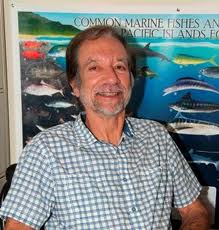
NOAA's Jeff Polovina questions DLNR's plan to build
artificial reefs using scrap concrete.
USING SCRAP CONCRETE TO CREATE ARTIFICIAL REEFS is the plan of Department Of Land & Natural Resources chair William Aila, Jr. He told Civil Beat’s Nathan Eagle that “it’s probably the most beneficial in terms of providing a return to fishermen and the resource at the same time. And it recycles concrete that was normally going to the landfill, so triple benefit.” 
      The story quotes Jeff Polovina, of the National Oceanic and Atmospheric Administration, who questions the plan. “It’s true that if coral reefs are going to be dying, building some concrete reefs could help climate change, but the idea of, well, we need to increase our fish catch so we put more of these down can actually result in greater exploitation of the population. An artificial reef can attract 10 times as many fish as it produces naturally,” he said. “So if unrestricted fishing is allowed, the fake reef just acts as a fish aggregator and can decimate the population.”
      “We should be out there looking for additional sites (for artificial reefs) throughout the state of Hawai`i,” Aila told Civil Beat. Eagle said that, when an artificial reef was proposed for Kailua-Kona, some Big Island residents blocked the effort based on public health and protection of natural reefs. “If they don’t want it, we don’t push it,” Aila said. See more at civilbeat.com.

EARLY ABSENTEE WALK-IN VOTING is available today and through Thursday before the primary election on Saturday. The ballot includes choices for a new County Council member, mayor, state senator and representative and U.S. senator and representative. Voters can cast ballots from 8 a.m. to 4 p.m. at West Hawai`i Civic Center Community Room, Waimea Community Center and Aupuni Center Conference Room in Hilo. 

DAVE TUGGLE PRESENTS AN ILLUSTRATED JOURNEY to the islands of Micronesia, the ancient, massive stonework of Palau and the limestone structures of the Marianas tomorrow at 7 p.m. at Kilauea Visitor Center Auditorium in Hawai`i Volcanoes National Park. Two-dollar donations support park programs, and park entrance fees apply.

SUPPORT OUR SPONSORS AT PAHALAPLANTATIONCOTTAGES.COM AND KAUCOFFEEMILL.COM.

Sunday, August 05, 2012

Ka`u News Briefs Aug. 5, 2012

 Christmasberry is one plant `Aina Koa Pono is considering as a feedstock for its biofuel refinery.
Photo is of holly, another invasive species in many places. Photo from ainakoapono.com
LEADERS AT `AINA KOA PONO, the hui that wants to build a refinery near Wood Valley Road and plant biofuel crops on ag land between Pahala and Na`alehu, have changed. The new website at ainakoapono.com names Kenton Eldridge as chairman, replacing Dr. Melvin Chiogioji, who was co-founder of `Aina Koa Pono. Chiogioji has formed a company called Sustainable Biofuels Solutions, which is licensed worldwide to sell TekGar’s new Microwave Catalytic Depolymerization process, now called Micro Dee.
`Aina Koa Pono chairman Kenton Eldridge
Photo courtesy of The Nature Conservancy
      Hawaiian Electric Light Co. and `Aina Koa Pono are applying to the state Public Utilities Commission for a contract to sell biofuel to the utility. The PUC turned them down last year, saying the cost was excessive and not cost-effective. This year’s contract would charge the utility less for the biofuel. A summary of the proposal is expected to be placed on the PUC website soon for public comment.
       Eldridge is also statewide chairman of the board of The Nature Conservancy, which owns and manages Kamehame turtle nesting preserve makai of Pahala and several other preserves between Pahala and Na`alehu.
      The website says he brings 40 years of business experience to `Aina Koa Pono, including 15 years with Duty Free Shoppers (DFS). He has extensive business operating experience in the U.S. and Asia, the website says. He also serves on advisory boards of Innovac and Entrepreneurs Foundation of Hawai`i. Prior to his retail career, Eldridge spent four years as a U.S. Army officer, serving in Europe and Vietnam. He attended the Defense Language Institute in Monterey, CA and the Army Officer’s Candidate School at Fort Benning, GA. He received Bachelor of Arts, Master of Arts and Master of Business Administration degrees from University of New Hampshire, the website says.
      Named a partner in `Aina Koa Pono and spokesman for the group is Kenton Eldridge’s son, Chris Eldridge. He is founder and president of America’s Mattresses Hawai`i, which, according to the website, is the state’s largest chain of specialty sleep shops. The website says Chris Eldridge has 20 years of entrepreneurial and start-up experience, having founded four companies including America’s Mattress and PortaBox Storage. “PortaBox Storage/FileMinders grew into Hawai`i’s largest commercial records and data storage company and was sold to Access Information Management in 2005,” says the website. 
`Aina Koa Pono plans to build a biofuel refinery on Meyer Camp Road off of Wood Valley Road above Pahala.
Photo by Julia Neal
      Chris Eldridge serves on the board of directors for Kapi`olani Medical Center for Women and Children as well as on advisory boards for several private companies. He is a member of The Nature Conservancy of Hawai`i’s Corporate Council for the Environment, and a member of the Young President’s Organization. He attended Punahou School and earned a Bachelor of Arts degree in Economics and Business form Boston University. Both Kenton and Chris Eldridge live on O`ahu. 

THE NEW `AINA KOA PONO AND HAWAI`I ELECTRIC LIGHT CO. PROPOSAL that could increase the average household electric bill by only one dollar a month could lead to much larger cost increases for businesses, schools, hospitals and other institutions, which are already looking for ways off the grid. The new West Hawai`i Civic Center installed photovoltaics, and University of Hawai`i is planning to install a second round of solar voltaic panels.
      “If you’ve ever felt the pain of paying an unanticipated monster electricity bill, just imagine being the guy who writes the checks at University of Hawaii at Hilo,” says a West Hawai`i Today story this morning by Colin M. Stewart. Electric bills increased by nearly a half million dollars in the 2011-2012 fiscal year, putting some educational programs at risk, UH-Hilo Chancellor Donald Straney told Hilo Rotary Club last week. 
       To get away from the growing electric bills, UH-Hilo appointed a sustainability director to help cut utility costs and develop an energy management plan. UH-Hilo is installing more photovoltaics after putting up solar panels that already generate more than 150 kilowatts. An additional 500 kilowatts will be installed. However, the additional photovoltaics “will put the campus very near the limit of photovoltaic production within the guidelines established by Hawai`i Electric Light Company,” the story says.
      See more at westhawaiitoday.com.

Dr. Nathan Zilz
CARDIAC SCREENINGS are expected to come to farmers markets and other public locations on the south end of the Big Island, according to a story in this morning’s West Hawai`i Today. The Colin M. Stewart article introduces Hawai`i Island Cardiovasular, Inc., “a new nonprofit that will seek to provide island residents with access to early screenings that can identify heart health issues before they become serious and expensive.” The founder and philanthropist behind the effort is Ray Chalkin, and the volunteer medical director is cardiologist Nathan Zilz.
      The story quotes Zilz on his mission as a doctor who prevents illness: ‘There’s an old Chinese proverb that says something like ‘A superior doctor prevents sickness. A mediocre doctor attends to impending disease. And an inferior doctor treats actual sickness.’ We want to try to prevent sickness, and hopefully we can change some of the statistics that we’ve been talking about.”
      Screenings will include blood pressure, blood glucose and cholesterol levels as well as ultrasounds and education.
      According to the story, Zilz said that, in addition to markets and fairs, the organization plans education in schools where volunteers will talk about anatomy and physiology and how to become and stay healthy. The story also reports Chalkin saying that, “by this time next year, we could be screening many, many hundreds or even thousands of people.”
      The article points to the Big Island having a 20 percent higher death rate than statewide in heart disease-related illnesses. See more at westhawaiitoday.com. To find out more and to make a donation, call Mary Stancill at stancill@hawaiicardiovascular.org.

One of Micronesia's monumental structures. Photo from NPS
MONUMENTAL ARCHITECTURE OF MICRONESIA is the topic at After Dark in the Park: Tue at 7 p.m. at Kilauea Visitor Center Auditorium in Hawai`i Volcanoes National Park. Dave Tuggle presents an illustrated journey to the islands of Micronesia, the ancient, massive stonework of Palau and the limestone structures of the Marianas. Two-dollar donations support park programs, and park entrance fees apply. 


SUPPORT OUR SPONSORS AT PAHALAPLANTATIONCOTTAGES.COM AND KAUCOFFEEMILL.COM.