About The Kaʻū Calendar

Monday, January 14, 2013

Ka`u News Briefs Monday, Jan. 14, 2013

Hawai`i's 2013 Legislature opens Wednesday, with four newly elected legislators representing Ka`u.
THE STATE LEGISLATURE OPENS this Wednesday, Jan. 16, with four newly elected legislators representing Ka`u. Incumbent Sen. Josh Green’s district extends to Honu`apo from Kona. Freshman Sen. Russell Ruderman’s district extends from Honu`apo throughout Volcano and Puna. Incumbent Rep. Denny Coffman’s district extends from Kona to Honu`apo, and freshman Rep. Richard Onishi’s district extends from Puna through Volcano to Honu`apo. The number of elected officials who will represent Ka`u in the state Legislature this year is up from two last year. None of them live here, but all promise not to forget this remote district.
Rep. Richard Onishi
      The change comes with the U.S. Census in 2010 and the subsequent redistricting to ensure the one person–one vote promise in the democratic form of government.
Sen. Josh Green
      Committee assignments in the Senate have Green, a physician, returning to chair the Committee on Health. He also sits on the Committees on Commerce and Consumer Protection, Energy and Environment, and Human Services. Ruderman sits on the Committees on Energy and Environment, Education, Water and Land, and Ways and Means.
      The committees for the state House of Representatives are yet to be confirmed, as the Speaker of the House has not been finalized. Maui Rep. Joe Souki claims he has the lead and will replace Speaker Calvin Say. His backers are a group of Republicans and Democrats but remain a vote short to be able to set up the committees, according to various news reports.
      The Senate majority, comprised of Democrats, unveiled its priorities last week, promising to be “open, inclusive and collaborative in its decision-making on initiatives impacting the state of Hawai`i,” said Senate president-elect Donna Mercado Kim. The theme of the Senate majority is No Na Mamo, which means “for all generations.”
Rep. Denny Coffman
      The Senate majority announced it would work on Food & Energy Resiliency; Supporting People, Strengthening Communities; and Government Efficiency and Accountability.

SOLAR TAX CREDITS could shave some $139 million off state income tax revenues this year as homeowners and businesses invest more in photovoltaics to wean themselves from expensive electric bills. However, the state wants to reduce the loss in tax revenues by reducing the credits and is taking its argument to the 2013 state Legislature, which opens Wednesday.
      According to a Sophie Cocke story in Civil Beat, Republican state Sen. Mike Gabbard said his main focus this session “is making sure that the tax credit isn’t having too big of an impact on the state’s pocketbook, and not crippling the industry or making it too expensive for residents to install solar panels.” Gabbard chairs the Energy and Environment Committee and looks at a number of bills that would change the laws for solar credits.
      Sen. Russell Ruderman, who represents east Ka`u through Puna, campaigned on removing impediments to more solar. Ruderman said that solar is the obvious solution to Hawai`i’s energy challenge.
Sen. Russell Ruderman
          Ruderman said this morning that the amount the state says it’s losing from solar tax credits is a “little exaggerated.” He described the emerging solar sector of the economy as “the hottest part of the construction industry. It creates a lot of jobs and puts a lot of benefits back into the community,” he said.
      Ruderman said that instead of eliminating tax credits, he supports reducing them over five or six years so people have time to plan and invest in solar.
      He said he will introduce three solar-related pieces of legislation into the 2013 Legislature. One would prevent the utilities from charging customers for an interconnect study.
      Another would set up a loan guarantee for people who can’t afford to put solar on their homes.
      The third would create “community solar, as they call it,” Ruderman said. “You could sign up for energy created by a solar farm, even if it is not in your own neighborhood or your roof,” he said.
      See more at www.civilbeat.com.

MORE MONEY FROM THE TRAVEL INDUSTRY could offset solar credits for homeowners. The state won a case last week that requires online travel reservation firms to pay general excise taxes to the Hawai`i government whenever it books a Hawai`i hotel room. The state sued to collect money from Expedia, hotels.com, Priceline, Hotwire, Orbits and Travelocity. The taxes date back to year 2000 and could be worth some $150 million to the state of Hawai`i.
      The online reservations companies argued that their businesses are outside of Hawai`i, but they lost in the Tax Appeals Court of Judge Gary Chang. Chang did rule earlier that the reservations companies are not responsible for paying the transient accommodations taxes.
      Gov. Neil Abercrombie noted that former Republican Hawai`i Governor Linda Lingle declined to go after collecting these taxes. He said he made the issue a top priority for his governorship.

DLNR wants to protect more of the state's watersheds
which include Ka`u Forest Reserve.
PROTECTING THE STATE’S WATERSHEDS is a priority for the Department of Land and Natural Resources, reports Sophie Cocke in today’s Civil Beat. During this year’s state Legislature, the department plans to try to secure $11 million a year over the next decade to double the percentage of land protected. According to the story, DLNR said that it has taken 40 years to protect only 10 percent of the state’s most important watershed areas. 
      At a briefing of the Senate Energy and Environment Committee last Friday, DLNR’s native ecosystem section manager said the revenue would come from a new bag bill that would charge 10 cents each for bags that aren’t banned or from an increase in conveyance taxes.
      The Civil Beat story reports that, according to the department, “more than half of the state’s forests have been lost, in large part due to invasive species such as Christmas berry that have choked out native species.” It also said pigs, cattle and goats trample vegetation.
      The story says protecting Hawai`i’s watersheds has been a major DLNR initiative under the Abercrombie administration. Last year, efforts to gain dedicated funding from the Legislature failed.
      See more at www.civilbeat.com.

THE COFFEE BERRY BORER is the subject of a meeting at 5 p.m. at Pahala Community Center today, co-hosted by Synergistic Hawai`i Agriculture Council, University of Hawai`i College of Tropical Agriculture & Human Resources and Ka`u Farm Bureau. Ka`u Farm president Chris Manfredi said that all coffee farmers should attend, whether or not they have CBB. He said the education session will focus on control and eradication of the pest which has severely impacted coffee farms on the island. The meeting will be followed by a Farm Bureau directors meeting.

Matt Patrick Photo from USGS
HAWAIIAN VOLCANO OBSERVATORY geologist Matt Patrick presents an overview of Kilauea’s summit eruption, including a survey of the volcanic processes occurring within the vent, tomorrow at 7 p.m. at Kilauea Visitor Center in Hawai`i Volcanoes National Park. The free After Dark in the Park program is part of Volcano Awareness month. Park entrance fees apply. 

KAI HO`OPI`I, an Aloha Festivals Hawaiian falsetto contest winner, shares music of his `ohana Wednesday at 6:30 p.m. at Kilauea Visitor Center in Hawai`i Volcanoes National Park. The free concert is part of the park’s ongoing Na Leo Manu, Heavenly Voices, presentations. Park entrance fees apply.

KA`U AGRICULTURAL WATER COOPERATIVE DISTRICT meets Thursday at 4 p.m. at Royal Hawaiian Orchards’ field office in Pahala. For more information, contact Jeff McCall at 928-6465 or mccalljeffreyw@gmail.com.

IN SPORTS THIS WEEK, grade checks for winter sports athletes are due today. 
      Ka`u High boys and girls soccer teams play at home, with Hilo High coming to Ka`u High tomorrow for games beginning at 2 p.m. On Saturday games with Kohala High begin at 1 p.m.
      Ka`u High girls basketball team travels to Kamehameha Wednesday, then on Friday meet Pahoa High at home.
      In boys basketball, Kea`au comes to Ka`u tomorrow, then Ka`u goes to Kamehameha on Thursday.
      Ka`u High’s wrestlers have a meet in Pahoa on Saturday.

SUPPORT OUR SPONSORS AT PAHALAPLANTATIONCOTTAGES.COM AND KAUCOFFEEMILL.COM. KA`U COFFEE MILL IS OPEN SEVEN DAYS A WEEK.

Sunday, January 13, 2013

Ka`u News Briefs Jan. 13, 2013

A nonprofit hospital corporation from Arizona has offered to take over management of Ka`u, Hilo, Kona
 and five other state-supported hospitals in Hawai`i. Photo by Julia Neal
KA`U HOSPITAL OPERATIONS may be transferred to an Arizona nonprofit hospital group, according to a report on Hawai`i News Now. The shift could include all eight of the Hawai`i Health Systems Corporation facilities, which are Hilo Medical Center; Kona Community Hospital; Ka`u, Kohala and Honoka`a hospitals; Maui Memorial Medical Center; and the small hospitals in Kula on Maui and on Lana`i.
      The nonprofit is called Banner Health, which owns 23 hospitals in seven states. It is making its first venture into Hawai`i with an “initial conceptual offer,” says the Hawai`i News Now story. According to sources reported by Hawai`i News Now, one element of the proposal is that Banner would pay no rent for the state-owned facilities and would be guaranteed an annual management fee.
      Sen. Josh Green, who started his medical career at Ka`u Hospital and now chairs the state Senate Health Committee, told Hawai`i News Now that the Hawai`i Health Systems Corporation “has a very large subsidy, and I think it’s good for us to look at ways to address whether we can control that subsidy or not.”

Teachers hold union signs near entrance to Pahala's public school
campus. Photo from HSTA members
HAWAI`I STATE TEACHERS ASSOCIATION plans to hold a rally on Thursday, Jan. 31 at the state Capitol to pressure the Legislature and governor to help settle the labor dispute between the union and the school system, which is a statewide entity with a state school board and administration operating within state government. The teachers are working under a mandate from the governor to keep the schools open after no contract was reached more than two years ago. Some teachers have taken to holding signs after school on chosen days near Na`alehu and Pahala public school campuses. 
      On the table are methods in which teacher and student evaluations are conducted, as well as pay, sick leave and other benefits. The teachers union walked away from what it called “meaningless mediation” in October, according to its website http://contractforthefuture.org. Negotiations were set to resume this weekend with HSTA making a new offer to the state.
      HSTA president Wil Okabe announced on the website: “Over the winter recess, we had the opportunity to meet with our teachers, focus groups and with surveys, which we will be sharing with our teachers and the public as well." Okabe said the new proposal will take into account the arbitration award in which “some United Public Workers members just won a 3.2 percent raise, on top of not having had to take the five-percent pay cut many other unions agreed to in negotiations, and UPW retained a better share of health premium costs.”

The open space on Pahala's school campus will be for public use, a gym
and disaster shelter. Other school campuses may be used by the state to
raise money by allowing commercial construction. Photo by Julia Neal
SCHOOL CAMPUSES may be the next target of state and private partnership development. According to this morning’s Honolulu Star-Advertiser story entitled Lawamakers Covet Land at Schools for Revenue, by Derrick DePledge, “Lawmakers are drafting a bill that would create an education-facilities trust that could lease out underutilized public school land for workforce housing or other commercial projects. The state would use the money from redevelopment to modernize public schools with broadband and other infrastructure that is part of the Information Age,” DePledge reports. 
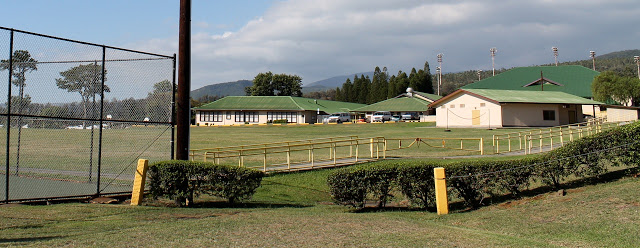
      Ka`u High and Pahala Elementary School’s major open space is already scheduled for added construction – these buildings for public use, with public money. An $18 million gymnasium to be managed by the county Department of Parks & Recreation and by the schools, and also to serve as a regional disaster shelter, is funded, with permitting nearly signed. The site is fenced, and construction is expected to be completed in the next several years.
      The Star-Advertiser story says that “Gov. Neil Abercrombie has called for schools to be modernized in his ‘New Day’ agenda, and the concept is being driven by many of his key allies, including William Kaneho, his campaign manager and an attorney who leads the Hawai`i Institute for Public Affairs.” Kaneho was also the registered lobbyist hired by `Aina Koa Pono during its 2011 attempt to gain support from the Legislature and permission from the Public Utilities Commission to approve the contract that would help with financing for a diesel refinery it would build off Wood Valley Road above Pahala.
      See more on the development of school lands issue at www.staradvertiser.com.

Robbie Alm
LIQUID NATURAL GAS, imported from the mainland, could cut electricity bills and reduce dependence on foreign oil, according to a proposal from the electric utilities to the Public Utilities Commission. A story in Civil Beat by Sophie Cocke quotes Hawai`i Electric Co. vice president Robbie Alm, the spokesperson for the utility who made a presentation Thursday at the Hawai`i Energy Policy Forum. Alm said that LNG burns cleaner than oil and could save the utilities on O`ahu, Maui and the Big Island up to $1 billion that would otherwise have to be spent upgrading its power plants to meet new Environmental Protection Agency regulations on oil-fired generators. Without switching to LNG, the cost of upgrading old power plants would be passed along to customers, he told attendees of the forum. See more at www.civilbeat.com.

HERE IS MORE ON THE PUBLIC UTILITIES COMMISSION’S publication of responses to questions asked by Life of the Land regarding the `Aina Koa Pono proposal to sell, at a fixed, undisclosed price for 20 years, 16 million gallons of diesel per year to be made in a refinery off Wood Valley Road above Pahala. Diesel would be extracted from biomass in 27 microwave units and sold to Hawai`i Electric Light and Hawaiian Electric Companies, most of it trucked to the power plant near Kona airport. The proposal calls for higher electric bills on O`ahu and the Big Island.
      Life of the Land compared the current `Aina Koa Pono proposal (AKP2) that offers the diesel at a lower price and the `Aina Koa Pono proposal (AKP1) rejected by the PUC in Sept. 2011: “The ratepayer impact for AKP2 over AKP1 appears to be around $100 million over 20 years.” Life of the Land asked, “Is this very roughly correct, that is, is it in the right ballpark? The electric companies said, “The ratepayer impact assumption … is close; it is approximately $124 million less for AKP2 compared to AKP1 over the 20-year term.”
      Life of the Land asked how this reduction was achieved. “That is, was it pulled out of the air by HECO or AKP, was it the result of savings in some input, was it the ability to get financing at a lower rate?” The utilities said the reduction is “primarily due to the AKP2 biodiesel price reduction over the AKP1 biodiesel price.” The utilities referred Life of the Land to Exhibit A of the application, which it said contains a section regarding contract and price negotiations that discusses the reasons AKP was able to offer a lower biodiesel price, but that exhibit is confidential and only available to the PUC and other parties and participants in the docket. It is not available to utility customers or the general public.
      Life of the Land also asked if pricing could go lower and still make the contract viable. “AKP is in early phases of the project development and, with the AKP Biodiesel Supply
      Contract’s fixed biodiesel price structure, AKP is taking a degree of risk on the economic viability of the project,” contended the utilities. “During AKP2 negotiations, AKP asserted that they could not further reduce the price and maintain the viability of the project.”
      Life of the Land asked what added due diligence the HECO Companies engaged in when they realized that AKP was willing to “shave such a large amount off the AKP1 contract costs? That is, did HECO come to the conclusion that perhaps the first contract was overpriced, and therefore did HECO set out to conduct further due diligence and analysis on the pricing?” The electric companies replied that they set out to renegotiate with AKP after the Commission did not approve AKP1, and a discussion of the AKP2 negotiations is in the confidential Exhibit A.
      When Life of the Land asked if publicly revealing the prices offered by each respondent to the biofuel RFP could put added pressure on individual companies to compete against each other and drive the cost down, the utilities said that publicly revealing fuel contract prices may or may not work in favor of negotiating lower fuel prices.
      “How can the Commission feel confident about biofuel pricing when the AKP1 and AKP2 pricing data are so far apart?” asked Life of the Land. The electric companies said they “believe the AKP2 biodiesel price is reasonable for the reasons set forth in their Application.”
      Complete responses to the Life of the Land’s questions, as well as other documents regarding the proposed contract, are online at puc.hawaii.gov. Docket number is 2012-0185.

Kai Ho`opi`i performs Wednesday evening.
KAI HO`OPI`I PRESENTS An Evening of Hawaiian Music Wednesday at 6:30 p.m. at Kilauea Visitor Center in Hawai`i Volcanoes National Park. Ho`opi`i, an Aloha Festivals Hawaiian falsetto contest winner, shares music of his `ohana from Kahakuloa, Maui. The free concert is part of Hawai`i Volcanoes’ ongoing Na Leo Manu, Heavenly Voices, presentations. Park entrance fees apply. 

VALENTINE VARIETY SHOW AUDITIONS are Thursday, Jan. 17 at 4 p.m. and Saturday, Jan. 19 at 10 a.m. Open to all ages and talents, and all applicants and performers must be able to make one of the scheduled auditions, one mandatory dress rehearsal on Feb. 7 and 8 and show times, which will be either Feb 9 and 16 or Feb. 10 and 17. Acts for the show to be held at Volcano Art Center’s Ni`aulani Campus in Volcano Village should be no longer than five minutes. Acts can be music, dance, drama, comedy, magic, juggling, acrobatics or any other form of entertainment. Solo and group acts encouraged. $15 application fee per act waived for VAC members. For an application or more information, email julie@volcanoartcenter.org.

SUPPORT OUR SPONSORS AT PAHALAPLANTATIONCOTTAGES.COM AND KAUCOFFEEMILL.COM. KA`U COFFEE MILL IS OPEN SEVEN DAYS A WEEK.

Saturday, January 12, 2013

Ka`u News Briefs Jan. 12, 2013

Ka`u Coffee Festival organizers have released a schedule of events for the April 27 - May 5 event. Local band Hands of Time played at last year's ho`olaule`a. Photo by Julia Neal
COFFEE BERRY BORER REDUCTION and prevention will be the topic of a Ka`u Farm Bureau meeting this Monday, Jan. 14 at Pahala Community Center beginning at 5 p.m. Pepe Miranda, of Synergistic Hawai`i Agriculture Council, will give the presentation. Farm Bureau president Chris Manfredi said that all coffee farmers should attend, whether or not they have CBB. Refreshments will be served.
Ka`u Farm Bureau discusses coffee berry borer reduction
and prevention Monday at Pahala Community Center.
      Manfredi said that the Ka`u Coffee industry has been a good example of farmers working together to hold back the pest that has impacted many farms. Any questions, call 929-9550. The meeting is co-sponsored by the College of Tropical Agriculture & Human Resources.
      The presentation will be followed by a Ka`u Farm Bureau directors meeting.

KA`U COFFEE FESTIVAL ORGANIZERS have announced a week of activities for the April 27 to May 5 annual event. The organizing committee has made the following release:
      The Ka`u Coffee Festival perks with java-jumping fun starting April 27 and culminating the weekend of May 4-5 with a ho`olaule`a on Saturday and coffee education on Sunday. Serving as an economic stimulus for the rural Ka`u region, the festival is supported by the County of Hawai`i Department of Research & Development, Hawai`i Tourism Authority and Hawai`i Department of Agriculture.
      On Saturday evening, April 27, enjoy foodie fun at Simply Elegant: 2nd Annual Ka`u Farmers’ Table at The Inn at Kalaekilohana. The limited seating Table features locally sourced gastronomy with live entertainment. Advance only tickets are $75 at www.kau-hawaii.com.
      On Sunday afternoon, April 28, the Triple C Recipe Contest returns to Ka`u Coffee Mill with competition in cookies, candies and crackers, all made with Ka`u Coffee. Attendance and coffee tasting are free. Find contest entry info at kaucoffeemill.com.
      During the week, visit Ka`u Coffee farms. Enjoy the beauty of Ka`u, Punalu`u Black Sand Beach, Honu`apo fishponds, the cliffs of Ka Lae - the southernmost place in the U.S., and nearby Hawai`i Volcanoes National Park. Stay in one of the many accommodations in Ka`u. See participating coffee farms and accommodations at www.kaucoffeefest.com.
A Ka`u Mountain Water System Hike takes
place Wednesday, May 1.
      On Wednesday, May 1, explore flume systems of the sugarcane era and development of hydroelectric power on a Ka`u Mountain Water System Hike. Fee. Limited to 30 with lunch provided. Visit www.kaucoffeemill.com or phone 808-928-0550.
      On Friday, May 3, enjoy Coffee & Cattle Day at Aikane Plantation Coffee farm, where descendants of the first coffee farmer in Ka`u explain how coffee is integrated into other agriculture. Fee. Lunch included. Visit www.aikaneplantation.com or phone 927-2252.
      On Friday, May 3, observe the heavens from the summit of Makanau at Ka`u Star Gazing, 7:30-10 p.m. Fee. To sign up, see www.kaucoffeemill.com or call 928-0550.
      On Saturday, May 4, enjoy the Ka`u Coffee Festival Ho`olaule`a, with a full day of music, hula, food, local crafts, coffee tastings and farm tours at the Pahala Community Center. Festival entry is free; Ka`u Coffee Experience coffee tasting $5; farm tours $20. Call 929-9550 or visit www.kaucoffeefest.com.
      On Sunday, May 5, learn about the coffee industry at the Ka`u Coffee College at Pahala Community Center. Free, donations appreciated. Call 929-9550 or visit www.kaucoffeefest.com
      Founded in a coffee tradition hailing to the 1800s—plus the hard work of sugar employees who lost their jobs in 1996—Ka`u Coffee burst onto the specialty coffee scene by winning numerous awards. These accolades highlight the unique combination of people and place that makes Ka`u Coffee a favorite across the globe. The festival’s mission is to raise awareness of Ka`u as a world-class, coffee-growing origin.
      Ka`u Coffee Festival vendor and sponsorship opportunities are available. For more information and festival updates, visit kaucoffeefest.com, follow the Ka`u Coffee Festival on Facebook and Twitter or call 929-9550.

HERE IS MORE ON THE PUBLIC UTILITIES COMMISSION’S publication of responses to questions asked by Life of the Land regarding the `Aina Koa Pono proposal to sell, at a fixed price for 20 years, 16 million gallons of diesel per year to be made in a refinery off Wood Valley Road above Pahala. Diesel would be extracted from biomass in 27 microwave units and sold to Hawai`i Electric Light and Hawaiian Electric Companies, most of it trucked to the power plant near Kona airport. The proposal calls for higher electric bills on O`ahu and the Big Island.
      Regarding the contention that “there are a number of advanced biofuel technologies that have proven viable in lab and pilot scales at various locations around the world; most are seeking feedstock and sufficient financing to advance to commercialization,” Life of the Land asked, “Isn’t this also true of OTEC, Ocean Wave Energy and Utility-Scale Batteries which are all seeking sufficient financing to advance to commercialization?" HELCO and HECO responded that their renewable energy program includes “a broad portfolio of resources, including technologies that are very mature such as waste to energy and wind power, as well as technologies that hold significant promise to contribute substantially to Hawai`i’s clean energy goals. Examples of the latter category include ocean thermal energy conversion and wave power energy. Hawaiian Electric has maintained this broad procurement approach consistently over the years, and is actively in power purchase contract discussions with developers of these various technologies.”
      Life of the Land asked, “Why is it in the public interest for ratepayers to finance one possible solution, that is, why should ratepayers bear the burden of assuming which technology will emerge as the more dominant player of the future?” The utilities said the Consumer Advocate and Hawai`i County asked a similar question. They told the Consumer Advocate, “There is no risk to HELCO’s customers of paying for anything outside of the price per gallon of the biodiesel delivered in accordance with the contract’s fuel specification. HELCO is not providing any financial assurances to AKP other than the obligation to purchase fourteen to sixteen million gallons of biodiesel per year under the twenty-year AKP Biodiesel Supply Contract at the agreed price per gallon. There is no cost that will be passed on to the companies’ customers if the AKP project development fails to produce biodiesel.”
TekGar president and CEO Michael Catto extracts biofuel from the
company's Micro Dee processor. Images from tekgar.com
      “The Hawaiian Electric Companies continue to pursue a range of solutions to increase
renewable energy and energy security,” they told Hawai`i County. “The AKP Biodiesel Supply Contract is one approach to provide a solution that displaces fossil fuel with renewable biofuel and enables the production of firm power.”
      Life of the Land asked, “In HECO’s due diligence analysis of AKP and of its principals, what expertise does the AKP company/principals have in agriculture, biofuels, utility contracts and greenhouse gas analysis?” The utilities contended that “AKP’s team includes an agronomist with international experience as well as individuals with vast experience in agriculture on the Island of Hawai`i and specifically in Ka`u.” The utilities also stated that “AKP also is working closely with the Hawai`i Agricultural Research Center as it tests and develops its agriculture plan. AKP’s partners, AECOM (AKP’s engineering, procurement and construction firm), and Mansfield Oil, are both leaders in their respective fields, the utilities stated AECOM has experience in analyzing and developing biofuel projects. Mansfield Oil is an industry leader in the marketing and transportation of fuel. AKP’s legal team, as well as Mansfield Oil, investment banks and other attorneys, all have extensive expertise involving biofuel contracts and working with AKP specifically. AECOM conducts greenhouse gas analyses in their normal course of business. According to AKP, AECOM has currently spent in excess of $1 million dollars testing AKP’s technology.”
Michael Catto displays a jar of biofuel created by TekGar's microwave
depolymerization process.
      Regarding microwave depolymerization technology that AKP intends to use in the refining process, Life of the Land asked if HECO believes that AECOM has found the TekGar pre-commercial technology for Renewable Liquid Fuel production to be the optimal solution. The utilities replied, “It is the Companies’ understanding that the test facility in North Carolina is providing positive results thus far. Because AECOM intends to provide AKP with a performance guarantee for the Micro Dee technology, the Companies feel confident that the AKP project will continue to move forward. It is also important to keep in mind that the Companies will not receive nor pay for any biodiesel that does not meet the specification …. Thus, there would be no impact to the Companies’ customers.”
      HELCO and HECO also replied that “AECOM is in the process of analyzing and testing all aspects of the technology to determine if the technology meets the required criteria. Without this guarantee, AKP will be unable to secure financing for the project. Financing for AKP’s project is dependent upon the guarantee mentioned above by AECOM and also the Commission approval of the AKP Biodiesel Supply Contract.”

What's Happening in Halema`uma`u Crater is the topic at Tuesday's
After Dark in the park. Photo from USGS/HVO
HAWAIIAN VOLCANO OBSERVATORY continues its Volcano Awareness Month programs Tuesday at After Dark in the Park. HVO geologist Matt Patrick presents an overview of Kilauea’s summit eruption, including a survey of the volcanic processes occurring within the vent. The program at Kilauea Visitor Center in Hawai`i Volcanoes National Park begins at 7 p.m. It is free, and park entrance fees apply. 

SUPPORT OUR SPONSORS AT PAHALAPLANTATIONCOTTAGES.COM AND KAUCOFFEEMILL.COM. KA`U COFFEE MILL IS OPEN SEVEN DAYS A WEEK.