About The Kaʻū Calendar

Saturday, February 23, 2013

Ka`u News Briefs Feb. 23, 2013

Trail maintenance and the fight against invasive species in Hawai`i Volcanoes National Park could suffer with sequestration.
Photo from National Park Service
HAWAI`I VOLCANOES NATIONAL PARK, with most of its land in Ka`u, is ready for the possibility of sequestration. The park is prepared to cut five percent of the $7.3 million it receives from Congress through the Operation of the National Park Service annual budget, said Superintendent Cindy Orlando.
      The budget cut would go into effect unless Congress comes to an agreement on the entire federal budget by March 1. The sequestration cuts the budget of all federal agencies.
      Orlando said that if sequestration takes place, “We won’t be doing as much preventive maintenance. We will have lower levels of trail maintenance, lower levels of invasive species control. There will also be reduction in our school and educational programs.” A half dozen permanent fulltime jobs will go unfilled for now, she said.
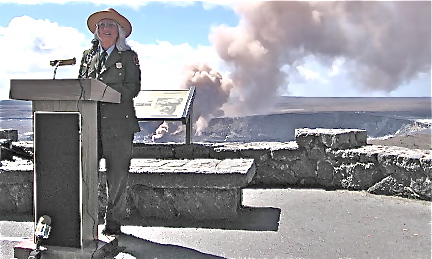
HVNP superintendent Cindy Orlando said the park will remain open 24/7,
and her goal is to protect jobs of full time employees and to keep
visitors safe. Photo by Julia Neal
      The superintendent said the goal, should sequestration happen, will be “to protect our fulltime employees and to protect the public visiting the park.”
      Getting ready for the sequestration is a “planning exercise, and we hope it won’t happen,” Orlando said. The overall budget for Hawai`i Volcanoes National Park is about $15 million. In addition to congressional funding, there are grants, the park competes for projects, and there are other programs from which there is income.
      With sequestration, the park may have to delay buying some supplies and equipment. However, “a good percentage of all of our budget is personal service – salaries,” she said. “We are prepared to protect them.”
      Over time, however, the park would not be able to sustain the cuts, said Orlando. The park needs to hire an electrician, journeyman carpenter and other skilled people to maintain the buildings and trails, she said.
      She noted, however, that the park is open 24/7 and that budget cuts in recent years have helped prepare the staff for any additional belt tightening.

Sen. Mazie Hirono
KA`U’S U.S. SENATOR MAZIE HIRONO recently wrote about the looming sequestration and called for preserving many educational, health, welfare and economic development programs as well as defense spending. 
      She praised Pres. Barack Obama’s efforts to avert sequestration. She said the President “laid out a strong and compelling course for Hawai`i and our country. He was right to focus on the economy and jobs. Our economy is still trying to recover from a deep recession, and we should do everything we can to create sustainable economic growth. In the near term, that means averting sequestration – the indiscriminate, across-the-board cuts that are projected to cost Hawai`i some 11,000 jobs. “Averting these cuts before March 1 is not just an economic necessity; it’s a matter of national security.”
      Hirono said that “top military officers warned my colleagues on the Senate Armed Services Committee and me that these cuts would impact the military’s readiness everywhere, including in the increasingly important Asia-Pacific region.


      “I applaud the far-sighted plan the President laid out for broad-based economic growth that creates dependable jobs and expands opportunities for everyone, not just those at the very top of society.
      She said that Obama’s effort in expanding access to early childhood education “is one of the smartest things we can do as a nation to ensure our economic future. Study after study has shown that early childhood education leads to increased educational achievement and employability later in life. Business leaders, economists, and educators all agree investing in early childhood education is one of the easiest ways to ensure we have a workforce that can compete on the international stage.” Head Start and Early Head Start could be cut if sequestration happens.

REGARDING THE `AINA KOA PONO proposal, the Public Utilities Commission on Tuesday published responses to more questions asked by the state Consumer Advocate, Hawai`i County and Life of the Land. The questions concern the proposed contract for `Aina Koa Pono to annually sell, at a fixed price for 20 years, 16 million gallons of diesel that would be manufactured at a refinery off Wood Valley Road above Pahala. The fuel, produced in 27 microwave units, would be sold to Hawai`i Electric Light and Hawaiian Electric Companies, with most of it trucked up Hwy 11 to a power plant in Kona. Electric rates on O`ahu and the Big Island would increase.
      County of Hawai`i asked about the use of biofuels for transportation, which it calls a “higher-value use.” “It seems the electricity sector is being used to start a biofuels industry that will ultimately benefit a biofuels industry for transportation,” the county said. “Therefore, a real likelihood exists that if this contract is authorized, Hawai`i electric ratepayers could be helping to subsidize a biofuels transportation industry. Why are long-term contracts not being done in the transportation sector?” the county asks. “Why is the electric ratepayer subsidizing a lower-value use? Should the higher-value use of a transportation fuels and the associated biofuels industry stand on its own?”
      The utilities replied that “the Companies are not in a position to speculate on why long-term contracts are not being done in the transportation sector or whether the biofuel use in the transportation sector should stand on its own, and issues related to these topics are beyond the scope of the subject proceeding. Further, the Companies also respectfully disagree with the characterization of the use of biodiesel by the utilities as a lower-value use. As explained in the Application and in response to County of Hawai`i’s Supplemental Information Request 13, the use of biofuels is a critical component of the Hawaiian Electric Companies’ strategy to actively seek and incorporate a diverse portfolio of new renewable energy resources (as opposed to a single sector) including wind, solar power, hydro, geothermal, biomass, biofuels, and other types of renewable generation that may emerge and become commercially viable several years down the road (e.g., wave energy, ocean thermal energy). Biofuels are an element of this strategy as biofuels can be used to generate energy from existing conventional generating units which provide essential grid services including load following, frequency response, voltage control and on-line operating and spinning reserves. Moreover, utilizing biofuel in existing generating units is expected to achieve cleaner air emissions and facilitate compliance with new and revised environmental regulations. Increasing the use of biofuels in existing power plants will help the Hawaiian Electric Companies meet the Renewable Portfolio Standard requirements.”
      Ka`u News Briefs will cover more responses in the coming days.
      Complete responses to all questions are online at puc.hawaii.gov. Docket number is 2012-0185.

THE SEVENTH ANNUAL SPAGHETTI DINNER raising funds for Ka`u Hospital’s emergency room takes place today beginning at 4 p.m. at Na`alehu Community Center. The event is sponsored every February by Red Hat Ladies of Ka`u and Ka Lae Quilters. Contributions are welcome. For more information, call Barbara Beatty at 929-9072.

SEN. RUSSELL RUDERMAN holds a talk story at Pahala Plantation House Tuesday, Feb. 26 from 5 p.m. to 6:30 p.m. Ruderman meets with constituents to discuss issues before the state Legislature. Light refreshments will be served. For more information, call 974-4000, ext. 66890.

AT AFTER DARK IN THE PARK on Tuesday, Toni Parras, communications manager for Papahanaumokuakea Marine National Monument, presents an overview of Hawai`i’s newest UNESCO World Heritage Site. The monument has been called a global treasure, rainforest of the sea, the last best place on earth, and it is a place of great cultural significance to Hawaiian people. The program, which covers the people, the partnerships and the promise for the monument, begins at 7 p.m.
 at Kilauea Visitor Center Auditorium in Hawai`i Volcanoes National Park.
      A short film about Midway Island in the western portion of the monument can be seen at midwayfilm.com.

SUPPORT OUR SPONSORS AT PAHALAPLANTATIONCOTTAGES.COM AND KAUCOFFEEMILL.COM. KA`U COFFEE MILL IS OPEN SEVEN DAYS A WEEK.

Friday, February 22, 2013

Ka`u News Briefs Feb. 22, 2013

Farmers who want to the sell products to the public can sign up for a workshop entitled Food Business Basics: Getting Started and Finding Your Niche in the Specialty Foods Business that will be offered at Pahala Community Center in March by The Kohala Center and The Laulima Center.
MORE TRANSPARENCY IN CONTRACTS SIGNED BY THE ELECTRIC COMPANIES would be available to the state Public Utilities Commission if state House of Representatives Bill 813 passes the 2013 Hawai`i Legislature. The bill goes to public hearing on Monday, Feb. 25 at the State Capitol.
      Life of the Land’s executive director Henry Curtis sent out an email entitled: Are Ratepayers Being Ripped Off? Key Legislative Bill Needs Your Support. He wrote that the electric company signs “contracts with `Aina Koa Pono, Pattern Energy, PGV or First Wind. The utility asks the Public Utilities Commission to approve the contract.
      “The renewable energy companies are not parties to the PUC proceedings and could be getting windfall profits at ratepayer expense.
      “HB813 would allow the PUC to review their financial records.”
      Citizens can send in testimony by going to http://www.capitol.hawaii.gov/measure_indiv.aspx?billtype=HB&billnumber=813&year=2013. Click on submit testimony at the top of the page.
Henry Curtis of Life of the Land
      The bill says that the PUC “shall have the authority to examine all documents, ledgers, records, projections, contracts, or any other information and data pertaining to the development, financing, taxation, construction, or operations and maintenance of a project in any power purchase agreement that has been submitted to the commission for review or approval, as the commission deems necessary, including the information and data of any third-party electricity producer seeking to sell electricity to a public utility as defined within section 269-1; provided that this section shall be effective to the extent it is not inconsistent with applicable federal law. The commission shall maintain the confidentiality of all information submitted under confidential seal and provided in accordance with this section."
      The justification section of the proposed legislation says: “Electricity in Hawai`i is supplied increasingly by non-utility power generators that use a variety of both fossil fuel and renewable energy resources. Electric utilities acquire third-party supplied energy via power purchase agreements that establish a final price for energy supplied throughout the entire contract term, which typically lasts for twenty years. Negotiated prices in purchased power agreements are reviewed by the Public UItilities Commission, though the independent power producers’ underlying cost data and associated assumptions are not typically disclosed to the commission.
     “Complete access to underlying renewable energy project cost information, including cost support information and associated materials, would allow the commission to better determine the reasonableness of proposed prices in the context of the local energy market, independently track trends in renewable energy project development and more readily compare independent power producers’ projects. More specific, detailed contract information can fundamentally shift the way renewable energy project costs are currently set so that they move more closely in line with the actual costs of energy production and are free of the influence of volatile fuel oil prices. In addition, more open and clear contract pricing information could potentially improve the financing environment for non-utility energy developers, thus benefiting the entire state through lower renewable energy project financing costs.
     “The purpose of this Act is to authorize the Public Utilities Commission to examine all records, projections, business documents, and other necessary information relating to the review by the commission of power purchase agreements for the sale of electricity to a public utility.”

CONCERNING THE `AINA KOA PONO proposal, the Public Utilities Commission on Tuesday published responses to more questions asked by the state Consumer Advocate, Hawai`i County and Life of the Land. The questions concern the proposed contract for `Aina Koa Pono to annually sell, at a fixed price for 20 years, 16 million gallons of diesel that would be manufactured at a refinery off Wood Valley Road above Pahala. The fuel, produced in 27 microwave units, would be sold to Hawai`i Electric Light and Hawaiian Electric Companies, with most of it trucked up Hwy 11 to a power plant in Kona. Electric rates on O`ahu and the Big Island would increase.
      Hawai`i County asked HELCO and HECO to list the financiers AKP has had discussion with this project. “At the previous and current dollar per gallon annual escalation figures, please provide copies of any and all pro-forma statements provided to possible financiers,” the county asked. “Please provide all past and present AKP pro-forma statements that are being provided to any potential investor. Please provide the amount of projected financial return and how AKP, investors, SBS/TekGar, Biocon, AECOM and other partners (listed by AKP) will be compensated from this proposed contract.”
      The utilities replied that, “according to AKP, the financial information requested by this information request is confidential and proprietary and if disclosed would risk AKP’s ability to obtain financing of the project. In addition, AKP objects to answering this information request as it is beyond the scope of County of Hawai`i’s permitted participation in this Docket. AKP asserts that Issue No. 1 and the sub-issues refer to factors that the Commission should consider in evaluating the AKP Biodiesel Supply Contract, but not an evaluation by County of Hawai`i of AKP’s underlying financing or other terms. AKP is not willing to provide this information even under protective order.
      “Without waiving these objections, AKP has stated that it has had numerous discussions with potential financiers. These include discussions with major investment banks and private equity firms who specialize in renewable energy and biofuels. AKP will continue these discussions in order to raise capital for both the initial 33-ton per day unit and the larger 900-ton per day plant.”
      Ka`u News Briefs will cover more responses in the coming days.
      Complete responses to all questions are online at puc.hawaii.gov. Docket number is 2012-0185.

Lou Cooperhouse
FARMERS WHO WANT TO SELL A PRODUCT to the public can learn from value-added and specialty foods consultant Lou Cooperhouse when he presents Food Business Basics: Getting Started and Finding Your Niche in the Specialty Foods Business. The workshop to be held at Pahala Community Center on Wednesday, March 13 from 9 a.m. to 3 p.m. is designed for farmers seeking to develop their raw product into a value-added product and bring it to market, entrepreneurs and restaurateurs interested in diversifying their revenue streams with specialty food products, and established producers looking to take their food businesses to the next level. 
      According to The Kohala Center, which is sponsoring the workshop, the Food Industry offers many exciting opportunities, and this workshop will provide attendees with critical assistance to develop, build or evolve their businesses. Topics include Understanding the Food Marketplace and Channels of Distribution; Top Trends Affecting Our Food Industry and their Impact on New Product Innovation; Identifying Your Target Consumer; Developing Your Product Niche and Creating Your
Unique Selling Proposition; The Strategic Planning Process and Your Business Plan; Local, State and Federal Food Regulations and Food Inspection Requirements; Food Processing Options and What to Look for in Getting Your Product Produced; Food Safety Technologies from Farm to Fork that will Enhance Quality and Safety; The Product Development Process: Scaling Up from Concept to Commercialization; and Funding Options and What Banks and Investors Will Want to Know.
      Following lunch (included with pre-registration), Nicole Milne, Agricultural Business Development specialist for The Laulima Center, will present two one-hour trainings. One is on Financial Resources Available for Hawai`i Farmers. The other is Marketing Agricultural Products on Hawai`i Island.
      In addition, Cooperhouse will also conduct 30-minute one-on-one consulting sessions each afternoon with pre-selected workshop participants. Registrants interested in the one-on-one consultations must complete and submit a brief application.
      For more information and to register, visit http://laulimacenter.org/foodbasics.html or call 443-2755.

THE SEVENTH ANNUAL SPAGHETTI DINNER raising funds for Ka`u Hospital’s emergency room takes place tomorrow beginning at 4 p.m. at Na`alehu Community Center. The event is sponsored every February by Red Hat Ladies of Ka`u and Ka Lae Quilters. Contributions are welcome. For more information, call Barbara Beatty at 929-9072. 

SEN. RUSSELL RUDERMAN holds a talk story at Pahala Plantation House Tuesday, Feb. 26 from 5 p.m. to 6:30 p.m. Ruderman meets with constituents to discuss issues before the state Legislature. Light refreshments will be served. For more information, call 974-4000, ext. 66890.

KA `OHANA O HONU`APO hosts its first 2013 family event at Honu`apo on Sunday, March 10 from 1 p.m. to 4 p.m. Titled Tutu & Keiki, it will showcase two hosts: Tutu & Me Traveling Preschool and Hawaiian Civic Club of Ka`u.
      “We’re excited to share what we do,” including learning activities and educating caregivers, said Tutu & Me administrator Betty Clark. Zachary DeBernardi, Civic Club chair of Na Mea Hawai`i Committee, said members will demonstrate and conduct five makahiki games - konane, hu, pala`ie, ulumaika, and moapahe`e. Prizes will go to keiki who participate.
      Refreshments and drinks will be available for sale along with handmade items from Ka`u kupuna. Call Ka `Ohana’s executive director Lehua Lopez at 929-9891 for more information.

IN SPORTS TOMORROW, Ka`u High’s tennis teams travel to Kea`au, and a judo tournament takes place in Hilo.

SUPPORT OUR SPONSORS AT PAHALAPLANTATIONCOTTAGES.COM AND KAUCOFFEEMILL.COM. KA`U COFFEE MILL IS OPEN SEVEN DAYS A WEEK. 

Thursday, February 21, 2013

Ka`u News Briefs Feb. 21, 2013

In a document published by the Public Utilities Commission Tuesday, Hawai`i County asks HELCO and HECO for more information about feedstocks `Aina Koa Pono plans to use to create biofuel at a refinery above Pahala.
Photo from ainakoapono.com
POLICE HAVE NABBED A SUSPECT in the recent series of Ka`u Coffee thefts. According to various coffee farmers, police visited coffee mills in Kona and found a receipt showing sales of Ka`u Coffee to the Kona mill by a person unrelated to a coffee farm. Mills are required to show receipts to confirm the source of their coffee under Hawai`i law. Such receipts or other documents are also required of people transporting coffee from place to place around the island. The cooperation of the mills and those selling coffee to retailers and at farmers markets will help cut down the thievery, said County Prosecuting Attorney Mitch Roth. Roth met with farmers and ranchers earlier this month following a string of thefts from coffee fields and coffee mills in Ka`u. The suspect has a criminal history with jail time and is suspected of having several accomplices still at large.
      In multiple incidents, thousands of pounds of coffee were stolen from Ka`u Coffee Mill on Wood Valley Road – from the drying pad. Thousands of pounds of coffee were also stolen from Aikane Plantation Coffee Co. on the old cane haul road between Pahala and Na`alehu.
      Farmers, including international coffee award winner Lorie Obra, said that coffee was stripped from the trees on her farm.
      With the coffee berry borer heavily damaging Kona coffee orchards, thieves have been stealing from Ka`u to sell to Kona, not only causing grief and economic damage to Ka`u coffee farmers but also tainting the branding when Ka`u Coffee is sold as Kona.
      Suggestions for dealing with the thieves have included increased security at all coffee farms and mills, dying the parchment with food dye to make it easy for buyers to recognize the origin, and heavier policing of wholesale and retail buying to prove coffee origins.
      Anyone with tips on coffee thieving can call Crimestoppers at 329-8181 or 961-8300.

Howard Dicus of Hawai`i News Now
TOURISM TO THE BIG ISLAND is soaring. According to Hawai`i News Now reporter Howard Dicus, the count is up 10.1 percent so far in February. Statewide, it has increased by more than 48,000 visitors, reaching a half million tourists in February.
      Dicus reports that tourism to the Big Island increased 8.2 percent this month over the same period as last year. Japanese visitors statewide increased 15.7 percent over the same period as last year.
      Earlier this month, Hawai`i Tourism Authority predicted that the total airline seat capacity in Hawai`i is expected to increase 6.8 percent in 2013 over last year. Double-digit growth is expected out of the U.S. East, Japan, Other Asia (South Korea, China and Taiwan) and Oceania (Australia and New Zealand) regions.
      Contributing to the growth will be additional new routes from the U.S. and Asia-Pacific regions to the Hawaiian Islands from Boise, Spokane, San Diego, Taiwan, New Zealand and Tokyo-Narita commencing in the first half of the year.
      “The success of our visitor industry has a direct correlation with the increased airlift, and we are committed to ensuring that we maintain a strong inventory of air seats to support our industry and our state’s economy,” said Mike McCartney, president and CEO of HTA. “Hawai`i lost 1.5 million air seats within two years following the closure of Aloha and ATA airlines and the economic downturn. Through our efforts and collaboration with our industry partners, it has taken us more than three years to gain back more than two million air seats to our state,” said McCartney.

Sen. Brian Schatz
HAWAI`I’S U.S. CONGRESSIONAL DELEGATION is back home during a recess, meeting with constituents and talking about the pending sequestration, which would cut $85 billion in federal spending across the board nationwide, if a compromise is not reached by March 1. 
      According to Sen. Brian Schatz, who said he would prefer that Congress kept working on the problem rather than take its current recess, sequestration could mean that 80 percent of all Department of Defense employees in the country could be furloughed starting in April, having a devastating impact on the Hawai`i economy.
      Said Shatz, sequestration “was designed not to happen…. It was supposed to be so awful for Republicans and Democrats and for the people of America that we would be forced to compromise, and that is what we’ve got to do…. It is avoidable, and it is unacceptable.” The new senator said, “We only have a little bit of time.” He called for a balanced approach with deficit reduction of $2 trillion through cutting some Department of Defense funding and domestic spending and through increased revenues through closing tax loopholes.
      “If we don’t do it, there will be severe consequences for real people,” said Schatz.

CONCERNING THE `AINA KOA PONO proposal, the Public Utilities Commission on Tuesday published responses to more questions asked by the state Consumer Advocate, Hawai`i County and Life of the Land. The questions concern the proposed contract for `Aina Koa Pono to annually sell, at a fixed price for 20 years, 16 million gallons of diesel that would be manufactured at a refinery off Wood Valley Road above Pahala. The fuel, produced in 27 microwave units, would be sold to Hawai`i Electric Light and Hawaiian Electric Companies, with most of it trucked up Hwy 11 to a power plant in Kona. Electric rates on O`ahu and the Big Island would increase.
      Hawai`i County asked about feedstocks that would be grown to create biofuel. “Please identify the specific feedstock(s) that AKP proposes to grow on the Island of Hawai`i. Assuming it is a grass, has this grass previously been cultivated as a commercial crop on the island? If not, have trial plots been grown at all? If so, then please describe the size, location, soil characteristics, altitude, ground slope, and actual rainfall at these plots. If there is no prior commercial experience with this grass, please describe the program to introduce this grass and to determine its optimal agronomics—including anticipated amounts of fertilizer, potential disease and insect pressure and how this will be managed, response to differing soils/altitudes/slopes/rainfall amounts. (Note that multi-year projects have been undertaken on the mainland to subsidize farmers as they gain experience with a new crop— switchgrass —including a recently complete four year project... which, by the way, has left farmers at a loss whether to continue growing switchgrass). Has the AKP/MicroDee process been tested on that particular biomass/feedstock (as different kinds of biomass can give very different results)?
      HELCO and HECO replied that, “According to AKP, specific feedstocks proposed by AKP consist of varieties currently under testing within the varietal selections found at the U.S. Department of Agriculture’s Agricultural Research Service, Hawai`i Agricultural Research Center, University of Hawai`i and from among local Hawai`i grasses. One specific grass variety that is a lead contender as an AKP feedstock was distributed over twelve years ago by UH throughout the Hawaiian Islands as an agricultural wind block for commercial farmers. This particular grass has proven itself to be robust, vigorous, and healthy without added fertilizers or much attention. Other varieties have been put into commercial production trial plots; for example, several are currently under observation at Hawaiian Commercial and Sugar Company. Trial plots continue to be propagated, monitored, and new trials are currently under design. Although one of the energy grasses AKP is considering has only been used in Hawai`i as an agricultural windbreak, the same grass variety is in commercial use in other regions of the world.
      “The specific grasses under consideration will be tested once the 33-ton-per-day unit is operational. However, several other wood species have been tested in the MicroDee process with satisfactory results.
      “The technical science of the MicroDee process is blind to the species and types of biomass. The specific volatiles content of each specific feedstock determines the potential for synthetic oil extraction. Knowing the volatile capacity of each feedstock allows an ability to understand the feedstock’s yield.”
      Ka`u News Briefs will cover more responses in the coming days.
      Complete responses to all questions are online at puc.hawaii.gov. Docket number is 2012-0185.

Sen. Russell Ruderman
KA`U AG WATER COOPERATIVE DISTRICT meets today at 4 p.m. at Royal Hawaiian Orchards’ field office in Pahala. For more information, call Jeff McCall at 928-6456.

THE SEVENTH ANNUAL SPAGHETTI DINNER raising funds for Ka`u Hospital’s emergency room takes place Saturday beginning at 4 p.m. at Na`alehu Community Center. The event is sponsored every February by Red Hat Ladies of Ka`u and Ka Lae Quilters. Contributions are welcome. For more information, call Barbara Beatty at 929-9072.

SEN. RUSSELL RUDERMAN holds a talk story at Pahala Plantation House Tuesday, Feb. 26 from 5 p.m. to 6:30 p.m. Ruderman meets with constituents to discuss issues before the state Legislature. Light refreshments will be served. For more information, call 974-4000, ext. 66890.

SUPPORT OUR SPONSORS AT PAHALAPLANTATIONCOTTAGES.COM AND KAUCOFFEEMILL.COM. KA`U COFFEE MILL IS OPEN SEVEN DAYS A WEEK.