About The Kaʻū Calendar

Sunday, February 24, 2013

Ka`u News Briefs Feb. 24, 2013

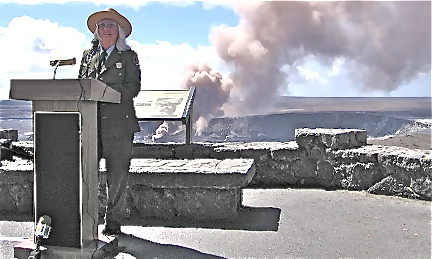
Papahanaumokuakea Marine National  Monument is the topic of this Tuesday's After Dark in the Park.
Photo by James Watt
OF THE 2,000 BILLS INTRODUCED to the 2013 Hawai`i State Legislature, the sugary beverage tax, which has failed in past sessions, is one of about 300 with the possibility of success this year. The bill would impose a fee on sugar-sweetened beverages. It would also establish the obesity and chronic disease prevention special fund and the Hawai`i interagency obesity prevention council to support obesity prevention programs. It would make an appropriation from the obesity and chronic disease prevention special fund to the state Department of Health. SB1085 passed second reading in the Senate Health Committee, chaired by Sen. Josh Green, who represents Ka`u. It also passed the Committee on Judiciary and Labor. The two no votes came from Republicans Sen. Mike Gabbard and Sen. Sam Slom. The measure is now before the Senate Ways and Means Committee.
      The language of the bill states that, “In Hawai`i, childhood obesity increased by 38 percent between 1999 and 2009, and adult obesity has more than doubled between 1996 and 2011. As a result of health risks and complications related to obesity, this generation of children may be the first generation not to outlive their parents.
A tax on sugary drinks would fund state obesity prevention and health
promotion programs. Image from nih.gov
      “Obesity-related medical expenditures in Hawai`i were calculated to be over $470 million in 2009 and are continuing to increase. Sugar-sweetened beverages have been identified by many scientific studies as a major contributor to the costly obesity epidemic.
      “A 2004 study found that sugared soft drinks are the single largest contributor of calorie intake in the United States.
      “According to nutritional standards, sugar-sweetened beverages such as non-diet soft drinks, energy drinks, sweet teas and sports drinks offer little or no nutritional value and contain massive quantities of added sugars and calories. For example, a twelve-ounce can of soda contains the equivalent of approximately eight to ten teaspoons of sugar.”
      The American Diabetes Association wrote, “If we do not do something about this growing epidemic, the quality of life and the economic cost to Hawai`i will be crippling.” The American Cancer Society Cancer Action Network and the Hawai`i Public Health Association support the bill.
      The Grocery Manufacturers Association, Hawai`i Bar Owners Association, and local soft drink manufacturers oppose the bill.
      The tax would be one cent per ounce and would increase the cost of an average soft drink by 17 percent. Gov. Neil Abercrombie’s testimony said the tax is “expected to reduce consumption by eight to 10 percent and maybe even higher on youth. If this bill passes, in 2014-15 we are hoping to raise $38 million in new revenue and will use these funds to support childhood and adult obesity prevention and health promotion programs,” wrote Abercrombie.
      Other supporters of the tax include The Queen’s Health System and numerous health organizations.
      Progress on this and other bills in the state Legislature can be tracked at capitol.hawaii.gov.

REGARDING THE `AINA KOA PONO proposal, the Public Utilities Commission on Tuesday published responses to more questions asked by the state Consumer Advocate, Hawai`i County and Life of the Land. The questions concern the proposed contract for `Aina Koa Pono to annually sell, at a fixed price for 20 years, 16 million gallons of diesel that would be manufactured at a refinery off Wood Valley Road above Pahala. The fuel, produced in 27 microwave units, would be sold to Hawai`i Electric Light and Hawaiian Electric Companies, with most of it trucked up Hwy 11 to a power plant in Kona. Electric bills on O`ahu and the Big Island would increase.
      County of Hawai`i asked the utilities to explain what it called “the rationale behind raising electricity prices to support a single new industry sector that may decrease the profitability of other sectors.”
      The county cited a Biofuels Study incorporated in the Final Report to the Legislature in Accordance with Act 203, Session Laws of Hawai`i, 2011, which, according to the county, states that “biorefineries produce a variety of products, including a variety of biofuels, enabling one or more of the products (such as fuel for electricity generation and/or fuel for the Department of Defense) to be supplied under long-term contracts at known prices.
      “This process has been identified by the industry as extremely important for success, and should be viewed as contributing to, rather than competing with, the success of other biofuel products. Having long-term contracts at high prices is attractive in any industry, but when electricity prices in Hawai`i are already the highest in the nation and eroding other industry-sector profits, there may be a net-negative effect to the economy from such contracts.
      HELCO and HECO replied, “As explained in the Application, the approval of the AKP Biodiesel Supply Contract is reasonable for, among other reasons, (1) the use of the biodiesel will help to meet State energy policy objectives and Hawaiian Electric’s, HELCO’s and Maui Electric Company, Limited’s mandated Renewable Portfolio Standards requirements; (2) the AKP Biodiesel Supply Contract provides a locally sourced fuel supply which will contribute to the State’s goal of greater energy security and energy self-sufficiency; (3) the fixed biodiesel price, with a nominal escalation provision, is reasonable and is projected to fall below the price of petroleum diesel during the term of the AKP Biodiesel Supply Contract; (4) use of the biodiesel in place of petroleum diesel will not result in any additional curtailment of existing as-available renewable resources or otherwise impede the consideration of additional renewable resources to HELCO’s system; and (5) the AKP Biodiesel Supply Contract is consistent with HELCO’s third major integrated resource plan.
      “HELCO is also aware that having its customers absorb the entire differential between the cost of the biofuel and the cost of the fossil fuel that the biofuel is replacing is unfair, especially given that the use of the biodiesel helps the Hawaiian Electric Companies, in total, meet the Renewable Portfolio Standards requirements. Therefore, the Companies are proposing the establishment of a Biofuel Surcharge Provision that will pass through the differential between the cost of the biofuel and the cost of the fossil fuel that the biofuel is replacing, in the event the cost of the biofuel is higher than the cost of the fossil fuel, over the customer base of the Companies, based on kilowatt-hour usage. Using the Biofuel Surcharge Provision, HELCO estimates that the impact to HELCO’s customers is relatively small, with the estimated overall bill impact (without MECO) for the Companies in the range of $0.84 to $ 1.00 per month (which is lower than the $1.55 to $ 1.86 per month from AKP1) for a residential bill of 500 to 600 kWh.
      “Finally, it is important to note that the Hawaiian Electric Companies’ strategy is to actively seek and incorporate a diverse portfolio of new renewable energy resources (as opposed to a single sector) including wind, solar power, hydro, geothermal, biomass, biofuels, and other types of renewable generation that may emerge and become commercially viable several years down the road (e.g., wave energy, ocean thermal energy). Along with adding new renewable energy resources, biofuels are a critical component of a “green” energy future for the Hawaiian Electric Companies because biofuels can be used to generate energy from existing conventional generating units which provide essential grid services including load following, frequency response, voltage control and on-line operating and spinning reserves. Moreover, utilizing biofuel in existing generating units is expected to achieve cleaner air emissions and facilitate compliance with new and revised environmental regulations. Increasing the use of biofuels in existing power plants will ensure that the Hawaiian Electric Companies meet the Renewable Portfolio Standards requirements.”
      Ka`u News Briefs will cover more responses in the coming days.
      Complete responses to all questions are online at puc.hawaii.gov. Docket number is 2012-0185.

Sen. Russell Ruderman
A TALK STORY WITH SEN. RUSSELL RUDERMAN takes place at Pahala Plantation House Tuesday from 5 p.m. to 6:30 p.m. Ruderman meets with constituents to discuss issues before the state Legislature. Light refreshments will be served. For more information, call 974-4000, ext. 66890. 

PAPAHANAUMOKUAKEA Marine National Monument is the topic at After Dark in the Park on Tuesday. Toni Parras, communications manager for the monument, presents an overview of Hawai`i’s newest UNESCO World Heritage Site. The program, which covers the people, the partnerships and the promise for the monument, begins at 7 p.m.
 at Kilauea Visitor Center Auditorium in Hawai`i Volcanoes National Park.

SUPPORT OUR SPONSORS AT PAHALAPLANTATIONCOTTAGES.COM AND KAUCOFFEEMILL.COM. KA`U COFFEE MILL IS OPEN SEVEN DAYS A WEEK.

Saturday, February 23, 2013

Ka`u News Briefs Feb. 23, 2013

Trail maintenance and the fight against invasive species in Hawai`i Volcanoes National Park could suffer with sequestration.
Photo from National Park Service
HAWAI`I VOLCANOES NATIONAL PARK, with most of its land in Ka`u, is ready for the possibility of sequestration. The park is prepared to cut five percent of the $7.3 million it receives from Congress through the Operation of the National Park Service annual budget, said Superintendent Cindy Orlando.
      The budget cut would go into effect unless Congress comes to an agreement on the entire federal budget by March 1. The sequestration cuts the budget of all federal agencies.
      Orlando said that if sequestration takes place, “We won’t be doing as much preventive maintenance. We will have lower levels of trail maintenance, lower levels of invasive species control. There will also be reduction in our school and educational programs.” A half dozen permanent fulltime jobs will go unfilled for now, she said.
HVNP superintendent Cindy Orlando said the park will remain open 24/7,
and her goal is to protect jobs of full time employees and to keep
visitors safe. Photo by Julia Neal
      The superintendent said the goal, should sequestration happen, will be “to protect our fulltime employees and to protect the public visiting the park.”
      Getting ready for the sequestration is a “planning exercise, and we hope it won’t happen,” Orlando said. The overall budget for Hawai`i Volcanoes National Park is about $15 million. In addition to congressional funding, there are grants, the park competes for projects, and there are other programs from which there is income.
      With sequestration, the park may have to delay buying some supplies and equipment. However, “a good percentage of all of our budget is personal service – salaries,” she said. “We are prepared to protect them.”
      Over time, however, the park would not be able to sustain the cuts, said Orlando. The park needs to hire an electrician, journeyman carpenter and other skilled people to maintain the buildings and trails, she said.
      She noted, however, that the park is open 24/7 and that budget cuts in recent years have helped prepare the staff for any additional belt tightening.

Sen. Mazie Hirono
KA`U’S U.S. SENATOR MAZIE HIRONO recently wrote about the looming sequestration and called for preserving many educational, health, welfare and economic development programs as well as defense spending. 
      She praised Pres. Barack Obama’s efforts to avert sequestration. She said the President “laid out a strong and compelling course for Hawai`i and our country. He was right to focus on the economy and jobs. Our economy is still trying to recover from a deep recession, and we should do everything we can to create sustainable economic growth. In the near term, that means averting sequestration – the indiscriminate, across-the-board cuts that are projected to cost Hawai`i some 11,000 jobs. “Averting these cuts before March 1 is not just an economic necessity; it’s a matter of national security.”
      Hirono said that “top military officers warned my colleagues on the Senate Armed Services Committee and me that these cuts would impact the military’s readiness everywhere, including in the increasingly important Asia-Pacific region.


      “I applaud the far-sighted plan the President laid out for broad-based economic growth that creates dependable jobs and expands opportunities for everyone, not just those at the very top of society.
      She said that Obama’s effort in expanding access to early childhood education “is one of the smartest things we can do as a nation to ensure our economic future. Study after study has shown that early childhood education leads to increased educational achievement and employability later in life. Business leaders, economists, and educators all agree investing in early childhood education is one of the easiest ways to ensure we have a workforce that can compete on the international stage.” Head Start and Early Head Start could be cut if sequestration happens.

REGARDING THE `AINA KOA PONO proposal, the Public Utilities Commission on Tuesday published responses to more questions asked by the state Consumer Advocate, Hawai`i County and Life of the Land. The questions concern the proposed contract for `Aina Koa Pono to annually sell, at a fixed price for 20 years, 16 million gallons of diesel that would be manufactured at a refinery off Wood Valley Road above Pahala. The fuel, produced in 27 microwave units, would be sold to Hawai`i Electric Light and Hawaiian Electric Companies, with most of it trucked up Hwy 11 to a power plant in Kona. Electric rates on O`ahu and the Big Island would increase.
      County of Hawai`i asked about the use of biofuels for transportation, which it calls a “higher-value use.” “It seems the electricity sector is being used to start a biofuels industry that will ultimately benefit a biofuels industry for transportation,” the county said. “Therefore, a real likelihood exists that if this contract is authorized, Hawai`i electric ratepayers could be helping to subsidize a biofuels transportation industry. Why are long-term contracts not being done in the transportation sector?” the county asks. “Why is the electric ratepayer subsidizing a lower-value use? Should the higher-value use of a transportation fuels and the associated biofuels industry stand on its own?”
      The utilities replied that “the Companies are not in a position to speculate on why long-term contracts are not being done in the transportation sector or whether the biofuel use in the transportation sector should stand on its own, and issues related to these topics are beyond the scope of the subject proceeding. Further, the Companies also respectfully disagree with the characterization of the use of biodiesel by the utilities as a lower-value use. As explained in the Application and in response to County of Hawai`i’s Supplemental Information Request 13, the use of biofuels is a critical component of the Hawaiian Electric Companies’ strategy to actively seek and incorporate a diverse portfolio of new renewable energy resources (as opposed to a single sector) including wind, solar power, hydro, geothermal, biomass, biofuels, and other types of renewable generation that may emerge and become commercially viable several years down the road (e.g., wave energy, ocean thermal energy). Biofuels are an element of this strategy as biofuels can be used to generate energy from existing conventional generating units which provide essential grid services including load following, frequency response, voltage control and on-line operating and spinning reserves. Moreover, utilizing biofuel in existing generating units is expected to achieve cleaner air emissions and facilitate compliance with new and revised environmental regulations. Increasing the use of biofuels in existing power plants will help the Hawaiian Electric Companies meet the Renewable Portfolio Standard requirements.”
      Ka`u News Briefs will cover more responses in the coming days.
      Complete responses to all questions are online at puc.hawaii.gov. Docket number is 2012-0185.

THE SEVENTH ANNUAL SPAGHETTI DINNER raising funds for Ka`u Hospital’s emergency room takes place today beginning at 4 p.m. at Na`alehu Community Center. The event is sponsored every February by Red Hat Ladies of Ka`u and Ka Lae Quilters. Contributions are welcome. For more information, call Barbara Beatty at 929-9072.

SEN. RUSSELL RUDERMAN holds a talk story at Pahala Plantation House Tuesday, Feb. 26 from 5 p.m. to 6:30 p.m. Ruderman meets with constituents to discuss issues before the state Legislature. Light refreshments will be served. For more information, call 974-4000, ext. 66890.

AT AFTER DARK IN THE PARK on Tuesday, Toni Parras, communications manager for Papahanaumokuakea Marine National Monument, presents an overview of Hawai`i’s newest UNESCO World Heritage Site. The monument has been called a global treasure, rainforest of the sea, the last best place on earth, and it is a place of great cultural significance to Hawaiian people. The program, which covers the people, the partnerships and the promise for the monument, begins at 7 p.m.
 at Kilauea Visitor Center Auditorium in Hawai`i Volcanoes National Park.
      A short film about Midway Island in the western portion of the monument can be seen at midwayfilm.com.

SUPPORT OUR SPONSORS AT PAHALAPLANTATIONCOTTAGES.COM AND KAUCOFFEEMILL.COM. KA`U COFFEE MILL IS OPEN SEVEN DAYS A WEEK.

Friday, February 22, 2013

Ka`u News Briefs Feb. 22, 2013

Farmers who want to the sell products to the public can sign up for a workshop entitled Food Business Basics: Getting Started and Finding Your Niche in the Specialty Foods Business that will be offered at Pahala Community Center in March by The Kohala Center and The Laulima Center.
MORE TRANSPARENCY IN CONTRACTS SIGNED BY THE ELECTRIC COMPANIES would be available to the state Public Utilities Commission if state House of Representatives Bill 813 passes the 2013 Hawai`i Legislature. The bill goes to public hearing on Monday, Feb. 25 at the State Capitol.
      Life of the Land’s executive director Henry Curtis sent out an email entitled: Are Ratepayers Being Ripped Off? Key Legislative Bill Needs Your Support. He wrote that the electric company signs “contracts with `Aina Koa Pono, Pattern Energy, PGV or First Wind. The utility asks the Public Utilities Commission to approve the contract.
      “The renewable energy companies are not parties to the PUC proceedings and could be getting windfall profits at ratepayer expense.
      “HB813 would allow the PUC to review their financial records.”
      Citizens can send in testimony by going to http://www.capitol.hawaii.gov/measure_indiv.aspx?billtype=HB&billnumber=813&year=2013. Click on submit testimony at the top of the page.
Henry Curtis of Life of the Land
      The bill says that the PUC “shall have the authority to examine all documents, ledgers, records, projections, contracts, or any other information and data pertaining to the development, financing, taxation, construction, or operations and maintenance of a project in any power purchase agreement that has been submitted to the commission for review or approval, as the commission deems necessary, including the information and data of any third-party electricity producer seeking to sell electricity to a public utility as defined within section 269-1; provided that this section shall be effective to the extent it is not inconsistent with applicable federal law. The commission shall maintain the confidentiality of all information submitted under confidential seal and provided in accordance with this section."
      The justification section of the proposed legislation says: “Electricity in Hawai`i is supplied increasingly by non-utility power generators that use a variety of both fossil fuel and renewable energy resources. Electric utilities acquire third-party supplied energy via power purchase agreements that establish a final price for energy supplied throughout the entire contract term, which typically lasts for twenty years. Negotiated prices in purchased power agreements are reviewed by the Public UItilities Commission, though the independent power producers’ underlying cost data and associated assumptions are not typically disclosed to the commission.
     “Complete access to underlying renewable energy project cost information, including cost support information and associated materials, would allow the commission to better determine the reasonableness of proposed prices in the context of the local energy market, independently track trends in renewable energy project development and more readily compare independent power producers’ projects. More specific, detailed contract information can fundamentally shift the way renewable energy project costs are currently set so that they move more closely in line with the actual costs of energy production and are free of the influence of volatile fuel oil prices. In addition, more open and clear contract pricing information could potentially improve the financing environment for non-utility energy developers, thus benefiting the entire state through lower renewable energy project financing costs.
     “The purpose of this Act is to authorize the Public Utilities Commission to examine all records, projections, business documents, and other necessary information relating to the review by the commission of power purchase agreements for the sale of electricity to a public utility.”

CONCERNING THE `AINA KOA PONO proposal, the Public Utilities Commission on Tuesday published responses to more questions asked by the state Consumer Advocate, Hawai`i County and Life of the Land. The questions concern the proposed contract for `Aina Koa Pono to annually sell, at a fixed price for 20 years, 16 million gallons of diesel that would be manufactured at a refinery off Wood Valley Road above Pahala. The fuel, produced in 27 microwave units, would be sold to Hawai`i Electric Light and Hawaiian Electric Companies, with most of it trucked up Hwy 11 to a power plant in Kona. Electric rates on O`ahu and the Big Island would increase.
      Hawai`i County asked HELCO and HECO to list the financiers AKP has had discussion with this project. “At the previous and current dollar per gallon annual escalation figures, please provide copies of any and all pro-forma statements provided to possible financiers,” the county asked. “Please provide all past and present AKP pro-forma statements that are being provided to any potential investor. Please provide the amount of projected financial return and how AKP, investors, SBS/TekGar, Biocon, AECOM and other partners (listed by AKP) will be compensated from this proposed contract.”
      The utilities replied that, “according to AKP, the financial information requested by this information request is confidential and proprietary and if disclosed would risk AKP’s ability to obtain financing of the project. In addition, AKP objects to answering this information request as it is beyond the scope of County of Hawai`i’s permitted participation in this Docket. AKP asserts that Issue No. 1 and the sub-issues refer to factors that the Commission should consider in evaluating the AKP Biodiesel Supply Contract, but not an evaluation by County of Hawai`i of AKP’s underlying financing or other terms. AKP is not willing to provide this information even under protective order.
      “Without waiving these objections, AKP has stated that it has had numerous discussions with potential financiers. These include discussions with major investment banks and private equity firms who specialize in renewable energy and biofuels. AKP will continue these discussions in order to raise capital for both the initial 33-ton per day unit and the larger 900-ton per day plant.”
      Ka`u News Briefs will cover more responses in the coming days.
      Complete responses to all questions are online at puc.hawaii.gov. Docket number is 2012-0185.

Lou Cooperhouse
FARMERS WHO WANT TO SELL A PRODUCT to the public can learn from value-added and specialty foods consultant Lou Cooperhouse when he presents Food Business Basics: Getting Started and Finding Your Niche in the Specialty Foods Business. The workshop to be held at Pahala Community Center on Wednesday, March 13 from 9 a.m. to 3 p.m. is designed for farmers seeking to develop their raw product into a value-added product and bring it to market, entrepreneurs and restaurateurs interested in diversifying their revenue streams with specialty food products, and established producers looking to take their food businesses to the next level. 
      According to The Kohala Center, which is sponsoring the workshop, the Food Industry offers many exciting opportunities, and this workshop will provide attendees with critical assistance to develop, build or evolve their businesses. Topics include Understanding the Food Marketplace and Channels of Distribution; Top Trends Affecting Our Food Industry and their Impact on New Product Innovation; Identifying Your Target Consumer; Developing Your Product Niche and Creating Your
Unique Selling Proposition; The Strategic Planning Process and Your Business Plan; Local, State and Federal Food Regulations and Food Inspection Requirements; Food Processing Options and What to Look for in Getting Your Product Produced; Food Safety Technologies from Farm to Fork that will Enhance Quality and Safety; The Product Development Process: Scaling Up from Concept to Commercialization; and Funding Options and What Banks and Investors Will Want to Know.
      Following lunch (included with pre-registration), Nicole Milne, Agricultural Business Development specialist for The Laulima Center, will present two one-hour trainings. One is on Financial Resources Available for Hawai`i Farmers. The other is Marketing Agricultural Products on Hawai`i Island.
      In addition, Cooperhouse will also conduct 30-minute one-on-one consulting sessions each afternoon with pre-selected workshop participants. Registrants interested in the one-on-one consultations must complete and submit a brief application.
      For more information and to register, visit http://laulimacenter.org/foodbasics.html or call 443-2755.

THE SEVENTH ANNUAL SPAGHETTI DINNER raising funds for Ka`u Hospital’s emergency room takes place tomorrow beginning at 4 p.m. at Na`alehu Community Center. The event is sponsored every February by Red Hat Ladies of Ka`u and Ka Lae Quilters. Contributions are welcome. For more information, call Barbara Beatty at 929-9072. 

SEN. RUSSELL RUDERMAN holds a talk story at Pahala Plantation House Tuesday, Feb. 26 from 5 p.m. to 6:30 p.m. Ruderman meets with constituents to discuss issues before the state Legislature. Light refreshments will be served. For more information, call 974-4000, ext. 66890.

KA `OHANA O HONU`APO hosts its first 2013 family event at Honu`apo on Sunday, March 10 from 1 p.m. to 4 p.m. Titled Tutu & Keiki, it will showcase two hosts: Tutu & Me Traveling Preschool and Hawaiian Civic Club of Ka`u.
      “We’re excited to share what we do,” including learning activities and educating caregivers, said Tutu & Me administrator Betty Clark. Zachary DeBernardi, Civic Club chair of Na Mea Hawai`i Committee, said members will demonstrate and conduct five makahiki games - konane, hu, pala`ie, ulumaika, and moapahe`e. Prizes will go to keiki who participate.
      Refreshments and drinks will be available for sale along with handmade items from Ka`u kupuna. Call Ka `Ohana’s executive director Lehua Lopez at 929-9891 for more information.

IN SPORTS TOMORROW, Ka`u High’s tennis teams travel to Kea`au, and a judo tournament takes place in Hilo.

SUPPORT OUR SPONSORS AT PAHALAPLANTATIONCOTTAGES.COM AND KAUCOFFEEMILL.COM. KA`U COFFEE MILL IS OPEN SEVEN DAYS A WEEK.