About The Kaʻū Calendar

Friday, March 01, 2013

Ka`u News Briefs, March 1, 2013

THE MAYOR’S PROPOSED COUNTY BUDGET was sent to the County Council yesterday. The $370,778,473 in spending from July, 2013 through June 30, 2014 would be 8 percent less than the operating budget in effect when Mayor Billy Kenoi took office. “It marks the fifth consecutive year of our efforts to control the cost of government in a strategic and responsible manner that maintains critical infrastructure and public services. This proposed balanced budget does not require any increase in property taxes,” the mayor said.
     Kenoi noted that “For the fifth straight year, the County of Hawai‘i will collect less in property taxes than it did when this administration began in 2008. Tax collections in Fiscal Year 2008-09 were $225.9 million and are expected to total $200.6 million during Fiscal Year 2013-2014. This continuing lag in tax collections has been coupled with years of cost increases in areas such as employee health care and retirement costs and unpredictable fluctuations in utilities and fuel. In short, it will cost us more to deliver the same services next year, and there will be approximately the same amount of money available to provide these services,” the budget message said.
     Kenoi said the admnistration’s proposed budget “represents the fifth year of our continuing effort to control and reduce spending wherever possible. Overtime spending has been reduced by 36 percent during this period, for a reduction of $5.1 million since Fiscal Year 2007-2008.”
      A cut that is expected to raise eyebrows in the County Council is a plan to discontinue funding for recycling centers based at county solid waste transfer stations, and to reduce county funding for soil and water conservation districts. The proposed budget also restricts out-of- state travel, cancels or delays vehicle purchases and the replacement of aging computers and software, and employee training has been deferred or eliminated, the budget message reports.
      It points out that 256 vacant positions have been unfunded during the first four years of the Kenoi administration. The mayor puts forth that “Unfunding positions has made it more difficult to provide County services, but we intend to again hold as many positions unfilled and unfunded as possible to provide for the largest possible savings.” The employee count for the County of Hawai‘i decreased from 2,787 on Nov. 30, 2008 to 2,582 as of Feb. 28, 2013.
      However, the mayor proposes eliminating county furloughs by increasing the budget by about $4.2 million. Other increases include non- discretionary expenses such as debt service, retirement system contributions and the new transfer to the Public Access, Open Space and Natural Resources Preservation Maintenance Fund. The increased costs “had to be offset with further spending cuts in order to stay within available revenue to generate a balanced budget,” the mayor said.
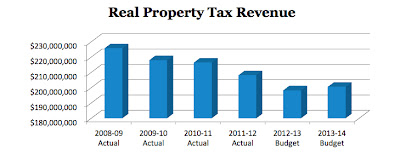
REVENUE CHANGES for county income areprojected in Mayor Billy Kenoi’s proposed budget for the coming fiscal year. He wrote that real property taxes are expected to increase by 1.2 percent, or $2.4 million with an estimated 1 percent rise in taxable values and a slight increase in interest payments. The Public Utilities Franchise Tax is expected to increase by $1.0 million, or 9.4 percent in franchise tax revenue. Increases in building permit revenue ($400,000), liquor license fees ($350,000) and vehicle weight tax revenue ($200,000 are expected to bring in $1.1 million, or a 7.0 percent increase.
        According to the mayor, “a higher projection of carryover savings is attributed to the cumulative effect of successful cost cutting measures for the past several years and additional spending restrictions in the current year.”
   
ADDITiONAL SPENDING on county government is proposed in Mayor Billy Kenoi’s budget released yesterday. He said that appropriations are increased by $1.3 million for anticipated property purchases under the geothermal relocation program through which the county buys properties in areas affected by geothermal operations.
      Fire Department spending would increase by approximately $200,000, primarily for fire protection costs. Funds are also budgeted to pay $350,000 of the cost to renovate the Hilo office of the Liquor Commission and to remove asbestos. Additional funds would be appropriated in subsequent years to complete payment of the full cost. Additional grant funding revenue of about $400,000 is anticipated and appropriated for various programs at the County Prosecuting Attorney’s office.
    Highway funding would increase by about $200,000. Debt service will increase with the beginning of principal payments on bonds issued in 2010. Contributions to the employee retirement system will increase by approximately 4.5 percent as the result of rate increases established by the state Legislature.
     Concerning vacation pay, payouts for employees separating from the County would be reduced by $500,000. Concerning insurance claims and judgments, the appropriation to cover those against the County would be reduced by $200,000.
      Regarding the Wastewater Replacement Reserve Account, funding appropriated to set aside for large equipment rehabilitation and replacement must be reduced by approximately $900,000 as the Sewer Fund fund balance and replacement reserve fund balance have been exhausted, the mayor reported.
      The mayor said that in order to keep the county funded, “We will continue to work closely with our state Legislators to maintain the County of Hawai‘i’s share of the Transient Accommodations Tax, which is critically important to maintain our balanced budget. We also continue to work with our Congressional delegation to secure federal resources as we work to expand our transportation infrastructure and build important capital improvement projects." He said and the county staff  “look forward to working closely with the County Council as we seek to address both new and continuing demands for public services while also maintaining a balanced and responsible budget.”

KA`U CHAMBER OF COMMERCE encourages Ka`u students, your and adults to apply for its annual scholarship program. The Ken Wicks Ka`u Chamber of Commerce Scholarship is available not only to high school juniors and seniors, but also to adults seeking to re-enter the educational system. Preference will be given to those who intend to remain in or return to Ka`u and live there. Scholarship money can be used for all college and vocational training and will range from $250-$1,000. The deadline is May 1, 2013. For more information and to download the application, visit the Ka`u Chamber website athttp://kauchamber.org/?page_id=4 or call Lee McIntosh at 929-9872.

VOLCANO VARIETY SHOW takes place this Saturday at 6:30 p.m. and Sunday at 2 p.m. at Volcano Art Center’s Ni`aulani Campus in Volcano Village. Acts include sketch, comedy, music and dance and are appropriate for all ages. Tickets are $8 for adults and $5 children under 17. Call 967-8222.

A NIGHT OF IMPROV is set for Saturday at 7:30 p.m. at Ocean View Community Center. Alohaha’s Improv-Sketch-Comedy troupe performs a series of improvisational games and original comedy sketches. $10 tickets are available at the door at 7 p.m. for adults 18 years old and over. For more, call 345-2571 or email thealohahas@gmail.com.
MAKING FOOD PRODUCTS through agriculture in Ka`u is a workshop open to the public. Farmers who want to sell a product to the public can learn from value-added and specialty foods consultant Lou Cooperhouse when he presents Food Business Basics: Getting Started and Finding Your Niche in the Specialty Foods Business. The workshop to be held at Pahala Community Center on Wednesday, March 13 from 9 a.m. to 3 p.m. is designed for farmers seeking to develop their raw product into a value-added product and bring it to market, entrepreneurs and restaurateurs interested in diversifying their revenue streams with specialty food products, and established producers looking to take their food businesses to the next level. To register call 443-2755 or visit http://laulimacenter.org/foodbasics.html


Thursday, February 28, 2013

Ka`u News Briefs, Feb. 28, 2013


Ka`u Hospital & Rural Health Clinic could be privatized if bills pass the Hawai`i State Legislature this session. Photo by Julia Neal
SHOULD KA`U HOSPITAL BE PRIVATIZED? This is one of the subjects for which Sen. Russell Ruderman, who serves the district where Ka`u Hospital and Rural Health Clinic are located, would like input from Ka`u residents. He brought up the issue at a meeting with Ka`u residents this week in Pahala.
      Another facility used by Ka`u residents that could also be acquired by Arizona company Banner Health is Hilo Medical Center. Legislation in both the state Senate (SB 1306) and the state House of Representatives (HB1483) would allow the transition from management by the non-profit Hawai`i Health Systems Corporation to Banner. The proposed legislation would allow any of the Hawai`i Health Systems Corporation regions or their health facilities to transition to non-public status. The transition would occur through the sale, lease, or transfer of assets, except for real property, which would only be transferred by lease.
      All liabilities of the transitioning region or facility that were transferred to HHSC upon its creation by Act 262, SLH 1996, and all collective bargaining contracts negotiated by the State, however, would remain the responsibility of the State. Subject to legislation appropriation, the State would be required to continue funding operating support subsidies and capital improvements for any of the new entities.
Kalbert Young, state Budget Director
    Kalbert Young, Director of the state Department of Budget and Finance, testified that his agency is concerned about the proposed requirement for the state to be responsible for previously negotiated labor contracts and continued subsidies and capital improvements for the health facilities. He also noted that employees have accrued benefits under the state’s Employees Retirement System and Employer-Union Trust Fund. He asked what would happen to these benefits?
      Young also wrote that many buildings at the medical facilities were financed with tax-exempt general bonds and that a transfer to a private entity could make the bonds no longer qualify for tax exemption. In addition, some facilities are on ceded lands, for which payments to the Office of Hawaiian Affairs have not been made as the health care serves Hawaiians and other members of the public. Should the facilities be privatized, OHA could demand payments.
      The board of the Hawai`i Health Systems Corp. took no stand on the issue, saying it plans to review the bill or come up with a board position, and that its supports “continued discussions with private entities for potential partnerships and relationships.”
Randy Perreira heads the HGEA
      Yesterday, the Senate Ways and Means Committee passed S.B. 1306 with Ruderman in favor, with reservations. Ka`u’s previous senator, Gil Kahele, who now represents Hilo, voted against the measure. The House Finance Committee passed the bill.  East Ka`u’s Representative Richard Onishi voted aye.
      United Public Workers state Director Dayton M. Nakanelua, who represents many health care facility employees, submitted opposition testimony. He said the bill  “undermines prior commitments made to public employees, eliminates the merit principle, and nullifies the right to engage in collective bargaining.” He wrote that Hawai`i Health Systems Corp. was created by the legislature in 1994 “to provide better health care for all the people of the State…by freeing the facilities from unwarranted bureaucratic oversight.” He said it was understood that Hawai`i Health Systems Corp. would maintain a “corporate-wide hospital personnel system …..and that no employee of the State having tenure with the state would suffer any loss of seniority, prior service credit, vacation, sick leave or other employee benefits or privileges as a consequence.” He said that a decision by the Hawai`i Supreme Court determined that “privatization violates the constitutionally established merit principle” under the Hawai`i constitution and eliminates “openness, merit, and independence” in public administration, which is promoted by the constitution.
           Hawai`i Government Employees Association union chief Randy Perreira also wrote in opposition: “The Hawai`i Health Systems Corporation operates a system of community hospitals primarily on the neighbor islands. That network provides a safety net of health care, with a Hawai`i State Constitutional mandate to ensure access to health care for all citizens. In many instances, care is provided without payment, a cost that our state taxpayers bear to ensure care for all.
         “To preserve the safety net for the neighbor islands the system must remain intact. If one or more regions were to withdraw from the system, it will create instability through the whole system, both financially and in the types of and mix of services available to local communities. A fragmented health care system is a disservice to Hawai`i's people and threatens the long-term viability of the entire health care delivery system. Further, the effort to divest our state from being involved in our health care, and put that responsibility on an Arizona-based provider is short-sighted and not in the best interest of our communities. It is unthinkable that our state will be better off with health care decisions for neighbor islanders being made out of state.”
      Numerous testimonies from workers opposing the bill and many testimonies asking for the partnership to improve health care are posted on the www.capitol.hawaii.gov website under SB1306 and HB1483.

Pahala Volunteer Firefighters fought a string of fires around the village that damaged eucalyptus, coffee and macadamia
and threatened the town. Photo by Julia Neal
THE VOLUNTEER FIRE DEPARTMENT will be supported by a huge rummage sale on Friday through Sunday, March 15-17, at Discovery Harbour Community Association clubhouse. Donations will be taken on Wednesday and Thursday, March 13-14. “We are looking for anything you want to get rid of that is clean and in working condition,” said rummage sale organizer Elizabeth Girard. The sale typically has good deals including CDs, DVDs, jewelry, artwork, electronics, exercise equipment, furniture and clothes, said Gerard. The Discovery Harbour Social Committee will sell $5 hot dog lunches.
     Proper firefighting gear is expensive and “many of our volunteers in Kaʻū are not rich. The county tried to provide equipment, but has a limited budget. A good pair of boots costs $300,” she said. Using fundraiser money the Discovery Harbour volunteer fire brigade was able to purchase seven 3M full-face respirator masks.
      ʻO Kaʻū Kākou has donated three 3M full-face respirator masks to the Pāhala volunteer fire department and three to the Nāʻālehu volunteer department. The masks cost  $1250. “It will help with health issues..,.not having to breath the smoke,” said Pāhala volunteer fire captain Ron Ebert. Breathing smoke - “you just start coughing and it zaps your energy. Breathing clean air, you can do a better job.,” he said. Mask shields also keep ash off of faces of the firefighters.
Fundraising has led to the purchase of respirators to
protect volunteer firefighters. 

VOLUNTEER FIREFIGHTERS ARE NEEDED. Pāhala and Nā’ālehu have three volunteer firefighters and Discovery Harbour has four. Ocean View also has fewer than a full company of 12. Discovery Harbour volunteer captain Terry James reported that during the huge dual fire blaze in Pāhala this past June, “more volunteers were needed.
      Said Ebert, “Volunteers are essential. They go out in very unpleasant conditions and fight fires to save people’s property. I can’t say enough about the people who do it.” He urged people to join “if you have the desire to serve your community in a very special way.”
     The mean age of Kaʻū volunteers runs between 55- and 60-years-old, said James. While the ranks would love young volunteers to join, the departments are calling to any male or female over the age of 18 to sign up. Volunteers need to be U.S. citizens and have valid driver’s licenses. At training sessions,  third Tuesday of each month, potential applicants can meet other volunteers and learn more on what is involved. Those interested can call one of the Kaʻū volunteer captains: Pāhala Ron Ebert, 928-0027; Nāʻālehu Wade Baji, 929-9923; Discovery Harbour Terry James, 895-8133; and Ocean View Mack Goddard, 939-7602.

VOLCANO VARIETY SHOW takes place this Saturday at 6:30 p.m. and Sunday at 2 p.m. at Volcano Art Center’s Ni`aulani Campus in Volcano Village. Acts include sketch, comedy, music and dance and are appropriate for all ages. Tickets are $8 for adults and $5 children under 17. Call 967-8222.

A NIGHT OF IMPROV is set for Saturday at 7:30 p.m. at Ocean View Community Center. Alohaha’s Improv-Sketch-Comedy troupe performs a series of improvisational games and original comedy sketches. $10 tickets are available at the door at 7 p.m. for adults 18 years old and over. For more, call 345-2571 or email thealohahas@gmail.com.

WOMEN’S ENERGY WORKSHOP takes place Sunday, March 3 from 9:30 a.m. to 3 p.m. at Shizuno Nasu’s Volcano Village Dance Studio. The workshop features yoga and dance meditation with Nasu and Debra Serrao focusing on the Sacred Feminine. $55 includes lunch; space is limited. Register with Debra at 985-7545 or debwhiteflower@hotmail.com or Shizuno at 967-8574 or shizunodance@gmail.com.


Wednesday, February 27, 2013

Ka`u News Briefs Feb. 27, 2013

Ka`u Intermediate girls stayed for several nights onboard the U.S.S. Missouri in Pearl Harbor.
Photo by Lawrence Lucero
KA`U INTERMEDIATE SCHOOL girls, interested in aviation, recently flew to O`ahu and stayed aboard the U.S.S. Missouri to attend Pacific Aviation Museum Flight School Encampment at Pearl Harbor. They were chosen after writing essays on their desire to learn about aviation, and yesterday received certificates for completing the mission from Sen. Russell Ruderman, who visited Pahala.
Teachers Dexsylin Navarro, Nellie Davis, Deisha Davis and Gailey
McGuire led junior high girls to the aviation academy.
Photo by Lawrence Lucero
      The group was led by Dexsilyn Navarro, who heads up the math department on the Ka`u campus. Also leading the group were teachers Deisha Davis, Nellie Davis and Gailey McGuire.

OVER THE NEXT EIGHT MONTHS, Ka`u residents will be able to interact with Sen. Russell Ruderman to plan for the 2014 Hawai`i State Legislature, he said. Ruderman came to Ka`u yesterday to meet with area residents and explained that new bills must be introduced into the Legislature within five days of opening day. He said that bills he introduced this year would still be alive next year and that there is plenty of time for interaction with the freshman senator before next session. He also encouraged constituents to interact with his staff and the legislative reference bureau, which can find bills and help community members draft bills.
Sen. Russell Ruderman congratulated Ka`u sixth-, seventh- and eighth-
grade girls yesterday for completing an aviation class on the
U.S.S. Missouri. Photo by Eileen O`Hara 
      At Ka`u High School, Ruderman visited the construction site of the new shelter and gymnasium, toured the campus with Principal Sharon Beck and gave a talk to middle school students at the cafeteria. He followed up with a talk story at Pahala Plantation House, where he discussed renewable energy, growing food, preventing farm theft, supporting irrigation for agriculture and agricultural education for both Puna and Ka`u. Residents also talked about the Ka`u Scenic Byway program and continued support for Pahala Library, which is open four afternoons a week with Internet and 28 computers. Residents urged that school students use the library during school hours and that it be opened in the future after work and on weekends, as well. Ruderman talked about his support for video conferencing and other ways for people living in remote places like Ka`u to participate in public hearings and other sessions of government.
      Constituents can sign up for a newsletter and for updates. See http://russellruderman.com/contact-russell-ruderman.

Sperm whales take care of their calves for more than a decade.
Photo by Brandon Cole/National Wildlife Federation
A DECAYING WHALE on the Ka`u Coast was examined by representatives of National Marine Fisheries and The Nature Conservancy yesterday. Justin Viezbicke, of the Hawaiian Islands Humpback Whale National Marine Sanctuary, was among them. He said the remains of the whale on the beach were likely from the head of a sperm whale. Sperm whales, the largest of the toothed whales, can reach 67 feet in length, with the huge head accounting for about a third of the body. The sperm whale dives deeper than any other mammal and could reach bottom of the Lo`ihi Seamount, which rises some ten thousand feet from the floor of the Pacific Ocean off the Ka`u Coast some 18 miles from where the whale was found.
      Sperm whales make the loudest noise of any animal and have the largest brains of any animal. They give birth every three to six years and take care of each calf for more than a decade. They can live more than 70 years.
      Anyone seeing marine mammals in distress, entangled, beached or washed ashore can contact Viesbicke at justin.viezbicke@noaa.gov, 327-3697 or 987-0765.

REGARDING THE `AINA KOA PONO proposal, the Public Utilities Commission last week published responses to more questions asked by the state Consumer Advocate, Hawai`i County and Life of the Land. The questions concern the proposed contract for `Aina Koa Pono to annually sell, at a fixed price for 20 years, 16 million gallons of diesel that would be manufactured at a refinery off Wood Valley Road above Pahala. The fuel, produced in 27 microwave units, would be sold to Hawai`i Electric Light and Hawaiian Electric Companies, with most of it trucked up Hwy 11 to a power plant in Kona. Electric bills on O`ahu and the Big Island would increase.
            Hawai`i County attorneys questioned production rates claimed by `Aina Koa Pono. The county said that, according to AKP’s website, the company “has determined that based on production per acre and quality of fuel, the Big Island facility would generate approximately 3,500 gallons of biofuel per acre, versus 650 gallons per acre for other liquid fuel technologies. This is seven times more productive than biodiesel from palm oil. Please explain how/where the 3500 gallons per acre is derived. Does this assume multiple harvests per year for the same acre?”
      The utilities responded, “AKP reports that the MicroDee process will use biomass feedstock (energy grasses and woody biomass). Therefore, the pyrolytic oils derived from the process can be called a biofuel. The specific biofuel produced is not derived from an oilseed crop, such as palm oil, soybean, canola, moringa, or any other type of oilseed crop. AKP asserts that it is able to produce enough feedstock from the proposed project’s land due to each harvest cycle being approximately nine months for the energy grasses and longer for woody biomass.
      “AKP discusses the need for about 900 dry tons per day of feedstock,” the county stated and asked, “How many cubic yards of harvested material is this equal to, or simply how many wet tons of feedstock do you have to produce to make a dry ton of biomass?” A dry ton is often confusing as you cannot grow dry biomass and you have to grow, harvest, transport and handle a lot of wet material in order to end up with a ton of dry biomass, the county said.
      The utilities replied, “AKP reports that woody biomass is assumed to be harvested with a 45 percent moisture content. When it is used in the MicroDee process in pellet form, the moisture content of the woody biomass pellet is now approximately at 10 percent. Therefore, the woody biomass had a 35 percent reduction of moisture content from harvest to pellet form. The energy grasses have an assumed 70 percent moisture content (varies upon the amount of rain and time of harvest). When used in the MicroDee process in pellet form, the moisture content of the energy grasses is now at approximately 10 percent. Therefore, the energy grasses had a 60 percent reduction of moisture content from harvest to pellet form. The volatiles content remains approximately the same with only minor losses throughout the processing into a finished pellet. At the AKP daily feed rate of 900 dry tons per day, AKP estimates that approximately 40 acres of energy grass will need to be harvested per day to meet their facility’s needs.”
      Hawai`i County asked the utilities to provide the projected amount that growers would be paid per dry ton of feedstock. “How does this compare with possible alternative fuels? Will AKP enter into a 20-year contract with growers? How will AKP handle situations where there is crop failure, inadequate yield, and/or if growers decide to produce other crops?”
      The utilities replied that “AKP will be performing the farming operation for production of energy grasses and woody biomass. Because the farming operation will be handled internally by AKP, there will not be any third party contracts with external growers…. Also, in the event of crop failures or inadequate yields, the AKP Biodiesel Supply Contract does allow for AKP to source their feedstock from anywhere within the state of Hawai`i.”
      Complete responses to all questions are online at puc.hawaii.gov. Docket number is 2012-0185.

VOLCANO VARIETY SHOW takes place this Saturday at 6:30 p.m. and Sunday at 2 p.m. at Volcano Art Center’s Ni`aulani Campus in Volcano Village. Acts include sketch, comedy, music and dance and are appropriate for all ages. Tickets are $8 for adults and $5 children under 17. Call 967-8222. 

A NIGHT OF IMPROV is also set for Saturday at 7:30 p.m. at Ocean View Community Center. Alohaha’s Improv-Sketch-Comedy troupe performs a series of improvisational games and original comedy sketches. $10 tickets are available at the door at 7 p.m. for adults 18 years old and over. For more, call 345-2571 or email thealohahas@gmail.com.

WOMEN’S ENERGY WORKSHOP takes place Sunday, March 3 from 9:30 a.m. to 3 p.m. at Shizuno Nasu’s Volcano Village Dance Studio. The workshop features yoga and dance meditation with Nasu and Debra Serrao focusing on the Sacred Feminine. $55 includes lunch; space is limited. Register with Debra at 985-7545 or debwhiteflower@hotmail.com or Shizuno at 967-8574 or shizunodance@gmail.com.

SUPPORT OUR SPONSORS AT PAHALAPLANTATIONCOTTAGES.COM AND KAUCOFFEEMILL.COM. KA`U COFFEE MILL IS OPEN SEVEN DAYS A WEEK.