About The Kaʻū Calendar

Friday, March 08, 2013

Ka`u News Briefs March 8, 2013

Monk seals will not be transported to Ka`u or any of the other areas in inhabited Hawai`i from the uninhabited northwest islands, according to a new management plan. This monk seal came into Honu`apu years ago as the community was lobbying to preserve the area. A family event will be  held at Honu`po this Sunday. Photo by Julia Neal
A PUBLIC-PRIVATE PARTNERSHIP AUTHORITY, initially for three specific projects, may become the replacement for the Public Land Development Corp. which is likely to be repealed by the 2013 Hawai`i Legislature.
      Over the objections of Ka`u state Senators Josh Green and Russell Ruderman, who voted no along with Senators Laura Thiielen, Mike Gabbard and Les Hara, the Senate approved SB215 yesterday with a 20 to 5 vote and sent the measure to the House.
      From the Senate floor, Ruderman objected, saying many people living in his district are worried that the bill is too much like the PLDC. He noted that the measure almost passed the Senate with a wording that would have allowed the county to provide waivers to the private-state partnerships for complying with local zoning and other land use requirements. The waivers were “glossed over” before being removed this week, Ruderman pointed out.
      Three pilot projects would be attempted with private developers using state land, should the Public-Private Partnership Authority pass the state House of Representatives. They would be restricted to a Wahiawa redevelopment, a Maui film studio and one project to be proposed by a county. The pilot project would be for five years before possibly extending public-private partnerships to other projects on state land.
Voting at the Pahala precinct. Photo by Julia Neal

KA`U MAY NO LONGER BE THE BIG FISH in public funding coffers for County Council elections. Sen. Russell Ruderman’s bill that would equalize public funding among the county council districts passed the state Senate yesterday and is headed for the House of Representatives.
   The formula for recent election funding was based on how much money candidates raised in elections before the pilot public funding went into effect.  In Ka`u, former County Council member Guy Enriques reported more than $90,000 in expenditures for his successful 2008 campaign with money raised from private sources. He lost the 2010 election but his spending in 2008 led to the most public funding for any council district during the 2012 election. Run-off candidates Maile David and Brenda Ford received $48,893 each in public funding, and primary election candidate Bradley Westervelt received $41,273.77.
      Council candidates in other districts around the island, where large donations were not taken in to conduct political campaigns, received much less when public funding kicked in. District 4 candidate Ian Greggor received $21,282 and James Weatherford $16,320. District 2 candidate J Yoshimoto received $14,559 and District 9 candidate Margaret Wile received $11,600.46. District 8 candidate Karen Eoff received $12,282.
      Ruderman’s bill would change the public campaign funding amount for all disctricts on the Big Island to $13,106 per candidate. Ruderman, a freshman senator, campaigned on reducing the influence of money in public elections.
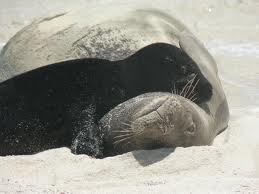
Seal pups in decline in uninhabited Hawaiian islands.
Photo from NOAA
YOUNG SEALS FROM THE NORTHWEST HAWAIIAN ISLANDS will stay in their remote home for now. The federal plan to transfer up to 20 pups and 30 juveniles to the inhabited Hawaiian Islands where the population of monk seals has been increasing, has been delayed. Before initiating the project, however, marine mammal scientists with NOAA said that they want to establish a public network of monitoring monk seals locally. Concern for monk seals in the Northwestern Hawaiian Islands grew with decline in the population there, blamed on sharks feeding on the pups and a reduction in availability of food there.
       A plan for scientific research over the next five years concerning monk seals in Hawai`I can be seen at www.nmfs.noaa. Comments can be made through April 15.

HO`OMALU KA`U is a new non-profit organization with 501 © 3 status. The organization has been established to serve the South Hawai`i region with the purpose of “perpetuating, protecting and conserving the lands, health, knowledge, culture and history of Ka`u and its people.”
      The organization has received the Ho`omalu Ka`u property, with 15 pristine acres of native, dryland forest. Founders note that only 5 percent of dryland forests in Hawai`i remain. The property, located makai of Hwy 11 at Road to the Sea, is served by an intact remnant of the Alaloa, an ancient rail used to travel around the island from ahuapua`a to ahupua`a.
      The first goal of the organization is to establish The Heritage Center of Ka`u. A statement from the group says, “Ka`u’s unique cultural, historical and traditional knowledge, as well as many priceless artifacts are being lost daily. There is no place in theDistrict where these never-to-be replaced resources can be stored, preserved and accessed by local residental and island visitors.”
      The plan calls for a Ka`u Gateway reception center to welcome and inform visitors about Ka`u; the archive and museum; a retail area with local art and agricultural products and community center for local gatherings. Founding board members are Wendy Vance, Lehua Lopez Mau and Chris Reed. The organization is partnering with Ka`u Hawaiian Civic Club and its President Blossom DeSilva.
PUC Chair Mina Morita. Photo by Julia Neal

“THE RATEPAYER DOESN’T HOLD THE PUC IN HIGH REGARD,” Public Utilities Chair Mina Morita said yesterday. She was speaking at a public session called PUC Regulation Purpose and Process, held at the Hawai`i State Legislature Auditorium in Honolulu. Morita opened by reporting from a survey of those invited. She said she learned that “If you appear to be a practitioner before the PUC, the general thought was that we were making improvements, but lacked the resources. On the other hand, those who were not regular practitioners before the PUC thought we were incompetent, a rubber stamp for HECO, didn't listen to the public, opaque, operating in a black box. So no doubt, the largest stakeholder group -- the one that the PUC decisions affect the most, the general public, or the ratepayer -- does not hold the agency in very high regard.”
       With the PUC entering “its 100th year of public service, it is a good time for re-examination of the PUC, and work towards a common understanding of its role and purpose. And it’s extremely important to make the PUC's core values, transparent, and its work and its decisions understandable to the general public,” said Morita. She called yesterday’s discussion “the first step in that direction.”
      The PUC is involved with Ka`u in deciding whether to approve a contract between `Aina Koa Pono and the electric utility for fuel that would be manufactured in a refinery that would be built off Wood Valley Road. The contract would mean increases in electric bills on O`ahu and the Big Island. The approval process could go into the year 2014.
      The utilities recently provided answers, on behalf of `Aina Koa Pono, to detailed questions from the County of Hawai`i, the state Consumer Advocate, the state Department of Business, Economic Development & Tourism and Life of the Land. The next round of testimony from the county and others is due March 15. The utility’s additional questions about `Aina Koa Pono are due April 12. The county and others respond by May 10. By June 7, the utilities file rebuttal testimony and exhibits. On July 5, the county and others ask more questions and the utilities reply by Aug. 2. Following these deadlines, there will be settelement discussions to attempt to create a final proposal for the `Aina Koa Pono proposal. Discussions could lead to evidentiary hearings, which could start in September with transcripts delivered in October, opening briefs in November and closing briefs in December. However, the process could be cut short with a decision by the PUC sometime this Fall. If evidentiary hearings are held, the process could go into 2014, the PUC scheduling indicates.

ADVANCE REGISTRATION for the Food Business Basics workshop to be held next Wednesday from 9 a.m. to 3 p.m. at Pahala Community Center is today. Getting Started and Finding Your Niche in the Specialty Foods Business is the title of the session for helping local residents to develop raw products and bring them to market. Understanding the food marketplace and distribution channels; identifying target consumers and developing product niche; business planning and food processing options; local state and federal regulations, product development and funding are some of the topics. Registration is $35 and scholarships are available. See laulimacenter.org/foodbasics.html.

KA `OHANA O HONU`APO hosts Tutu & Keiki, its first 2013 Sunday in the Park family event, this Sunday from 1 p.m. to 4 p.m. at Whittington Beach Park. Co-hosts are Tutu & Me Traveling Preschool and Hawaiian Civic Club of Ka`u. The event features Hawaiian activities, games and prizes. For more information call 929-9891.

Thursday, March 07, 2013

Ka`u News Briefs March 7, 2013

Filipino World War II heroes would be able to bring their families to the U.S. under Sen. Mazie Hirono's legislation.
Photo from the American Coalition of Filipino Verterans 
SUPPORTING FILIPINO WAR HEROES, Sen. Mazie K. Hirono introduced her first bill as United States Senator this week. The legislation would allow immigration for Filipino World War II veteran families. A statement from her office says, “The long-overdue legislation, which has been the priority of Hawai`i’s congressional delegation for many years, could gain new life as the Senate drafts and marks up immigration reform legislation. This legislation underscores Hirono’s immigration reform approach of bringing families together and assisting communities whose voices aren’t often heard in
Sen. Mazie K. Hirono
     Hirono stated: “Immigration reform should reflect our values and these are the types of ideas I will be working to include in the final legislation,” said Hirono. “Our nation can never fully repay the debt we owe the Filipino World War II veterans who bravely served and sacrificed alongside Americans in the critical South West Pacific Theatre. The brave servicemen who are still with us, now in their 80s and 90s, should not have to wait any longer in order to be reunited with their children.” Thousands of Filipino veterans were granted citizenship in recognition of their service to the United States in World War II. Their children, however, were not granted citizenship. As a result, the veterans who came to the United States could only sponsor their children by filing a petition and “getting in line,” Hirono noted. The backlogs affecting Filipino immigration applications date back more than 20 years in some cases.
       The statement says that Hirono has “a key perch to influence immigration reform legislation” as she sits on the Senate Judiciary Committee and the Judiciary Subcommittee on Immigration.
      The American Coalition of Filipino Veterans estimates that 20,000 sons and daughters of U.S. Filipino World War II veterans will directly benefit from Hirono’s legislation. “We applaud Sen. Hirono's great decision in reintroducing the Filipino Veterans Family Reunification bill,” said Eric Lachica, Executive Director, American Coalition of Filipino Veterans. "Salamat po! Mabuhay Senator Hirono,” he proclaimed.
      Rep. Colleen Hanabusa will introduce the bill in the House of Representatives.

FRESHMAN CONGRESSWOMAN TULSI GABBARD voted with Republicans in the U.S. House of Representatives yesterday when they passed their budget. Gabbard was among 53 Democrats who said yes to the measure, noting that it would restore some military funding cut by the sequester.
Rep. Tulsi Gabbard
      Hawai`i is considered one of the states most dependent on infusion of military money. While protecting some military funding, however, the bill would preserve the overall $85 million in budget cuts, meaning that funding restored to the military would come from reduced funding for social services, education and other federal services, including furloughing some air traffic controllers and airport security staff – as many as 21 air traffic controllers in Hilo. Democrats warn that this could mean long waits for air travelers.
     Hawai`i’s senior House member Colleen Hanabusa voted against the Republican budget, which received 267 votes in favor and 151 in opposition. “This measure not only reaffirms sequestration, it does nothing to remove sequestration," said Hanabusa. A member of the House Armed Services Committee, she called for flexibility for the military in the use of its funding – a measure that was included in the Republican budget. Hanabusa also called for congress to give agencies beyond the Defense Department more flexibility in the use of their reduced budgets.
The proposal before congress is called the Continuing Resolution and would prevent a government shutdown at the end of March when the current resolution expires. 
Sen Colleen Hanabusa
     Hanabusa said: “While I support in principle extending funding and also making full-year appropriations for Defense spending and Military Construction and Veterans Affairs, this bill does not accomplish what we need to get done.” 
      Gabbard called the bill she voted for “far from perfect” and said she supported it “because it provides important funds for our men and women serving overseas, our military-related jobs in Hawai`i, and it works to avert a government shutdown, protecting our economy from yet another self-manufactured crisis… I’m hopeful the Senate will improve upon this bill and a final bipartisan compromise can be reached to ensure the government remains open at the end of the month.”

VISITOR INDUSTRY SPENDING is expected to total $15.8 billion in Hawai`i this year with a half million more tourists coming to the islands. The Hawai`i Tourism Authority adjusted its projection yesterday and pointed to the increased number of airline seats coming to Hawai`i. The Tourism Authority predicted that 8.5 million visitors will come to the Islands in 2013.

THE USE OF THE CHEMICAL ATRAZINE is the subject of a Civil Beat investigative story published yesterday. The Sophie Cocke article states that “For decades, Hawai`i sugarcane and pineapple farmers, and increasingly seed corn growers, have sprayed the weed killer atrazine on their fields. Atrazine is the second most used weed control chemical in the country, first registered with the federal government in 1958. Civil Beat reports that “When it rains, the popular herbicide is swept into rivers and streams, threatening plant and aquatic life. Atrazine has been shown to reduce reproduction in fish and amphibians, cause birth defects, and according to the U.S. Environmental Protection Agency, is toxic to algae and plant life.”
Atrazine is a popular herbicide in the U.S. and is found in streams and oceans.
Photo from agritrue.com
    According to Civil Beat, its “review of state records and interviews with local regulators shows Hawai`i’s rivers, streams and coastal waters are not being tested for the chemical even though the EPA established water safety levels a decade ago and last year required states to regulate pesticides under the Clean Water Act. The state doesn't track where the chemical is being sprayed and in what quantities,” Civil Beat reports.
      Cocke writes that “atrazine users are largely left to police themselves when it comes to complying with strict EPA guidelines that limit spraying and require setbacks from water resources.”
      She quotes Thomas Matsuda, manager of the pesticides program at the state Department of Agriculture, saying, “We don’t test.” Matsuda told Civil Beat: “Basically, the label is the law. So basically whoever is the applicator is supposed to comply with whatever the label states.”
     The Civil Beat story also quotes Matsuda saying he is concerned about pesticide levels in Hawai`i, but monitoring is difficult with only six inspectors statewide. He said state agriculture inspectors must initiate formal investigations to gain specific information on atrazine use. Civil Beat followed the paper trail of sales records of atrazine at the Department of Agriculture and reported they “indicate that some of the largest buyers of atrazine include Hawai`i seed corn companies, Monsanto and Mycogen, and some of the state’s biggest farming operations.” 
Scientist and ocean researcher Joy Shih says that atrazine
should be banned to protect groundwater and marine life
 in Hawai`i.  Photo from SOEST
      The Natural Resources Defense Council sued the Enviornmental Protection Agency in 2003, “arguing that lax regulations failed to protect endangered species from atrazine in waterways throughout the mainland. In recent years, the EPA has required testing of 40 waterways in agricultural areas in the Midwest and southern U.S. but not in Hawai`i. The tests revealed widespread atrazine contamination, according to a report by the NRDC. In one-third of the waterways, tests came back with atrazine levels five to 10 times higher than the EPA’s safety limit,” Civil Beat reported. “The European Union has prohibited the use of atrazine since 2003 out of concern that the herbicide can easily contaminate groundwater,” according to the Civil Beat story. 
      Atrazine “has shown up repeatedly in drinking water in Hawai`i — something that the state does monitor. Much of the contamination is in Hilo on the Big Island, according to data from the Hawai`i Department of Health. The levels are within the EPA's safe standards for drinking water, and state officials say they don't warrant concern,” reports Civil Beat.
      According to the Civil Beat story, researcher Joy Shih, a doctoral candidate at the University of Hawai`i’s School of Ocean and Earth Science and Technology, believes that atrazine should be banned. “I think of Hawai`i as one giant watershed,” she told Civil Beat. “There is no inland, from the tops of the mountains, everything flows into the ocean. So anything that you apply that is water soluble ends up in the ocean. Fish are definitely affected and coral is affected.”
      Shih told Civil Beat that studies link atrazine to coral bleaching and that the chemical harms the phytoplankton at the bottom of the aquatic food chain. Phytoplankton is “like grass in a prairie. It’s analogous to that,” Shih told Civil Beat. See more at www.civilbeat.com

KA `OHANA O HONU`APO hosts Tutu & Keiki, its first 2013 Sunday in the Park family event, this Sunday from 1 p.m. to 4 p.m. at Whittington Beach Park. Co-hosts are Tutu & Me Traveling Preschool and Hawaiian Civic Club of Ka`u. The event features Hawaiian activities, games and prizes. For more information and to volunteer, call 929-9891.

Wednesday, March 06, 2013

Ka`u News Briefs March 6, 2013

The Nature Conservancy sponsors prizes for pig-hunting contests in Ka`u, including this annual event to
honor the late Chaz Moses. Photo by Julia Neal
PIGS AND HAWAIIAN CULTURE became a topic of discussion among attendees at The Nature Conservancy’s presentation at After Dark in the Park last night at Kilauea Visitor Center Theater. When did native Hawaiians start hunting pigs in the forest? John Replogle, of The Nature Conservancy, who grew up in Ka`u, said he figures that pigs brought to Hawai`i with the early Polynesians were kept close to home as they were important food – like farm animals, living around the hale and venturing out and coming back to be near the human community and the food provided to them. It is likely that very few people hunted them during ancient Hawaiian times as pigs belonged to families and community.
      Field biologist Rick Warshauer, during discussions after the presentation, said domestic Polynesian pigs brought to Hawai`i on voyaging canoes were small and probably unable to live in the native forest as their jaws weren’t strong enough to break into hapu`u fern stalks for nutrition. He also noted that the main sources of protein for piglets are earthworms, which didn’t live on the island before western contact.
Pigs brought by western explorers were likley
better able to survive in the wild than those brought
by Polynesians. Photo by Julia Neal
      However, western explorers and trading vessels shipped in the larger European pigs with ability to survive in the wild with their bigger jaws and tusks. Westerners also brought in the earthworms that help piglets to flourish.
       During sugar days, pigs lived in the cane fields, eating the cane stalks, and immigrant sugar workers built the tradition of hunting pigs with dogs. With hunters in the sugar fields, wild pigs began retreating into the forest and living there part-time. The sugar fields also provided a barrier between imported, invasive plants being brought to the islands and spreading toward the native forests, which are not only home to native species but the watershed that creates drinking water for people.
      When sugar companies closed down – the last one in Ka`u in 1996 – pigs made further inroads into the native forest, as abandoned sugar fields provided less and less sustenance with much of the land turned into pasture, Replogle ventured.
      Replogle said that The Nature Conservancy works with hunters in educating them on the reasons for excluding wild pigs from portions of the forests to allow native plants and the animals they support to recover - the watershed better preserved. Replogle described the dense forest as creating water with its many layers of vegetation. The pigs, as well as sheep, goats and cattle, can destroy the understory of the forest, and the native plants and animal populations as well as watershed decline, sometimes rapidly when invasive plants like kahili ginger, the purple-flowered tibouchina, strawberry guava, common guava, lilikoi and Christmas berry move into land disturbed by the ungulates. The ungulates spread the seeds of many invasives into the forest through their droppings and on their coats and hooves, he said.
      Ka`u, Replogle explained, has a particular advantage in protecting and restoring native species as it already has the largest pristine native forest in all of the Hawaiian Islands. With hunters helping to keep down the pig population, there is a chance that the Hawaiian forest can survive, he said. The Nature Conservancy helps sponsor local pig tournaments with prizes such as global positioning systems for hunters. The Nature Conservancy office in Na`alehu is also a location where hunting licenses can be retrieved online between 7 a.m. and 2 p.m. on weekdays.
      The Nature Conservancy’s 3,548-acre Ka`u Preserve is located at altitudes between 2,600 and 5,770 feet and includes four separate parcels of forested land with mountainous ridgelines and narrow plateaus broken by alternating steep valleys. The forest includes a closed-canopy of koa and `ohi`a with a lush understory of uluhe and hapu`u. Rare nuku `i`iwi as well as `io, apapane, i`iwi, `elepaio, `amakihi and `akepa native birds survive there. Monthly volunteer opportunities are open to the public. Call 443-5413.

Ka`u Scenic Byway Task Force hopes to save Na`alehu Theater.
Photo from historichawaii.org
KA`U SCENIC BYWAY TASK FORCE is working to save Na`alehu Theater. At its meeting on Monday, members of the task force and the public discussed how best to draw attention to the plight of the theater. Marge Elwell said she will try to get articles published in O`ahu newspapers and magazines including pointing out that the theater could be viable, since popular artists have attracted full house attendances in the fairly recent past. Letters will be also sent to elected representatives asking for their help. Stephanie Donoho suggested contacting the group of theater managers on the island who meet regularly.

HAWAIIAN ELECTRIC CO. has published Locational Value Maps online that show where and how much customer-sited generation of electricity, also called Distributed Generation, is in place. The maps provide an indication of the percentage of DG on the utilities’ distribution circuits. DG may include solar, wind, hydro or biomass renewable generation for Net Energy Metering, Feed-In Tariff or a Standard Interconnection Agreement, or Conventional generation for a Standard Interconnection Agreement.
Map from HECO shows amounts of customer-sited generation of
electricity that are going onto the utility's grid.
      DG percentages on the Locational Value Maps are based on installed systems and accepted interconnections. The maps are rough guides, updated regularly, but can quickly get out of date, the utility stated. 
      It also said that, in almost all cases, small home or business systems will not require an interconnection requirements study.
 For larger systems, a Locational Value Map address search or a preliminary circuit check from your utility does not guarantee that an interconnection requirements study will not be needed when submitting an application for utility review.
      HECO stated, “Our goal is to help get as much customer-sited generation, especially renewable energy, as possible while maintaining reliable service to all customers. Reliable service may be impacted if a circuit has too much DG interconnected without proper protection equipment.”
      According to HECO, no limits are set on the amount of DG on a circuit. However, all interconnection applications go through an initial review process. Generally, if DG penetration on a circuit is less than 15 percent of peak load, systems may qualify for Simplified Interconnection. If penetration is 15 percent or greater, further review may be needed.
      For more information, contact HELCO’s Solar Support Specialist at c-nmcint@heco.com or 808-543-4721.
      The maps are available at heco.com.

Kumu hula Raylene Kawai`ea Photo by Dave Boyle
VOLCANO ART CENTER PRESENTS a hula kahiko performance in honor of late kumu hula Raylene Kawai`ea on Saturday, March 9. The event features Halau Hula Manaolana `O Kohala, visiting Hula Halau Pi`o O Ke Anuenue of Ashland, Oregon and Halau Hula Keao `O Kala of Pahoa under the direction of kumu hula Roy Leabig. 
      The 50-minute narrated presentation demonstrates the preparation, protocol and offering of traditional hula and chant at the hula platform in Hawai`i Volcanoes National Park. A hands-on cultural demonstration takes place from 9:30 a.m. to 1:30 p.m. on the gallery porch. All events are free (donations welcome), and park entrance fees apply.
      For more information, call 967-8222 or visit www.volcanohula.com.

Lou Cooperhouse
FOOD BUSINESS BASICS: Getting Started and Finding Your Niche in the Specialty Foods Business takes place a week from today, next Wednesday, at Pahala Community Center. Farmers who want to sell a product to the public can learn from value-added and specialty foods consultant Lou Cooperhouse when he presents the workshop from 9 a.m. to 3 p.m.
      Following lunch (included with pre-registration), Nicole Milne, Agricultural Business Development specialist for The Laulima Center, will present two one-hour trainings on Financial Resources Available for Hawai`i Farmers and Marketing Agricultural Products on Hawai`i Island.
     Cooperhouse will also conduct 30-minute one-on-one consulting sessions each afternoon with pre-selected workshop participants. Registrants interested in the one-on-one consultations must complete and submit a brief application.
      For more information and to register, visit http://laulimacenter.org/foodbasics.html or call 443-2755.

SUPPORT OUR SPONSORS AT PAHALAPLANTATIONCOTTAGES.COM AND KAUCOFFEEMILL.COM. KA`U COFFEE MILL IS OPEN SEVEN DAYS A WEEK.