About The Kaʻū Calendar

Thursday, May 07, 2015

Ka`u News Briefs Thursday, May 7, 2015

A new study estimates healthcare costs of emissions from Kilauea Volcano. Photo by Peter Anderson
KILAUEA VOLCANO’S EMISSIONS from the summit eruption that began in 2008 have increased healthcare costs in the state by more than $6.2 million, according to a study by the Economic Research Organization at University of Hawai`i.
      Researchers concluded that particulate matter formed by sulfur dioxide increases pulmonary-related hospitalization, especially among the very young.
      “Air quality conditions in Hawai`i are typically ranked the highest in the nation except when the largest stationary source of SO2 pollution in the United States is erupting,” the report states. “We observe a strong statistical correlation between volcanic emissions and air quality in Hawai`i.”
      See uhero.hawaii.edu/products/view/488.
      To comment on or like this story, go to facebook.com/kaucalendar.

Keone Grace
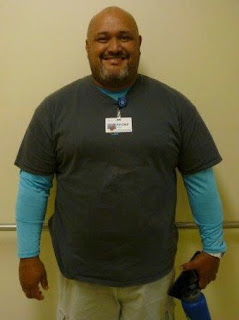
KEONE GRACE IS THE NEW Institutional Food Services Manager at Ka`u Hospital. Grace comes has many years of food industry experience in both retail and health care settings. “We are enjoying his can-do attitude and eagerness to learn about the needs of our patients and staff,” hospital Administrator Merilyn Harris said. 
      Grace replaces Brad Hirata, who is now Food Services Manager at Kealakehe High School.
      To comment on or like this story, go to facebook.com/kaucalendar.

TWO KA`U COMMUNITY DEVELOPMENT PLAN Focused Discussions will be held Saturday at Na`alehu Community Center. The topic at 9 a.m. is Agriculture, and at 1 p.m., Coastal Management.
       The discussions are opportunities for community members to expand their understanding of the CDP and the rationale behind particular strategies. They are also opportunities to provide new information, suggest alternative CDP strategies and propose additional areas of analysis.
       The discussions are designed to be friendly, fact-driven and learning-oriented. They are not formal meetings, opportunities to testify or debates. Planner Ron Whitmore said participants should come with an open mind and a sincere interest in finding the most effective CDP strategies to achieve the community’s objectives.
       During the morning session about agriculture, planners anticipate covering sub-topics like ag zones and permitted uses, farm land preservation, infrastructure improvements to expand agriculture (e.g., water, energy, amendments), and barriers farmers face like land tenure, diversification and value chain development.
       During the afternoon session about coastal management, sub-topics for discussion will likely include shoreline setbacks, public access and trails, South Point management, resort development and the future of Punalu`u.
       County planners familiar with these issues will be on hand and equipped with background material and geographic information systems to support the discussion and do “on the fly” analysis.
Ka`u's coast and agriculture are topics at Ka`u CDP discussions Saturday.
Photo by Peter Anderson
       The discussions will be facilitated and organized roughly as follows:
  1. Brief overview; 
  2. Round robin among participants to suggest questions and sub-topics for discussion; 
  3. Short break to organize the discussion; 
  4. Brief summary of CDP strategies designed to achieve related community objectives; 
  5. Discussion by question and sub-topic. 
       Participants’ questions, comments and suggestions will be documented. As appropriate, the CDP Planning Team will use outputs of the discussion to do additional analysis, refine the CDP rationale and/or recommend CDP revisions.
       A similar discussion about potential development in Discovery Harbour is scheduled for Tuesday, May 12 at 10 a.m. Focused Discussions about other topics can also be scheduled.
      To comment on or like this story, go to facebook.com/kaucalendar.
NEW YORK TIMES’ EDITORIAL BOARD recently published an article in support of the Thirty Meter Telescope. 
      “Sometime in the 2020s, when an international consortium completes the Thirty Meter Telescope, the most powerful telescope on the planet, astronomers will gaze from the 14,000-foot summit of Mauna Kea volcano, on the Big Island of Hawai`i, out to the edge of the observable universe.
       “Or maybe they won’t. With a militant advocacy not often seen in the Aloha State, a small group of Native Hawaiians and their sympathizers have managed to stall the $1.4 billion project, which was to begin construction in April. They stood in front of trucks on the road to the summit and declared the telescope an abomination – to the Hawaiian people and their ancient religion, to the environment and to the mountain, revered in Hawaiian tradition as the piko, the navel, the island's sacred center.
      “Several were arrested last month. On Thursday the trustees of the Office of Hawaiian Affairs, a state agency charged with improving the well-being of Native Hawaiians, voted to rescind their 2009 vote of support for the telescope. Now they are officially noncommittal.
New York Times' Editorial Board supports the Thirty Meter Telescope.
       “The political eruption has left the telescope operators – the California Institute of Technology; the University of California; and research institutions in Canada, China, India and Japan – stranded. When they agreed this month to halt construction, Gov. David Ige thanked them for being ‘respectful and sensitive’ to native beliefs and culture.
       “It is not clear when the project will resume.
       “The protesters don’t speak for all Hawai`i residents, or even all Native Hawaiians, many of whom embrace the telescope. But it is easy to understand why they may feel fed up. Mauna Kea is a site of wonderment even before night falls and the stars come out by the billions. It is a habitat for threatened insects and birds, and rich in precious archaeological sites. It also has been stressed for decades.
       “The University of Hawai`i, which has managed the mountaintop since 1968 under a lease from the state, has at times been a sloppy steward. An embarrassing state audit in 1998 cited its failures to protect the summit's fragile ecology and cultural resources as it oversaw the development of a sprawling complex of more than a dozen observatories there. Over the decades it has collected little to no rent from its many scientific tenants. (The Thirty Meter Telescope is to be the rare exception, paying up to $1 million a year.) 
       “It’s hard to know if the anti-telescope furor has crested yet. The telescope builders have a strong claim to legitimacy, and they are being blamed for things they had nothing to do with – like the 1893 overthrow of the Hawaiian kingdom, the loss of native lands, the state’s many social ills and degraded environment. This is an unfair burden for a group that has spent years cultivating local support, navigating the approval process and successfully – so far – fending off lawsuits. It insists its paperwork is in order. It also points to plans to donate about $2 million a year to local causes like business incubation; job training; and scholarships in science, technology, engineering and math.
      “Mr. Ige, who has been far too withdrawn in this confrontation, needs to step up. If he thinks the telescope is an important asset that promises great benefits to Hawaii's residents and economy, not to mention to science and humanity at large, he should say so. If he thinks more needs to be done to protect the environment and native interests, he should say what that is and make it happen. His mild news releases urging more dialogue are not enough.
       “Coexistence may never satisfy the core group of protesters who have been demanding the total erasure of technology from Mauna Kea's peak. What is tragic is the missed opportunity for shared understanding, given that many of these protesters are themselves descendants of some of history's greatest astronomers, Polynesian wayfinders who set out across the Pacific a millennium ago, guided by the stars and currents, to find Mauna Kea in the first place.”
      To comment on or like this story, go to facebook.com/kaucalendar.

THE SIXTH ANNUAL MANUKA NARS CLEANUP is Saturday. Hawai`i Wildlife Fund and Natural Area Reserves invite Ka`u residents to the hiking cleanup along the rocky South Kona shoreline.
      For more information and to RSVP, email kahakai.cleanups@gmail.com.

ST JUDE’S EPISCOPAL CHURCH in Ocean View hosts its annual Cinco de Mayo fiesta tomorrow. Doors open at 6 p.m., and dinner is served from 6:30 p.m. to 9 p.m., with live music provided by the Last Fling Band. Dinner includes cerdo verde enchiladas (pork with green chili sauce), salad, frijoles refritos (refried beans), drinks and dessert. Tickets are available at the door for $8 each or two for $15, or can be pre-purchased from Thom White, Elaine Meier or Cordelia Burt. The event contact number is 939-7555. Proceeds help fund St. Jude’s community service programs such as free hot showers, free hot lunch and free wifi.
      The church is at 92-8606 Paradise Circle in Ocean View (the southeast corner of Keaka Pkwy and Paradise Circle). “Bring a healthy appetite and your dancing shoes, and join in the fun all for a good cause,” said Madalyn McWhite Lamson.

SUPPORT OUR SPONSORS AT PAHALAPLANTATIONCOTTAGES.COM AND KAUCOFFEEMILL.COM. KA`U COFFEE MILL IS OPEN SEVEN DAYS A WEEK.

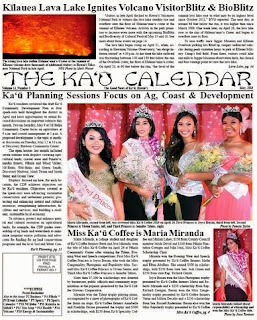
See kaucalendar.com/KauCalendar_May2015.pdf.
See kaucalendar.com/Directory2015.pdf and
kaucalendar.com/Directory2015.swf.


Wednesday, May 06, 2015

Ka`u News Briefs Wednesday, May 6, 2015


Lava still creeps into Puna from Pu`u 'O'o, with breakouts photographed yesterday northeast of Pu`u 'O`o.
Photo from Hawaiian Volcano Observatory
A STATE SENATE SHAKE-UP is causing east Ka`u's  Sen. Russell Ruderman to lose his chairmanship of the Agriculture committee and west Ka`u Sen. Josh Green his chairmanship of the Health committee, according to a report in this morning's Honolulu Star-Advertiser. According to the story, Ruderman and Green did not take part in the initial organization of the coup that led to the ousting of Senate president Donna Mercado Kim yesterday in a 19-6 vote. She is replaced by career legislator from Kaua`i, Ron Kouchi, who served 22 years on the County Council and was appointed to the state Senate in 2010 by then-governor Linda Lingle. After the change in Senate leadership, Green released a statement: "I have been asked to serve as part of President Kouchi's leadership team." He said he will continue on the Health committee as vice chair and will work under Kouchi as Senate floor leader.
To comment on or like this story, go to facebook.com/kaucalendar.

HAWAI`I FARMERS UNION UNITED is circulating a message this morning urging members to call the White House today at 888-793-4597 and "urge President Obama to stand up for my right to know where my food comes from by protecting country of origin labels." The Farmers Union states that the White House tracks every call on each issue, so volume of calls matters. Strong truth in labeling proposals at  the Hawai`i state Legislature, including coffee and food origin labels, failed to pass during this year's session.
To comment on or like this story, go to facebook.com/kaucalendar.

NATIONAL GEOGRAPHIC AND HAWAI`I VOLCANOES NATIONAL PARK will host more than 160 scientists and traditional cultural practitioners from Hawai‘i and around the country May 15 and 16 to lead students and the general public in a two-day race to count as many species of plants and animals as possible and better appreciate the dynamic culture of the park.
     The natural events leading up to this month's BioBlitz are extremely active with lava intermittently spilling from a vent onto the floor of Halema`uma`u crater and Pu`u 'O`o continuing to pump out lava into Puna.
     According to Hawaiian Volcano Observatory, the lake in Halema`uma`u overflowed slightly several times yesterday, and the lava has heightened the rim by 12 feet.
35th Annual Cultural Festival will coincide with BioBlitz
 at Hawai`i Volcanoes National Park.
Photo from National Geographic
     According to Hawai`i Volcanoes National Park, visitors are crowding onto the terrace of Jaggar Museum, and rangers are encouraging them to stay quiet in order to hear the crackling and explosions in the lava lake.
     More than 850 students from local schools will visit Hawai`i Volcanoes National Park on Friday, May 15, as part of this ultimate field trip provided by National Geographic, the National Park Service and event supporters. National Park Service and National Geographic leadership, Native FM radio's  Jaz Kaiwiko`o Yglesias and award-winning recording artist Keoki Kahumoku will help kick off the festivities a week from this Friday.
    Themed I ka nana no a `ike - By observing, one learns -  Hawai`i Volcanoes National Park BioBlitz is part scientific endeavor, part outdoor classroom excursion and part celebration of biodiversity and culture. Online registration is now open to join scientist-led inventory teams. No experience is required, just a desire to explore, work side-by-side with a scientist, document findings and learn more about this diverse national park. Inventory teams are best for ages 8 and up; minors (under 18) must be accompanied by an adult.
The dark lava of the overflow onto the floor of Halema`uma`u Crater can
be seen, the overflow area covering about 28 acres.
 Photo from Hawaiian Volcano Observatory
     In order to coincide with the BioBlitz, the park moved its 35th annual Cultural Festival from July to May this year and expanded it to include biodiversity. Embodying I ka nana no a `ike principles, the Biodiversity & Cultural Festival will offer hands-on science and cultural exhibits, food, art, family-friendly activities and entertainment, says a statement from the park.
     Both BioBlitz and the Biodiversity & Cultural Festival are free and open to the public a week from this Friday and Saturday. BioBlitz “base camp” and the festival will be located at the Kahua Hula overlooking Halema`uma`u Crater near Kīlauea Visitor Center. Public parking will be available at Kilauea Military Camp. Participants will receive free entrance to the park, free parking and free shuttle bus service to and from KMC. Online registration is required to guarantee a spot on an inventory team.
     No registration is required for the festival. To learn more about BioBlitz and the festival, visit nationalgeographic.com/bioblitz. For more information about the park, visit www.nps.gov/havo.
To comment on or like this story, go to facebook.com/kaucalendar.

EARTHQUAKE RELIEF DONATIONS are sought by the Nepal Foundation following the April 25 devastation in the Himalayas. The Nepal Foundation is based in Philadelphia and Na`alehu and headed by Mary Carroll, who has hosted numerous Nepali academics, artists and journalists as part of a cultural exchange with Ka`u, in addition to carrying out many health and educational projects in Nepal.
The Nepal Foundation seeks funds to help restore homes damaged by the
earthquake. Photo from the Nepal Foundation
      In Nepal, the foundation has worked with BasaKhali Secondary School, which educated 400 students a day on its campus before the quake. Yadav Rai, Nepal Foundation manager, taught sanitation and good health at the school, part of a community-wide program funded by the Nepal Foundation. The school was severely damaged during the quake. So were many of what Carroll describes as “lovely little houses that dot the landscape, all of them built by family members. Many had vegetable gardens grown with the help of Nepal Foundation Agriculture technician’s training.”
    Another supporter of Nepal Foundation is Dr, Shirshak, a volunteer who walked six days into Basa, Nepal two years ago to operate a free medical camp. Since the quake, he has collected more than $50 from 30 friends to purchase food, supplies and water which he is distributing for disaster relief, but needs additional financial help.
     Carroll pointed out that much was not destroyed by the earthquake: “Nepali resourcefulness and ability to get things done despite all obstacles; Nepali hospitality and kindness and gratitude for even the smallest things done for them; Nepalis who are trained with the help of a variety of nonprofit organizations like the Nepal Foundation; resiliency of the Nepal people who never give up; and patience of Nepalis everywhere to accept what life gives.”
Mary Carroll at BasKhali Secondary School in 2014. The
earthquake took it down.  Photo from Nepal Foundation 
The Nepal Foundation brought sanitation
to Nepali villagers, including  construction of
 this latrine. Photo from the Nepal Foundation
     Carroll said that the Nepal Foundation plans to: help rebuild the BasaKhali Secondary School; create an interest-free loan program to help Nepalis who want to rebuild their homes but have no funds; fund training programs that will continue Nepal Foundation’s work to empower the people so they can acquire the skills to do for themselves and reconstruct the devastation around them; support special medical relief led by Nepalis like Dr. Shirshak; help rebuild 16 water systems for healthy drinking water and irrigation for nutritious gardens; and support worthy projects that are inadequately funded such as living expenses in Basa for trained relief workers and college student volunteers.
  See www.thenepalfoundation.org. Contributions can be sent through Paypal. Checks can be made out to the Nepal Foundation and mailed to Mary C. Carroll, Chair, Nepal Foundation,  PO Box 654, Na`alehu, HI 96772. Carroll is also an honorary counsel for Nepal.
To comment on or like this story, go to facebook.com/kaucalendar.

SMALL BUSINESS DEVELOPMENT CENTER AND LEHUA COURT PLAZA will offer a seminar entitled How to Start a Business in Hawai'i. It will take place Thursday, May 28, with registration at 5:30 p.m. and the workshop from 6 p.m. to 8:30 p.m. at Ocean View Community Center. Lehua Court partner Steve Sahines said that “many times we have an idea for a business, but just don't know how to develop it.” He noted that Hazel Beck, of the Small Business Development Center, “knows all the ins and outs of how to develop a business plan, cash flow projections - all that is necessary and critical to obtain funding, secure a good lease, and to be sure your business will succeed!”
     Lehua Court Plaza, a commercial center planned for Ocean View, will cosponsor the event, partially underwriting its cost. Instead of $20, participants will pay $10 each, “a very small price to pay for the valuable information and literature you will receive,” Sahines pointed out. “We at Lehua Court have been working closely with the SBDC in formulating our plans. We hope that you will take advantage of this opportunity and get going on your business and that you will become some of the first ones in the Lehua Court Plaza.”
    Anyone with questions may call Sahines at 808-443-9982 or Jackie Muller at SBDC, 808-327-3680. To register ahead, visit www.hisbdc.org.

SUPPORT OUR SPONSORS AT PAHALAPLANTATIONCOTTAGES.COM AND KAUCOFFEEMILL.COM. KA`U COFFEE MILL IS OPEN SEVEN DAYS A WEEK.
See kaucalendar.com/Directory2015.pdf and
kaucalendar.com/Directory2105.swf.
See kaucalendar.com/KauCalendar_May2015.pdf.


Tuesday, May 05, 2015

Ka`u News Briefs Tuesday, May 5, 2015

Traffic near Punalu`u was detoured onto Ninole Loop yesterday when a runaway brushfire reached and crossed Hwy 11.
Photos by Daryl Lee licensed to The Ka`u Calendar

A RUNAWAY BRUSHFIRE NEAR Punalu`u at the intersection of Hwy 11 and Ninole Loop closed the highway yesterday. According to Assistant Fire Chief Glen Honda, the fire burned 217 acres. The wind-fed blaze crossed Hwy 11 and spread up the hillside, coming as close as 200 yards from homes.
Scorched earth following yesterday's brushfire near Punalu`u. Photo by Daryl Lee
      Fire personnel are still in the area to monitor against possible flare-ups.
      During the fire, traffic was detoured onto Ninole Loop.
      To comment on or like this story, go to facebook.com/kaucalendar.

KAHUKU COASTAL PROPERTY PRESERVATION comes before Hawai`i County Council tomorrow. Resolution 184-15 authorizes the mayor to enter into an agreement with the state of Hawai`i, Board of Land and Natural Resources and Legacy Land Conservation Commission and to accept funds for acquisition of the parcel makai of Ocean View. According to the resolution, the purchase would expand monitoring, management and protection of the potential Hawksbill turtle nesting habitat.
      On Sept. 16, 2011, the county applied for funding by grant in the amount of $621,245 from the state, Board of Land & Natural Resources and Legacy Land Conservation Commission for acquisition of the 3,127.95 acres at Tax Map Key parcel (3)9-2-01:75. The request was approved by LLCC on Dec. 14, 2011 and by BLNR on May 11, 2012.
Kahuku Coastal Property preservation is on Hawai`i County Council's
agenda tomorrow.
      On Jan. 16, 2012, the state Department of Land & Natural Resources applied for funding by grant from the U.S. Department of the Interior, Fish & Wildlife Service, Recovery Land Acquisition program. That request for more than $1.2 million was approved Sept. 10, 2012.
      An additional $761,641comes from the county’s Public Access, Open Space and Natural Resources Preservation Committee, funded by two percent of collected property taxes.
      Total funding is $2.6 million.
      Tomorrow’s meeting at 9 a.m. at Council Chambers in Hilo is streamed live at hawaiicounty.gov. Click on Council Meetings.
      Ka`u residents can participate via videoconferencing at Ocean View Community Center.
      To comment on or like this story, go to facebook.com/kaucalendar.

Miss Ka`u Coffee 2014 Amery Silva is featured
in a new Japanese guidebook.
MISS KA`U COFFEE 2014 AMERY SILVA is featured in a new Japanese tour book for the Big Island of Hawai`i. She introduces a section in the Globe-Trotter Travel Guidebook entitled Volcano – South Point. Points of interest listed include Hawai`i Volcanoes National Park, Volcano Village businesses, Pahala Plantation House, Aikane Coffee Plantation, Moa`ula Ka`u Cloud Rest Coffee stop, Ka`u Coffee Mill, Pahala Hongwanji, Wood Valley Temple, Punalu`u Black Sand Beach, Honu`apo Green Sand Beach, Punalu`u Bake Shop and Ka Lae Coffee.
      To comment on or like this story, go to facebook.com/kaucalendar.

TODAY’S OVERLOOK CRATER LAVA LAKE, which first formed in 2008 at the summit of Kilauea Volcano, has already outlasted all other Halema`uma`u lava lakes since 1924, according to Hawaiian Volcano Observatory’s latest issue of Volcano Watch. Scientists give a history of previous lava lakes in the article.
      “Over the past week, lava has risen within the Halema`uma`u Overlook crater (active vent at the summit of Kilauea) and overflowed onto the floor of the larger Halema`uma`u Crater. As a result, visitation to Hawai`i Volcanoes National Park has skyrocketed. This is understandable because it’s the first time that a lake of lava within Halema`uma`u Crater has been visible from park visitor overlooks since 1974.
      “The Overlook crater opened on March 19, 2008, but until this week, only the gas plume and nighttime glow from the vent had been visible. Over the years, the vent opening enlarged as parts of its rim spalled off and dropped dramatically into the lava lake. Today, the opening is about 160 meters (175 yards) wide and about 220 m (240 yds) long, and the lava lake within it slowly circulates – ascending in the north and descending in the south.
      “This is the16th lava lake hosted in Halema`uma`u Crater since the explosions of May 1924, which doubled the crater’s width and increased its depth to about 410 m (450 yds).
      “From 1924 to 1934, seven lava lakes occurred in Halema`uma`u, each lasting from two to 33 days. After 1934, Kilauea Volcano was completely inactive until June 27, 1952, when an active lava lake reoccupied Halema`uma`u for 136 days. Four more short-lived lava lakes popped up in the crater in 1954 and 1961. Accumulation of lava from these 11 lakes decreased the depth of Halema`uma`u Crater to 170 m (186 yds).
Firefighters head toward the blaze on Ninole Loop. Photo by Daryl Lee
      “In early November 1967, another lava lake was created by an eruption that occurred in phases over a period of 251 days. By the time the eruption ended on July 13, 1968, Halema`uma`u Crater had been filled with another 100 m (110 yds) of lava.
      “The 1967-1968 eruption produced perched lava lakes or ponds. These are bodies of circulating lava that build their own rims, much like an above-ground swimming pool. The 1967-1968 eruptive phases typically started with lava erupting from, and covering most of, the Halema`uma`u Crater floor before being confined within its perched boundaries. The rest of the eruptive phase would consist of stationary and migrating spattering sources, or low lava fountains, within the perched circulating lava lake.
      “Not long after the 1967-1968 summit eruption ended, activity picked up in Kilauea’s upper East Rift Zone, where, in 1969, the Mauna Ulu eruption began. Twenty-nine months later, Mauna Ulu activity waned, and Kilauea’s summit started to inflate rapidly. On August 14, 1971, a brief fissure eruption occurred in the east summit caldera. This was followed in September by a five-day eruption in the Southwest Rift Zone and within Halema`uma`u Crater, where lava fountains filled a broad ring along the outer edges of the crater before the summit activity ceased.
      “But changes within Halema`uma`u Crater were not only due to lava filling. By the end of the September 1971 eruption, the central part of the floor, still covered with 1968 lava, had dropped 45 m (49 yds), leaving a 150-m- (165-yd-) wide bench of lava about halfway up the crater walls. The bench is now narrower, but can still be seen about halfway up the walls of Halema`uma`u Crater.
This example of a perched lava lake within Pu`u `O`o in May 2011 shows what could
happen with Kilauea's current summit lava lake. Lava overflowing the vent could
build a levee around the lake and increasing the rim's height. Photo from HVO  
      “In February 1972, eruptive activity resumed at Mauna Ulu in Kilauea’s upper East Rift Zone and continued until late July 1974. This was followed by three brief eruptions at the summit and upper Southwest Rift Zone of Kilauea. The second of these eruptions included a fissure that crossed the floor of Halema`uma`u Crater on Sept. 19, 1974. But unlike the September 1971 eruption, the September 1974 eruption remained within Kilauea Caldera.
      “The 1974 fissure erupted for less than half a day, but lava covered the Halema`uma`u Crater floor – except for the tops of three high spatter cones formed in the 1967-1968 eruption – before the lava level dropped about seven m (eight yds). The current floor of Halema`uma`u Crater is what remains of the September 1974 eruption… .
      “Will (the volcano) continue to build a perched lava lake on the Halema`uma`u Crater floor? Or will the lava lake collapse back into the crater in response to another rift zone breakout? Whatever happens, USGS Hawaiian Volcano Observatory scientists will be closely watching and documenting the activity.”
      See hvo.wr.usgs.gov/volcanowatch.
      To comment on or like this story, go to facebook.com/kaucalendar.

AUDITIONS FOR KDEN’S PRODUCTION of Rodgers and Hammerstein’s The King and I are coming up. Auditions will be held on Monday and Tuesday, May 18 and 19 at 6:30 p.m. at Kilauea Military Camp Theater in Hawai`i Volcanoes National Park. 
      The show is directed by Suzi Bond, with musical direction by Kait Wilson and choreography by Carmen Richardson. Pedro Ka`awaloa conducts the orchestra, Jonathan Sudler is designing the set and costume construction is lead by Helie Rock.
      The story is based on the 1944 novel Anna and the King of Siam, by Margaret Landon. English widow, Anna Leonowens, and her young son arrive at the Royal Palace in Bangkok, having been summoned by the King to serve as tutor to his many children and wives. The king is largely considered to be a barbarian by those in the West, and he seeks Anna’s assistance in changing his image, if not his ways. With both keeping a firm grip on their respective traditions and values, Anna and the King grow to understand and, eventually, respect one another, in a unique love story.
      KDEN’s summer musical is a family affair with parts available for all ages. Principal parts are available for three women, two men and two boys. There are featured roles for two men and a singing-dancing ensemble consisting of royal dancers, wives, children, priests and amazons. Auditioneers should be prepared to sing with accompaniment and dance some. Dress comfortably to be able to move freely on stage. There will be some line readings for those interested in the lead roles.
      For more information, contact KDEN at 982-7344 or kden73@aol.com.
      To comment on or like this story, go to facebook.com/kaucalendar.

CINCO DE MAYO BUFFET TAKES PLACE today from 5 p.m. to 8 p.m. at Kilauea Military Camp’s Crater Rim Café in Hawa`‘i Volcanoes National Park. Cost is $18 per adult and $9 per child $9. KMC is open to authorized patrons and sponsored guests. Park entrance fees apply; Call 967-8371 for more information.

HISTORIAN DAWN DUENSING DISCUSSES National Park Service roads in Hawai`i during After Dark in the Park this evening at 7 p.m. at Kilauea Visitor Center Auditorium in Hawai`i Volcanoes National Park. $2 donations support After Dark programs. Park entrance fees apply.

SUPPORT OUR SPONSORS AT PAHALAPLANTATIONCOTTAGES.COM AND KAUCOFFEEMILL.COM. KA`U COFFEE MILL IS OPEN SEVEN DAYS A WEEK.
See kaucalendar.com/KauCalendar_May2015.pdf.
See kaucalendar.com/Directory2015.pdf and
kaucalendar.com/Directory2105.swf.