 |
| The mouth of Hilea Stream at Kawa beach. Photo by Julia Neal |
THE DRAFT COUNTY PLAN FOR Kāwā, which goes to a public meeting on Wednesday, March 15 at Na`alehu Community Center at 7 p.m., covers a lot of ground. It addresses the past and future of 785 acres on the Ka`u Coast between Punalu`u and Honu`apo. It covers the very special assets of this popular open space – its surfing and fishing beaches, fishponds, streams, wildlife and cultural resources and the plethora of moʻolelo – the stories rich in oral tradition of people and events of days gone by.
The draft plan enumerates the many problems that are facing this strip of shoreline, which is one of the properties closest to Highway 11 along the Ka`u Coast.
The Kāwā Resources Management Plan is a condition of the funding from the RLA program. The draft plan investigates options for restoring the more important endangered species of fauna, as well as restoring the “sense of place” while preserving the attachments that families have built, over the generations, with the ‘aina.
“It is crucial that this special place be protected and preserved for its historic and cultural significance as well as for the important role it plays in the overall ecosystem of the island,” states the planning consultancy Townscape, Inc., author of the draft plan.
“This Resources Management Plan inventories the vast array of natural and cultural resources at Kawa; outlines specific management strategies and actions to ensure resources within the County’s property are properly cared for, particularly habitat for native, threatened, and endangered plants and animals; and discusses a management framework for Kāwā and other PONC lands.
“The overall management theme for Kāwā is that this very special place must be protected for future generations and should not be developed; these lands should remain open and wild,” recommend the authors.
 |
| Kawa is close to Hwy 11 between Punalu`u and Honu`apo, Photo by Julia Neal |
The goal of the plan is stated succinctly: “The desired outcome is a safe environment for all to use and enjoy. The sense of place that is uniquely Kāwā is maintained. The demand for recreational areas is balanced with the need to protect the natural environment from overuse. Native plants and animals are protected and can exist in harmony with human activities. Cultural practices and knowledge are perpetuated, existing landscape and view planes are intact, and natural and cultural resources are cared for,” states the authors of the County plan.
 |
| The orange-black Hawaiian damselfly. Photo from Kawa Resources Management Plan |
A list of animals in Appendix C documents nine species observed at Kāwā, and a further 22 species that could or should be at Kawā. The report prioritizes four endangered species, the Hawksbill sea turtle, the Green sea turtle, the Hawaiian coot, and the Orange- black Hawaiian damselfly. The plan explores ways to not only protect these four, but to enhance and restore Kāwā so that it can provide a quality habitat for the priority species.
The draft plan discusses ways that the habitat can become degraded, listing large groups of people “using the area for surfing, swimming, fishing, camping, etc. often results in disturbed habitats, littered beaches, and contamination of the environment, ultimately affecting all four species. Fishing gear such as nets and lines left along the shoreline can entangle hawksbill and green turtles.
“Off-road driving can damage hawksbill nests and hatchlings and compact the sand, making nesting more difficult for females and emergence more difficult for hatchlings.” The USFWS calls unmanaged vehicular traffic a “serious problem” for hawksbills.
The draft plan discusses ways that the habitat can become degraded, listing large groups of people “using the area for surfing, swimming, fishing, camping, etc. often results in disturbed habitats, littered beaches, and contamination of the environment, ultimately affecting all four species. Fishing gear such as nets and lines left along the shoreline can entangle hawksbill and green turtles.
“Off-road driving can damage hawksbill nests and hatchlings and compact the sand, making nesting more difficult for females and emergence more difficult for hatchlings.” The USFWS calls unmanaged vehicular traffic a “serious problem” for hawksbills.
 |
| A meeting on the future of Kawa held by the county in Na`alehu in 2013. Photo by Julia Neal |
“Artificial lights from vehicular traffic, campers’ flashlights, lanterns, and campfires disorient nesting females and hatchlings, increasing the risk of stranding, injury, and death.
“Predation by feral cats, mongooses, and rats is one of the greatest threats to the Hawaiian coot. Domestic dogs are known to prey on birds, including the Hawaiian coot, and may pose risks to other species as well. The abundance of human food and trash can increase the populations of all of these predators” writes the authors.
The draft plan explores various ways in which predators can be controlled – with various traps and fencing. Table 6 summarizes the advantages and disadvantages of the various predator control methods described in this plan.
The report discusses the options in controlling crowds of people.
“Ideally, vehicular access should be completely prohibited throughout the property because of the presence of sensitive natural resources and cultural sites found at Kāwā. However, there are several rights of way easements on the County’s property whereby vehicular access must be provided to the general public. Civil No. 4590 Judgement dated Oct. 14, 1980 states that the “general public are entitled to reasonable access to Kāwā Bay and the adjacent shoreline” via a 10-foot wide vehicular, equestrian and pedestrian easement along the Corral Gate Road.”
The report also explores other ways of minimizing human damage in Kāwā, when the authors write: “Educate the public about the sensitive resources present at Kāwā and the value of conserving threatened and endangered species.
“The community should be actively engaged in restoration and preservation efforts in order to promote a greater sense of respect for the place. Educational outreach could include: installing interpretive educational signs to raise public awareness about the significance of suitable habitat areas for priority species and the presence of cultural sites at Kāwā; conducting a series of talk story events in the community; partnering with local schools; and/or providing volunteer opportunities at Kāwā to restore and maintain the place”.
The impact of pigs and dogs in Kāwā are thought to not be significant, but the draft plan suggests three tiers of management – firstly have a hui monitor dogs and hunt pigs. If that fails, then install fences for Kāwā and Kaʻiliʻili beaches. A third step would be to install “a predator-proof fence to exclude all mammalian predators, including mice, rats, mongooses, cats, dogs, and pigs”.
Additional management actions specifically to protect cultural resources from inadvertent disturbances and intentional looting, and to perpetuate cultural knowledge and practices are discussed by the authors: “This management plan was developed based on field visits and consultations with Kaʻū community members and kūpuna who are knowledgeable about the place, and with agencies and organizations involved in the management of resources specific to Kāwā.
“At Kāwā, there are numerous groups consisting of lineal and cultural descendants and community organizations that care deeply about Kāwā and have expressed interest in long-term stewardship of the place. These groups share common goals of restoring, caring for and protecting the natural and cultural resources. Some of the current activities by these groups include: maintenance of house sites by lineal and cultural descendants; vegetation maintenance and restoration work by Na Mamo o Kāwā, a local community group; and removal of invasive plant species at Kāwā Pond by Hawaiʻi Wildlife Fund. These undertakings have also served as educational tools by involving and engaging the larger community and student groups”.
A large section of the report focuses on the wahi pana (sacred places), moʻolelo (stories), cultural practices, resources, and archaeology of the property. The authors write: “In addition to the diverse plants and animals present, the landscape at Kāwā is rich in cultural resources including burials, heiau, house sites and other archaeological features. More than 300 iwi, petroglyphs, and kōnane (board game) boards have been found at Kāwa.”
Appendix A, covering roughly 20 pages, presents the cultural historical significance of Kāwā through interviews and oral histories. The page-turning material is organized under headings such as “Value of Kāwā”, “Wahi Pana, Mo‘olelo, and Sense of Place”, “Vision”, “Cultural Resources”, “Cultural Practices”, “Natural Resources”, “Endangered Species”, and other headings. The authors of the report interviewed a wide range of Hawaiians who felt connected to the land and organized their thoughts, memories, opinions and stories into logical areas of concern.
The report also suggests nominating Kāwā as a Historic District to the State and National Historic Places registries. “Formalizing nominations to the Hawai‘i and/or the National Register of Historic Places may provide an additional layer of protection for archaeological sites,” write the authors.
The final conclusion of the draft plan’s authors is that the success of the management plan hinges on “the County’s ability to strictly enforce rules and to maintain control of these lands, especially if human use is anticipated to increase in the future.
“Regarding on-going management of the land and water resources of Kāwā, as well as management of other PONC lands, it is recommended that a new Branch or Office within the County’s Finance Department be created to provide staff support for the PONC program, administer and manage the maintenance fund, and actively maintain and preserve lands and easements acquired by the PONC fund.
“Implementation of management strategies identified in this plan will require partnership amongst state and county agencies, community organizations, and lineal descendants to carry out many of the actions outlined. A collective effort is key to successfully execute the actions described in this plan, as it is a task beyond the capacity of just one organization or government agency,” concludes the authors of the draft resources management plan.
“Predation by feral cats, mongooses, and rats is one of the greatest threats to the Hawaiian coot. Domestic dogs are known to prey on birds, including the Hawaiian coot, and may pose risks to other species as well. The abundance of human food and trash can increase the populations of all of these predators” writes the authors.
The draft plan explores various ways in which predators can be controlled – with various traps and fencing. Table 6 summarizes the advantages and disadvantages of the various predator control methods described in this plan.
The report discusses the options in controlling crowds of people.
 |
| Kawa was a popular place for camping. Photo by Julia Neal |
The report also explores other ways of minimizing human damage in Kāwā, when the authors write: “Educate the public about the sensitive resources present at Kāwā and the value of conserving threatened and endangered species.
“The community should be actively engaged in restoration and preservation efforts in order to promote a greater sense of respect for the place. Educational outreach could include: installing interpretive educational signs to raise public awareness about the significance of suitable habitat areas for priority species and the presence of cultural sites at Kāwā; conducting a series of talk story events in the community; partnering with local schools; and/or providing volunteer opportunities at Kāwā to restore and maintain the place”.
 |
| The County and community will discuss the carrying capacity of Kawa for people and their pets. Photo by Julia Neal |
Additional management actions specifically to protect cultural resources from inadvertent disturbances and intentional looting, and to perpetuate cultural knowledge and practices are discussed by the authors: “This management plan was developed based on field visits and consultations with Kaʻū community members and kūpuna who are knowledgeable about the place, and with agencies and organizations involved in the management of resources specific to Kāwā.
“At Kāwā, there are numerous groups consisting of lineal and cultural descendants and community organizations that care deeply about Kāwā and have expressed interest in long-term stewardship of the place. These groups share common goals of restoring, caring for and protecting the natural and cultural resources. Some of the current activities by these groups include: maintenance of house sites by lineal and cultural descendants; vegetation maintenance and restoration work by Na Mamo o Kāwā, a local community group; and removal of invasive plant species at Kāwā Pond by Hawaiʻi Wildlife Fund. These undertakings have also served as educational tools by involving and engaging the larger community and student groups”.
 |
| Kawa has long been a gathering place for Ka`u families. Photo by Julia Neal |
Appendix A, covering roughly 20 pages, presents the cultural historical significance of Kāwā through interviews and oral histories. The page-turning material is organized under headings such as “Value of Kāwā”, “Wahi Pana, Mo‘olelo, and Sense of Place”, “Vision”, “Cultural Resources”, “Cultural Practices”, “Natural Resources”, “Endangered Species”, and other headings. The authors of the report interviewed a wide range of Hawaiians who felt connected to the land and organized their thoughts, memories, opinions and stories into logical areas of concern.
The report also suggests nominating Kāwā as a Historic District to the State and National Historic Places registries. “Formalizing nominations to the Hawai‘i and/or the National Register of Historic Places may provide an additional layer of protection for archaeological sites,” write the authors.
 |
| Kawa is the most popular surf spot in Ka`u. Photo by Julia Neal |
“Regarding on-going management of the land and water resources of Kāwā, as well as management of other PONC lands, it is recommended that a new Branch or Office within the County’s Finance Department be created to provide staff support for the PONC program, administer and manage the maintenance fund, and actively maintain and preserve lands and easements acquired by the PONC fund.
“Implementation of management strategies identified in this plan will require partnership amongst state and county agencies, community organizations, and lineal descendants to carry out many of the actions outlined. A collective effort is key to successfully execute the actions described in this plan, as it is a task beyond the capacity of just one organization or government agency,” concludes the authors of the draft resources management plan.
Public testimony is being accepted on paper and verbally at Wednesdays meeting. See the plan at http://records.co.hawaii.hi.us/weblink/1/edoc/85210/Kawa%20Resources%20Management%20Plan%20-%20Draft%20(February%202017).pdf
To read comments, add your own, and like this story, see Facebook. Follow us on Instagram and Twitter.
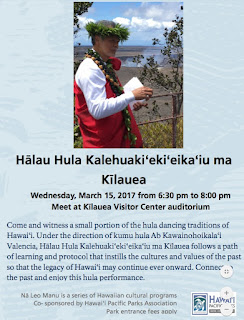
Hula Performance, Wed, Mar 15, 6:30 – to 8 p.m., Kīlauea Visitor Center Auditorium in Hawai`i Volcanoes National Park. Under the direction of Kumu Hula Ab Kawainohoikala‘i Valencia, Hālau Hula Kalehuaki‘eki‘eika‘iu ma Kīlauea performs. Free; park entrance fees apply.
Thursday Night at the Center, Mar 16, 7 – 9 p.m., Volcano Art Center. Susan Scott and Wally Johnson present their book, Hawai`i’s Kolea, the Amazing Transpacific Life of the Pacific Golden-Plover. 967-8222
St. Patrick’s Day Dinner Buffet, Fri, Mar 17, 5 – 8 p.m., Kilauea Military Camp’s Crater Rim Café in Hawai`i Volcanoes National Park. Corned beef & cabbage, lamb stew, shepherd’s pie & more. $19 adults; $10 children 6 – 11 years. Open to authorized patrons and sponsored guests. Park entrance fees apply. 967-8356.


