About The Kaʻū Calendar

Saturday, May 06, 2017

Ka`u News Briefs Saturday, May 6, 2017

Big Island Democrats held their annual convention on Saturday and talked about climate change,
the needs for the elderly, homelessness and other topics. Photo from Big Island Video News
NEW LEADERSHIP FOR THE HAWAI`I ISLAND DEMOCRATIC PARTY was named on Saturday at the annual convention, this year held in Kea`au. The new Chair is former County Council member Margaret Wille.
      Gov. David Ige gave a talk. Rep. Tulsi Gabbard skyped in. Topics at the convention, attended by Ka`u Sen. Russell Ruderman and Rep. Richard Creagan, included Climate Change, Homelessness and Elderly Needs, and the basics of How to Run for Office.
Margaret Wille to chair Democratic Party.
Photo from Big Island Video News
     Ka`u's Raina Whiting, a Na`alehu school teacher, was named Secretary. Vice Chair is Tonya Coulter. East Hawai Vice Chair is Shannon Matson. Treasurer is Valerie Barnes. Assistant Secretary is Maya Parish and Assistant Treasurer is Richard Harris.
      In a Big Island Video News interview, the new chair for the Big Island said that members of the leadership in the Democratic Party should "really earn their (letter) 'D'. Should every candidate be allowed to put a 'D' by their name, regardless of how they vote, or whether they block hearings on matters that are party priorities? I think there needs to be more accountability," said Wille. She was referring to only two of the Democratic Party's legislative priorities making it through House and Senate to conference committee discussions in the 2017 Hawai`i Legislature. Some of the other Democratic Party priority bills were blocked, she said, by Democrats themselves.
     "We need everyone to mobilize," said Wille. She said that Saturday may have been the Democratic Party day but it is also "the first day of work." She called the convention "inspired" and said that all candidates who ran for office within the Democratic Party will be invited to serve with their skills and knowledge whether or not they won a title in the party organization.

To read comments, add your own, and like this story, see Facebook. Follow us on Instagram and Twitter

MAYOR HARRY KIM'S REVISED $491.2 MILLION COUNTY BUDGET is a 6.1 percent hike over last year's budget. It goes before the County Council on May 17. He released it on Friday.
     The extra money, in the mayor's plan, is expected to come from an increase in property tax revenues by hiking rates for all properties with the exception of affordable rentals. The mayor also proposes more property tax savings for the elderly.
 Mayor Kim expects higher property taxes and gas taxes to help
pay for the rising county budget. Image from Big Island Video News
     A rise in the gas tax, planned for next year, would take it from 8.8 cents per gallon to 19 cents. An additional 2 percent increase each year would be levied until 23 cents per gallon becomes the new gas tax. Infrastructure would be the targeted use of gas tax income. Other priorities are upgrading police cars and the Hele-On Bus vehicles. Some costs that are rising are uncontrolled by the Mayor and County Council. They include statewide hikes in union-negotiated pay for government workers.
     Cut short in the mayor's budget are the contingency funds for County Council members, that go to subsidizing non-profit organization's activities, such as Summer Fun in Ka`u this year. The mayor's islandwide budget for such spending has been slashed from $810,000 to $675,000 to be split up among the nine County Council members.

To read comments, add your own, and like this story, see Facebook. Follow us on Instagram and Twitter

HARVARD UNIVERSITY IS PROVIDING HAWAI`I VOLCANO OBSERVATORY the latest program to archive important earthquake data, reports USGS scientists in this week's Volcano Watch:
     Seismology is often thought of as “earthquake science” because earthquakes—while not the only cause—are the most prolific producers of seisms, or earth shaking. The largest earthquakes ever recorded release many thousands of times more energy than the largest man-made explosions.
Thomas Jaggar working on his seismograph in 1913 at Volcano.
Photo from USGS
      Continuous and systematic study of volcanic and related earthquake activity began at the Hawaiian Volcano Observatory  in 1912, when Professor Thomas Jaggar put his first seismographs into operation in HVO’s Whitney Laboratory. He purchased and installed these instruments to record the shaking produced by Hawai‘i’s active volcanoes and frequent earthquakes.
      Through the early 1900s, led by Jaggar and other geological pioneers, seismic monitoring gradually spread around the world into areas known for earthquake and volcanic activity. During roughly this same time, mathematicians were developing the theoretical underpinnings of seismic wave generation and propagation.
      At HVO, the seismic waves were initially recorded by a stylus that etched its squiggly trace into a layer of kerosene soot that coated glossy paper wrapped around the seismograph’s slowly rotating drum. Through the next 100 years, the recording media changed from smoked or soot-coated papers to photographic, then heat-sensitive papers, and finally to pen-and-ink before paper recording was discontinued in 2013.
Hawaiian Volcano Observatory volunteer Marcy Frenz feeds seismogram
 from the May 1982 Kīlauea south caldera earthquake flurry into a 
large-format document scanner. Preserving stacks of paper earthquake
records as digital image files is an ongoing project at HVO. 
USGS photo by S. Tsang
     By then, HVO had moved to its fourth-generation of computer-based data acquisition, recording, and processing systems. In addition to automatically detecting and locating earthquakes, seismograms in digital format make it possible to more rigorously apply seismological theory toward a deeper understanding of seismic processes associated with active volcanoes.
      With computer-based recording, adding stations or instruments is achieved with RAM, disk space, and clock-cycles. With paper recording, an additional instrument required an additional seismograph that produced another paper record per day. In the late 1960s, just as the U.S. Geological Survey began processing earthquake data in California on mainframe computers at Stanford University, the number of seismic paper records produced at HVO reached a peak of 30 per day. From 1912 to 2013, HVO collected nearly half-a-million paper seismograms.
     HVO is by no means alone with its stacks upon stacks of paper seismograms. This is a common problem among seismic network operations, and the older the seismic network, the more records there are.
      Creative storage solutions are sometimes exercised. The University of California’s Berkeley Seismological Laboratory stored seismograms from their 100-year-old collection in the Campanile clock and bell tower at the center of the university’s Berkeley campus.
      The seismological community has long been striving to preserve historical seismograms for future researchers. Early efforts produced copies of seismograms on microfilm. Now, large-format digital scanners enable more groups to work through their stacks of paper seismograms and preserve them as digital image files.
      With funding from USGS data rescue initiatives, HVO scanned seismograms from a number of significant earthquakes and seismic sequences. Since last summer, volunteer Marcy Frenz has enthusiastically and diligently assumed scanning duties at HVO, working through the 1974–1984 interval spanning Mauna Loa Volcano’s two most recent eruptions.
      Motivated by the opportunity to renovate and upgrade their seismographic station, seismologists at Harvard University recovered and scanned records collected from 1933 to 1953. They also wrote a computer program that digitizes or extracts digital seismic traces from the squiggles captured by the scanner.
      Harvard colleagues have generously shared their program with HVO. As HVO builds up its collection of scanned and digitized historical seismograms, the scientists say they  look forward to exploring data recovered from these seismograms with analytical tools used on current and recent data that track changes in seismic wave properties within the volcanoes.


Visit the HVO website (http://hvo.wr.usgs.gov) for past Volcano Watch articles, Kīlauea daily eruption updates, Mauna Loa weekly updates, volcano photos, recent earthquakes info, and more; call for summary updates at 808-967-8862 (Kīlauea) or 808-967-8866 (Mauna Loa); email questions to askHVO@usgs.gov.

To read comments, add your own, and like this story, see Facebook. Follow us on Instagram and Twitter


Ham Radio Operators Potluck Picnic, Sun, May 7, 
Manukā Park. All American Radio Emergency Service members, anyone interested in learning how to operate a ham radio and families are invited to attend. Dennis Smith, 989-3028 

Hi‘iaka & Pele, Sun, May 7, 9:30 – 11:30 a.m., Kahuku Unit of Hawai‘i Volcanoes National Park. Discover the Hawaiian goddesses and the natural phenomena they represent on this free, moderate, one-mile walk. nps. gov/havo 


Friday, May 05, 2017

Ka`u News Briefs Friday, May 5, 2017

Papahānaumokuākea is a National Marine Monument, created by Pres. George W. Bush, its status in jeopardy
under an Executive Order from Pres. Donald Trump to review the status of five marine monuments in the U.S.
NATIONAL MONUMENT STATUS OF PAPAHANAUMOKUAKEA'S 60,938,240 acres, the largest marine protected area in the U.S., may be rescinded. Papahānaumokuākea educates the public with its Mokupāpapa Discovery Center in Hilo and online at www.papahanaumokuakea.gov. It is a World Heritage site and one of the largest marine preserves in the world.
     Pres. Donald Trump signed an Executive Order and directed the Department of the Interior to reconsider all National Monuments of more than 100,000 acres that were established since 1996.
     Papahānaumokuākea in the Northwestern Hawaiian Islands was established after 1996 by Pres. George W. Bush with support from Hawai`i's Republican Gov. Linda Lingle. It was doubled in size by Pres. Barrack Obama with support from Hawai`i's Democrat Gov. David Ige.
     A statement from the Department of the Interior issued today says that the reason for the review is "to determine whether the designation or expansion was made without adequate public outreach and coordination with relevant stakeholders.
Each year, some 50 tons of marine debris are removed from the
National Marine Monument Papahānaumokuākea. Photo from NOAA
     "A public comment period is not required for monument designations under the Antiquities Act; however, Secretary of the Interior Ryan Zinke and President Trump both strongly believe that local input is a critical component of federal land management," said the statement from the Department of the Interior. Along with Papahānaumokuākea, the Trump Administration plans to reconsider the status of other National Marine Monuments in the Pacific Ocean: Mairanas Trench, Rose Atoll in American Samoa, and Pacific Remote Island. There is one in the Atlantic called Northeast Canyons and Seamounts.  
      Said the Secretary of the Interior: “The Department of the Interior is the steward of America’s greatest treasures and the manager of one-fifth of our land. Part of being a good steward is being a good neighbor and listening to the American people who we represent. Today’s action, initiating a formal public comment process finally gives a voice to local communities and states when it comes to Antiquities Act monument designations. There is no pre-determined outcome on any monument. I look forward to hearing from and engaging with local communities and stakeholders as this process continues.”
Papahānaumokuākea protects marine heritage and 
marine life. Photo from NOAA
     The review of the monuments marks the first ever formal public comment period for members of the public to officially weigh in on monument designations under the Antiquities Act of 1906.    
     Comments may be submitted online after May 12 at http://www.regulations.gov by entering “DOI-2017-0002” in the Search bar and clicking “Search,” or by mail to Monument Review, MS-1530, U.S. Department of the Interior, 1849 C Street NW, Washington, DC 20240.
    The Interior Department promised to soon publish a notice in the Federal Register officially opening the public comment period. Written comments must be submitted within 60 days of that date.
     In addition to the Marine National Monument, the Trump administration is reconsidering the status of 22 land-based National Monuments: Basin and Range in Nevada; Bears Ears in Utah; Berryessa Snow Mountain in California; Canyons of the Ancients in Colorado; Carrizo Plain in California, Cascade Siskiyou in Oregon; Crates of the Moon in Idaho; Giant Sequoia in California, Gold Butte in Nevada; Grand Canyon-Parashant in Arizona; Grand Staircase-Escalante in utah; Hanford Reach in Washington; Ironwood Forest in Arizona; Mojave Trails in California; Organ Mountains-Desert Peaks in New Mexico; Rio Grande del Norte in New Mexico; Sand to Snow in California; San Gabriel Mountains in California; Sonoran Desert in Arizona; Upper Missouri River Breaks in Montana; and Vermilion Cliffs in Arizona. 
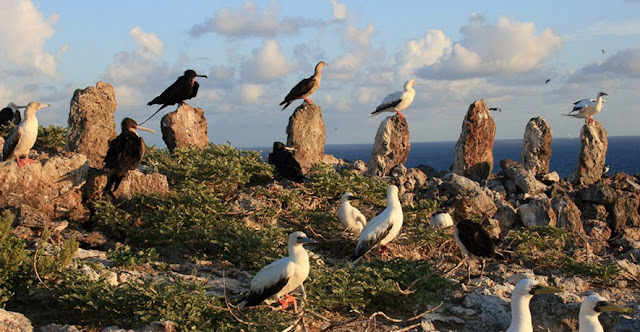
Papahānaumokuākea is the home to millions of seabirds, many of them nesting there.
Photo from NOAA
    Those considered for review are "designations or expansions of designations under the Antiquities Act made since January 1, 1996, where the designation covers more than 100,000 acres, where the designation after expansion covers more than 100,000 acres, or where the Secretary determines that the designation or expansion was made without adequate public outreach and coordination with relevant stakeholders, to determine whether each designation or expansion conforms to the policy set forth in section 1 of the order. Among other provisions, Section 1 states that designations should reflect the Act’s 'requirements and original objectives' and 'appropriately balance the protection of landmarks, structures, and objects against the appropriate use of Federal lands and the effects on surrounding lands and communities.'” 
Manta rays are protected at Papahānaumokuākea. Photo from NOAA
     Those reviewing the designations are expected to consider whether the reservations of land exceed
 “the smallest area compatible with the proper care and management of the objects to be protected;”
whether designated lands are appropriately classified under the Act as “historic landmarks, historic and prehistoric structures, [or] other objects of historic or scientific interest;"  and the effects of a designation on the use and enjoyment of non-Federal lands within or beyond monument boundaries;
     The statement also says that the review will take into consideration the "concerns of State, tribal, and local governments affected by a designation, including the economic development and fiscal condition of affected States, tribes, and localities;  and the availability of Federal resources to properly manage designated areas."

To read comments, add your own, and like this story, see Facebook. Follow us on Instagram and Twitter
DORIS "DD" DAVIS IS THE BIG ISLAND'S OUTSTANDING OLDER AMERICAN WAHINE. Ceremonies were held today at the Hilton Waikoloa Village. Davis, 85, a Pahala resident, will be attending statewide ceremonies and a luncheon with Gov. David Ige in Honolulu.
Doris Davis is Outstanding Older
 American Wahine.
     Says her description from the Hawai`i Couny Office of Aging, since moving to Pahala in 2013, Davis "has made a big impact on the community she now calls home. Whether it is serving meals or assisting with sewing and art classes at the Pahala Nutrition site or helping with the home delivered meal program, DD is always willing to help.
     "She has held two leadership positions at the Pahala Senior Club serving as Secretary in 2014 and currently as Vice President. In consecutive years since 2014, Ms. Davis has served as Secretary, President, Treasurer and Chair of the Membership Committee for Friends of the Ka`u Libraries.
     "She is also very active at Bahai Faith Spiritual Assembly for Ka`u where she teaches children and is an Adopt-a-Highway volunteer.
     "While she is certainly busy with her many volunteer commitments, DD still finds time to express herself artistically. She paints in both the oil and acrylic mediums, has learned to play the `ukulele and has even written memoirs about her time living in Ghana, West Africa."
      Davis lives in Pahala with her daughter Kerry Pitcher, her grandson Kyle Pitcher and her son-in-law Alan Moorse.

To read comments, add your own, and like this story, see Facebook. Follow us on Instagram and Twitter

LILLIAN T. ARATANI, 93, of Pahala, was a nominee for 2017 Outstanding Older American for Hawai`i Island. According to her description by the County Office of Aging:
   "Lillian Aratani brings a great energy to the many organizations she serves and was a very familiar face at Ka`u Hospital where she served as a weekly volunteer for over 17 years visiting with patients and helping with activities. She also served as a volunteer with Ka`u Community Voices Council, The Ka`u Calendar newspaper, Mala Lulima Senior Community Garden and the Intergenerational Program at the Ka`u High School SHOUT.
     "For the past 16 years, Lillian has been an active member and volunteer with the Pahala Senior Club, Hawai`i County Nutrition Program and RSVP program.
     "Ms. Aratani is doing her part to preserve the history of her community. She served as the Historian of the Pahala Senior Club for several years and helped organize photo albums to chronicle the Club's history.
     She is also vital in passing along the story of the historic Pahala Hongwanji where she is a Fujinkai member and valued volunteer. Lillian enjoys traveling and pending time with her family in Hilo over the holidays."

To read comments, add your own, and like this story, see Facebook. Follow us on Instagram and Twitter

Paint Your Own Silk Scarf, Sat, May 6, 9 a.m. – 12:30 p.m., Volcano Art Center. Patti Pease Johnson helps students open up their creativity and challenge themselves. $50/$45 VAC members. 967-8222

Stewardship at the Summit, Sat, May 6, 12, 20, 26; 9 a.m. – 12 p.m., Kīlauea Visitor Center in Hawai‘i Volcanoes National Park. Volunteers clear ginger from park trails. Free; park entrance fees apply. nps.gov/havo Realms & Divisions of Kahuku, Sat, May 6, 9:30 – 11:30 a.m., Kahuku Unit of Hawai‘i Volcanoes National Park. Pu‘u Kahuku Trail explores the traditional Hawaiian land classification system. Free. nps.gov/havo 

Realms & Divisions of Kahuku, Sat, May 6, 9:30 – 11:30 a.m., Kahuku Unit of Hawai‘i Volcanoes National Park. Pu‘u Kahuku Trail explores the traditional Hawaiian land classification system. Free. nps.gov/havo 

Ham Radio Operators Potluck Picnic, Sun, May 7, Manukā Park. All American Radio Emergency Service members, anyone interested in learning how to operate a ham radio and families are invited to attend. Dennis Smith, 989-3028 

Hi‘iaka & Pele, Sun, May 7, 9:30 – 11:30 a.m., Kahuku Unit of Hawai‘i Volcanoes National Park. Discover the Hawaiian goddesses and the natural phenomena they represent on this free, moderate, one-mile walk. nps. gov/havo.


Ka`u News Briefs, Thursday, May 4, 2017

Rep. Tulsi Gabbard said she supports an Expanded and Improved Medicare for All Act, rather than the Trumpcare
bill that passed the U.S. House of Representatives on Thursday. Photo from National Nurses Union
A TRUMPCARE BILL TO REPEAL THE AFFORDABLE CARE ACT passed the U.S. House of Representatives on Thursday, and was sent to the U.S. Senate, which is less likely to pass it. 
Officially called the American Health Care Act, the Trumpcare bill passed the House by a vote of 217-213.
Sen. Mazie Hirono said she
will "stand strong" to protect
affordable health care.
     Sen Mazie Hirono reacted swiftly: “Today, I’m thinking of the thousands of Hawai`i residents I’ve heard from who are living in fear of losing their insurance and other protections they’ve received thanks to the Affordable Care Act. Constituents like Kathryn, a teacher and single parent, who is afraid of losing her insurance because of a preexisting condition; and Anne, who gave birth to a healthy baby boy thanks to Medicaid coverage. The fight to save the Affordable Care Act in the Senate starts today. I will stand strong to ensure Trumpcare does not undermine Prepaid Health Care and Affordable Care Act protections for Hawaii families.”
    Sen. Brian Schatz tweeted: "This is a loss, no doubt. But now we dust ourselves off and use this against them. The resistance grows strong every day. Especially today." Schatz said the "age tax is one of the most offensive parts of this awful bill," and retweeted another Senator's comment, "Trumpcare would mean insurers could charge older Americans 5 x more than they charge younger Americans. Five Times." 
     Referring to allowing for insurers to charge higher health insurance rates for those with
Sen. Brian Schatz called the "age
tax the most offensive part
of this awful bill."
preconditions, and also referring to a group of Republicans applauding the House vote Thursday at a White House hoopla before another congressional vacation, Schatz tweeted: "They are making healthcare more expensive for sexual assault survivors. Then they are celebrating it. Then they are taking 10 days off."
     U.S. Rep. Tulsi Gabbard tweeted,  "Our healthcare system is broken. The AHCA 217 R's voted for today just makes it worse. Let's continue our push for #HR676 - #MedicareForAll." She also tweeted that #AHCA is a giveaway for pharma & ins companies on the backs of the people;" and " #AHCA is worse for our kūpuna, those with preexisting conditions, & those who need maternity, substance abuse, & mental health care."
     This being National Nurses Week, Gabbard, who co-chairs the National Nurses Caucus, urged Congress to pass the Title XIII Nursing Workforce Reauthorization Act "that trains our nurses. Passing it will help fill the one million nursing jobs needed by 2022."
     After voting against Trumpcare,  Gabbard issued a statement: “The bill that passed today is not a healthcare bill—it’s a big handout to insurance and pharmaceutical companies. This bill slashes $880 billion from Medicaid, strips away health benefits like maternity care, substance
Rep. Tulsi Gabard wants
universal health care.
abuse treatment, and mental health services, expands a crippling age tax on our seniors, eliminates healthcare tax credits for over 7 million veterans, and breaks the bank for those with pre-existing conditions. 
     "While corporations rake in over $600 billion in tax breaks, many low-income Americans will see their coverage drop completely. This partisan bill was rushed through, resulting in corporate benefits on the backs of the people. We need real healthcare reform that brings down costs, increases access to quality care, and ensures basic health services are available to all Americans. 
     "As a cosponsor of H.R.676, the Expanded & Improved Medicare for All Act, I’m working towards a system that will provide universal healthcare to all Americans—a standard met by nearly every other industrialized nation.” 
     The Trumpcare bill is opposed by AARP, the American Academy of Family Physicians, the American Academy of Pediatrics, the American Medical Association, the American Hospital Association, the American Nurses Association, the National Nurses Union United, the National Disability Rights Network, the AFL-CIO, the National Farmers Union, the National Education Association and many other organizations. 
     The National Nurses Union United issued a list of Trumpcare bill concerns, contending it would:
     Eliminate the Prevention and Public Health Fund, which will worsen the health of communities, spread infectious disease, and increase health system costs;
Add caption
     Phase out coverage for Medicaid expansion in Medicaid expansion states beginning in 2020, while preventing new states from receiving enhanced Federal Medical Assistance Percentage in order to expand Medicaid;
     Institute a per capita cap for Medicaid, along with the option for states to use a block grant instead. Both options will reduce coverage for the most vulnerable, shift care from clinics to emergency rooms, increase system costs for the chronically ill as they defer treatments because of cost, and unfairly shift the burden of costs to the states;
     Empower individual states to determine eligibility, scope and benefits for Medicaid as per their own discretion, but there will be no increase in federal monies to cover expanded eligibility;
     Eliminate funding to Planned Parenthood which will worsen women’s health, and create burdens for women, families and society from unsafe pregnancies and other health conditions no longer treated;
National Nurses Union came out with a list of concerns over the health
care bill that passed the U.S. House of Representatives.
Photo from National Nurses Union
     Eliminate the definition of “essential benefits” – a move that makes all patients vulnerable to the distortions and marketing games of insurance companies;
      Repeal the cost-sharing subsidies of the ACA, and destroy the ability of 80 percent of people currently buying insurance on the Exchanges to maintain coverage;
     Open the door for junk insurance. The bill includes a penalty for lack of continuous coverage, creating a big incentive for patients to buy low-cost, no-coverage plans;
     Fail to encourage low-cost coverage, because the legislation shifts thousands of dollars in spending from insurance company spending to the individual’s out of pocket costs;
     Reproduce the failed “high – risk pools” of the 1990’s and 2000’s, through the “Patient and Stability Fund, ” stating that "it is inevitable that the number of eligible patients will overwhelm the resources of these high risk pools;"
     Repeal the Medicare Hospital Insurance Tax, which will reduce funding and destabilize the Medicare program that our nation’s seniors rely on;
     Allow insurers to charge seniors five times the amount of a younger person. "This revision will prove to be deadly for our nation’s seniors, and it reveals the extent to which this reform will benefit the profit margins of insurance companies, at the expense of patients’ lives," stated the National Nurses Union.

To read comments, add your own, and like this story, see Facebook. Follow us on Instagram and Twitter

A 14.1 PERCENT INCREASE IN THE NUMBER OF FIREARMS registered statewide in 2016 was announced by the Hawai`i Attorney General yesterday. The annual report details state and county firearms registration statistics for calendar year 2016, showing that 53,400 firearms were registered. 
Hawai`i Attorney General Doug Chin
    A total of 21,408 personal firearm permit applications were processed statewide during 2016, marking an 8.4 percent increase from the tally in 2015. Of the applications processed in 2016, 95.7 percent (20,488) were approved and resulted in issued permits; 2.8 percent (592) were approved but subsequently voided after the applicants failed to return for their permits within the specified time period; and 1.5 percent (328) were denied due to one or more disqualifying factors. 
    About half (26,616, or 49.8 percent) of the firearms registered during 2016 were imported from out-of-state, with the remainder accounted for by transfers of firearms that were previously registered in Hawai`i. Firearm registration activity increased dramatically over the course of the 17 years for which these data have been systematically compiled and reported. 
     Statewide, from 2000 through 2016, the annual number of statewide permit applications processed climbed 341.1 percent, the annual number of firearms registered soared 392.2 percent, and the annual number of firearms imported surged 368.2 percent. 
     It is a misdemeanor in the State of Hawai`i to provide falsified information on firearm permit applications, unless the falsified information pertains to criminal or mental health histories, in which case it is a felony offense. In 2016, falsified criminal or mental health information or both were provided in 60.1 percent (197) of the 328 denial cases; falsified information pertaining to anything other than criminal or mental health histories was provided in 1.5 percent (5) of the cases; and no falsified information was provided in 38.4 percent (126) of the cases. 
Makana Kamahele will emcee the Ka`u Coffee
Festival Ho`olaulea, May 27.
 Photo by Eric Einwiller
     Persons with documented mental health histories; those who within one year of their applications were medical marijuana patients; and those with documented alcohol and/or substance abuse treatment histories were the top three types of applicants whose permit applications were denied in 2016. 
     The report Firearm Registrations in Hawai`i 2016 provides a range of additional statistics and analyses focused on firearm permits/licenses, registrations, and denials in the State of Hawai`i and its four counties. The full report can be downloaded from the Department of the Attorney General’s Research and Statistics Branch web site at http://ag.hawaii.gov/cpja/rs.

To read comments, add your own, and like this story, see Facebook. Follow us on Instagram and Twitter


THE ENTERTAINMENT LINEUP FOR KA`U COFFEE FESTIVAL has been announced for the Ho`olaulea on Saturday, May 27, all day at Pahala Community Center, beginning at 9 a.m. 
     Makana Kamahele is emcee. 
The talent from hula to Hawaiian music and jazz, features: Ab Valencia and Halau Hula Kalehuaki`eki`eika'iu; Hands of Time; Foggy; Halau Hula O Leonalani, with Debbie Ryder; Keaiwa with Demetrius Oliveira; Harry Evengelista and Tui Masaniai; Hannah's Makana `Ohana Halau with Joe Ooka; Jean Pierre Thoma & the Jazz Tones; Sammi Fo and Halau Kahokukauahiahionalani; the Larry Dupio Band and Back Yahd Bruddahs.

To read comments, add your own, and like this story, see Facebook. Follow us on Instagram and Twitter

Ocean View Cinco de Mayo Party, Fri, May 5, 6:30 – 8:30 p.m., St. Jude’s Episcopal Church. Enchiladas, refried beans, salad, beverage & dessert. $8 per person, $15 for two, $20 for family at the door. 939-7555

Paint Your Own Silk Scarf, Sat, May 6, 9 a.m. – 12:30 p.m., Volcano Art Center. Patti Pease Johnson helps students open up their creativity and challenge themselves. $50/$45 VAC members. 967-8222

Stewardship at the Summit, Sat, May 6, 12, 20, 26; 9 a.m. – 12 p.m., Kīlauea Visitor Center in Hawai‘i Volcanoes National Park. Volunteers clear ginger from park trails. Free; park entrance fees apply. nps.gov/havo Realms & Divisions of Kahuku, Sat, May 6, 9:30 – 11:30 a.m., Kahuku Unit of Hawai‘i Volcanoes National Park. Pu‘u Kahuku Trail explores the traditional Hawaiian land classification system. Free. nps.gov/havo