About The Kaʻū Calendar

Monday, June 12, 2017

Ka`u News Briefs Monday, June 12, 2017


Managing Rapid ‘Ōhi‘a Death at Hawai‘i Volcanoes National Park, Tue, June 13, 7 p.m., Kīlauea Visitor Center Auditorium in Hawai‘i Volcanoes National Park. Ecologist David Benitez shares lessons learned since ROD was first identified in 2014 and discusses management of ROD within and beyond park boundaries. Free; park entrance fees apply.

Hawaiian Monk seals haul out onto the atols and islands of the National Marine Monument
in Northwest Hawaiian Islands. Photo by Mark Sullivan/NOAA
THE WORLD'S LARGEST MARINE PROTECTED AREA has gained an aggressive defense by Sen. Brian Schatz. In a statement today, the U.S. Senator noted that "Less than a year ago, President Obama announced the creation of the world’s largest marine protected area with the expansion of Papahānaumokuākea Marine National Monument in the Northwest Hawaiian Islands.
     Shatz called it "one of the most important actions an American president has taken for the health of the oceans,” and says, "I still believe that to be true. Protecting some of the world’s most significant ocean ecosystems gives us  the chance to replenish stocks of ahi and swordfish, take action to fight climate change, and give a greater voice to Native Hawaiians."
Nenue and other fish abound at the National Marine Monument that
could lose its status under a Trump directive.
Photo from NOAA
     Schatz states that Papahānaumokuākea faces a threat under President Donald Trump who has ordered the Department of the Interior to review its status as a national marine monument. "This is part of an unprecedented move by the Trump Administration to consider eliminating or shrinking at least 27 national monuments," declared Schatz.
     "Our best chance to stop them is an outpouring of public support. Will you help us save these 27 national monuments, like Papahānaumokuākea, and add an official comment to the Department of the Interior here?" asks Schatz.
     According to Schatz, "Like many of the other national monuments targeted by this unnecessary review, the value of Papahānaumokuākea comes not only from its beauty and unique place in American history, but also from the opportunity for educational exploration and cultural practice that can only occur in its protected environment.
     "We must fight to keep Papahānaumokuākea, Giant Sequoia in California, and the countless other places that help us better understand both our country’s past and future. These landmarks are protected because of their official status as national monuments. Any change in designation could have drastic effects on our ability to protect them.

To read comments, add your own, and like this story, see Facebook. Follow us on Instagram and Twitter.

"MERE CAMOUFLAGE FOR AN UNCONSTITUTIONAL PURPOSE" is how the 9th Circuit Court of Appeals in San Francisco characterized its ruling today against the revised executive order by Pres. Donald Trump that would have halted entry into the U.S. from six Muslim-majority countries. The decision affirmed nearly all of Hawai`i federal Judge Derrick Kahala Watson's ruluing blocking the Trump travel ban.
AG Chin
Hawai`i AG Doug Chin
    Responding to Hawai`i Attorney General Doug Chin's lawsuit, the 9th Circuit rejected the government’s contention that Trump's March 6 executive order was valid on its face. Hawai`i argued and the appeals court agreed that a “mountain of extrinsic evidence, mostly in the form of statements by the President himself," indicated that the Trump administration's "rationale is a sham.”
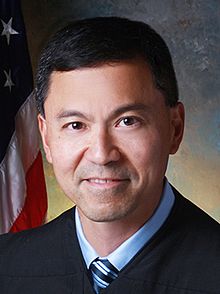
Derrick Kahala Watson.JPG
Judge Derrick Kahala Watson
     The 9th Circuit did lift an injunction that prevented the administration from reviewing its vetting procedures while the case moves forward. Should the administration finish its work on vetting, the case may become moot, as the ban would be for only 90 days.
     The decision states that "The order does not offer a sufficient justification to suspend the entry of more than 180 million people on the basis of nationality. National security is not a 'talismanic incantation' that, once invoked, can support any and all exercise of executive power." 
     The decision is similar to the 4th Circuit Court's May 25th ruling in Virginia, saying that the ban was motivated by a desire to exclude Muslims.      The 9th Circuit described the Trump rationale as “mere camouflage for an unconstitutional purpose.” The ban was to have applied to people from Iran, Libya, Syria, Somalia, Sudan and Yemen. It also would have banned all refugees for 120 days.
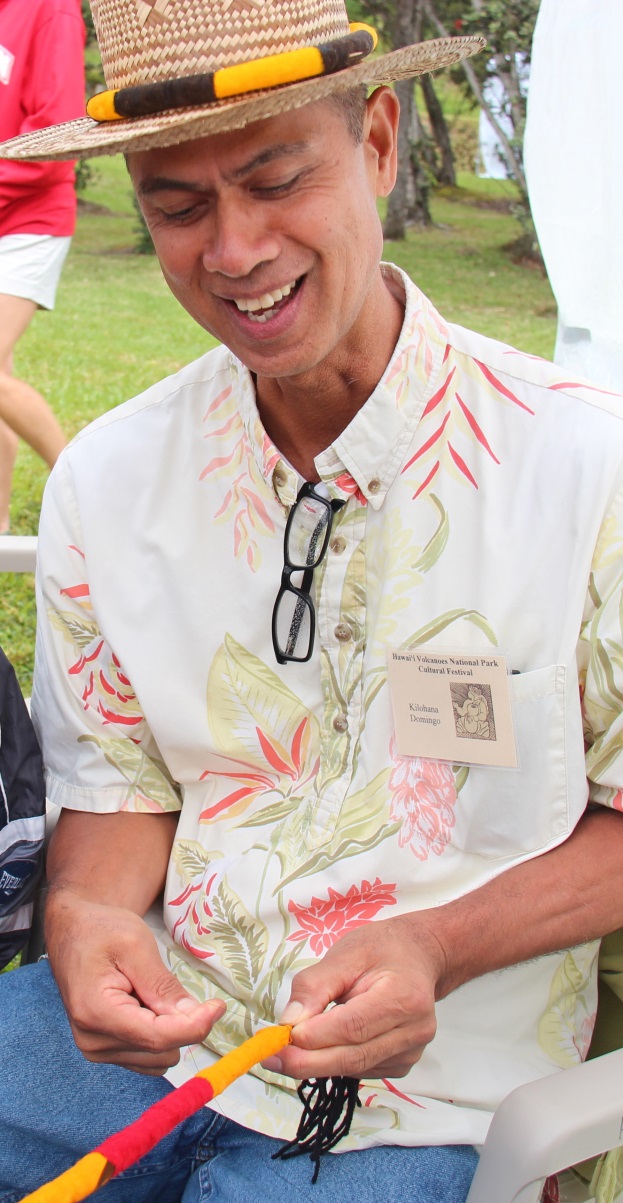
Demonstrating Lei Hulu (feather lei)
Kilohana Domingo shares
his skill at making feather lei.
Photo from NPS

To read comments, add your own, and like this story, see Facebook. Follow us on Instagram and Twitter. 

A Walk into the Past features a living history presenter, dressed in period costume and bringing back to life Thomas A. Jaggar, founder of Hawaiian Volcano Observatory and a prominent figure in the history of volcanology, the study of volcanoes. It takes place Tuesday at 10 a.m. and also at noon and 2 p.m. Meet at Kilauea Visitor Center. Free. park entrance fees apply.

Lei Hulu (Feather Lei Making) Demo, Wed, June 14, 10 a.m. – 12 p.m., Kīlauea Visitor Center lānai in Hawai‘i Volcanoes National Park. Kilohana Domingo demonstrates his mastery of this Hawaiian art form. Free; park entrance fees apply.


Hawai‘i Cordage Plants, Thu, June 15, 10 – 11:30 a.m., Volcano Art Center in Volcano Village. Linda Pratt discussed the botanical aspects, distribution and habitat of various species. Register at 967-8222. Free; register at 967-8222.

Family Reading Night, Thu, June 15, 5 p.m., Ocean View Community Center. 939-7033

OVCA Board Meeting, Thu, June 15, 6 p.m., Ocean View Community Center. 939-7033

Sunday, June 11, 2017

Ka`u News Briefs Sunday, June 11, 2017

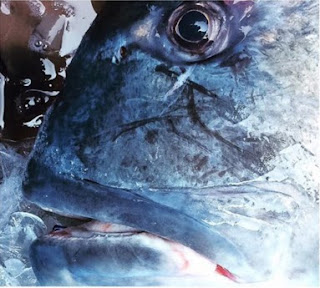
The winning catch at the Ulua Challenge was 86.2 lbs. pulled in by Brandon Rainey.
Photo by Dave Corigan/Big Island Video News
Ulua Challenge photo from
Tokigawa Store.
THE RESULTS ARE IN FOR THE ULUA CHALLENGE 2017, with the winning ulua - giant trevally - weighing 86.2 lbs., caught by Brandon Rainey. 
     Fishermen camped and used their sturdy poles from the cliffs of South Point and all along the Ka`u to the Puna shore for the annual competition that ended Sunday morning.
     Tokunaga Store owner and sponsor Mike Tokunaga told Big Island Video News that this year's tournament drew the most participants with hundreds pole fishing along the rugged coastline.
     In second place was an ulua 82.5 lbs. caught by Sean Farias. Third was 82.2 lbs. by Reuben Llanes, fourth was 75.9 lbs. by Bristan Savella. Fifth was 72 lbs. by Mel Hirayama. Sixth was 69.7 lbs. by Barry Sugimoto. Seventh was 69.2 lbs .by Waymne Cypriano. Eighth was 68.9 lbs. by Tyson Martinez. Ninth was 67.6 lbs. by Kelson Kihe and tenth was 66.1 lbs. by Kahana Ituaki.
Ulua Challenge Queen Cherokee Luker at the weigh in,
following a weekend of fishing for the giant
fish along the coast, particularly along the 80 miles of remote
shoreline in Ka`u.  Photo by Big Island Video News
    In the Omilo - bluefin trevally division, first was 20.4 lbs., caught by Harry Batalona. Second was 20 lbs. by David Llanes, third was 19.8 lbs. by Chat Kasonski, fourth was 19 lbs. by Joel Baptista, fifth was 18.7 lbs. by Ransen Fernandez. Sixth was 18.4 lbs. by H. Correa. seventh was 17.2 lbs. by Adrian Medallia. Eighth was 16.4 lbs. by Zyman Barawis. Ninth was 16.1 lbs. by Chris Llanes and tenth was 16.1 lbs. by Tommy Kasoga.

To read comments, add your own, and like this story, see Facebook. Follow us on Instagram and Twitter.

THE 48TH ANNUAL KING KAMEHAMEHA LEI DRAPING ceremony took place today in Washington, D.C. today with Ka`u's Senator Mazie Hirono and Rep. Tulsi Gabbard on Hand.
King Kamehameha's legacy was one of unity
and servant leadership, said Gabbard.
     Gabbard spoke at the Emancipation Hall celebration, which honors King Kamehameha’s legacy of uniting the islands and establishing the Kingdom of Hawaiʻi in 1810. The 48th Annual Lei Draping Ceremony, hosted by the Hawaiʻi State Society, is held each June at the U.S. Capitol to coincide with King Kamehameha Day celebrations taking place throughout Hawaiʻi.  Hundreds of people attended, including Kauaʻi Mayor Bernard Carvalho, Hawaiʻi State Senate President Ron Kouchi, Office of Hawaiian Affairs Vice-Chair Dan Ahuna, and other state and local elected officials, and included performances by hula halaus from Maryland, Virginia, and Washington, DC. 
     Said Gabbard,  “King Kamehameha’s legacy is one of unity and servant leadership. He brought people together in the face of great division, uniting the islands of Hawaiʻi for the first time. King Kamehameha was a leader ahead of his time who understood that true unity, in the end, could not be achieved at the tips of spears or by the muzzles of guns, but through dialogue, mutual respect, and working to understand common goals between people.”
      “What we learn from leaders like King Kamehameha is that we are at our best when we confront challenges together—when we set aside differences and unite. King Kamehameha was able to unify the islands of Hawaiʻi, not by creating a system that benefited a few, but by empowering many. These values still need to be protected and upheld today so that those who work hard have opportunities to succeed; that education and health care are not just for the privileged; that we serve as caretakers of our land and water for future generations; and that we treat others with aloha, love, and respect.”

Rep. Tulsi Gabbard and Sen. Mazie Hirono at Emancipation Hall today.
Photo from Office of Rep. Tulsi Gabbard.
To read comments, add your own, and like this story, see Facebook. Follow us on Instagram and Twitter.

Managing Rapid ‘Ōhi‘a Death at Hawai‘i Volcanoes National Park, Tue, June 13, 7 p.m., Kīlauea Visitor Center Auditorium in Hawai‘i Volcanoes National Park. Ecologist David Benitez shares lessons learned since ROD was first identified in 2014 and discusses management of ROD within and beyond park boundaries. Free; park entrance fees apply.

Lei Hulu (Feather Lei Making) Demo, Wed, June 14, 10 a.m. – 12 p.m., Kīlauea Visitor Center lānai in Hawai‘i Volcanoes National Park. Kilohana Domingo demonstrates his mastery of this Hawaiian art form. Free; park entrance fees apply.

Hawai‘i Cordage Plants, Thu, June 15, 10 – 11:30 a.m., Volcano Art Center in Volcano Village. Linda Pratt discussed the botanical aspects, distribution and habitat of various species. Register at 967-8222. Free; register at 967-8222.

Family Reading Night
, Thu, June 15, 5 p.m., Ocean View Community Center. 939-7033

Hawaiian Civic Club of Ka‘ū, Thu, June 15, 5:30 p.m. 929-9731 or 936-7262

OVCA Board Meeting, Thu, June 15, 6 p.m., Ocean View Community Center. 939-7033


Saturday, June 10, 2017

Ka`u News Briefs Saturday, June 10, 2017

USGS Hawaiian Volcano Observatory broadband-seismic stations located at the summit of Kīlauea have been
significantly upgraded over the past three years. During the upgrades, HVO field engineers (inset) complete
the wiring connections of the solar power and telemetry systems at each site, which are about 10 m (33 ft) from
the seismometer. The equipment is camouflaged to minimize its visual impact on the natural environment.
See story below. USGS photos.
DEREGULATING WALL STREET BANKS is of concern to Ka`u's Representative in the U.S. Congress. Tulsi Gabbard wrote today, "As the media cameras were trained on former FBI Director Comey's hearing on Thursday, followed by hours of panel discussions about the hearings, the Republican-led House of Representatives passed a sweeping bill deregulating Wall Street big banks. This bill, which threatens the economic security of the American people, barely got a mention, if it was even noticed at all. It's almost like they completely forgot about the Wall Street crash of 2008 and the people who suffered as a result."
A promotional title and tagline from the new bill to deregulate large banks
Image from U.S. House of Representatives
     Gabbard wrote that the people who haven't forgotten are the "more than 11 million Americans who lost their homes, the millions who lost their savings and pensions, and all those who lost their jobs. In Hawai`i between 2008 and 2010, our unemployment rate more than doubled - all as a result of greedy Wall Street banks who gambled heavily on the backs of the American people, all to benefit their pockets."
     The House member said that the Financial CHOICE Act that passed on Thursday "takes away the few protections that were in place, and deregulates the 'too big to fail' banks even more. It wipes out the Volcker Rule which prevents government-insured banks from certain risky speculative investments. It lowers the amount of capital that a bank is required to maintain, placing even more of a burden on the American people who these banks rely on to bail them out. It defangs the Consumer Financial Protection Bureau's ability to regulate the big banks and payday lenders. The list goes on and on."
As You Sow states that the new bill would impair shareholders' rights
to file resolutions. Image from www.asyousow.org
     Gabbard contended that the "Dodd-Frank Act regulations on Wall Street banks put in place after the 2008 crash did not go far enough. They did not prevent these banks that were 'too big to fail' in 2008 from getting even bigger and more powerful today. It did not stop these banks from gambling on the backs of the American people. And it placed undue regulatory burdens on small, community banks, who were not the bad actors that caused the financial crisis."
    Gabbard declared that "We need to lessen the regulatory burden on our community banks, and strengthen restrictions and oversight of the big Wall Street banks to protect the American people from yet another economic crisis. It's why I'm pushing for the reinstatement of a stronger, 21st Century Glass-Steagall Act to separate regular commercial banking from risky investment practices."
    She asked for those interest to sign a petition and asked the quesiton: "Do you agree we need to break up big banks and reinstate a 21st Century Glass-Steagall Act? Add your name to my petition if you agree."
     "There is no shortage of issues vying for our attention, but we have to stay focused and fight to make sure bills like this do not become the law of the land. We cannot allow our country's leaders to bring us closer to the same reckless environment that caused the economic catastrophe in 2008," Gabbard concluded.
     Among other concerns by advocacy groups is the bill's change in the rights of shareholders and obligations of the company to the stockholders, as reported by www.asyousow.org.

To read comments, add your own, and like this story, see Facebook. Follow us on Instagram and Twitter.


ULUA FISHERMEN ARE ALL OVER THE KA`U COAST, camping and putting out lines and bait for the Ulua Challenge 2017. The annual fishing contest sponsored by S. Tokunaga Store started on Friday, June 9 and ends tomorrow with a weigh-in and awards at 11 a.m. at the CIvic Auditorium in Hilo. However, fishermen and their friends have been staking out sites and camping for the competition for many days.
      The event often draws more than 600 fishermen and many participate in a barbless category. Education about conservation of marine resources is often part of the program. Last year the winning ulua weighed 117.2 lbs.

To read comments, add your own, and like this story, see Facebook. Follow us on Instagram and Twitter.

AN UPGRADE OF SEISMIC STATIONS AT KILAUEA SUMMIT ARE COMPLETED, according to this week's Volcano Watch, written by scientists at Hawaiian Volcano Observatory. "Field engineers at the USGS Hawaiian Volcano Observatory recently completed a multi-year effort to upgrade a subset of seismic stations at the summit of Kīlauea Volcano.
     Starting in 2014, each of the stations was progressively upgraded with a new-generation broadband seismometer, solar-power system, radio, antenna, enclosure, and cabling. The new enclosures for the seismometers were designed with better insulation properties to buffer the effects of changing temperatures throughout the day.
     The latest upgrades are an important milestone for HVO. The stations ensure that Kīlauea will remain a productive laboratory for the advancement of volcano seismicity. They will also continue to improve our understanding of the complex magma plumbing system beneath volcano's summit area.
     HVO’s original seismometers were installed in 1994 as a year-long field test of "broadband" seismometers—digital sensors that are more sensitive over a much greater frequency range than are the short-period analog seismometers that were widely used at the time. But the 1994 broadband instruments were kept past the one-year test period, because they proved crucial for recording many types of earthquake and volcanic signals that scientists were able to analyze in new ways.
     Frequency is one way of describing the number of oscillations (peaks and troughs) of a seismic signal, typically measured in cycles per second, or Hertz (Hz). In volcano seismology, the dominant frequency of a seismic signal is related to different processes within the volcano.    
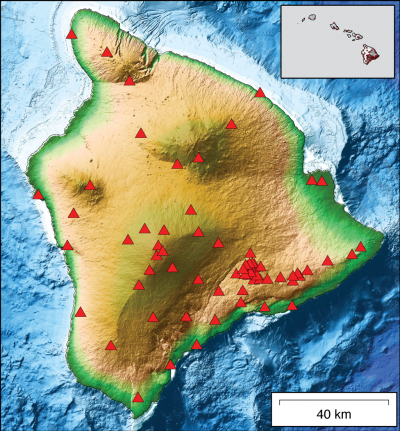
Kilauea Volcano where seismic stations have been upgraded.
USGS Photo
  For example, high frequency waves (greater than 1 Hz) recorded for normal earthquakes are typically related to slip on a fault. Low frequency waves (less than 1 Hz) for some earthquakes are related to the movement of magma or other mixtures of fluids and gases through fractures. 
     Broadband seismometers provide complete recordings of both high and low frequency waves coming from the volcano. The more commonly used short-period seismometers are tuned to record only high frequency waves.
      The movement of magma under Kīlauea generates a variety of low-frequency (often called Long-Period) and Very Long Period earthquakes with peak frequencies of 0.17 Hz or 60 seconds. The latter earthquakes, which can only be detected with broadband seismometers, were virtually invisible to the existing seismic network. The value of the dense broadband network became even more apparent when the summit eruption within Halema‘uma‘u began in 2008.  
     In 2009, the American Recovery and Reinvestment Act (ARRA) was enacted by Congress and signed into law by the President. This provided resources for HVO to convert the mixed analog and digital monitoring network to an all-digital network—a first for a U.S. volcano observatory.  

Seismographs are stationed all over the island, but new
field-hardened computers and seismometers have been
installed at Kilauea. USGS image
  With ARRA funding, HVO purchased new field-hardened computers (called digitizers) to record seismic signals on-site and digital radios to transmit the data in real time to HVO. The digitizers significantly expanded the useful dynamic range of the original broadband network. This added capability was important for characterizing the mechanism that generates seismic signals associated with large rockfalls into the summit lava lake. Scientists also are using the expanded seismic signals to develop models of the short-term rise and fall of the lava lake surface related to the accumulation and release of volcanic gas in the uppermost part of the lava lake.
     It became clear in about 2011 that the harsh environmental conditions in Kīlauea’s summit caldera were taking a toll on the aging seismometers. The instruments were corroding inside and outside, leading to inconsistent measurements of ground shaking. Some sensors were failing. So, starting in 2014, HVO placed a high priority on improving the summit broadband network, and the stations were upgraded in phases as resources allowed.
     This upgraded network reflects state-of-the-art earthquake monitoring, and offers volcano seismologists a more powerful tool to investigate processes that cause ground shaking at Kīlauea. This in turn supports advances in our understanding of the volcano’s magma plumbing system, eruptive activity, and hazards. 
      For additional information about HVO’s broadband seismic network, please see the 2011 Volcano Watch article: https://volcanoes.usgs.gov/hvo/hvo_volcano_watch.html?vwid=81. A former HVO seismologist describes highlights of recent research on Kīlauea seismic activity in a video presentation, “Several flavors of seismogenic magma movement under Kīlauea Volcano,” posted at https://www.youtube.com/playlist?list=PLD4D607C2FA317E6D.

To read comments, add your own, and like this story, see Facebook. Follow us on Instagram and Twitter.


www.kaucalendar.com
‘Ōhi‘a Lehua, Sun, June 11, 9:30 – 11 a.m., Kahuku Unit of Hawai‘i Volcanoes National Park. Learn about the vital role of ‘ōhi‘a lehua in native Hawaiian forests, the many forms of the ‘ōhi‘a tree and its flower on this free, easy, one-mile walk.

Medicine for the Mind, Sun, June 11, 4 – 5:45 p.m., Volcano Art Center in Volcano Village. Buddhist healing meditation for beginners through advanced. Free. Patty, 985-7470

Managing Rapid ‘Ōhi‘a Death at Hawai‘i Volcanoes National Park, Tue, June 13, 7 p.m., Kīlauea Visitor Center Auditorium in Hawai‘i Volcanoes National Park. Ecologist David Benitez shares lessons learned since ROD was first identified in 2014 and discusses management of ROD within and beyond park boundaries. Free; park entrance fees apply.