About The Kaʻū Calendar

Thursday, August 04, 2022

Ka‘ū News Briefs, Thursday, Aug. 4, 2022

Gov. David Ige and First Lady Dawn Amano-Ige with Miloli'i residents as the new Community Based Subsistence Fishing Area is established with the stroke of a pen. Photo from DLNR

A VISIT TO MILOLI'I BY THE GOVERNOR THIS WEEK CELEBRATES THE NEW COMMUNITY BASED SUBSISTENCE FISHING AREA. On Tuesday, with the stroke of a pen in front of Miloli'i residents, Gov. David Ige signed administrative rules to make the coastline bordering this remote village the second Community-Based Subsistence Fishing Area in the state. A long time in the making and supported by the persistence of residents, the Miloli‘i CBSFA aims to protect and conserve fish populations and their habitats, by combining traditional Hawaiian fishing practices with modern approaches to conservation.
First Lady Dawn Ige and Gov. David Ige at Miloli'i to make
the Community Based Subsistence Fishing Area official.
Photo from DLNR
    
    Act 271, enacted by the Hawaiʻi Legislature in 1994, led to the designation of 18-miles of coastal waters along the rugged coastline on either side of the small community as the first permanent, legislatively designated CBSFA. Years of work by dedicated community members, with support from biologists and staff at the DLNR Division of Aquatic Resources and research and non-governmental organizations, led to the development of a set of administrative rules designed to ensure abundant stocks of priority species and high-quality fishing now and into the future.
    Laila Kaupu, a fifth generation Miloli‘i fisher, was one of the prime movers behind the CBSFA initiative and headed up the community group, Kalanihale, which was instrumental in the development of the rules.
    On Tuesday, following a boat tour and snorkel with the Governor and First Lady Dawn Amano-Ige, Kaupu let out a happy sigh and said, “That’s my feeling and I’ve got a feeling our kupunas are feeling the same. Just a lot of relief knowing that the community came together in its efforts, with the support of state and federal agencies. We can be that shining light that the governor mentioned for other coastal communities.”
    In remarks before signing the administrative rules into law, the Governor said, “We need young people to carry this work forward and encourage other communities to create community-based subsistence fishing areas for the benefit and future of the entire state. Miloli‘i is a shining example of how we can all work together for the benefit of our marine resources, our keiki and our kupuna.”
State Division of Aquatic Resources staff joined Miloli'i residents, including
 Laila Kaupu, to take Gov. David Ige and First Lady Dawn Ige snorkeling
 during their Tuesday visit. Photo from DLNR
 
    State Department of Land & Natural Resources Chair Suzanne Case added, “This has indeed been a long road for Miloli‘i, but you all have persevered. We join you today in celebrating this tremendous achievement and remind us all, that the work has just begun in implementing these rules to manage Miloli'i’s resources. Here, and across the state we face immense challenges due to climate change, over-fishing and other ecosystem stressors. This is a giant step in the right direction, and we are grateful for such dedicated partners, rooted in tradition, with the goal of co-management of nearshore resources.”
    In 2015, also during the Ige Administration, the Hāʻena CBSFA was established on Kauaʻi. In 2016 the Kaʻūpūlehu “Try Wait” community-led marine rules on Hawaiʻi Island were passed. These communities, with Miloliʻi, "have inspired communities statewide to propose rules with the DAR to sustain Hawaiʻi’s marine resources," says a statement from DLNR.
    After his snorkeling expedition at Miloli'i, the Governor said, “It’s beautiful being out in the ocean and being able to see the coral colonies. It’s a spectacular day.”

To read comments, add your own, and like this story, see www.facebook.com/kaucalendar. See latest print edition at wwwkaucalendar.com. See upcoming events at https://kaunewsbriefs.blogspot.com/2022/04/upcoming-events-for-kau-and-volcano.htm

HIGH PATIENT CENSUS AT KAʻŪ HOSPITAL'S SISTER FACILITY IN HILO is the word from spokesperson Elena Cabatu. She sent out a report on Thursday saying that for the past two to three months, Hilo Medical Center has been experiencing high patient census and "operating above our capacity. Today, we started with a very full hospital with 13 holds in the Emergency Department, 13 patients in our overflow areas and 37 waitlisted patients."

    She said she will provide updates on the hospital two to three times per week "to keep our staff and community informed."
    Cabatu said multiple factors "are causing our hospital to be very full." They include: a continuous flow of sicker patients seeking care for a variety of issues, including COVID; long-term care facilities on island with limited capacity to accept hospital patients due to staffing shortage and COVID outbreaks; difficulty in discharging patients resulting in high number of waitlisted patients remaining in hospital beds; and fewer open beds leading to holding patients in the Emergency Department waiting for a bed to open.
    To accommodate the high patient census, Hilo Medical Center has opened additional beds in the Extended Care Facility; uses overflow beds in other patient care areas such as OB Unit, Short Stay and Recovery; offers overtime to staff and brings in traveler to staff additional beds; has doubled enrollment for its Nurse Residency Program to train 45 new nurses; has launched a paid Nurse Aide Training Program; and encourages staff to enroll in a Critical Care Nurse Training Program to help care for sicker patients. View a Town Hall Meeting on the subject at https://youtu.be/lePA4Cpev80. Learn about opportunities to enroll in the paid Nurse Aid Training Program at http://kaunewsbriefs.blogspot.com/2022_07_26_archive.html


To read comments, add your own, and like this story, see www.facebook.com/kaucalendar. See latest print edition at wwwkaucalendar.com. See upcoming events at https://kaunewsbriefs.blogspot.com/2022/04/upcoming-events-for-kau-and-volcano.htm

THE COUNTY INVITES THE PUBLIC TO AN UPDATE ON CLOSURE OF PĀHALA AND  NĀ’ALEHU LARGE-CAPACITY CESSPOOLS. The public informational meeting will be at 6 p.m. Wednesday, Aug. 31 at Nā‘ālehu Community Center, 95-5635 Māmalahoa Highway.
    The meeting will cover the Administrative Order on Consent recently signed by the County and the U.S. Environmental Protection Agency, which is posted at https://www.epa.gov/uic/closure-cesspools-pahala-and-naalehu-administrative-order-consent-county-hawaii, and answer questions about potential impacts to residents resulting from compliance with the order. See a story on the evolution of the plans at http://kaunewsbriefs.blogspot.com/2022_07_30_archive.html.


    The county's Deputy Director of Environmental Management, Brenda Iokepa-Moses, said the public gathering will include "updates since our meeting in Pāhala on March 16, 2022, on the different options under consideration for wastewater treatment as a result of the cesspool closures. County representatives will explain requirements of the Administrative Order on Consent, and also provide an opportunity for the public to ask questions and provide comment." See story on the March 16 meeting at http://kaunewsbriefs.blogspot.com/2022_03_16_archive.html.
    The county is expected to present its idea of switching from lagoon style wastewater treatment to individual wastewater systems.

To read comments, add your own, and like this story, see www.facebook.com/kaucalendar. See latest print edition at wwwkaucalendar.com. See upcoming events at https://kaunewsbriefs.blogspot.com/2022/04/upcoming-events-for-kau-and-volcano.htm

Coffee leaf rusts devastates crops.
Photo from CTHAR
A NEW PRUNING METHOD PUBLICATION FOR COFFEE LEAF BORER AND LEAF RUST has come from University of Hawaiʻi at Mānoa College of Tropical Agriculture & Human Resources. The pruning methods for Hawaiʻi coffee growers aim to to mitigate the effects and further spread of these devastating stressors. Coffee Leaf Rust and the Coffee Berry Borer were identified in Hawaiʻi in October 2020 and August 2010, respectively. See the U.H. publication. The updated publication can be found at: at https://www.ctahr.hawaii.edu/oc/freepubs/pdf/PD-126.pdf.

To read comments, add your own, and like this story, see www.facebook.com/kaucalendar. See latest print edition at

wwwkaucalendar.com. See upcoming events at

https://kaunewsbriefs.blogspot.com/2022/04/upcoming-events-for-kau-and-volcano.htm


A POLICE OFFICER'S RESPONSE IN VOLCANO netted him an Officer of the Month Award. Officer Michael Sailer is honored "for his exceptional investigative police work and lifesaving efforts during an incident involving the kidnapping and torture of a male victim," says the statement from Hawaiʻi Police Department. He received the Officer of the Month commendation from the Aloha Exchange Club of East Hawai‘i during a ceremony Thursday, July 14.
     A four-year veteran of the department, Sailer responded to a report of a dispute at a residence in Volcano on Tuesday, June 7. According to the statement from HPD: Upon arrival, the officer began
searching the area initially making a loud announcement of police presence. "He heard a male yelling for help one time then it became quiet. Officer Sailer continued calling out 'police!' for several minutes with no response. In the quiet, Officer Sailer could hear heavy breathing coming from inside the residence.

Aloha Exchange Club's Raymond Hasegawa with Officer
Michael Sailer, who is honored for rescuing a kidnap victim
 in Volcano from two culprits who may have planned murder.
Photo from HPD
    "Officer Sailer again called out 'police!' and observed what appeared to be a small amount of blood on the front door. While at the front door, he called out “police!” again and a teenage male answered the door. The officer noted that the male was wearing gloves and could hear a man yell for help from inside the residence.
    "Asking the teen to step out from the residence, Officer Sailer entered the front room and discovered a man lying on the floor handcuffed with his feet zip-tied and a second man kneeling on top of the male victim. In addition to having his hands and feet restrained, the victim had a rag partially stuffed in his mouth and duct taped. The man kneeling on the victim told officers that there was a restraining order and that the tied up male had broken the law."
    After securing the residence, Sailer found tactical gear, an assault rifle, a pistol, ammunition, and evidence of a kidnapping and assault that had taken place in the residence. "In the course of investigation, the officer officer discovered that the victim had been held against his will within the residence and assaulted. It appeared that the two males in the residence may have intended on killing the victim and covering up the incident." Police charged both with a variety of crimes, including kidnapping and assault.
     The HPD statement says, "Sailer’s perseverance to uncover what had transpired that evening in Volcano resulted in him interrupting a potential homicide in the making. Through his efforts, a life was saved, two violent suspects were apprehended, and multiple firearms were safely recovered."
    Every month Aloha Exchange Club of East Hawai‘i honors a Police Officer of the Month. Officers are nominated by their supervisors. All officers selected for Officer of the Month are eligible to be selected as the Aloha Exchange Club of East Hawai‘i Officer of the Year.

Wednesday, August 03, 2022

Ka‘ū News Briefs, Wednesday, Aug. 3, 2022

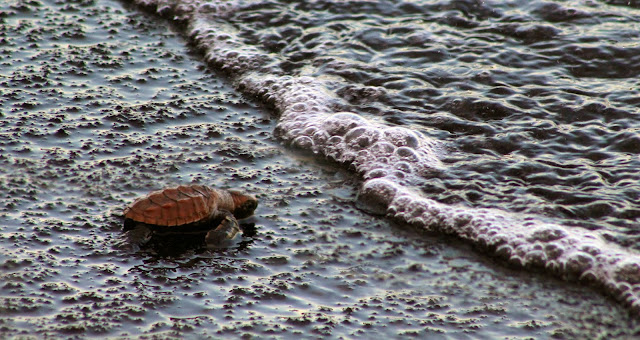
A hatchling comes out of its nest during a hawksbill hatchling season and scurries to the ocean on a remote Kaʻū beach.
Photo by Amy Krommes/Hawai'i Island Hawksbill Project
IT'S NESTING SEASON IN KAʻŪ FOR CRITICALLY ENDANGERED HAWKSBILL TURTLES. "Our first hatchling scurried to the ocean on July 3," says Amy Krommes, volunteer for the Hawaiʻi Island Hawksbill Project for seven turtle seasons. She said the nest was in a remote beach location.
   Krommes explains that nesting season begins in May when the female turtles start to lay their nests into late December when the last nest hatches. A female may lay three to five nests in one season. A nest on average contains 180 eggs. The eggs usually take 50 to 60 days to incubate depending on the temperature. Incubation temperature of the nest determines a hatchling's gender. Warmer nests produce females and
A hatchling from a nest on Punaluʻu Black Sand Beach makes its way
  to the Pacific Ocean on Oct. 2, 2018. The latest nesting
at Punaluʻu was later that year. Photo by Peter Bosted
cooler nests produce males.
    "Honuʻea, the Hawaiian Hawksbill Turtles, love Kaʻū," says Krommes. They are listed as critically endangered. These turtles do not travel around the world nor do other Hawksbill Turtles come to Hawaiʻi. Hawaiian Hawksbill Turtles are a unique population that nest on the Big Island, Maui and Molokaʻi. Roughly 90 percent of Hawaiian Islands nests are in Kaʻū. Nine Kaʻū beaches have been documented with nests over the last 30 years of monitoring. Two of these beaches have returning nesting turtles every year.
    Before hawksbill turtles were protected under the 1973 Endangered Species Act, their numbers dramatically declined from harvesting their beautiful shells. Even though protected, these turtles are still struggling to rebound and are considered critically endangered.  Even though their numbers are extremely low, nesting habitat is being lost due to people expanding their impact on beaches. Beach erosion also impacts their ability to come ashore and nest. 
The exodus. Dogged determination and strong instincts motivate the
hatchlings to get off the Punaluʻu Black Sand Beach and into the water. 
Photo by Annie Bosted at Punalu'u Black Sand Beach in 2018
    Five to 25 female Hawksbill turtles may nest in the Hawaiian Islands during one season, far fewer than the number of green sea turtles. The green sea turtles that bask on the beaches at Punaluʻu and elsewhere in the Hawaiian Islands swim some 700 miles to the Northwest Hawaiian Islands, including French Frigate Shoals, where 400 to 600 nest annually. 
     Since 1989, the Hawaiʻi Island Hawksbill Turtle Recovery Project has monitored the hawksbills, tagging them since 1991. In the past 30 years, 178 female turtles have been individually identified and tagged. In 2021, the Hawksbill Turtle Project documented 53 Hawksbill nests.
    Why do the Hawksbill love Kaʻū? "I believe it is the lack of artificial light and people activity at night," says Krommes. "Turtles usually return to the beach where they were born and imprinted as hatchlings. At night the nesting mother turtle leaves the ocean and searches the beach along the vegetation edge in search of a non-rocky area to dig her approximately 20-inch-deep nest. These turtles evolved to recognize their ocean home by the light reflecting off of the ocean. Both the mother turtles and baby hatchlings are hardwired to go towards the light.  
Volunteers with the Turtle Recovery Project release tiny hatchlings onto the
beach. They instinctively scurry towards the water, where they will spend the
rest of their lives, save for infrequent visits to the sand for egg-laying females.
Photo by Annie Bosted at Punalu'u Black Sand Beach in 2018.
    "After laying her eggs, covering up the nest the mother makes a direct line to the light. Similar to a moth being attracted to light. Stranded mothers have been found beneath lit porches and along streets. Baby turtles typically hatch as a team and leave the nest at night, they can sense when the sand is cooler. These hatchlings are also attracted by light and have been found going towards the light and away from the ocean."
    Krommes explains that mother turtles are also very sensitive to movement on the beach. "They recognize motion and if she feels vulnerable, she will not come up to lay her eggs. The mother turtle is carrying a heavy load of eggs and may watch for three days assessing the safety of the beach, she may find another beach close by to nest or she may release her eggs in the ocean.
    "Non-native plants such as coconut and haole koa create root barriers that prevent nesting turtles from digging suitable egg chambers and trap hatchlings from emerging. Introduced predators: mongooses, rats, and cats dig up turtle nests and eat eggs and hatchlings."
    In 2018, Punalu'u hosted five nests from two different mothers. One of the nesting females was tagged #H99 and last observed nine years earlier. It has been established that hawksbills do not nest every season. They return to the same shoreline from two to more than eight years for the next nesting.
Lifeguard stand area was the site of the latest hawksbill nest at Punaluʻu
 where Turtle Recovery Project volunteers, in 2018, carefully excavated to
free hatchlings unable to dig their way to the surface Photo by Annie Bosted
    Krommes recalls, "The last hatchlings at Punaluʻu emerged two weeks before Christmas. Over a few nights hatchlings trickled out of the nest. A nest excavation to assist the last straggling turtles occurred with a crowd of people building. Folks were able to witness the two-inch hatchlings scurrying across the beach, building up their muscles, charging their adrenaline, imprinting on the beach and marching in a parade-like manner to the ocean. Then being washed back a few times by the waves. Folks cheered, gave words of encouragement and waved goodbye."
    Krommes offers the following recommendations on helping the hawksbills survive:
    No white light at night. Use wildlife friendly lighting near the coast (red, yellow, amber and shielded lights.
     Limit beach fires. The light will keep turtles from coming up to lay a nest and the heat may be damaging nests that are present.
    Avoid beach driving. Off-road vehicles crush nests, compact the sand impeding nest building and create tire ruts that trap hatchlings.
    Prevent debris and rubbish from entering the ocean.
    Volunteer with a monitoring and conservation program. Contact the Hawaii Island Hawksbill project: info@hawaiiislandhawksbillproject.org.
    What to do when finding hatchlings? Krommes recommends: Assist them by smoothing a path to the ocean. Call 808-985-6090.

To read comments, add your own, and like this story, see www.facebook.com/kaucalendar. See latest print edition at wwwkaucalendar.com. See upcoming events at https://kaunewsbriefs.blogspot.com/2022/04/upcoming-events-for-kau-and-volcano.htm

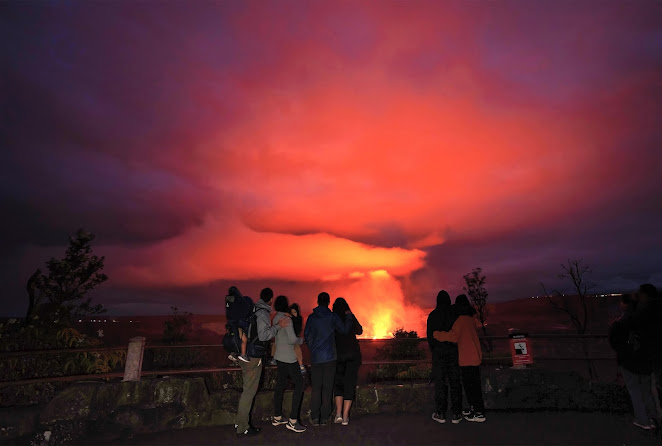
A group of people at an overlook watch an erupting lava lake in the distance reflect a beautiful palette of pink, orange,
purple and red hues into the dark sky. Photo by Janice Wei
ENTRANCE FEES ARE WAVED ON THURSDAY AT HAWAIʻI VOLCANOES AND OTHER NATIONAL PARKS. It's Great American Outdoors Day.
     In honor of the two-year anniversary of the signing of the #GreatAmericanOutdoorsAct, National Park Service entrance fees will be waived at all fee-collecting parks on Thursday, Aug. 4th.
    The Great American Outdoors Act, passed in August 2020, improves infrastructure and expanding recreation opportunities in national parks and other public lands. The legislation established the National Parks and Public Lands Legacy Restoration Fund and guaranteed permanent funding for the existing Land and Water Conservation Fund. Learn more at: https://www.nps.gov/subjects/infrastructure/gaoa.htm

Mauna Loa Road has reopened in Hawaiʻi Volcanoes
National Park. Photo by J.W. Frank
MAUNA LOA ROAD in Hawaiʻi Volcanoes National Park has reopened. It has been closed to all vehicles, bicycles, pedestrians) past the gate at Kīpukapuaulu due to strong and hazardous winds. There were dead trees along the road, and snags from the 2018 Keauhou Fire that posed a threat to anyone in the area, said a statement from the Park.

To read comments, add your own, and like this story, see www.facebook.com/kaucalendar. See latest print edition at wwwkaucalendar.com. See upcoming events at https://kaunewsbriefs.blogspot.com/2022/04/upcoming-events-for-kau-and-volcano.htm

See www.kaucalendar.com


Tuesday, August 02, 2022

Ka‘ū News Briefs, Tuesday, Aug. 2, 2022

ZION KALIKAHKAMANAO HAO-KALLIO OF OCEAN VIEW DIED IN A TRAFFIC COLLISION on Monday. Hawai‘i Island police are investigating the three-vehicle crash on Māmalahoa Highway in Pepe‘ekeō that ended the life of the 15-year-old passenger. He was not wearing a seatbelt. Hao-Kallio is the 25th traffic collision fatality of 2022, following 13 fatal traffic collisions during this same time period last year.
    A statement from Hawaiʻi Police Department says, "Police believe that speed is the primary factor in the outcome of this collision at this time. An investigation will continue into any additional contributing factors. The East Hawaiʻi Traffic Enforcement Unit has initiated a negligent homicide investigation."
Zion Kalikahkamanao Hao-Kallio loved surfing. He died in a car wreck
on Monday, north of Hilo. Photo by Asia Nihipali Sesson 

    The accident was reported at 6:09 p.m. Monday. Police determined that a 1996 Honda Civic was traveling Hilo bound near the 12 mile marker. As the Honda approached the double lanes, the 20-year old driver Tyson Acacio attempted to overtake another vehicle, but lost control on wet asphalt and spun into the oncoming north-bound lane, colliding with a 2002 Chevrolet pickup truck traveling Hamakua bound. The third vehicle, a 2005 Toyota Solara, was traveling southbound behind the Honda and was struck by flying debris from the collision.
    Hao-Kallio and Acacio were ejected from the Honda. Hao-Kallio was unresponsive at the scene and transported to Hilo Medical Center where he was pronounced dead Monday at 9:12 p.m. An autopsy was ordered to determine the exact cause of death.
    A 16-year-old female, and sister of Kallio, who was riding in the front passenger seat, appeared to have been wearing a seatbelt and was not ejected. Both Acacio and the female were conscious and transported to the Hilo Medical Center. Acacio sustained serious internal injuries and has received surgery, while the female sustained a broken bone in her arm and was set to be released pending treatment.
    The driver of the 2002 Chevrolet pickup truck, a 40-year-old female, sustained a broken right heel and additional minor injuries and was treated at Hilo Medical Center. Operator of the 2005 Toyota Solara, a 58-year-old female, was not injured.
    Police are asking for anyone who may have witnessed the collision to contact Officer Jerome Duarte at (808) 961-2339 or via email Jerome.Duarte@HawaiiCounty.gov. Tipsters who prefer to remain anonymous may call Crime Stoppers at (808) 961-8300.

To read comments, add your own, and like this story, see www.facebook.com/kaucalendar. See latest print edition at wwwkaucalendar.com. See upcoming events at https://kaunewsbriefs.blogspot.com/2022/04/upcoming-events-for-kau-and-volcano.htm

DHHL recently launched water improvements in Kaʻū and
is now seeking input for its 20-year General Plan. Photo from DHHL
NATIVE HAWAIIAN BENEFICIARIES OF DEPARTMENT OF HAWAIIAN HOMELANDS are asked for input for the DHHL General Plan. It is available to read online at https://dhhlgeneralplan.konveio.com/beneficiary-review-draft-comment. The Plan, available to read for anyone who wants to learn about Hawaiian Home Lands, is 92 pages long, plus appendices. It is rich in the history of land and natural resources in Hawaiʻi and provides approaches to move forward. Also available is https://dhhl.hawaii.gov/po/general-plan-2022 with numerous YouTube presentations on subjects covered in the Plan, along with many ways for beneficiaries to comment.

Hawaiian Home Land General Plan draft is up for comment.
 Its policies and goals will apply to DHHL properties in Ka'ū
and throughout the Hawaiian Islands. DHHL Map

    Updated every 20 years, DHHL General Plan establishes statewide policies that guide land management and programs over the next two decades. The Department last updated its General Plan in 2002. 
    Seven topic areas for setting policy direction in the Plan are: Land Use and Water Resources; Infrastructure; Housing; Food Production; Healthy Communities; Natural and Cultural Resource Management and Revenue Generation and Economic Development.
    Homesteaders and applicants on the DHHL Waiting List for land and housing can submit their comments online, or in-person at eight open house events scheduled between Aug. 4 and Aug. 22, 2022, statewide. The deadline for input online and by mail and email is Sept. 21. The two meetings on this island will be held on Aug. 8 in Hilo at Keaukaha Elementary School cafeteria from 6 p.m. to 8 p.m. and on Aug. 9 at Department of Hawaiian Homelands Kuhio Hall.
    DHHL's statement calling for input says, the "General Plan provides a comprehensive policy that ensures coordinated and integrated orderly social, physical, and economic development of Hawaiian Home Lands. It establishes goals and objectives that guide the implementation of the program. The plan is followed by detailed Island and Regional plans that are updated on a rotating basis and on their respective timetables."
    Tyler Iokepa Gomes, Deputy to the DHHL Chair, said, "It is critical that beneficiaries take part in shaping DHHL's General Plan. This document will guide the direction and use of trust lands over the next couple of decades so we're making every effort to ensure that the goals and objectives of this plan are a reflection of the community it intends to serve."
    A final General Plan document is anticipated to be presented to the Hawaiian Homes Commission for adoption before the end of the year, says the DHHL statement.
    To view a schedule of the upcoming Open House events, comment on the Draft General Plan, and to learn more about DHHL's planning system, visit dhhl.hawaii.gov/po/general-plan-2022.


To read comments, add your own, and like this story, see www.facebook.com/kaucalendar. See latest print edition at wwwkaucalendar.com. See upcoming events at https://kaunewsbriefs.blogspot.com/2022/04/upcoming-events-for-kau-and-volcano.htm.
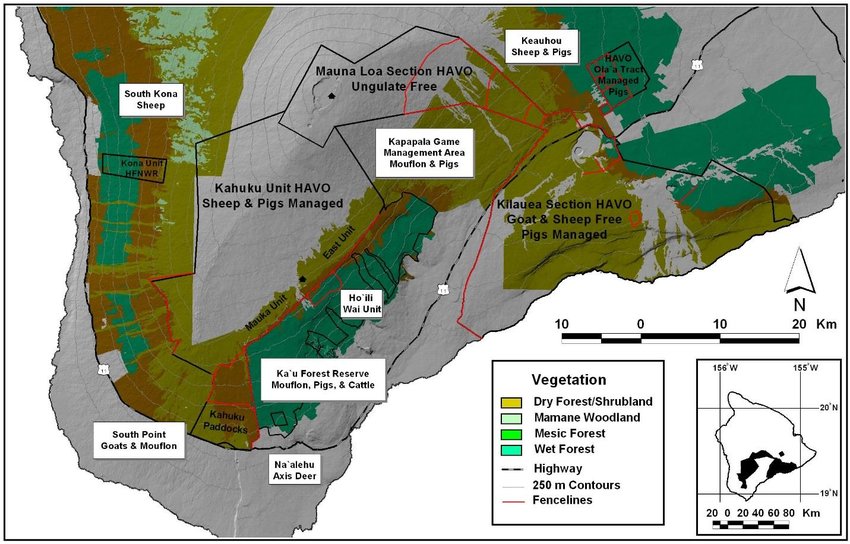
Areas of wild goats, pigs, mouflon and cattle are shown in this presentation along with types of vegetation across Kaʻū. Hawaiʻi Volcanoes continues monitoring for ungulates in its Aug. 9 flight to 3,500 - 4,500 ft. elevation at Kahuku. NPS map

FLIGHT OPS FOR HAWAI'I VOLCANOES NATIONAL PARK are scheduled for August 2022:
    Aug. 3 between 10 a.m. and noon at the Mauna Loa Road quarry for aviation management training.
    Aug. 8 and 11 between 6:30 a.m. and noon for Hawaiian petrel monitoring on Mauna Loa between 4,000- and 9,000-ft elevation.
    Aug. 8, 12, 29 between 6:30 a.m. and 3 p.m. for camp set up and removal of old fence material in the Koa Unit of ʻŌlaʻa forest, between 3,500- and 4,500-ft. elevation.
    Aug. 9 between 6:30 a.m. and 11:30 a.m. for ungulate surveys and control work in Kahuku
Helicopter flight on Aug. 14 will lift a crew to between 10,500 and
 12,320 ft. elevation to carry out facilities maintenance, to include
 Mauna Loa Cabin. HVNP Photo

between 4,000- and 6,000-ft. elevation. In addition, flights will occur for survey, control and eradication of banana poka on Mauna Loa between 3,800- and 6,800-ft. elevation.
    Aug. 10 between 7 a.m. and 1 p.m. for invasive tree control in the Ka'ū Desert and Pepeiao area, between 1,000- and 3,000-ft. elevation.
    Aug. 14, 17, 21 between 10 a.m. and noon for maintenance on the Mauna Loa cabin luas, between the 10,500- and 13,200-ft. elevation.
    In addition, the U.S. Geological Survey will be finishing up low-level helicopter flights in early August that will cover Kīlauea volcano. Visit the USGS Hawaiian
Volcano Observatory website for more information. The USGS may conduct additional flight operations over Kīlauea and Mauna Loa to assess volcanic activity and maintain instrumentation.
    A statement from HVNP says, "The park regrets any noise impact to residents and park visitors. Dates and times are subject to change based on aircraft availability and weather. Management of the park requires the use of aircraft to monitor and research volcanic activity, conduct search-and-rescue missions and law enforcement operations, support management of natural and cultural resources, and to maintain backcountry facilities."

To read comments, add your own, and like this story, see www.facebook.com/kaucalendar. See latest print edition at wwwkaucalendar.com. See upcoming events at https://kaunewsbriefs.blogspot.com/2022/04/upcoming-events-for-kau-and-volcano.htm

See www.kaucalendar.com