A 66-acre fire burned Sunday along Maile Street, raging from the macadamia processing plant's husk storage below Pāhala. Photo by Julia Neal
THE MAILE STREET FIRE IN PĀHALA BURNED 66 ACRES on Sunday, according to County of Hawai'i Civil Defense. People on the street said it started in the macadamia nut processor's mulch pile of husks and spread to a hillside largely composed of bagasse and other waste left from more than a century of sugar mill processing that ended in 1996. Driven by strong winds coming from the Kaʻū Desert, the fire spread through the former grounds of the sugar mill, which became a dump for abandoned vehicles, other trash and, more recently, the site of a camp for homeless people. The fire raged through it and homeless folks ran off. The fire also revealed the wasteland of the old sugar mill site as trees and brush burned. Left are hulks of abandoned sugar processing facilities, burned out vehicles and other metal thrown away by people using it as a dump. The fire continued into macadamia orchards owned by Kamehameha Schools. Firefighters concentrated on saving buildings, most of them along Maile Street, all of them historic. The old bank that became a radio station; the community clubhouse that is seasonal housing for farm labor and
Bulldozers make firebreaks to protect houses along Maile St. from a fire coming from old sugar mill grounds. Photo by Julia Neal
used for students off season; the former nurse's station and sugar worker union hale that is now the house of Ed Olson; the old Sasaki Store that is now The Market House; and PāhalaPlantation Manager's House were preserved. The remains of the old sugar camp store on Mill Road and the mango tree lane leading to the Pāhala Hongwanji were also protected by the firefighters. Also saved is the macadamia nut processing facility. Those running bulldozers to create fire breaks helped save the old Manager's House and other buildings.
A county helicopter scooped water and made continuous runs between a pool at Pāhala Fire Department and the firefighting front for many hours. Police blocked Maile Street from its Hwy 11 entrance to Pikake Street, also closing the road across Scottie White Bridge to Moa'ula. Both the Olson House and old community clubhouse residents were evacuated and invited to stay at housing in Pāhala until the smoke and fire risk abate and their quarters cleaned. A huge amount of ash settled there, as well as in many houses in Pāhala village. Making conversation even more dramatic among those gathered to watch the fire on their four wheelers and trucks, a 3.6 earthquake rattled offshore below Pāhala, shaking the ground and houses in the area in the middle of the firefight. By sundown, the fire seemed tamed with firefighters standing by and putting out pop-up blazes as the wind continued to howl intermittently. Firefighters said they will remain on the scene into Monday.
Smoke from Maile Street Fire as seen from Kaʻū High & Pāhala Elementary and the District Gym. Photo by Bob Martin
Maile Street Fire in Pāhala, seen from Hwy 11 toward Nāʻālehu. Photo by Bob Martin
A GRANT IS OFFERED FOR PRODUCING LIMU. Hawai'i state Department of Agriculture is accepting grant proposals for one project that enhances the competitiveness of Hawai'i limu (seaweed). The total amount for the single competitive grant is $31,315. The deadline for applications is Wednesday, Nov, 30, by noon. Applications are available at https://hands.ehawaii.gov/hands/opportunities/opportunity-details/22134 In March, Gov. David Ige proclaimed 2022 as “Year of the Limu” in recognition of the significant role limu have in Native Hawaiian traditions. The governor’s proclamation noted that limu are an integral part of the traditional Hawaiian diet, are used for medicinal, religious, and cultural purposes. The limu grant is part of Hawai`i’s Specialty Crop Block Grant Program which is funded by the U.S.
Department of Agriculture and administered through HDOA’s Market Development Branch. For the purposes of the grant, limu is defined as any various kinds of edible seaweed, which form an important part of the traditional Hawaiian diet. Eligible plants must be cultivated or managed and used by people for food, medicinal purposes, and/or aesthetic gratification and be considered cultivated, as wild plants are not considered specialty crops by the USDA. This definition includes plants or plant products harvested from “wild areas” whose populations are managed, monitored and documented to ensure long-term, sustainable production. HDOA is seeking eligible non-profit organizations, local, state, and federal government entities, for-profit organizations, universities and individuals for projects that enhance the competitiveness of Hawai`i limu. Eligible applicants must reside in, or their business or educational affiliation must be registered in Hawai`i. For more information on the grant, contact the Market Development Branch via email at: hdoa.addrfp@hawaii.gov or (808) 973-9595.
USDA EXTENDS REGIONAL FOOD BUSINESS CENTERS DEADLINE: The U.S. Department of Agriculture Regional Food Business Centers program will provide coordination, technical assistance, and capacity building to help farmers, ranchers, and other food businesses access new markets and navigate federal, state, and local resources, thereby closing the gaps or barriers to success. The Regional Food Business Centers will assist small- and mid-sized producers and food and farm businesses with the goal of creating a more resilient, diverse, and competitive food system. Applications must be submitted electronically by 11:59 p.m. ET on Dec. 15. Visit the USDA How to Apply page for more information.
The flag of Portugal raised at the new site of the Hawai'i Island Portuguese Chamber of Commerce Cultural & Educational Center. Photo by Tim Wright
Brenda Deluz-Campbell, Council member Maile David, Dr. Marlene Hapai, Contractor Michael Singer, Honorary Portuguese Consul Tyler Dos Santos Tam and Hawai'i Island Portuguese Chamber President Archie Hapai III at groundbreaking for a cultural and educational center. Photo by Tim Wright
HAWAI'I ISLAND PORTUGUESE CHAMBER OF COMMERCE, which has supported Portuguese cultural events in Kaʻū, held a groundbreaking ceremony in Hilo on Saturday for a Portuguese Cultural & Educational Center. Helping with groundbreaking were Brenda DeLuz-Campbell, Councilwoman Maile Medeiros David, Dr. Marlene Hapai, Contractor Michael Singer, Honorary Consul of Portugal Tyler Dos Santos-Tam, and HIPCC President Archie Hapai III. Father Clyde Phillips officiated. Construction of the Portuguese Cultural & Educational Center will begin in 2023 at the corner of Komohana and Ponahawai Streets.
Paniolo Hall of Fame member Casey Da Silva celebrates his Portuguese heritage. Photo by Julia Neal
The Portuguese arrived to Hawai'i 144 years ago, with families sailing to Hawaiʻi on a journey that took them across the Atlantic, around the southern point of South America, and across the vast Pacific to their new island home. The first ship was the Priscilla, which arrived Sept. 30, 1878, with 120 Madeira Islanders. The second ship left Funchal on April 23, 1879, taking four months to cross the Atlantic Ocean, round Cape Horn and sail across the Pacific to Honolulu. Among the passengers were Manuel Nunes, Augusto Dias, Jose do Espirito Santo, and Joao Fernandes, who are credited with introducing the Portuguese stringed instrumente that became 'ukulele in Hawaiʻi. Many of the Portuguese settlers worked at the sugar companies in Kaʻū. They became ranchers, paniolo and leaders in the Catholic Church.
Portuguese names like Amaral, Andrade, Baruz, Da Silva, De Silva, Enos, Fontes, Freitas, Francis, Frances, Gomes, Gouveia, Joseph, Lorenzo, Louis, Manoa, Marques, Medeiros, Manuel, Oliveira, Pedra, Pestano, Silva and Vierra are well known in Kaʻū, with many families of Hawaiian and Portuguese ancestry.
Darlyne Vierra with her display of photos and cultural items from Kaʻū Portuguese families. Photo by Julia Neal
Kaʻū Multicultural Society President Darlyne Vierra was an early supporter of the cultural and education center, encouraging Portuguese families from Kaʻū to become involved. Vierra has been collecting photos, documents and cultural items of Portuguese families in Kaʻū for many years. She said that copies of photos and documents could be offered to show the history of Portuguese culture in this district. She noted that Portuguese families have had a large influence of on ranching, sugar and coffee heritage of Kaʻū, and over the years have presented Portuguese dance, song and food at such events as Kaʻū Plantation Days.
THE 'OHANA READERS PROGRAM has been expanded in Kaʻū by Hawai'i's first lady Dawn Amano-Ige along with state and non-profit partners This program is now available to children under five-years-old throughout the zip codes of Nāʻālehu and Pāhala.
ʻOhana Readers is a literacy program that focuses on reading with family. Initially launched on
Molokaʻi in 2019, the program offers high-quality, age-appropriate Imagination Library books each month to children in specific zip codes. Children who register for the program will receive one book each month via the U.S. Postal Service. The program operates through the Dolly Parton Imagination Library and is free of charge. Families can sign up at Nāʻālehu Public Library and Pāhala Public & School Library. The libraries have already begun to offer programs that complement the books the children receive and will provide other activities to promote literacy and reading. "Research shows that children are ready to learn in their earliest years, and this program provides no-cost opportunities for learning from birth through age four," said Amano-Ige. "ʻOhana Readers encourages family read-aloud time, an activity that increases the vocabulary and language skills of our children and contributes to their growing knowledge of the world." In addition to Kaʻū, 'Ohana readers is available for families with children five years old and younger on Moloka'i (entire island), Lānaʻi (entire island), and parts of Kauaʻi (in zip code areas 96703, 96714, 96722, 96752, 96754, and 96796). The Hawai'i State Public Library System is encouraging families within the covered areas to register for the 'Ohana Readers program at their libraries.
First Lady Dawn Amano-Ige and 'Ohana Readers has delivered more than 10,000 books to Hawai'i children since 2019. Photo from the Governor's Office
"This program is all about reading!" said State Librarian Stacey Aldrich. "It encourages the development of a love of words and reading by helping each child create their own library of books. Each book read builds early literacy skills for school readiness. The Hawai'i State Public Library System is very excited to partner with the ʻOhana Readers program by being a place for families to sign up their little ones and attend story times at the Nāʻālehu Public Library and Pāhala Public and School Library to complement the books being mailed out." The program is made possible through a collaborative partnership between the Office of the Governor, the Hawaiʻi Department of Human Services, the Hawaiʻi State Public Library System, state Rep. Lynn DeCoite, and nonprofit partners Dollywood Foundation, Friends of the Library of Hawaʻi, Learning to Grow, and Read to Me International. Program sponsors also include Kamehameha Schools, Kauaʻi Island Utility Cooperative, Friends of the North Shore Library at Princeville, Windward Community College's
Learning to Grow project in partnership with the Hawai'i State Department of Human Services through monies from the Federal Child Care and Development Block Grant, and aio. The Hawaiʻi island program is funded by aio. "Friends of the Library of Hawai'i is pleased to be expanding the ʻOhana Readers program that helps build a life-long love of reading at home with family," said Nainoa Mau, executive director of Friends of the Library of Hawai'i. Since 2019, the ʻOhana Readers program has distributed over 10,000 books to Hawaiʻi children through Dolly Parton's Imagination Library. Prior to that, First Lady Dawn Amano-Ige distributed approximately 2,000 books through the Scholastic Summer Reading Ambassador program through schools across the state in Kekaha, Lāʻie, Fern, Nāʻālehu, Maunaloa, and Nānāikapono. For more information about the ʻOhana Readers program, visit FLHhawaii.org/ohanareaders. To sign up for the program locally, visit either the Nāʻālehu Public Library or the Pāhala Public & School Library. The form is available for download from the website above and must be dropped off at the library.
SNAP BENEFITS HAVE BEEN EXTEDNDED THROUGH JAN. 16. Gov. David Ige signed a fifth emergency proclamation this week, extending Supplemental Nutrition Assistance Program The program is backed by federal COVID relief funding. "Food insecurity is just one of the lingering effects of the pandemic, and SNAP benefits provide Hawaiʻi families with nutritious food," said Ige. "This emergency proclamation ensures food security through the holidays. I urge families in need to sign up for SNAP so they can get this federal assistance. Mahalo to the employees at the Hawaiʻi Department of Human Services and the Benefit, Employment & Support Services Division who work with our federal partners to administer the program. They remain committed to providing food
security for individuals and families in Hawaiʻi though the pandemic and beyond." SNAP provides crucial food and nutritional support to qualifying households, and those making the transition from public assistance to self-sufficiency. SNAP is managed by the U.S. Department of Agriculture and is the largest food nutrition assistance program in the country. Hawaiʻi Department of Human Services reminds the public that the federal government requires recipients of SNAP and Financial Assistance Programs to recertify, or renew, their eligibility annually (for most households) to receive continued benefits. To apply for or renew SNAP benefits, visit https://pais-benefits.dhs.hawaii.gov/. For more information about applications and renewals, please call the Public Assistance Toll Free Information Line at 1-855-643-1643.
Ceramic tiles by Charlotte Forbes Perry represent artworks to see and purchase at the annual Volcano Artists Hui studio tour Thanksgiving weekend. See more below. Art by Charlotte Forbes Perry
SHORT TERM VACATION RENTAL REGULATIONS WILL SOON BE UPDATED, with measures to be introduced to the County Council in January 2023. Council Members Ashley Kierkiewicz and Heather Kimball are hosting an informational meeting on proposed updates Monday, Nov. 21, 5:30 p.m.-6:30 p.m. via Zoom. To participate, community members must register for their unique Zoom login via tinyurl.com/cohstvr1121 "A promise was made by the County to revisit and update the vacation rental ordinance," said
Kierkiewicz. "We are fulfilling that promise and socializing proposed changes in an effort to inform the community and gather feedback before the bill is introduced at Council." Kierkiewicz and Kimball worked in partnership with the Planning Department, Corporation Counsel, and the Council's Legislative Review Branch to craft the proposed measure. Amendments come nearly four years after the initial STVR ordinance was adopted in November 2018, and looks to comply with recent changes to Hawaii State Statute, which refers to these rentals as Transient Accommodation Rentals or TARs. Changes include the regulation of hosted rentals, an update to fee structure including one-time registration fees and annual renewal fees, clear and enforceable penalties, and the establishment of vacation nodes - designated areas suitable for TARs and currently underserved by hotel and resort facilities. "Drafting this bill has been a lengthy and involved process and I want to thank everyone who contributed to the effort," said Kimball. "It is still a work in progress and we recognize that the bill may still need revisions after we share it with the public. We look forward to hearing from our community." Monday's presentation on proposed changes to vacation rental regulations will be followed by a Q&A session. Members of the Planning Department will also be participating and available to answer questions regarding the implementation of current regulations and what is being proposed. The Zoom will be recorded and posted to the Planning Department website, says the statement from the County of Hawai'i.
HAWAIIAN ELECTRIC CALLED FOR ENERGY CONSERVATION THURSDAY NIGHT, with a statement explaining: "The need for conservation is prompted by the unavailability of several large generators. In addition, wind resources are forecast to be lower than usual. Hawaiian Electric’s steam generator Hill 6 is offline due to emergency repairs and Keahole Power Plant steam turbine annual maintenance work continues. In addition, one unit at Hamakua Energy, an independent power producer, remains offline due to unexpected issues. Combined, these units usually supply about 66 megawatts of power. The evening peak demand is when electricity use is highest. Using less electricity from 5 to 9 p.m. helps ensure enough power is available during those hours. Conservation methods include turning off air conditioners and unnecessary lighting, shutting off water heaters, and delaying activities like cooking, showering, laundry, and dishwashing. Larger commercial customers, including government, hotels and retail, were asked to voluntarily reduce electricity use. "If necessary, rolling 30-minute outages will be initiated to protect the electric system and prevent loss of power to an even greater number of customers. Hawaiian Electric will notify customers in advance through social media. Please check @HIElectricLight on Twitter for updates.
Hawai'i's Congressional Delegation with Speaker of the House Nancy Pelosi, in June, at the unveiling of a portrait of the late U.S. Rep. Patsy Mink, of Hawai'i. Photo from Hawai'i Public Radio
RESPONDING TO U.S SPEAKER OF THE HOUSE NANCY PELOSI'S DECISION to decline leadership positions in the new Congress to be sworn in Jan. 3, Hawai'i's Congressional Delegation praised her: Sen. Mazie Hirono: "House Speaker Nancy Pelosi has served this country with grace, grit, and determination. As leader of the Dem Caucus and Speaker of the House, she oversaw the passage of historic bills that changed the course of this country. Thank you, Speaker Pelosi for your leadership." Rep. Kai Kahele: "Mahalo House Speaker Nancy Pelosi for your leadership and service to our nation, to the American people and to the U.S. House. An inspiration for women across the globe, I will always remember how gracious you were with your time to meet my daughters and ‘ohana."
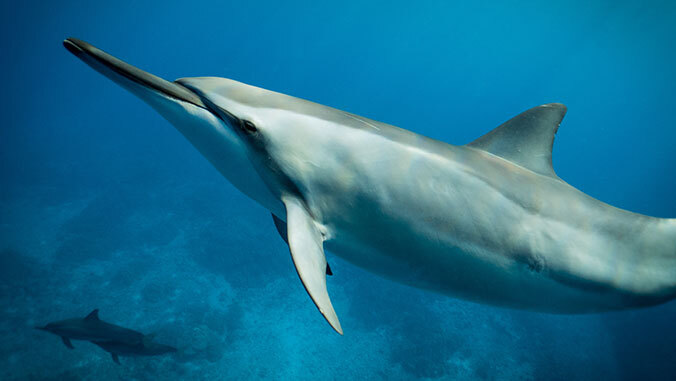
Spinner dolphins are among the marine mammals that have been infected and died from
toxoplasmosis, which washes into the ocean from streams. Many mammals carry the disease,
including cats and pigs. Photo from U.H.
TOXOPLASMOSIS HAS BEEN FOUND IN SPINNER DOLPHINS and the source is pollution of fresh water running into the ocean, according to to a University of Hawai'i study released on Thursday. One dolphin that died was found on Hawai'i Island. "Invasive species such as pigs, mongoose, chickens and cats harbor the parasite, but it is unclear which genotypes are most likely to infect wildlife species. The findings were published in Diseases of Aquatic Organisms. The study reviewed archived tissue and was carried out by researchers at the University of Hawaiʻi at Mānoa Health and Stranding Lab. One dolphin was stranded on Hawaiʻi Island in 2015 and the other on Oʻahu in 2019. Tissues from past dolphin and whale strandings showed the parasite in the animals that died of it. "This demonstrates that if a spinner dolphin has a severe toxoplasmosis infection they will die," says the report from U.H. “We suspect that many more spinner dolphins may succumb to toxoplasmosis and die than the animals that are recovered dead and examined for cause of death,” said Kristi West, associate researcher at UH Mānoa’s Hawaiʻi Institute of Marine Biology who directs the UH Health and Stranding Lab. “A better understanding of toxoplasmosis infections and infectious cycles is important to developing effective conservation strategies for protected and endangered Hawaiian wildlife.” Toxoplasmosis is found globally infecting warm-blooded animals and humans. The parasite reproduces in the digestive system of cats, which shed the oocytes (eggs) in their feces. Oocytes are resistant to environmental conditions and remain viable for up to two years and may be washed out to sea in runoff where they infect monk seals, dolphins and whales. Researchers presume that marine animals most likely ingest the oocytes through contaminated water or prey. UH researchers performed necropsies, collected tissue samples for microscopic inspection and used molecular tools to test for the presence of infectious pathogens. They discovered that the strain of toxoplasmosis that infected both spinner dolphins is Toxoplasma gondii genotype 24. This same genotype was identified in feral pigs on Oʻahu in 2020 and described in previous studies from bobcats in Missouri, and chickens in Costa Rica and Brazil. Land andsea connection: The research shows how land and sea are connected, and that the parasite Toxoplasma gondii that reproduces on land can spread to animals that live an entirely aquatic existence in the ocean.
"The first spinner dolphin death from infection by this parasite was documented in an adult spinner dolphin that was stranded in Haleʻiwa in 1990. Since then, this parasite has claimed the lives of two more dolphins, but it is likely that many additional dolphins have died from this infection," concludes the U.H. study. The UH Health and Stranding Lab only recovers and examines approximately 5 percent of the spinner dolphins that die in Hawaiian waters, which can be extrapolated to suggest that at least 60 spinner dolphins may have died of toxoplasmosis. Studies in California have also shown that marine invertebrates accumulated Toxoplasma oocytes after rain and runoff and sea otters that preyed on invertebrates developed the disease. Similarly, marine invertebrates and fish might harbor Toxoplasma oocytes swept downstream from watersheds and lead to infection of nearshore spinner dolphins. Impact in Hawaiʻi: Marine mammals are culturally significant to the people of Hawaiʻi and are recognized sentinels of ocean health. Toxoplasmosis has been identified in a number of Hawaiian native species and causes serious disease or death in monk seals, spinner dolphins, and birds such as the ʻalalā, the endangered Hawaian crow. “Spinner dolphins in Hawaiʻi are small island associated populations that spend part of their daily routine in nearshore waters,” said West. “We need to understand the causes of mortality and the threats that Hawaiʻi’s dolphins face to better protect these species.” The U.H. report says, "The public can help reduce the spread of toxoplasmosis through responsible cat ownership by spaying/neutering cats, keeping cats exclusively indoors, and reporting any illegal dumping of cats or kittens outdoors into feral colonies. "A significant challenge is that marine mammal carcass recovery rates are very low, which emphasizes the importance of the public’s role in rapid reporting of dolphin and whale strandings and the value of thoroughly examining every carcass. Sightings of dead or distressed marine mammals can be reported to the toll-free statewide NOAA Marine Wildlife Hotline at 1(888) 256-9840. Funding for this work came from NOAA John H. Prescott Marine Mammal Assistance Grant Program, the U.S. Commander, Pacific Fleet and NOAA Pacific Islands Regional Office.
HOW LAVA FLOWS ON THIS ISLAND IMPACT BUILDINGS AND INFRASTRUCTURE is the study carried out by USGS, Earth Observatory of Singapore and GNS Science in New Zealand. The setting for the study is the lava that erupted from the lower East Rift Zone of Kīlauea in 2018 and devastated lower Puna. In 2019, the team of scientists set out to document and assess the impacts to buildings and infrastructure to advance understanding of how lava flows impact the built environment. Their work is the subject of this week's Volcano Watch, the column from USGS Hawaiian Volcano Observatory, this one written by Elinor Meredith, a PhD candidate at the Earth Observatory of Singapore.
Building damage states used to classify buildings affected by Kīlauea's 2018 lower East Rift Zone lava flows by
damage severity, the first such categorization developed for lava flows.
Image from Elinor Meredith and Nguyen Thi Nam Phuong/Earth Observatory of Singapore
Volcano Watch: With the permission of residents, we visited properties along the lava flow margins to meet residents, take photographs, and note the severity and types of damage to structures. In addition to field visits, we assessed more than 8,000 photographs taken by USGS scientists before, during, and after the eruption. These photographs, along with satellite imagery, make up the largest available dataset of lava flow impacts in the world. We used our data to develop the first set of damage states for lava flows. Damage states are structure damage classifications in a scale ranging from minor damage to major damage and destruction, and they are widely used to categorize buildings damaged from other hazards such as hurricanes or earthquakes. This new set of damage states allowed us to classify all structures in the area by damage severity. Severity ranged from no visible damage, minor melting of plastic due to heat, corrosion of metal by gases, to complete burial. Damage classification included all types of structures, including homes, water tanks and other farming or industrial buildings. Inundating 14 square miles (35.5 square km) of land, Kīlauea’s 2018 lava flows destroyed 1,839 and damaged 90 structures in total. These are the highest recorded numbers of impacted structures from a lava flow event in Hawaiʻi and one of the highest globally. Later in 2021, lava flows destroyed 2,896 buildings at La Palma, Spain, and destroyed 3,629 homes, 12 schools, and 3 health facilities at Nyiragongo volcano, Democratic Republic of Congo. The damage severity at each structure was related to lava thickness. The data showed that increased lava flow thickness was generally related to higher damage severity, up to about 6.6 ft (2 m), after which all buildings were destroyed. However, for flow thickness less than 6.6 ft (2 m), there was a range of damage severity along the flow margins. Notably, circular and metal water tanks were resistant to these thinner flows. There were similar findings for the circular structures at Chã das Caldeiras, Cape Verde, during the 2014-2015 lava flows of Fogo volcano, where circular masonry buildings resisted destruction along the flow margins. During these lava flows, 170 structures were destroyed and 90 structures were damaged.
Aerial photograph of Kīlauea's 2018 lower East Rift Zone lava flows that inundated 14 square miles (35.5 square km) of land, damaging and destroying structures. USGS photographs like this were used in impact assessment of the lava flows. Image from USGS
We found structures were damaged mostly within the first four weeks of the 14 week-long 2018 eruption, while the main lava channels were being emplaced. Many other structures not initially impacted were destroyed by later lava flows that broke out from or overtopped the main lava channels. We note that some homes survived in kīpukas and were classified as not damaged at all or damaged less severely. However, these homes were greatly impacted by a lack of access and disruption of utilities. We also noted impacts to homes from fissure steam and gases months after the eruption had ended. One of our key findings is that damage was recorded up to almost 2,000 ft (600 m) away from the lava flow, likely from secondary processes such as fire spread facilitated by the dried vegetation downwind of the lava channels. This finding suggests that flammable materials on or near properties may cause damage beyond the lava flow. This work was recently published in the Bulletin of Volcanology and it emphasizes that damage from lava flows can occur beyond the main lava flow itself, especially from later breakout lava flows and channel overflows, or from secondary fires. Findings from this research contribute to the global empirical dataset of lava impacts, and will be used to inform future lava flow damage assessments in Hawaiʻi and beyond.
VOLCANO ACTIVITY UPDATES: Kīlauea volcano is erupting. Its USGS Volcano Alert level is at WATCH (https://www.usgs.gov/natural-hazards/volcano-hazards/about-alert-levels). Kīlauea updates are issued daily. Over the past week, lava has continued to erupt from the western vent within Halemaʻumaʻu crater in Hawai‘i Volcanoes National Park. Sulfur dioxide emission rates remain elevated and were last measured at approximately 500 tonnes per day (t/d) on November 15. Seismicity is elevated but stable, with few earthquakes and ongoing volcanic tremor. Over the past week, summit tiltmeters recorded one deflation-inflation (DI) event. For more information on the current eruption of Kīlauea, see https://www.usgs.gov/volcanoes/kilauea/recent-eruption. Mauna Loa is not erupting and remains at Volcano Alert Level ADVISORY. This alert level does not mean that an eruption is imminent or that progression to an eruption from the current level of unrest is certain. Mauna Loa updates are issued daily. This past week, about 300 small-magnitude earthquakes were recorded below the summit and upper elevation flanks of Mauna Loa—the majority of these occurred at shallow depths less than 15 kilometers (9 miles) below sea level. Global Positioning System (GPS) measurements show continued ground deformation consistent with inflation of a magma chamber beneath the summit. Gas concentrations and fumarole temperatures at both the summit and at Sulphur Cone on the Southwest Rift Zone have remained stable over the past week. Webcams show no changes to the landscape. For more information on current monitoring of Mauna Loa, see: https://www.usgs.gov/volcanoes/mauna-loa/monitoring. There were five events with three or more felt reports in the Hawaiian Islands during the past week: a M3.9 earthquake 5 km (3 mi) SSW of Pāhala at 31 km (19 mi) depth on Nov. 16 at 6:56 p.m. HST, a M2.2 earthquake 3 km (1 mi) S of Volcano at 2 km (1 mi) depth on Nov. 13 at 10:50 p.m. HST, a M3.2 earthquake 15 km (9 mi) ENE of Honaunau-Napoopoo at 4 km (3 mi) depth on Nov. 12 at 3:10 p.m. HST, a M3.7 earthquake 18 km (11 mi) ESE of Nāʻālehu at 35 km (22 mi) depth on Nov. 12 at 10:44 a.m. HST, and a M3.6 earthquake 9 km (5 mi) E of Pāhala at 31 km (19 mi) depth on Nov. 11 at 10:29 a.m. HST. HVO continues to closely monitor Kīlauea's ongoing eruption and Mauna Loa for any signs of increased activity. Visit HVO’s website for past Volcano Watch articles, Kīlauea and Mauna Loa updates, volcano photos, maps, recent earthquake info, and more. Email questions to askHVO@usgs.gov.
THANKSGIVING DINNER WILL BE SERVED at Kīlauea Military Camp's restaurant. Make reservations for next Thursday's dinner buffet by emailing marketing@kilaueamilitarycamp.com, or by calling 808-967-3371. Event open to all authorized patrons. Menu is Roasted Turkey, Stuffing, Cranberry Sauce, Pineapple Honey Glazed Ham, Mashed Potatoes with Gravy, Green Bean Casserole, Corn Chowder, Pumpkin Crunch, Beverage. Prices are $28.95 for Adults; $14.95 for Children (6-11 yrs).
An 'Iwa bird, double vessel by Emily Herb
VOLCANO VILLAGE ARTIST HUI OPENS STUDIOS to the public Thanksgiving weekend. The 36th Annual Studio Tour & Sale will be held at four studio sites on Friday, Saturday and Sunday, Nov. 25 - 27 from 10 a.m. to 4.pm at: Studio # 1 - 2400 Fahrenheit Glass Studio with Charlotte Forbes Perry (ceramic tiles and stained glass), Emily Herb (pottery and sculptural clay vessels) andJoan Yoshioka (original paintings and prints) Studio #2 - Volcano Garden Arts with Ira Ono (fine art & exquisite gifts) Studio #3 - Margaret Barnaby Studio with Margaret Barnaby (woodblock prints) and Mike & Misato Mortara (hand blown art glass). Studio #4 - Volcano Art Center Niaulani Campus with Elizabeth Miller (paintings, prints, metalwork, Ricia Shema (vintage silk clothing, bags and more) Phan Barker, guest artist (quilts, woodblock prints & mixed media) and Scott Pincus, guest artist (handmade silver jewelry) The Volcano Village Artist Hui recommends: "For a less crowded, and more relaxed shopping experience, please consider attending on Saturday or Sunday. For everyone's health and safety, masks may be required at some studios."
VOLCANO SWAP MEET is set for Saturday, Dec.10 from 8 a.m. to noon at Cooper Center on Wright Road in Volcano Village. It resumes the second and fourth Saturdays in January. Large number of vendors with variety of products will be on hand with ono grinds, live music, local made jewelry, crafts, plants, produce, honey, jam, Koa, antiques, gemstones, and crystals. To vend and for more info, call Auntie Frances at 808-985-8646. See Facebook under Volcano Swap Meet.
A VOLCANO THURSDAY MARKET CHRISTMAS FAIR will be held on Dec. 22 from 3 p.m. to 6 p.m. It will feature Crafts, Food, Produce, Live Music, & Entertainment for the Kids. The venue is Cooper Center on Wright Road in Volcano Village.
COFFEE TALK: BIRDS NOT MOSQUITOES! is the Coffee Talk this Saturday, Nov. 19 from 9:30 a.m. to 11 a.m. at Kahuku Visitor Contact Station in Hawai'i Volcanoes National Park. The session reviews the severe depletion of native Hawaiian forest birds through avian diseases transmitted by mosquitoes. The hope is that a common bacteria to reduce mosquito populations can break the disease cycle and allow the forest birds to thrive. Birds, Not Mosquitoes partners state, federal and nonprofit organizations to implement this tool. Join Chris Farmer of the American Bird Conservancy and Evelyn Wight of The Nature Conservancy at the Coffee Talk.